Content Menu
● Historical Background of Business Cards
● Purpose and Importance of Business Cards
● Design Elements of Business Cards
● Types of Business Cards
● Benefits of Using Business Cards
● Trends in Business Card Design
● How to Distribute Your Business Cards Effectively
● Conclusion
● Related Questions
>> 1. What information should I include on my business card?
>> 2. How much do business cards typically cost?
>> 3. Are digital business cards effective?
>> 4. What is the best size for a business card?
>> 5. How can I make my business card stand out?
● Citations:
A business card is a small, printed card that contains essential information about a person or a business. Typically measuring about 3.5 inches by 2 inches, these cards serve as a convenient way to share contact details and promote one's professional identity. Business cards have been an integral part of networking and business communication for centuries, evolving from their historical roots into modern digital formats.
Historical Background of Business Cards
The concept of business cards dates back to ancient China in the 15th century, where they were known as "visiting cards" or "Meishi." These cards were used by aristocrats to announce their presence when visiting others, serving as a formal introduction and request for a meeting. The practice spread to Europe in the 17th century, where they evolved into "trade cards," which included not only personal information but also promotional details about businesses, often featuring maps to help customers locate services.
During the Industrial Revolution, advancements in printing technology allowed for mass production of business cards, making them accessible to a broader audience beyond the upper class. This democratization of business cards led to their widespread use in professional settings, transforming them into essential tools for networking and branding.
Purpose and Importance of Business Cards
Business cards serve multiple purposes in today's professional landscape:
- Networking: They facilitate introductions and exchanges of contact information during meetings, conferences, and social gatherings. Exchanging business cards is often seen as a standard practice that helps establish connections quickly.
- Professional Image: A well-designed business card conveys professionalism and credibility. It reflects the individual's or company's brand identity, helping to create a lasting impression on potential clients or partners.
- Convenience: Instead of writing down contact information or relying on digital devices, business cards provide a quick and efficient way to share essential details. They eliminate the risk of errors that can occur when manually entering information into phones or computers.
- Marketing Tool: Business cards can be used as marketing materials that showcase the brand's visual identity through logos, color schemes, and taglines. A unique design can make a card memorable and encourage recipients to reach out later.
- Tangible Reminder: In an increasingly digital world, having a physical card can leave a more significant impact than an email or social media connection. Recipients can keep the card on hand as a reminder of the interaction.
Design Elements of Business Cards
Creating an effective business card involves careful consideration of several design elements:
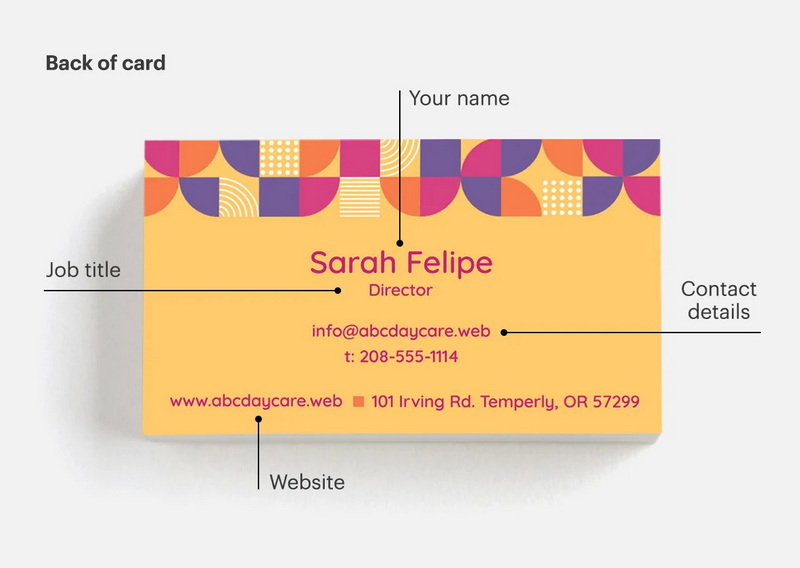
1. Essential Information: Include your name, job title, company name, phone number, email address, and website. The information should be clear and easy to read.
2. Visual Identity: Incorporate your logo and brand colors to ensure consistency with your overall branding strategy.
3. Typography: Choose fonts that are legible and reflect your brand's personality. Avoid overly decorative fonts that may hinder readability.
4. Layout: Organize the information logically; prioritize essential details at the top or center of the card for immediate visibility.
5. Quality Materials: Use high-quality cardstock or specialty materials to give your card a professional feel. Consider finishes like matte or glossy coatings for added impact.
6. Call-to-Action (CTA): If appropriate, include a CTA that encourages recipients to take action, such as visiting your website or following you on social media.
Types of Business Cards
Business cards come in various types tailored for different purposes:
- Standard Business Cards: The most common type featuring basic contact information.
- Digital Business Cards: These are electronic versions that can be shared via smartphones or email, often including interactive elements like links to websites or social media profiles.
- Folded Business Cards: These provide extra space for additional information or creative designs while maintaining portability.
- Specialty Cards: Unique shapes (like square or rounded corners), materials (like plastic or metal), or finishes (like embossed text) can help stand out from traditional cards.
- Industry-Specific Cards: Certain professions may require specialized designs; for example, medical professionals might include their qualifications or areas of expertise on their cards.
Benefits of Using Business Cards
The advantages of having business cards extend beyond mere convenience:
- Cost-Effective Marketing: Business cards are relatively inexpensive compared to other advertising methods but can yield high returns by generating leads and establishing connections.
- Enhanced Networking Opportunities: Carrying business cards allows you to seize networking opportunities spontaneously without needing digital devices.
- Memorability: A well-designed card can make you more memorable than competitors who rely solely on digital communication methods.
- Personal Touch: Handing over a physical card adds a personal element to interactions that digital exchanges lack.
Trends in Business Card Design
As technology continues to evolve, so do the trends surrounding business card design. Some notable trends include:
1. Minimalism: Many professionals are opting for minimalist designs that focus on essential information without clutter. This approach often uses ample white space and simple typography to create an elegant look.
2. Interactive Elements: With the rise of QR codes and NFC technology, many business cards now incorporate interactive elements that allow recipients to scan the card with their smartphones for instant access to websites or contact details.
3. Sustainable Materials: As environmental consciousness grows among consumers, there is an increasing demand for eco-friendly business cards made from recycled materials or sustainable sources.
4. Unique Shapes and Sizes: Breaking away from traditional rectangular designs, some businesses are experimenting with unique shapes and sizes that reflect their brand identity more creatively.
5. Augmented Reality (AR): Some innovative designers are integrating AR features into business cards that allow users to view additional content through their smartphones when they point their camera at the card.
How to Distribute Your Business Cards Effectively
Distributing your business card effectively is just as important as its design:
- Be Strategic at Networking Events: Attend industry-specific events where potential clients or partners are present. Approach individuals with confidence and introduce yourself before handing over your card.
- Follow Up After Meetings: If you meet someone interesting but don't have time for an in-depth conversation, offer your card with an invitation to connect later via email or phone call.
- Include Them in Mailings: If you send out promotional materials or newsletters, consider including your business card as an added touch that encourages recipients to reach out directly.
- Utilize Social Media Platforms: Share images of your business card on platforms like LinkedIn to create awareness about your brand while inviting connections from those who see it online.
Conclusion
In conclusion, business cards remain an essential tool in professional communication despite the rise of digital alternatives. They serve not only as a means of sharing contact information but also play a critical role in branding and networking efforts. A well-crafted business card can leave a lasting impression and facilitate meaningful connections in various professional contexts. With evolving design trends and distribution strategies, professionals must adapt their approach while ensuring their business cards effectively represent their brand identity.
Related Questions
1. What information should I include on my business card?
Include your name, job title, company name, phone number, email address, and website URL.
2. How much do business cards typically cost?
Costs vary widely depending on design complexity and quantity; basic options can start at around $25 for 100 cards while premium designs may cost significantly more.
3. Are digital business cards effective?
Yes, digital business cards are increasingly popular as they allow for easy sharing via smartphones and often include interactive features like links.
4. What is the best size for a business card?
The standard size is 3.5 inches by 2 inches; however, variations exist depending on design preferences.
5. How can I make my business card stand out?
Consider unique designs, high-quality materials, special finishes (like embossing), and incorporating your brand colors effectively.
Citations:
[1] https://www.clickcardapp.com/blog/what-is-a-business-card
[2] https://www.4over4.com/content-hub/stories/the-history-of-business-cards-how-it-all-started
[3] https://www.gelato.com/blog/how-to-design-a-business-card-2024-guide
[4] https://www.activate.co.nz/Blog/why-you-should-still-have-business-cards/
[5] https://www.gatewaydigitalpress.com/what-we-print/business-cards/business-card-faqs.html
[6] https://www.template.net/graphic-design/business-cards-designs/
[7] https://www.caseyprinting.com/blog/what-is-the-history-of-business-cards
[8] https://www.linkedin.com/pulse/importance-business-cards-8-reasons-you-still-need-them-tewathia
[9] https://www.absolutecp.co.uk/the-letterpress/important-questions-about-business-cards
[10] https://www.namecheap.com/visual/card-maker/faqs/
[11] https://www.brandly.com/blog/questions-business-card-vendor/
[12] https://smartpress.com/support/product-faq/business-card-printing-faq
[13] https://printingsolutions.com/purpose-business-card/
[14] https://dictionary.cambridge.org/us/dictionary/english/business-card
[15] https://aura-print.com/usa/blog/post/the-history-of-business-cards
[16] https://www.plasticprinters.com/history-of-business-cards
[17] https://www.duplointernational.com/article/evolution-business-card
[18] https://www.primoprint.com/blog/10-crucial-parts-to-a-business-card-design/
[19] https://www.vistaprint.com/hub/business-card-design-rules
[20] https://www.reddit.com/r/graphic_design/comments/18m8r6f/what_is_the_latest_design_trend_for_business_cards/
[21] https://www.spaceprint.com.au/12-benefits-of-a-business-card/
[22] https://www.designhill.com/design-blog/reasons-why-business-cards-are-still-important/
[23] https://www.printingforless.com/blog/why-business-cards-are-still-important-in-the-digital-age/
[24] https://orchid.ganoksin.com/t/several-questions-about-business-cards/55622
[25] https://www.printplace.com/articles/business-card-design-faq
[26] https://graphicdesign.stackexchange.com/questions/830/making-a-business-card-any-advice
[27] https://silkcards.com/blog/inspire/purpose-of-business-cards-7-reasons-why-business-cards-still-matter/
[28] https://en.wikipedia.org/wiki/Business_card
[29] https://www.entrepreneur.com/encyclopedia/business-card
[30] https://www.swallowtailprint.co.uk/news/articles/post/78-a-brief-history-of-business-cards
[31] https://www.linkedin.com/pulse/history-business-card-how-cards-have-adapted-changed-over-years-
[32] https://www.jukeboxprint.com/blog/history-of-business-cards
[33] https://creativemarket.com/blog/10-commandments-of-business-card-design
[34] https://www.indeed.com/career-advice/career-development/business-card-tips
[35] https://www.swagify.com/blog/how-to-design-a-business-card/
[36] https://www.neo.space/blog/business-card-design
[37] https://www.solopress.com/blog/business-marketing/10-advantages-of-business-cards/
[38] https://www.graficcentre.com/en/blog/news/5-benefits-of-having-a-business-card
[39] https://www.namecheap.com/blog/15-reasons-to-use-a-business-card-in-2020/


