Content Menu
● What Are Custom Pins?
● Why Custom Lapel Pins Still Matter
● Main Types of Custom Pins
>> Soft Enamel Pins
>> Hard Enamel Pins
>> Die-Struck Custom Pins
>> Printed Custom Pins
● Custom Pins Materials and Surface Finishes
>> Common Base Materials
>> Plating Options
● How to Prepare Artwork for Custom Pins
>> Use Vector Artwork Whenever Possible
>> Use Clear Color Instructions
>> Follow Practical Line and Text Rules
● Selecting the Right Size and Shape
>> Size Recommendations
● Choosing the Best Pin Backing
>> Butterfly Clutch
>> Rubber Clutch
>> Magnetic Backing
>> Locking Clutch
>> Safety Pin Backing
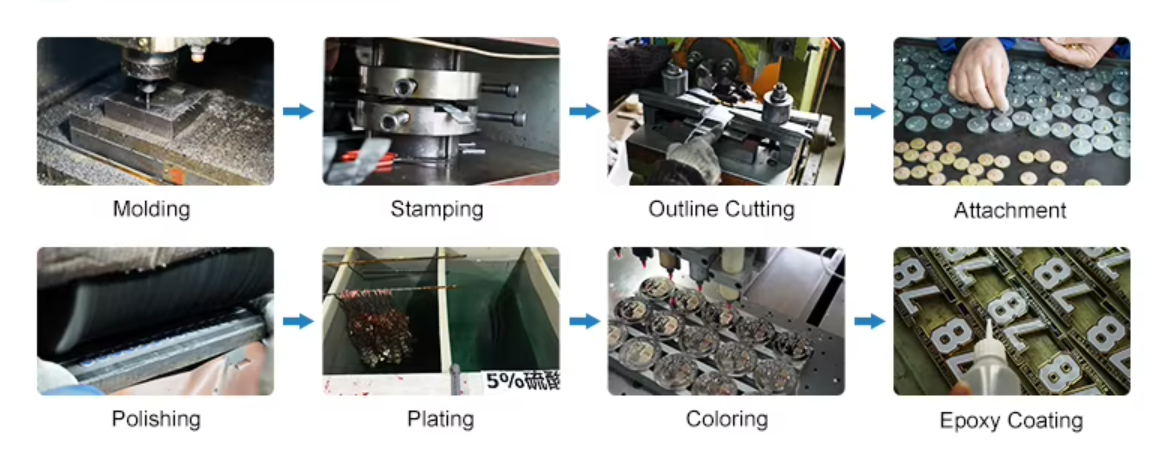
● The Custom Pin Manufacturing Process
>> 1. Design Review
>> 2. Digital Proof
>> 3. Mold or Die Preparation
>> 4. Metal Forming
>> 5. Surface Finishing
>> 6. Enamel Filling or Printing
>> 7. Polishing and Inspection
>> 8. Individual Packing
● Quality-Control Checklist for Buyers
● How to Choose a Custom Pins Manufacturer
● OEM and ODM Custom Pins for Brands
>> OEM Custom Pins
>> ODM Custom Pins
● Custom Pins for Retail and Packaging
● Three Practical Strategies to Increase Pin Sales
>> Create Limited Editions
>> Build a Series
>> Use Pins as a Customer-Experience Tool
● Common Mistakes When Ordering Custom Pins
● Recommended Ordering Workflow
● Conclusion
● FAQs About Custom Pins
>> 1.How much do custom pins cost?
>> 2.What is the most popular custom lapel pin size?
>> 3.What is the difference between soft enamel and hard enamel pins?
>> 4.Can I order custom pins with my own logo?
>> 5.What file format should I use for custom pin artwork?
>> 6.Do custom pins require a mold?
>> 7.Are custom pins suitable for retail packaging?
>> 8.How can I check the quality of custom pins?
>> 9.How long does custom pin production take?
>> 10.Can a manufacturer help improve my design?
● References
Custom pins are small products with significant branding potential. A well-designed pin can turn a company logo, event symbol, fandom illustration, or social message into a wearable and collectible item. For brands, wholesalers, retailers, schools, organizations, and event planners, custom pins offer an affordable way to increase visibility, build community, and create memorable merchandise.
At XingKun, Shenzhen XingKun Packing Products Co., Ltd., we understand that a successful custom pin project involves more than simply stamping a logo onto metal. Buyers must make informed decisions about pin type, material, size, artwork, enamel finish, plating, backing, packaging, quality control, and production quantity. This guide explains the complete process from initial concept to final delivery, helping international buyers develop custom lapel pins that are attractive, practical, and commercially successful.
What Are Custom Pins?
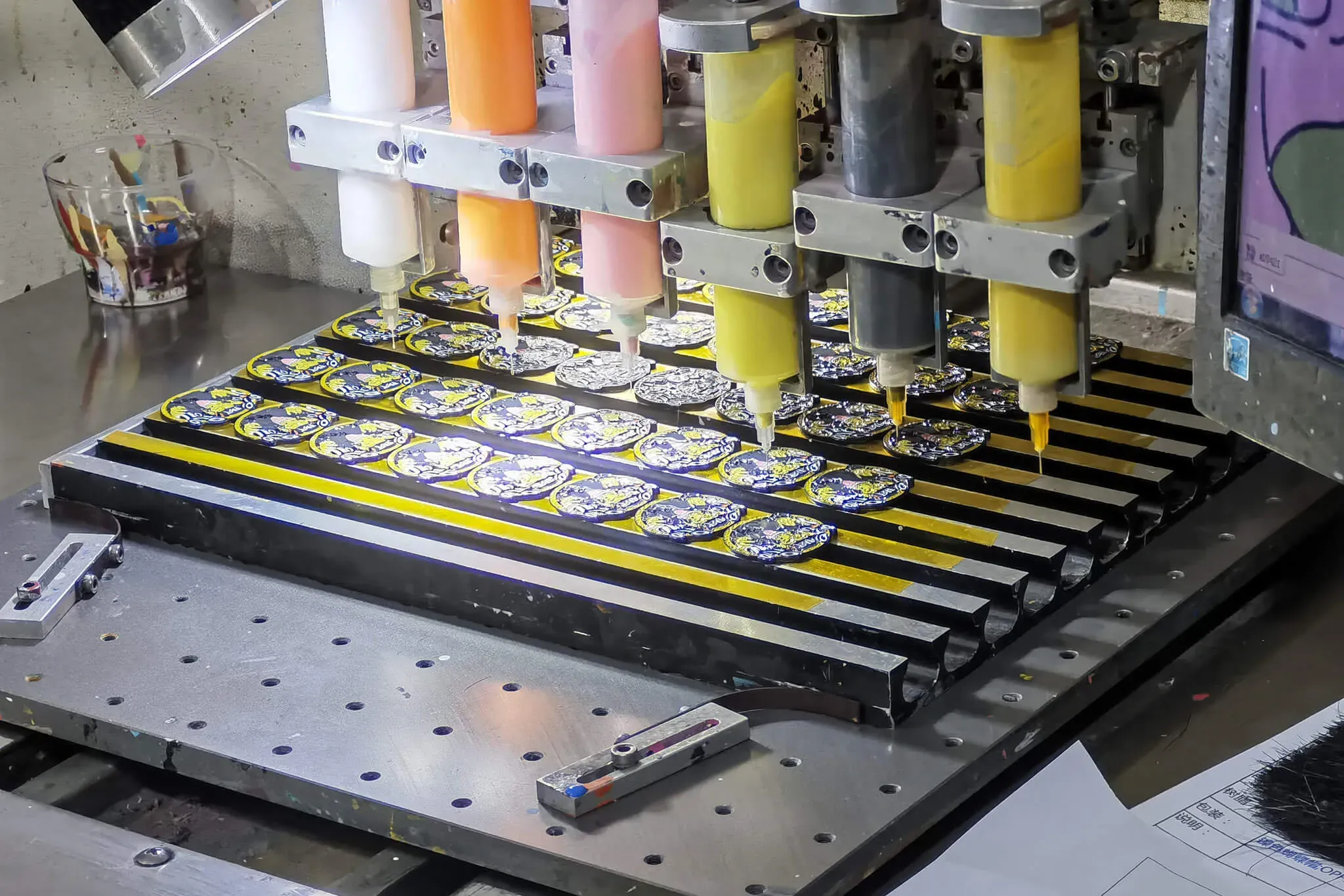
Custom pins are personalized pin badges manufactured according to a specific design, logo, shape, color scheme, or message. They can be attached to clothing, uniforms, bags, hats, jackets, display boards, gift boxes, or retail packaging.
Unlike generic promotional products, custom pins are usually designed around a brand identity or a particular community. This makes them useful for:
- Corporate branding and employee recognition
- Trade shows and business events
- Schools, clubs, and membership organizations
- Political campaigns and awareness programs
- Music, film, anime, and gaming merchandise
- Retail collectibles and limited-edition product lines
- Wedding favors and commemorative gifts
- Retail packaging and promotional gift sets
Custom pins may be produced from iron, brass, stainless steel, zinc alloy, or other metal materials. Depending on the design, they may include enamel color, printed graphics, engraved details, special plating, cutout sections, glitter, glow effects, or a combination of techniques.
The main commercial advantage is flexibility. A buyer can create a pin in almost any silhouette, from a simple round logo to a detailed character, product icon, mascot, flag, or irregular geometric shape.
Why Custom Lapel Pins Still Matter
Digital advertising is essential for modern brands, but physical promotional items continue to provide a different type of interaction. A custom lapel pin can be worn repeatedly, displayed on a bag, or collected as part of a series. Each use creates another opportunity for the design to be seen.
Custom lapel pins are especially effective because they are:
- Small and lightweight
- Easy to ship internationally
- Simple to distribute at events
- Suitable for both promotional and retail use
- Highly customizable
- Compatible with limited-edition marketing campaigns
- Easy to combine with printed packaging
Industry guides commonly identify custom lapel pins as products used for brand recognition, employee awards, membership identification, awareness campaigns, and collector merchandise. Their value comes from combining symbolism, portability, and repeat exposure rather than from size alone. [qualitypatches](https://www.qualitypatches.com/blog/custom-lapel-pins-a-complete-guide-to-designing-high-quality-pins-for-brands-events-and-organizations/)
For a packaging company such as XingKun, custom pins can also be integrated with printed backer cards, retail boxes, paper inserts, display cards, and promotional packaging. This creates a more complete product presentation for brands that want to sell pins through e-commerce, conventions, gift shops, or subscription boxes.
Main Types of Custom Pins
Choosing the right pin style is one of the most important decisions in the project. The correct option depends on the visual effect, budget, artwork complexity, target audience, and expected usage.
Soft Enamel Pins
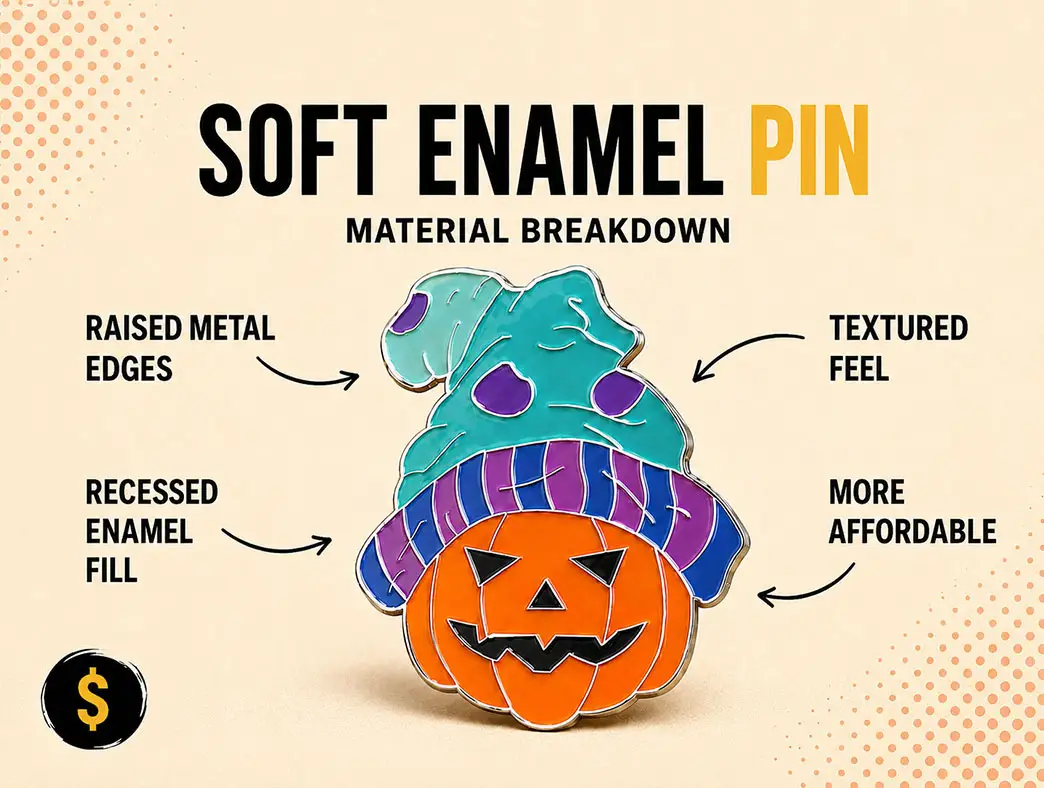
Soft enamel pins have recessed color areas and raised metal borders. The enamel sits slightly below the metal lines, creating a textured surface that customers can feel.
Advantages include:
- Strong color contrast
- A traditional handcrafted appearance
- Competitive pricing for bulk production
- Good suitability for logos, symbols, and bold illustrations
- A wide range of plating and enamel color options
Soft enamel is often selected for promotional campaigns, clubs, fan merchandise, school organizations, and event giveaways. It works particularly well when the design uses clear outlines and separate color blocks.
Hard Enamel Pins
Hard enamel pins have a smooth, polished surface. The enamel is filled to the level of the metal borders and then polished, producing a refined appearance similar to jewelry.
Hard enamel is suitable for:
- Premium corporate branding
- High-end retail merchandise
- Commemorative pins
- Hotel, fashion, and lifestyle brands
- Designs requiring a smooth and durable surface
Hard enamel generally creates a more polished visual impression than soft enamel. However, the production process may require greater control over color filling, polishing, and surface finishing.
Die-Struck Custom Pins
Die-struck pins use raised and recessed metal details without necessarily including colored enamel. The design is stamped directly into the metal, and the surface may receive polished, matte, or antique plating.
This style is useful when the brand wants a classic, professional, or understated appearance. It is often selected for:
- Corporate logos
- Military-style insignia
- Membership badges
- Awards and recognition products
- Monochrome brand marks
Because the design relies on metal relief rather than color, line clarity and depth are especially important.
Printed Custom Pins
Printed pins are useful for artwork containing photographic details, gradients, very small text, or color areas that are difficult to reproduce with traditional enamel.
Possible printing methods may include:
- Digital printing
- Offset printing
- Silk screen printing
- UV printing
- Laser engraving
XingKun's custom lapel pin product reference identifies several of these options, including digital print, laser engraving, offset print, silk screen print, UV print, hard enamel, soft enamel, Pantone colors, plating, and different attachment and packaging possibilities. [xkdisplay](https://www.xkdisplay.com/custom-lapel-pins.html)
Printed pins can be a better solution when the design contains complex illustrations or when the customer requires more detailed color reproduction.
Custom Pins Materials and Surface Finishes
The base metal influences both appearance and structural performance.
Common Base Materials
| Material | Typical Benefits | Suitable Applications |
| Iron | Cost-effective and suitable for many standard designs | Promotional pins and bulk orders |
| Brass | Good detail reproduction and a premium feel | Corporate and commemorative pins |
| Stainless steel | Durable and resistant to corrosion | Outdoor, industrial, and long-term use |
| Zinc alloy | Suitable for three-dimensional and irregular shapes | Sculpted logos and character designs |
| Aluminum | Lightweight and suitable for selected printed applications | Lightweight promotional products |
The most appropriate material depends on the product size, design structure, required weight, budget, and finishing method. A professional manufacturer should recommend the base metal after reviewing the artwork rather than offering the same material for every project.
Plating Options
Common plating finishes include:
- Gold plating
- Silver plating
- Nickel plating
- Black nickel plating
- Antique gold
- Antique silver
- Antique copper
- Matte or polished finishes
The plating should support the brand personality. For example, polished gold may communicate premium value, while antique bronze may suit a vintage or heritage design. Black nickel can create a strong contrast with bright enamel colors.
Buyers should also confirm whether the selected plating is intended for indoor promotional use, everyday wear, outdoor exposure, or retail merchandise. The finish should be evaluated together with the material and quality-control requirements.
How to Prepare Artwork for Custom Pins
Artwork is one of the most common causes of production delays. A design that looks attractive on a large computer screen may become difficult to manufacture when reduced to a one-inch pin.
Use Vector Artwork Whenever Possible
Preferred file formats often include:
- Adobe Illustrator AI
- CorelDRAW CDR
- Editable PDF
- EPS or SVG when accepted by the manufacturer
Vector artwork allows the production team to inspect outlines, color areas, dimensions, and typography more accurately. Customers should convert text to outlines to prevent missing-font problems during file opening and pre-production.
If a buyer only has a JPG, PNG, sketch, or low-resolution image, the factory may be able to assist with artwork reconstruction or vectorization. However, the customer should confirm whether an artwork fee applies and whether the final design requires approval before production.
Use Clear Color Instructions
Pantone references can help communicate the intended color more precisely. However, enamel, plating, printed ink, and digital displays may not appear exactly the same.
A production-ready design should include:
- The actual pin size
- The intended metal color
- Pantone or other color references
- Clear separation between metal lines and color areas
- The required number of pin backs
- Any cutout or hollow sections
- A front-view design and, when needed, a side-view reference
Follow Practical Line and Text Rules
Manufacturing tolerances vary according to the material, process, size, and equipment. As a practical starting point, one specialist design guide recommends a minimum metal line thickness of approximately 0.2 mm, a minimum color-fill width of approximately 0.3 mm, and text sizes of around 6 pt or larger for soft and imitation hard enamel designs. [js-pins](https://js-pins.com/blog/knowledge/6-key-design-rules-for-custom-lapel-pins/)
These figures should not be treated as universal guarantees. They are useful production guidelines, but the final recommendation should come from the selected manufacturer after reviewing the artwork.
To improve readability:
- Use bold, simple shapes.
- Avoid extremely thin lines.
- Reduce unnecessary internal details.
- Use strong contrast between metal and enamel.
- Avoid placing tiny text around curved edges.
- Convert fonts to outlines.
- Request a production mockup before approval.
Selecting the Right Size and Shape
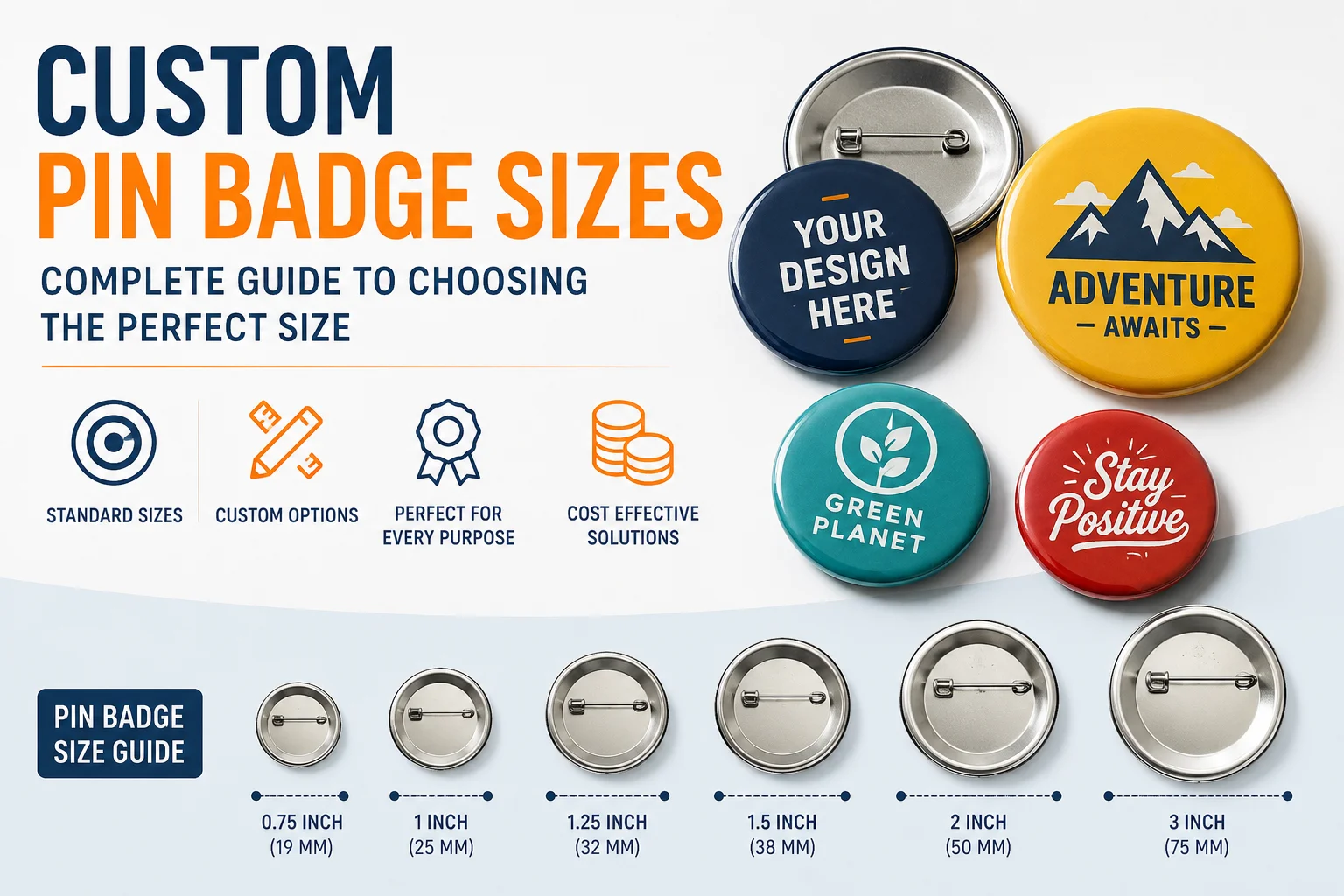
The most popular custom lapel pin sizes are often around 0.75 to 1.5 inches, depending on the design and intended use. One inch is a common compromise between visibility, comfort, and cost. [qualitypatches](https://www.qualitypatches.com/blog/custom-lapel-pins-a-complete-guide-to-designing-high-quality-pins-for-brands-events-and-organizations/)
Size Recommendations
| Pin Size | Best Use |
| 0.5–0.75 inch | Small logos, uniforms, subtle branding |
| 1 inch | General promotional use and retail merchandise |
| 1.25–1.5 inches | Detailed illustrations, event souvenirs, collectibles |
| Over 1.5 inches | Statement pieces, large mascots, display-focused products |
A pin that is too small may lose important details. A pin that is too large may become heavy or uncomfortable on lightweight fabric. For wearable applications, a specialist guide recommends keeping the overall size below approximately 5 cm when possible. [js-pins](https://js-pins.com/blog/knowledge/6-key-design-rules-for-custom-lapel-pins/)
The shape may be circular, square, rectangular, shield-shaped, character-shaped, or completely irregular. However, complex shapes should maintain sufficient structural strength around narrow sections and sharp corners.
Choosing the Best Pin Backing
The attachment affects how securely and comfortably the pin is worn.
Butterfly Clutch
The butterfly clutch is a common option for standard lapel pins. It is compact, affordable, and suitable for uniforms, jackets, bags, and event merchandise.
Rubber Clutch
Rubber clutches are lightweight and comfortable. They are often selected for casual use, children's products, convention merchandise, and designs that need a softer backing.
Magnetic Backing
Magnetic pins avoid making a hole in clothing. They are suitable for premium uniforms, delicate fabrics, and corporate gifts. Buyers should confirm the magnet strength and whether the intended garment thickness is compatible.
Locking Clutch
Locking backs provide additional security and are suitable for pins that will be worn frequently or attached to valuable garments, bags, and uniforms.
Safety Pin Backing
Safety pin attachments may be considered for larger badges, textile products, or designs where a longer attachment mechanism is preferred.
The correct backing should be selected according to the pin weight, garment type, frequency of use, retail price, and security requirement.
The Custom Pin Manufacturing Process
A professional factory normally follows a series of controlled steps.
1. Design Review
The customer submits the logo, illustration, sketch, or concept. The manufacturer reviews size, line thickness, color separation, cutouts, text clarity, and production feasibility.
2. Digital Proof
The factory creates a digital mockup showing the approximate size, shape, plating, colors, and backing. Customers should carefully review the proof before approving production.
3. Mold or Die Preparation
For stamped metal and enamel pins, a custom mold or die may be required. The mold defines the outer contour and raised or recessed details.
4. Metal Forming
The selected metal is stamped, die-cast, cut, or formed according to the product design. Three-dimensional designs may require additional tooling or multiple production steps.
5. Surface Finishing
The pin may be polished, brushed, plated, oxidized, or treated with an antique finish. Surface preparation directly affects the final appearance.
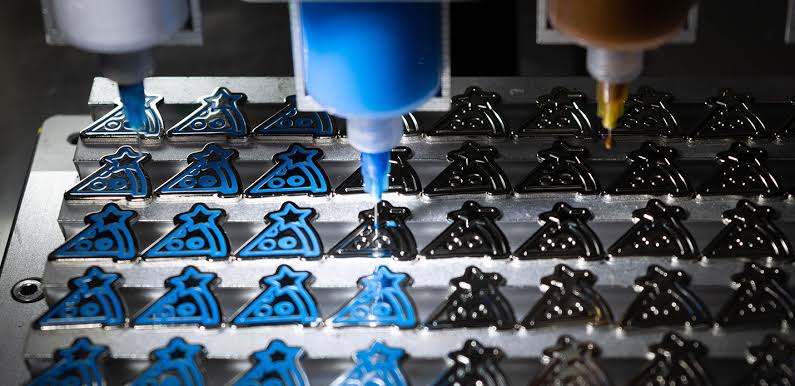
6. Enamel Filling or Printing
Color is filled into recessed areas for enamel pins. Printed designs are processed using the selected printing method. The factory should check for uneven filling, color contamination, missing details, and surface defects.
7. Polishing and Inspection
Hard enamel pins may require polishing to create a smooth finish. The finished products should be inspected for plating consistency, color accuracy, scratches, sharp edges, weak attachments, and dimensional problems.
8. Individual Packing
Pins may be packed in bulk polybags, paper cards, plastic boxes, custom retail boxes, or branded gift packaging. Packaging should be selected according to the sales channel and product positioning.
Quality-Control Checklist for Buyers
Before placing a large order, buyers should request clear specifications and confirm the inspection process.
Important quality points include:
- Correct pin size and shape
- Consistent metal plating
- Even enamel filling
- No significant scratches or sharp edges
- Accurate logo and color reproduction
- Secure pin backing
- Correct quantity
- Consistent packaging
- Acceptable weight and thickness
- Clear handling of defective products
A digital proof confirms the intended design, but it does not always reveal every physical detail. For high-value, complex, or retail projects, buyers should consider requesting a physical sample or pre-production sample.
The approval process should be documented. The final production version should match the approved artwork in terms of size, colors, plating, back type, packaging, and quantity.
How to Choose a Custom Pins Manufacturer
Price is important, but it should not be the only selection criterion. A reliable custom pins manufacturer should be able to explain how the design will be produced and identify potential risks before manufacturing starts.
Look for a supplier that provides:
- Clear artwork review
- Responsive communication
- Transparent quotations
- OEM and ODM support
- Multiple manufacturing techniques
- Digital proofs before production
- Quality-control procedures
- International shipping experience
- Custom packaging support
- Confidential handling of customer designs
For international buyers, communication is particularly important. The supplier should clearly state the production timeline, sample policy, tooling charges, payment terms, shipping method, carton information, and responsibilities for import clearance.
XingKun specializes in customized packaging and printed products and provides a product reference for custom lapel pins with options such as enamel, printing, plating, attachment styles, and packaging. This combination may be useful for brands that want to coordinate their pins with printed cards, packaging boxes, books, stickers, or other promotional products. [xkdisplay](https://www.xkdisplay.com/custom-lapel-pins.html)
OEM and ODM Custom Pins for Brands
OEM means the manufacturer produces pins according to the buyer's own design, specifications, and branding. ODM generally involves adapting an existing concept, product structure, or design direction into a finished product.
OEM Custom Pins
OEM projects are suitable for:
- Established brands
- Corporate identity programs
- Retail merchandise
- Promotional agencies
- Licensed character products
- Private-label collections
The buyer normally controls the artwork, colors, packaging, dimensions, and branding requirements.
ODM Custom Pins
ODM support is useful when the buyer has a general concept but needs help with:
- Design refinement
- Shape development
- Material selection
- Color matching
- Packaging design
- Product-line planning
- Sample optimization
For both OEM and ODM projects, intellectual property should be managed carefully. Buyers should confirm ownership of artwork, confidentiality expectations, licensing rights, and approval responsibilities before production.
Custom Pins for Retail and Packaging
One of the most valuable opportunities is to treat a custom pin as part of a complete product experience instead of an isolated accessory.
A retail brand can combine pins with:
- Printed backer cards
- Custom folding cartons
- Window boxes
- Hang tags
- Instruction cards
- Sticker sheets
- Collectible series packaging
- Subscription-box inserts
For example, an anime-inspired pin collection may be sold on a branded card and placed inside a small printed box. A corporate recognition pin may be mounted on a presentation card with a message and packed in a gift box.
This approach improves perceived value and creates more space for brand storytelling. It also allows the buyer to coordinate production through fewer suppliers.
Three Practical Strategies to Increase Pin Sales
Create Limited Editions
Limited-edition pins can encourage urgency and collectability. Brands may use numbered cards, seasonal colors, event-specific designs, or small-batch releases.
The important point is to make the limitation credible. If the product is described as limited edition, the production quantity and release plan should be managed consistently.
Build a Series
A single pin may attract attention, but a coordinated series can encourage repeat purchases. The series may use:
- Different characters
- Seasonal themes
- Product milestones
- Travel destinations
- Brand mascots
- Community achievements
A consistent backing card and packaging system can make the entire collection appear more professional.
Use Pins as a Customer-Experience Tool
Pins can be included with online orders, event tickets, membership packages, or product launches. The pin becomes more memorable when it is connected to a specific customer action or occasion.
For B2B brands, pins can also be used as employee awards, distributor gifts, trade-show giveaways, and customer loyalty products.
Common Mistakes When Ordering Custom Pins
Several mistakes can increase costs or reduce product quality.
- Approving artwork without checking it at actual size
- Using text that is too small
- Choosing a finish without considering the brand image
- Ignoring the weight of a large pin
- Failing to specify the pin backing
- Comparing quotations without checking what is included
- Ordering a large quantity before reviewing a sample
- Providing low-resolution artwork without production instructions
- Treating the digital mockup as an exact color guarantee
- Forgetting to plan the packaging and distribution process
The best way to avoid these issues is to prepare a complete product specification before requesting a quotation.
Recommended Ordering Workflow
Follow this process for a more predictable custom pin project:
1. Define the purpose, target audience, sales channel, and estimated quantity.
2. Prepare the logo, illustration, dimensions, colors, and packaging requirements.
3. Ask the manufacturer to recommend the best material and production technique.
4. Review the quotation, tooling charges, shipping terms, and estimated timeline.
5. Approve the digital proof and request a physical sample when appropriate.
6. Confirm the sample, packaging, backing, and inspection standard.
7. Approve mass production only after all specifications are documented.
8. Inspect the shipment upon arrival and record any quality issues.
Conclusion
Custom pins are versatile products for branding, retail merchandise, events, recognition programs, and collector communities. Their success depends on more than an attractive illustration. The pin size, metal material, enamel technique, plating, artwork preparation, backing, packaging, and quality control must work together as one product system.
For brands, wholesalers, and production companies, the most efficient approach is to work with a manufacturer that can support the project from artwork review through production and packaging. XingKun provides OEM and ODM-oriented custom product services and offers custom lapel pin options that can be coordinated with printed packaging and promotional materials. [xkdisplay](https://www.xkdisplay.com/custom-lapel-pins.html)
If you are planning a new pin collection, company promotion, event giveaway, or retail merchandise project, send XingKun your artwork, target size, quantity, preferred finish, backing type, and packaging requirements. The production team can then help evaluate feasibility and prepare a customized quotation.
FAQs About Custom Pins
1.How much do custom pins cost?
The cost depends on the size, base material, enamel or printing method, plating, design complexity, backing, packaging, quantity, and tooling requirements. Larger orders generally reduce the average unit cost, but buyers should compare complete quotations rather than unit prices alone.
2.What is the most popular custom lapel pin size?
A one-inch pin is widely used because it balances visibility, comfort, and production cost. Smaller sizes may be better for uniforms and subtle logos, while 1.25- to 1.5-inch pins are more suitable for detailed artwork and collectible merchandise. [qualitypatches](https://www.qualitypatches.com/blog/custom-lapel-pins-a-complete-guide-to-designing-high-quality-pins-for-brands-events-and-organizations/)
3.What is the difference between soft enamel and hard enamel pins?
Soft enamel pins have recessed color areas and a textured surface. Hard enamel pins have a smooth, polished surface. Soft enamel is often selected for colorful promotional products, while hard enamel is frequently used for premium, polished, or retail-oriented designs.
4.Can I order custom pins with my own logo?
Yes. OEM custom pins can be manufactured using a buyer's logo, artwork, shape, color references, and packaging specifications. The buyer should confirm that they own or have permission to use the submitted artwork.
5.What file format should I use for custom pin artwork?
Vector formats such as AI, CDR, EPS, SVG, and editable PDF are generally preferred. Text should be converted to outlines, and the file should show the actual size, color references, metal lines, cutouts, and other production instructions.
6.Do custom pins require a mold?
Many stamped metal enamel pins require a custom mold or die. The manufacturer should explain whether a tooling charge applies and whether the mold can be reused for future orders.
7.Are custom pins suitable for retail packaging?
Yes. Pins can be attached to printed backing cards, packed in custom boxes, or included in gift sets and subscription packages. Coordinating pin production with packaging can improve product presentation and simplify procurement.
8.How can I check the quality of custom pins?
Review the approved artwork and, when necessary, request a physical sample. Check the size, shape, plating, color filling, printed details, surface finish, pin backing, packaging, and quantity before approving mass production.
9.How long does custom pin production take?
The timeline depends on artwork approval, tooling, sample requirements, quantity, production method, packaging, and shipping. Buyers should request a written schedule covering proofing, sampling, mass production, inspection, and delivery.
10.Can a manufacturer help improve my design?
Many experienced manufacturers can identify production risks and suggest adjustments to line thickness, color areas, text size, cutouts, and finishing methods. Design assistance may be included or charged separately, so confirm the service terms in advance.
References
1. [XingKun – Custom Lapel Pins](https://www.xkdisplay.com/custom-lapel-pins.html) — Product options, printing methods, enamel techniques, plating, attachment styles, and packaging references. [xkdisplay](https://www.xkdisplay.com/custom-lapel-pins.html)
2. [Jin Sheu – 6 Key Design Rules for Custom Lapel Pins](https://js-pins.com/blog/knowledge/6-key-design-rules-for-custom-lapel-pins/) — Practical guidance on pin size, vector artwork, line thickness, color-fill areas, text size, and cutout design. [js-pins](https://js-pins.com/blog/knowledge/6-key-design-rules-for-custom-lapel-pins/)
3. [Quality Patches – Custom Lapel Pins: A Complete Guide](https://www.qualitypatches.com/blog/custom-lapel-pins-a-complete-guide-to-designing-high-quality-pins-for-brands-events-and-organizations/) — Reference information on applications, materials, production stages, pin sizes, backings, cost factors, and quality checks. [qualitypatches](https://www.qualitypatches.com/blog/custom-lapel-pins-a-complete-guide-to-designing-high-quality-pins-for-brands-events-and-organizations/)


