Content Menu
● The Objective of the Game
● Components of the Game
● Game Setup
● Gameplay Overview
● Example of an Asset Challenge
● Ending a Round
● Strategy and Tips for Winning
● Common Mistakes Beginners Make
● Variations and House Rules
● Why People Love “Cover Your Assets”
● The Psychology Behind the Game
● Learning Curve and Replay Value
● Comparing “Cover Your Assets” to Similar Games
● Cleaning Up and Storing
● Related Questions and Answers
>> Q1: Can two people play “Cover Your Assets”?
>> Q2: How long does one round typically last?
>> Q3: Is “Cover Your Assets” appropriate for kids?
>> Q4: What happens if the draw pile runs out before anyone empties their hand?
>> Q5: Are there expansions or sequels?
● Conclusion
“Cover Your Assets” is a lively, competitive card game designed by Grandpa Beck and published under Grandpa Beck’s Games. The title plays on the pun of “covering your assets,” meaning both protecting your wealth and literally hiding your valuable sets of cards under others. The game is popular among families and friends thanks to its quick learning curve, fast gameplay, and humor-packed illustrations.
This article explores how to play, strategies to win, and why people love it. Whether you’re new to the game or looking to refine your approach, this deep dive covers everything from setup to advanced tips.

The Objective of the Game
The central goal in Cover Your Assets is to become the first player to reach one million dollars in total net worth. Players do this by forming and defending sets of matching asset cards—such as “Jewelry,” “Cash under the Mattress,” “Classic Cars,” “Heirlooms,” or “Piggy Banks.”
Every set you make adds to your growing stack (known as your “assets”), but beware—other players can steal your top set by making bold moves and using matching cards or wild cards. The race to wealth is fierce, and fortunes can change in an instant.
Components of the Game
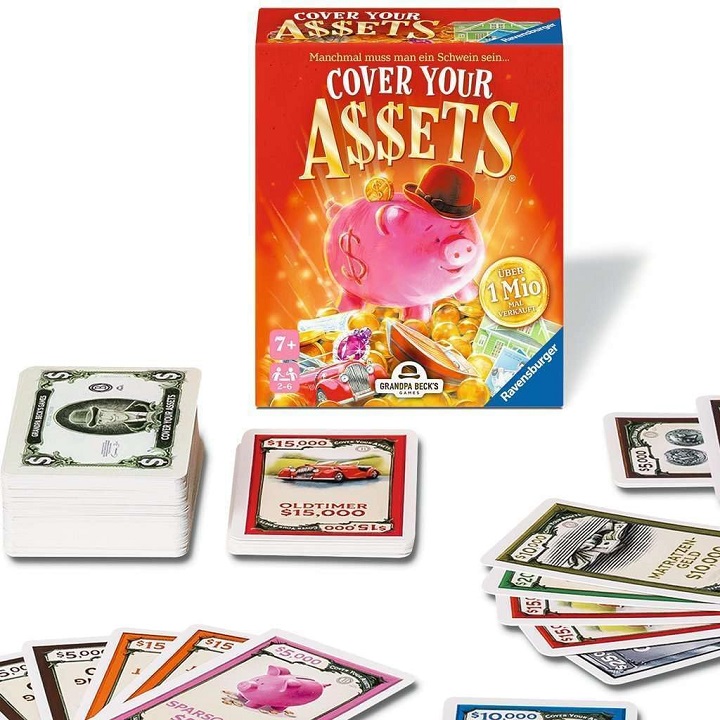
Each box of Cover Your Assets contains everything you need to play:
110 cards consisting of various Asset cards (each with a value, usually $5,000–$25,000).
Several Wild cards represented as “Gold” or “Silver,” which can match any other asset.
Score sheets for tracking cumulative wealth between rounds.
Illustrated instructions outlining basic rules, examples, and variant suggestions.
The box suggests ages 7 and up and supports 4–6 players, though some versions allow for smaller or larger groups with modified rules.
Game Setup
Setting up the game is quick and straightforward:
1.Shuffle all cards thoroughly and place the deck face-down in the center to form a draw pile.
2.Deal 4 cards to each player.
3.Place a discard pile next to the draw deck when cards begin being discarded.
4.Players will use a personal space in front of them to build their “Stack of Assets.”
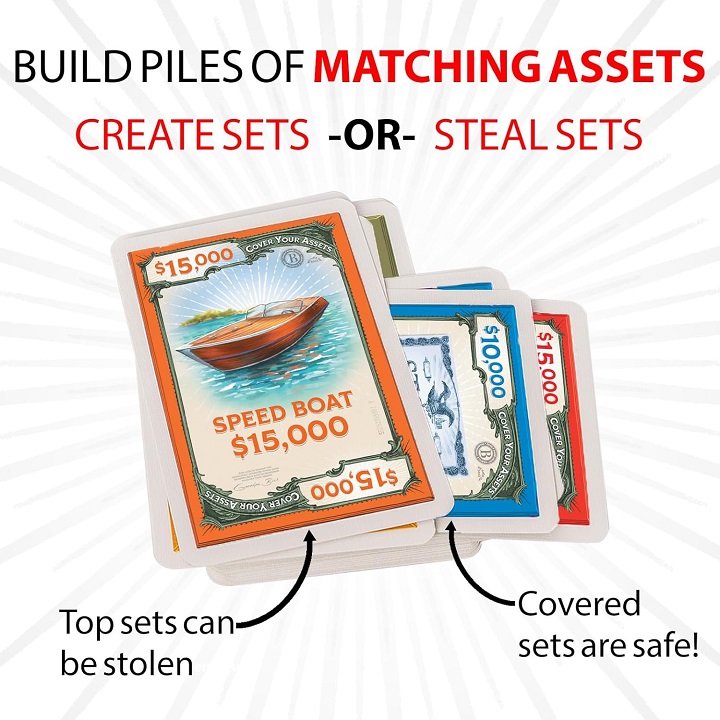
Each player’s asset pile starts empty. During play, you will collect pairs (or sets) of cards and place them face up in front of you to represent your first “asset.” Once you form another set, you place it on top of the previous one, forming a vertical “stack” like layers of wealth building up over time.
Only the top set of your asset pile is vulnerable to theft—everything else beneath it is protected, hence the phrase “Cover Your Assets.”
Gameplay Overview
Gameplay flows clockwise and consists of four main actions per turn:
1.Make a Pair (Form an Asset Set)
You may use cards in your hand to form a pair (two identical assets or one asset plus a wild card). Once a pair is made, place it on top of your pile, face up.
2.Steal a Top Asset
Instead of making a new set, you may attempt to steal another player’s topmost asset by presenting a matching card (e.g., if their top set is “Jewelry,” you must play a “Jewelry” card or wild card to challenge).
3.Defend Your Asset
The defending player can respond to a challenge by playing another card that matches the asset. If they do, the challenger can respond again, continuing the “battle” back and forth until one runs out of matches or chooses to stop.
The person who plays the final matching card wins the challenge and claims the contested pile—including all cards played during the fight—adding them to their own stack as the new top set.
4.Draw New Cards
After your turn (whether you made or lost a challenge), draw back up to four cards. The turn then continues clockwise.
Example of an Asset Challenge
Suppose you have two “Classic Car” cards and want to make them your asset. You place them down—this becomes your top set. On the next player’s turn, they hold one “Classic Car” and a “Gold” wild card. They decide to steal your top set by playing the “Classic Car.” The battle begins.
You can defend with another “Classic Car” or a wild card. If you use your last matching card, your opponent could respond again with another, if they have one. When one party can’t—or won’t—continue, the winner takes all involved cards and stacks them atop their assets. Thus, one successful challenge can multiply card value rapidly.
Ending a Round
The round ends when the draw pile runs out and one player has no cards left. Then it’s time to calculate the total value of your stacked assets:
Add the dollar values shown on each set to find your round total.
Record it on the score sheet.
The next round begins fresh—all cards get re-shuffled and re-dealt.
The first player to reach a net worth of $1,000,000 (usually after several rounds) wins the game.

Strategy and Tips for Winning
Although Cover Your Assets is lighthearted, strategy plays a huge role. Here are key tactics to increase your odds:
Diversify your hand early. It’s risky to hold too many of the same type in case those cards get stolen.
Use Wild Cards carefully. Silver and Gold can save you—but also make you a target. Avoid stacking multiple wilds in one set unless you really need to.
Track what others are discarding. This helps predict what assets they might collect next.
Time your attacks. Wait until someone’s defense is weak (fewer cards in hand) before attempting a steal.
Protect high-value assets first. If your top set is worth $25,000, try covering it quickly with a smaller-value pair just to shield it.
Keep the game moving fast. The pace and bluffing make the experience exciting, and players who hesitate often lose momentum.
Example: If another player has “Gold + Silver” on top—that’s a high-value wildcard set and a tempting target. But if they have only two cards left in hand, that’s your prime moment to strike with a matching wild or asset.
Common Mistakes Beginners Make
1.Wasting Wilds early. Keeping a wild for defense is more valuable than using it for a low-value pair.
2.Ignoring card memory. Forgetting which assets people accumulate leads to missed opportunities for challenges.
3.Failing to draw replacements. Some players forget to refill to four cards, weakening their options.
4.Stacking too high too quickly. A tall pile looks rich but vulnerable; balance growth with protection.
5.Underestimating the discard pile. Smart discards control the rhythm—avoiding giving others easy sets.
Variations and House Rules
Like many popular card games, Cover Your Assets has fan-made modifications to keep the experience fresh:
Speed Variant: Skip the draw-step formality to create constant play—use a community draw pile open to anyone.
Team Play: Pair up players, combining scores but allowing limited shared defense.
Hidden Defense Mode: Defenders secretly place challenge cards face down, revealing them simultaneously for surprise elements.
Mini Decks for 2 Players: Use only half of the deck to maintain balance and tension.
These rule tweaks keep the game dynamic and suited to different group sizes and play styles.

Why People Love “Cover Your Assets”
The game’s charm lies in its blend of accessibility, humor, and competitiveness. Unlike some strategic card games that require deep math or memory, Cover Your Assets balances skill with luck and social interaction.
Families often praise it because even children can grasp the core rules quickly, yet adults still find it challenging. The witty theme of accumulating faux riches—complete with whimsical art—adds to the sense of lighthearted rivalry.
Another reason for its popularity is that Cover Your Assets often becomes a storytelling experience. Matches are filled with laughter, mock drama, and unexpected shifts in fortune. Someone losing their “piggy bank” to a grandparent’s “silver stash” tends to spark plenty of good-natured teasing.
The Psychology Behind the Game
Interestingly, Cover Your Assets illustrates basic lessons in risk management and opportunity cost. Every turn represents a micro-decision between protecting what you have (defending) and pursuing more (attacking). Players subconsciously learn to assess probabilities, manage limited resources, and read opponents’ behavior.
This psychological depth, hidden beneath playful packaging, makes it an educational tool as well as entertainment. Game nights often lead to discussions about luck, timing, and the meaning of “wealth.”
Learning Curve and Replay Value
Most new players master the game within one or two rounds. Once comfortable, strategies evolve, alliances form, and meta-play develops—where you predict not just cards but personalities.
Each round feels different thanks to randomized draws and shifting social dynamics. Even losing can be fun because comebacks are always possible. The emotional rollercoaster of triumph and loss keeps replay value high.
Comparing “Cover Your Assets” to Similar Games
If you’ve enjoyed games like Monopoly Deal, Phase 10, or Exploding Kittens, you’ll find familiar energy in Cover Your Assets. Compared to those:
It’s faster (15–30 minutes per game).
It has less downtime and more interaction.
It balances luck and strategy more evenly than many other quick card games.
That blend of tension and laughter makes it ideal for families, casual game nights, or even icebreaker sessions at gatherings.
Cleaning Up and Storing
After each session, simply collect all cards, shuffle, and return them to the sturdy box. Because shuffling and dealing happen frequently, using card sleeves can extend card life. For serious fans, Grandpa Beck’s website often offers replacement decks and expansions with new themes.
Related Questions and Answers
Q1: Can two people play “Cover Your Assets”?
A1: Yes, but using the full deck slows the pace. Many players recommend removing half the deck (especially duplicate low-value assets) for a tighter two-player experience.
Q2: How long does one round typically last?
A2: Around 10–15 minutes. Full matches (to $1,000,000 net worth) usually take 30–45 minutes depending on the number of players.
Q3: Is “Cover Your Assets” appropriate for kids?
A3: Absolutely. The rules are simple, the humor is family-friendly, and it promotes quick math, memory, and social interaction skills.
Q4: What happens if the draw pile runs out before anyone empties their hand?
A4: Once the deck empties, finish the current rotation until no player can continue. Add remaining hand cards to your discard pile, then calculate your wealth for scoring.
Q5: Are there expansions or sequels?
A5: Yes. The sequel Cover Your Kingdom expands on the same mechanics with new fantasy elements and additional strategic depth.
Conclusion
Cover Your Assets combines the best elements of competition, clever card management, and humor. It’s simple enough for beginners yet layered enough to keep frequent gamers engaged. The constant risk of having your wealth stolen adds suspense, while friendly banter keeps it fun for all ages.
Ultimately, its success comes from turning basic card mechanics into a miniature world of unpredictable fortunes and family bonding. Like real life, in Cover Your Assets, your wealth can rise or vanish in a heartbeat—so cover them well!


