Content Menu
● Quick Comparison: Acrylic vs Aluminum Nameplates
● What Is an Acrylic Nameplate?
>> Advantages of Acrylic Nameplates Outdoors
>> Limitations of Acrylic Nameplates Outdoors
● What Is an Aluminum Nameplate?
>> Advantages of Aluminum Nameplates Outdoors
>> Limitations of Aluminum Nameplates Outdoors
● Outdoor Durability: Which Material Lasts Longer?
>> Outdoor Exposure Decision Matrix
● UV Resistance and Color Stability
>> Acrylic Under UV Exposure
>> Aluminum Under UV Exposure
● Printing, Appearance, and Brand Experience
>> Best Design Treatments for Acrylic
>> Best Design Treatments for Aluminum
● Installation Matters More Than Many Buyers Expect
>> Acrylic Nameplate Installation Tips
>> Aluminum Nameplate Installation Tips
● Cost: Initial Price vs Replacement Cost
● How to Specify the Right Outdoor Nameplate
● Final Verdict: Acrylic or Aluminum for Outdoor Nameplates?
● FAQ
>> 1. Are acrylic nameplates suitable for outdoor use?
>> 2. Which outdoor nameplate material has better UV resistance?
>> 3. Will aluminum nameplates rust outdoors?
>> 4. Is acrylic or aluminum better for machine nameplates?
>> 5. Can acrylic nameplates crack outside?
>> 6. What is the best aluminum finish for harsh outdoor conditions?
>> 7. Can outdoor nameplates use adhesive instead of screws?
● References
Choosing between acrylic vs aluminum nameplates for outdoor use is not simply a question of appearance or unit price. It is a specification decision that affects legibility, service life, branding, installation, maintenance, and replacement risk.
At Shenzhen XingKun Packing Products Co., Ltd., we have spent more than 20 years producing nameplates and other printed packaging products for brands and distributors in over 30 countries and regions. From that production perspective, the best outdoor nameplate material is the one matched to the real environment—not the one that looks best in a sample photo.
For premium retail signage, decorative branding, or visually layered displays, acrylic nameplates can create a modern and high-value appearance. For machinery, electrical equipment, industrial assets, marine environments, and long-term identification, aluminum nameplates are usually the more dependable choice.
This guide compares acrylic outdoor nameplates and aluminum outdoor nameplates across durability, UV resistance, corrosion, printing, customization, cost, installation, and end-use suitability.
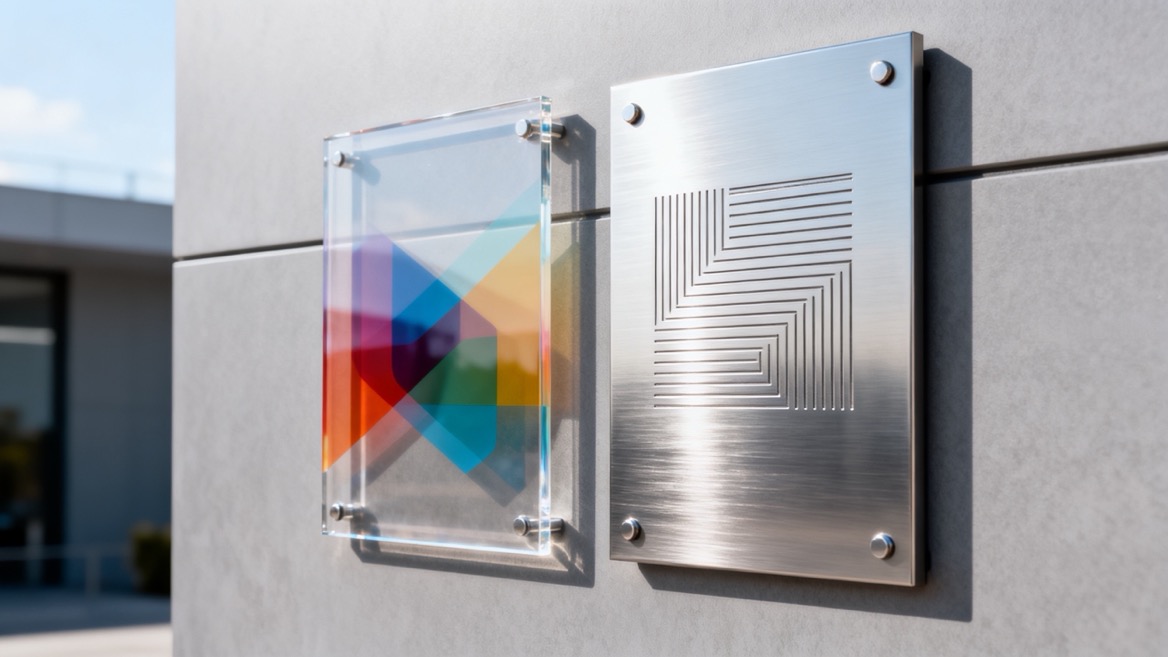
Quick Comparison: Acrylic vs Aluminum Nameplates
| Factor |
Acrylic Nameplates |
Aluminum Nameplates |
| Material type |
Rigid transparent or colored plastic, commonly PMMA |
Lightweight non-ferrous metal |
| Visual effect |
Glossy, dimensional, transparent, premium |
Industrial, metallic, professional, durable |
| UV performance |
Good when using quality outdoor-grade acrylic |
Excellent with anodizing, durable coatings, or photo-anodized processes |
| Impact resistance |
Moderate; can crack under hard impact |
High resistance to impact and deformation |
| Scratch resistance |
Surface can scratch without a hard coating |
Stronger, especially anodized aluminum |
| Corrosion resistance |
Does not rust |
Naturally corrosion resistant; finish selection remains important |
| Heat tolerance |
More sensitive to heat expansion and warping |
Better for heat, temperature cycling, and industrial equipment |
| Chemical resistance |
Depends on acrylic grade and print finish |
Strong with anodized or chemically resistant finishing |
| Best visual use |
Brand badges, decorative logos, retail displays |
Equipment labels, compliance plates, asset tags, outdoor identification |
| Typical outdoor risk |
Cracking, surface scratching, adhesive failure, thermal movement |
Corrosion at damaged edges, galvanic corrosion, coating degradation |
| Premium option |
UV-stable cast acrylic with protected print |
Anodized, photo-anodized, etched, or UV-printed aluminum |
Short answer: Choose acrylic when visual depth, gloss, transparency, and brand presentation are the priority. Choose aluminum when the nameplate must remain readable through years of sun, rain, heat, abrasion, chemicals, vibration, or salt exposure.
What Is an Acrylic Nameplate?
An acrylic nameplate is made from acrylic sheet, often called PMMA or acrylic glass. It may be clear, frosted, opaque, colored, mirrored, or printed on the front or reverse side.
Acrylic is popular because it can look more like a decorative component than a conventional label. It offers a smooth surface, bright color reproduction, and the possibility of layered visual effects.
For example, a clear acrylic nameplate can be reverse-printed and mounted with adhesive. The front surface remains clean and glossy, while the printed graphics sit behind the transparent layer. This can create a refined three-dimensional appearance for outdoor brand plaques, retail fixtures, hospitality signs, and consumer-product badges.
PMMA is widely valued for optical clarity and outdoor weatherability. Research on conventional PMMA has found that it can retain visible-light transmission and much of its mechanical performance after long-term weathering exposure. However, weathering results vary significantly by formulation. Impact-modified acrylic may degrade differently from standard PMMA, and lower-quality recycled or poorly stabilized materials can age much faster.
Advantages of Acrylic Nameplates Outdoors
Acrylic can be an excellent choice when the outdoor environment is relatively controlled and the nameplate is primarily decorative.
Key benefits include:
- High visual clarity for transparent or translucent branding.
- Glossy, premium surface quality that supports modern brand identity.
- Excellent color presentation for reverse printing, digital printing, and layered designs.
- Flexible design options, including laser-cut shapes, clear windows, raised layers, and colored backgrounds.
- Low weight, which is useful for adhesive-mounted signs and lightweight product housings.
- Natural UV stability in quality acrylic grades compared with many other transparent plastics.
Outdoor-grade acrylic is often used in signage because properly formulated PMMA can maintain clarity, gloss, and appearance under sunlight. Some technical sources describe PMMA as one of the more weather-resistant transparent thermoplastics, with minimal yellowing when correct UV-stabilized material is selected.
Limitations of Acrylic Nameplates Outdoors
The visual advantages of acrylic do not remove its physical limitations.
Acrylic is more rigid and brittle than metal. A hard impact, overtightened screw, or poorly positioned mounting hole can cause cracking. This matters on gates, equipment covers, vehicles, construction machinery, and any application exposed to vibration or accidental contact.
Acrylic also expands and contracts more noticeably than aluminum during temperature changes. In a hot outdoor installation, a large acrylic plate can move as temperatures rise. If the part is fixed too tightly, internal stress may build around fasteners or corners.
Common acrylic outdoor nameplate risks include:
- Cracks around drilled holes caused by overtightened screws.
- Crazing, or fine surface cracks, caused by stress and incompatible cleaners.
- Scratches from frequent cleaning, rubbing, sand, or handling.
- Warping or movement under strong heat and direct solar exposure.
- Print vulnerability if graphics are printed on an exposed front surface.
- Adhesive failure when a plate is bonded to low-surface-energy plastic, textured coatings, or contaminated metal.
For outdoor acrylic nameplates, the material itself is only one part of the system. The full specification should include acrylic grade, thickness, print location, ink type, protective layer, mounting method, and expected exposure conditions.
What Is an Aluminum Nameplate?
An aluminum nameplate is a metal identification plate made from aluminum sheet. It can be printed, embossed, etched, laser marked, anodized, photo-anodized, or finished with protective coatings.
Aluminum is widely used for industrial nameplates, machine labels, electrical panels, asset tags, warning labels, serial-number plates, control panels, and outdoor equipment identification. It combines low weight with high strength and can withstand environments that would quickly damage many plastic-based plates.
Its performance depends heavily on the selected finishing process. Plain printed aluminum is not equal to anodized aluminum. Likewise, a decorative painted plate is not equal to a photo-anodized identification plate designed for harsh service.
Advantages of Aluminum Nameplates Outdoors
Aluminum is usually the safer choice where outdoor durability has a direct operational, regulatory, or safety consequence.
Key benefits include:
- Excellent resistance to impact and bending compared with acrylic.
- Better temperature stability in hot, cold, and cycling environments.
- Strong outdoor durability with anodized or high-performance coated finishes.
- Good corrosion resistance, especially when the alloy and finish suit the environment.
- Compatibility with industrial marking, including barcodes, serial numbers, QR codes, variable data, and compliance information.
- Long service life for machinery, utility equipment, agricultural equipment, marine products, and external enclosures.
- Multiple attachment choices, including rivets, screws, weld studs, industrial adhesive, and mechanical mounting.
Anodizing creates an oxide layer integrated with the aluminum rather than simply placing a coating on top. This improves surface hardness and resistance to corrosion and abrasion. In architectural specifications, high-performance Class I anodized finishes are intended for continuous exterior exposure and must meet demanding testing requirements related to weathering, abrasion, and corrosion resistance.
For the most demanding environments, photo-anodized aluminum is often selected because the image is sealed beneath the anodic layer. Manufacturers of photo-anodized nameplates commonly cite outdoor lifetimes of 20 years or more for properly specified products, including use in environments involving UV exposure, moisture, abrasion, solvents, salt spray, and temperature extremes.
Limitations of Aluminum Nameplates Outdoors
Aluminum is durable, but it is not automatically maintenance-free or corrosion-proof in every condition.
Outdoor aluminum nameplates require correct alloy, finish, ink, and mounting design. In coastal or chemically aggressive settings, poor design can lead to corrosion, edge damage, staining, or galvanic reaction.
Potential concerns include:
- Galvanic corrosion when aluminum contacts a more noble metal in the presence of water or saltwater.
- Higher tooling or processing cost for embossing, etching, anodizing, and specialty shapes.
- Limited transparency compared with acrylic.
- Potential dents under heavy impact, although aluminum is less likely to crack.
- Surface scratches on untreated, brushed, or decorative finishes.
- Color limitations for some anodized processes, especially when a metallic appearance must remain visible.
Galvanic corrosion is especially relevant for aluminum nameplates mounted with unsuitable fasteners in wet or marine settings. Direct contact between aluminum and dissimilar metals, combined with an electrolyte such as saltwater, can accelerate corrosion. Insulating washers, compatible fasteners, sealed joints, and appropriate surface treatments reduce this risk.
Outdoor Durability: Which Material Lasts Longer?
For most heavy-duty outdoor applications, aluminum nameplates last longer than acrylic nameplates.
That conclusion does not mean acrylic is a poor outdoor material. Quality UV-stable acrylic can perform well in sunlight and rain. Its limitations become more obvious when the nameplate faces mechanical abuse, thermal stress, abrasive cleaning, chemicals, vibration, or salt exposure.
Aluminum has a broader performance range because it can be upgraded through finishing methods. A basic screen-printed aluminum plate may suit moderate outdoor use. An anodized aluminum plate provides stronger wear resistance. A photo-anodized plate can support extreme long-term identification requirements.
Outdoor Exposure Decision Matrix
| Outdoor Condition |
Better Material |
Why |
| Storefront branding under a canopy |
Acrylic |
Premium appearance, gloss, clear and layered effects |
| Outdoor wall logo with limited physical contact |
Acrylic or aluminum |
Choose acrylic for visual impact; aluminum for extended service life |
| Industrial machine identification |
Aluminum |
Better resistance to abrasion, oil, vibration, heat, and impact |
| Electrical enclosure labels |
Aluminum |
Strong long-term legibility and mechanical durability |
| Marine equipment |
Anodized aluminum |
Better suited to salt exposure when correctly specified and isolated |
| Construction equipment |
Aluminum |
Resists impact, dirt, vibration, and repeated cleaning |
| Outdoor consumer appliance badge |
Acrylic or aluminum |
Depends on visual target, surface shape, and warranty period |
| Parking, wayfinding, or public-area signage |
Aluminum |
Better vandalism and weather resistance |
| Luxury cosmetic, beverage, or retail display branding |
Acrylic |
Strong decorative value and color presentation |
| Compliance and serial-number plates |
Aluminum |
Supports permanent data retention and traceability |
UV Resistance and Color Stability
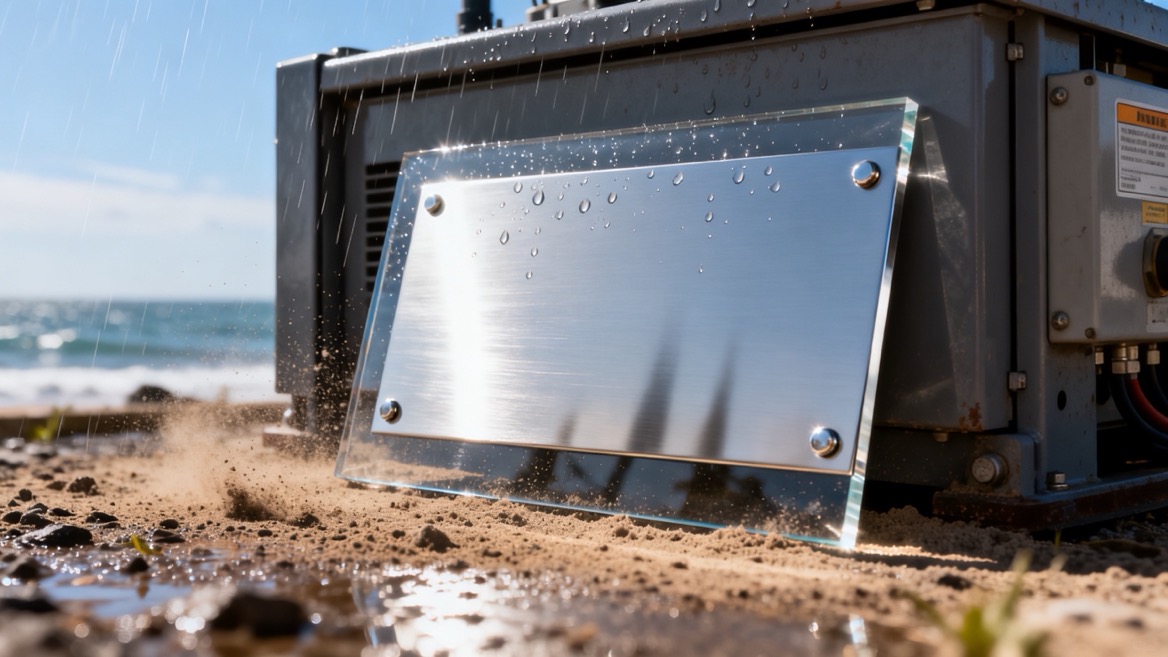
Sunlight is often the first concern when buyers compare acrylic vs aluminum nameplates for outdoor use. However, UV resistance is not just about whether a substrate fades. It is also about inks, coatings, adhesives, colors, print location, and surface protection.
Acrylic Under UV Exposure
Quality PMMA is naturally more UV stable than many common transparent plastics. Studies of PMMA have shown strong resistance to long-term outdoor weathering, with relatively limited changes in visible-light transmission under certain exposure conditions.
Still, the acrylic nameplate specification should not stop at "acrylic."
Ask these questions:
1. Is the material virgin cast acrylic, extruded acrylic, or recycled-content acrylic?
2. Does the grade include UV stabilization suitable for direct exterior exposure?
3. Are graphics printed on the reverse side to protect them behind the acrylic?
4. Is the plate exposed vertically, horizontally, or at an angle?
5. Will it receive intense tropical sunlight, reflected heat, or high UV exposure?
6. Does the application require an expected service life of three years, five years, or more than ten years?
For a branded acrylic outdoor plaque, reverse printing is often the smarter construction. The acrylic face acts as a physical shield for the printed graphics. This helps preserve the visual finish, although edge sealing and suitable adhesive selection are still important.
Aluminum Under UV Exposure
Aluminum itself does not suffer the same yellowing behavior as plastic. The critical question is how the image, coating, or color is created.
For a long-lasting aluminum outdoor nameplate, consider:
- Anodized aluminum for surface hardness and corrosion resistance.
- Photo-anodized aluminum for permanent black graphics protected within the anodic layer.
- UV-resistant inks and clear coats for full-color printed designs.
- Powder coating or high-performance paint systems when bold brand colors are required.
- Laser marking or etching for durable variable information.
Class I anodized finishes are designed for severe exterior use and have higher thickness and salt-spray performance requirements than lower-duty anodized finishes. In a specification comparison, Class I anodizing is listed with a minimum dry-film thickness of 0.7 mils and salt-spray testing of 3,000 hours, while Class II is listed at 0.4 mils and 1,000 hours.
Printing, Appearance, and Brand Experience
Acrylic and aluminum create very different customer impressions.
Acrylic is the better material when a nameplate must feel polished, decorative, clean, or visually dimensional. It works particularly well for logos, branded product fronts, hospitality signs, retail displays, salon equipment, furniture, consumer electronics, and premium packaging displays.
Aluminum is the better material when a nameplate must communicate reliability, engineering, safety, traceability, or industrial quality. It is common on generators, pumps, HVAC systems, agricultural equipment, electrical cabinets, marine components, and production machinery.
Best Design Treatments for Acrylic
- Clear acrylic with reverse-printed graphics.
- Black, white, or colored acrylic with laser-cut shapes.
- Frosted acrylic for a softer premium effect.
- Mirror acrylic for decorative brand badges.
- Layered acrylic with raised logo elements.
- Matte acrylic for reduced glare in bright outdoor locations.
Best Design Treatments for Aluminum
- Brushed aluminum with black printing.
- Matte silver aluminum with full-color graphics.
- Black anodized aluminum with laser-marked detail.
- Embossed aluminum for tactile logos or warnings.
- Photo-anodized aluminum for highly durable data plates.
- Etched and color-filled aluminum for premium industrial branding.
Practical recommendation: If your design includes fine text, QR codes, serial numbers, warning icons, or regulatory content, use aluminum whenever long-term readability is essential. If your design depends on transparency, depth, and a glossy display effect, acrylic is usually the more expressive material.
Installation Matters More Than Many Buyers Expect
A high-quality outdoor nameplate can fail early if it is mounted incorrectly.
From a manufacturing and application viewpoint, the most common field failures are not always caused by the substrate. They often come from unsuitable adhesive, poor surface preparation, incompatible fasteners, insufficient edge protection, or a mismatch between the mounting method and the environment.
Acrylic Nameplate Installation Tips
- Use sufficient thickness for the plate size and mounting method.
- Avoid placing mounting holes too close to edges.
- Use oversized holes or controlled-clearance holes where thermal movement is expected.
- Do not overtighten screws.
- Use washers or protective gaskets to distribute pressure.
- Keep incompatible solvents away from stressed acrylic.
- Use outdoor-rated adhesive tape only on properly cleaned and suitable surfaces.
- Consider reverse printing to protect graphics from physical wear.
Aluminum Nameplate Installation Tips
- Select anodized or coated aluminum for exposed use.
- Match the mounting hardware to the environmental conditions.
- Isolate aluminum from incompatible metals in marine or wet locations.
- Seal mounting points where water can collect behind the plate.
- Use mechanical fastening for high-vibration equipment.
- Check that adhesive systems can handle the operating temperature and substrate texture.
- Specify a finish that supports the expected cleaning chemicals.
Cost: Initial Price vs Replacement Cost
Acrylic nameplates may offer a lower production cost for certain decorative designs, especially when the project uses simple cutting, printing, and adhesive mounting. They can also reduce cost when lightweight visual branding is needed without industrial-grade performance.
Aluminum nameplates may cost more initially when they involve anodizing, etching, embossing, variable marking, or specialized finishing. However, a higher initial price can be the lower-cost decision over the life of the product.
The important comparison is not only "price per piece." It is:
Total ownership cost=Initial cost+installation cost+maintenance cost+replacement cost+brand or compliance risk
Acrylic may be cost-effective for a decorative outdoor logo replaced every few years during a brand refresh. Aluminum may be cost-effective for a machine plate that must remain legible throughout a 10-, 15-, or 20-year service period.
How to Specify the Right Outdoor Nameplate
Before requesting a quotation, provide the following information to your nameplate manufacturer.
1. Application location
State whether the nameplate will be installed indoors, outdoors, under cover, in direct sunlight, near the sea, or in an industrial setting.
2. Expected service life
Define whether the plate needs to last three years, five years, ten years, or more than 20 years.
3. Environmental exposure
Mention UV exposure, rain, salt spray, heat, cold, chemicals, oils, fuel, abrasion, vibration, and cleaning procedures.
4. Graphic requirements
Specify whether you need logos, gradients, metallic effects, serial numbers, QR codes, barcodes, warning symbols, or compliance data.
5. Mounting method
Identify whether the plate will use adhesive, screws, rivets, holes, studs, magnetic attachment, or another system.
6. Surface and shape
Tell the manufacturer if the plate will be mounted on metal, plastic, painted surfaces, curved surfaces, textured powder coating, or irregular equipment housings.
7. Performance standard
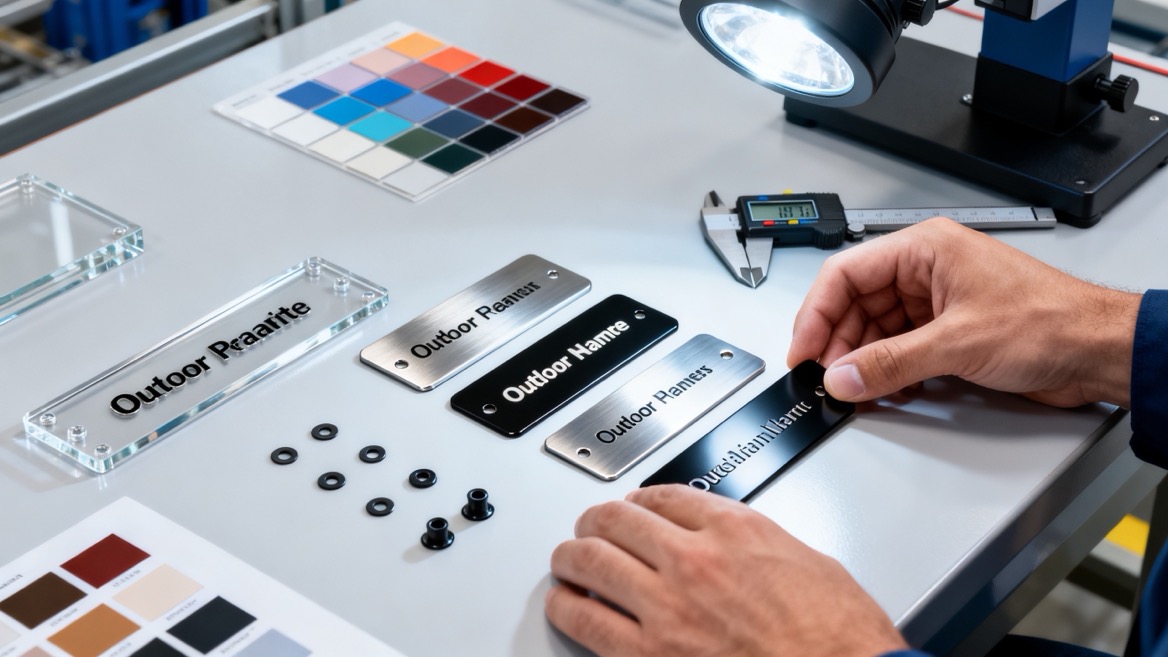
For demanding projects, request material samples, adhesion testing, salt-spray testing, UV-weathering information, or application-specific validation.
Final Verdict: Acrylic or Aluminum for Outdoor Nameplates?
For decorative outdoor branding, acrylic nameplates offer visual depth, clarity, gloss, and a premium display effect. They are particularly suitable for brand logos, retail signs, product badges, and applications with moderate weather exposure and limited physical abuse.
For durable outdoor identification, aluminum nameplates are the stronger long-term option. They provide better resistance to impact, heat, vibration, abrasion, and harsh environments. Anodized or photo-anodized aluminum is especially suitable for machinery, electrical equipment, outdoor assets, marine products, and applications where label failure is not acceptable.
At Shenzhen XingKun Packing Products Co., Ltd., we help buyers move beyond a simple material choice. We evaluate the visual target, exposure conditions, mounting method, graphic complexity, and expected service life before recommending an acrylic or aluminum nameplate solution.
Need outdoor nameplates that match your product, climate, and brand requirements? Contact Shenzhen XingKun Packing Products Co., Ltd. with your artwork, dimensions, quantity, mounting method, and use environment for a tailored material and finishing recommendation.
FAQ
1. Are acrylic nameplates suitable for outdoor use?
Yes. Quality outdoor-grade acrylic nameplates can perform well in sunlight and rain, especially for decorative signs and brand badges. However, acrylic should be properly specified for UV exposure, thickness, print protection, and mounting conditions. It is less suitable than aluminum for high-impact, high-heat, high-vibration, or chemically aggressive environments.
2. Which outdoor nameplate material has better UV resistance?
Both can provide good UV performance when properly specified. Acrylic has natural UV stability, particularly in high-quality PMMA grades. Aluminum does not yellow like plastic, but its outdoor appearance depends on the durability of the print, coating, anodizing, or marking method. For very long-term outdoor identification, anodized or photo-anodized aluminum is generally the safer option.
3. Will aluminum nameplates rust outdoors?
Aluminum does not rust in the way steel does, but it can corrode under certain conditions. Coastal salt exposure, standing moisture, damaged coatings, and contact with incompatible metals can create corrosion risks. Anodizing, proper sealing, compatible fasteners, and electrical isolation help improve outdoor durability.
4. Is acrylic or aluminum better for machine nameplates?
Aluminum is usually better for machine nameplates. It offers greater resistance to abrasion, impact, vibration, heat, oils, and industrial cleaning. For equipment that requires permanent serial numbers, warning labels, or compliance information, anodized or photo-anodized aluminum is often preferred.
5. Can acrylic nameplates crack outside?
Yes. Acrylic can crack if it is hit, bent, drilled incorrectly, mounted under stress, or tightened too firmly with screws. Temperature expansion and contraction can also create stress if the plate is rigidly fixed without adequate allowance for movement.
6. What is the best aluminum finish for harsh outdoor conditions?
For many harsh outdoor uses, anodized aluminum is a strong choice because the protective oxide layer is integrated into the aluminum surface. For extreme durability and permanent black identification graphics, photo-anodized aluminum is commonly used for long-life industrial, aerospace, military, marine, and equipment-identification applications.
7. Can outdoor nameplates use adhesive instead of screws?
Yes, but the adhesive must match the plate material, substrate, surface texture, temperature range, and exposure level. Adhesive mounting is effective for many acrylic and aluminum nameplates, but high-vibration, high-load, rough-surface, or critical outdoor applications may require screws, rivets, or another mechanical fastening method.
References
1. National Research Council Canada. "[Weatherability of Acrylic-Based Plastics in Long-Term Outdoor Exposure]."
2. Formerra. "[Acrylic (PMMA) Plastic & Resin Distributor]."
3. Fenestration and Glazing Industry Alliance / AAMA discussion via Apogee Architectural Metals. "[Anodize Finishes Enhance Natural Metallic Look with Industry-Leading Performance, Durability, Sustainability]."
4. Linetec. "[Anodize AAMA Specifications]."
5. Metalphoto of Cincinnati. "[Custom Aluminum Nameplates: Durable Metalphoto]."
6. Aluma Photo-Plate Co. "[Metal Name Plate & Control Panel Plates]."
7. Alumeco. "[Aluminium Corrosion]."
8. PW Marine OEM. "[Galvanic Corrosion Between Stainless and Aluminum]."


