Content Menu
● What Are Kraft Paper Labels?
● Why Custom Kraft Paper Labels Work for Brands
>> Natural Visual Positioning
>> Flexible Customization Options
>> Practical Space for Product Information
● Where Kraft Paper Labels Perform Best
● When Kraft Paper Labels Are Not the Best Choice
● How to Choose the Right Kraft Label Material
>> 1. Identify the Packaging Surface
>> 2. Define the Temperature and Moisture Conditions
>> 3. Select the Adhesive Type
>> 4. Choose the Printing and Finishing Method
>> Expert Design Tip: Build for the Kraft Base Color
● Custom Kraft Paper Label Sizes and Shapes
>> Common Label Formats
>> A Simple Sizing Process
● Sustainable Claims: What Brands Must Verify
>> Avoid Vague Environmental Language
>> Better Sustainability Claim Examples
● A Practical Pre-Production Checklist
>> Product Details
>> Artwork Details
>> Production Details
● How XingKun Supports OEM and ODM Kraft Label Projects
● Conclusion
● FAQ About Kraft Paper Labels
>> 1. Are kraft paper labels waterproof?
>> 2. Can custom kraft labels be printed in full color?
>> 3. What products are kraft paper labels best for?
>> 4. Can kraft paper labels be recycled?
>> 5. Can I use kraft labels on glass jars and bottles?
>> 6. What is the minimum order quantity for custom kraft paper labels?
>> 7. Can kraft paper labels include white printing?
>> 8. What artwork format should I send for custom kraft label printing?
● References
Kraft paper labels are a strong choice for brands that want packaging to feel natural, tactile, handcrafted, and credible—without relying on generic "eco-friendly" messaging. For food, candles, cosmetics, soaps, coffee, apparel, retail boxes, jars, and shipping cartons, custom kraft paper labels can turn plain packaging into a recognizable branded experience.
At Shenzhen XingKun Packing Products Co., Ltd. (XingKun), we work with overseas brands, wholesalers, and manufacturers on OEM and ODM printing projects. In practice, successful custom kraft labels are not selected by color alone. Buyers need to assess the actual paper stock, print design, adhesive, product surface, storage temperature, moisture exposure, packing method, and sustainability claim before production starts.
This guide explains how to choose, design, print, and source custom kraft paper labels for packaging that looks premium, performs reliably, and supports your brand story.
What Are Kraft Paper Labels?
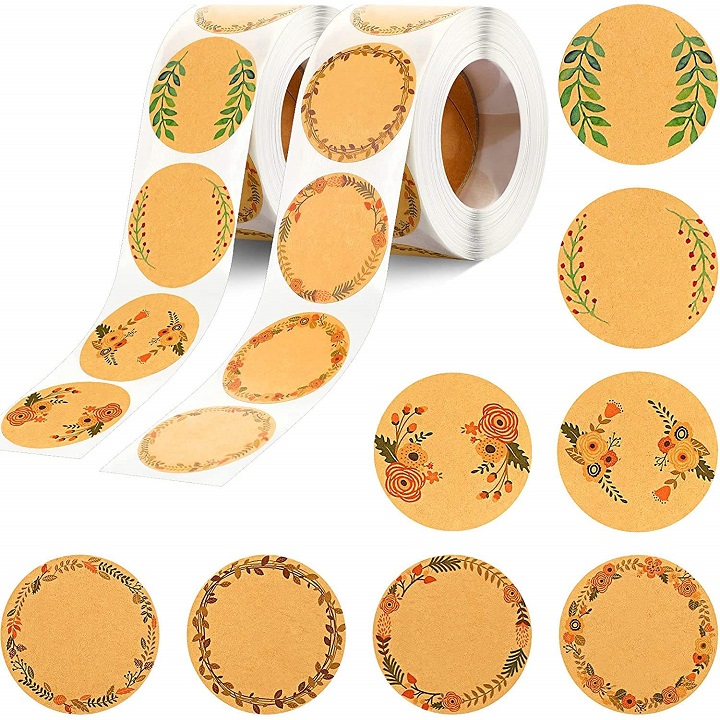
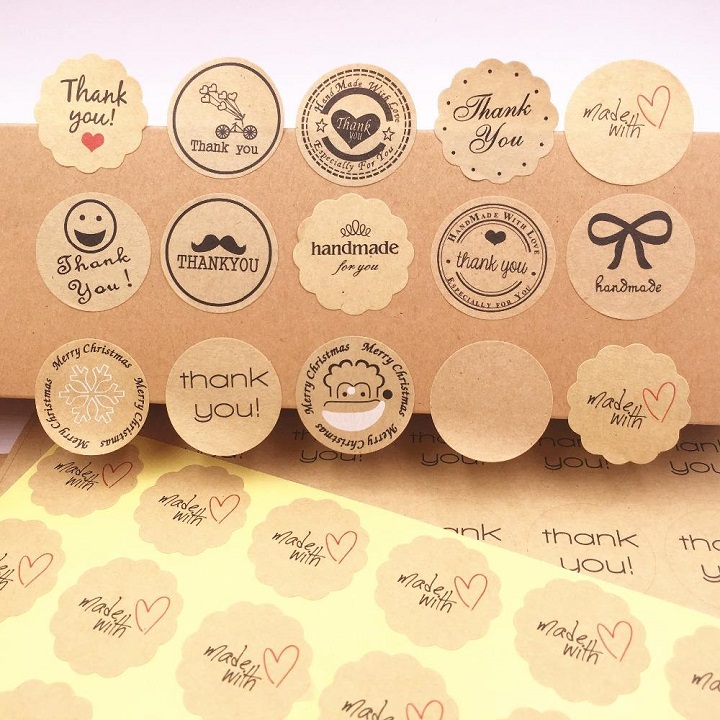
Kraft paper labels are self-adhesive labels or stickers made with brown, uncoated paper stock. Their recognizable warm-brown tone, visible fibers, and slightly textured surface create a rustic, organic, natural, or handmade look.
Unlike glossy white labels, kraft label paper is not a neutral white printing surface. The brown substrate becomes part of the design. This makes it especially effective for minimalist logos, black artwork, dark-green graphics, white ink highlights, stamped-looking typography, and earthy color palettes.
Common names include:
- Kraft paper labels
- Custom kraft labels
- Brown kraft stickers
- Kraft paper stickers
- Kraft product labels
- Kraft roll labels
- Eco-look packaging labels
- Natural paper labels
Kraft paper is traditionally associated with strength because the kraft pulping process produces relatively long, robust fibers. In label applications, however, the final performance depends on the whole construction—not just the face paper. A label consists of the printed paper face stock, adhesive layer, release liner, inks, varnish or lamination, and sometimes specialty coatings.
For this reason, a "kraft label" is not automatically waterproof, recyclable, compostable, food-safe, or suitable for refrigeration. Those requirements must be confirmed for the exact material combination.
Why Custom Kraft Paper Labels Work for Brands
The value of custom kraft paper labels goes beyond visual style. They help brands communicate a product position quickly—often before a buyer reads the details on the pack.
Natural Visual Positioning
Kraft labels work especially well when a brand wants to signal:
- Handmade production
- Small-batch or artisan quality
- Farm-to-table, organic, or natural positioning
- Rustic, vintage, heritage, or craft aesthetics
- Refillable or low-waste packaging concepts
- Minimalist packaging
- Premium products with a tactile identity
For example, a black one-color logo on a natural kraft label applied to an amber glass candle jar can create a more coherent visual story than a full-gloss label with heavy gradients. The label, jar, typography, and packaging box should communicate the same level of quality.
Flexible Customization Options
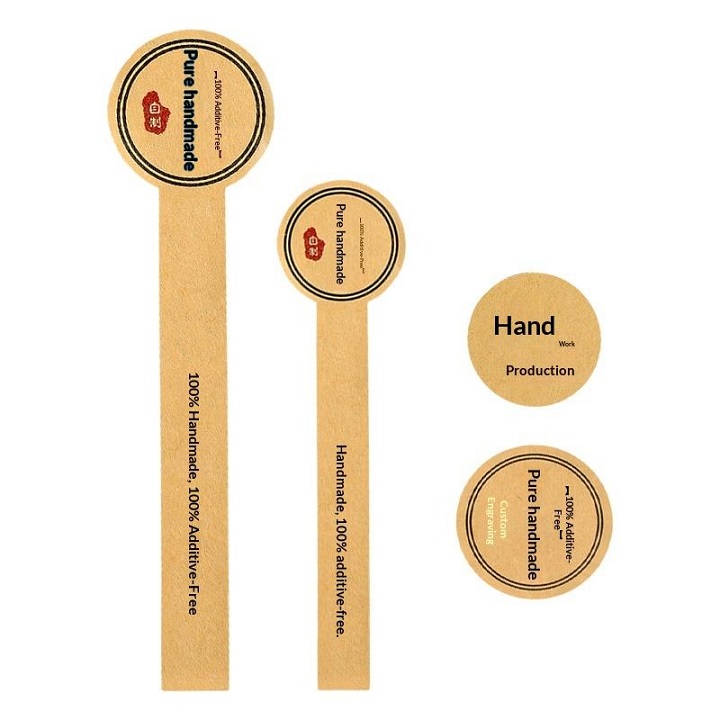
Custom kraft paper labels can be produced in many formats, including:
- Roll labels for manual or machine application
- Sheet labels for smaller runs and hand application
- Die-cut labels in custom shapes
- Round labels for jars, lids, candles, and bottles
- Rectangle labels for boxes, pouches, and cartons
- Oval labels for food jars and cosmetic containers
- Seal labels for tissue paper, mailer boxes, and gift packaging
- Hang tags or non-adhesive kraft labels for apparel and accessories
At XingKun, an OEM label project can also be coordinated with other printed packaging components, such as custom packaging boxes, stickers, printed books, playing cards, jigsaw puzzles, inserts, folders, and branded paper bags. This helps a brand keep color, logo usage, finishing, and packaging quality more consistent across its product range.
Practical Space for Product Information
A kraft paper label can carry much more than a logo. Depending on the format and regulatory needs, it may include:
- Brand name and logo
- Product name
- Ingredients or materials
- Net weight or volume
- Barcode or QR code
- Batch number, lot code, or expiration information
- Directions for use
- Warning statements
- Country-of-origin information
- Recycling or disposal instructions
- Contact details and website
- Social-media handles
For labels used in regulated categories—including foods, cosmetics, supplements, chemicals, and pharmaceutical-related products—visual style must never reduce required information, readability, or compliance. In the United States, FDA labeling rules include requirements around mandatory label information for food, and drug manufacturers must have written controls to ensure correct labels and packaging materials are used. [ecfr]
Where Kraft Paper Labels Perform Best
Kraft labels are most effective in dry, indoor, low-abrasion applications. They are often used successfully for retail packaging, but they should not be treated as a universal replacement for synthetic labels.
| Application | Why Kraft Labels Fit | Key Requirement |
| Candle jars | Creates a handmade or premium-apothecary look | Test adhesion on glass and curved surfaces |
| Soap packaging | Supports artisan and natural-product positioning | Protect against direct water contact |
| Coffee bags | Works well with matte pouches and earthy branding | Select adhesive for the pouch film |
| Honey, jam, spice jars | Gives small-batch food products a warm identity | Confirm label size and container curvature |
| Cosmetics and skincare | Fits botanical and clean-beauty concepts | Consider oils, bathroom humidity, and rub resistance |
| Gift boxes and mailers | Great for seals, logo stickers, and seasonal campaigns | Choose a reliable permanent adhesive |
| Apparel and accessories | Useful as tags, seals, or carton labels | Consider scuffing during shipping |
| Stationery and craft products | Matches handmade paper, notebooks, and art goods | Use legible contrast for small text |
| Retail cartons | Adds branding without printing every carton | Confirm bond strength on coated/uncoated board |
A common market example is natural kraft label stock with permanent acrylic adhesive for dry, indoor products such as candles, soaps, food packaging, and artisan goods. Some suppliers explicitly state that these constructions are not water-resistant and should avoid prolonged exposure to direct sunlight or wet environments. [stickergiant]
When Kraft Paper Labels Are Not the Best Choice
A supplier should be transparent about limitations. Natural kraft paper labels may not be appropriate when labels must survive:
- Refrigeration or condensation
- Freezing and thawing cycles
- Outdoor weather exposure
- Direct water contact
- Dishwasher use
- Heavy oil contamination
- Repeated rubbing or abrasion
- High humidity during storage or transport
- Strong chemical contact
- Long-term UV exposure
For these uses, a brand may need a water-resistant paper label, a coated label construction, or a synthetic film label such as BOPP, PP, PET, or vinyl-equivalent material depending on the product and market requirements.
The key lesson is simple: choose the label according to the product environment, not only the packaging style.
How to Choose the Right Kraft Label Material
Before requesting a quotation, define the label's working conditions. This reduces sampling delays, prevents unsuitable material selections, and protects the final customer experience.
1. Identify the Packaging Surface
The same adhesive can perform differently on different packaging materials.
Typical surfaces include:
- Glass jars and bottles
- Aluminum tins
- Plastic bottles and pouches
- PE, PP, PET, or laminated flexible packaging
- Coated paperboard boxes
- Uncoated corrugated cartons
- Kraft paper bags
- Fabric packaging
- Wood, bamboo, or other textured materials
A surface that looks smooth may still have low surface energy, oil residue, coatings, dust, or texture that affects adhesion. For example, labels may bond differently to a glossy laminated pouch than to an uncoated carton.
2. Define the Temperature and Moisture Conditions
Ask these questions before selecting stock and adhesive:
1. Will the label be applied at room temperature, chilled temperature, or a production-line temperature?
2. Will the finished product enter refrigeration, freezing, or humid storage?
3. Will condensation form on the container?
4. Will consumers use the product in kitchens, bathrooms, or outdoor settings?
5. Does the product contain oil, alcohol, wax, or other materials that may contact the label?
A natural paper face stock can absorb moisture and may wrinkle, soften, stain, or lose visual quality in wet conditions. If a kraft look is essential, request an application-specific construction and test it under real use conditions.
3. Select the Adhesive Type
The adhesive is as important as the kraft paper itself.
| Adhesive Type | Typical Use | Buyer Consideration |
| Permanent adhesive | Standard product labels, cartons, jars, retail packs | Designed to remain attached; confirm surface compatibility |
| Removable adhesive | Promotions, temporary labels, reusable containers | Must be tested for clean removal and residue |
| Freezer-grade adhesive | Chilled or frozen products | Requires material-specific testing at actual temperatures |
| High-tack adhesive | Rough, curved, or challenging surfaces | May be useful for textured cartons and some low-energy surfaces |
| Repositionable adhesive | Alignment-sensitive hand application | Usually has different long-term holding performance |
Do not assume that "permanent" means it will adhere to every material in every condition. Adhesive performance varies by surface, temperature, dwell time, label size, pressure during application, and contamination.
4. Choose the Printing and Finishing Method
Kraft label printing should account for the brown base color. Full-color artwork may look darker, warmer, or less vibrant than it does on a white monitor background.
Common production options include:
- One-color black printing for a clean, classic look
- Spot-color printing for consistent brand colors
- White ink underprint to improve the visibility of selected colors
- White ink as a design color for strong contrast on brown stock
- CMYK printing for artwork with multiple colors
- Matte varnish for light scuff resistance
- Gloss varnish for more visual contrast
- Foil stamping for premium accents
- Embossing or debossing for tactile branding
- Die-cutting for custom label shapes
Expert Design Tip: Build for the Kraft Base Color
Designers often create artwork on a white screen canvas and forget that kraft paper is brown. This can cause a mismatch between proof expectations and finished labels.
For better results:
- Use darker colors for body text
- Reserve small light details for white ink or a white underprint
- Avoid relying on pale yellow, light gray, or pastel colors for tiny text
- Test barcode readability after printing
- Use high contrast for legal information, ingredients, and instructions
- Request a physical proof for complex color designs
A kraft label is not a white label with a brown background. It is a different print surface with its own visual logic.
Custom Kraft Paper Label Sizes and Shapes
The best label size is determined by the package geometry and content hierarchy.
Common Label Formats
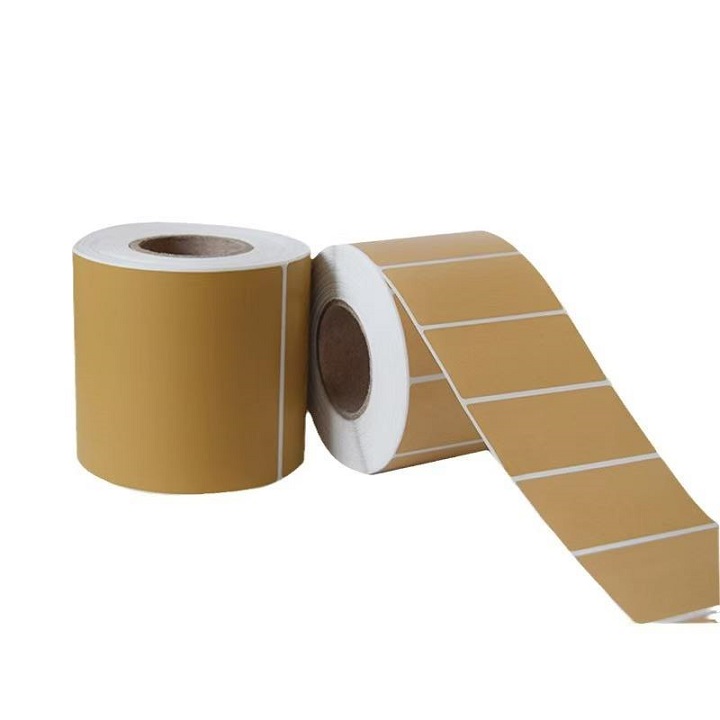
- Round labels: Candle lids, jar lids, seals, cosmetics, small containers
- Rectangle labels: Boxes, bottles, pouches, food packaging, shipping cartons
- Square labels: Gift seals, product stickers, mailer branding
- Oval labels: Jars, honey containers, bath products, vintage-style packaging
- Custom contour die-cuts: Logos, mascots, special product shapes, promotional labels
- Wrap-around labels: Cylindrical bottles, tubes, jars, and cans
A Simple Sizing Process
1. Measure the usable label area of the container or box.
2. Leave a safety margin from edges, seams, curves, folds, and handles.
3. List mandatory information before designing decorative artwork.
4. Choose a shape that follows the packaging rather than fighting it.
5. Print and apply a prototype before mass production.
6. Check label alignment, wrinkle risk, barcode scanning, and text readability.
For curved jars or bottles, a label that is too tall or too wide can wrinkle or lift near the edges. A smaller front label plus a separate back information label is often a more practical solution.
Sustainable Claims: What Brands Must Verify
Kraft paper has a natural appearance, but natural-looking packaging is not automatically sustainable packaging. Responsible environmental marketing requires evidence for the exact label construction.
A self-adhesive label includes more than paper:
- Face stock
- Adhesive
- Silicone-coated release liner
- Printing inks
- Varnish, foil, or laminate
- Packaging and shipping materials
For example, a label face stock may contain recycled fiber while its release liner is not accepted in normal curbside recycling streams. One supplier of 100% post-consumer recycled kraft shipping labels specifically notes that its silicone-coated virgin paper liner is not curbside recyclable, while describing the adhesive as recycle-compatible. [ecoenclose]
Avoid Vague Environmental Language
Do not make broad claims such as:
- "100% eco-friendly"
- "Zero-waste label"
- "Fully recyclable"
- "Biodegradable"
- "Compostable"
unless the complete claim can be documented and applies to the actual product configuration.
The U.S. Federal Trade Commission's Green Guides state that marketers should not represent a product or package as recyclable unless it can be collected, separated, or recovered through an established recycling program. The FTC also advises qualifying recyclable claims when suitable facilities are unavailable to at least 60% of consumers or communities where the product is sold. [ftc]
Better Sustainability Claim Examples
Use specific, supportable claims instead:
- "Label face paper contains X% recycled content."
- "Paper sourced through an FSC-certified supply chain."
- "Please check local recycling guidance before disposal."
- "Natural uncoated paper label."
- "Plastic-free paper face stock."
- "Made with FSC-certified paper materials," only when supported by valid supply-chain documentation and approved trademark use.
FSC chain-of-custody certification is relevant because it tracks forest-based materials through the supply chain and allows eligible organizations to use FSC claims and labels on finished products. FSC describes separate FSC 100%, FSC Recycled, and FSC Mix label categories, each with specific material requirements. [fsc]
A Practical Pre-Production Checklist
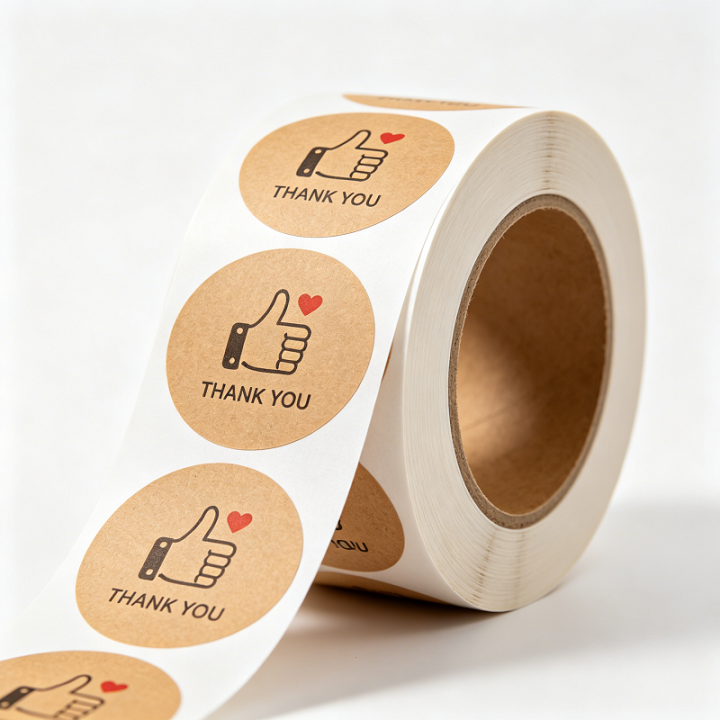
Before approving a custom kraft paper label order, provide your manufacturer with the information below.
Product Details
- Product category and end use
- Packaging material and surface finish
- Container size, diameter, and usable labeling area
- Whether labels will be hand-applied or machine-applied
- Storage and shipping conditions
- Refrigeration, freezer, moisture, oil, or chemical exposure
- Expected shelf life
Artwork Details
- Vector logo files, preferably AI, PDF, EPS, or SVG
- Finished label size and shape
- Bleed, safe area, and die-cut line
- Pantone colors, if color consistency is critical
- White ink requirements
- Barcode and QR code specifications
- Required regulatory text
Production Details
- Order quantity
- Roll direction and core size, if machine-applied
- Label gap and unwind direction
- Required finishing, such as varnish, foil, embossing, or lamination
- Packaging requirements
- Destination country and shipping preference
This level of preparation helps a factory quote accurately and recommend the most suitable label construction rather than simply offering the lowest-cost material.
How XingKun Supports OEM and ODM Kraft Label Projects
For B2B buyers, label sourcing is not just an art-file transaction. It is a packaging-engineering and brand-consistency decision.
XingKun can support buyers with an OEM and ODM workflow that focuses on practical requirements:
1. Requirement review — Confirm application, label size, packaging surface, design, quantity, and special performance needs.
2. Material recommendation — Match kraft paper stock, adhesive, liner, and finishing to the product environment.
3. Artwork preflight — Review bleed, die-cut lines, text size, barcode area, color usage, and white-ink requirements.
4. Proofing and sampling — Validate appearance, adhesion, readability, and fit before larger-scale production.
5. Mass production — Produce custom labels based on approved specifications.
6. Quality inspection and packing — Check critical features such as dimensions, print quality, die-cut accuracy, roll condition, and packaging.
7. Coordinated packaging supply — Where useful, align labels with custom boxes, inserts, stickers, paper bags, and other printed packaging components.
For a private-label candle brand, for instance, XingKun can help coordinate kraft jar labels, branded box seals, insert cards, outer shipping cartons, and retail packaging boxes so that the full unboxing experience uses consistent typography, colors, and finishing.
Conclusion
Kraft paper labels can make packaging feel more authentic, premium, and brand-specific—but only when their material and adhesive are matched to real product conditions. The best results come from balancing visual style with practical performance: select the right surface-compatible adhesive, design for the brown kraft base, protect important text with high contrast, test labels on the actual package, and make sustainability claims only when they are precise and documented.
For brands, wholesalers, and manufacturers, the goal is not simply to buy brown stickers. It is to create custom kraft labels that apply cleanly, stay attached, communicate clearly, and reinforce the value of the product inside.
Need custom kraft paper labels for boxes, jars, pouches, or retail products? Contact XingKun with your artwork, label size, package material, intended application environment, and order quantity to receive a tailored OEM/ODM recommendation and quotation.
FAQ About Kraft Paper Labels
1. Are kraft paper labels waterproof?
Usually, standard kraft paper labels are not waterproof. Natural paper can absorb moisture, wrinkle, stain, or weaken when exposed to water and humidity. If your product is used in a bathroom, refrigerator, freezer, outdoor area, or wet environment, request a water-resistant material or test a specially coated kraft-label construction before mass production. [stickergiant]
2. Can custom kraft labels be printed in full color?
Yes. Kraft paper labels can be printed in full color, but colors will appear differently because the substrate is brown rather than white. Dark colors generally print better. For vivid colors or fine light-colored elements, use white ink or a white underprint beneath selected areas.
3. What products are kraft paper labels best for?
They are especially suitable for dry, indoor products such as candles, soaps, coffee bags, gift boxes, bakery packaging, spice jars, honey jars, handmade cosmetics, stationery, and retail cartons. They are less suitable for wet, frozen, heavily oiled, or long-term outdoor applications unless a tested specialty construction is used.
4. Can kraft paper labels be recycled?
It depends on the complete label system, including the face paper, adhesive, liner, ink, and the recycling infrastructure in the destination market. Do not claim that a label is recyclable solely because it looks like paper. The FTC recommends that recyclable claims be substantiated and clearly qualified when appropriate recycling facilities are not widely available. [ftc]
5. Can I use kraft labels on glass jars and bottles?
Yes, provided the adhesive is suitable for glass and the packaging remains dry enough for the paper stock. For curved jars and bottles, test the label size and shape first to avoid wrinkling, edge lifting, or poor alignment. A front label and separate back label may work better than one large wrap-around label.
6. What is the minimum order quantity for custom kraft paper labels?
Minimum order quantity depends on label size, shape, material, printing method, finishing requirements, and whether labels are supplied on sheets or rolls. Share your specifications with XingKun so the team can recommend the most economical production option for your order volume.
7. Can kraft paper labels include white printing?
Yes. White ink can be printed directly on kraft paper to create contrast, highlight logos, or improve readability. White underprint can also be used under selected color graphics where a brighter result is needed.
8. What artwork format should I send for custom kraft label printing?
Vector artwork is preferred, such as AI, PDF, EPS, or SVG. Please include the final size, die-cut line, bleed area, text, barcode, QR code, and any Pantone color references. High-resolution raster files may be usable for some designs, but vector files generally produce sharper print results.
References
1. Federal Trade Commission. "[Environmental Claims: Summary of the Green Guides]." Guidance on substantiating recyclable and recycled-content claims, including the need to qualify recycling claims where appropriate. [ftc]
2. Federal Trade Commission. "[Guides for the Use of Environmental Marketing Claims (Green Guides)]." Detailed FTC guidance on environmental claims, recycled content, recyclability, qualifications, and avoidance of deceptive marketing. [ftc]
3. Forest Stewardship Council. "[Chain of Custody Certification]." Explanation of FSC chain-of-custody certification and its role in enabling eligible use of FSC labels on finished products. [fsc]
4. Forest Stewardship Council. "[FSC Claim, Labels, and Logo]." Explanation of FSC 100%, FSC Recycled, and FSC Mix claims and related material-status requirements. [my.fsc]
5. U.S. Food and Drug Administration. "[21 CFR Part 1, Subpart B—General Labeling Requirements]." Regulatory reference for mandatory food-label information in the United States. [ecfr]
6. U.S. Food and Drug Administration. "[21 CFR Part 211, Subpart G—Packaging and Labeling Control]." Regulatory reference for procedures ensuring correct labels and packaging materials for drug products. [ecfr]
7. StickerGiant. "[Custom Kraft Paper Labels]." Example material specifications illustrating common kraft-label characteristics and dry, indoor-use limitations. [stickergiant]
8. EcoEnclose. "[100% Recycled Kraft Shipping Label]." Example disclosure showing why the paper face stock, adhesive, and release liner should be evaluated separately in sustainability claims. [ecoenclose]


