Content Menu
● What Does Luxury Packaging Mean?
● Why Luxury Packaging Matters for Brands
>> Luxury Packaging vs. Standard Packaging
● The Core Elements of Premium Packaging Design
>> High-Quality Structural Materials
>> Precision Printing and Color Control
>> Finishes That Add Sensory Value
● Luxury Packaging Box Styles and Uses
>> Rigid Setup Boxes
>> Magnetic Closure Boxes
>> Drawer Boxes
>> Shoulder and Neck Boxes
● How to Design Luxury Packaging Step by Step
>> 1. Define the Product and Customer Experience
>> 2. Select the Right Box Structure
>> 3. Build the Unboxing Sequence
>> 4. Prototype Before Mass Production
>> 5. Set Clear Quality Standards
● Sustainable Luxury Packaging Without Losing Premium Appeal
● Common Luxury Packaging Mistakes to Avoid
● Work With an Experienced Luxury Packaging Manufacturer
● FAQs About Luxury Packaging
>> What is luxury packaging?
>> Which products benefit most from luxury packaging?
>> What is the most popular luxury packaging box style?
>> Are rigid boxes better than folding cartons?
>> Which finishes make a package look luxurious?
>> Can luxury packaging be more sustainable?
>> How long does custom luxury packaging production take?
● References
Luxury packaging is more than an attractive box. It is a carefully engineered brand experience that protects a product, communicates its value, and makes the customer feel that what is inside deserves attention.
For premium cosmetics, jewelry, fragrances, wine, electronics, gifts, and high-end retail products, the package is often the first physical touchpoint a customer has with a brand. Its weight, texture, opening sequence, print quality, and finishing details can shape expectations before the product is even seen.
At Shenzhen XingKun Packing Products Co., Ltd., we have spent more than 20 years producing custom packaging boxes and printed products for brands and distributors across more than 30 countries and regions. From our production experience, the best luxury packaging is not created by adding every possible decoration. It is created by making the structure, material, finish, protection, and brand story work together.
What Does Luxury Packaging Mean?
Luxury packaging refers to premium product packaging designed to create a strong impression of quality, exclusivity, craftsmanship, and brand identity. It usually combines durable materials, precise construction, high-definition printing, refined finishes, and a deliberate unboxing experience.
A standard package may primarily focus on holding, protecting, and transporting a product. A luxury package must do those things while also making the product feel more desirable and gift-worthy.
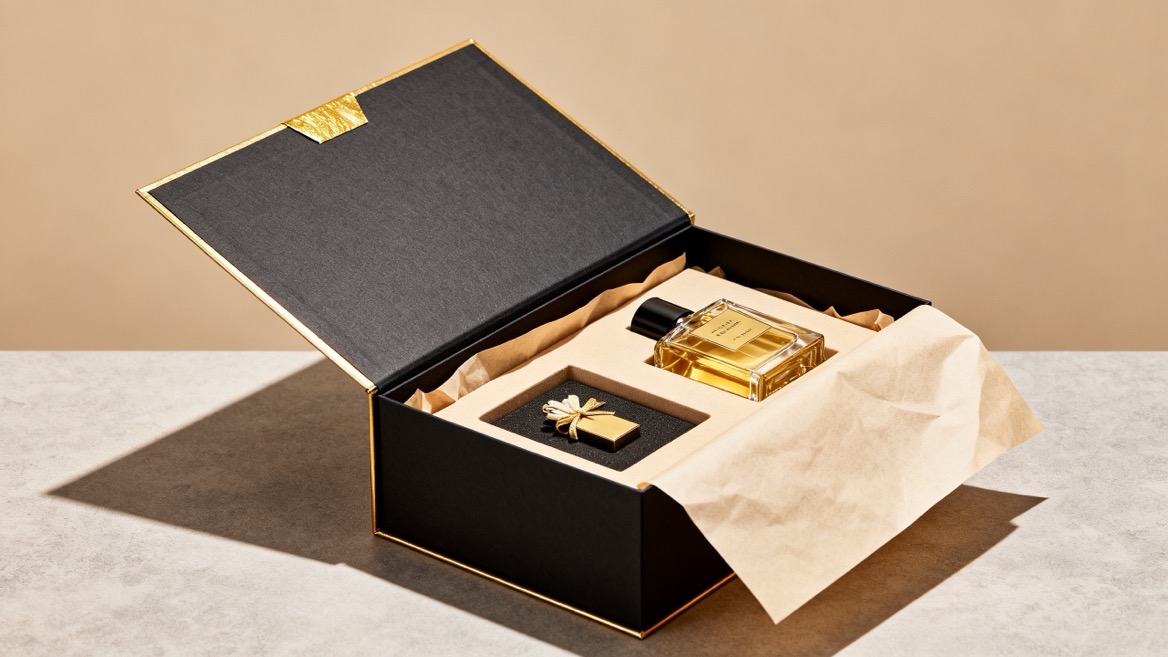
For example, a fragrance bottle can be packed in a simple folding carton. However, when it is presented in a rigid setup box with soft-touch paper, a carefully aligned foil-stamped logo, a fitted insert, and a smooth magnetic closure, the package becomes part of the product experience.
Luxury does not always mean excessive. In many successful premium designs, restraint is the key. A clean uncoated specialty paper, subtle blind embossing, precise edges, and a well-designed insert may feel more refined than a box covered in several competing effects.
Why Luxury Packaging Matters for Brands
Luxury packaging helps a brand justify its positioning through a tangible experience. Customers cannot always evaluate product quality before purchase, especially online. Packaging provides visual and physical signals that influence expectations.
A premium box can help a brand achieve several important commercial goals:
- Improve product presentation at retail, in gift settings, and during delivery
- Support a higher perceived value for premium product lines
- Create a memorable unboxing moment that customers may share online
- Protect delicate, high-value, or irregularly shaped products
- Strengthen brand recognition through consistent colors, materials, and finishing
- Improve gifting appeal for seasonal launches, corporate gifts, and special editions
- Encourage customers to retain, reuse, or display the packaging
Emotional connection has become particularly important in luxury purchasing. Recent industry research indicates that emotional connection is now a leading driver of luxury-brand desirability in both the United States and China, ahead of several traditional luxury signals. Packaging is one of the most immediate ways to translate that emotional promise into a physical interaction.
Luxury Packaging vs. Standard Packaging
| Feature |
Luxury Packaging |
Standard Packaging |
| Primary purpose |
Protects the product while creating a premium brand experience |
Protects, stores, and transports the product efficiently |
| Typical materials |
Rigid greyboard, specialty paper, textured paper, fabric, wood, metal, premium inserts |
Folding carton, corrugated board, standard paperboard, basic plastic |
| Structural design |
Custom openings, layered reveals, magnetic closures, drawer boxes, shoulder-neck boxes |
Conventional tuck-end cartons, mailers, and shipping cases |
| Finishing |
Foil stamping, embossing, debossing, soft-touch lamination, spot UV, edge painting |
Standard printing, basic lamination, limited decoration |
| Customer impression |
Exclusive, giftable, memorable, collectible |
Practical, functional, economical |
| Production priority |
Consistency, tactile quality, visual precision, presentation |
Efficiency, material optimization, transport performance |
The goal is not to make every item expensive. The goal is to make each design decision feel intentional.
The Core Elements of Premium Packaging Design
A strong luxury box begins with a clear understanding of the product, customer, sales channel, and target price point. Once these are defined, the design can be developed around the following elements.
High-Quality Structural Materials
Material selection determines both the appearance and the physical performance of a package.
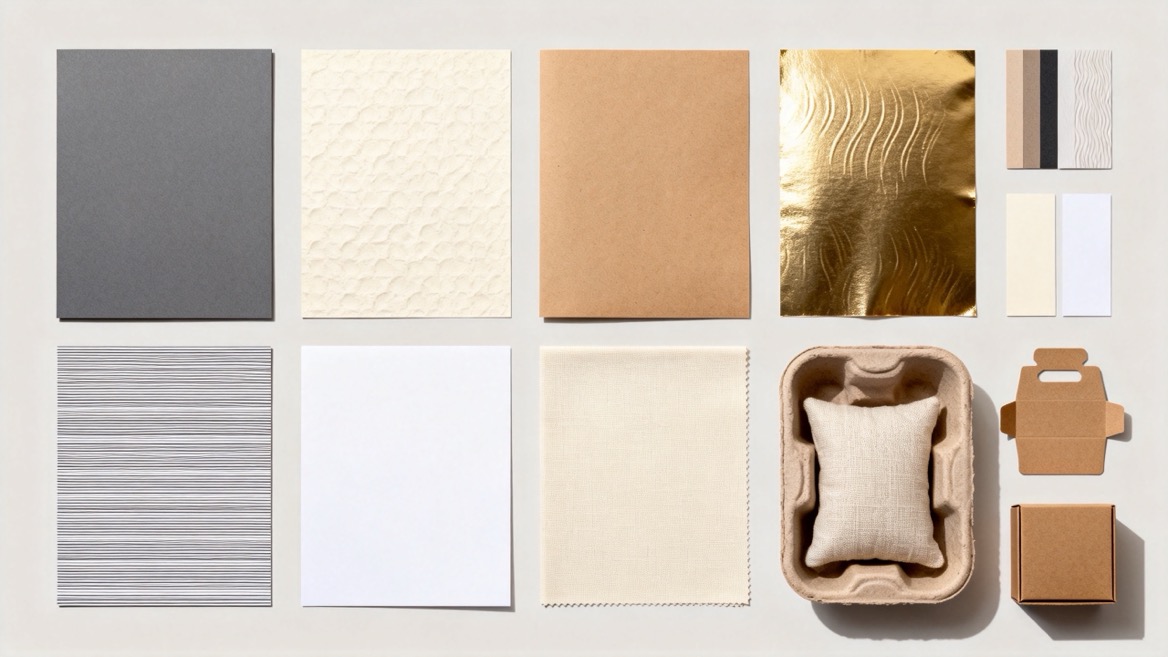
For rigid boxes, manufacturers commonly use thick greyboard or chipboard as the structural base. It is then wrapped with printed art paper, specialty paper, textured paper, fabric, or another decorative material. The board thickness should match the product weight and the desired level of sturdiness.
Popular luxury packaging materials include:
- Rigid greyboard for setup boxes, magnetic boxes, and drawer boxes
- Coated art paper for vivid color printing and detailed imagery
- Uncoated specialty paper for a natural, understated, tactile finish
- Textured paper for visual depth without heavy graphics
- Velvet, suede, satin, or microfiber for jewelry and gift-box interiors
- EVA foam, molded pulp, paperboard, or cardboard inserts for product positioning
- Recycled paper and responsibly sourced paperboard for brands seeking a lower-impact material direction
The material must support the intended finish. For instance, a deep emboss may look excellent on a heavier uncoated sheet, while highly detailed photographic artwork may require a smoother coated surface.
Precision Printing and Color Control
Luxury packaging often depends on color consistency. A small shift in a signature color can make a package feel less professional, especially when boxes, gift bags, tissue paper, labels, and inserts are displayed together.
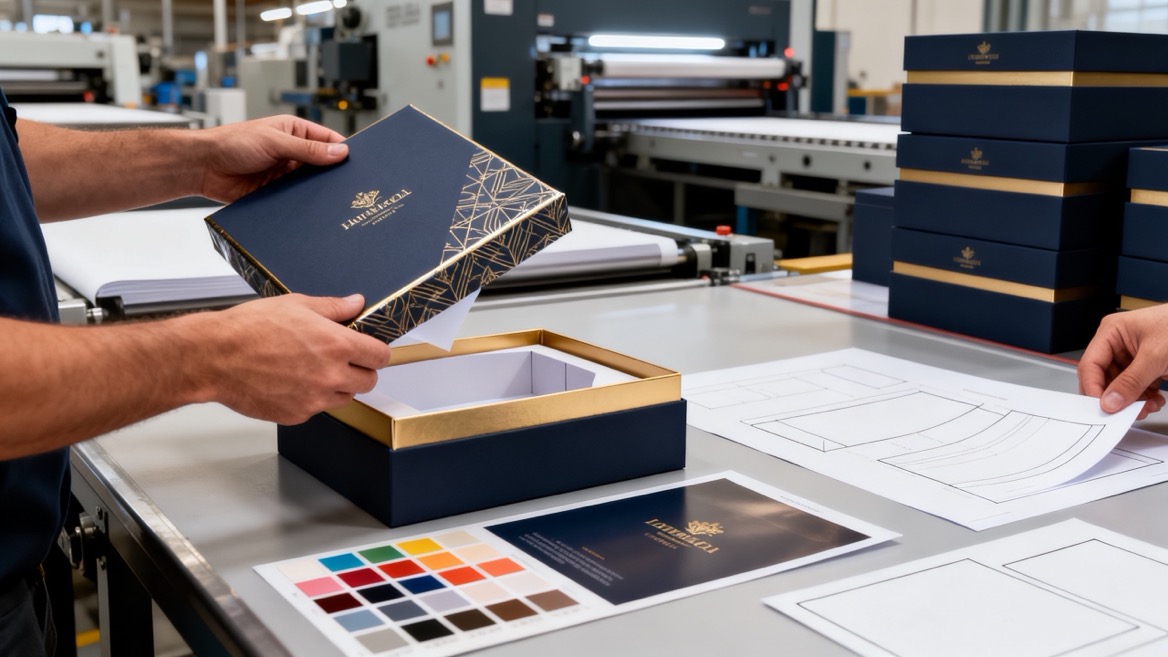
Before production, brands should provide the correct artwork files, color specifications, and finishing instructions. Pantone references can be helpful for spot colors, while CMYK artwork is common for full-color imagery.
For a premium result, check:
1. Logo size, placement, and clear space
2. Text readability after finishing
3. Barcode position and scan performance
4. Color consistency across packaging components
5. Alignment between print, foil, embossing, and die-cut windows
6. Artwork accuracy after the final dieline is confirmed
A physical pre-production sample is especially valuable for complex boxes, metallic effects, unusual substrates, or high-value launches.
Finishes That Add Sensory Value
Finishing turns a printed package into a tactile object. It should reinforce the brand personality rather than distract from it.
| Finish |
Best Use |
Customer Effect |
| Hot foil stamping |
Logos, borders, patterns, short messages |
Metallic contrast and visual prestige |
| Embossing |
Logos, monograms, decorative textures |
Raised tactile detail |
| Debossing |
Minimalist marks and premium paper surfaces |
Quiet, refined depth |
| Spot UV |
Selected text, patterns, or graphic details |
Gloss contrast on matte surfaces |
| Soft-touch lamination |
Cosmetics, technology, gift packaging |
Smooth, velvety hand feel |
| Matte lamination |
Elegant, modern branding |
Low-glare, sophisticated appearance |
| Textured wrapping paper |
Heritage, artisanal, natural brands |
Material richness without over-printing |
| Edge painting |
Premium rigid boxes and presentation cases |
A polished finishing detail |
A useful design rule is to choose one dominant visual element and one or two supporting details. For example, a matte-black rigid box with a blind-embossed logo and copper foil accent can look more premium than a package that uses foil, spot UV, embossing, ribbons, windows, and multiple colors at once.
Luxury Packaging Box Styles and Uses
Different products require different box structures. The opening method should suit the product's value, fragility, retail environment, and customer expectations.
Rigid Setup Boxes
Rigid setup boxes are made from thick board and delivered in their final shape. They offer excellent protection and a substantial feel.
They are suitable for:
- Jewelry and watches
- Perfume and beauty gift sets
- Premium candles
- Consumer electronics
- Corporate gifts
- Fashion accessories
- High-end food and confectionery
Rigid boxes can be produced with lift-off lids, shoulder-and-neck structures, partial lids, book-style openings, and more.
Magnetic Closure Boxes
Magnetic closure boxes, often called book-style or foldable magnetic boxes, open like a book and close securely with concealed magnets. They create a satisfying opening and closing action and work particularly well for gift-oriented products.
They are widely used for:
- Skincare sets
- Apparel and fashion accessories
- Influencer kits
- Subscription boxes
- Event gifts
- E-commerce premium bundles
For international shipping, collapsible magnetic boxes can reduce storage volume before assembly. This can be useful for brands managing warehouse space or distributing flat-packed packaging to multiple locations.
Drawer Boxes
Drawer boxes use an outer sleeve and a sliding inner tray. A ribbon pull, thumb notch, or die-cut opening can make the movement easy and elegant.
This format is effective for products that benefit from a gradual reveal, such as:
- Jewelry
- Chocolate collections
- Fragrance discovery sets
- Small electronics
- Stationery
- Premium tea and coffee
- Gift cards and promotional kits
A drawer box should be tested carefully. If the fit is too tight, the customer may struggle to open it. If it is too loose, it may feel cheap or fail during transport.
Shoulder and Neck Boxes
A shoulder-and-neck box has a base, a lid, and a visible inner section, or "shoulder," between them. It creates a layered, architectural appearance and is frequently used for premium spirits, beauty products, jewelry, and gift sets.
This structure is ideal when the brand wants an elevated reveal without relying on magnets or complicated mechanisms.
How to Design Luxury Packaging Step by Step
Premium packaging projects are most successful when decisions are made in the right order. Starting with a decorative effect before confirming the structure, product fit, and shipping requirements can lead to delays and unnecessary cost.
1. Define the Product and Customer Experience
Begin by answering practical questions:
- What are the product dimensions and weight?
- Is the product fragile, liquid-filled, sharp-edged, or temperature-sensitive?
- Will the customer buy it in-store, online, or as a gift?
- Should the package be reusable, display-worthy, or compact?
- What emotion should the unboxing experience create?
- Does the package need to include accessories, instructions, samples, or multiple products?
A skincare gift set may need compartments, a presentation insert, and space for printed instructions. A luxury watch box may need a secure cushion, a strong outer shell, and a discreet logo treatment.
2. Select the Right Box Structure
Choose the structure based on the product's use case rather than visual preference alone.
A heavy glass bottle may require a rigid box with an engineered insert. A small jewelry item may look best in a compact shoulder box. A fashion gift set may benefit from a magnetic closure box with tissue paper and a printed thank-you card.
The package must pass a simple practical test: Can it protect the product through packing, shipping, handling, and customer opening without losing its premium appearance?
3. Build the Unboxing Sequence
Luxury packaging should create a clear and comfortable opening journey. Consider what the customer sees and feels at each stage:
1. Outer shipping protection
2. Branded outer box or sleeve
3. Opening mechanism
4. Welcome message, brand card, or tissue layer
5. Product reveal
6. Insert and product removal
7. Reuse, storage, or disposal guidance
The best unboxing experience is not necessarily the longest. It should be intuitive and frustration-free. Packaging that is difficult to open may negatively affect repeat-purchase intent, while easy-return functionality can also matter for e-commerce businesses.
4. Prototype Before Mass Production
A prototype identifies problems early, including loose inserts, weak corners, incorrect tolerances, difficult openings, and artwork alignment issues.
For premium packaging, test the sample under realistic conditions:
- Insert and remove the product repeatedly
- Check lid alignment and closing force
- Review foil and embossing placement under normal lighting
- Assess whether the box scratches easily
- Perform basic shipping and drop checks
- Confirm that every included component fits correctly
From a manufacturer's perspective, this is where many premium projects are won or lost. A beautiful digital mockup is not enough. Luxury is experienced in the hand.
5. Set Clear Quality Standards
Before mass production, agree on the acceptable standards for color, finishing, surface marks, glue application, structural fit, and packing method.
Useful quality checkpoints include:
- Board thickness and finished box dimensions
- Print color tolerance
- Foil registration accuracy
- Embossing depth and consistency
- Corner wrapping quality
- Magnet strength and placement
- Insert fit and product stability
- Carton packing quantity and export protection
Clear standards help both the brand and manufacturer evaluate the finished goods consistently.
Sustainable Luxury Packaging Without Losing Premium Appeal
Luxury and responsible material choices can work together, but they require careful design. A premium package does not need to be oversized or packed with unnecessary layers to feel valuable.
Consumer research continues to show that recyclability is one of the most important factors customers consider when evaluating sustainable packaging, although priorities vary by country and product category.
Practical approaches include:
- Use appropriately sized boxes to reduce material use and shipping volume
- Choose recycled-content or responsibly sourced paper where performance allows
- Design paper-based structures that are easy to separate and recycle locally
- Replace plastic foam with molded pulp, paperboard, or engineered paper inserts when suitable
- Avoid unnecessary mixed materials and permanent plastic windows
- Use fewer decorative layers while improving the quality of selected details
- Add clear disposal instructions when components require separation
However, sustainability claims must match the actual construction and local recovery systems. A package with paper, plastic film, metalized layers, magnets, foam, and heavy coatings may be difficult to recycle as one unit. Designing with simpler material combinations can improve recoverability and reduce confusion for customers.
Premium packaging should be purposeful, not wasteful. A well-proportioned rigid box with a well-fitted paper insert can deliver a better experience than an oversized package filled with unnecessary materials.
Common Luxury Packaging Mistakes to Avoid
Even premium materials cannot compensate for weak planning. These are common issues that can reduce perceived value.
- Choosing a box size before confirming the product dimensions and insert requirements
- Using too many finishes, colors, fonts, or decorative elements
- Selecting a fragile surface that scratches easily during shipping
- Ignoring the practical opening experience
- Making inserts overly tight or difficult to remove
- Failing to test the package with the actual finished product
- Using luxury-style graphics on a weak or poorly constructed box
- Adding sustainability claims without validating materials and disposal pathways
- Neglecting color consistency across boxes, bags, cards, labels, and tissue paper
- Prioritizing the unit price while overlooking damage risk, assembly labor, and customer perception
A luxury package succeeds when it looks refined, performs reliably, and feels consistent with the product inside.
Work With an Experienced Luxury Packaging Manufacturer
Choosing a packaging partner involves more than finding a supplier that can print a logo. For a successful custom luxury packaging project, the manufacturer should understand structural engineering, material behavior, sampling, print production, finishing techniques, protective inserts, and export packing requirements.
At Shenzhen XingKun Packing Products Co., Ltd., we support custom packaging projects with more than two decades of printing and packaging manufacturing experience. We work with global brands and distributors across more than 30 countries and regions, helping them turn packaging concepts into practical, high-quality finished products.
Whether you need custom rigid boxes, magnetic closure boxes, drawer boxes, folding cartons, gift boxes, inserts, paper bags, labels, or related printed materials, a detailed packaging brief can help accelerate the process.
Please prepare the following information when requesting a quotation:
- Product dimensions, weight, and photos
- Preferred box style and reference images
- Quantity requirement
- Artwork files or logo details
- Preferred material and finishing options
- Insert requirements
- Target market and shipping requirements
- Desired delivery date
Contact our packaging team to discuss your luxury packaging concept and receive practical recommendations for materials, structure, finishing, and production.
FAQs About Luxury Packaging
What is luxury packaging?
Luxury packaging is premium packaging that combines strong protection with refined materials, custom structure, precise printing, and elevated finishing. It is designed to make a product feel more valuable and create a memorable customer experience.
Which products benefit most from luxury packaging?
Luxury packaging is commonly used for cosmetics, skincare, perfumes, jewelry, watches, candles, premium food, spirits, fashion accessories, electronics, corporate gifts, and limited-edition products. It is especially useful when presentation, gifting, and perceived value influence purchasing decisions.
What is the most popular luxury packaging box style?
Rigid setup boxes are among the most popular choices because they are sturdy, versatile, and visually premium. Magnetic closure boxes, drawer boxes, and shoulder-and-neck boxes are also widely used depending on the desired opening experience and product shape.
Are rigid boxes better than folding cartons?
Neither format is universally better. Rigid boxes generally provide greater durability and a more substantial premium feel. Folding cartons are lighter, more space-efficient, and often better suited to higher-volume products. The right choice depends on the product, budget, shipping method, and desired customer experience.
Which finishes make a package look luxurious?
Hot foil stamping, embossing, debossing, soft-touch lamination, spot UV, textured paper, and edge painting can all create a premium appearance. The best result usually comes from using a limited number of finishes with strong visual discipline.
Can luxury packaging be more sustainable?
Yes. Brands can reduce excess size, use responsibly sourced or recycled paper materials, simplify material combinations, choose paper-based inserts, and design components for easier separation. The best solution depends on the product's protection needs and the recycling infrastructure in the target market.
How long does custom luxury packaging production take?
Timing depends on the box structure, quantity, material availability, finishing requirements, sample approval process, and shipping method. Complex rigid boxes with custom inserts and multiple finishes generally require more development time than simple folding cartons. Confirm production and delivery schedules with the manufacturer before finalizing a launch date.
References
1. [Custom Box Makers — What Is Luxury Packaging? Definition, Importance, and Design Tips]
2. [McKinsey — State of Luxury: US and China Outlook]
3. [McKinsey — Sustainability in Packaging: 2025 Global Consumer Views]
4. [Packaging Europe — McKinsey on Unboxing Experiences]
5. [Sustainable Packaging Coalition — Packaging Design Resources]
6. [GreenBlue — Sustainable Packaging Coalition]


