Content Menu
● Why Use Custom Logo Stickers for Small Business Packaging?
>> Give Each Sticker a Clear Job
● Start With a Packaging Brief Before Requesting Prices
>> Separate Essential Requirements From Preferences
● How to Choose Materials for Custom Packaging Stickers
>> Paper Logo Stickers for Dry Packaging
>> Film Labels for More Demanding Conditions
>> Clear Stickers and White-Ink Planning
● Adhesive Selection: The Decision Buyers Often Make Too Late
>> Permanent or Removable?
>> Application Temperature Is Not Service Temperature
>> Do Not Confuse a Decorative Seal With Tamper Evidence
● Design Custom Logo Stickers That Work at Actual Size
>> Test Readability on the Package
>> Confirm Bleed, Safe Areas, and Cut Lines
● Rolls, Sheets, or Individual Stickers?
● A Practical Sample-Testing Protocol Before Bulk Production
>> Step 1: Use Actual Packaging
>> Step 2: Reproduce Normal Application
>> Step 3: Reproduce Expected Handling
>> Step 4: Agree on Pass-or-Fail Conditions
● Compare Total Applied Cost, Not Just Price Per Sticker
>> An Illustrative Cost Comparison
● Sustainable Packaging Stickers: Make Specific Claims
>> Questions to Ask Before Using Environmental Claims
● Add QR Codes Only When They Improve the Customer Experience
● How to Request Custom Logo Stickers From XingKun
>> Clarify OEM and ODM Responsibilities
● Conclusion
● Frequently Asked Questions
>> 1. What size should custom logo stickers be for small business packaging?
>> 2. Are paper stickers suitable for every packaging application?
>> 3. Can one sticker specification work on boxes, plastic containers, and glass?
>> 4. What is the difference between a waterproof sticker and a freezer label?
>> 5. Should a small business order rolls or sheets?
>> 6. Can custom logo stickers make packaging recyclable?
>> 7. What should I send when requesting a quotation from XingKun?
>> 8. Should I approve a digital proof or a physical sample?
● References
Custom logo stickers for small business packaging offer a practical way to give plain boxes, mailers, tissue wraps, and product containers a consistent brand identity. However, choosing the right sticker involves more than uploading a logo and selecting a shape. The best specification connects your design with the packaging surface, handling conditions, application process, and budget.
My recommendation is to start with the package—not the artwork. A beautiful sticker that lifts from a textured box or wrinkles around a small container creates a problem that an attractive design cannot solve. Adhesive manufacturers likewise emphasize that surface characteristics and application conditions are central to label selection. [label.averydennison]
This guide explains how to develop branded packaging stickers that look intentional, perform reliably, and support a manageable purchasing process. It also provides a practical framework for discussing OEM and ODM requirements with Shenzhen XingKun Packing Products Co., Ltd., known as XingKun.
Why Use Custom Logo Stickers for Small Business Packaging?
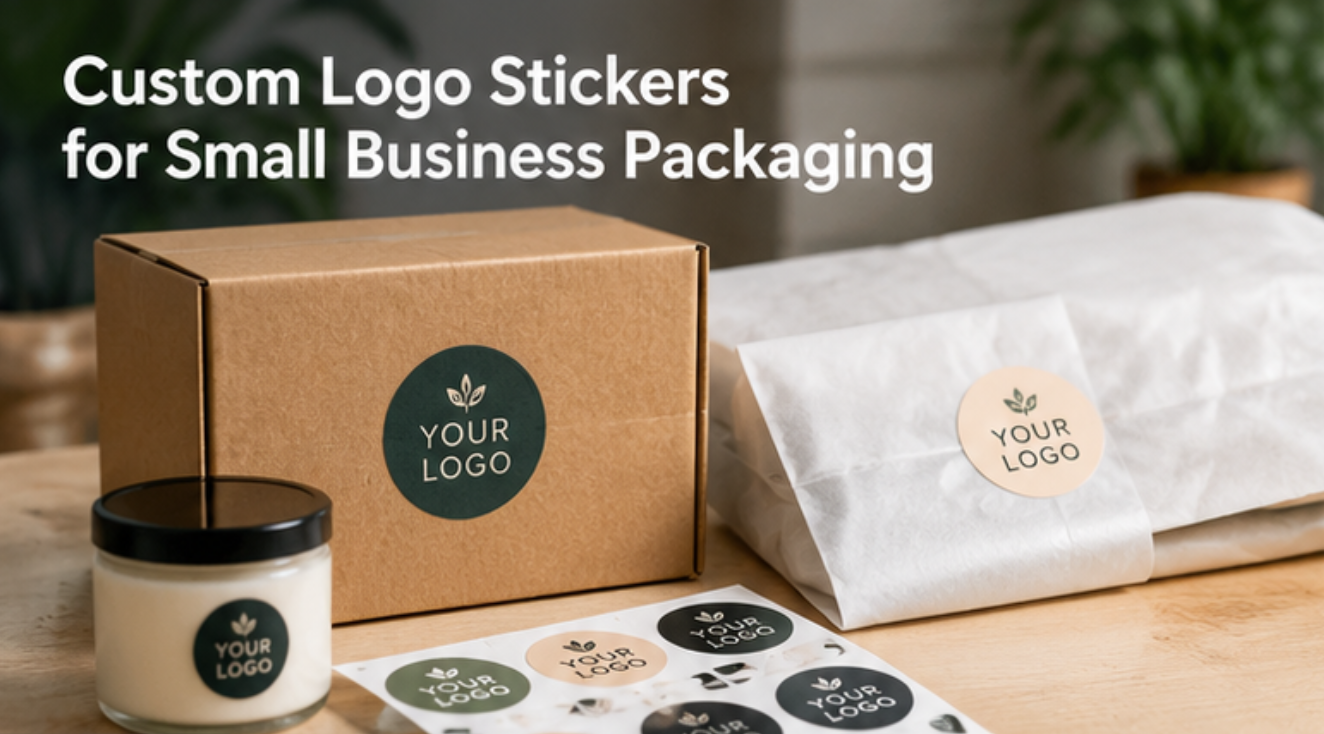
For a small business, packaging must balance presentation with operational flexibility. A logo sticker can serve as the visible branding element on otherwise standard packaging.
Consider a simple packaging system:
- One neutral shipping box.
- One consistent tissue-paper color.
- One custom logo sticker.
- One interchangeable product or promotional insert.
This approach separates the basic packaging structure from campaign-specific branding. Instead of redesigning every component for each promotion, a business can change the sticker or insert while keeping the core packaging consistent.
That is a planning strategy, not a guarantee of lower costs. Whether it saves money depends on your order quantities, packaging inventory, labor, and the alternatives available.
Give Each Sticker a Clear Job
Before choosing materials, decide what the sticker must accomplish:
| Sticker purpose | Primary design priority | Main performance question |
| Identify the brand | Recognizable logo and contrast | Is it readable on the actual package? |
| Close tissue paper | Appropriate size and adhesion | Does it hold without making opening difficult? |
| Decorate a gift box | Finish and visual alignment | Does it suit the box texture and color? |
| Label a product container | Readability and surface compatibility | Will it remain attached during normal use? |
| Carry a QR code | Scan reliability | Does the code work after application? |
| Act as a promotional giveaway | Appearance and intended durability | Does its construction suit the expected use? |
Do not assume one construction will work equally well for every role. A removable promotional sticker and a permanent product label may need different adhesive systems. [label.averydennison]
Start With a Packaging Brief Before Requesting Prices
The most useful first document is a short specification brief. It helps the buyer and manufacturer discuss the same product rather than compare loosely defined prices.
Include:
1. Packaging material and surface finish.
2. Sticker dimensions and shape.
3. Intended placement.
4. Application conditions.
5. Expected exposure during shipping or use.
6. Desired removal behavior.
7. Quantity per design.
8. Required delivery format.
9. Destination and target delivery date.
10. Artwork status and reference colors.
Describe the surface precisely. "Cardboard box" could mean uncoated kraft, coated white board, a printed corrugated mailer, or a laminated presentation box.
These differences matter because adhesive performance depends on the actual surface, including its texture and surface energy. Avery Dennison's technical guidance specifically distinguishes more readily bonded surfaces, such as glass and PET, from more challenging low-surface-energy materials, such as HDPE. [label.averydennison]
Separate Essential Requirements From Preferences
A useful purchasing brief has two categories:
- Essential: the label must remain attached to a chilled container.
- Preferred: the label should have a soft matte appearance.
This distinction helps prevent a decorative preference from overriding a functional requirement. It also gives the manufacturer room to propose alternatives without changing the purpose of the product.
How to Choose Materials for Custom Packaging Stickers
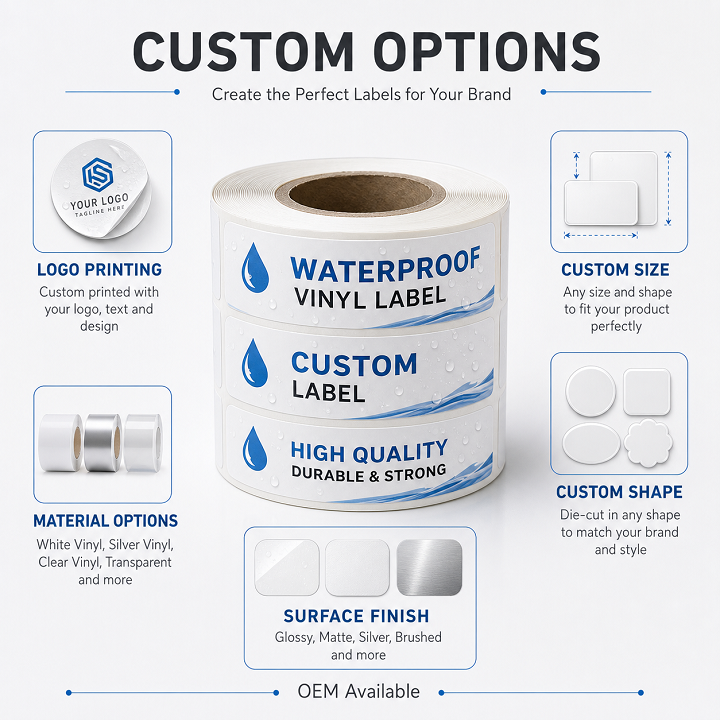
A sticker is a construction, not simply a printed image. Its performance involves the face material, adhesive, printing, protective finish, and release liner.
Ask about the complete construction rather than requesting "premium material" without further definition.
Paper Logo Stickers for Dry Packaging
For dry indoor packaging, paper-based constructions are worth discussing when your priorities include a paper-like appearance, simple branding, or compatibility with a particular visual style.
However, avoid treating every paper label as equivalent. Coatings and protective finishes can change its behavior, and the adhesive still needs to suit the package.
For tissue-paper seals, also consider the opening experience. A sticker that holds strongly may tear delicate wrapping when removed. That may be acceptable for a single-use seal, but not for a reusable wrapping concept.
Film Labels for More Demanding Conditions
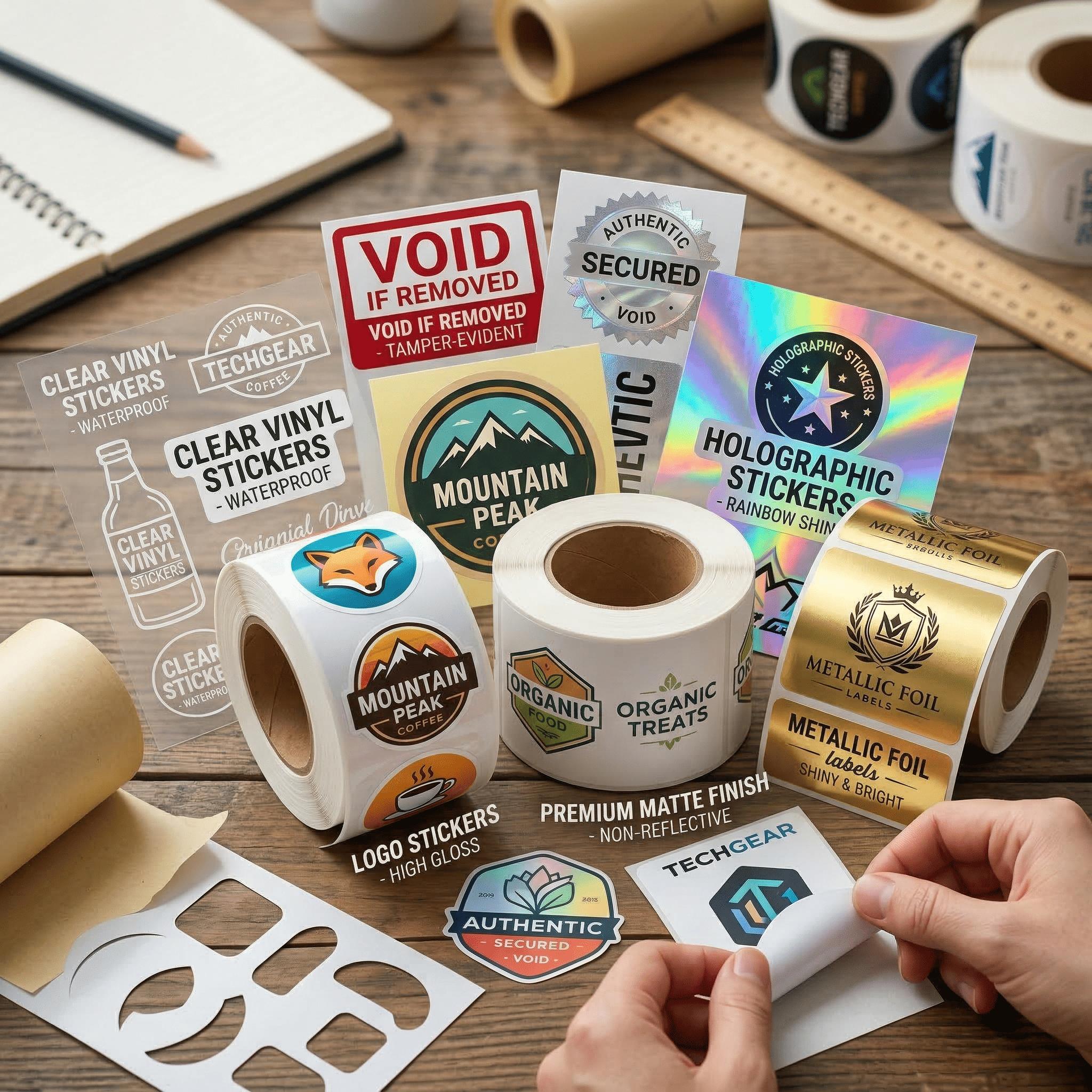
When moisture, handling, or other exposure is expected, ask the supplier to propose a suitable film-based construction and explain its limitations.
Do not accept "waterproof" as a complete specification. Clarify whether the proposed label is intended for:
- Occasional splashes.
- Condensation.
- Refrigerated storage.
- Repeated handling.
- Prolonged water exposure.
These are different use conditions. Avery Dennison recommends evaluating the complete label construction for the specific application rather than assuming that a general material description predicts performance. [label.averydennison]
Clear Stickers and White-Ink Planning
For transparent packaging stickers, include a white-ink discussion in the artwork review.
Ask the printer to demonstrate:
- Which areas remain transparent.
- Which areas receive white ink.
- How the logo appears on the actual package.
- Whether small text remains readable.
Treat this as a proofing requirement. A design reviewed only against a white computer background does not show how it will appear on a dark box or colored container.
Adhesive Selection: The Decision Buyers Often Make Too Late
From a packaging-specification perspective, adhesive selection deserves the same attention as the visible design.
A label may be easy to print but difficult to apply reliably if the adhesive does not match the surface or environment. Manufacturer guidance identifies surface type, roughness, contamination, and temperature as important selection factors. [label.averydennison]
Permanent or Removable?
Define the expected removal behavior before approving the order.
Ask whether you need:
- A label intended to remain attached throughout the product's use.
- A sticker intended to peel away for a particular application.
- A closure that will be broken during opening.
- A resealable solution designed for repeated opening.
Avoid assuming that "removable" guarantees clean removal from every surface. Agree on the actual packaging material and testing conditions.
For valuable or reusable packaging, request removal testing after a realistic storage period—not just immediately after application.
Application Temperature Is Not Service Temperature
This distinction is especially important for chilled or frozen products.
- Application temperature describes conditions when the sticker is attached.
- Service temperature describes conditions after the label has been applied.
A label applied to a dry container at room temperature and later chilled faces a different application challenge from a label attached to an already cold container.
Avery Dennison explicitly separates these two temperature requirements in its technical guidance. Ask the manufacturer to confirm both for the proposed construction. [label.averydennison]
Do Not Confuse a Decorative Seal With Tamper Evidence
A logo sticker placed across a box opening is not automatically a validated tamper-evident solution.
If visible evidence of opening is required, specify that requirement separately. Ask the supplier to explain the proposed mechanism and provide samples for evaluation.
Use precise language in the purchase specification. "Branding seal" and "tamper-evident label" should not be treated as interchangeable descriptions.
Design Custom Logo Stickers That Work at Actual Size
A packaging sticker usually has limited space. Its job is not to reproduce your entire website or brand story.
My recommended information hierarchy is:
1. Brand name or logo.
2. One supporting message, if necessary.
3. One optional action or destination.
For example, a tissue seal may need only the logo. A promotional sticker might include a short slogan. A product-facing label may require a more detailed layout and separate compliance review.
Test Readability on the Package
Before approving artwork:
- Print the design at its intended size.
- Position it on a packaging sample.
- Review it under ordinary lighting.
- Check it from a normal handling distance.
- Compare its appearance with neighboring packaging elements.
This is a proposed design-review process, not a substitute for a production proof.
Pay particular attention to small lettering, fine lines, and low-contrast color combinations. Ask the printer to identify details that may be difficult to reproduce consistently.
Confirm Bleed, Safe Areas, and Cut Lines
Request the manufacturer's artwork template instead of assuming a universal setup.
Confirm:
- Finished dimensions.
- Bleed requirements.
- Safe areas for text and logos.
- Cut-line treatment.
- Color workflow.
- Font handling.
- White-ink or special-finish layers.
- Accepted file formats.
Keep important information away from the cut edge according to the supplier's guidance.
For irregular shapes, ask whether the proposed outline introduces handling or application concerns. A visually interesting silhouette should still be practical to peel, position, and use.
Rolls, Sheets, or Individual Stickers?
Delivery format affects packing work as much as appearance.
Rather than choosing by habit, describe how your team will apply the stickers and ask the supplier to recommend an appropriate format.
| Format to evaluate | Potential workflow | What to confirm |
| Rolls | Repeated application at a packing station | Roll dimensions, core, winding direction, dispensing compatibility |
| Sheets | Manual use or organized storage | Sheet layout, spacing, peelability, identification |
| Individual pieces | Inserts or promotional distribution | Backing style, separation, handling, packing method |
For machine application, obtain the equipment requirements before placing the order.
For manual application, run a short packing trial. Observe whether staff can peel, align, and apply the stickers comfortably.
A format that looks convenient in a quotation may behave differently during a busy fulfillment shift.
A Practical Sample-Testing Protocol Before Bulk Production
Sampling is one of the strongest opportunities to improve this buying decision.
A screen proof checks appearance. A physical application trial checks whether the proposed construction works with the package.
Avery Dennison recommends testing the complete label construction for the intended application. The following is a suggested buyer-side protocol, not a formal laboratory standard. [label.averydennison]
Step 1: Use Actual Packaging
Test on the boxes, containers, wrapping, or mailers you intend to purchase.
Include the actual coating or finish. Do not approve performance on plain board if production packaging will be laminated.
Step 2: Reproduce Normal Application
Apply samples using the planned method and realistic working conditions.
Record:
- Surface condition.
- Approximate application temperature.
- Placement.
- Application pressure or equipment.
- Time between application and evaluation.
Step 3: Reproduce Expected Handling
Build a test around the intended use:
- Normal packing and unpacking.
- Contact with neighboring products.
- Representative shipping handling.
- Chilled storage, where relevant.
- Expected exposure to condensation.
Avoid treating an aggressive test unrelated to the product's use as the only acceptance criterion.
Step 4: Agree on Pass-or-Fail Conditions
Write down what counts as acceptable:
- No visible edge lifting under agreed conditions.
- Readable print.
- Acceptable appearance after handling.
- QR-code functionality, if included.
- Required removal behavior.
Photograph results and keep the approved sample identified by specification and artwork version.
Compare Total Applied Cost, Not Just Price Per Sticker
The lowest quotation is not necessarily the least expensive option in use.
A practical comparison should include:
- Sticker purchase cost.
- Tooling or setup charges.
- Freight and applicable import costs.
- Application labor.
- Spoilage.
- Rework.
- Unused inventory.
For internal planning, use:
Cost per usable labeled package=Total relevant labeling cost÷Number of acceptable labeled packages
An Illustrative Cost Comparison
Suppose a business buys 10,000 stickers for $200. If 9,000 produce acceptable finished packages, the purchase cost alone is approximately 2.22 cents per usable labeled package.
Another order costs $240 for 10,000 stickers. If 9,900 produce acceptable packages, its purchase cost is approximately 2.42 cents per usable labeled package.
The second option still has a higher purchase cost per acceptable package. Whether it becomes cheaper overall depends on measured differences in labor, rework, or other costs.
These figures are hypothetical. They illustrate a comparison method, not a XingKun quotation or a prediction of defect rates.
Sustainable Packaging Stickers: Make Specific Claims
Environmental language should be precise enough for a buyer to verify.
Avoid assuming that a paper face material makes the entire label recyclable, compostable, or compatible with every recycling system.
For U.S.-facing marketing, the FTC advises businesses to qualify broad environmental claims and substantiate the particular benefit they communicate. Its guidance also distinguishes recycled content from recyclability. [consumer.ftc]
Questions to Ask Before Using Environmental Claims
Ask the manufacturer:
- Which component does the claim describe?
- What evidence supports it?
- Does it cover the finished label or only one material?
- How does the label interact with the intended packaging?
- What disposal instructions are appropriate for the destination market?
The FTC's published Green Guides summary states that recyclable claims should be qualified when appropriate facilities are unavailable to at least 60% of consumers or communities where the item is sold. This is U.S.-specific guidance, not a universal global labeling rule. [ftc]
A safer editorial approach is to state a narrow, supported fact rather than an expansive promise.
For example, use an accurately documented recycled-content statement instead of an unsupported "100% eco-friendly" slogan.
Add QR Codes Only When They Improve the Customer Experience
A QR code should have a clear purpose.
Useful destinations to consider include:
- Product instructions.
- A care guide.
- Product registration.
- A relevant reorder page.
- A concise brand story.
- A support resource.
Choose the destination before designing the sticker. Otherwise, the code may become a decorative element without a useful customer action.
My recommendation is to test the printed code on the actual package, using more than one device and realistic lighting. Check it after any relevant handling or exposure tests.
Keep the destination manageable over time. Assign responsibility for checking the link so the packaging does not lead customers to an outdated or missing page.
How to Request Custom Logo Stickers From XingKun
XingKun identifies its business as a Chinese OEM and ODM supplier serving overseas brands, wholesalers, and manufacturers across custom printing and packaging products. Its website includes a stickers manufacturer and supplier page that buyers can use as an initial reference. Specific material availability, minimum order quantities, certifications, and production commitments should be confirmed directly rather than assumed. [xkdisplay]
For a useful inquiry, send a structured request:
| Information to provide | Example |
| Packaging | Uncoated kraft gift box |
| Sticker purpose | Front-facing brand identification |
| Dimensions | Proposed size with a placement photo |
| Appearance | Matte look, subject to sampling |
| Adhesion requirement | Remain attached during normal handling |
| Environment | Dry indoor storage and standard shipping |
| Quantity | Quantity per artwork version |
| Format | Rolls or sheets for evaluation |
| Artwork | Available logo files and brand colors |
| Timing | Required arrival date and destination |
Clarify OEM and ODM Responsibilities
For an OEM project, explain which elements are already fixed, such as approved artwork or an established specification.
For an ODM discussion, identify where you want development support, such as material selection, layout adaptation, or packaging coordination.
In either case, confirm responsibilities in writing. Do not assume the same services are included in every quotation.
Before authorizing production, review the agreed specification, proof, sample requirements, price basis, and delivery terms.
Conclusion
Custom logo stickers for small business packaging work best when design and production decisions support the same purpose. Start with the package, define the sticker's job, and select the construction around real application conditions.
Then validate the details that matter: readability, adhesion, opening behavior, packing efficiency, and total applied cost. Treat environmental statements as claims that require evidence, not decorative selling points.
To discuss a project with XingKun, prepare your logo, packaging photos, dimensions, quantities, destination, and intended use. Request a specification proposal and suitable sampling plan before committing to bulk production. Make compatibility the foundation of the decision, and let the visual design build on it.

Frequently Asked Questions
1. What size should custom logo stickers be for small business packaging?
Choose the size around the packaging area, logo proportions, and intended function. Print a full-size mockup and place it on the actual package before approval. A tissue-paper seal and a front-facing box label may need different dimensions.
2. Are paper stickers suitable for every packaging application?
No single construction should be assumed suitable for every use. Discuss the package surface, exposure, and required durability with the manufacturer. Evaluate the complete label rather than choosing on face material alone. [label.averydennison]
3. Can one sticker specification work on boxes, plastic containers, and glass?
Possibly, but it requires verification. Different surfaces present different adhesion conditions. Avery Dennison's technical guidance notes that surface energy affects bonding and distinguishes materials such as glass, PET, and HDPE. Test each intended surface. [label.averydennison]
4. What is the difference between a waterproof sticker and a freezer label?
These descriptions address different requirements. A moisture-resistance claim does not establish suitable application or service temperatures. For cold-chain use, confirm both temperature ranges and test the proposed construction under the intended conditions. [label.averydennison]
5. Should a small business order rolls or sheets?
Choose according to the application workflow. Ask for format details and trial them at the packing station. For automated application, obtain the equipment specifications before ordering. For manual use, evaluate peeling, alignment, storage, and handling.
6. Can custom logo stickers make packaging recyclable?
A sticker alone does not establish the recyclability of the complete package. Evaluate the packaging system and destination-market collection conditions. For U.S. marketing, follow FTC guidance on substantiating and qualifying recyclable claims. [ftc]
7. What should I send when requesting a quotation from XingKun?
Provide artwork, dimensions, packaging material, intended use, quantity per design, preferred format, delivery destination, and target timing. Include photos or samples when possible. Ask the supplier to confirm any unresolved specification rather than pricing an undefined "standard sticker."
8. Should I approve a digital proof or a physical sample?
Use each for a different purpose. A digital proof supports layout review. A physical sample allows assessment of the proposed appearance and application performance. Where adhesion is important, test the complete construction on the intended packaging. [label.averydennison]
References
The technical and regulatory statements above draw on the following sources. The purchasing frameworks, test checklist, design-review recommendations, and hypothetical cost example are editorial recommendations developed for this article—not reported customer results.
1. XingKun. "Stickers Manufacturer & Supplier." Company-provided product reference page. Used as a starting point for the supplier discussion, not as independent verification of certifications or performance claims. [xkdisplay]
2. Avery Dennison. "Adhesive Technologies — Technical Guide ASEAN." Technical guidance on application surfaces, surface energy, temperature, and adhesive selection. [label.averydennison]
3. Avery Dennison. "Cold Temperature — Product Overview SSA." Guidance distinguishing minimum application temperature from service temperature and recommending application-specific testing of complete label constructions. [label.averydennison]
4. Avery Dennison. "When Planning a Labelling Application." European technical factsheet explaining cold-temperature labeling considerations. [label.averydennison]
5. Avery Dennison. "Get a Grip: How to Select the Right Adhesive." Technical presentation covering substrate properties, surface conditions, and adhesive-selection factors. [label.averydennison]
6. U.S. Federal Trade Commission. "Environmental Claims: Summary of the Green Guides." Published October 2, 2012. Guidance on general environmental claims, recyclability, and recycled-content representations. [ftc]
7. U.S. Federal Trade Commission. "Eco-Friendly and Green Marketing Claims." Published May 19, 2021. Consumer guidance explaining environmental claims and local recycling limitations. [consumer.ftc]


