Content Menu
● Kraft Packaging Boxes vs White Cardboard Boxes: Quick Comparison
● What Are Kraft Packaging Boxes?
>> Where Kraft Boxes Work Well
>> Important Limitations
● What Are White Cardboard Boxes?
>> Where White Cardboard Boxes Work Well
● Printing and Branding: Which Material Shows Your Design Better?
>> Kraft Packaging Boxes Support Substrate-Led Design
>> White Cardboard Boxes Support Color-Led Design
● Strength and Protection: Compare the Finished Box
>> Why Equal Paper Weight Is Not Enough
>> Separate Retail Packaging from Shipping Protection
● Moisture and Food Packaging: Appearance Is Not Protection
>> Specify the Actual Exposure
● Cost Comparison: Look Beyond the Board Price
>> What Changes the Quotation?
>> Compare Cost per Usable Package
● Sustainability: Brown Does Not Automatically Mean Better
>> Separate Three Different Claims
>> Assess the Finished Construction
● Three Deeper Insights for Better Packaging Decisions
>> 1. A Hybrid Material May Resolve the Trade-Off
>> 2. Color-Critical Brands Need a Sample Standard
>> 3. Use a Controlled Comparison Instead of Two Unrelated Samples
● How to Choose: A Five-Step Procurement Checklist
>> Step 1: Define the Product
>> Step 2: Define the Customer Experience
>> Step 3: Request Fully Identified Materials
>> Step 4: Review Physical Samples
>> Step 5: Approve the Production Standard
● Discuss Your Packaging Brief with XingKun
● Frequently Asked Questions
>> 1. Are kraft packaging boxes always recycled?
>> 2. Are white cardboard boxes stronger than kraft boxes?
>> 3. Can kraft packaging boxes have colorful printing?
>> 4. Which option is better for premium packaging?
>> 5. Are kraft and white cardboard boxes recyclable?
>> 6. What should I provide when requesting a quotation?
● References
Choosing between kraft packaging boxes vs white cardboard boxes is not simply a matter of brown versus white. The decision affects print quality, product protection, purchasing costs, customer perception, and the accuracy of your environmental claims.
At Shenzhen XingKun Packing Products Co., Ltd., our perspective as a printing and packaging manufacturer is straightforward: specification matters more than appearance. With over 20 years of experience serving brands and distributors across more than 30 countries and regions, we encourage buyers to compare actual materials, finished samples, and delivery requirements—not just product photographs.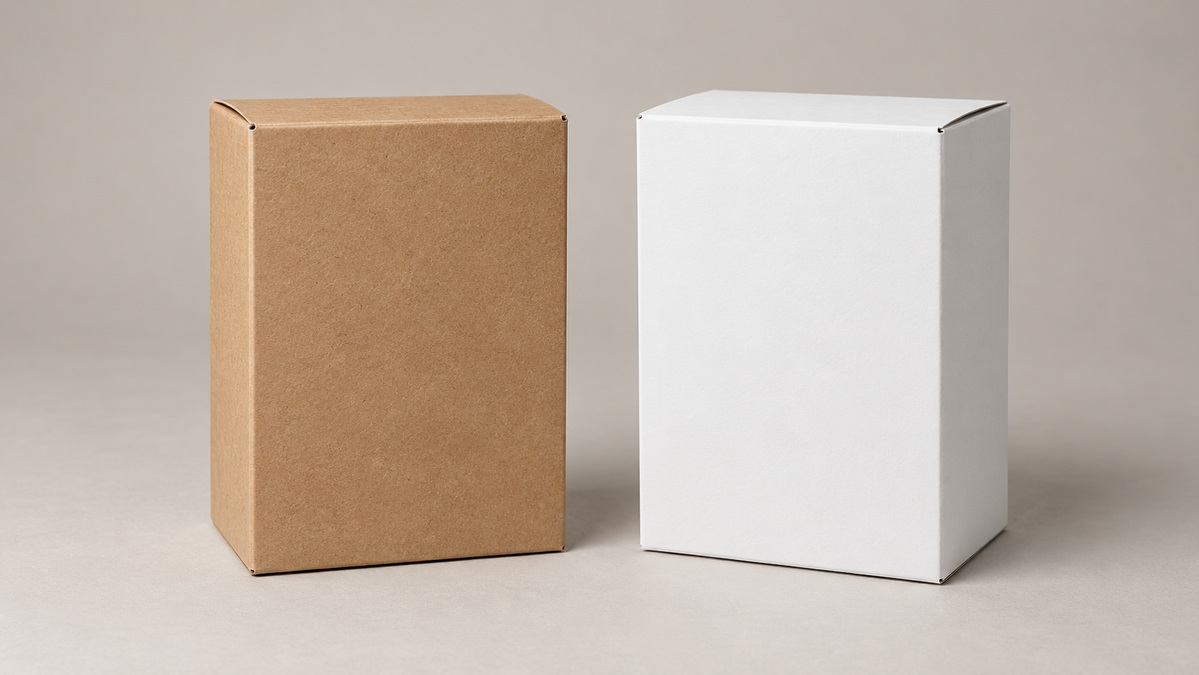
Kraft Packaging Boxes vs White Cardboard Boxes: Quick Comparison
For this comparison, kraft packaging boxes generally mean brown kraft-style folding cartons. White cardboard boxes mean white-faced paperboard folding cartons, rather than corrugated shipping cases.
| Comparison factor | Kraft packaging boxes | White cardboard boxes |
| Typical appearance | Brown, natural-looking surface | White, clean printing surface |
| Common material options | Virgin or recycled kraft-based boards | SBS, folding boxboard, or white-lined recycled board |
| Graphic direction | Minimalist artwork and contrasting graphics | Detailed images and color-focused designs |
| Color reproduction | Brown substrate influences printed colors | White surface provides a more neutral background |
| Structural performance | Depends on grade, thickness, and construction | Depends on grade, thickness, and construction |
| Environmental credentials | Must be verified separately | Must be verified separately |
| Typical purchasing priority | Tactile character and restrained decoration | Graphic consistency and visual detail |
Neither category automatically wins on strength, price, or sustainability. The correct comparison is between two clearly specified packaging solutions.
What Are Kraft Packaging Boxes?
Kraft packaging boxes commonly use brown paperboard associated with kraft fibers or a kraft-style surface. Their visible texture can support a straightforward, tactile brand identity.
However, "kraft" does not establish recycled content. A brown carton may contain virgin fibers, recycled fibers, or a combination. Buyers should request the actual board grade and fiber declaration.
Where Kraft Boxes Work Well
Custom kraft packaging boxes are worth considering for:
- Handmade soaps and personal-care products.
- Specialty coffee and dry-food outer packaging.
- Apparel accessories and gift products.
- Brands using simple typography or limited-color artwork.
These are design applications, not guarantees of suitability. Food contact, moisture exposure, and product weight still require separate assessment.
Important Limitations
A brown surface changes how printed colors appear. Light colors may lose impact, while photographic artwork can look different from the same design printed on white board.
A white ink layer can help create a more neutral printing area, but its availability, opacity, and cost depend on the production process.
What Are White Cardboard Boxes?
White cardboard boxes are a broad packaging category, not a single material.
Common options include solid bleached sulfate board, often called SBS; folding boxboard, or FBB; and recycled board with a white printing surface.
Their composition and performance differ. A white exterior does not mean the board is white throughout, made entirely from virgin fibers, or suitable for direct food contact.
Where White Cardboard Boxes Work Well
White-faced paperboard is useful when packaging requires:
- Detailed illustrations or product photography.
- Consistent brand colors.
- Clearly presented instructions.
- A coordinated appearance across several product lines.
Whiteness, smoothness, and surface finish influence print presentation. However, different white boards can still produce noticeably different results.
Printing and Branding: Which Material Shows Your Design Better?
Kraft Packaging Boxes Support Substrate-Led Design
Kraft works particularly well when the brown background forms part of the artwork.
Black typography, spacious layouts, and simple illustrations can create a distinctive package without covering the entire surface.
Our practical recommendation is to design for the material from the beginning. Transferring an existing white-box design directly onto brown board often creates avoidable compromises.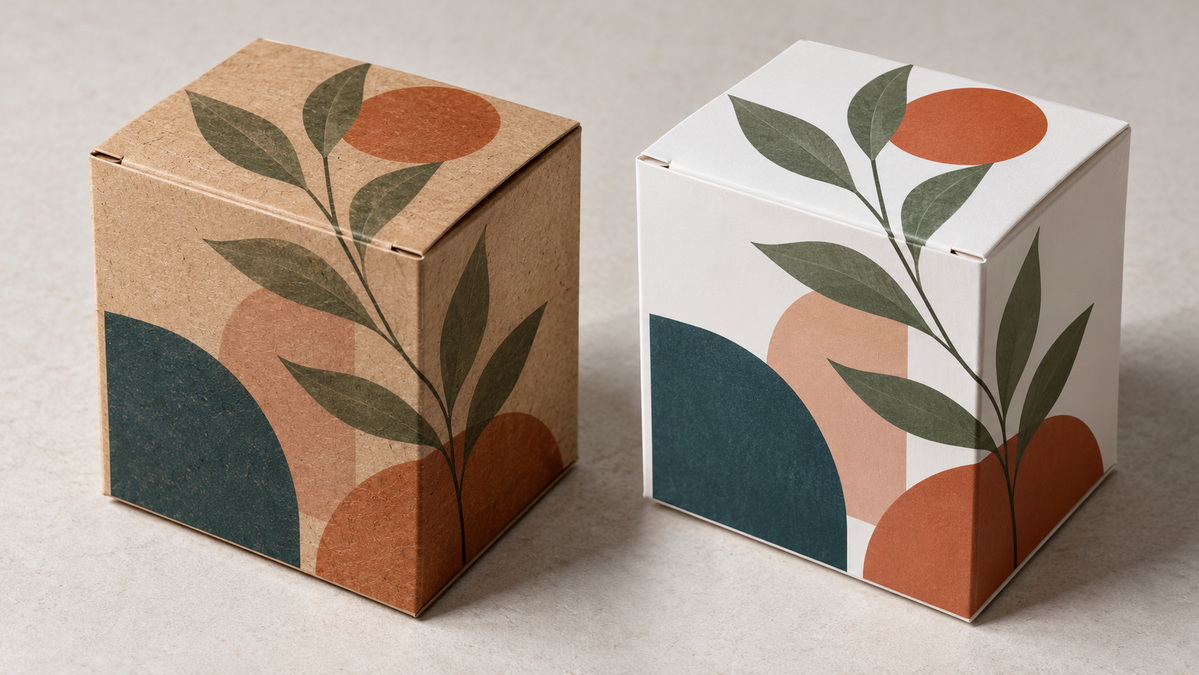
White Cardboard Boxes Support Color-Led Design
White paperboard generally provides a more neutral background for process-color printing.
This makes it a strong starting point for cosmetics cartons, illustrated gift packaging, and products that depend on recognizable color families.
Nevertheless, "white" is not a complete color specification. Board shade, coating, ink absorption, and finishing can all influence the final appearance.
For either material, approve a physical proof or representative production sample rather than relying only on a screen preview.
Strength and Protection: Compare the Finished Box
One common misconception is that kraft packaging boxes are always stronger than white cardboard boxes.
Kraft-based grades can offer useful strength characteristics, but color alone cannot predict performance. White paperboards also include grades engineered for demanding packaging applications.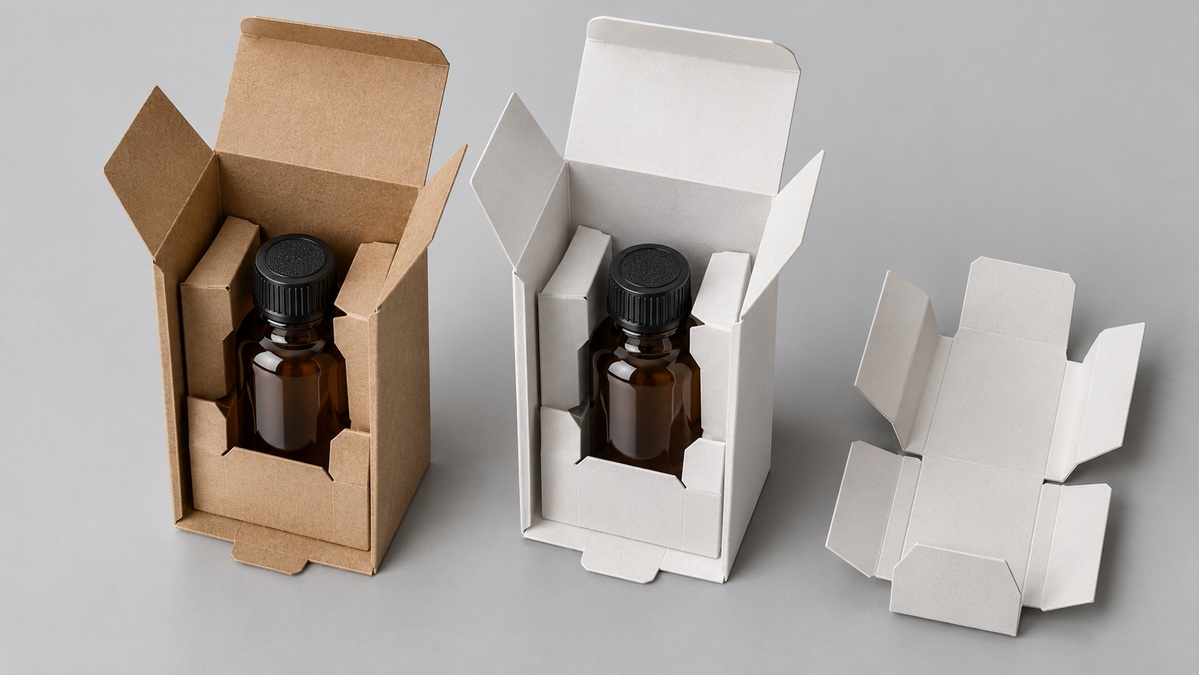
Why Equal Paper Weight Is Not Enough
Grammage, expressed in grams per square meter, measures mass per unit area. It does not directly establish thickness or stiffness.
Two boards with the same grammage can behave differently because their fiber composition, bulk, and layered construction differ.
Ask suppliers to compare:
- Board grade and grammage.
- Thickness, also called caliper.
- Bending stiffness.
- Grain direction.
- Creasing and folding performance.
- The assembled box under the intended load.
Separate Retail Packaging from Shipping Protection
A folding carton that looks excellent on a shelf may still require an outer shipping case.
For fragile or heavy products, inserts, internal clearance, and transport packaging can matter more than the choice between brown and white paperboard.
Evaluate the complete packaging system, not only the visible retail box.
Moisture and Food Packaging: Appearance Is Not Protection
Neither ordinary kraft board nor ordinary white paperboard should be treated as waterproof.
Humidity can influence paperboard behavior, including curl and dimensional stability. Grease, condensation, or direct liquid exposure may require a specially selected grade or barrier system.
Specify the Actual Exposure
Before choosing a material, explain whether the package will encounter:
- Dry indoor storage.
- Humid transport conditions.
- Refrigeration or condensation.
- Greasy products.
- Direct food contact.
A coated surface is not automatically an effective moisture barrier. Likewise, a natural-looking surface does not establish food-contact suitability.
For food applications, request documentation appropriate to the intended food, contact conditions, and destination market. Review the finished construction, including inks, adhesives, and barriers—not just the base paperboard.
Cost Comparison: Look Beyond the Board Price
Are kraft packaging boxes cheaper than white cardboard boxes?
Sometimes, but there is no dependable universal price ranking. The answer changes with the board grade, order volume, artwork, construction, and finishing requirements.
What Changes the Quotation?
Major cost drivers include:
1. Material grade and availability.
2. Box dimensions and cutting layout.
3. Print colors and ink coverage.
4. White ink or additional printing operations.
5. Foil, embossing, coatings, or lamination.
6. Assembly requirements and packing method.
7. Freight volume and protective outer packaging.
A minimally printed kraft carton may be economical. A heavily decorated kraft box requiring an opaque white base may not offer the same advantage.
Compare Cost per Usable Package
The lowest unit price is not necessarily the lowest business cost.
A better purchasing comparison includes packaging, freight, assembly labor, damage exposure, and rejected units.
Request quotations against the same dimensions, quantity, artwork requirements, and performance expectations. Otherwise, two attractive prices may represent substantially different products.
Sustainability: Brown Does Not Automatically Mean Better
The environmental comparison between kraft packaging boxes and white cardboard boxes requires evidence.
Brown color does not prove recycled content. White color does not prove poor environmental performance.
Separate Three Different Claims
These terms describe different things:
- Recycled content concerns the fibers already used in the product.
- Responsible sourcing concerns where applicable forest-based materials originate.
- Recyclability concerns whether the finished package can enter a relevant collection and recycling system.
The Forest Stewardship Council distinguishes between its 100%, Mix, and Recycled labels. They should not be treated as interchangeable claims.
Also, a supplier's general certification statement does not establish that every order can carry a particular label. Confirm the applicable supply-chain documentation and labeling authorization.
Assess the Finished Construction
A sustainability review should consider material weight, fiber sourcing, coatings, windows, inserts, adhesives, and the disposal conditions in the destination market.
Do not assume a base board's recyclability automatically applies unchanged after decoration or lamination.
From a purchasing perspective, the most useful question is: "What evidence supports the environmental claim on this specific finished box?"
Three Deeper Insights for Better Packaging Decisions
1. A Hybrid Material May Resolve the Trade-Off
Kraft and white are not always mutually exclusive.
Coated unbleached kraft, commonly called CUK, combines an unbleached kraft-based structure with a coated printing face. Other constructions may combine a white exterior with a differently colored reverse.
These options deserve evaluation when a project needs both a suitable printing surface and particular structural properties.
However, specify the exact grade. CUK does not automatically mean waterproof or suitable for every application.
2. Color-Critical Brands Need a Sample Standard
A digital artwork file cannot fully describe the effect of the substrate.
For repeat orders, retain an approved physical sample and record:
- Board grade and surface.
- Artwork version.
- Printing process.
- Agreed color expectations.
- Finishing specification.
This creates a clearer basis for discussing consistency than instructions such as "make it look premium."
3. Use a Controlled Comparison Instead of Two Unrelated Samples
When evaluating kraft versus white cardboard packaging, keep other variables as consistent as practical.
Use the same product, similar box geometry, and an agreed protection target. Then compare appearance, assembly, fit, and handling.
This is a recommended evaluation method, not a claim that one material has already outperformed the other.
How to Choose: A Five-Step Procurement Checklist
Step 1: Define the Product
Record dimensions, weight, fragility, surface sensitivity, and any contact requirements.
Step 2: Define the Customer Experience
Decide whether the package should emphasize natural texture, detailed graphics, gift presentation, or straightforward product information.
Step 3: Request Fully Identified Materials
Avoid approving descriptions such as "premium kraft" or "high-quality white card" without a grade specification.
Step 4: Review Physical Samples
Check product fit, folding, closure, print appearance, rubbing, and handling under relevant conditions.
Step 5: Approve the Production Standard
Confirm the board, artwork, finish, packing method, inspection expectations, and acceptable variations before production begins.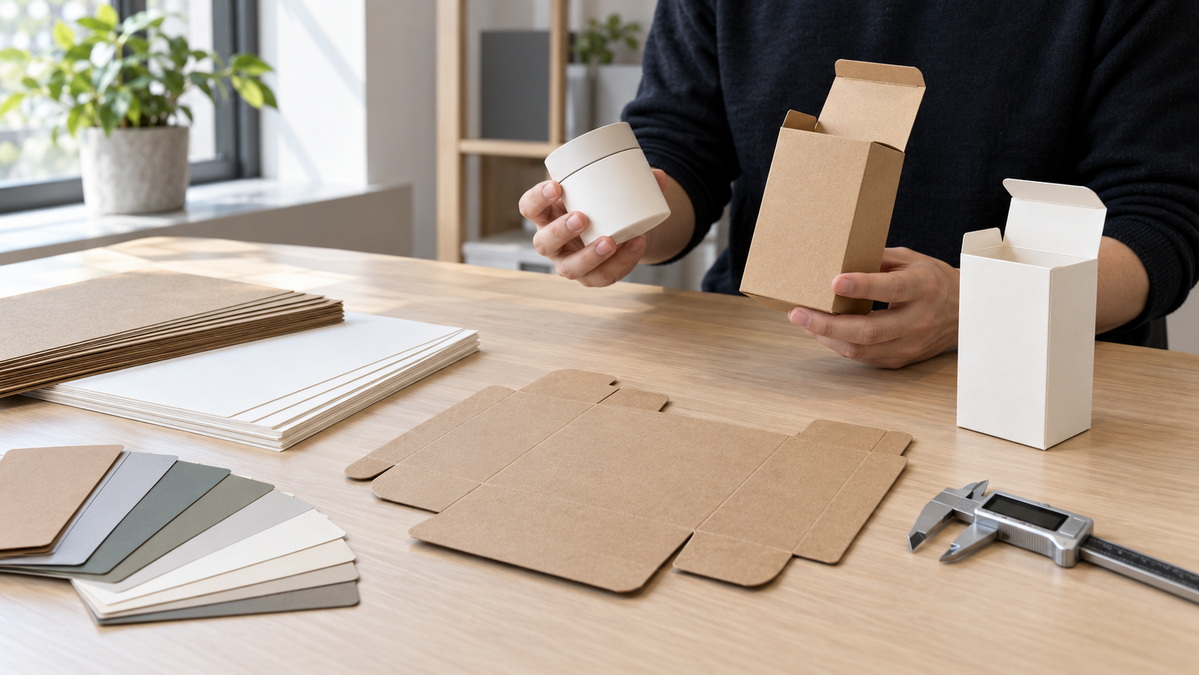
Discuss Your Packaging Brief with XingKun
Choose kraft packaging boxes when the substrate's natural-looking character supports your brand. Choose white cardboard boxes when a neutral printing surface better serves your graphics. In both cases, validate protection and compliance separately.
Shenzhen XingKun Packing Products Co., Ltd. brings over 20 years of printing and packaging manufacturing experience and has served brands and distributors across more than 30 countries and regions.
Send your product dimensions, weight, order quantity, artwork, destination market, and finishing preferences. Ask our team to compare suitable kraft and white paperboard options against the same brief, so your decision rests on clearly defined materials and samples.
Frequently Asked Questions
1. Are kraft packaging boxes always recycled?
No. Brown kraft-style packaging may contain virgin fibers, recycled fibers, or both. Request a material declaration rather than judging recycled content by color.
2. Are white cardboard boxes stronger than kraft boxes?
Neither category is automatically stronger. Compare the specified grades, thickness, stiffness, box construction, and performance with the actual product.
3. Can kraft packaging boxes have colorful printing?
Yes. However, the brown background influences color appearance. Some designs may require white ink or artwork adjustments to achieve the intended result.
4. Which option is better for premium packaging?
Both can work. Kraft can support tactile, restrained design, while white board supports detailed graphics. Premium presentation also depends on structure, finishing quality, and product fit.
5. Are kraft and white cardboard boxes recyclable?
Many paperboard packages can enter paper recycling systems, but the finished construction and local acceptance rules matter. Coatings, contamination, windows, and other components require consideration.
6. What should I provide when requesting a quotation?
Provide product dimensions and weight, box style, quantity, artwork, finishing preferences, destination market, and any testing or food-contact requirements. Include an existing sample when available.
References
- Holmen Board & Paper. "How to Choose the Right Paperboard." Guidance on matching protective and promotional requirements to paperboard characteristics. [Read the guide]. [holmen]
- Holmen Board & Paper. "Consumer Goods Packaging." Technical discussion of print surfaces, compression strength, folding endurance, creasing, and humidity-related behavior. [Read the application guidance]. [holmen]
- Holmen Board & Paper. "Paper Characteristics." Definitions and explanations of bulk, whiteness, brightness, and other paper properties. [Read the technical overview]. [holmen]
- Holmen Board & Paper. "How to Choose Paperboard for Food and Confectionery Packaging." Material-selection considerations for food packaging. [Read the guidance]. [holmen]
- Forest Stewardship Council. "What the FSC Labels Mean." Definitions of FSC 100%, FSC Mix, and FSC Recycled claims. [Read the label explanations]. [fsc]
- PackCalc. "SBS vs CUK vs CRB: Paperboard Grades for Folding Cartons." Supporting terminology for material families and grade-selection limitations. [Read the material guide]. [packcalc]


