Content Menu
● What Are Custom Affirmation Cards?
● Why Affirmation Cards Can Support Wellbeing
>> What Brands Should Say—and Avoid Saying
● Who Buys Custom Affirmation Cards?
● Choosing the Right Card Size and Format
>> Practical Recommendation
● Selecting Cardstock for Durability and Feel
>> Material Decision Framework
● Finishes That Improve Readability and Perceived Value
>> Expert Tip: Match Finish to Usage
● Designing Affirmations That Actually Help Users
>> Use a Simple Card Structure
>> Writing Guidelines
● A 7-Step Production Workflow for Custom Affirmation Cards
● Packaging: Turn a Card Deck Into a Retail Product
● Sustainability Considerations
● Quality Control Checklist Before Mass Production
● How XingKun Supports Custom Affirmation Card Projects
● Conclusion
● FAQ
>> 1. What is the best size for custom affirmation cards?
>> 2. What cardstock should I use for affirmation cards?
>> 3. Are affirmation cards scientifically proven to work?
>> 4. What finish is best for affirmation cards?
>> 5. How many cards should an affirmation deck contain?
>> 6. Can I customize the box and include a guidebook?
● References
Custom affirmation cards are short, intentional prompts printed on durable cards to help users practice self-reflection, gratitude, confidence, mindfulness, or values-based goal setting. For brands, coaches, therapists, educators, and wellness retailers, a well-produced affirmation deck is more than a print product—it is a daily-use brand touchpoint that can support emotional wellbeing and create a premium unboxing experience.
This guide explains how to develop custom affirmation cards that feel credible, useful, and commercially strong—from message design and card size to paperboard, finishes, packaging, and quality control. It also separates what research supports from what brands should avoid overpromising.
What Are Custom Affirmation Cards?
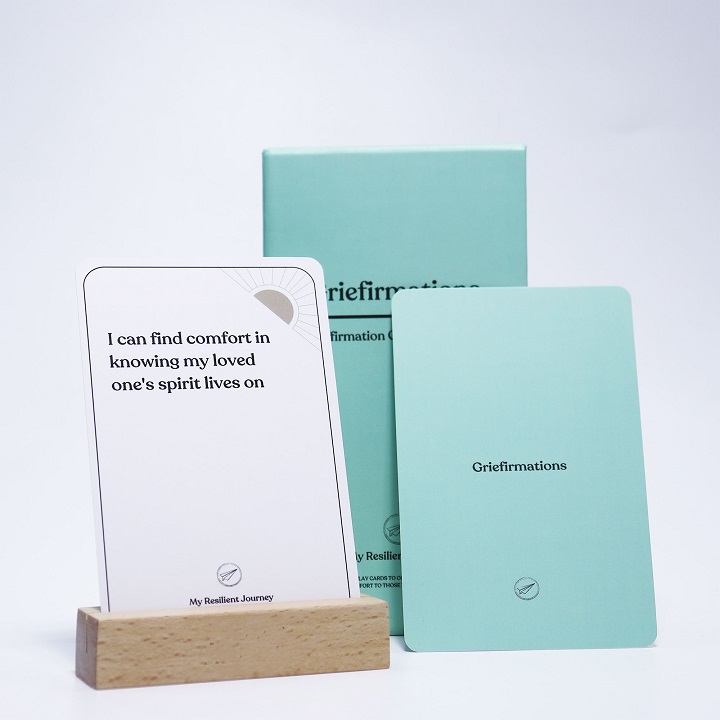
Custom affirmation cards are personalized decks containing positive statements, reflective questions, values prompts, breathing cues, or action-oriented reminders. Unlike generic quote cards, a custom deck is designed around a specific audience, purpose, visual identity, and user journey.
A strong affirmation deck typically includes:
- A clear theme: confidence, anxiety support, gratitude, leadership, recovery, creativity, or team culture.
- A defined user moment: morning routine, therapy session, classroom activity, corporate workshop, or gift set.
- Readable, inclusive language: concise wording that avoids unrealistic promises.
- Practical prompts: reflection questions or micro-actions alongside affirmations.
- Durable materials: cardstock, coating, and packaging chosen for frequent handling.
Affirmation products sit within a much larger wellness market. The Global Wellness Institute estimated the global wellness economy at approximately $6.8 trillion in 2024, with projected growth toward nearly $9 trillion by 2028. NIQ also found that 70% of consumers across 19 countries regularly engage in health-boosting activities, while 55% said they were willing to spend more than $100 per month on total wellness. [nielseniq]
For brands, this means demand exists—but buyers increasingly expect products that are thoughtfully designed, ethically produced, and supported by realistic claims.
Why Affirmation Cards Can Support Wellbeing
Affirmation cards should not be marketed as therapy or a cure for mental-health conditions. However, values-based self-affirmation has a meaningful research base.
Self-affirmation theory suggests that people can protect their sense of self-worth by reflecting on important values, strengths, relationships, or identities—especially during stress or self-doubt. A review in *Social and Personality Psychology Compass* found that values affirmations may reduce defensiveness, attenuate stress responses, and improve academic performance for people experiencing identity threat. [onlinelibrary.wiley]
One frequently cited study by Creswell and colleagues found that participants who affirmed personal values before a laboratory stress challenge had significantly lower cortisol responses than the control group. A broader 2024 review also notes that self-affirmation research has linked values reflection to improved wellbeing, problem-solving, message acceptance, and reduced stress responses. [journals.sagepub]
What Brands Should Say—and Avoid Saying
| Appropriate positioning | Avoid overclaiming |
| “Designed to encourage daily reflection and positive self-talk.” | “Cures anxiety or depression.” |
| “Prompts users to focus on personal values and strengths.” | “Guarantees confidence or success.” |
| “A supportive tool for mindfulness routines and journaling.” | “A replacement for professional mental-health care.” |
| “May help users build a more intentional daily ritual.” | “Clinically proven to treat any condition.” |
Recent evidence is encouraging but nuanced. A 2025 review of 67 studies found that writing or repeating positive affirmations had a meaningful but small effect on wellbeing and self-perception; researchers also note that effects vary by person and context. The most responsible brands frame affirmation cards as reflective tools, not medical interventions. [theconversation]
Who Buys Custom Affirmation Cards?
Custom affirmation cards serve a wide range of B2B and B2C buyers:
- Wellness and self-care brands seeking a tactile product for morning routines or gift bundles.
- Therapists, coaches, and counselors using prompts in sessions or client homework.
- Schools and educators supporting social-emotional learning and classroom reflection.
- Corporate HR and culture teams creating employee-recognition, onboarding, or wellbeing kits.
- Yoga studios, meditation apps, and retreat organizers offering branded merchandise.
- Retailers and subscription boxes looking for compact, giftable products with strong perceived value.
- Nonprofits and advocacy organizations distributing empowerment or values-based messaging.
The best decks solve a specific problem. For example, a leadership deck may include prompts such as: *"What value guided my hardest decision this week?"* A self-compassion deck may pair an affirmation with a grounding action: *"Place one hand on your chest and take three slow breaths."*
Choosing the Right Card Size and Format
Card size affects readability, portability, shuffling, printing cost, and retail presentation. There is no single "correct" size, but several formats are widely used in affirmation and oracle-card production.
| Format | Typical size | Best use |
| Poker size | 2.5 × 3.5 in / 63 × 88 mm | Pocket decks, travel sets, high card counts |
| Tarot size | 2.75 × 4.75 in / 70 × 120 mm | Daily reflection decks with artwork and longer text |
| Large oracle size | 3.5 × 5 in / 88 × 126 mm | Premium decks, detailed illustrations, journaling prompts |
| Square | 3.5 × 3.5 in or 4 × 4 in | Minimalist mantras, social-media-friendly branding |
| Mini size | About 1.75 × 2.5 in | Add-ons, event giveaways, compact gift sets |
Industry suppliers commonly list poker, tarot, large-format, and square dimensions as standard affirmation-card options, while also supporting fully custom die-cut shapes. For most wellness brands, tarot size offers the best balance: it is comfortable to hold, provides enough room for a headline affirmation and supporting prompt, and still fits neatly into a tuck box or magnetic closure box. [qinprinting]
Practical Recommendation
- Choose poker size for portable, lower-cost, high-volume decks.
- Choose tarot size for the broadest wellness and gift-market appeal.
- Choose large oracle size when artwork is central to the product.
- Choose square cards for modern, minimalist, Instagram-oriented brands.
Selecting Cardstock for Durability and Feel
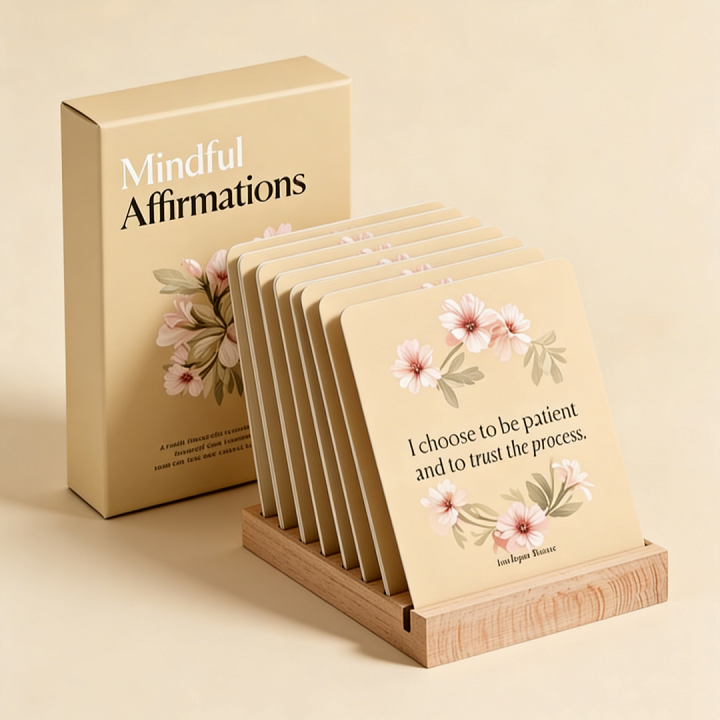
Paperboard selection is one of the most important production decisions. It determines stiffness, opacity, color reproduction, bend resistance, and the perceived quality of the deck.
Common affirmation-card materials include:
- 300–350 gsm art paper: A versatile, cost-effective choice for standard decks; 350 gsm is often considered a strong balance of flexibility and durability. [bookprintingchina]
- 400 gsm cardstock: Thicker and more rigid, suitable for luxury decks or shorter decks where a substantial feel matters. [bookprintingchina]
- Black-core or blue-core paper: Multi-layer board that improves opacity and stiffness; black core is often used for premium playing-card-style decks. [xinyicardprinting]
- Kraft paper: A natural, earthy look suited to eco-conscious or rustic branding. [bookprintingchina]
- Recycled or FSC-certified stock: A strong option for sustainability-focused wellness brands. [bookprintingchina]
- PVC or plastic: Waterproof and highly durable, but less aligned with paper-based sustainability positioning. [bookprintingchina]
Material Decision Framework
| Brand priority | Recommended material |
| Cost-effective retail deck | 300–350 gsm art paper |
| Premium gift product | 350–400 gsm cardstock with soft-touch lamination |
| Frequent shuffling and handling | Black-core or blue-core paper |
| Eco-conscious positioning | Recycled or FSC-certified paper |
| Outdoor, spa, or high-moisture use | PVC or laminated synthetic material |
As a printing manufacturer, XingKun recommends testing a physical proof before mass production. A card that looks excellent on screen may feel too thin, glare too strongly under lighting, or fail to shuffle smoothly in real use.
Finishes That Improve Readability and Perceived Value
Finishing should support the user experience—not simply make the deck look expensive. For affirmation cards, matte and soft-touch finishes are especially popular because they reduce glare and make short text easier to read. [ezracard]
Popular finishing options include:
- Matte lamination: Smooth, non-reflective, fingerprint-resistant, and ideal for daily reading. [qinprinting]
- Gloss lamination: Enhances color saturation and provides a shiny, protective surface. [qinprinting]
- Soft-touch lamination: Adds a velvety tactile feel associated with premium wellness products. [ezracard]
- Spot UV: Applies gloss to selected artwork or typography for contrast. [qinprinting]
- Foil stamping: Adds metallic gold, silver, rose gold, or holographic accents. [qinprinting]
- Embossing or debossing: Creates raised or recessed texture for logos, borders, or symbols. [qinprinting]
- Gilded edges: Applies metallic or colored edge treatment for a luxury presentation. [qinprinting]
- Rounded corners: Improves handling and reduces edge wear.
Expert Tip: Match Finish to Usage
For a deck used during meditation, journaling, or bedtime routines, choose matte or soft-touch lamination. For a bold, colorful deck aimed at younger consumers or retail display, consider gloss lamination with spot UV. For a luxury gift product, combine 350–400 gsm stock, soft-touch lamination, foil stamping, and gilded edges—but use foil sparingly so the affirmation remains the focal point.
Designing Affirmations That Actually Help Users
The wording on each card matters as much as the printing quality. Effective affirmation decks are specific, believable, and actionable.
Use a Simple Card Structure
A high-performing affirmation card often follows this pattern:
1. Theme label: "Confidence," "Boundaries," "Gratitude," or "Resilience."
2. Core affirmation: One short, memorable sentence.
3. Supporting prompt: A question or micro-action.
4. Optional visual cue: Icon, illustration, color block, or breathing symbol.
Example:
> Theme: Confidence
> Affirmation: "I can take the next small step."
> Prompt: "What is one action you can complete in the next 10 minutes?"
This structure avoids vague statements and gives the user something practical to do.
Writing Guidelines
- Use present tense where appropriate: "I am learning," "I choose," "I can."
- Keep core statements under 12 words when possible.
- Avoid absolute claims such as "I will never fail."
- Make language inclusive across gender, culture, body type, and ability.
- Include a mix of comfort, challenge, reflection, and action.
- Add disclaimers where needed, especially for therapeutic or mental-health audiences.
A 7-Step Production Workflow for Custom Affirmation Cards
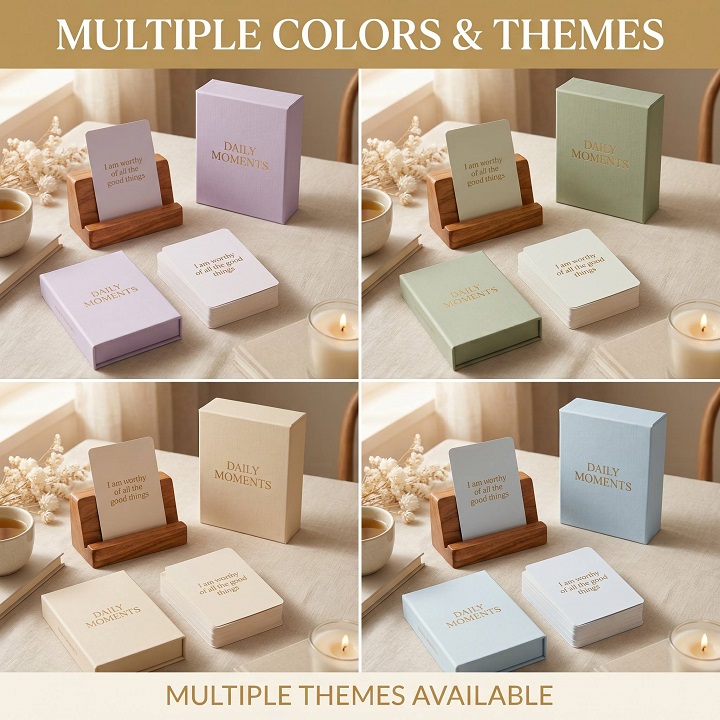
A reliable manufacturing process reduces revisions, delays, and quality issues.
1. Define the audience and use case. Identify whether the deck is for personal use, therapy, education, corporate wellbeing, or retail gifting.
2. Create the content framework. Decide the number of cards, categories, tone, reading level, and whether the deck includes instructions or a guidebook.
3. Develop print-ready artwork. Use CMYK color, bleed, safe margins, high-resolution images, and embedded fonts.
4. Choose specifications. Confirm card size, stock, coating, corners, card count, box style, and inserts.
5. Request a pre-production proof. Review color accuracy, text alignment, finish, and material feel.
6. Approve a signed sample. Test shuffling, readability, edge quality, and packaging fit.
7. Proceed to mass production and QC. Check print registration, color consistency, coating defects, card count, and carton condition before shipment.
XingKun provides OEM and ODM customization across packaging, cards, printed books, stickers, and related printed products, supporting brands from design requirements through production. The company was established in 2004 and specializes in custom printed and packaging products, including playing cards, flash cards, notebooks, boxes, labels, and display stands. [xkdisplay]
Packaging: Turn a Card Deck Into a Retail Product
Packaging strongly influences perceived value, shelf appeal, and giftability. A basic tuck box works well for accessible decks, while premium wellness products often benefit from more protective and presentational packaging.
Common packaging options include:
- Tuck box: Lightweight, cost-effective, and familiar to card buyers.
- Rigid two-piece box: Premium feel and strong shelf presence.
- Magnetic closure box: Ideal for luxury gift sets and higher price points.
- Drawer box: Creates an interactive unboxing experience.
- Slipcase: Adds protection and branding without a full rigid box.
- Custom insert: Holds cards securely and prevents movement during shipping.
- Guidebook or booklet: Adds educational value and supports deeper reflection.
For retail-ready affirmation decks, we recommend a rigid box or magnetic closure box with a custom insert, especially when the deck includes foil, gilded edges, or a guidebook. The packaging should protect the cards while reinforcing the emotional promise of the product.
Sustainability Considerations
Sustainability is now a practical purchasing criterion, particularly for wellness audiences. Brands can reduce environmental impact by:
- Choosing FSC-certified, recycled, or responsibly sourced paper where available. [bookprintingchina]
- Using soy-based or low-VOC inks where the supplier supports them. [xinyicardprinting]
- Avoiding unnecessary plastic shrink wrap.
- Selecting recyclable paperboard packaging.
- Designing decks with lasting value rather than disposable promotional appeal.
- Printing clear recycling guidance on the box.
Be careful with environmental claims. Use specific, verifiable language such as "printed on FSC-certified paper" only when certification documentation supports it.
Quality Control Checklist Before Mass Production
Before approving production, check the following:
- Card count: Confirm every deck contains the correct number of cards.
- Color accuracy: Compare printed samples with approved artwork under neutral lighting.
- Text legibility: Check small type, contrast, and finish glare.
- Card stiffness: Bend-test sample cards gently; they should recover without creasing.
- Opacity: Ensure artwork or text does not show through the reverse side.
- Cutting accuracy: Inspect edges, corners, and size consistency.
- Finish durability: Rub-test lamination, foil, and spot UV areas.
- Packaging fit: Cards should not be too loose or too tight.
- Shipping carton strength: Confirm cartons protect decks during international transit.
A pre-production sample is the lowest-cost way to prevent expensive errors. It also gives your team a physical reference for future reorders.
How XingKun Supports Custom Affirmation Card Projects
Shenzhen XingKun Packing Products Co., Ltd. supports OEM and ODM production for brands, wholesalers, and product developers. Its capabilities extend beyond card printing to custom packaging boxes, printed books, stickers, labels, display stands, and related printed components—allowing brands to consolidate card decks, guidebooks, and packaging within one supply chain. [xkdisplay]
For a custom affirmation card project, XingKun can help with:
- Custom card dimensions and die-cut shapes.
- CMYK or special-color printing.
- Cardstock, black-core, kraft, textured, recycled, and specialty material options.
- Matte, gloss, soft-touch, spot UV, foil, embossing, and gilded-edge finishes.
- Tuck boxes, rigid boxes, magnetic boxes, inserts, and guidebooks.
- Sample approval, production support, and export-ready packaging.
Explore XingKun's custom affirmation card service here: [Custom Affirmation Cards].
Conclusion
Custom affirmation cards can be a powerful wellness product when they combine thoughtful messaging, durable materials, readable design, and premium packaging. The most successful decks do not rely on exaggerated promises; they create a useful daily ritual built around values, reflection, and small positive actions.
For brands entering this category, start with a clear audience, choose a card format that fits real-world use, invest in a tactile finish, and validate the product with a physical sample. With the right manufacturing partner, a custom affirmation deck can become a distinctive, giftable, and repeat-purchase product that reflects your brand's values.
Ready to create your own custom affirmation cards? Contact XingKun for a tailored quotation, material recommendation, and pre-production sample.
FAQ
1. What is the best size for custom affirmation cards?
Tarot size, 2.75 × 4.75 inches (70 × 120 mm), is a strong all-purpose choice because it offers enough space for artwork and text while remaining easy to hold. Poker size is better for compact travel decks, while 3.5 × 5-inch oracle size suits premium, illustration-heavy decks. [qinprinting]
2. What cardstock should I use for affirmation cards?
For most decks, 300–350 gsm art paper offers a practical balance of cost, flexibility, and durability. For luxury decks, choose 350–400 gsm with matte or soft-touch lamination. For frequent shuffling, black-core or blue-core paper provides better stiffness and opacity. [bookprintingchina]
3. Are affirmation cards scientifically proven to work?
Affirmation cards can support reflection and positive self-talk, but they are not a treatment for mental-health conditions. Research on values-based self-affirmation shows potential benefits for stress responses and wellbeing, although effects vary and are often small. [journals.sagepub]
4. What finish is best for affirmation cards?
Matte lamination or soft-touch lamination is usually best for affirmation cards because it reduces glare and makes text comfortable to read. Gloss, spot UV, foil stamping, embossing, and gilded edges can be added for visual impact or premium positioning. [qinprinting]
5. How many cards should an affirmation deck contain?
Common decks range from about 30 to 100 cards. A 52-card deck is familiar and easy to organize by theme, while a 30–40 card deck can feel more focused and affordable. Choose the number based on your content categories, price point, and packaging size.
6. Can I customize the box and include a guidebook?
Yes. Custom affirmation card projects can include tuck boxes, rigid boxes, magnetic closure boxes, inserts, instruction cards, and printed guidebooks. Packaging should be selected based on retail positioning, card quantity, and shipping requirements. [bookprintingchina]
References
1. XingKun — Custom Affirmation Cards product page: [https://www.xkdisplay.com/custom-affirmation-cards.html]
2. XingKun — About Us: [https://www.xkdisplay.com/aboutus.html]
3. Creswell, J. D., et al. (2005). *Affirmation of Personal Values Buffers Neuroendocrine and Psychological Stress Responses*, Psychological Science: [https://journals.sagepub.com/doi/10.1111/j.1467-9280.2005.01624.x]
4. Cohen, G. L., & Sherman, D. K. (2013). *Self-Affirmation: Understanding the Effects*, Social and Personality Psychology Compass: [https://onlinelibrary.wiley.com/doi/pdf/10.1111/spc3.12072]
5. McQueen, A., et al. (2024). *Internal and external self-affirmation resources*, PMC: [https://pmc.ncbi.nlm.nih.gov/articles/PMC11024277/]
6. The Conversation (2026). *Do positive affirmations work? A psychologist unpacks the evidence*: [https://theconversation.com/do-positive-affirmations-work-a-psychologist-unpacks-the-evidence-266464]
7. NIQ (2025). *Global State of Health & Wellness 2025*: [https://nielseniq.com/global/en/wp-content/uploads/sites/4/2025/05/Global-State-of-Health-Wellness-2025_FINAL-1-2.pdf]
8. Global Wellness Institute (2025). *Global Wellness Economy Monitor 2025*: [https://globalwellnessinstitute.org/wp-content/uploads/2025/11/2025-GWI-WE-Monitor_DIGITAL-FINAL.pdf]
9. QinPrinting — Custom Affirmation Card Printing: [https://www.qinprinting.com/custom-affirmation-cards/]
10. BookPrintingChina — Affirmation Card Printing: [https://www.bookprintingchina.com/affirmation-card-printing]
11. EzraCard — Custom Affirmation Cards Printing & Manufacturing: [https://ezracard.com/products/custom-affirmation-cards/]
12. WJPC — Custom Positive Affirmation Cards Printing: [https://wjplayingcard.com/product/positive-affirmation-cards/]
13. Xinyi Card Printing — Guide to Manufacturing Custom Affirmation Card Sets: [https://xinyicardprinting.com/manufacturing-custom-affirmation-card-sets/]


