Content Menu
● What Is Hot Foil Stamping?
● How the Hot Foil Stamping Process Works
>> 1. Prepare the Foil Artwork
>> 2. Select the Substrate and Foil
>> 3. Manufacture the Stamping Die
>> 4. Establish the Operating Settings
>> 5. Inspect and Approve the Result
● Choosing Hot Stamping Foil for Custom Packaging Boxes
● Hot Foil Stamping vs. Cold Foil and Embossing
● Designing Foil Artwork That Survives Production
>> Check Fine Lines and Small Text
>> Treat Large Solids as a Separate Challenge
>> Respect Folds, Edges, and Assembly
● A Practical Hot Foil Stamping Quality Checklist
● Common Foil Stamping Defects and What to Investigate
● What Determines Hot Foil Stamping Cost?
● Packaging Scenarios: Matching the Finish to the Product
>> Cosmetic Folding Carton
>> Premium Rigid Gift Box
>> Seasonal Promotional Packaging
● Is Foil-Stamped Paper Packaging Recyclable?
● How to Brief Your Packaging Manufacturer
● Plan Your Custom Foil-Stamped Packaging
● Frequently Asked Questions
>> Can Hot Foil Stamping Be Used on Textured Paper?
>> Does Hot Foil Stamping Always Create a Raised Design?
>> Can Foil Be Applied Over Lamination?
>> Is Gold Foil More Expensive Than Silver Foil?
>> What Files Should I Supply?
>> How Can I Improve Repeat-Order Consistency?
● References
Hot foil stamping gives packaging boxes a distinctive metallic or colored finish through heat, pressure, and a precisely made die. For brands developing cosmetic cartons, gift boxes, or premium retail packaging, it can turn a simple logo into a memorable visual feature. However, attractive results depend on more than choosing gold or silver foil.
At Shenzhen XingKun Packing Products Co., Ltd., we approach packaging decoration as part of the complete product specification. With more than 20 years of printing and packaging experience, serving brands and distributors across over 30 countries and regions, our focus is connecting design expectations with practical manufacturing requirements.
This guide explains how hot foil stamping works, what affects its quality, and how to prepare a packaging project for a more productive supplier discussion.
What Is Hot Foil Stamping?
Hot foil stamping is a finishing process that transfers a decorative layer from a carrier film onto a substrate using a heated die.
The die carries the artwork. When it presses against the foil and packaging surface, heat and pressure enable the selected decorative areas to bond to the material. The carrier film separates, leaving the stamped design behind.
Unlike metallic printing ink, the effect comes from a transferred decorative layer. Depending on the foil selected, the result can be reflective, opaque, patterned, or holographic.
Common applications include:
- Brand logos on folding cartons.
- Product names on rigid gift boxes.
- Decorative borders on presentation packaging.
- Premium details on sleeves and printed inserts.
- Coordinated finishes across packaging and promotional materials.
Hot foil stamping is not automatically an embossed finish. A raised effect requires an embossing operation or suitable combination tooling.
How the Hot Foil Stamping Process Works
A successful production run begins before the press starts. Artwork, material selection, tooling, and sampling all influence the result.
1. Prepare the Foil Artwork
The foil design should be supplied as a clearly separated production element, preferably using vector artwork.
Keep the foil layer distinct from printed graphics, cutting lines, and crease positions. Convert text to outlines when requested by the supplier, and identify every area intended for stamping.
Do not assume that a design that looks sharp on a screen will reproduce equally well on textured paperboard.
2. Select the Substrate and Foil
Foil must suit the actual surface receiving it.
Uncoated paper, coated board, laminated sheets, and textured wrapping papers can behave differently. A foil suitable for one surface may not transfer cleanly onto another.
Specify the final surface construction, including coatings or lamination. Testing bare board alone does not establish performance on the finished packaging.
3. Manufacture the Stamping Die
The die reproduces the design and transfers heat and pressure to the selected areas.
Magnesium, copper, and brass are among the materials used for graphic finishing dies. Selection depends on artwork, substrate, production requirements, and whether embossing is involved.
The lowest tooling price is not necessarily the lowest overall production cost.
4. Establish the Operating Settings
Temperature, pressure, and dwell time—the duration of contact—work together.
There is no universal setting suitable for every packaging project. The correct combination depends on the foil, surface, artwork, tooling, and equipment.
Settings should follow supplier guidance and be confirmed through controlled trials rather than copied from an unrelated job.
5. Inspect and Approve the Result
Review transfer completeness, edge definition, positioning, and surface damage.
Approval should cover the actual packaging construction, not simply an isolated stamped sheet. Folding, wrapping, and assembly may reveal issues that are difficult to see in a flat sample.
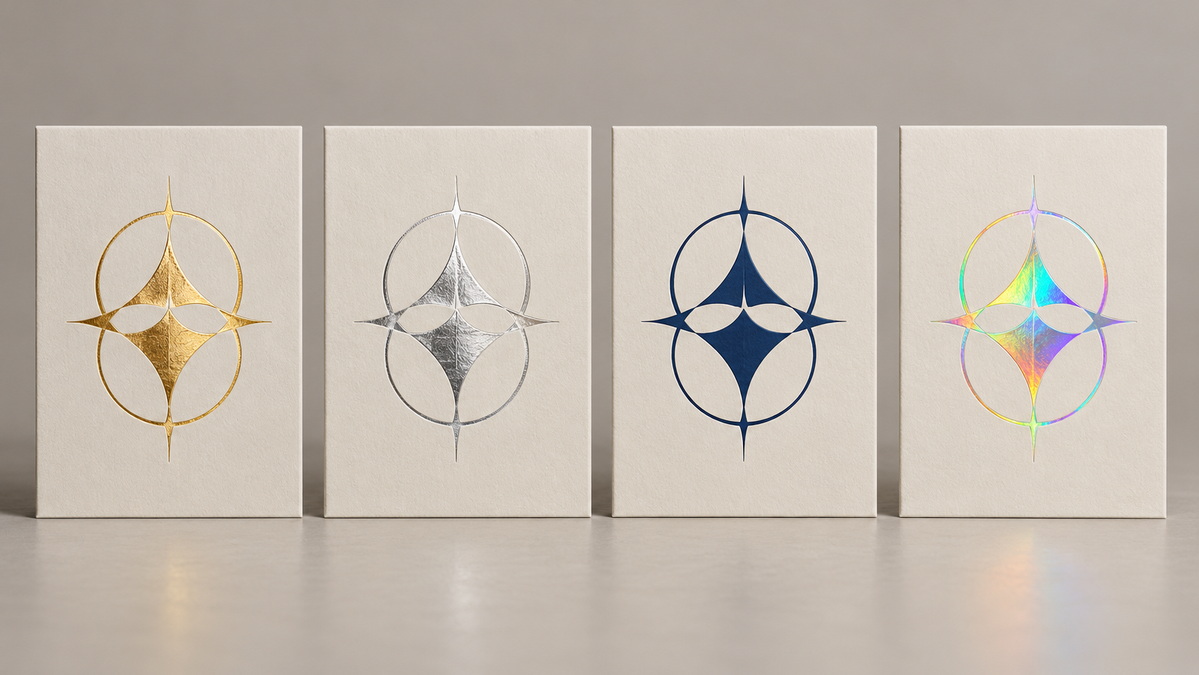
Choosing Hot Stamping Foil for Custom Packaging Boxes
Start with the intended visual effect, then confirm technical compatibility.
| Foil type | Typical appearance | Packaging application | Main consideration |
| Metallic foil | Reflective gold, silver, or colored metal | Logos, borders, product names | Shade and transfer quality on the selected surface |
| Pigment foil | Opaque, nonmetallic color | Minimalist branding and contrasting details | Coverage and edge definition |
| Holographic foil | Changing patterns and light effects | Promotional or distinctive packaging | Pattern selection and visual consistency |
| Specialty effect foil | Decorative textures or patterned effects | Limited editions and creative packaging | Availability and suitability for the artwork |
A holographic appearance alone does not establish an effective authentication system. Security applications require purpose-designed features and appropriate controls.
For brand consistency, approve the specific foil grade and shade. "Gold foil" is too broad a description for repeatable purchasing.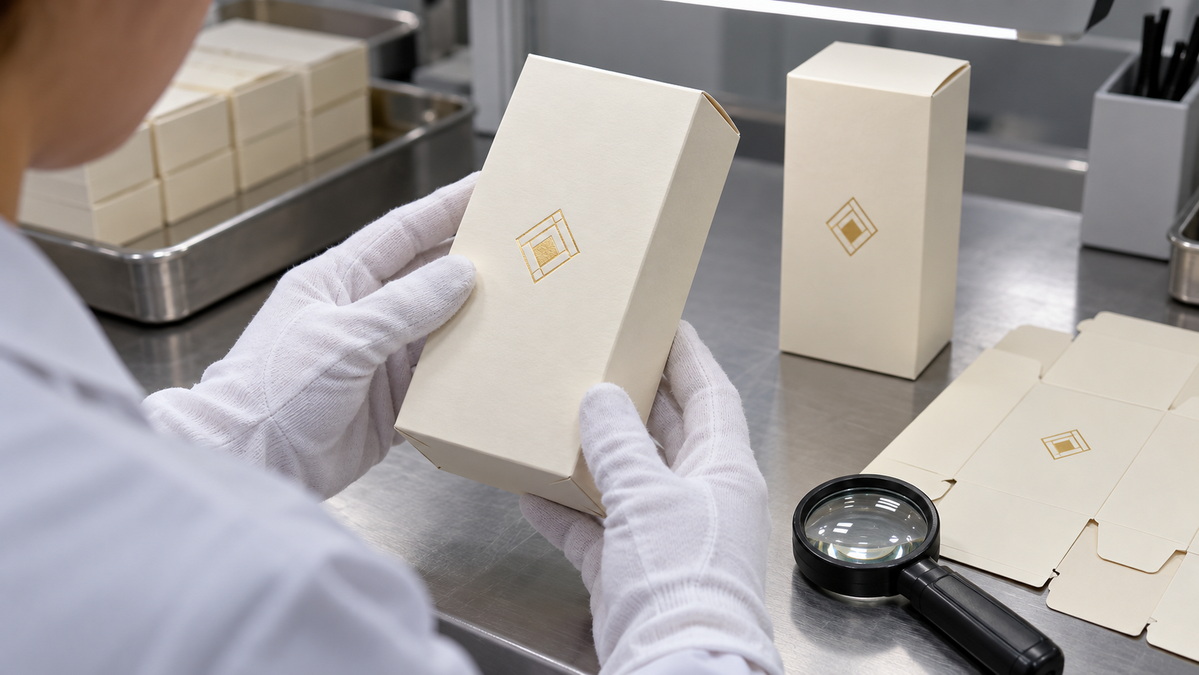
Hot Foil Stamping vs. Cold Foil and Embossing
These processes create different effects and should not be treated as interchangeable.
Hot foil stamping uses a heated die to transfer decoration. Cold foil transfer uses an adhesive-based process rather than a heated image die. Embossing changes the surface profile, creating a raised design.
Hot foil stamping is worth evaluating when a project needs selective metallic decoration, opaque details, or a combination of foil and relief.
Cold foil may be relevant when the production workflow favors adhesive-based transfer or integrated printing effects.
Embossing is appropriate when touch and dimensional form are central to the design. It can be used without foil or combined with it.
The practical question is not which process is universally better. It is which process achieves the desired appearance on the specified material at an acceptable cost.
Designing Foil Artwork That Survives Production
The most useful design review considers the finished box rather than the artwork alone.
Check Fine Lines and Small Text
Fine strokes, narrow gaps, and tiny lettering can become difficult to reproduce consistently.
Ask the manufacturer to assess the smallest positive lines and negative spaces. Avoid adopting a universal minimum without checking the substrate and production method.
Textured surfaces may require a different approach from smooth coated board.
Treat Large Solids as a Separate Challenge
A broad metallic panel is not simply a larger version of a small logo.
Large areas require consistent contact and transfer. They can make incomplete coverage or uneven appearance more noticeable.
If both delicate lettering and a large solid appear in one design, discuss whether the proposed tooling and setup can handle both reliably.
Respect Folds, Edges, and Assembly
Position foil with the box structure in mind.
A decorative element near a crease, wrapped corner, or cutting edge may require extra review. Ask for a formed sample when the design crosses a structural transition.
The objective is a clean finished package, not merely an attractive flat sheet.
A Practical Hot Foil Stamping Quality Checklist
Approval should be based on observable criteria agreed before production.
Use this checklist when reviewing samples:
1. Confirm the foil shade under consistent lighting.
2. Check complete transfer across all intended areas.
3. Inspect lettering, corners, and narrow gaps.
4. Compare positioning against printed graphics and the box structure.
5. Look for unintended impressions, distortion, or surface damage.
6. Review an assembled box, including folds and wrapped edges.
7. Agree on an appropriate handling or rub assessment.
8. Keep an approved reference sample for subsequent checks.
Avoid instructions such as "make it luxurious" as the only acceptance standard. They describe an impression, not a measurable requirement.
Where tolerances or test methods matter, document them with the supplier. The acceptance criteria should reflect the packaging's intended use.
Common Foil Stamping Defects and What to Investigate
Different problems can look similar. Troubleshooting should consider the complete setup rather than changing one setting blindly.
| Observed issue | Possible contributing factors | Investigation priority |
| Missing or patchy transfer | Surface incompatibility, uneven contact, unsuitable settings | Confirm foil and substrate compatibility |
| Filled-in lettering | Excessive transfer, tight artwork gaps, tooling limitations | Review artwork and operating conditions |
| Rough edges | Texture, die condition, unsuitable foil release | Compare surface, foil grade, and tooling |
| Misaligned decoration | Sheet positioning, setup, variation between operations | Check registration through the workflow |
| Scuffing during handling | Surface interaction or handling conditions | Assess samples under agreed handling conditions |
These are investigation starting points, not guaranteed diagnoses.
A useful corrective-action record identifies the defect, affected area, materials used, settings checked, and outcome of each controlled adjustment.
What Determines Hot Foil Stamping Cost?
The final price reflects more than the amount of visible foil.
Important cost drivers include:
- Die manufacture and preparation.
- Number of foil colors and stamping operations.
- Artwork complexity.
- Foil coverage and layout.
- Substrate and surface treatment.
- Setup time and production quantity.
- Sampling and inspection requirements.
- Additional embossing or assembly work.
Tooling and setup create fixed costs. Their contribution per box generally decreases as those costs are spread across more units, although total pricing still depends on the complete production specification.
For comparable quotations, give each supplier the same quantity, dimensions, material, artwork, finish, and delivery requirements.
Ask whether tooling, samples, and additional operations are included. Also clarify die ownership, storage, and reuse conditions for repeat orders.
Packaging Scenarios: Matching the Finish to the Product
The following examples illustrate planning decisions; they are not reported customer projects.
Cosmetic Folding Carton
A compact foil logo may provide enough contrast without covering the entire panel.
Review small lettering and foil-to-print positioning. Approve the finish on the final coated or laminated surface.
Premium Rigid Gift Box
A foil logo combined with embossing can create both visual and tactile interest.
Evaluate the wrapping paper, tooling, and assembled box together. Pay particular attention to positioning relative to the lid and wrapped edges.
Seasonal Promotional Packaging
A decorative foil can distinguish a limited edition without changing every printed element.
Confirm foil availability, sampling time, and repeatability before committing to a launch schedule.
In each case, selective decoration should support the product identity rather than compete with every other design feature.
Is Foil-Stamped Paper Packaging Recyclable?
Transfer foil decoration and foil-laminated packaging are different constructions.
In transfer stamping, the carrier film is removed rather than becoming a complete film layer on the package. Industry testing has found that certain transfer-metallic-decorated paper and board constructions can be compatible with established recycling processes.
However, this does not justify calling every foil-stamped box recyclable.
Lamination, coatings, adhesives, windows, inserts, and local collection systems also matter. Assess the complete package and the intended destination market before making an environmental claim.
Request documentation relevant to the specific materials. Avoid treating a decorative material supplier's general statement as proof for every finished packaging configuration.
How to Brief Your Packaging Manufacturer
A complete brief reduces assumptions and makes sampling more useful.
Provide:
- Product category and intended market.
- Box style, dimensions, and order quantity.
- Board or wrapping-paper specification.
- Printing, coating, and lamination requirements.
- Separate foil artwork and preferred shade.
- Embossing or debossing requirements.
- Critical positioning and visual expectations.
- Sampling deadline and required delivery date.
Include reference images to communicate appearance, but do not use them as substitutes for material specifications.
If budget flexibility is limited, identify the most important feature first. A well-executed logo may be more valuable than several decorative effects that weaken consistency or increase complexity.
Plan Your Custom Foil-Stamped Packaging
A successful finish starts with a clear specification and a representative sample.
Send Shenzhen XingKun Packing Products Co., Ltd. your box dimensions, quantity, artwork, material preferences, and target finish. Request a project-specific discussion covering foil compatibility, tooling, sampling, and quotation details before approving production.
The aim is straightforward: packaging that looks intentional, reproduces consistently, and suits the product it protects.
Frequently Asked Questions
Can Hot Foil Stamping Be Used on Textured Paper?
Yes, suitable combinations can produce good results. However, texture affects contact and transfer. Test the selected foil and artwork on the actual paper rather than relying on a smooth-paper sample.
Does Hot Foil Stamping Always Create a Raised Design?
No. Foil transfer and embossing are separate effects. Specify embossing or combination tooling when a raised finish is required.
Can Foil Be Applied Over Lamination?
It can, provided the foil and laminated surface are compatible. Confirm the complete material construction and approve a production-representative sample.
Is Gold Foil More Expensive Than Silver Foil?
Color alone is not a reliable pricing rule. Foil grade, availability, coverage, tooling, quantity, and production requirements all influence the quotation.
What Files Should I Supply?
Provide production-ready artwork with foil areas clearly separated. Vector files are generally useful for die preparation. Confirm the manufacturer's requirements for outlines, layers, and file formats before submission.
How Can I Improve Repeat-Order Consistency?
Keep an approved reference sample and record the material specification, foil grade, artwork revision, and agreed acceptance criteria. Confirm any material substitutions before the next production run.
References
1. Custom Box Makers. "What Is Hot Foil Stamping?" Original article supplied for restructuring; used as the starting point for process descriptions, foil categories, and the assessment of content gaps. [customboxmakers]
2. LEONHARD KURZ. "KURZ Hot Stamping." Manufacturer guidance on hot stamping applications, compatible surfaces, and the role of carrier film in decorative transfer. [kurz-graphics]
3. OWOSSO Graphic Arts. "Tech Tips." Technical guidance covering heat, pressure, dwell time, and the selection of magnesium, copper, and brass dies. [owosso]
4. American Forest & Paper Association. "Design Guidance for Recyclability of Paper-Based Packaging," 2021. Guidance discussing foil treatments, transfer decoration, and considerations affecting paper-packaging recyclability. [afandpa]
5. Foil & Specialty Effects Association. "Sustainability & Green Initiatives." Industry testing and information concerning the recyclability and sorting of fiber-based transfer-metallic-decorated materials. Findings should not be generalized to every finished package. [fsea]
6. KURZ USA. "Hot Foil Stamping, Cold Foil Transfer, and Digital Embellishment." Industry overview identifying distinct decorative transfer technologies. [kurzusa]
7. Shenzhen XingKun Packing Products Co., Ltd. Company information supplied for this article: more than 20 years of experience and service to brands and distributors across more than 30 countries and regions. These statements were provided by the commissioning company and were not independently verified. No customer reviews were supplied or invented.


