Content Menu
● Magnetic Closure Boxes vs Lid and Base Boxes at a Glance
● What Are Magnetic Closure Boxes?
>> Why Brands Choose Custom Magnetic Closure Boxes
● What Are Lid and Base Boxes?
>> Why Two-Piece Rigid Boxes Remain Versatile
● Comparing the Unboxing Experience
>> Magnetic Closure Boxes: A Guided Reveal
>> Lid and Base Boxes: A Complete Reveal
● Product Protection: Look Beyond the Closure
>> Match the Insert to the Product
>> Validate the Complete Shipping System
● Cost Comparison: Unit Price Is Only the Beginning
>> Request Like-for-Like Quotations
>> Compare Total Landed and Operating Cost
● Shipping and Storage: When Collapsible Magnetic Boxes Matter
>> Flat-Pack Benefits Come With Assembly Requirements
>> Consider the Final Shipping Carton
● Sustainability: Evaluate the Whole Package
>> Understand Non-Paper Components
>> Use Precise Environmental Claims
● An Expert Sampling Checklist for Both Box Styles
>> Magnetic Closure Box Checks
>> Lid and Base Box Checks
● Practical Selection Scenarios
>> Scenario 1: A Premium Skincare Gift Set
>> Scenario 2: A Fashion Accessory Collection
>> Scenario 3: A Multi-Market Promotional Campaign
● Conclusion
● Frequently Asked Questions
>> Are Magnetic Closure Boxes Always More Expensive?
>> Are Lid and Base Boxes Suitable for Luxury Products?
>> Can Magnetic Closure Boxes Be Shipped Flat?
>> Which Box Style Protects Fragile Products Better?
>> Are Magnetic Closure Boxes Recyclable?
>> What Information Should I Send for a Packaging Quotation?
● References
Magnetic closure boxes vs lid and base boxes is not simply a choice between two attractive packaging styles. It is a decision about product protection, customer experience, production complexity, shipping efficiency, and total cost. Both structures can create premium packaging, but they achieve that result differently.
At Shenzhen XingKun Packing Products Co., Ltd.,our company background includes more than 20 years of printing and packaging experience and service to brands and distributors across over 30 countries and regions. Our perspective is practical: packaging should look impressive while remaining appropriate for the product, packing process, and distribution channel.
The best choice is the structure that performs reliably throughout that journey—not necessarily the one with the most elaborate closure.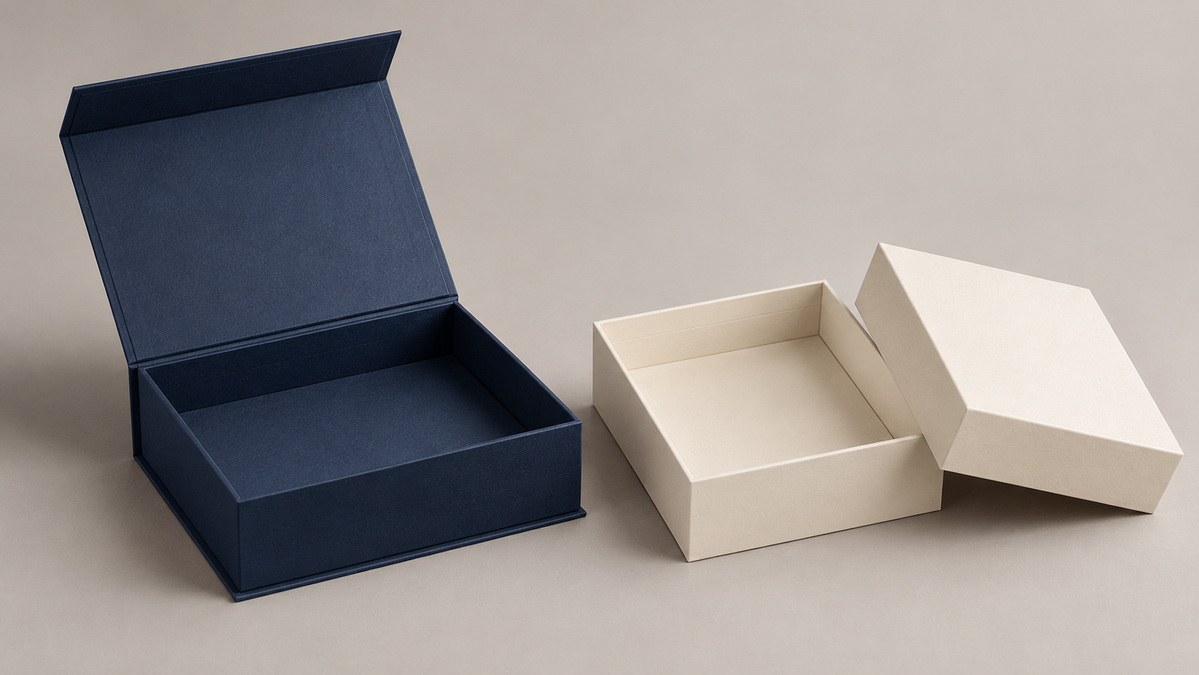
Magnetic Closure Boxes vs Lid and Base Boxes at a Glance
The comparison below focuses on paperboard-based rigid packaging. Actual performance depends on dimensions, materials, inserts, construction quality, and finishing.
| Comparison factor | Magnetic closure boxes | Lid and base boxes |
| Basic construction | Attached hinged lid with concealed magnets | Separate removable lid and base |
| Opening experience | Controlled, book-style reveal | Lift-off reveal with unrestricted access |
| Reclosing | Magnetic engagement helps retain the lid | Depends on fit and lid overlap |
| Production considerations | Requires hinge and magnet alignment | Requires consistent lid-to-base clearance |
| Cost tendency | Additional components can increase cost | Simpler construction can support cost control |
| Storage format | Available in assembled or collapsible designs | Conventional rigid versions remain assembled |
| Presentation | Useful for staged reveals and interior messages | Useful for clean, symmetrical product presentation |
| Recycling considerations | Embedded magnets add non-paper components | Magnet-free versions avoid this particular complication |
| Typical applications | Gift sets, presentation kits, premium accessories | Apparel, confectionery, cosmetics, jewelry |
Neither structure automatically provides superior shipping protection. The complete packaging system must be evaluated.
What Are Magnetic Closure Boxes?
Magnetic closure boxes typically combine a rigid paperboard body, an attached lid, and concealed magnets. The lid opens along a hinge and closes when the magnetic components align.
The exterior usually consists of printed or decorative paper wrapped around the structural board. The interior can accommodate inserts, printed messages, or compartments.
Why Brands Choose Custom Magnetic Closure Boxes
This structure provides a deliberate opening sequence. Customers lift the flap, open the lid, and discover the product inside.
That sequence creates several design opportunities:
- A welcome message inside the lid.
- Instructions positioned before the product reveal.
- Separate compartments for accessories.
- A reusable presentation format.
I would prioritize this style when the opening experience contributes meaningfully to the product proposition. A carefully organized skincare collection, for example, may benefit from an attached lid and staged presentation.
However, magnets do not compensate for weak board, poor insert design, or inaccurate construction.
What Are Lid and Base Boxes?
Lid and base boxes, also called two-piece rigid boxes or lift-off lid boxes, consist of two independent components. The lid fits over the base, with the overlap and clearance determining how the box opens.
Different configurations produce different experiences. A shallow lid exposes more of the base, while a deeper lid creates a more enclosed appearance.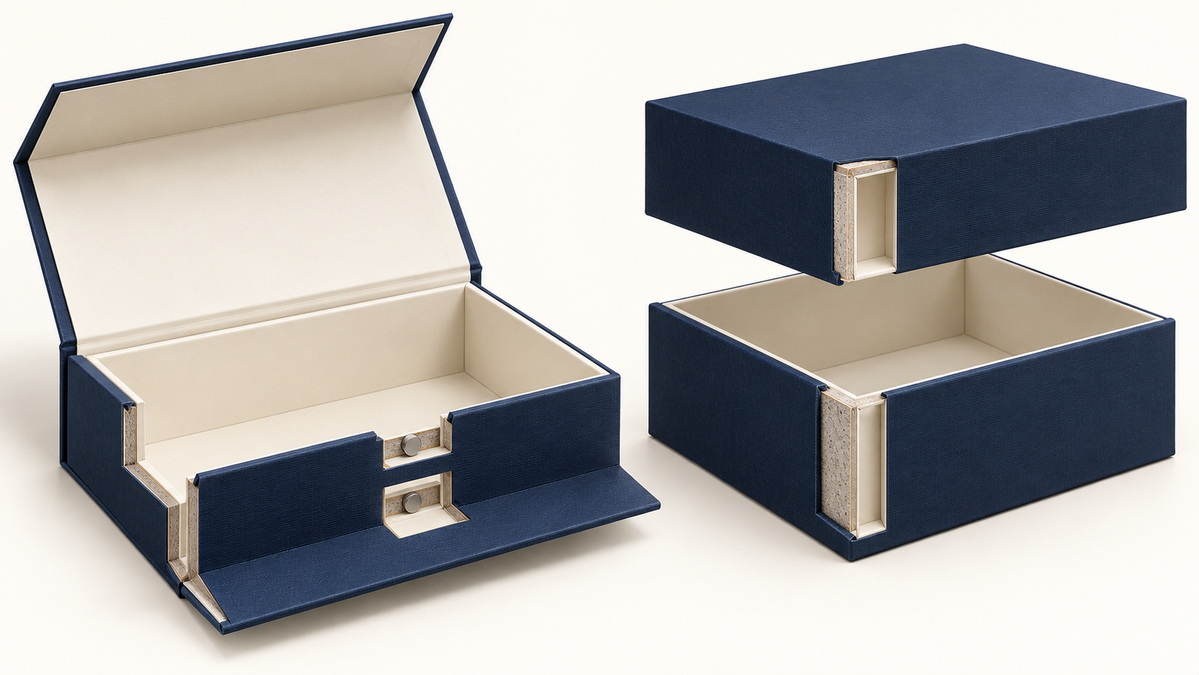
Why Two-Piece Rigid Boxes Remain Versatile
The structure is straightforward without being visually basic. Premium papers, restrained printing, foil details, embossing, and well-designed inserts can create a sophisticated result.
Once the lid is removed, customers have unobstructed access to the product. This can suit folded apparel, coordinated gift sets, and products that benefit from a full overhead view.
The main engineering challenge is fit. A loose lid may feel imprecise; an excessively tight lid may frustrate the customer.
Comparing the Unboxing Experience
The most useful question is not "Which box looks more luxurious?" It is "How should customers encounter the product?"
Magnetic Closure Boxes: A Guided Reveal
An attached lid keeps the opening motion predictable. It also gives designers a stable surface for interior messaging.
For a presentation kit, this may help organize the sequence:
1. Introduce the brand.
2. Explain the product.
3. Reveal the contents.
4. Present supporting accessories.
The potential drawback is space. A hinged lid needs room to open and may remain upright during product removal.
Lid and Base Boxes: A Complete Reveal
A removable lid allows customers to see the whole arrangement immediately. It also gives them freedom to move the lid away.
This is useful when the contents should speak for themselves. A precisely arranged accessory set may need little additional explanation.
However, customers must handle a separate component. In retail or fulfillment operations, staff must also keep lids and bases correctly paired.
Product Protection: Look Beyond the Closure
A magnetic closure can retain a flap, but it is not a substitute for cushioning. Similarly, a deep lift-off lid does not guarantee protection against drops.
Protection depends on several connected factors:
- Structural board selection.
- Product weight and geometry.
- Insert fit and support.
- Internal clearance.
- Outer shipping protection.
- Handling and transport conditions.
Match the Insert to the Product
A fragile bottle needs support that limits movement and protects vulnerable areas. A polished accessory may require surfaces that minimize abrasion.
Paperboard dividers, molded fiber, foam, and other insert materials serve different purposes. Select them around the product's risks rather than appearance alone.
For both box styles, check that removing the product feels easy without allowing excessive movement during handling.
Validate the Complete Shipping System
For parcel distribution, test the product, presentation box, cushioning, and outer shipping carton together.
ISTA Procedure 3A provides a general simulation framework for individual packaged products moving through parcel delivery systems. Its relevance is the complete packaged product—not the decorative box in isolation.
Choose a suitable test plan with a qualified packaging laboratory and define acceptable damage before testing.
Cost Comparison: Unit Price Is Only the Beginning
Magnetic closure boxes often require more components and alignment work. These factors can increase manufacturing cost.
Lid and base boxes can offer a simpler construction route. Nevertheless, premium wrapping materials, complicated inserts, large dimensions, and demanding finishes can make a two-piece box expensive.
Request Like-for-Like Quotations
To compare prices fairly, keep these specifications consistent:
- Internal dimensions.
- Structural materials.
- Wrapping paper.
- Printing coverage.
- Finishing requirements.
- Insert design.
- Order quantity.
- Delivery terms.
Otherwise, a lower quotation may simply represent a different package.
Compare Total Landed and Operating Cost
A practical comparison includes:
> Total packaging cost = box price + inserts + freight + storage + packing labor + packaging-related losses.
This is a decision framework, not a universal accounting formula. Include only relevant costs and avoid counting the same expense twice.
A cheaper box can become less economical if it consumes more storage space, slows packing, or requires additional protective materials.
Shipping and Storage: When Collapsible Magnetic Boxes Matter
Some magnetic closure boxes are designed to fold flat before assembly. Conventional rigid magnetic boxes are not.
That distinction matters more than the presence of magnets.
Flat-Pack Benefits Come With Assembly Requirements
Collapsible magnetic boxes may reduce inbound storage and shipping volume. However, the destination team must assemble them.
Before choosing this format, evaluate:
1. Packed-carton dimensions.
2. Quantity per carton.
3. Assembly time.
4. Assembly consistency.
5. Space available at the packing station.
Do not assume savings without comparing actual carton specifications and labor requirements.
Consider the Final Shipping Carton
Dimensional weight can influence parcel charges when a package occupies substantial space relative to its actual weight. FedEx explains that applicable charges can be based on dimensional or actual weight, whichever is greater.
Consequently, unnecessary packaging volume can affect outbound costs.
Ask whether either box design can reduce external dimensions without compromising product clearance, appearance, or protection.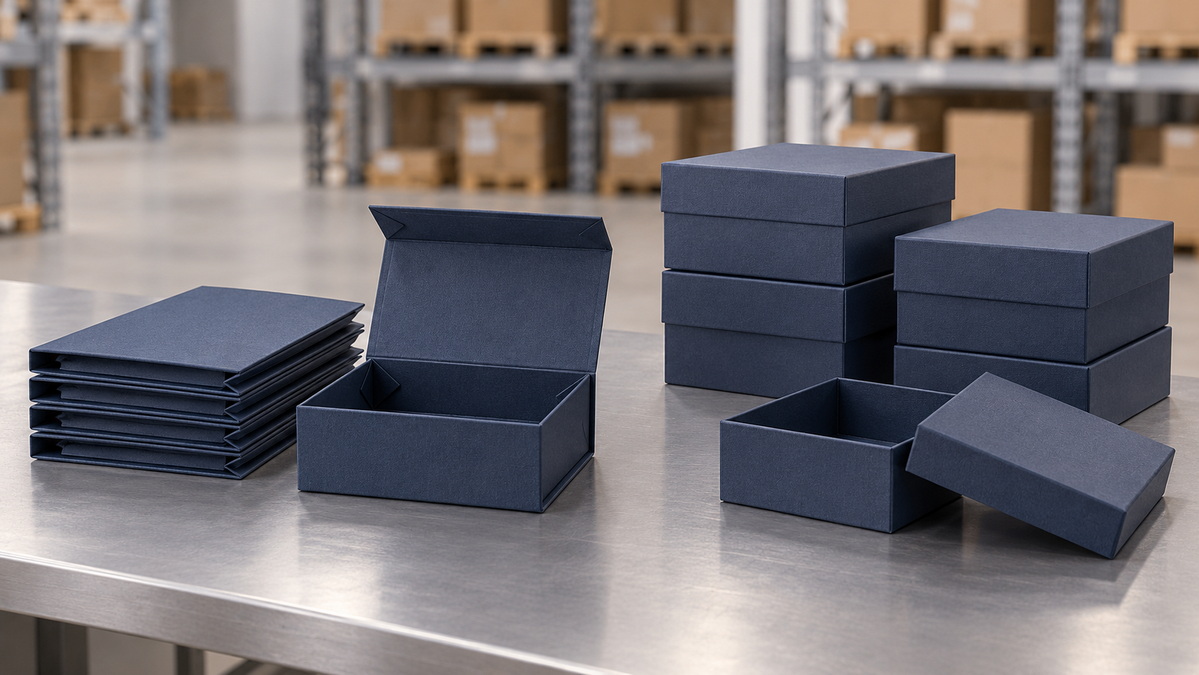
Sustainability: Evaluate the Whole Package
Neither magnetic closure boxes nor lid and base boxes are automatically sustainable.
Material selection, packaging weight, transport volume, reuse, and local recycling systems all influence the outcome.
Understand Non-Paper Components
Magnets add metal components to an otherwise paper-based structure. Laminations, adhesives, coatings, ribbons, windows, and inserts can also influence recycling compatibility.
A magnet-free lid and base box avoids one component, but that alone does not establish recyclability.
Paper industry guidance emphasizes evaluating the complete design and the recycling systems available in the intended market.
Use Precise Environmental Claims
Avoid broad promises such as "100% eco-friendly" without appropriate evidence.
Instead, identify verifiable attributes:
- Documented recycled content.
- Confirmed material sourcing.
- Reduced unnecessary components.
- Appropriate recycling instructions.
- A design suitable for repeated use.
FSC sourcing labels and recyclability answer different questions. An FSC claim concerns eligible forest-based materials and sourcing; it does not independently prove that the finished package is accepted by local recycling programs.
Request documentation before specifying any certification claim or label.
An Expert Sampling Checklist for Both Box Styles
A production sample should answer operational questions—not merely confirm color and appearance.
I would review the following points before approving either structure.
Magnetic Closure Box Checks
- Does the flap align evenly?
- Does the closure engage consistently?
- Is opening comfortable?
- Does the hinge show stress after repeated use?
- Does the insert interfere with closing?
- Are magnets securely enclosed?
Agree on inspection methods and acceptance criteria with the manufacturer. Avoid treating an arbitrary opening-cycle count as proof of long-term durability.
Lid and Base Box Checks
- Does the lid lift smoothly?
- Is clearance consistent around the perimeter?
- Does the fit change when the product is inserted?
- Are corners square and wrapping edges neat?
- Does the lid remain appropriately seated during handling?
- Can staff pair components efficiently?
Test samples with the actual product. An empty box can conceal fit and handling problems that become obvious after packing.
Practical Selection Scenarios
These are illustrative purchasing scenarios, not reported customer case studies.
Scenario 1: A Premium Skincare Gift Set
A coordinated collection may benefit from a magnetic closure box with an organized insert and an interior introduction.
Choose it when the attached lid improves presentation and the additional cost fits the product margin.
Also verify bottle restraint, leakage-related requirements, and shipping protection.
Scenario 2: A Fashion Accessory Collection
A lid and base box may suit scarves, wallets, or other accessories that benefit from an immediate full reveal.
Choose it when clean presentation and straightforward packing matter more than a guided opening sequence.
Scenario 3: A Multi-Market Promotional Campaign
A collapsible magnetic box may be worth evaluating when empty packaging travels to several regional packing locations.
Compare freight and storage advantages against local assembly labor. If assembly capacity is limited, a ready-assembled two-piece box may be operationally preferable.
Conclusion
Choosing between magnetic closure boxes and lid and base boxes comes down to your product, brand presentation, and operational requirements. Magnetic closure boxes offer a guided opening experience with an attached lid, making them a compelling option for premium gift sets and presentation kits. Lid and base boxes provide a clean, versatile structure with unrestricted product access, making them equally suitable for thoughtfully designed luxury packaging.
Neither style is automatically better. The right choice balances appearance with insert fit, protection, packing efficiency, shipping volume, and total cost. Before placing an order, compare equivalent specifications and evaluate physical samples with your actual product.
With more than 20 years of printing and packaging experience, Shenzhen XingKun Packing Products Co., Ltd. helps brands turn packaging concepts into practical custom solutions. Contact our team with your product dimensions, order quantity, and design requirements to request a side-by-side proposal for magnetic closure boxes and lid and base boxes.
Frequently Asked Questions
Are Magnetic Closure Boxes Always More Expensive?
No. They often involve additional components and construction steps, but dimensions, materials, finishes, inserts, and quantities also influence price. Compare equivalent specifications.
Are Lid and Base Boxes Suitable for Luxury Products?
Yes. Luxury presentation depends on fit, materials, printing, finishing, and product arrangement. A simple two-piece structure can produce an excellent premium experience.
Can Magnetic Closure Boxes Be Shipped Flat?
Some collapsible designs can. Standard assembled rigid magnetic boxes generally cannot. Confirm the construction and packed-carton dimensions before ordering.
Which Box Style Protects Fragile Products Better?
Neither wins automatically. Protection depends on the complete design, particularly the insert, product restraint, cushioning, and shipping carton.
Are Magnetic Closure Boxes Recyclable?
Local acceptance and material compatibility determine the answer. Embedded magnets and other non-paper components require consideration. Do not make a universal recyclability claim without supporting evidence.
What Information Should I Send for a Packaging Quotation?
Provide product dimensions and weight, quantity, target markets, intended distribution method, artwork, finish preferences, insert requirements, and delivery schedule. Include a physical product sample when practical.
References
1. [Shenzhen XingKun Packing Products Co., Ltd. — Official Website]. Company identification and custom printing and packaging service context. [xkprint-pack]
2. [PackMojo — "Luxury Rigid Box vs Magnetic Closure Box"]. Structural distinctions between attached magnetic lids and separate lid-and-base rigid boxes. [packmojo]
3. [International Safe Transit Association — Test Procedures]. General simulation testing and the scope of Procedure 3A for parcel-delivery packaged products. [ista]
4. [FedEx — "What Is Dimensional Weight?"]. Relationship between package volume, actual weight, and applicable shipping charges. [fedex]
5. [Cepi — Paper-Based Packaging Recyclability Guidelines]. Design-for-recycling considerations and differences between collection systems. [cepi]
6. [American Forest & Paper Association — Design Guidance for Recyclability]. Effects of non-fiber elements on paper-packaging recycling compatibility. [afandpa]
7. [Forest Stewardship Council — "What the FSC Labels Mean"]. Definitions of FSC material-sourcing labels, including FSC Mix and FSC Recycled. [fsc]


