Content Menu
● Hot Foil Stamping vs Spot UV: A Quick Comparison
● What Is Hot Foil Stamping?
>> What Makes Foil Look Luxurious?
>> Does Hot Foil Stamping Create Raised Lettering?
● What Is Spot UV?
>> Why Matte and Gloss Work Together
>> Conventional Spot UV vs Raised Spot UV
● Which Looks More Premium: Hot Foil Stamping or Spot UV?
>> Hot Foil Stamping: Stronger Traditional Luxury
>> Spot UV: Stronger Understated Sophistication
>> The Real Deciding Factor: Visual Hierarchy
● Material Compatibility: Why the Same Finish Can Look Different
>> Smooth, Coated, and Laminated Surfaces
>> Textured and Uncoated Papers
>> Folding Cartons vs Rigid Boxes
● Hot Foil Stamping vs Spot UV Cost: Compare the Specification
>> What Drives Hot Foil Stamping Costs?
>> What Drives Spot UV Costs?
● A Practical Sample Test Before You Commit
>> Step 1: Produce Comparable Samples
>> Step 2: Inspect Under Different Conditions
>> Step 3: Evaluate the Finished Structure
>> Step 4: Record the Decision
● Artwork Preparation: Prevent Expensive Misunderstandings
>> Create Separate Finishing Layers
>> Confirm Minimum Details Rather Than Guessing
>> Define What "Matched" Means
● Can You Combine Hot Foil Stamping and Spot UV?
● Durability, Food Packaging, and Recycling
>> Neither Finish Is Automatically More Durable
>> Food Packaging Needs Application-Specific Review
>> Assess the Whole Pack for Recycling
● Choose the Finish That Supports Your Brand
● Frequently Asked Questions
>> Is hot foil stamping more luxurious than spot UV?
>> Is spot UV cheaper than hot foil stamping?
>> Can spot UV create a gold metallic effect?
>> Can both finishes be used on matte black packaging?
>> Is raised spot UV the same as embossing?
>> Which finish should I choose for small text?
● References
Hot foil stamping vs spot UV: which finish makes packaging look more premium? Hot foil stamping generally creates the stronger impression of traditional luxury because of its metallic reflection. Spot UV delivers a more understated premium effect through selective gloss, contrast, and—in raised applications—tactile texture. Neither automatically produces better packaging. The right choice depends on your brand, artwork, materials, and the experience you want customers to have.
At Shenzhen XingKun Packing Products Co., Ltd., our packaging perspective is shaped by more than 20 years in printing and packaging production, serving brands and distributors across over 30 countries and regions. Our starting point is straightforward: choose the finish that strengthens the design, not simply the one that attracts the most attention.
Hot Foil Stamping vs Spot UV: A Quick Comparison
For buyers comparing luxury packaging finishes, the most useful distinction is metallic decoration versus selective surface gloss.
| Comparison |
Hot Foil Stamping |
Spot UV |
| Main effect |
Metallic, pigmented, or specialty decoration |
Selective clear coating, commonly high gloss |
| Premium character |
Classic, ceremonial, jewelry-like |
Contemporary, restrained, texture-focused |
| Strong applications |
Logos, borders, seals, short lettering |
Patterns, images, logos, tonal details |
| Metallic appearance |
Available with metallic foil grades |
Not from clear varnish alone |
| Tactile possibilities |
Flat decoration or relief with suitable tooling |
Conventional or raised coating |
| Main production variables |
Die, temperature, pressure, dwell time, foil compatibility |
Coating chemistry, application, curing, adhesion |
| Cost drivers |
Tooling, coverage, foil choice, passes, quantity |
Process, coverage, coating thickness, passes, quantity |
| Best selection method |
Review a production-representative sample |
Review a production-representative sample |
My practical recommendation is to choose foil when metallic identity is essential. Choose spot UV when the design needs controlled contrast without introducing another color.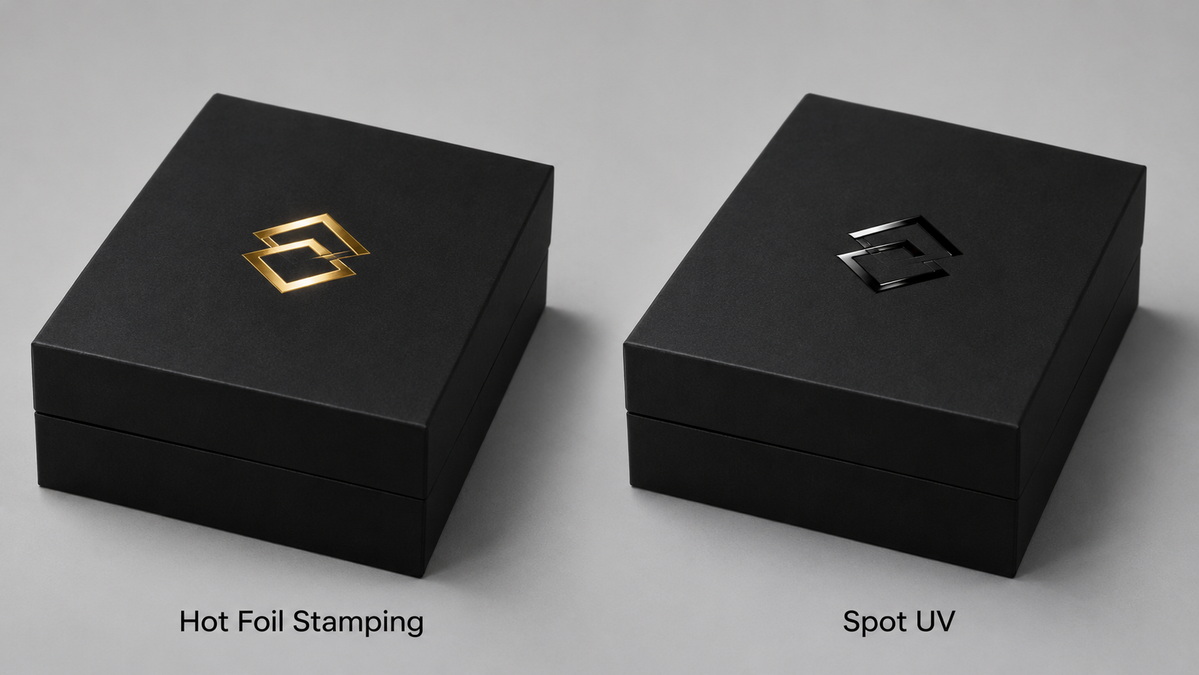
What Is Hot Foil Stamping?
Hot foil stamping uses a heated die and pressure to transfer a decorative layer from a carrier onto a substrate. The carrier is removed after transfer; it does not remain as a continuous plastic film on the finished box.
What Makes Foil Look Luxurious?
Metallic foil catches and redirects light differently from ordinary printed colors. That reflection can give a small logo or border a distinct presence.
Available effects extend beyond bright gold and silver:
- Matte metallic finishes.
- Copper and other metallic shades.
- Pigmented, nonmetallic colors.
- Holographic and diffractive effects.
- Specialty transparent or pearlescent decoration.
This variety matters. A muted metallic can suit a restrained skincare carton better than highly reflective gold.
Does Hot Foil Stamping Create Raised Lettering?
Not automatically. Conventional foil stamping can produce relatively flat decoration, sometimes with an impression depending on the material and settings.
For a deliberate raised effect, specify foil combined with embossing or suitable combination tooling. "Gold foil" alone does not communicate the required relief.
What Is Spot UV?
Spot UV applies a UV-curable coating to selected areas rather than the entire printed surface. Ultraviolet energy cures the coating into a solid layer.
The familiar effect is a glossy logo or pattern against a matte background.
Why Matte and Gloss Work Together
Spot UV relies heavily on contrast. A clear glossy pattern may look striking on a matte black carton but less noticeable on an already glossy surface.
It can highlight:
- Brand marks and product names.
- Printed illustrations.
- Geometric or repeating patterns.
- Tonal graphics.
- Selected photographic details.
Because the coating is transparent, it generally works with the underlying printed design rather than replacing it with a metallic color.
Conventional Spot UV vs Raised Spot UV
Conventional spot UV primarily changes surface gloss. Raised spot UV adds a more noticeable coating profile.
Digital embellishment systems can produce tactile varnish effects and support short-run or customized work. However, conventional and raised processes are not interchangeable. Specify the desired texture and approve a physical sample.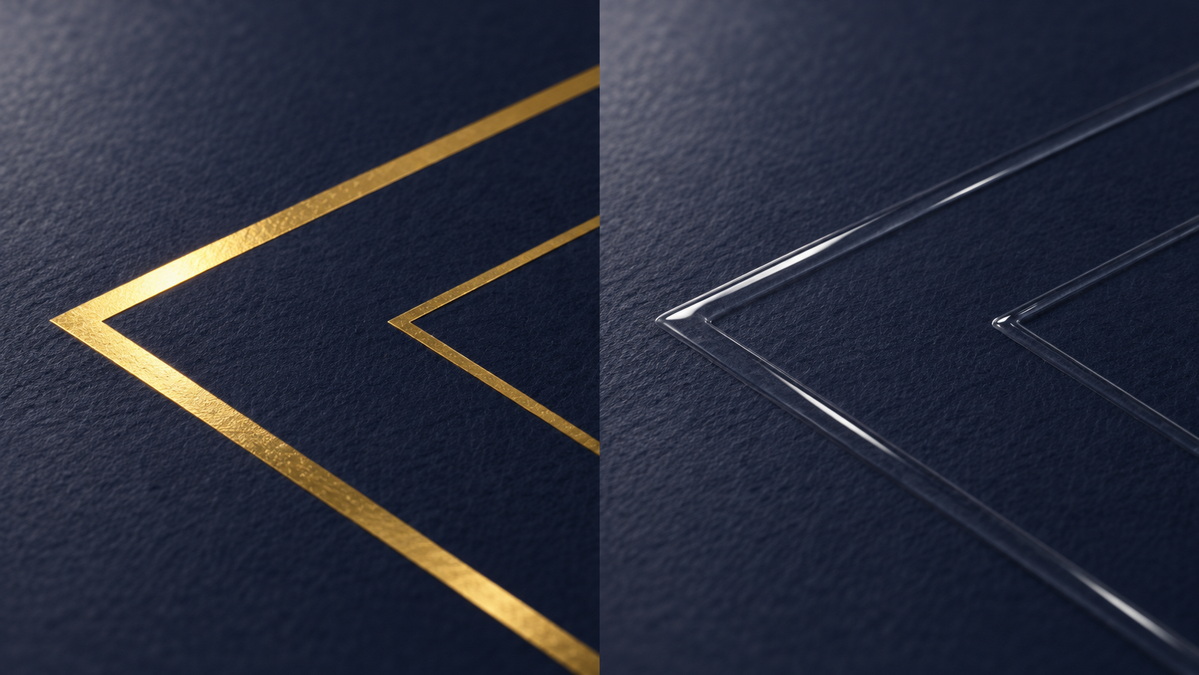
Which Looks More Premium: Hot Foil Stamping or Spot UV?
There is no universal winner. "Premium" describes a brand impression, not a measurable property of either process.
Hot Foil Stamping: Stronger Traditional Luxury
From a design perspective, foil is the stronger starting point when packaging should suggest ceremony, gifting, heritage, or ornament.
Consider a fragrance box with a restrained metallic emblem. The foil creates a focal point without requiring a complicated printed design.
However, increasing foil coverage does not necessarily increase perceived value. An oversized metallic treatment can compete with typography and weaken the intended hierarchy.
Spot UV: Stronger Understated Sophistication
Spot UV is a useful starting point when the brand should feel contemporary and controlled.
A tonal pattern on a matte electronics box can become visible as the customer rotates it. The effect rewards closer inspection rather than demanding attention immediately.
This is a design judgment, not evidence that every modern brand should use gloss.
The Real Deciding Factor: Visual Hierarchy
Ask one question before choosing either finish:
What should the customer notice first?
If the answer is the brand emblem, selective foil may be appropriate. If it is a printed illustration or subtle texture, spot UV may support the design more naturally.
The finish should direct attention, not divide it.
Material Compatibility: Why the Same Finish Can Look Different
A finish cannot be evaluated independently of the surface beneath it.
Smooth, Coated, and Laminated Surfaces
Smooth surfaces can support clean-looking detail, but compatibility still depends on the complete material system.
For foil, confirm that the selected grade works with the paper, ink, coating, or laminate.
For spot UV, confirm coating adhesion and wetting on the intended surface. A matte or soft-touch laminate should not be assumed compatible without testing.
Textured and Uncoated Papers
Textured papers introduce additional variables. Surface irregularities can affect foil coverage, while absorbency and roughness can influence the appearance of a clear coating.
These materials are not automatically unsuitable. They require a realistic design, appropriate consumables, and production trials.
Folding Cartons vs Rigid Boxes
The box structure also matters.
On folding cartons, creases and folds must remain functional. On rigid boxes, the decorated wrap must tolerate mounting and wrapping.
Keep critical decorative elements away from vulnerable folds unless the complete construction has been tested.
Hot Foil Stamping vs Spot UV Cost: Compare the Specification
Neither finish is always cheaper.
What Drives Hot Foil Stamping Costs?
Important variables include:
- Die manufacture and tooling complexity.
- Foil grade and availability.
- Decorated area and layout.
- Number of foil colors or passes.
- Registration requirements.
- Setup, spoilage, and order quantity.
A small foil logo and a large decorative panel are very different purchasing specifications.
What Drives Spot UV Costs?
Spot UV pricing depends on:
- Conventional versus digital application.
- Flat versus raised effects.
- Coating coverage and thickness.
- Surface preparation.
- Registration requirements.
- Setup and production quantity.
Digital processes may reduce certain tooling requirements, but that does not guarantee the lowest unit price.
For a meaningful comparison, request quotations using identical box dimensions, board, printing, base finish, quantity, and acceptance requirements. Change only the decorative treatment.
A Practical Sample Test Before You Commit
A useful comparison needs more than two attractive photographs. The following is a proposed buyer evaluation method, not an industry certification.
Step 1: Produce Comparable Samples
Prepare three versions where feasible:
1. The printed box without selective decoration.
2. The same design with hot foil stamping.
3. The same design with spot UV.
Use the intended substrate and base finish. Otherwise, you may be comparing different materials rather than different embellishments.
Step 2: Inspect Under Different Conditions
Review each sample:
- Face-on and at an angle.
- Under diffuse and directional light.
- At normal shelf-viewing distance.
- In typical product photography.
Check both visual impact and legibility. A reflective effect that photographs dramatically may obscure fine lettering at certain angles.
Step 3: Evaluate the Finished Structure
Assess the assembled package, not only a flat sheet.
Look for alignment, adhesion, surface marking, fold damage, and consistency. Agree with the manufacturer on appropriate handling and performance tests for the intended product.
Step 4: Record the Decision
Score each version against brand fit, readability, appearance, tactile quality, and production practicality.
Record the reasons behind approval. This creates a clearer production reference than "make it look more luxurious."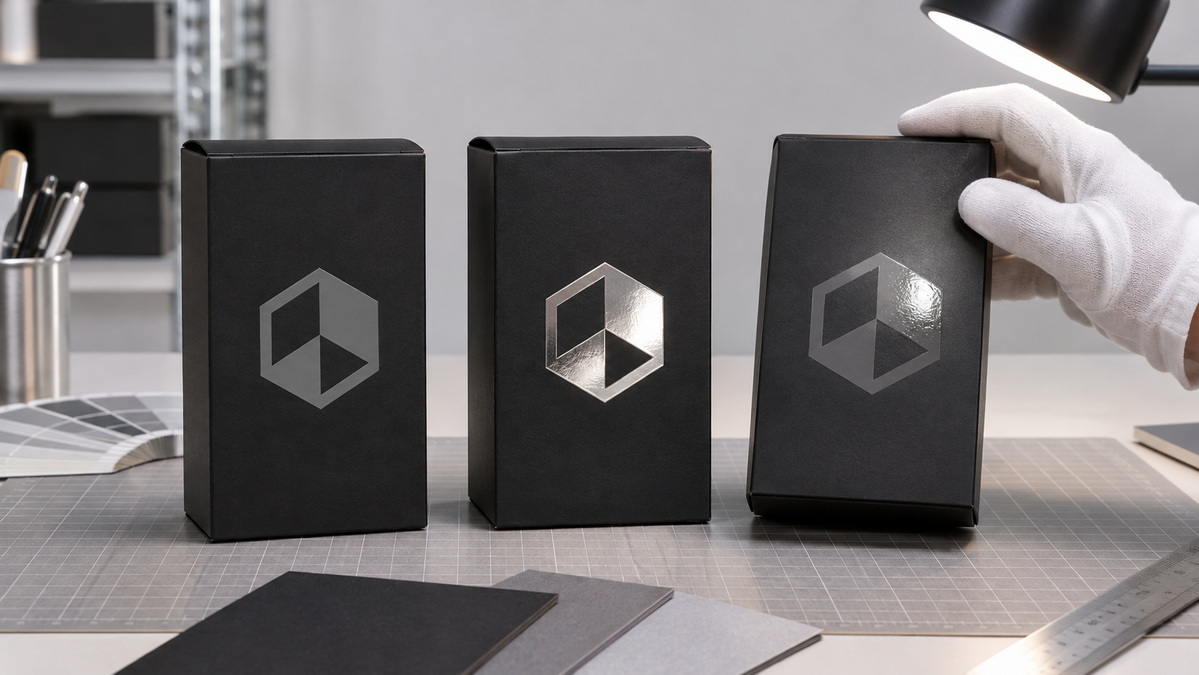
Artwork Preparation: Prevent Expensive Misunderstandings
Good artwork preparation starts with the selected manufacturer's requirements.
Create Separate Finishing Layers
Supply clearly named layers or separations for foil and spot UV. Keep the structural dieline separate and identify any embossing.
Use vector artwork where required, and confirm file format, spot-color naming, and overprint settings with the production team.
Confirm Minimum Details Rather Than Guessing
Do not apply one universal minimum line width to every job.
Feasible detail depends on the process, tooling, substrate, coating thickness, and artwork. Ask the manufacturer to review:
- Small lettering.
- Fine positive lines.
- Reversed details.
- Tight gaps.
- Large solid areas.
- Distances from creases and edges.
Define What "Matched" Means
If a coating must align precisely with printed artwork, identify those critical areas.
Agree on achievable registration and inspection criteria before production. A technically acceptable shift can still look distracting on a tightly outlined logo.
Can You Combine Hot Foil Stamping and Spot UV?
Yes. The two effects can complement each other when they have different jobs.
For example:
- Foil identifies the brand.
- Spot UV introduces a secondary pattern.
- A matte background separates both effects.
The risk is unnecessary complexity. Too many competing finishes can make packaging feel visually crowded.
Production sequencing also requires attention. If varnish overlaps foil, or foil is applied over a coated surface, the materials and process order must be compatible. Approve the combined construction rather than approving each finish separately.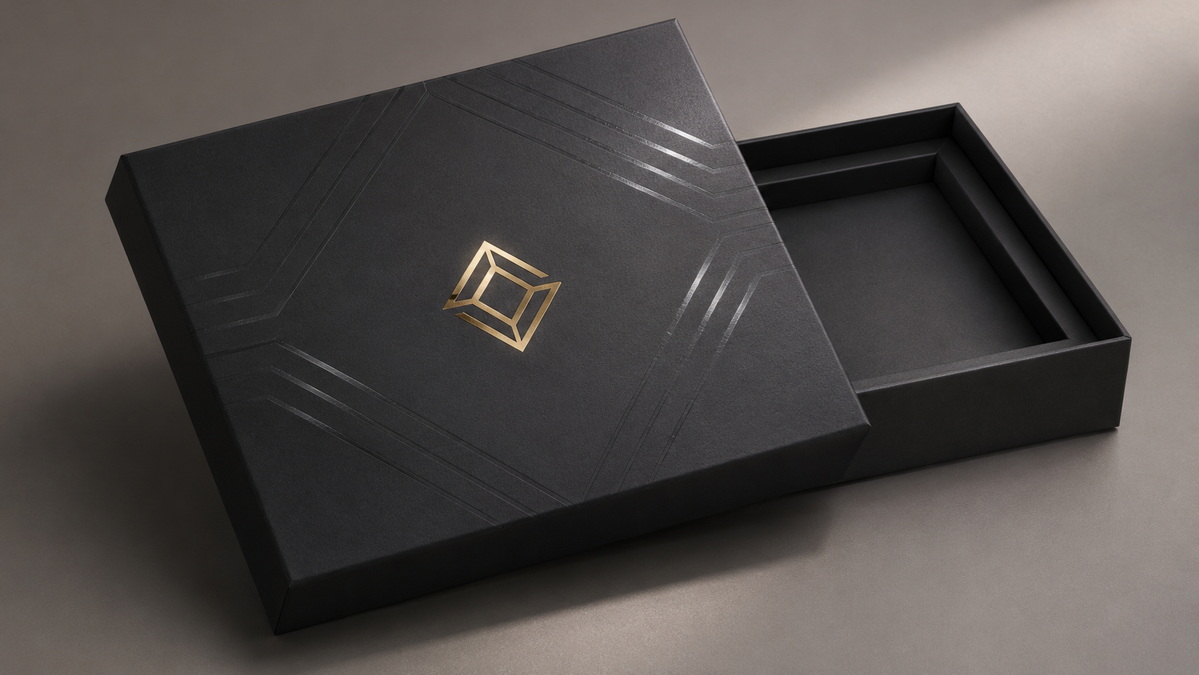
Durability, Food Packaging, and Recycling
Neither Finish Is Automatically More Durable
Performance depends on adhesion, substrate, formulation, application, curing where applicable, and handling conditions.
Spot UV does not make an entire carton waterproof. Foil decoration does not make it scratch-proof.
Specify the actual use environment instead of relying on broad durability claims.
Food Packaging Needs Application-Specific Review
UV-cured materials require appropriate formulation and curing controls for the intended packaging application.
Do not assume an exterior decoration is automatically suitable for every food package. Discuss migration, odor, barriers, and relevant compliance documentation with qualified suppliers.
Assess the Whole Pack for Recycling
KURZ reports favorable recyclability and deinking results for its tested transfer decorations. These findings should not be generalized to every foil, coating, or package.
Likewise, spot UV should not automatically be described as either recyclable or unrecyclable.
Board, laminates, adhesives, coatings, decoration, and the destination recycling system all affect the assessment. Make claims about the verified packaging construction, not just one finish.
Choose the Finish That Supports Your Brand
Choose hot foil stamping when metallic appearance is central to the design. Choose spot UV when selective gloss or tactile contrast better expresses the brand.
For an accurate recommendation, send Shenzhen XingKun Packing Products Co., Ltd. your box dimensions, artwork, order quantity, target market, product category, and preferred visual effect.
Request a comparison of suitable materials, finishing routes, and sampling options before approving bulk production. A clear specification and representative sample are more valuable than choosing a finish by name alone.
Frequently Asked Questions
Is hot foil stamping more luxurious than spot UV?
It often communicates traditional luxury more directly. Spot UV can look equally premium when the design calls for understated contrast rather than metallic decoration.
Is spot UV cheaper than hot foil stamping?
Not always. Compare the same box specification and quantity. Tooling, coverage, coating thickness, production method, and finishing passes can change the result.
Can spot UV create a gold metallic effect?
Clear spot UV does not create metallic gold by itself. It can enhance underlying artwork, but a metallic appearance requires an appropriate additional material or process.
Can both finishes be used on matte black packaging?
Yes, subject to material compatibility. Foil adds decorative contrast, while spot UV creates gloss contrast. Review fingerprints, scuffing, adhesion, and legibility on samples.
Is raised spot UV the same as embossing?
No. Raised spot UV builds a coating above the surface. Embossing reshapes the substrate using tooling. Their appearance and tactile character differ.
Which finish should I choose for small text?
Neither is automatically preferable. Submit the actual lettering for review, confirm achievable detail, and approve a production-representative sample.
References
1. LEONHARD KURZ. "KURZ Hot Stamping." Manufacturer overview covering decorative effects, substrates, packaging applications, and transfer technology. [kurz-graphics]
2. LEONHARD KURZ. "True Emotions with Glossy & Metallized Hot Stamping." Technical product information on metallic finishes and substrate compatibility. [kurz-graphics]
3. PRINTING United Alliance. "New Products Reference Guide." Includes the Duplo DDC-810 Raised Spot UV Coater and digital embellishment applications. [printing]
4. PRINTING United Alliance. "Konica Minolta and Print Panther Celebrate FSEA Award Wins." September 14, 2021. Documents raised varnish, tactile finishing, and production equipment capabilities. [printing]
5. LEONHARD KURZ. "Recyclability of the Finished End Product." Explains carrier removal and product-specific recycling and deinking findings. [kurz-graphics]
6. PRINTING United Alliance. "Sun Chemical Launches First UV Flexo Ink Concentrate and Technology Varnish System for Standard UV Flexo Dispensers." August 15, 2019. Discusses application-specific formulations, curing systems, and migration-related considerations. [printing]


