Content Menu
● How Does a Tuck Box Work?
● Types of Tuck Boxes: Which Structure Fits Your Product?
>> Straight Tuck End Boxes
>> Reverse Tuck End Boxes
>> Tuck Top Auto-Bottom Boxes
>> Tuck Top Snap-Lock Bottom Boxes
● How to Choose Materials for Custom Tuck Boxes
>> Match the Board to the Application
>> Compare Caliper and Stiffness, Not Only GSM
>> Define Product Contact Requirements
● How to Measure a Tuck Box Correctly
● A Practical Tuck Box Sampling and Approval Checklist
>> Check Fit and Closure
>> Check Printing and Finishing
>> Check the Distribution System
● Tuck Box Design for Better Customer Experience
● What Determines Custom Tuck Box Cost?
● Are Tuck Boxes Recyclable?
● An Illustrative Example: Packaging a Cosmetic Bottle
● Request a Custom Tuck Box Evaluation
● Frequently Asked Questions About Tuck Boxes
>> What is the difference between a tuck box and a folding carton?
>> Are straight tuck or reverse tuck boxes better?
>> Can a tuck box hold heavy products?
>> Can tuck boxes be used for shipping?
>> Do tuck boxes require glue?
>> What should I approve before mass production?
● References
A tuck box is a folding carton with a closure flap that slides inside the box to keep it closed. Usually made from paperboard, custom tuck boxes combine printable surfaces, compact storage, and convenient opening. They are widely used for cosmetics, playing cards, supplements, confectionery, and small retail products.
Choosing the right design, however, involves more than selecting an attractive finish. Flap direction, board stiffness, product weight, and packing methods all influence performance.
At Shenzhen XingKun Packing Products Co., Ltd., we bring more than 20 years of printing and packaging experience to this discussion, having served brands and distributors across more than 30 countries and regions. Our practical starting point is simple: define what the box must do before deciding how it should look.
How Does a Tuck Box Work?
A typical tuck-end carton starts as a flat, printed blank. The manufacturer cuts and creases the board, then usually glues a side seam to form a collapsible sleeve.
During packing, the sleeve opens into shape. Smaller dust flaps fold inward, followed by the main closure flap. Its extended tab slides behind the opposite panel.
This construction creates several useful features:
- Flat storage before filling.
- Broad surfaces for product information and branding.
- Reclosable access without repeatedly tearing the carton.
- Flexible dimensions for different product formats.
However, a friction-fit tuck closure is not automatically tamper-evident, moisture-resistant, or suitable for parcel shipping. Those requirements need additional design measures.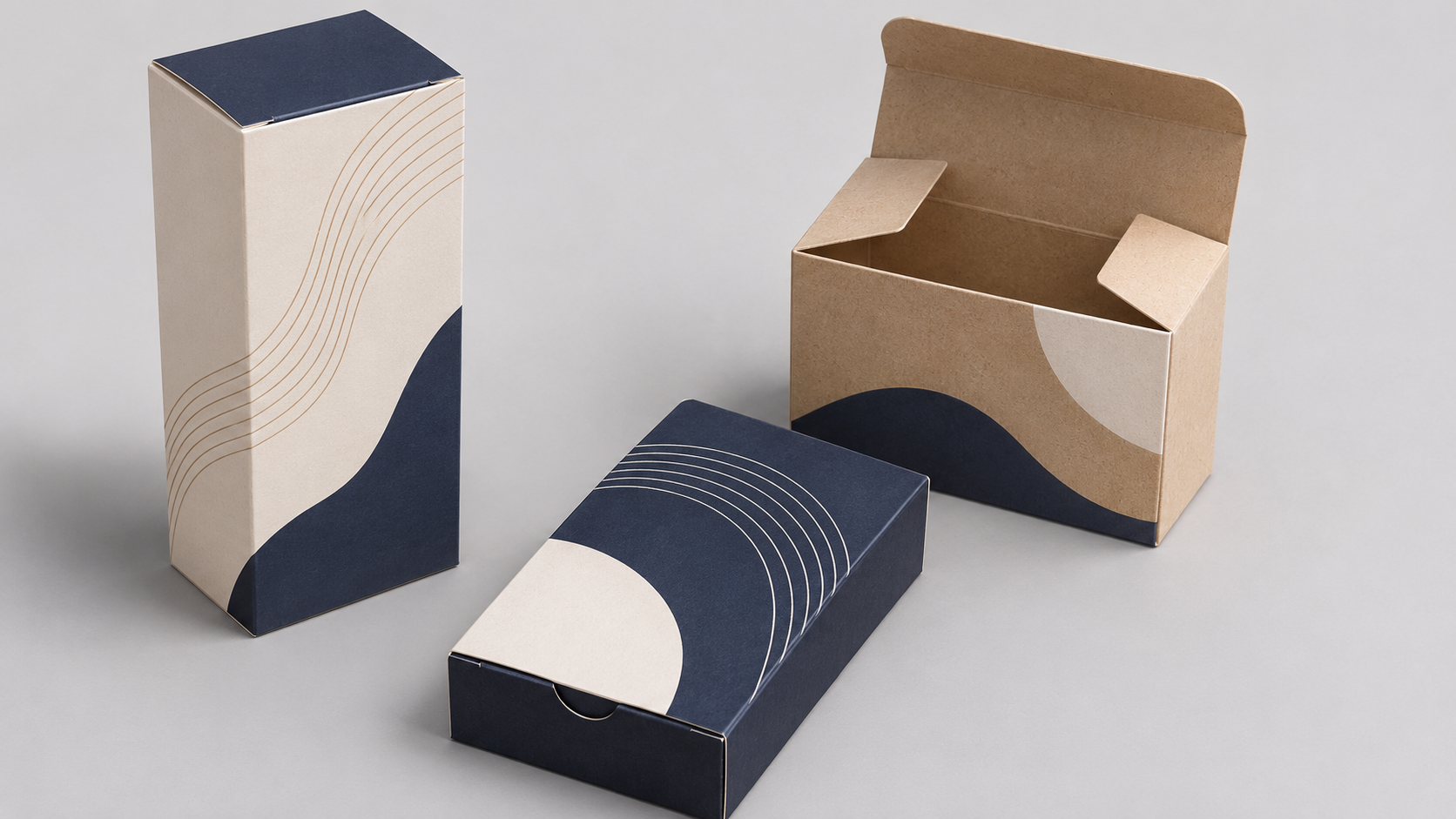
Types of Tuck Boxes: Which Structure Fits Your Product?
The most useful distinction is between cartons with tuck closures at both ends and cartons combining a tuck top with another bottom construction.
Straight Tuck End Boxes
A straight tuck end box has its top and bottom closure flaps attached to the same main panel. Both ends therefore tuck in the same direction.
This arrangement can help control how closure edges appear on the displayed carton. It is a common option for cosmetics, personal-care products, and other presentation-focused packaging.
Before approval, check the assembled sample from the intended shelf-facing angle. A flat drawing alone may not reveal how flap edges affect the finished appearance.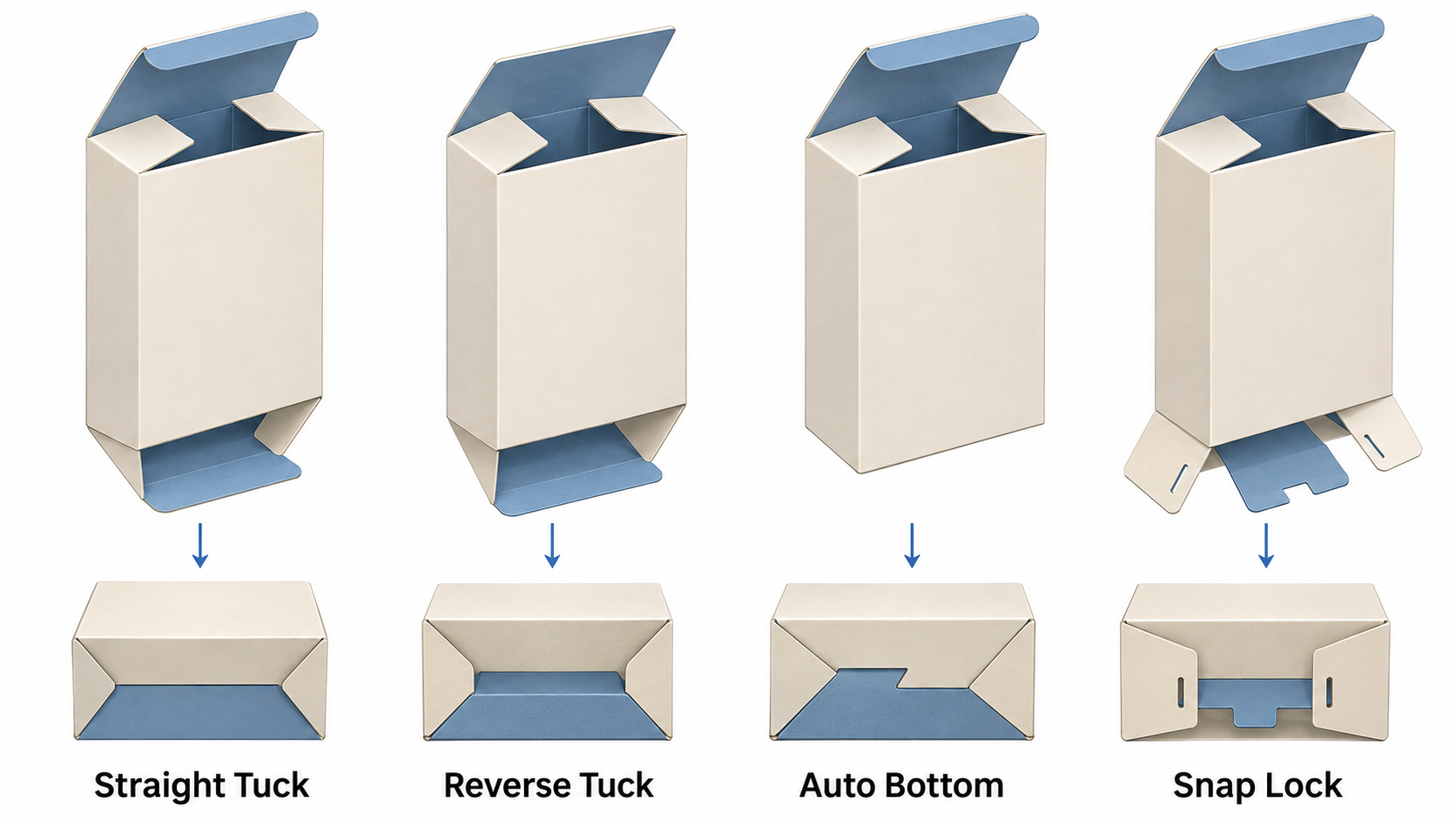
Reverse Tuck End Boxes
A reverse tuck end box has its top and bottom closure flaps attached to opposite main panels.
Reverse tuck cartons are used for products such as small accessories, healthcare items, and confectionery. They can offer efficient layouts, but they are not automatically cheaper than straight tuck designs.
Actual cost depends on carton dimensions, sheet utilization, board selection, printing, and production quantity.
Tuck Top Auto-Bottom Boxes
An auto-bottom carton combines a tuck-style top with a pre-glued bottom that forms as the carton opens.
The term "crash-lock bottom" commonly describes this automatic-bottom construction. Treating auto-bottom and crash-lock cartons as entirely separate categories can confuse purchasing decisions.
This format is worth evaluating when packing speed or bottom support matters. Its suitability still depends on the actual product and tested construction.
Tuck Top Snap-Lock Bottom Boxes
A snap-lock bottom uses manually interlocking flaps rather than a pre-glued automatic mechanism.
It can suit hand-packing operations where additional bottom security is desirable, but erection requires more folding steps.
| Structure | Closure arrangement | Main consideration |
| Straight tuck end | Both tuck flaps face the same direction | Presentation and filling orientation |
| Reverse tuck end | Tuck flaps face opposite directions | Layout efficiency and product access |
| Auto-bottom | Tuck top with pre-glued automatic bottom | Erection speed and verified support |
| Snap-lock bottom | Tuck top with manually interlocking bottom | Assembly time and bottom engagement |
How to Choose Materials for Custom Tuck Boxes
Material selection should begin with the packed product, not a standard board weight copied from another project.
Match the Board to the Application
Common options include:
- Bleached paperboard for bright printed graphics.
- Coated recycled board where its appearance and performance suit the application.
- Kraft-style board for a natural-looking presentation.
- Corrugated board for applications requiring a different level of cushioning or structural protection.
A material's appearance does not establish its strength, recycled content, or suitability for direct food contact. Request the relevant specification.
Compare Caliper and Stiffness, Not Only GSM
GSM measures mass per unit area. Caliper measures thickness. Neither alone fully predicts carton performance.
Two boards with similar GSM can differ in stiffness, bulk, folding behavior, and print surface. Grain direction and crease quality also influence how panels fold and whether printed surfaces crack.
For purchasing, specify the intended board grade and required performance rather than relying on a GSM figure alone.
Define Product Contact Requirements
Food packaging needs assessment of the complete system: board, inks, coatings, adhesives, barriers, and intended conditions of use.
A carton holding an individually wrapped snack presents different contact conditions from one touching an unwrapped bakery item.
Similarly, "food packaging ink" does not necessarily mean an ink is suitable for direct physical contact with food. Confirm the exact application and destination-market requirements before production.
How to Measure a Tuck Box Correctly
Dimension errors can create loose products, difficult packing, or cartons that will not close properly.
Start with the actual product, including its immediate wrapping, accessories, and any insert.
1. Measure the product's maximum length, width, and height.
2. Identify protrusions, flexible sections, and dimensional variation.
3. Establish the intended packing and opening orientation.
4. Add clearance appropriate to insertion and product movement.
5. Confirm the supplier's dimension convention.
6. Test the proposed internal dimensions with a physical sample.
There is no universal clearance that suits every product. A rigid glass bottle, soft pouch, and tightly fitted card deck have different needs.
Also clarify whether quoted measurements are internal or external. Board thickness and folding geometry affect the relationship between them.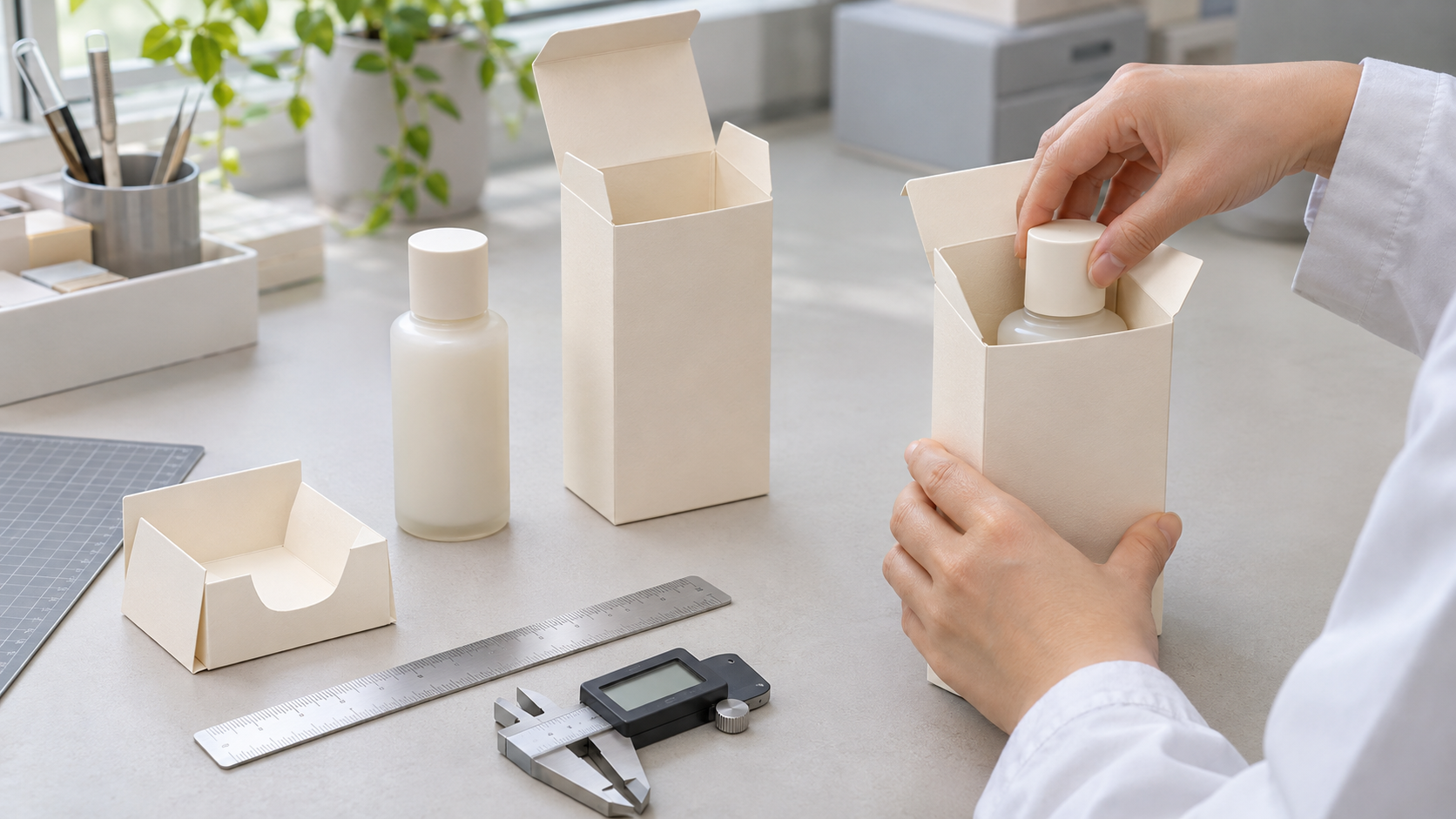
A Practical Tuck Box Sampling and Approval Checklist
A digital mockup helps review appearance. It does not prove fit, closure reliability, or transport performance.
Before ordering custom printed tuck boxes, evaluate a structural sample using the actual product.
Check Fit and Closure
Confirm that:
- The product inserts without excessive force.
- The panels remain reasonably square.
- The tuck flap closes without buckling.
- The bottom remains engaged during normal handling.
- Inserts prevent unacceptable movement.
Open and close the sample repeatedly to identify difficult access, torn edges, or early flap wear.
Check Printing and Finishing
Review small text, barcode readability, color expectations, and artwork positioning around folds.
Inspect foil, embossing, coatings, and laminated surfaces for interference with creasing or closure. A decorative feature should not make the carton harder to assemble.
Agree on an approved production reference rather than judging color only from an uncalibrated screen.
Check the Distribution System
For online orders, test the complete shipment: retail carton, product, insert, cushioning, and outer shipping container.
A tuck box that performs well on a shop shelf may not survive parcel handling by itself. The relevant question is whether the complete packaging system protects the product through its actual distribution route.
Tuck Box Design for Better Customer Experience
Good packaging should make the next action obvious.
Customers should quickly understand what the product is, which end opens, and how to remove it without damaging the contents.
Keep the primary display panel focused. Prioritize product identity, the most useful differentiator, and essential information. Move supporting details to secondary panels where appropriate.
For repeat-use products, test whether the flap remains easy to access after the first opening. An overly tight closure can frustrate customers; an overly loose one can reopen unexpectedly.
If tamper evidence is required, assess a suitable seal or alternative closure feature. Do not describe an ordinary tuck flap as tamper-proof.
What Determines Custom Tuck Box Cost?
The lowest unit price does not always deliver the lowest total packaging cost.
Important cost drivers include:
- Carton dimensions and material consumption.
- Board grade and caliper.
- Order quantity and setup requirements.
- Printing colors and surface coverage.
- Foil, embossing, windows, and coatings.
- Gluing complexity and packing labor.
- Inserts, shipping cartons, and freight.
A useful comparison is:
Total packaging cost = carton purchase cost + packing labor + associated protective materials + logistics + damage-related costs.
For example, an auto-bottom structure may cost more per carton but reduce manual assembly work. Whether that trade-off is worthwhile depends on measured packing time and order volume.
Ask suppliers to quote against the same specification. Otherwise, apparent savings may reflect different materials or omitted finishing steps.
Are Tuck Boxes Recyclable?
Many paperboard tuck boxes can enter paper recycling systems, but recyclability depends on their complete construction and local collection arrangements.
Plastic windows, laminations, coatings, adhesives, and contamination can affect how a package is collected and processed. Avoid assuming that every paper-based carton is recyclable everywhere.
For a more considered specification:
- Use only the material necessary for the required protection.
- Review whether decorative laminations are essential.
- Consider how non-paper components can be separated.
- Check acceptance in the intended sales markets.
- Use environmental claims supported by relevant evidence.
Recycled content and recyclability describe different things. A carton may contain recycled fiber without being readily recyclable in every market.
Likewise, claims about responsible sourcing do not independently establish the recyclability of the finished package.
An Illustrative Example: Packaging a Cosmetic Bottle
Consider a brand developing a carton for a small cosmetic bottle. This is a hypothetical design exercise, not a reported customer case.
The initial brief requests a reverse tuck box with a premium finish. During sampling, however, the bottle moves excessively and presses against the lower closure.
The appropriate response is not automatically thicker board.
First, review internal dimensions. Next, assess an insert that locates the bottle. Then compare the bottom construction and test the complete packed sample.
Only after these decisions should the team finalize finishes and production artwork.
This sequence addresses the source of the problem. Extra material alone may leave poor fit unresolved while increasing cost and shipping volume.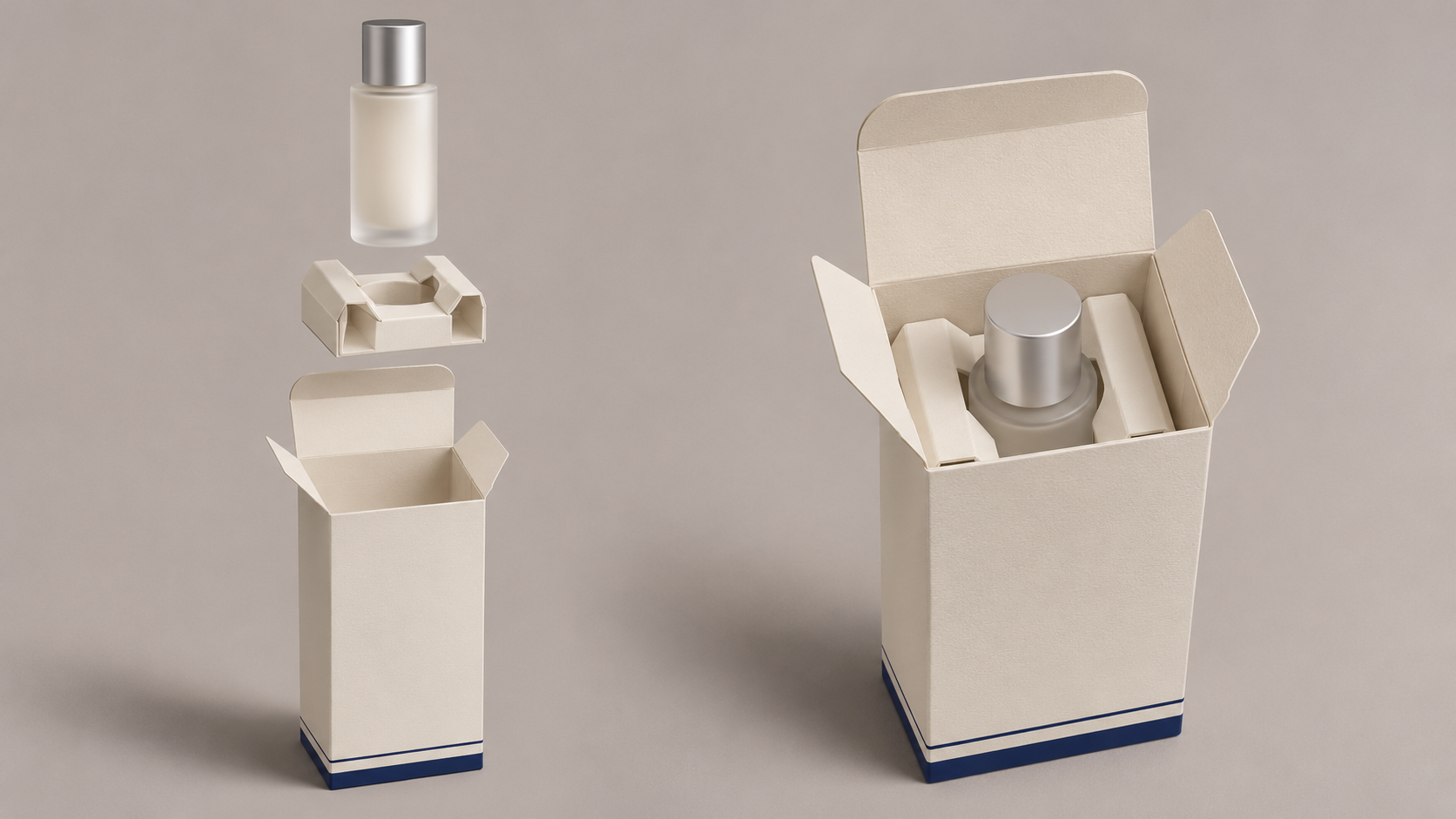
Request a Custom Tuck Box Evaluation
A useful quotation begins with a complete brief.
Send Shenzhen XingKun Packing Products Co., Ltd.:
- Product dimensions, weight, and photographs.
- Quantity and expected reorder requirements.
- Preferred carton style, if known.
- Printing and finishing expectations.
- Sales destination and distribution method.
- Any product-contact or compliance requirements.
Request a proposed structure, material specification, and sample plan before confirming production. This gives your team a clearer basis for evaluating fit, appearance, packing efficiency, and overall value.
Frequently Asked Questions About Tuck Boxes
What is the difference between a tuck box and a folding carton?
A folding carton is a broad category of packaging made from cut and creased board. A tuck box is one type, identified by its tuck-in closure. Other folding cartons use glued, locking, or different closure arrangements.
Are straight tuck or reverse tuck boxes better?
Neither is universally better. Compare display appearance, filling orientation, product fit, and manufacturing layout. Request samples and equivalent quotations rather than selecting by style name alone.
Can a tuck box hold heavy products?
Some constructions can accommodate relatively demanding loads, but there is no universal weight limit. Suitability depends on dimensions, board properties, bottom construction, inserts, and handling conditions. Test the packed design.
Can tuck boxes be used for shipping?
They can form part of a shipping system. Ordinary paperboard retail cartons often need an outer shipping container and suitable cushioning. Validate the complete shipment rather than assuming the retail carton provides sufficient protection.
Do tuck boxes require glue?
Many commercially produced tuck cartons have a glued side seam. Auto-bottom versions also use pre-glued bottom components. The user-operated tuck closure itself generally closes without additional glue.
What should I approve before mass production?
Approve dimensions, structure, material, artwork, finishing, and an agreed sample or production reference. Also establish acceptance criteria for fit, closure, print appearance, and any required performance testing.
References
1. [Custom Box Makers — "What Is a Tuck Box? A Detailed Guide"]. Original article reviewed for topic coverage, terminology, and opportunities for deeper practical guidance. [customboxmakers]
2. [European Carton Makers Association — *ECMA Code of Folding Carton Design Styles*]. Technical reference for folding-carton structures and closure combinations. [ecma]
3. [European Carton Makers Association — *ECMA Dictionary*, English edition]. Terminology reference distinguishing automatic/crash-lock and other bottom constructions. [ecma]
4. [European Carton Makers Association — "Statement on Direct Food Contact Inks"]. Guidance on direct-contact and non-direct-contact printing inks and the limitations of generic food-contact terminology. [ecma]
5. [European Carton Makers Association — "Statement on Testing Conditions," April 2024]. Supports assessment of defined substrate, ink, and adhesive combinations under intended conditions of use. [ecma]
6. [European Carton Makers Association — *Effectiveness of the Essential Requirements for Packaging and Packaging Waste*]. Background on packaging recyclability, component considerations, and collection, sorting, and recycling in practice. [ecma]


