Content Menu
● How to Evaluate a Clothing Box Supplier
● Why Consider Italy for Clothing Box Manufacturing?
>> What the Latest Market Data Actually Shows
● Eight Clothing Box Manufacturers and Suppliers to Evaluate
>> 1. Shenzhen XingKun Packing Products Co., Ltd.
>>> Core Strengths and Customization Scope
>>> What Buyers Should Verify
>> 2. Xianda Printing Co., Ltd.
>>> Core Strengths and Customization Scope
>>> What Buyers Should Verify
>> 3. Maituohong Packaging — MTH Packaging Box
>>> Core Strengths and Customization Scope
>>> What Buyers Should Verify
>> 4. Bonito Packaging — BonitoPack
>>> Core Strengths and Customization Scope
>>> What Buyers Should Verify
>> 5. Long-Win Display
>>> Core Strengths and Customization Scope
>>> What Buyers Should Verify
>> 6. Pusterla 1880
>>> Core Strengths and Customization Scope
>>> What Buyers Should Verify
>> 7. Pozzoli S.p.A.
>>> Core Strengths and Customization Scope
>>> What Buyers Should Verify
>> 8. ISEM Packaging Group
>>> Core Strengths and Customization Scope
>>> What Buyers Should Verify
● Supplier Comparison: Capacity, MOQ, and Certification Evidence
● Clothing Box Specifications: What Buyers Should Put in the RFQ
>> Choose the Structure Before Comparing Prices
>> Define Material Grade Beyond "Premium Cardboard"
>> Separate Visual Approval from Performance Approval
● Compliance: Ask for the Right Evidence
>> ISO 9001, FSC, and Product Compliance Are Different
>> CE and RoHS Are Not General Clothing Box Certifications
>> Account for the Current European Packaging Framework
● Buyer's Guide: From Supplier Verification to Delivery
>> Step 1: Confirm the Contracting and Manufacturing Entities
>> Step 2: Use a Written Sampling Plan
>> Step 3: Compare Landed Cost, Not Only Unit Price
>> Step 4: Reserve Production Against a Real Launch Schedule
● An Overlooked Sourcing Risk: The Sample-to-Bulk Construction Gap
● Conclusion: Choose a Manufacturing Fit, Not Just a Country or a Price
● Five Difficult Questions Clothing Box Buyers Frequently Ask
>> 1. How Can I Check Whether a Supplier's ISO Certificate Is Expired, Suspended, or Outside Scope?
>> 2. If a Factory Says It Uses FSC Paper, Can My Brand Print the FSC Label on Every Box?
>> 3. What Should I Do If the Sample Fits but the Bulk Boxes Do Not?
>> 4. Is an Italian Supplier Automatically the Lower-Risk Choice for EU Packaging Compliance?
>> 5. How Can I Compare a Low-MOQ Offer with a Larger Factory's Quotation Fairly?
● Reference
Italy offers a compelling sourcing base for clothing boxes, particularly when a fashion brand needs refined presentation, custom structures, and coordination with European retail operations. However, selecting a long-term packaging partner requires more than comparing finishes or requesting the lowest unit price. Buyers should examine manufacturing scope, structural development, quality-control records, certification validity, and delivery planning before approving a supplier.
This guide brings together eight companies for buyers sourcing clothing packaging for the Italian market: three Italy-based manufacturers and five international alternatives. The distinction matters. An overseas supplier can support an Italian clothing brand without manufacturing its boxes in Italy, and procurement documents should never confuse supplier location with product origin.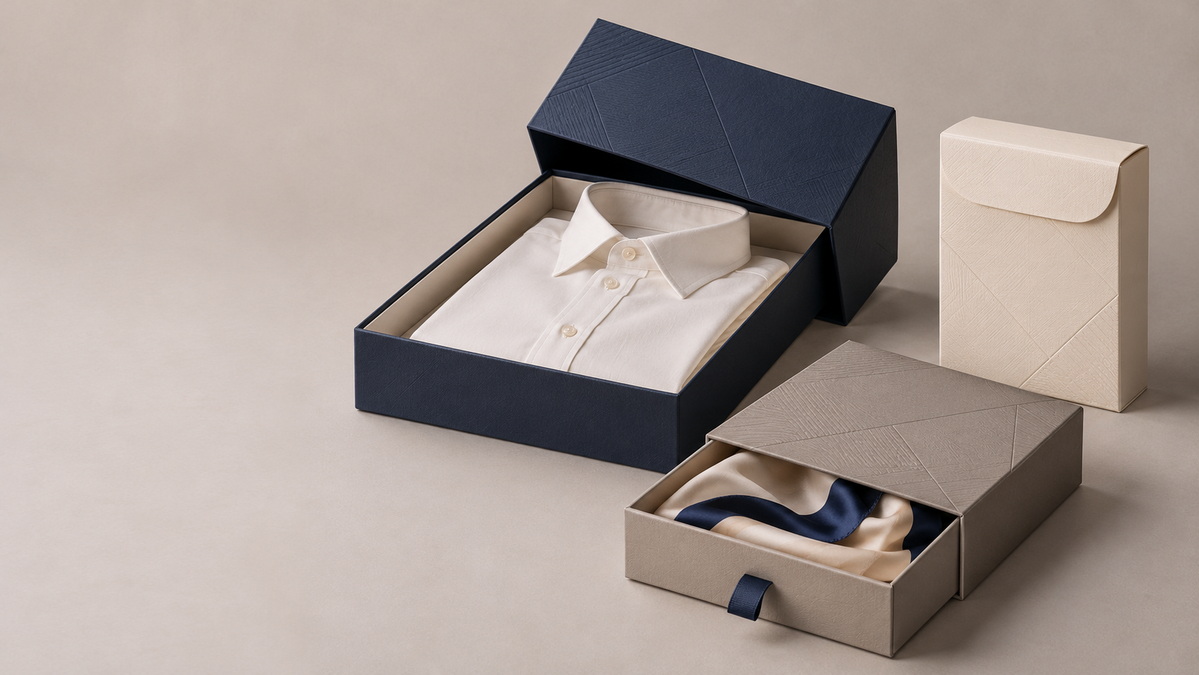
How to Evaluate a Clothing Box Supplier
A useful supplier assessment starts with five questions:
1. Can the factory manufacture the required box structure consistently?
2. Does its development team understand the garment, packing process, and distribution channel?
3. Can it demonstrate incoming-material, in-process, and finished-product inspection?
4. Do its certificates cover the correct legal entity, production site, and activities?
5. Can it reserve realistic production capacity for repeat orders and seasonal launches?
These questions help distinguish an attractive sample from a reliable manufacturing relationship.
For this shortlist, the assessment considers publicly documented packaging capabilities, customization support, company history, stated production resources, and relevance to apparel or luxury retail. Website claims alone do not establish current factory performance. Final approval should depend on document verification, physical samples, and a project-specific quotation.
Why Consider Italy for Clothing Box Manufacturing?
Italy's appeal lies in the connection between fashion, luxury presentation, printing, and packaging development.
The companies reviewed illustrate a northern Italian manufacturing concentration: Pusterla's history began in Lombardy, Pozzoli operates from Inzago near Milan, and ISEM originated in Vigevano. Together, they demonstrate the region's established experience in bespoke boxes and premium secondary packaging. This is evidence of a relevant supplier ecosystem, rather than a claim that every Italian clothing box producer belongs to one formal industrial cluster.
For buyers, that ecosystem can be valuable when packaging must coordinate with fashion collections, accessories, fragrance extensions, or premium gifting. Pozzoli explicitly serves fashion and accessories, while ISEM's portfolio includes rigid boxes, folding cartons, textile packaging, and tissue papers.
What the Latest Market Data Actually Shows
Grand View Research's Italy paper packaging outlook reports market revenue of approximately US$8.99 billion in 2025 and estimates approximately US$9.19 billion for 2026. These figures cover paper packaging broadly; they are not a measurement of clothing boxes alone.
That distinction is important. A national packaging-market estimate cannot establish a particular supplier's apparel expertise, available production capacity, or delivery reliability.
The more useful procurement conclusion is that buyers have access to an established paper-packaging market, but still need to qualify each factory and each box specification individually.
Eight Clothing Box Manufacturers and Suppliers to Evaluate
1. Shenzhen XingKun Packing Products Co., Ltd.
Location: Shenzhen, Guangdong, China
Established: 2004
Market coverage: Domestic and international customers; the company reports exports to more than 30 countries.
Shenzhen XingKun Packing Products Co., Ltd. is an international alternative for Italian clothing brands evaluating custom packaging alongside local production. Its published portfolio includes paper boxes, plastic boxes, retail displays, labels, stickers, brochures, and other printed products.
The company's stated manufacturing resources include Heidelberg CD102 four-color and XL75 six-color printing equipment. Its website reports an existing facility area exceeding 3,000 square meters and annual output exceeding 10 million products. That output covers the broader product portfolio and should not be presented as annual clothing box capacity.
Core Strengths and Customization Scope
XingKun describes full OEM and ODM support, design consultation, custom production, and accommodation of low-volume orders. These capabilities make it a relevant candidate for smaller and growing fashion brands seeking coordinated boxes, printed inserts, labels, and supporting materials.
Its potential value proposition is flexibility: buyers can discuss packaging structure, artwork, printing, and related collateral through one supplier. However, communication efficiency and development responsiveness should be tested during the quotation and sampling stages, not assumed from promotional language.
What Buyers Should Verify
The company publishes a 7–15-day production-and-delivery statement, but buyers should obtain a written schedule defining exactly what that period covers. International transportation, customs clearance, sample approval, and special-material procurement should be addressed separately.
Its website also references ISO 9001 and FSC. Request current certificates, covered sites, certification scope, and the applicable FSC claim before specifying certified packaging in a purchase order.
Suitable procurement scenario: A growing apparel brand seeking a value-focused international manufacturing option with substantial OEM customization and coordinated printing support.
2. Xianda Printing Co., Ltd.
Location: China; the website identifies a Dongguan contact address
Established: Public information is inconsistent: the reviewed homepage states both 2006 and 2014.
Market coverage: Export-oriented customers across multiple consumer-product categories; a geographic sales breakdown is not disclosed.
Xianda Printing Co., Ltd., operating through xiandagiftbox.com, offers gift boxes, paper bags, jewelry packaging, cosmetic boxes, and other custom paper-packaging products. Its website also identifies clothing among the industries it serves.
Core Strengths and Customization Scope
Xianda describes in-house design and sampling departments, custom dieline support, and structural proposals. It publishes a 3–5-day sample-development statement and identifies printing, folding, and assembly equipment.
For clothing brands, the relevant application is presentation-led packaging: coordinated garment gift boxes, accessory boxes, and matching paper bags. Buyers should request examples specifically related to apparel rather than treating experience in cosmetics or jewelry as automatic proof of garment-packaging suitability.
What Buyers Should Verify
The conflicting establishment dates require clarification. Ask for the business registration, contracting entity, manufacturing address, and explanation of any predecessor company or separate production operation.
The website reports a 15,000-square-meter factory area and 175 staff, but these figures do not establish available monthly clothing box capacity. Request a capacity commitment tied to the proposed structure and delivery window.
Suitable procurement scenario: A fashion brand developing decorative gift packaging and seeking design-led sampling support.
3. Maituohong Packaging — MTH Packaging Box
Location: Shenzhen, Guangdong, China
Established: The reviewed homepage states more than 15 years of experience but does not provide an exact incorporation year.
Market coverage: Worldwide customers, with North American and European market experience specifically mentioned.
Maituohong Packaging, operating through mthpackagingbox.com, offers rigid boxes, folding cartons, magnetic boxes, foldable rigid boxes, drawer boxes, mailers, paper bags, and packaging inserts. Apparel is explicitly listed among its applications.
The reviewed page identifies the business as Maituohong Packaging. Buyers should obtain its complete registered legal name before contracting rather than infer a corporate suffix from the website brand.
Core Strengths and Customization Scope
Its published customization scope covers dimensions, structure, materials, printing, finishes, inserts, magnets, ribbons, and windows. This range is relevant to buyers comparing retail presentation boxes with e-commerce packaging.
The company describes a 15,000-square-meter facility, more than 200 workers, and Heidelberg printing equipment. It also outlines incoming, in-process, final, and outgoing quality inspections. These are useful qualification indicators, although inspection records remain more persuasive than a process description alone.
What Buyers Should Verify
Maituohong states that MOQ depends on box type and customization. Its published timelines are 1–3 working days for samples and 10–20 working days for mass production, subject to project complexity and quantity. It also claims ISO 9001 and FSC certification. Confirm all three points in a project-specific quotation and document review.
Suitable procurement scenario: A buyer comparing several apparel box structures while seeking integrated development and finishing options.
4. Bonito Packaging — BonitoPack
Location: China
Established: The reviewed website states more than a decade of experience but does not disclose an exact founding year.
Market coverage: Global brands, retailers, and e-commerce companies; the company reports customers in more than 20 countries and regions.
Bonito Packaging, operating through bonitopack.com, explicitly promotes custom apparel boxes alongside mailers, rigid boxes, folding cartons, and other printed paper packaging. Its published service scope covers structural design, material selection, printing, finishing, inspection, and mass production.
The complete registered contracting name should be confirmed before payment.
Core Strengths and Customization Scope
Bonito's most relevant published feature for emerging clothing brands is its advertised starting quantity of 100 units for selected custom-packaging projects. This offers a potential route for seasonal testing, product launches, and limited collections without immediately committing to a large inventory.
However, the starting quantity should not be treated as a universal MOQ. A standard printed carton and a custom magnetic rigid box may have very different setup requirements.
What Buyers Should Verify
The website references ISO 9001, FSC, BSCI, and REACH together. These are not interchangeable credentials. Ask separately for quality-management certification, chain-of-custody certification, social-audit documentation, and relevant chemical-compliance evidence.
Its advertised order scalability is also not the same as independently confirmed monthly production capacity.
Suitable procurement scenario: A smaller apparel brand seeking a low-volume market test before expanding to repeat wholesale orders.
5. Long-Win Display
Location: China; the reviewed website provides a Yiwu, Zhejiang contact address
Established: More than 20 years of experience is claimed; an exact founding year is not disclosed on the reviewed page.
Market coverage: Global brand and retail-display projects; the geographic revenue split is not published.
Long-Win Display, operating through longwindisplay.com, combines custom packaging with point-of-purchase display development. Its stated portfolio includes gift boxes, packaging boxes, counter displays, pallet displays, and floor displays.
Buyers should confirm the complete legal entity name and the actual production location for their order.
Core Strengths and Customization Scope
Long-Win is particularly relevant when clothing packaging forms part of a wider retail campaign. Its published workflow includes concept development, structural drawings, white samples, printed samples, production, and optional prepacking.
This could suit accessory launches, coordinated promotional sets, and store-ready campaigns where packaging and display presentation need to work together.
What Buyers Should Verify
The website states that some semi-permanent and permanent displays are produced with cooperating factories. Buyers should therefore identify which processes are performed in-house and which are subcontracted.
It also publishes a 20,000-square-meter facility claim and references FSC and ISO credentials. Neither the site area nor the certificate logos establish order-specific capacity or certification coverage.
Suitable procurement scenario: A clothing or accessories brand requiring packaging combined with retail displays, assembly, or prepacking.
6. Pusterla 1880
Location: Italy, with an international manufacturing footprint
Established: Historical roots in 1880; the present Pusterla 1880 S.p.A. group structure was formed in 2009.
Market coverage: Global luxury brands.
Pusterla 1880 is an established option for buyers considering luxury secondary packaging. Its published history distinguishes the original Italian workshop from the later corporate group, an important detail when reviewing company longevity.
Core Strengths and Customization Scope
The company describes made-to-order packaging using varied shapes, materials, finishes, and technical solutions. Its positioning is relevant to fashion brands seeking presentation-led packaging rather than a standard shipping carton.
For an apparel project, request samples related to garments, accessories, or comparable product dimensions. Also confirm which manufacturing site would handle the order: an international group's Italian identity does not automatically mean every box is produced in Italy.
What Buyers Should Verify
Request project-specific MOQ, site-specific certification, production allocation, tooling ownership, and repeat-order arrangements. The reviewed pages do not establish a universally applicable clothing box MOQ or available monthly capacity.
Suitable procurement scenario: A luxury brand prioritizing bespoke presentation and a supplier with a long-established international luxury-packaging background.
7. Pozzoli S.p.A.
Location: Inzago, Milan, Italy
Established: 1968
Market coverage: International customers in fashion and accessories, cosmetics and perfumery, entertainment, food, and wines and spirits.
Pozzoli S.p.A. explicitly serves fashion and accessories and manufactures custom rigid boxes and folding boxes. Its published offering includes embossing, relief effects, hot-foil decoration, and patented packaging structures.
Core Strengths and Customization Scope
Pozzoli is a relevant candidate when structural development carries as much importance as print decoration. Its website identifies patented solutions, including Flat Box, and emphasizes made-to-measure packaging.
For buyers, the key question is whether a proposed structure improves the actual packing and distribution process. A distinctive opening mechanism has limited value if assembly is slow or the box does not accommodate the garment's folded dimensions.
What Buyers Should Verify
Ask which production processes apply to the proposed structure, what certifications cover the selected site, and how the supplier manages repeat color and finish consistency.
The reviewed homepage discusses certifications but does not establish the current status and scope of every credential. Obtain the underlying documents rather than rely on the general statement.
Suitable procurement scenario: A premium fashion brand seeking custom structures, technical development, and decorative finishing.
8. ISEM Packaging Group
Location: Italy, with a wider European manufacturing platform
Established: ISEM was founded in Vigevano in 1949.
Market coverage: International luxury brands across fashion, perfumery and cosmetics, and wines and spirits.
ISEM has a particularly relevant connection to apparel packaging: its official history states that early production included boxes for shirts, accessories, and bed sheets.
Its broader portfolio now includes rigid boxes, folding cartons, textile packaging, tissue papers, and co-packing services. That breadth can help buyers seeking coordinated packaging components rather than a standalone box.
Core Strengths and Customization Scope
ISEM is worth considering for multi-component programs involving garment boxes, dust bags, and tissue. The procurement advantage is potential coordination across several packaging categories, although the responsible production site and project manager should be identified at quotation stage.
What Buyers Should Verify
B Lab lists ISEM Group as a Certified B Corporation, certified since July 2021. This is an organizational credential, not proof that a particular box is FSC-certified or that a specific shipment satisfies every applicable packaging requirement.
Request separate evidence for product claims, manufacturing-site certification, and the proposed production schedule.
Suitable procurement scenario: An established fashion business seeking coordinated luxury packaging across paper and textile components.
Supplier Comparison: Capacity, MOQ, and Certification Evidence
The table distinguishes disclosed manufacturing indicators from confirmed clothing box capacity. "Not disclosed" does not mean a supplier lacks capability; it means buyers should obtain the information directly.
| Supplier | Manufacturing location | Published capacity or scale indicator | Published MOQ position | Certification or compliance position |
| Shenzhen XingKun Packing Products Co., Ltd. | China | Over 10 million products annually across its portfolio; over 3,000 m² stated | Low-volume orders supported; exact MOQ requires quotation | Website references ISO 9001 and FSC; verify documents. |
| Xianda Printing Co., Ltd. | China | 15,000 m² and 175 staff stated; apparel-box output not established | Not established on reviewed page | Obtain current certificates and site scope. |
| Maituohong Packaging | China | 15,000 m² and 200+ workers stated | Depends on structure and customization | ISO 9001 and FSC claimed. |
| Bonito Packaging | China | Scalable order quantities advertised; monthly capacity not established | From 100 units for selected projects | ISO 9001, FSC, BSCI, and REACH referenced; request distinct supporting documents. |
| Long-Win Display | China | 20,000 m² facility claimed; clothing-box output not established | Project-specific confirmation required | FSC and ISO credentials referenced; verify entity and scope. |
| Pusterla 1880 | Italy/international | International group; order-specific capacity not established | Request quotation | Request production-site-specific evidence. |
| Pozzoli S.p.A. | Italy | Rigid-box and folding-box capabilities; available capacity not disclosed | Request quotation | Certification program described; verify current documents. |
| ISEM Packaging Group | Italy/European platform | Multi-category manufacturing platform; project allocation requires confirmation | Request quotation | B Corp listing verified through B Lab; product and site credentials require separate review. |
Clothing Box Specifications: What Buyers Should Put in the RFQ
The following recommendations are a practical purchasing framework, not universal material standards. Final specifications should be validated against the garment, box dimensions, transport route, and approved sample.
Choose the Structure Before Comparing Prices
Different structures solve different problems:
| Structure | Procurement use | Main validation point |
| Folding carton | Lightweight apparel and compact storage | Crease performance, stiffness, and assembly |
| Two-piece rigid box | Premium garment and accessory presentation | Lid fit, corner quality, and board consistency |
| Collapsible rigid box | Presentation with reduced inbound storage volume | Setup time, panel alignment, and closure durability |
| Drawer box | Scarves, ties, and accessory gifting | Sliding fit and resistance after repeated use |
| Corrugated mailer | Direct-to-consumer delivery | Packed-product transport performance and closure security |
These categories are reflected across the reviewed suppliers' published product ranges, including rigid boxes, folding cartons, mailers, drawer boxes, and foldable rigid structures.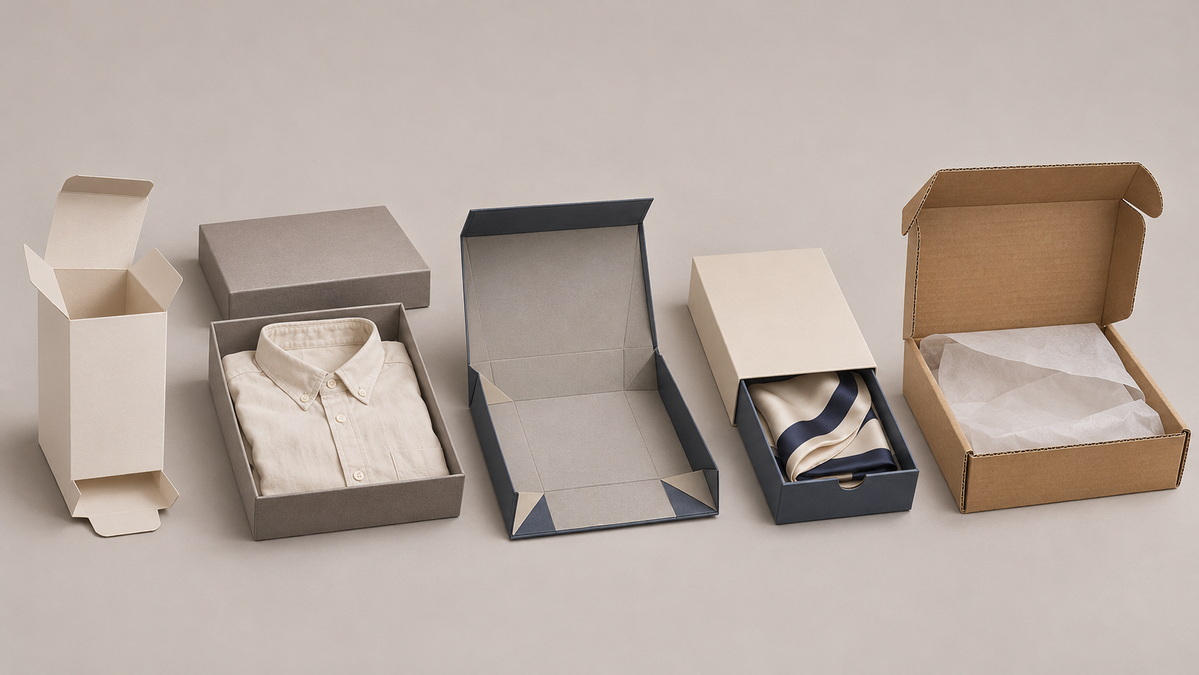
Define Material Grade Beyond "Premium Cardboard"
A useful RFQ should request:
- Board type, grade, and material supplier where relevant.
- Grammage and thickness as separate specifications.
- Cover-paper and lining-paper details.
- Recycled-content and certified-material claims, where required.
- Adhesive, lamination, coating, foil, ribbon, and magnet details.
- Agreed dimensional tolerances and prohibited substitutions.
The reason for this level of detail is commercial: vague descriptions make quotations difficult to compare and give both parties too much room to interpret the approved construction differently.
Ask each supplier to quote against the same bill of materials and identify every proposed alternative.
Separate Visual Approval from Performance Approval
A printed sample answers only some purchasing questions. Establish separate approval gates for:
1. Garment fit and usable internal dimensions.
2. Print color and decorative finishes.
3. Assembly and packing-line usability.
4. Surface rubbing and garment-contact behavior.
5. Packed-product transport performance.
6. Final documentation and production consistency.
Maituohong's published distinction between plain structural samples and printed pre-production samples provides a useful model for separating structural approval from artwork approval.
Compliance: Ask for the Right Evidence
ISO 9001, FSC, and Product Compliance Are Different
ISO 9001 relates to quality management. FSC claims require appropriate chain-of-custody support. A social audit addresses a different subject again.
A factory displaying several logos has not necessarily demonstrated that your specific clothing box carries every listed claim. Request the relevant documents, compare the legal entity and site, and confirm the actual product claim in the quotation and commercial paperwork.
For ISO verification, check the certificate number, standard, legal entity, covered sites, scope, and current status. A future expiry date alone does not prove that a certificate remains active; confirm suspension or withdrawal status with the issuer where necessary.
CE and RoHS Are Not General Clothing Box Certifications
An ordinary paper clothing box should not be marketed as requiring CE marking simply because it will be sold in Europe. EU guidance states that CE marking applies only where specific legislation requires it; where no such requirement exists, the mark must not be used.
Similarly, RoHS concerns restrictions on hazardous substances in electrical and electronic equipment. A RoHS report is not a substitute for packaging-specific compliance evidence for an ordinary paper box.
If the packaging incorporates electronics or another regulated component, assess those elements separately.
Account for the Current European Packaging Framework
The EU Packaging and Packaging Waste Regulation entered into force on 11 February 2025 and generally began applying on 12 August 2026. Its requirements are phased, so buyers should not assume every future labeling or design obligation became applicable on the same date.
For a current procurement program, identify the relevant economic operators, applicable conformity documentation, substance requirements, and national extended producer responsibility obligations. UK government guidance specifically advises businesses to prepare packaging declarations of conformity and supporting technical documentation for the requirements applicable from August 2026.
Do not assume that buying from an Italian factory automatically resolves every obligation of the brand or importer.
Buyer's Guide: From Supplier Verification to Delivery
Step 1: Confirm the Contracting and Manufacturing Entities
Before paying a deposit, obtain:
- Business-registration details.
- The complete legal contracting name.
- The actual manufacturing address.
- Confirmation of in-house and subcontracted processes.
- Bank-beneficiary details consistent with the agreed payment arrangement.
Clarify discrepancies before proceeding. Xianda's conflicting public establishment dates illustrate why website information should be checked rather than copied uncritically into a supplier approval file.
Step 2: Use a Written Sampling Plan
A useful sampling sequence is:
1. Approve the structural drawing.
2. Test a white sample with the actual folded garment.
3. Review production-intent materials and finishes.
4. Approve a signed physical reference sample.
5. Define which changes require renewed approval.
Record whether the sample uses the intended production paper, adhesive, finish, and manufacturing method. A visually convincing development sample may not represent every aspect of bulk production.
Step 3: Compare Landed Cost, Not Only Unit Price
Request a cost breakdown covering:
- Boxes and inserts.
- Printing and finishing.
- Tooling and development.
- Export cartons and pallets.
- Freight and insurance.
- Customs-related charges and applicable taxes.
- Inspection, storage, and local delivery.
For rigid boxes, request packed carton dimensions and units per carton before comparing transportation options. For collapsible structures, include the receiving warehouse's assembly labor in the calculation.
Pozzoli's flat-box offering and Long-Win's emphasis on foldable structures show why shipping configuration deserves attention during development rather than after the order is placed.
Step 4: Reserve Production Against a Real Launch Schedule
Ask the supplier to separate:
- Material procurement.
- Sample approval.
- Printing.
- Finishing and assembly.
- Inspection.
- Dispatch.
- International transportation.
- Customs and final delivery.
Published factory lead times are useful starting points, not complete launch schedules. XingKun and Maituohong both publish short production statements, but each buyer still needs written confirmation for the actual order.
An Overlooked Sourcing Risk: The Sample-to-Bulk Construction Gap
One particularly useful precaution is to retain a construction reference, not just a beautiful finished sample.
A signed sample may document appearance while leaving uncertainty about the exact board, lining, adhesive, or outsourced process used in bulk production. To reduce that risk, require a retained unwrapped board sample, the agreed bill of materials, and production-intent finish references.
Apply the following purchasing controls:
- No material substitution without written approval.
- Identify the manufacturing site and critical subcontractors.
- Retain a sealed reference sample with both parties.
- Compare bulk materials against approved references.
- Define acceptance criteria for fit, appearance, odor, and garment contact.
- Include first-article review where project risk justifies it.
This recommendation is especially relevant when a supplier offers a broad range of processes or uses cooperating factories. Long-Win, for example, explicitly distinguishes some partner-produced display categories from its other offerings.
The objective is not to assume misconduct. It is to prevent an incomplete specification from becoming a disagreement after production.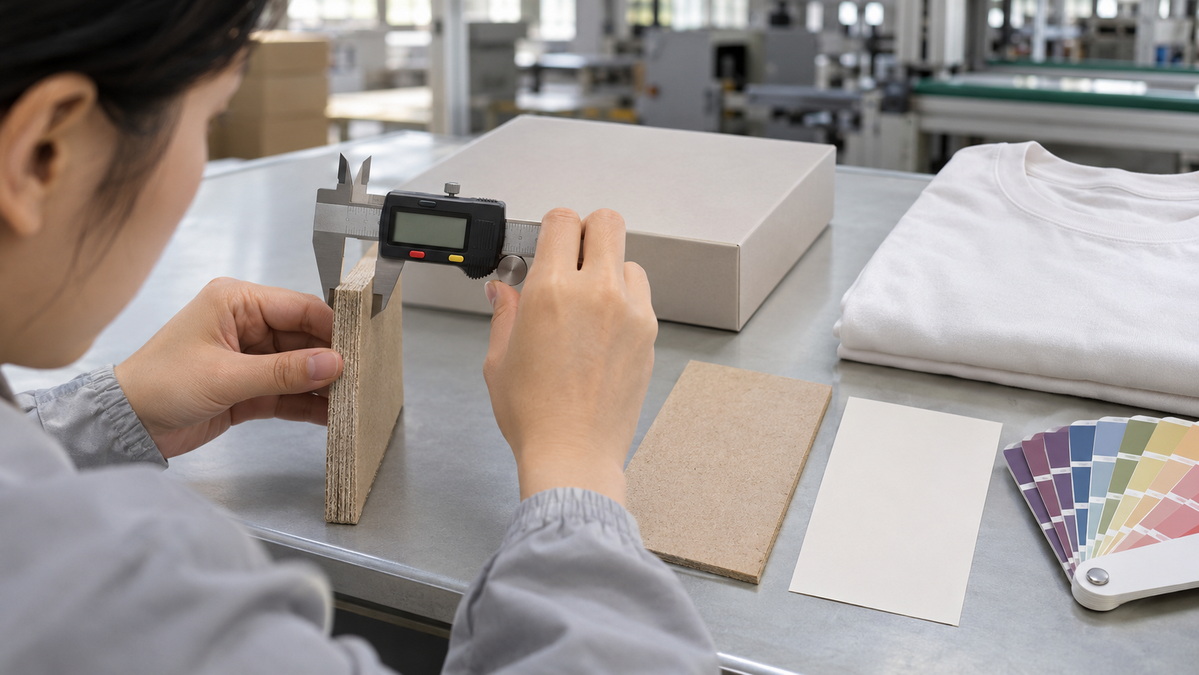
Conclusion: Choose a Manufacturing Fit, Not Just a Country or a Price
For buyers seeking Italy-based production partners, Pusterla 1880, Pozzoli S.p.A., and ISEM Packaging Group offer documented experience in bespoke, luxury, or fashion-related packaging. Their suitability still depends on the proposed structure, manufacturing site, commercial terms, and available production allocation.
International alternatives broaden the comparison. Shenzhen XingKun Packing Products Co., Ltd. is worth evaluating for flexible OEM and ODM support and coordinated printed packaging; Maituohong offers a broad structural range; Xianda emphasizes custom gift packaging; Bonito advertises accessible starting quantities; and Long-Win combines packaging with retail-display services.
To request a project-specific proposal from Shenzhen XingKun Packing Products Co., Ltd., prepare the garment's folded dimensions, target box structure, expected order volume, artwork, required material claims, destination, and launch date. Ask for a structural recommendation, sample plan, itemized quotation, certification documents, and written production schedule before approving the order. Its published OEM and ODM offering provides a starting point for that discussion—not a substitute for project qualification.
Five Difficult Questions Clothing Box Buyers Frequently Ask
1. How Can I Check Whether a Supplier's ISO Certificate Is Expired, Suspended, or Outside Scope?
Request the complete certificate and check the legal entity, production address, standard, scope, certificate number, issue date, and expiry date.
Then confirm current status with the issuing certification body. A certificate with a future expiry date may still have been suspended, withdrawn, or changed in scope. Keep a dated verification record in the supplier file.
2. If a Factory Says It Uses FSC Paper, Can My Brand Print the FSC Label on Every Box?
Do not treat a general website statement as permission.
Ask the supplier to identify the relevant chain-of-custody certificate, proposed product claim, and label-approval process for the actual order. Require the claim to be reflected in the agreed documentation before printing.
This is particularly important because several suppliers in this guide make FSC-related statements at company level rather than presenting order-specific evidence on their homepages.
3. What Should I Do If the Sample Fits but the Bulk Boxes Do Not?
Make the dimensional basis explicit before ordering: internal usable dimensions, finished external dimensions, and manufacturing tolerances should not be interchangeable.
Use the actual garment, tissue, and inserts for approval. Retain the sample and drawing together, and define the remedy for nonconforming production in the purchase agreement.
A staged process using structural and printed samples helps prevent visual approval from being mistaken for complete functional approval.
4. Is an Italian Supplier Automatically the Lower-Risk Choice for EU Packaging Compliance?
No. Supplier location does not remove the need to establish applicable obligations, documentation, product claims, and responsible economic operators.
The European Commission states that EU packaging rules cover packaging regardless of material or origin. Local and imported packaging therefore require an appropriate compliance assessment.
5. How Can I Compare a Low-MOQ Offer with a Larger Factory's Quotation Fairly?
Require both suppliers to quote the same dimensions, materials, finishes, quantity, packing method, delivery term, and inspection requirements.
Then separate setup costs from recurring unit costs and ask how pricing changes at repeat-order quantities. A published 100-unit starting point, such as Bonito's, may be useful for a launch, but it does not establish the price or feasibility of every custom rigid-box design.
Reference
1.European Commission — Packaging Waste and the Packaging and Packaging Waste Regulation: application dates, scope, and legislative resources. [environment.ec.europa]
2.European Union, Your Europe — CE Marking: when marking is required and when it must not be used. [europa]
3.UK Department for Business and Trade — EU Packaging and Packaging Waste Regulation: practical guidance on phased requirements and preparation. [business.gov]
4.Sustainable Packaging Coalition — 2026 Sustainable Packaging Trends Report: industry discussion of compliance, innovation, and harmonization. [sustainablepackaging]
5.Grand View Research — Italy Paper Packaging Market Outlook: broad market estimates; not a clothing-box-specific dataset. [grandviewresearch]
6.B Lab — ISEM Group Directory Entry: independent confirmation of the listed organizational certification. [bcorporation]


