Content Menu
● Embossing vs Debossing: A Quick Comparison
● What Is Embossing on Luxury Packaging?
>> Blind Embossing for Understated Branding
>> Registered and Foil Embossing
● What Is Debossing on Luxury Packaging?
>> Blind Debossing for Minimalist Packaging
>> Debossing With Foil or Printed Detail
● Embossed vs Debossed Packaging: Which Looks More Luxurious?
>> Choose Embossing for a Prominent Focal Point
>> Choose Debossing for Restrained Tactile Detail
● How Paper and Box Construction Affect the Result
>> Evaluate Caliper, Not Just Paper Weight
>> Distinguish Folding Cartons From Wrapped Rigid Boxes
>> Test Coated and Laminated Surfaces
● Embossing vs Debossing Cost: What Actually Changes the Quote?
● A Practical Artwork Checklist for Reliable Results
● An Expert Sampling Method: Compare the Finish, Not the Mockup
>> Build a Controlled Sample Comparison
>> Review Samples Under Real Conditions
● Quality Control: Look Beyond Impression Depth
● Sustainability: Evaluate the Whole Package
● Plan Your Luxury Packaging With XingKun
● Frequently Asked Questions
>> 1. Is Embossing Better Than Debossing for Luxury Packaging?
>> 2. Can Embossing and Debossing Be Used on the Same Box?
>> 3. What Is the Difference Between Blind Embossing and Foil Embossing?
>> 4. Does Debossing Always Cost Less?
>> 5. Can Small Text Be Embossed or Debossed?
>> 6. Should Foil Be Applied Before or After Embossing?
● References
Embossing vs debossing on luxury packaging comes down to one fundamental difference: embossing raises a design above the surface, while debossing presses it below. Both add tactile detail to packaging boxes, but they create different visual impressions, manufacturing requirements, and design opportunities.
For a luxury brand, the better choice is not necessarily the more dramatic finish. It is the one that suits the product, paper, artwork, and customer experience.
At Shenzhen XingKun Packing Products Co., Ltd., our perspective starts with the complete package rather than an isolated decorative effect. With more than 20 years of printing and packaging experience serving brands and distributors across over 30 countries and regions, we approach this comparison as a practical manufacturing decision.
This guide explains how both techniques work, what influences their cost, and how to specify a finish that looks convincing beyond a digital mockup.
Embossing vs Debossing: A Quick Comparison
| Comparison Point | Embossing | Debossing |
| Surface effect | Raises selected artwork | Creates a recessed impression |
| Visual character | Dimensional and prominent | Restrained and architectural |
| Typical applications | Crests, logos, decorative patterns | Wordmarks, monograms, minimalist branding |
| Blind finishing | Uses relief without ink or foil | Uses an impression without ink or foil |
| Foil compatibility | Can combine metallic shine with raised detail | Can combine metallic detail with recessed depth |
| Main production concerns | Cracking, flattening, registration | Uneven depth, surface damage, lost detail |
| Cost drivers | Tooling, material, complexity, production operations | Tooling, material, complexity, production operations |
| Best approval method | Physical sample on intended material | Physical sample on intended material |
Neither technique is inherently more luxurious. A carefully controlled blind deboss can feel more appropriate than elaborate embossing when the brand identity depends on restraint.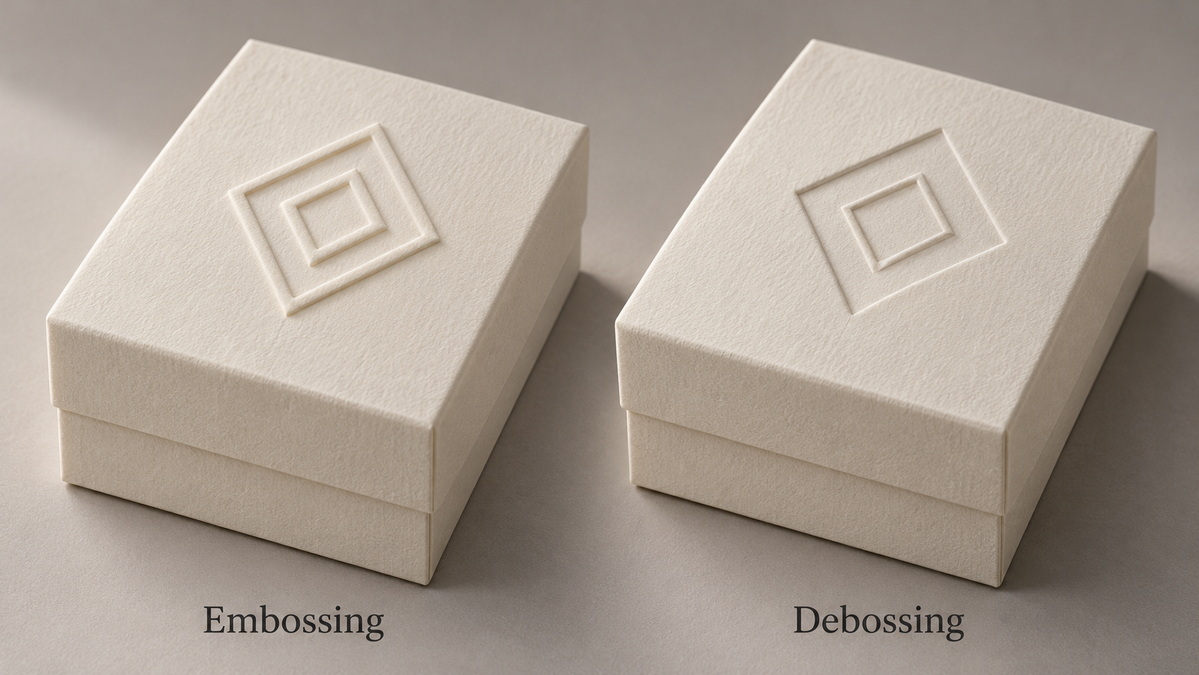
What Is Embossing on Luxury Packaging?
Embossing forms a raised image in paper or paperboard using shaped tooling and controlled pressure. A matched die and counter-die guide the material into the intended relief. Heat may be used, depending on the substrate and production setup.
Unlike a printed graphic, an embossed logo changes the physical shape of the surface. Light catches its edges, while fingers register its height.
Blind Embossing for Understated Branding
Blind embossing uses no ink or foil within the embossed design. The effect depends on the paper, relief, highlights, and shadows.
It is worth considering for:
- Tonal logos on presentation boxes.
- Decorative borders around a central label.
- Repeating patterns on premium sleeves.
- Minimalist gift packaging.
Blind embossing does not automatically guarantee visibility. A subtle mark that looks beautiful under directional studio lighting may become difficult to read under flat retail lighting.
Registered and Foil Embossing
Registered embossing aligns the raised design with printed artwork or an existing foil image.
Foil embossing combines dimension with metallic or pigmented foil. Depending on the specification, production may involve separately registered operations or a combination die that transfers foil and forms relief together.
These approaches require different tooling and setup decisions. Buyers should describe the desired result and ask the manufacturer to recommend the production route.
What Is Debossing on Luxury Packaging?
Debossing creates a recessed design by pressing selected artwork into the surface. Its appeal comes from depth rather than projection.
A debossed wordmark can resemble an engraved detail, particularly when paired with substantial paper and generous empty space.
Blind Debossing for Minimalist Packaging
Blind debossing leaves the recessed area without added ink or foil.
From a design perspective, I would consider it when a brand wants the customer to discover the logo through handling rather than encounter it as the loudest element on the box.
However, understated should not mean illegible. Small lettering, shallow impressions, or heavily textured paper can make a blind deboss difficult to recognize.
Debossing With Foil or Printed Detail
A recessed design can also incorporate foil or align with printed artwork.
This provides additional contrast, but successful execution depends on the surface, tooling geometry, and finish compatibility. Deep recesses and narrow details should be tested rather than approved from illustrations alone.
Also, avoid assuming debossing always leaves the reverse side untouched. Reverse-side visibility depends on the material, impression depth, backing, and package construction.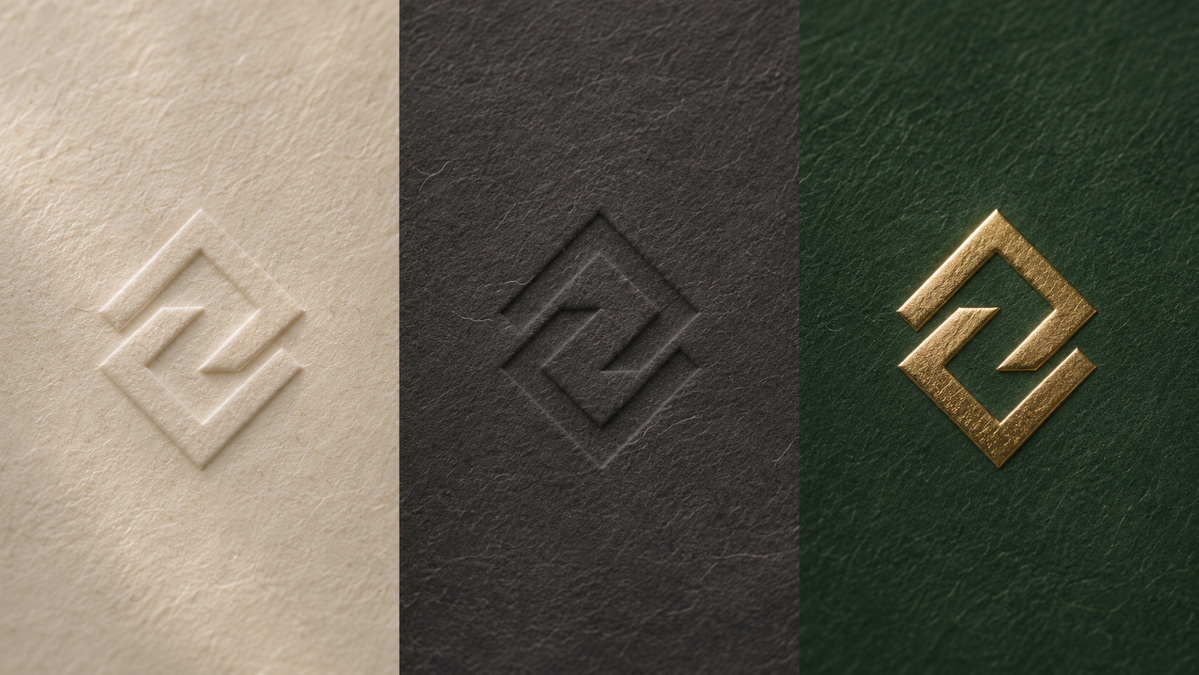
Embossed vs Debossed Packaging: Which Looks More Luxurious?
Luxury is a design outcome, not a finishing category.
Embossing often suits packaging that needs an expressive focal point. Debossing often suits packaging built around quiet confidence. These are useful starting points, not fixed rules.
Choose Embossing for a Prominent Focal Point
Consider embossing when:
- A crest or emblem anchors the design.
- The artwork has strong, recognizable shapes.
- The package benefits from visible light-and-shadow contrast.
- Foil and dimension support the same visual hierarchy.
For an illustrative fragrance-box concept, a raised emblem could lead the front panel while supporting text remains flat.
Choose Debossing for Restrained Tactile Detail
Consider debossing when:
- The identity uses a simple wordmark.
- The paper itself is a major design feature.
- The package should reward close inspection.
- Decorative restraint supports the product positioning.
For an illustrative jewelry-box concept, a recessed monogram could create a quiet focal point without competing with the item inside.
These are design scenarios, not reported customer projects or evidence of guaranteed commercial results.
How Paper and Box Construction Affect the Result
Material selection can matter more than whether the artwork points upward or downward.
Evaluate Caliper, Not Just Paper Weight
Paper weight describes mass per unit area. Caliper describes thickness. Neither measurement alone tells you exactly how a material will respond to forming.
Also evaluate:
- Fiber structure and compressibility.
- Surface coating.
- Existing texture.
- Lamination or varnish.
- Required relief depth.
- Artwork size and detail.
Two papers with the same weight can produce noticeably different results.
Ask for trials on the intended production stock rather than selecting material solely from a weight specification.
Distinguish Folding Cartons From Wrapped Rigid Boxes
A folding carton forms its structure from the paperboard itself. A wrapped rigid box combines a structural board with an outer covering material.
That difference changes how a tactile effect must be planned. A thick rigid-box wall does not automatically mean its decorative surface can accept an equally deep impression.
For wrapped constructions, confirm which layer receives the effect and how wrapping, adhesive, and assembly influence the final appearance.
Test Coated and Laminated Surfaces
Coatings and films introduce additional variables. Forming can expose cracking, whitening, separation, or altered surface appearance.
A finish that works on uncoated paper may need different tooling or reduced depth on coated stock. Soft-touch surfaces also require compatibility checks when foil is involved.
Embossing vs Debossing Cost: What Actually Changes the Quote?
Debossing is not automatically cheaper than embossing. Likewise, embossing does not always require a premium simply because it projects above the surface.
The quotation depends on the complete specification.
| Cost Driver | Why It Matters |
| Tool complexity | Sculpted or multilevel artwork requires more involved tooling |
| Design area | Larger impressions can demand different tooling and press conditions |
| Material response | Difficult stock can increase setup and trial requirements |
| Registration | Alignment with print or foil adds control requirements |
| Production quantity | Setup and tooling costs are distributed across the order |
| Number of operations | Separate finishing passes affect production time |
| Quality expectations | Tight appearance requirements influence inspection and acceptable yield |
Request itemized quotations where practical. Distinguish one-time tooling charges from recurring production costs.
When comparing suppliers, keep the paper, dimensions, artwork, finish coverage, quantity, and packing requirements consistent. Otherwise, the apparent price difference may reflect different products.
A Practical Artwork Checklist for Reliable Results
The most useful production advice is to simplify uncertainty before tooling begins.
1. Supply vector artwork so the finishing shape remains clearly defined.
2. Separate embossing or debossing onto a named artwork layer or spot color.
3. Position the finish on the approved dieline.
4. Identify whether it must register to print, foil, or both.
5. Flag fine lines, small counters, and tightly spaced lettering for review.
6. Keep relief away from scores, cut edges, and glue areas unless specifically approved.
7. Confirm acceptable alignment variation before ordering tooling.
Do not apply a universal minimum line width or impression depth to every project. Suitable limits depend on the material, tool, design, and equipment.
Where a logo contains delicate details, a simplified finishing version may reproduce more convincingly than an exact miniature of the printed artwork.
An Expert Sampling Method: Compare the Finish, Not the Mockup
A useful comparison controls the variables.
If you compare embossing on one paper with debossing on another, you are evaluating two material-and-finish combinations—not the techniques alone.
Build a Controlled Sample Comparison
For an important launch, request:
- The same logo at the same size.
- The same intended production paper.
- Comparable placement on the package.
- A blind version of each effect.
- A foil version only if foil is genuinely under consideration.
This creates a fairer basis for approval.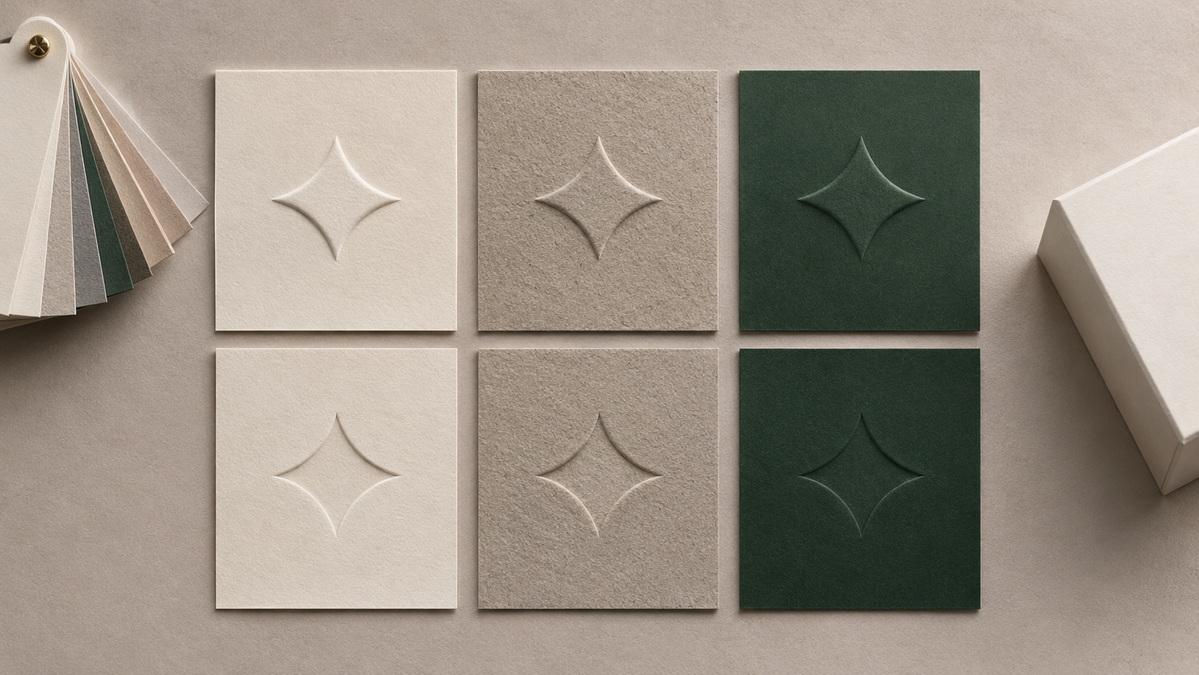
Review Samples Under Real Conditions
Inspect the samples in daylight, retail-style lighting, and ordinary indoor lighting.
Then evaluate:
- Recognition at normal viewing distance.
- Edge sharpness.
- Consistency across the impression.
- Reverse-side appearance.
- Surface condition after folding or assembly.
- Visibility in product photography.
A tactile finish may feel excellent in hand yet disappear in online images. If online presentation matters, photograph the physical sample before committing.
Quality Control: Look Beyond Impression Depth
The deepest impression is not necessarily the best result.
Excessive forming can damage the surface or reduce fine-detail clarity. A shallower, cleaner impression may communicate craftsmanship more effectively.
Before production, agree on a physical approval sample and define the most important acceptance points:
- Logo readability.
- Consistent relief or recess.
- Alignment with surrounding artwork.
- No unacceptable cracking or whitening.
- Clean foil coverage where specified.
- Acceptable appearance after assembly.
Also evaluate packed samples. Raised areas may encounter rubbing or compression during transport, while recessed details can still suffer surface scuffing.
Protective packing and shipment conditions belong in the finishing discussion, not just the logistics discussion.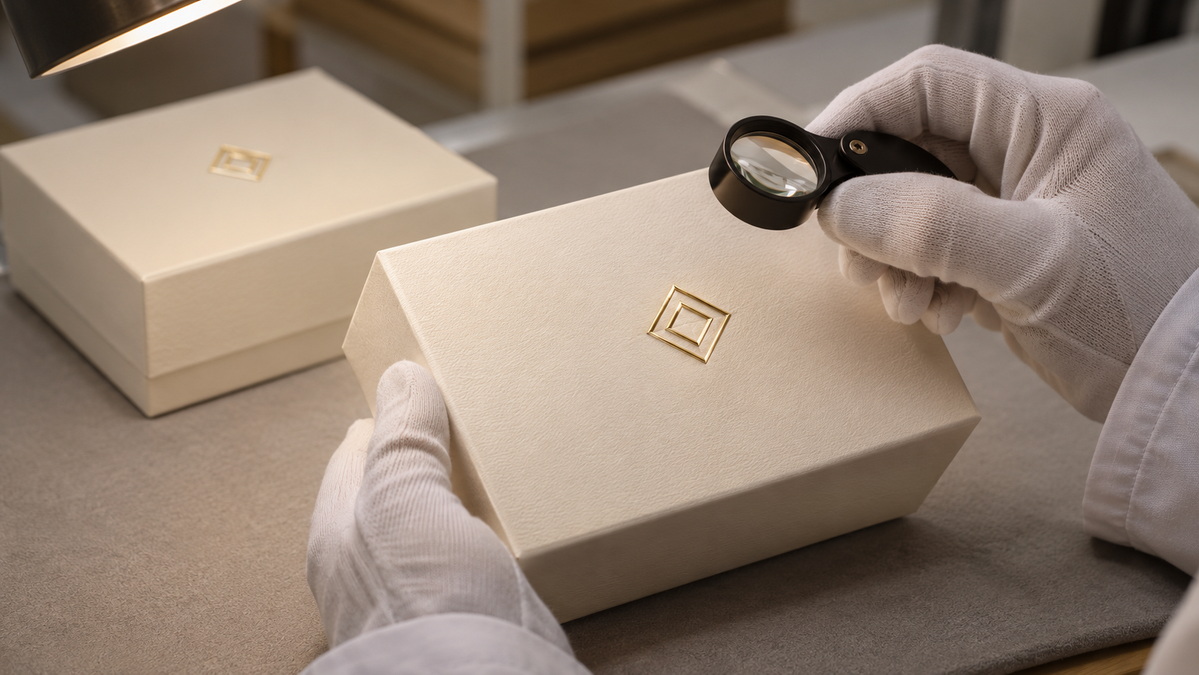
Sustainability: Evaluate the Whole Package
Blind embossing and debossing form the substrate without adding decorative ink or foil to the treated area.
That can support a material-restrained design, but it does not make the entire package automatically recyclable or environmentally preferable.
Paper composition, coatings, laminates, adhesives, inserts, and local collection systems all influence end-of-life options.
Avoid broad claims such as "fully sustainable" based only on a blind finish. Request material information and evaluate the complete packaging construction for the destination market.
Plan Your Luxury Packaging With XingKun
The right choice between embossing and debossing begins with the package your customer will actually receive.
Send Shenzhen XingKun Packing Products Co., Ltd. your box dimensions, product category, artwork, expected quantity, preferred materials, and destination market. Ask for a side-by-side finishing proposal covering material suitability, tooling, sampling, and production considerations.
Make the decision with a physical sample—not a screen alone.
Frequently Asked Questions
1. Is Embossing Better Than Debossing for Luxury Packaging?
Neither is universally better. Embossing suits prominent raised details; debossing suits recessed, restrained branding. Choose through physical trials that reflect the brand, artwork, and actual material.
2. Can Embossing and Debossing Be Used on the Same Box?
Yes. Different areas can use raised and recessed details. However, placement, tooling, and production sequence require coordination. Give each effect a clear purpose rather than adding complexity without visual benefit.
3. What Is the Difference Between Blind Embossing and Foil Embossing?
Blind embossing creates relief without ink or foil in the design. Foil embossing combines raised detail with transferred foil, adding metallic or colored contrast alongside the dimensional effect.
4. Does Debossing Always Cost Less?
No. Tooling complexity, material, registration, quantity, and finishing operations determine cost. Compare quotations using identical specifications rather than assuming one technique is inherently cheaper.
5. Can Small Text Be Embossed or Debossed?
Sometimes, but small lettering needs careful evaluation. Narrow strokes and enclosed spaces may lose definition. Ask the manufacturer to review actual-size artwork and produce a material-specific sample.
6. Should Foil Be Applied Before or After Embossing?
There is no single sequence for every specification. Separate operations commonly involve foil followed by registered embossing, while combination tooling can perform both together. Confirm the route through production trials.
References
1. Crystal Chan, PakFactory. ["What Is Embossing and Debossing in Packaging."] Published March 29, 2023. Background on raised and recessed finishes, blind and registered effects, tooling, and die styles. [pakfactory]
2. Arkay Editorial Team. ["Types of Packaging Finishes: What They Are and How to Combine Them."] Published October 20, 2026. Manufacturing guidance on finish sequencing, combination dies, registration, scores, coatings, physical proofing, and whole-package recyclability considerations. [arkay]
3. MM Group. ["Embossing."] Industry overview of raised and recessed packaging effects and their combination with other finishing processes. [mm]
4. PrintNinja. ["Embossing and Debossing Packaging."] Practical examples of blind finishing and combinations with foil and other specialty effects. [printninja]


