Content Menu
● What Is Holographic Paper, and Why Does It Change Color?
● How Is Holographic Paper Made?
>> Film-Laminated Holographic Paper
>> Transfer-Metallized Holographic Paper
>> Printing and Box Conversion
● What Is Holographic Paper Used For?
● Holographic Paper vs. Metallic Paper vs. Holographic Foil
● How to Print on Holographic Paper Successfully
>> Confirm Substrate and Ink Compatibility
>> Use White Ink to Control the Background
>> Protect Barcodes and Small Text
● A Six-Step Approval Checklist for Holographic Packaging Boxes
>> 1. Define the Intended Use
>> 2. Record the Material Construction
>> 3. Approve a Physical Printed Sample
>> 4. Evaluate Folding and Gluing
>> 5. Check Surface and Print Performance
>> 6. Confirm Repeat-Order Controls
● Industry Case: Holography Designed Around a Brand Story
● Is Holographic Paper Recyclable?
● What Affects Holographic Packaging Costs?
● Develop Your Custom Holographic Packaging With XingKun
● Frequently Asked Questions
>> 1. Can I Print Holographic Paper With a Home Printer?
>> 2. Is Holographic Paper Waterproof?
>> 3. Does Holographic Paper Prevent Counterfeiting?
>> 4. Can Holographic Paper Be Used for Food Packaging?
>> 5. What Should I Send When Requesting a Quotation?
● References
Holographic paper is a decorative paper-based material that creates shifting rainbow colors and visual depth as the light or viewing angle changes. For brands considering custom packaging boxes, it offers a distinctive finish—but choosing the right holographic paper involves more than selecting an attractive pattern.
The material's construction affects printing, folding, surface durability, cost, and recyclability. Two samples that look similar can perform differently during production.
At Shenzhen XingKun Packing Products Co., Ltd., we bring more than 20 years of printing and packaging manufacturing experience, serving brands and distributors across over 30 countries and regions. Our approach to packaging selection is straightforward: evaluate the appearance alongside the requirements of the finished box.
This guide explains how holographic paper works, where it fits, and what buyers should confirm before approving production.
What Is Holographic Paper, and Why Does It Change Color?
Holographic paper typically combines a paper or paperboard base with a specially structured surface that produces an optical effect.
Microscopic patterns interact with light through diffraction, separating it into colors that change as the material moves. A reflective metallic layer commonly helps make those effects visible.
The important distinction is that shine alone does not make a surface holographic. Ordinary silver paper reflects light, while a holographic surface adds changing patterns, color movement, or apparent depth.
Common appearances include:
- Rainbow patterns across the entire sheet.
- Repeating geometric shapes.
- Sparkle or fragmented-light effects.
- Custom images with apparent movement or depth.
Not every holographic material displays a realistic three-dimensional image. Many packaging grades use decorative diffraction patterns rather than image-based holography.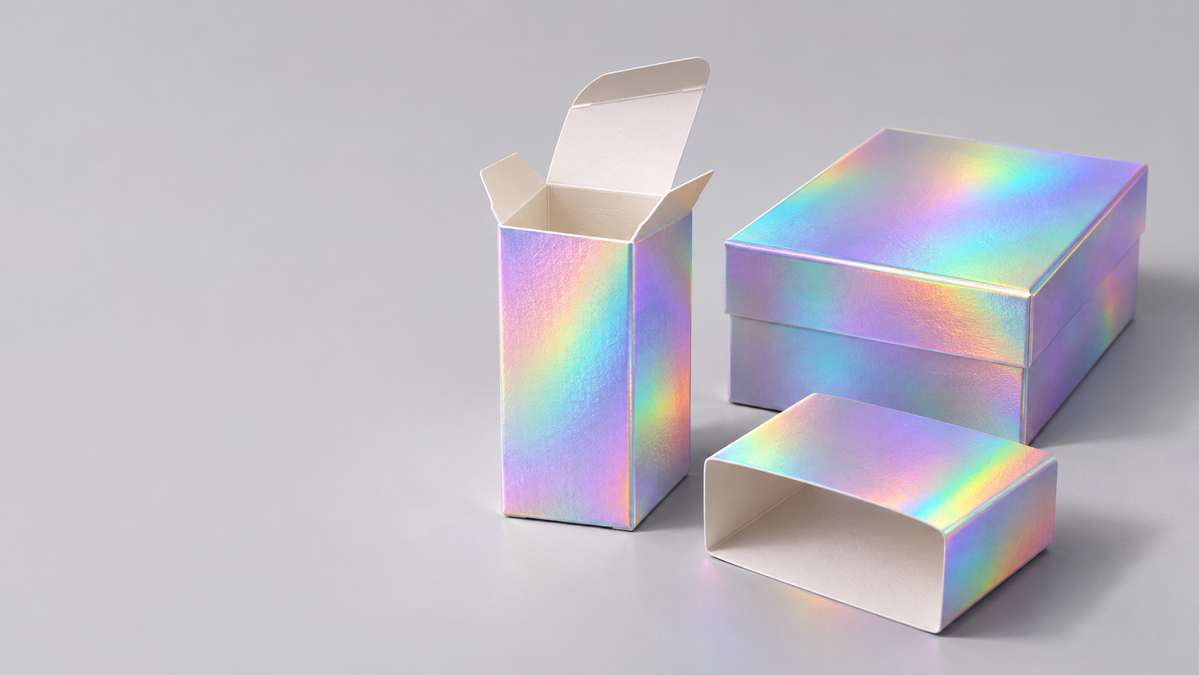
How Is Holographic Paper Made?
There is no single manufacturing sequence for every product sold as holographic paper. Buyers should distinguish between permanent film lamination and transfer-metallized constructions.
Film-Laminated Holographic Paper
In a typical laminated construction, a holographic film is bonded to paper or board. The film remains part of the finished material.
This approach can deliver a striking decorative surface. However, the retained film also becomes part of the packaging's material structure and must be considered when evaluating folding, adhesives, and recycling compatibility.
Ask the supplier to identify the film type rather than relying on a general description such as "rainbow paper."
Transfer-Metallized Holographic Paper
Transfer-metallized materials use a carrier during manufacturing to transfer a thin decorative structure onto the paper surface. The carrier film is subsequently removed.
The finished material is therefore different from paper with a permanently laminated film.
Some commercial transfer-metallized grades have obtained paper-recyclability certifications. Those results apply to the evaluated products, not automatically to every holographic box.
Printing and Box Conversion
After the decorative substrate is prepared, the converter prints, coats, die-cuts, creases, folds, and glues it into the required packaging format.
These stages matter as much as the initial optical effect. A beautiful flat sheet is not sufficient evidence that the finished box will fold cleanly or resist handling damage.
What Is Holographic Paper Used For?
Holographic paper and paperboard are used in packaging, printed promotional materials, and decorative products where changing light effects support the design.
| Application | Design opportunity | Main specification concern |
| Cosmetic cartons | Distinctive panels and metallic color effects | Legibility and surface scuffing |
| Gift packaging | A coordinated decorative presentation | Fold quality and handling durability |
| Collectible packaging | Visual depth and limited-edition styling | Artwork registration and consistency |
| Electronics accessories | Contrasting technical graphics | Barcode readability |
| Labels and sleeves | Selective decorative impact | Adhesion and application conditions |
For packaging boxes, distinguish the decorative surface from the structural material underneath.
A thin holographic sheet may function as a wrap, while a folding carton requires suitable paperboard. A rigid presentation box uses a separate supporting structure.
The finish does not replace structural engineering.
Holographic Paper vs. Metallic Paper vs. Holographic Foil
These terms describe related effects, but they are not interchangeable purchasing specifications.
| Material or process | Typical appearance | Useful when |
| Holographic paper or board | Color-shifting patterns over a supplied substrate | The design needs broad decorative coverage |
| Metallic paper or board | Reflective silver, gold, or colored metallic appearance | A metallic effect is needed without rainbow movement |
| Holographic stamping foil | Holographic decoration applied to selected areas | Logos, borders, or accents need emphasis |
| Conventional white board | A neutral printable background | Predictable color and information clarity take priority |
A fully holographic exterior is not always the most effective choice.
For some brands, a small holographic logo on a restrained background creates a clearer visual hierarchy. Compare full-surface and selective decoration before committing to either approach.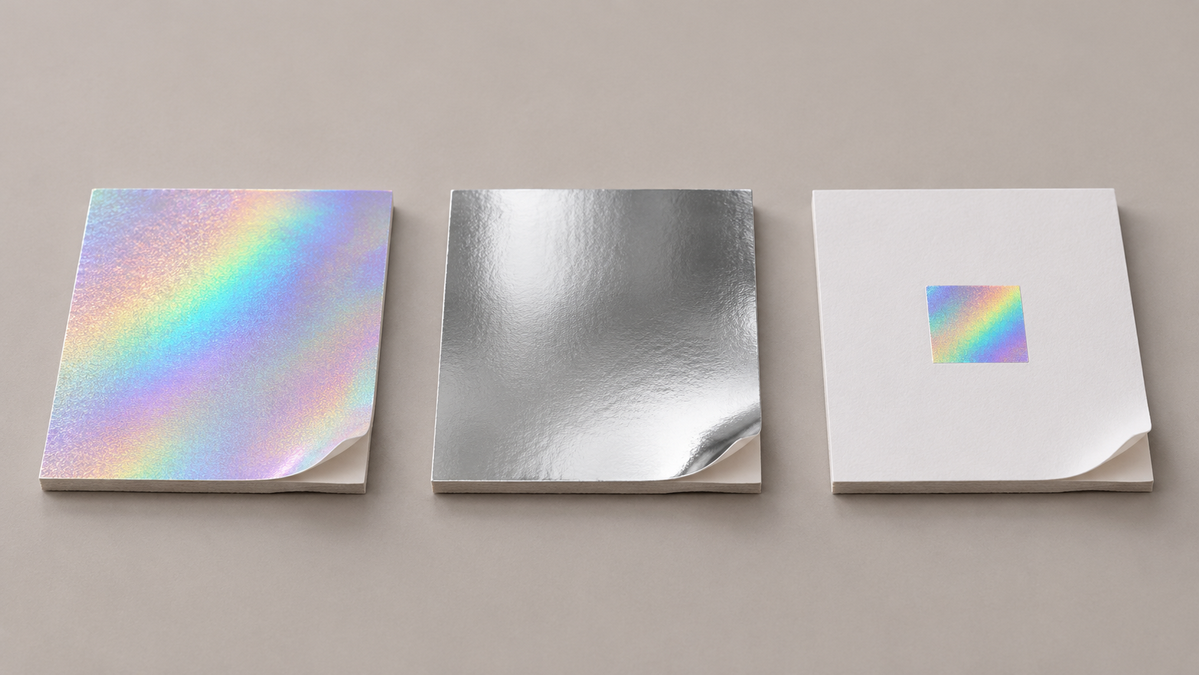
How to Print on Holographic Paper Successfully
Successful holographic paper printing depends on the specific substrate, its print-receptive coating, the press, and the ink system.
Do not assume that every holographic sheet is compatible with every offset or digital process.
Confirm Substrate and Ink Compatibility
Ask the converter to confirm:
- Whether the material is approved for the intended printing process.
- Whether a primer or special surface treatment is required.
- Which ink system will be used.
- How ink adhesion and curing will be checked.
- Whether protective finishing changes the optical effect.
Commercially available holographic materials include grades prepared for specific digital printing systems. Compatibility should still be confirmed for the exact material and production setup.
Use White Ink to Control the Background
Transparent color over a reflective surface can look different from the same color printed on white paper.
A selective opaque-white underprint can separate two design functions: areas intended to retain holographic movement and areas that need a more stable background.
For example, a cosmetic carton might leave a decorative border exposed while placing instructions and product descriptions over white.
Treat the white layer as part of the artwork, not a last-minute production adjustment.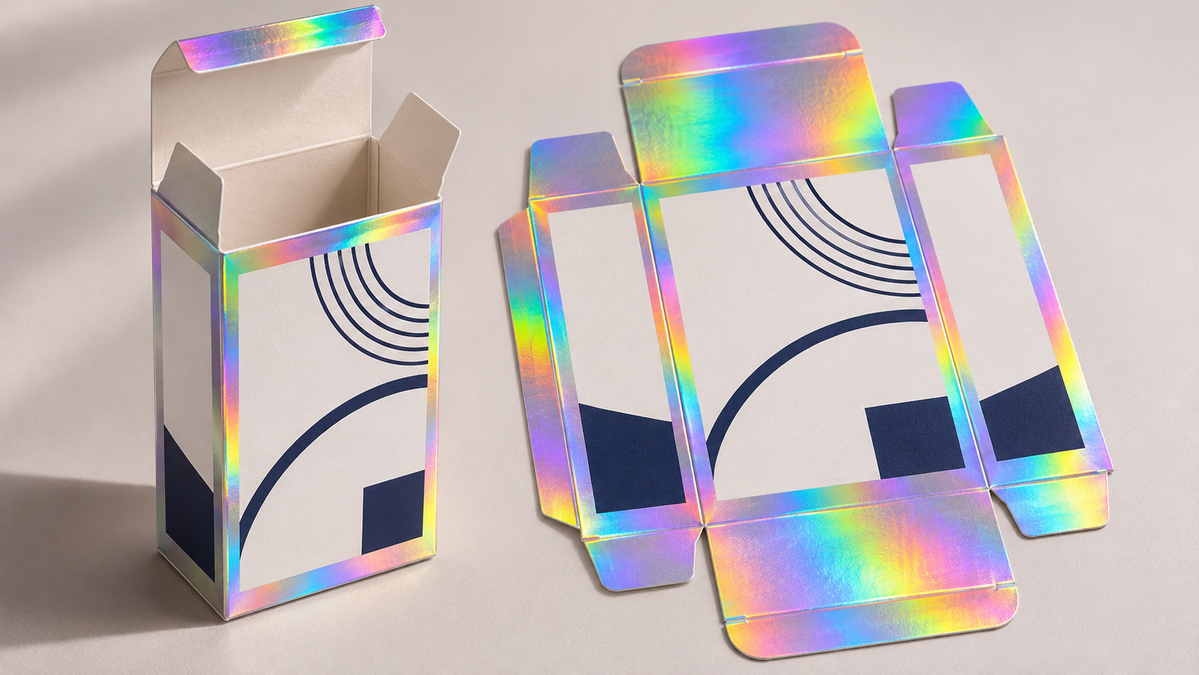
Protect Barcodes and Small Text
Opaque white is particularly important when designing machine-readable areas on reflective packaging.
A practical starting point is a dark barcode on a matte, opaque-white panel, with the required clear space around it.
Avoid placing codes across folds, seams, or visually active holographic areas. Verify the finished packaging with appropriate equipment; a successful smartphone scan alone is not sufficient proof of reliable retail performance.
A Six-Step Approval Checklist for Holographic Packaging Boxes
From a packaging-development perspective, the most useful question is not simply, "Does this sample look impressive?"
It is, "Will this construction remain attractive, readable, and functional after production and distribution?"
1. Define the Intended Use
Specify the product dimensions, weight, sales channel, storage conditions, and expected handling.
Clarify whether the box is a retail carton, gift presentation box, sleeve, or decorative outer package.
2. Record the Material Construction
Request the paperboard grade, thickness, decorative construction, coating details, and any retained film.
Use an identifiable material specification rather than an informal description.
3. Approve a Physical Printed Sample
Screen previews cannot reproduce changing reflective effects reliably.
Review the proposed material under store-like lighting, daylight, and the lighting used for product photography. Check whether the brand name remains easy to read.
4. Evaluate Folding and Gluing
Inspect creases, corners, glue seams, and closure performance.
Look for cracking, lifting, distortion, or loss of appearance around folds. Agree on acceptable appearance using a signed reference sample.
5. Check Surface and Print Performance
Define suitable checks for ink adhesion, rubbing, scratching, and handling.
The method and acceptance criteria should reflect the product's actual journey rather than an arbitrary claim that the finish is "scratch-proof."
6. Confirm Repeat-Order Controls
Retain an approved sample and record the pattern, orientation, artwork version, and material code.
If the design uses a registered image, establish alignment expectations before ordering. This helps avoid disagreements when later batches are compared.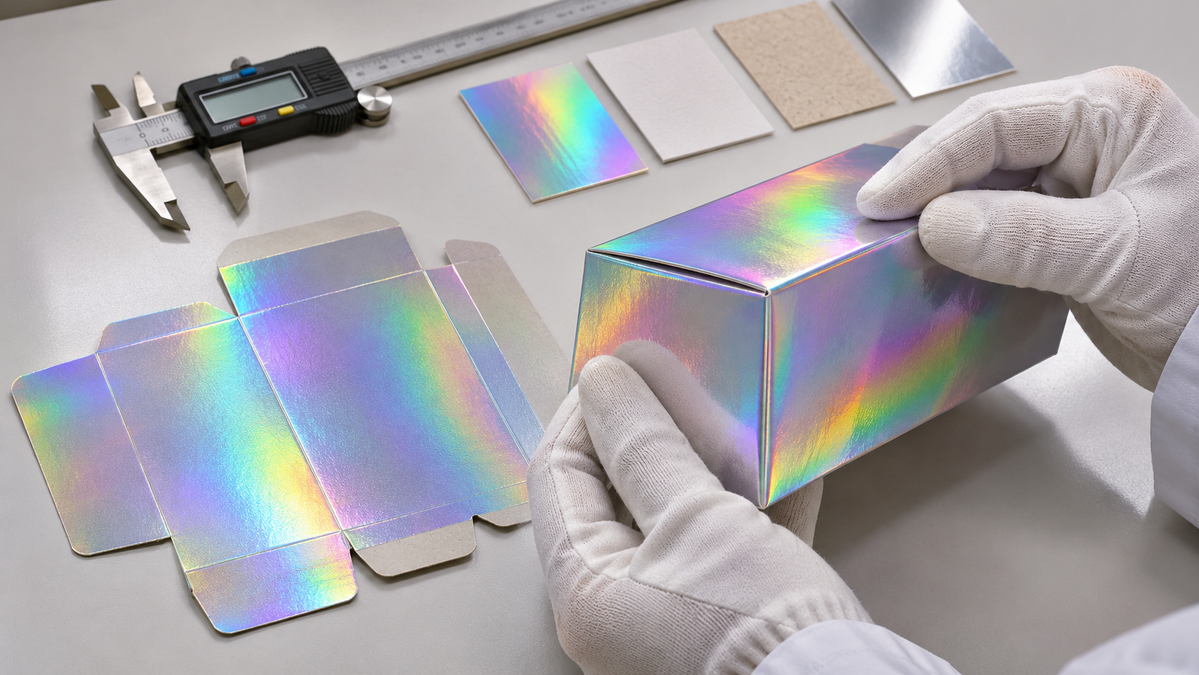
Industry Case: Holography Designed Around a Brand Story
A documented example is the Arctic Blue Gin carton produced using custom holography from Hazen Paper.
The project received the AIMCAL 2020 Product of the Year award. Its transfer-metallized surface used a microscopic embossing structure to create changing radiance and color, supporting the package's atmospheric visual concept.
The material was transferred onto MetsäBoard Pro FBB Bright paperboard, then printed and converted by AM Lithography.
The lesson is not that a reflective finish guarantees commercial success. It is that the optical pattern, paperboard, artwork, and conversion process should be developed together.
For your own project, identify what the effect should communicate: icy freshness, futuristic technology, celebration, or collectible value. Then evaluate whether the selected pattern actually supports that message.
Is Holographic Paper Recyclable?
The responsible answer depends on the construction and the recycling system receiving it.
"Paper-based" does not automatically mean that a finished package is accepted in every paper-recycling stream.
Some transfer-metallized substrates have product-specific recyclability evaluations. For example, Hazen reports that its silver and holographic Envirofoil grades received a 19-out-of-20 assessment from Interseroh and certification under the Aticelca 501 system.
These findings should not be extended to unrelated substrates or finished boxes.
Before making an environmental claim, request:
- The exact material name and construction.
- The applicable test report or certification.
- Confirmation of what the evaluation covers.
- Details of additional films, coatings, windows, or attachments.
- Guidance relevant to the destination market.
Recyclability should be supported by evidence for the proposed construction, not inferred from its appearance.
What Affects Holographic Packaging Costs?
There is no reliable universal price premium for holographic paper.
The final quotation depends on material selection, order quantity, sheet utilization, print coverage, white-ink requirements, finishing, tooling, and conversion complexity.
Custom holographic images may also introduce origination costs and additional development work.
To compare suppliers fairly, issue the same specification to each one. Separate one-time setup costs from repeat-order unit prices, and confirm whether sampling, inserts, freight, and protective packing are included.
Consider three design routes:
1. Full-surface holographic material for broad visual coverage.
2. Selective holographic decoration for focused accents.
3. A holographic sleeve combined with a conventional inner box.
These are alternatives to quote and test—not guaranteed savings.
Do not assume that a higher packaging cost will automatically produce higher sales. Where practical, compare customer response and operational performance before a wider rollout.
Develop Your Custom Holographic Packaging With XingKun
An effective holographic package balances visual impact with readable graphics, dependable structure, and a clearly documented material specification.
Send Shenzhen XingKun Packing Products Co., Ltd. your product dimensions, target quantity, artwork, preferred finish, and destination market. Ask our team to review the proposed construction and sampling requirements before you approve production.
Start with a physical sample that demonstrates both the appearance you want and the performance your product needs.
Frequently Asked Questions
1. Can I Print Holographic Paper With a Home Printer?
Only if the material is explicitly approved for that printer technology. Commercial holographic packaging substrates are not automatically suitable for desktop inkjet or laser printers. Confirm compatibility before use.
2. Is Holographic Paper Waterproof?
Not necessarily. A decorative surface does not make the paper core or cut edges waterproof. If moisture exposure is expected, define the conditions and request suitable material-performance testing.
3. Does Holographic Paper Prevent Counterfeiting?
A generic rainbow pattern should not be treated as proof of authenticity. Custom holographic features can support a broader authentication strategy, but they require controlled design, sourcing, and verification.
4. Can Holographic Paper Be Used for Food Packaging?
Do not assume suitability for direct food contact. The complete construction—including inks, coatings, and adhesives—needs documentation appropriate to its intended use and destination market.
5. What Should I Send When Requesting a Quotation?
Provide box dimensions, product weight, quantity, artwork, preferred pattern, structural style, delivery destination, and required date. Include any testing, food-contact, or environmental requirements.
References
1. Custom Box Makers. ["What Is Holographic Paper? Everything You Should Know."]
2. Hazen Paper Company. ["Envirofoil®."] Manufacturer information on transfer-metallized paper, carrier removal, printing compatibility, and product-specific recyclability assessments. [hazen]
3. Hazen Paper Company. ["Laminations."] Information on film-to-paper and foil-to-paper constructions, specialty coatings, and digital-printable materials. [hazen]
4. GS1. ["GS1 2D Barcode Colour & Quality Guide."] Technical guidance on reflective substrates, opaque-white backgrounds, contrast, and scanning limitations. [ref.gs1]
5. GS1. ["10 Steps to Barcode Your Product."] Guidance on barcode colors, background opacity, and quiet zones. [gs1]
6. Hazen Paper Company. ["Hazen Paper 'Arctic Blue' Wins AIMCAL 2020 Product of the Year."] Published February 11, 2021. Documented packaging example identifying the optical construction, paperboard, and printing/converting partner. [hazen]
7. Hazen Paper Company. ["Recyclability Certifications."] Manufacturer-reported Interseroh and Lucense evaluations for specific silver and holographic substrates. These findings are product-specific. [hazen]


