Content Menu
● Why Are Cardboard Boxes Expensive? Start with the Box Type
● The Main Factors Behind High Cardboard Box Prices
>> Paper Materials and Required Performance
>> Manufacturing Setup and Order Quantity
>> Printing, Finishing, and Assembly
>> Dimensions, Layout, and Material Waste
● Are Cardboard Box Prices Actually Rising?
● The Hidden Cost: Paying to Ship Empty Space
>> An Illustrative Dimensional-Weight Comparison
● Compare Total Packaging Cost, Not Just Unit Price
>> A Hypothetical Purchasing Example
● How to Reduce Cardboard Packaging Costs Without Weakening Protection
>> 1. Define the Product and Distribution Requirements
>> 2. Request a Structural Review Before Finalizing Artwork
>> 3. Separate Essential Branding from Optional Finishes
>> 4. Consolidate Quantities Carefully
>> 5. Standardize Suitable Packaging Sizes
● What to Include in a Custom Packaging Quote Request
● Sustainability and Quality: Ask for Specific Evidence
● Get a Packaging Proposal Built Around Your Product
● Conclusion
● Frequently Asked Questions
>> Why are custom cardboard boxes more expensive than stock boxes?
>> How much should a cardboard box cost?
>> Does ordering cardboard boxes in bulk always save money?
>> Is recycled cardboard always the cheapest option?
>> Can smaller packaging reduce shipping costs?
>> How can I check whether a cheaper box is strong enough?
● Referencs
Why are cardboard boxes expensive when they look like such simple products? The answer lies in everything behind the finished box: paper quality, structural design, manufacturing setup, printing, finishing, order quantity, and transportation. For businesses buying custom packaging boxes, these factors work together—not independently—to determine the final price.
At Shenzhen XingKun Packing Products Co., Ltd., we approach this question from a manufacturing perspective. With more than 20 years of experience producing packaging boxes and other printed products, and serving brands and distributors across more than 30 countries and regions, our focus is value: packaging that protects your product, supports your brand, and controls your overall costs.
This guide explains what drives cardboard box prices and how to make better purchasing decisions without sacrificing essential performance.
Why Are Cardboard Boxes Expensive? Start with the Box Type
"Cardboard box" is a broad description, not a complete purchasing specification. A shipping carton, folding carton, and rigid gift box can differ substantially in materials, construction, and production requirements.
| Packaging type | Typical construction | Main cost considerations |
| Corrugated shipping box | Fluted paper between liner sheets | Board specification, dimensions, printing, strength |
| Folding carton | Paperboard cut, creased, and folded | Board grade, artwork, cutting layout, finishing |
| Rigid presentation box | Rigid board covered with wrapping material | Assembly, wrapping, inserts, freight volume |
Comparing these products only by unit price can be misleading.
A plain shipping carton may be appropriate for distribution but unsuitable for a premium retail presentation. Conversely, a decorative rigid box may add unnecessary cost to a product that needs only reliable transit protection.
The first purchasing question should therefore be: what must this packaging accomplish?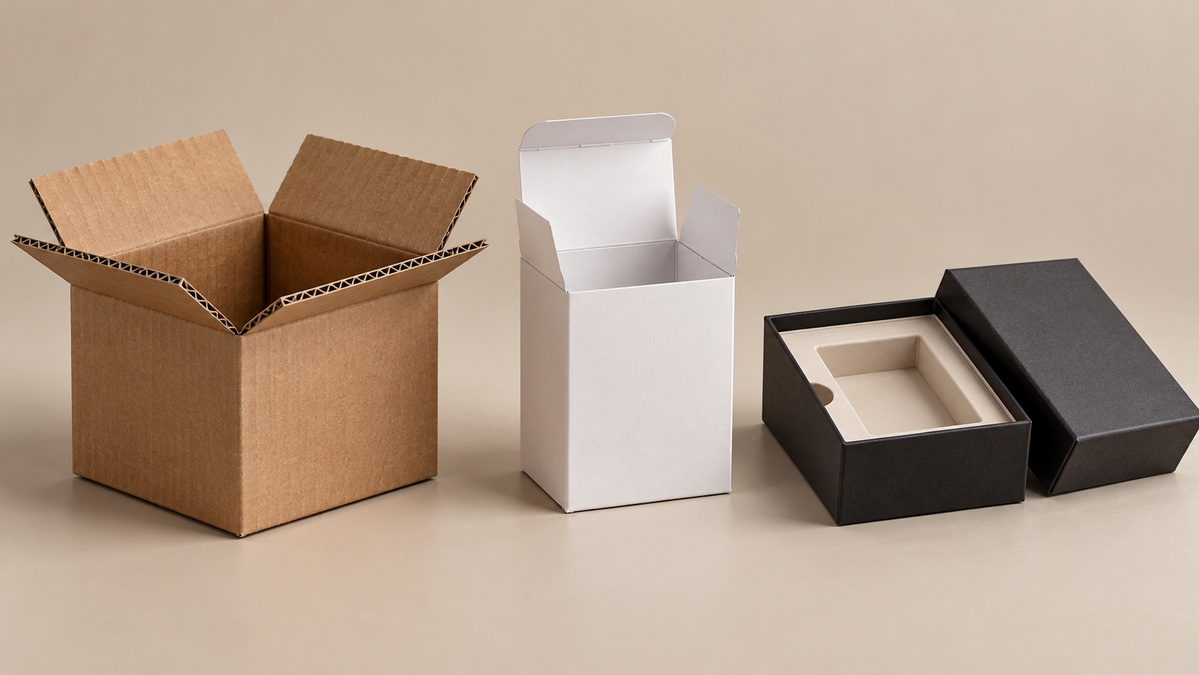
The Main Factors Behind High Cardboard Box Prices
Paper Materials and Required Performance
The paper specification affects both cost and functionality. Suppliers may use different combinations of virgin and recovered fiber, liner grades, paperboard thicknesses, and surface treatments.
Higher specifications can be justified when products are heavy, fragile, stacked in warehouses, or exposed to challenging distribution conditions. However, choosing thicker material without identifying the actual requirement can create avoidable expense.
Recycled material is not automatically cheaper—or automatically more expensive. Its cost depends on the grade, available supply, processing requirements, and local market conditions.
Ask suppliers to describe the proposed material precisely. "Premium cardboard" tells you far less than a defined board construction and measurable performance requirement.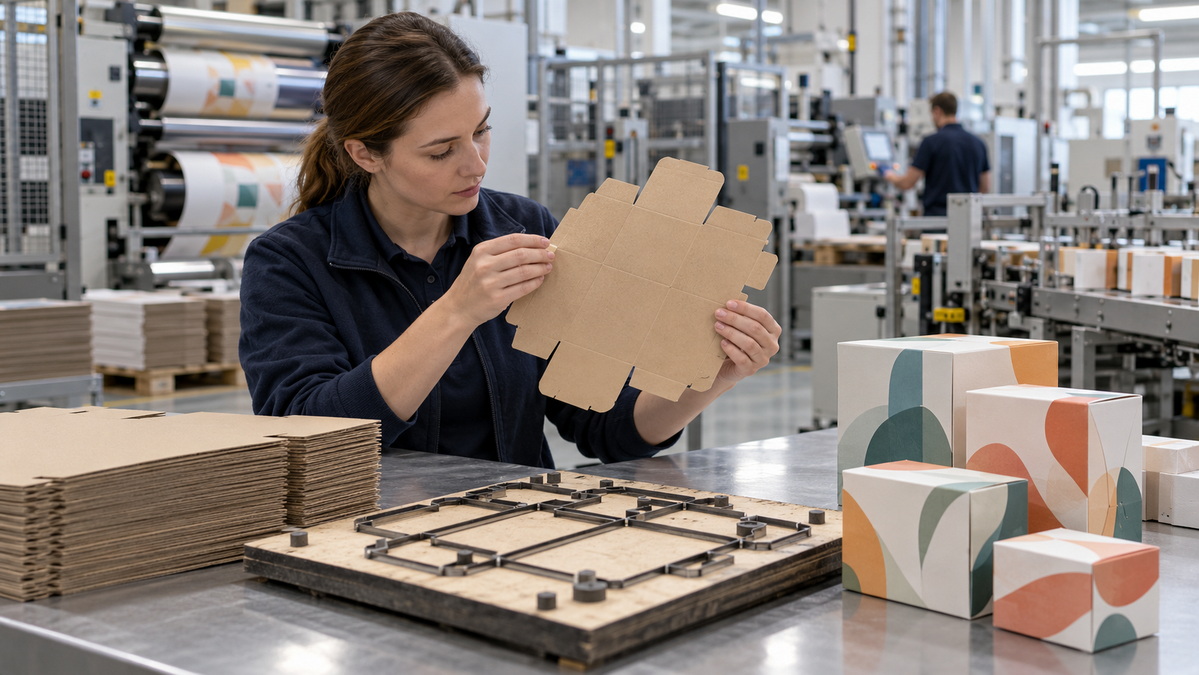
Manufacturing Setup and Order Quantity
Custom packaging involves work before the first saleable box is produced.
Depending on the design and production method, this may include:
- Structural development and sample preparation.
- Cutting dies or printing plates.
- Machine setup and color adjustment.
- Production checks and material preparation.
These costs must be recovered across the order.
For an illustrative calculation, suppose setup costs $300. Spread across 500 boxes, that contributes $0.60 per box. Across 3,000 boxes, it contributes $0.10 per box.
This is not a market quotation. It demonstrates why small custom runs can carry higher unit prices even when their materials resemble those used in larger orders.
Printing, Finishing, and Assembly
Custom printed cardboard boxes can require additional production stages. Foil stamping, embossing, specialty coatings, window patches, and fitted inserts each introduce their own requirements.
The important distinction is between appearance and production complexity.
A visually simple package may still be expensive if it requires unusual materials or extensive assembly. A colorful design may be comparatively efficient when it suits the supplier's equipment and production workflow.
Instead of removing every decorative feature, identify which elements genuinely support product recognition or customer experience. Then ask for alternatives that deliver a similar result with fewer operations.
Dimensions, Layout, and Material Waste
Box dimensions influence more than the amount of paper surrounding a product.
They also affect how the design fits onto production sheets, how much material remains after cutting, and how efficiently finished boxes are packed for delivery.
A small dimensional adjustment may improve sheet utilization, but it must preserve product fit and protection. This is why structural review should happen before artwork approval.
Once artwork and tooling are finalized, dimensional changes can trigger additional work.
Are Cardboard Box Prices Actually Rising?
Market movements should be separated from claims about an individual quotation.
The U.S. Bureau of Labor Statistics' selected-industry table reports a producer price index of 465.078 for corrugated and solid fiber box manufacturing in January 2026 and a preliminary 501.441 in August 2026—an increase of approximately 7.8%.
This index measures changes in producer selling prices. It is not a retail box price, a Chinese factory quotation, or a forecast for every packaging category.
The practical lesson is to question blanket statements such as "box prices increase every day." A useful explanation should identify the material, market, period, and quotation conditions involved.
For international buyers, exchange rates, freight arrangements, and packaging specifications may also affect the final comparison.
The Hidden Cost: Paying to Ship Empty Space
An oversized box can appear inexpensive at purchase while increasing delivery costs.
Some parcel services charge according to dimensional weight when it exceeds actual weight. Dimensional weight reflects the space occupied by the shipment rather than simply what it weighs.
An Illustrative Dimensional-Weight Comparison
Using a divisor of 5,000 for dimensions measured in centimeters:
| Example | External dimensions | Calculated dimensional weight |
| Larger shipping box | 40 × 30 × 20 cm | 4.8 kg |
| Right-sized shipping box | 35 × 25 × 15 cm | 2.625 kg |
The second design has approximately 45% less volume.
That does not mean the freight bill automatically falls by 45%. Actual weight, carrier rules, rounding, service type, and rate bands determine the charge.
Nevertheless, the example shows why reviewing external dimensions can be more valuable than negotiating a small reduction in box price.
Remove unnecessary space, but retain sufficient cushioning and clearance to protect the product.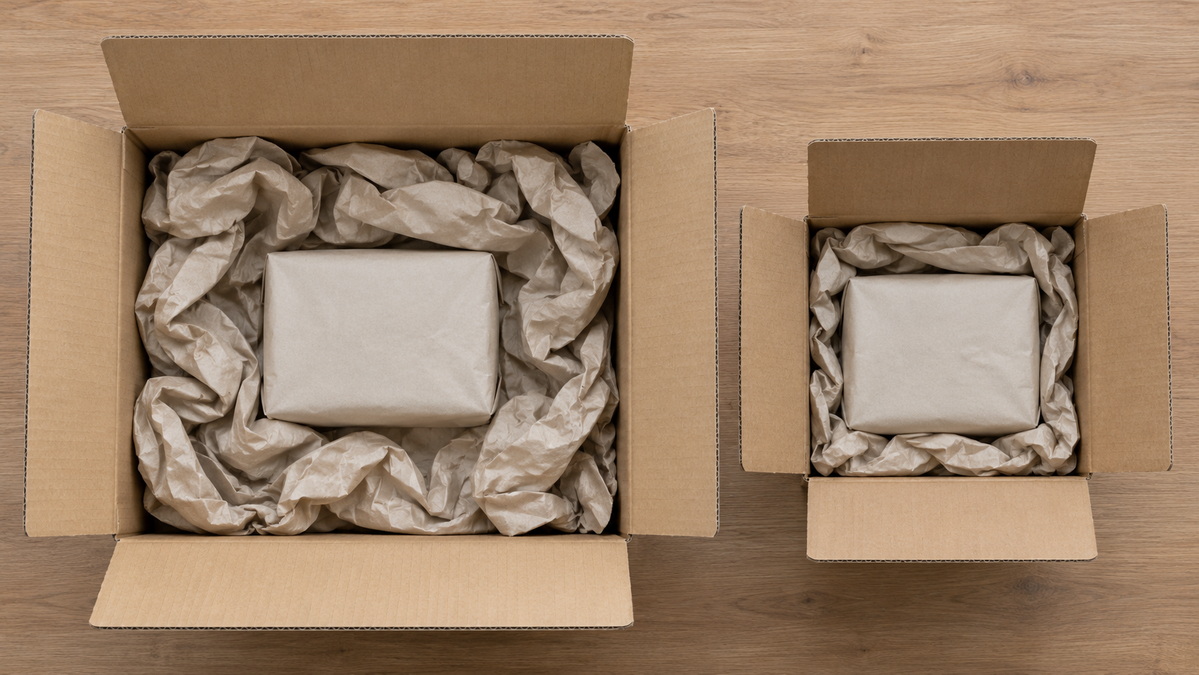
Compare Total Packaging Cost, Not Just Unit Price
The cheapest quotation does not necessarily produce the lowest business cost.
A more useful comparison considers:
Total packaging cost = box purchase cost + tooling + freight + storage + packing labor + expected damage-related costs.
For imported packaging, include applicable duties, taxes, and handling charges when comparing landed costs.
A Hypothetical Purchasing Example
Consider two packaging options:
- Option A costs $0.80 per box and $0.20 in inbound freight.
- Option B costs $0.90 per box and $0.08 in inbound freight.
Before considering other expenses, Option A totals $1.00 per box, while Option B totals $0.98.
The higher factory price produces the lower delivered cost in this example.
The same principle applies to packing labor and product damage. An easy-to-assemble box or a properly designed insert may justify a higher purchase price when it reduces other expenses.
Use your own operational data rather than assuming those benefits will occur.
How to Reduce Cardboard Packaging Costs Without Weakening Protection
1. Define the Product and Distribution Requirements
Start with product dimensions, weight, fragility, presentation needs, and shipping conditions.
Include stacking requirements and relevant environmental exposure. A lightweight retail product and a heavy replacement component do not need identical packaging.
Clear requirements help suppliers avoid both excessive specifications and insufficient protection.
2. Request a Structural Review Before Finalizing Artwork
Ask the manufacturer to evaluate:
- Internal and external dimensions.
- Box style and closure method.
- Insert design and assembly steps.
- Opportunities to reduce unused space.
- Material utilization during production.
Structural improvements are easier to implement before the design becomes a finished production file.
3. Separate Essential Branding from Optional Finishes
List the elements customers must recognize: brand name, product identification, required information, and important visual cues.
Then distinguish them from optional embellishments.
Request quotations for a baseline version and an enhanced version. This makes the extra cost visible and allows a commercial decision rather than an assumption.
4. Consolidate Quantities Carefully
Larger orders can spread setup costs over more units, but buying more is not always better.
Evaluate storage capacity, cash flow, expected consumption, and the risk of artwork becoming obsolete.
A lower unit price offers little benefit if a large share of the order remains unused.
5. Standardize Suitable Packaging Sizes
Where product ranges allow it, reducing the number of box sizes can simplify purchasing, stock management, and packing.
However, avoid forcing every product into one oversized package. Standardization should improve efficiency without creating unnecessary freight volume or inadequate protection.
What to Include in a Custom Packaging Quote Request
A detailed brief makes supplier quotations more comparable.
| Information to provide | Why it matters |
| Product dimensions and weight | Establishes fit and protection needs |
| Internal box dimensions | Prevents dimensional misunderstandings |
| Packaging type and intended use | Defines construction requirements |
| Material or performance specification | Creates a consistent comparison |
| Printing and finishing requirements | Clarifies production scope |
| Quantity and reorder expectations | Supports production planning |
| Delivery destination and trade terms | Enables freight and landed-cost review |
| Sample and testing requirements | Defines approval expectations |
Also ask whether tooling, samples, inserts, assembly, and freight are included.
Confirm quotation validity, production lead time, and how approved specifications will be recorded. A complete quotation is easier to evaluate than an attractive price with missing details.
Sustainability and Quality: Ask for Specific Evidence
Environmental preferences should be translated into clear purchasing requirements.
FEFCO reports that 88% of European corrugated packaging is derived from recycled content. This is an industry-level figure, not proof of the recycled content in a particular supplier's box.
Ask for product-specific information where it matters. Do not assume that an industry statistic verifies your order.
Likewise, "strong cardboard" is not a test result.
For corrugated packaging, relevant evaluations can include edgewise crush resistance, compression resistance, water absorption, and drop or vibration testing. The appropriate combination depends on the product and distribution environment.
An edge-crush result describes a board property; it does not alone prove that a finished, packed box will survive its shipping route.
The objective is to select and validate adequate protection—not simply purchase the thickest available board.
Get a Packaging Proposal Built Around Your Product
At Shenzhen XingKun Packing Products Co., Ltd., we welcome packaging briefs that connect product protection, brand presentation, and purchasing requirements.
Send us your product dimensions, weight, intended box style, estimated quantity, artwork requirements, and delivery destination. If you already have a box, include photographs or a structural drawing.
Ask us to review a practical baseline option alongside any premium finishes you are considering.
A well-defined inquiry helps turn "Why are cardboard boxes expensive?" into a more useful question: which packaging design delivers the best overall result for this product?
Conclusion
Cardboard boxes cost more than their simple appearance suggests. Materials, manufacturing setup, printing, finishing, order quantity, and transportation all contribute to the final price. The best purchasing decision is therefore not just about finding the cheapest box—it is about achieving the right balance of protection, presentation, and value.
To control packaging costs, start with accurate product specifications, review box dimensions, and compare supplier quotations on the same basis. Consider delivered cost, packing efficiency, and potential product damage alongside the unit price. Right-sized packaging and carefully selected finishes can help eliminate unnecessary spending without compromising essential performance.
With more than 20 years of printing and packaging experience, Shenzhen XingKun Packing Products Co., Ltd. serves brands and distributors across more than 30 countries and regions. Share your product dimensions, order quantity, artwork requirements, and delivery destination with our team to request a tailored packaging proposal that supports your product, brand, and budget.
Frequently Asked Questions
Why are custom cardboard boxes more expensive than stock boxes?
Custom boxes may require design development, tooling, printing setup, and specialized finishing. Stock boxes typically use existing specifications. The difference depends on quantity and construction, not customization alone.
How much should a cardboard box cost?
There is no reliable universal price. Dimensions, material, strength, printing, quantity, and delivery terms all matter. Compare quotations against the same specification and distinguish factory price from delivered cost.
Does ordering cardboard boxes in bulk always save money?
Bulk orders can reduce unit production costs, but storage, cash commitment, and unused inventory may offset the savings. Base the order quantity on realistic demand and reorder planning.
Is recycled cardboard always the cheapest option?
No. Recycled grades have their own collection, processing, quality, and supply considerations. Compare materials that meet the same performance requirements rather than judging cost by recycled content alone.
Can smaller packaging reduce shipping costs?
It can when reduced dimensions lower the applicable dimensional weight or move the parcel into a cheaper rate band. Confirm the carrier's rules and ensure the smaller box still protects the product.
How can I check whether a cheaper box is strong enough?
Request defined specifications, suitable samples, and relevant testing. Evaluate the finished package with the actual product inside, because board strength alone does not establish complete shipping performance.
Referencs
1. Custom Box Makers — "Why Are Cardboard Boxes Expensive?" Original article by Dian Priastuti, dated November 7, 2025. Used as the starting point for restructuring; its unsupported universal pricing and blanket cost claims were not retained. [customboxmakers]
2. U.S. Bureau of Labor Statistics — "Producer Price Index—Selected Industries," corrugated and solid fiber box manufacturing series. Source for the January and preliminary August 2026 index values. These are U.S. producer-price indicators, not company quotations. [bls]
3. FedEx — "How Do I Calculate Dimensional Weight of a Package?" Source for the centimeter-based dimensional-weight formula and 5,000 divisor. Actual shipment rating remains subject to the applicable service and carrier rules. [fedex]
4. FedEx — "What Is Dimensional Weight?" Source for the explanation that applicable shipment charges use dimensional or actual weight, whichever is greater. [fedex]
5. FEFCO — European Federation of Corrugated Board Manufacturers. Source for the reported 88% recycled-content figure for European corrugated packaging. [fefco]
6. FEFCO — "Testing Methods & Recommendations." Source for the named board and packaging evaluations, including edgewise crush, compression, water absorption, drop, and vibration testing. [fefco]


