Content Menu
● What Are Industrial Labels and How Do They Differ From Nameplates?
● Eight Benefits of Industrial Labels for Manufacturers
>> 1. Faster Equipment and Inventory Identification
>> 2. Clearer Safety Communication
>> 3. More Reliable Asset Tracking
>> 4. Better Maintenance and Service Access
>> 5. Stronger Traceability and Recall Management
>> 6. More Consistent Quality Control
>> 7. Easier Product Use and Customer Support
>> 8. Consistent Branding Across Product Lines
● Choosing Industrial Label Materials for the Application
● Five Steps to Specify Custom Industrial Labels
>> Step 1: Define the Information and Its Purpose
>> Step 2: Document the Operating Environment
>> Step 3: Select the Complete Construction
>> Step 4: Review Readability at Actual Size
>> Step 5: Approve Samples Before Production
● A Practical Validation Plan for Durable Industrial Labels
● An Application Example: Export Equipment Identification
● Comparing Industrial Labels by Lifetime Cost
● Working With Shenzhen XingKun on Custom Nameplates and Labels
● Frequently Asked Questions
>> What Are the Main Benefits of Industrial Labels?
>> What Is the Best Material for Industrial Equipment Labels?
>> Can Industrial Labels Be Used Outdoors?
>> Do All Industrial Labels Need UL Recognition?
>> Can QR Codes Replace Printed Equipment Information?
>> What Should Buyers Provide When Requesting a Quote?
● References
The benefits of industrial labels extend far beyond putting a name on a machine. Well-designed labels help people identify equipment, understand hazards, locate assets, and connect products with maintenance records. For manufacturers and distributors, durable industrial labels and custom nameplates also support consistent branding throughout a product's working life.
At Shenzhen XingKun Packing Products Co., Ltd., we approach identification as part of the product, not an afterthought. With more than 20 years of printing and packaging experience serving brands and distributors across over 30 countries and regions, our perspective is straightforward: start with the application, then develop the label.
What Are Industrial Labels and How Do They Differ From Nameplates?
Industrial labels communicate information on equipment, components, containers, storage locations, and finished products. Their functions include identification, warnings, operating instructions, traceability, and branding.
Common formats include:
- Adhesive equipment labels carrying model numbers and electrical ratings.
- Asset identification labels linking tools to ownership records.
- Barcode labels connecting physical products with digital information.
- Safety labels explaining hazards and protective actions.
- Metal nameplates providing rigid, durable product identification.
The distinction is not absolute. A nameplate may use an adhesive backing, while an industrial label may incorporate a metal construction. For purchasing purposes, specify the construction and performance requirements rather than relying on the product name alone.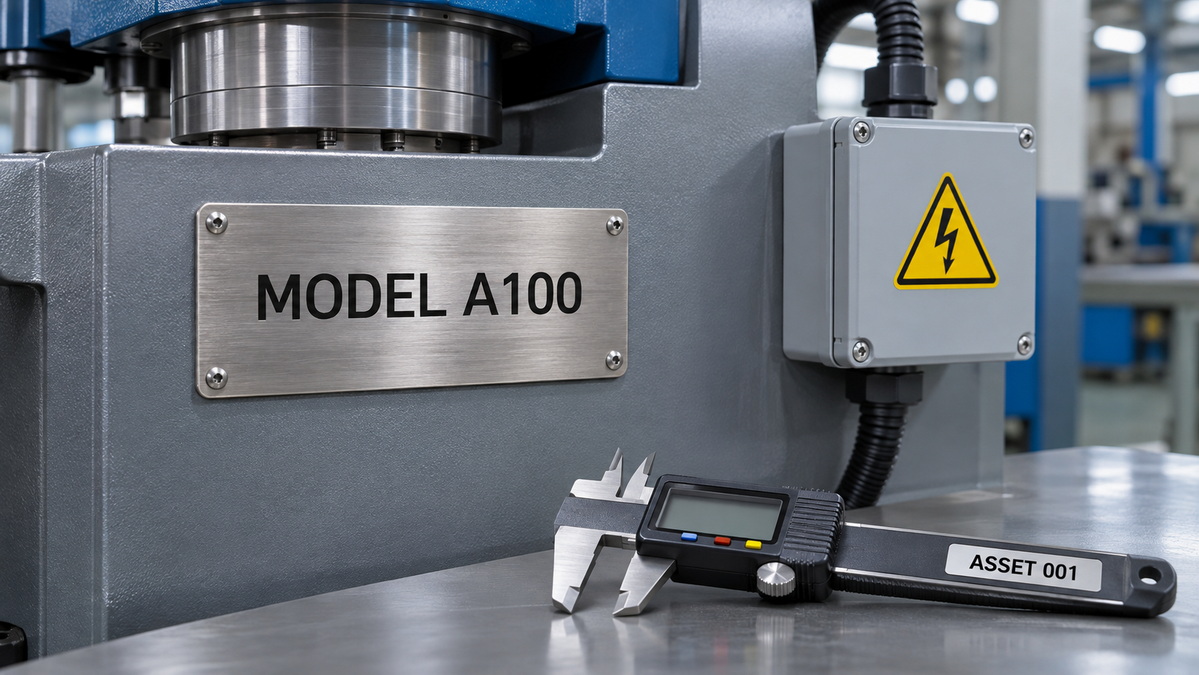
Eight Benefits of Industrial Labels for Manufacturers
1. Faster Equipment and Inventory Identification
Clear identification gives workers a consistent way to distinguish similar components, storage positions, and machines.
A useful label answers the immediate question: "What is this, and does it match the job?" Depending on the application, that may require a part number, location code, equipment description, or serial number.
Standardize naming conventions across labels and internal records. Attractive labels cannot resolve inconsistent product descriptions or duplicate identifiers.
2. Clearer Safety Communication
Industrial safety labels place important information close to the point of use. They can identify a hazard, describe the possible consequence, and explain the action needed to reduce exposure.
However, labels complement rather than replace protective equipment, machine guarding, documented procedures, and worker training.
For U.S. workplaces, accident-prevention signs and tags fall within specific requirements where applicable. Hazardous chemical containers involve a separate hazard communication framework. Buyers should distinguish these applications instead of treating every warning label as interchangeable.
3. More Reliable Asset Tracking
A unique asset number connects an item to its purchasing history, assigned location, maintenance schedule, and responsible department.
This is particularly useful when several machines look identical or when portable tools move between work areas.
Ownership markings and tamper-evident constructions may also support accountability. They should not be presented as guaranteed theft prevention: an identification label is not a physical security system.
4. Better Maintenance and Service Access
Equipment identification helps technicians confirm the model, rating, and serial number before selecting replacement parts or reviewing service instructions.
A QR code can provide convenient access to approved documentation. Keep essential identification readable without a phone or network connection, however.
The practical objective is continuity. A technician should still identify the equipment if a website moves, a code becomes damaged, or connectivity is unavailable.
5. Stronger Traceability and Recall Management
Batch, lot, and serial numbers connect products with production and inspection records. When a problem emerges, these identifiers can help teams investigate which units may be affected.
The benefit depends on the records behind the label. A perfectly printed serial number provides little traceability if it is duplicated, entered incorrectly, or disconnected from production data.
Treat traceability as a workflow linking identification, records, and retrieval—not simply as a printing feature.
6. More Consistent Quality Control
Machine-readable identification can reduce reliance on repeatedly typing long product codes. It also gives inspection teams a consistent reference for comparing products with work orders.
Nevertheless, scanning alone does not establish accuracy.
The encoded information must match the visible text, approved artwork, and associated database entry. Include variable-data checking in the approval process, especially when every label carries different information.
7. Easier Product Use and Customer Support
Clear control legends, operating instructions, and maintenance reminders help customers understand equipment at the point of use.
Prioritize what users need immediately. A crowded label containing every possible instruction may be harder to use than a concise label supported by a separate manual.
For international products, plan language versions early and have technical wording reviewed before artwork approval.
8. Consistent Branding Across Product Lines
Custom industrial labels and nameplates combine functional information with recognizable branding.
Consistent typography, logo proportions, color references, and finishes help create a coordinated product family. However, branding should never compete with critical ratings, warnings, or identifiers.
A successful design makes the product recognizable while keeping its most important information easy to find.
Choosing Industrial Label Materials for the Application
The best material is not necessarily the thickest or most expensive. It is the construction that remains attached and readable under the intended conditions.
Use this table as an initial discussion guide, not a substitute for application testing.
| Construction |
Potential application |
Questions to resolve |
| Printed polyester label |
Equipment identification and asset marking |
Is the complete print, adhesive, and protective system suitable for the exposure? |
| Flexible vinyl label |
General identification on surfaces requiring flexibility |
Will it conform and remain stable on the actual surface? |
| Aluminum nameplate |
Rigid equipment identification and branded plates |
Is the marking method suitable for expected wear and environmental exposure? |
| Stainless steel nameplate |
Applications requiring a rigid metal identifier |
Which grade, marking process, and attachment suit the service conditions? |
| Tamper-evident label |
Ownership and inspection-status identification |
Does the tamper feature work reliably on the intended substrate? |
Avoid selecting by material name alone. Two polyester labels can perform differently because their adhesives, inks, protective layers, and printing processes differ.
Similarly, a metal plate does not automatically guarantee permanent readability. Evaluate the marking and attachment alongside the base material.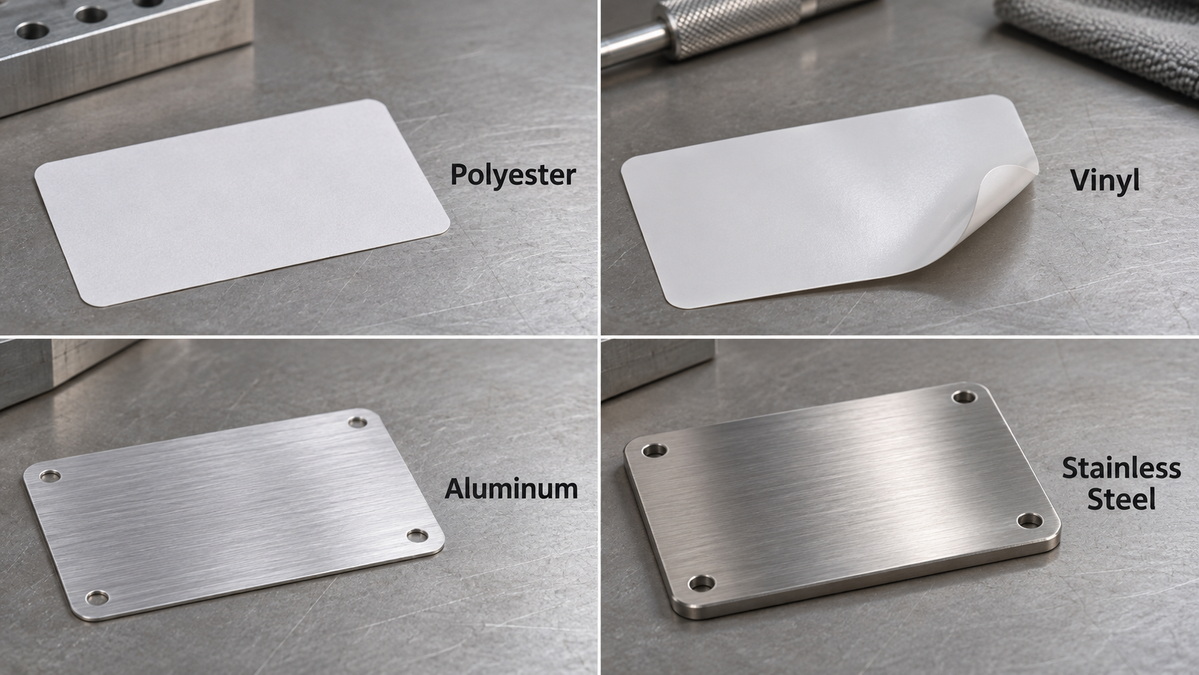
Five Steps to Specify Custom Industrial Labels
Step 1: Define the Information and Its Purpose
Separate mandatory content from optional content.
Start with model numbers, ratings, safety messages, serial numbers, and other required identifiers. Then allocate space for branding and supporting information.
Confirm who owns each field. Engineering may approve ratings, while quality teams control serial-number rules and marketing approves logo artwork.
Step 2: Document the Operating Environment
Replace vague descriptions such as "heavy duty" with specific conditions:
- Indoor or outdoor installation.
- Expected operating temperatures.
- Exposure to water, oils, cleaners, or other chemicals.
- Frequency of wiping and abrasion.
- Expected service life.
- Actual application surface and curvature.
Distinguish occasional splashing from immersion, and routine cleaning from prolonged chemical contact. These are different design conditions.
Step 3: Select the Complete Construction
Review the face material, printing method, adhesive, protective finish, and attachment together.
For applications involving recognized marking systems, check the applicable conditions of acceptability. These can include application surfaces, temperature ratings, indoor or outdoor use, and additional exposures.
UL 969 recognition is not a universal approval for every label application. Suitability depends on the recognized system and the requirements of the end product.
Step 4: Review Readability at Actual Size
Approve artwork at its final dimensions rather than only viewing an enlarged screen image.
Check text contrast, spacing, units, symbols, and the order in which information is read. Keep codes away from holes, edges, and other features that may interfere with scanning.
Where relevant, test the layout under realistic lighting and viewing conditions.
Step 5: Approve Samples Before Production
A digital proof confirms content and layout. A physical sample helps assess appearance, fit, attachment, and usability.
Apply samples to representative production surfaces. Follow the specified preparation and application instructions, then evaluate them against agreed acceptance criteria.
Record the approved construction and artwork revision so repeat orders have a clear reference.
A Practical Validation Plan for Durable Industrial Labels
An application-focused validation plan provides more useful evidence than a general promise of durability.
Consider the following checks:
1. Attachment: Inspect for lifting, movement, or detachment after the agreed conditioning.
2. Legibility: Confirm that essential text remains readable.
3. Surface resistance: Examine the printing after representative wiping or contact.
4. Data accuracy: Compare visible and encoded information with the approved source.
5. Scanning: Test codes with the intended devices and workflow.
6. Fit: Confirm that holes, edges, and dimensions match the installation location.
Define the exposure, duration, and pass criteria before testing. An informal workshop check is useful for screening, but it should not be described as certification or proof of a service life it did not evaluate.
For safety-related applications, obtain the evidence required by the relevant product standard or approval process.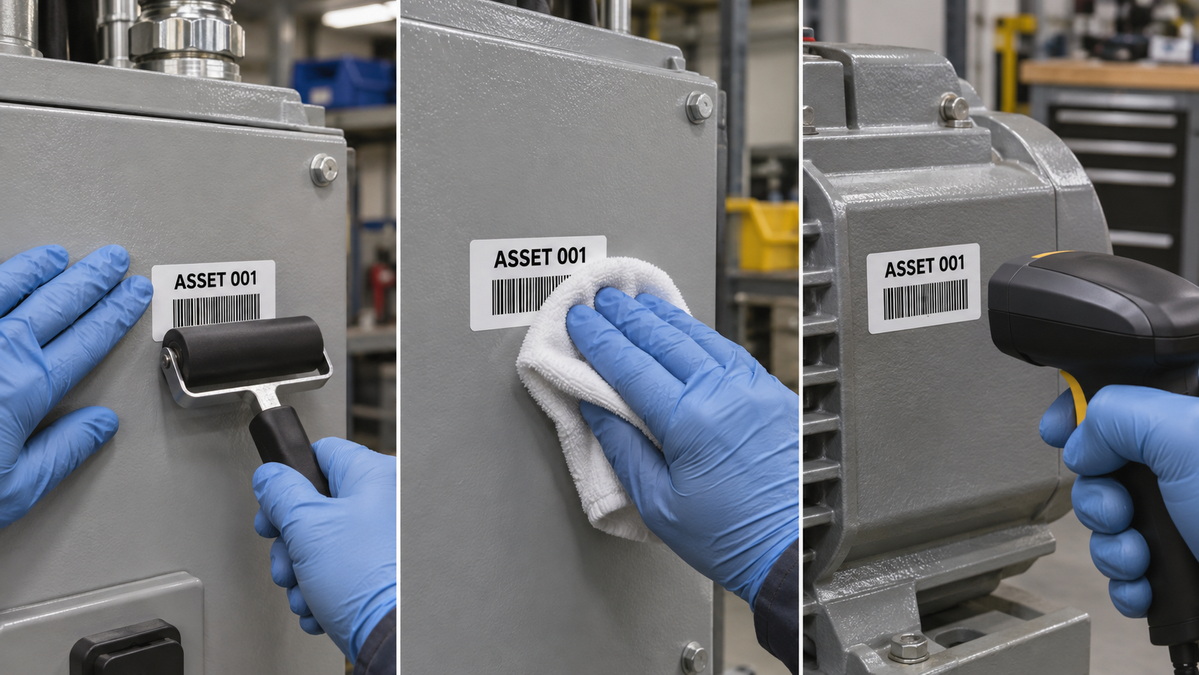
An Application Example: Export Equipment Identification
Consider an illustrative equipment manufacturer shipping machines to several markets. Each machine needs a permanent identifier, a warning label, and access to service documentation.
Instead of forcing every function onto one crowded plate, the manufacturer could separate them:
- A nameplate for the model, serial number, and ratings.
- A warning label positioned near the relevant hazard.
- A service code linked to controlled documentation.
The purchasing team would then review language versions, surface conditions, and market-specific requirements separately.
This is a planning example, not a reported customer project. Its lesson is that label placement and information architecture matter as much as appearance.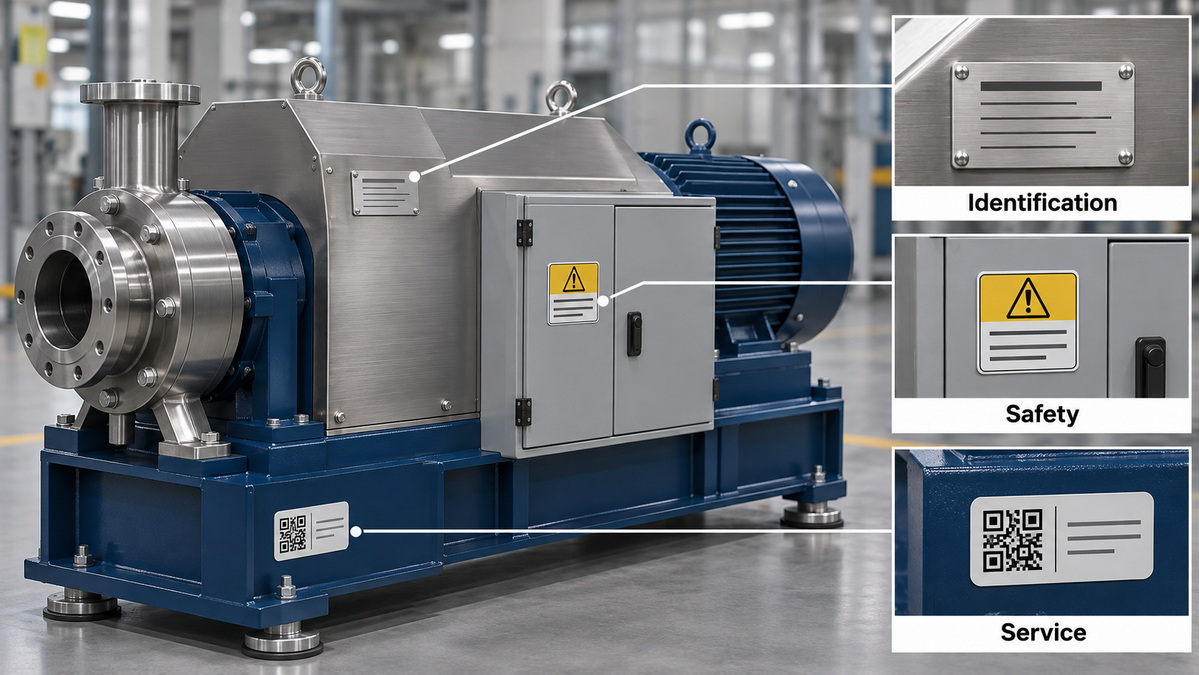
Comparing Industrial Labels by Lifetime Cost
Unit price matters, but it does not capture the full purchasing decision.
A practical comparison includes:
> Total identification cost = purchase cost + installation labor + replacement work + disruption associated with identification failures.
Use your own production and service records to estimate these factors. Do not assume that a higher-priced construction automatically delivers better value.
Where performance is uncertain, run a controlled pilot. Track application time, readability, detachment, scanning problems, and replacement frequency. These observations provide a more defensible purchasing basis than unsupported percentage-saving claims.
Working With Shenzhen XingKun on Custom Nameplates and Labels
Shenzhen XingKun Packing Products Co., Ltd. brings more than 20 years of printing and packaging manufacturing experience to custom identification projects, serving brands and distributors across more than 30 countries and regions.
For a productive quotation discussion, share:
- Artwork or the required information.
- Dimensions, quantity, and variable-data requirements.
- Application surface and installation method.
- Operating conditions and expected service life.
- Required standards, documentation, and sample approval criteria.
Send your drawings and application details to Shenzhen XingKun to discuss suitable constructions, sample requirements, and a quotation for your custom nameplates or industrial labels.
Frequently Asked Questions
What Are the Main Benefits of Industrial Labels?
They support identification, safety communication, maintenance, traceability, quality control, and branding. Results depend on readable design, suitable construction, accurate data, and consistent operating procedures.
What Is the Best Material for Industrial Equipment Labels?
There is no universal best material. Start with the surface, environment, required information, and expected service life. Then compare complete constructions and validate representative samples.
Can Industrial Labels Be Used Outdoors?
Yes, when the complete construction is suitable for the intended outdoor exposure. Confirm the relevant sunlight, moisture, temperature, and attachment conditions rather than relying only on an "outdoor" description.
Do All Industrial Labels Need UL Recognition?
No. Requirements depend on the end product and application. Where recognition is relevant, confirm that the system's conditions of acceptability cover the intended use.
Can QR Codes Replace Printed Equipment Information?
Use them primarily to supplement readable identification and documentation access. Do not remove required markings or safety information without confirming that the applicable rules permit it.
What Should Buyers Provide When Requesting a Quote?
Provide dimensions, quantity, artwork, variable data, application surface, operating conditions, attachment preferences, and approval requirements. These details help suppliers propose relevant options instead of quoting from appearance alone.
References
1. American Nameplate. "[Benefits of Industrial Labels]." Published April 7, 2021. Original article used as the thematic starting point for the discussion of organization, identification, traceability, customer support, and branding. [american-nameplate]
2. Occupational Safety and Health Administration. "[29 CFR 1910.145 — Specifications for Accident Prevention Signs and Tags]." Primary regulatory source for the discussion of applicable safety signs, tags, and concise, readable messages. [osha]
3. Occupational Safety and Health Administration. "[29 CFR 1910.1200 — Hazard Communication]." Primary regulatory source distinguishing hazardous chemical shipped-container labeling from workplace labeling. [osha]
4. UL Solutions. "[Marking and Labeling Systems FAQs]." Source for application-specific requirements, conditions of acceptability, and the limits of general claims about recognized label systems. [ul]
5. UL Solutions. "[Marking and Labeling Systems Program]." Source for environmental conditioning, adhesion, legibility, and evaluation of complete marking systems. [ul]
6. UL Solutions. "[Labels — Surfaces and Conditions]." Source for the importance of specified substrates and additional environmental exposure conditions. [ul]


