Content Menu
● Die Cut vs Kiss Cut Stickers: The Main Differences
● What Are Die Cut Stickers?
>> When Custom Die Cut Stickers Make Sense
>> What Buyers Should Check
● What Are Kiss Cut Stickers?
>> When Custom Kiss Cut Stickers Make Sense
>> Kiss Cut Does Not Necessarily Mean Sticker Sheets
● Does Die Cut or Kiss Cut Affect Sticker Durability?
>> Material and Adhesive Selection Come First
>> Application Temperature and Service Temperature Are Different
>> Avoid Unsupported Performance Promises
● Which Sticker Format Is Best for Your Application?
>> Promotional Giveaways and Standalone Merchandise
>> Packaging Stickers Applied by Hand
>> Sticker Sets for Books, Cards, and Puzzles
>> Detailed Artwork and Narrow Shapes
● Die Cut vs Kiss Cut Sticker Cost: Compare the Complete Workflow
>> Compare Applied Results, Not Only Purchase Price
>> Run a Small Handling Trial
● How to Prepare Artwork for Custom Stickers
>> Specify the Peeled Sticker Size and Backing Size Separately
>> Distinguish the Cut Line, Bleed, and Safe Area
>> Request a Proof That Shows Both Boundaries
● A Sample-Approval Checklist for Wholesale Buyers
>> Step 1: Confirm the Actual Construction
>> Step 2: Test the Intended Surface
>> Step 3: Observe Relevant Failure Modes
>> Step 4: Keep an Approved Reference Sample
● Sustainability: Compare the Whole Sticker Construction
● What to Include in a Custom Sticker RFQ
● Conclusion
● Frequently Asked Questions
>> 1. What is the main difference between die cut and kiss cut stickers?
>> 2. Do die cut and kiss cut stickers look different after application?
>> 3. Can kiss cut stickers have custom shapes?
>> 4. Are kiss cut stickers easier to peel?
>> 5. Are die cut stickers more waterproof?
>> 6. Is a kiss cut sticker the same as a sticker sheet?
>> 7. Which option is better for delicate designs?
>> 8. What dimensions should I provide for a kiss cut sticker order?
● References
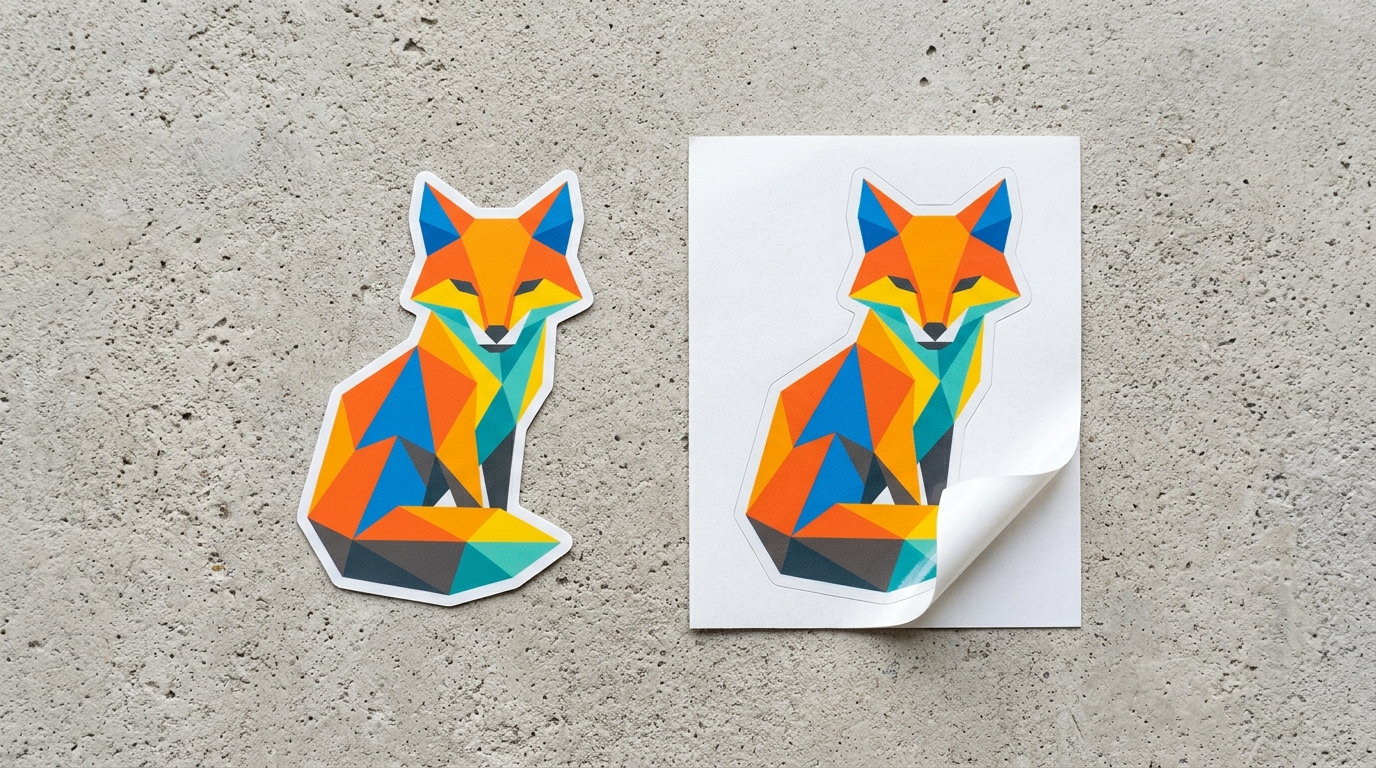
When comparing die cut vs kiss cut stickers, the main difference is straightforward: die cut stickers are cut through both the sticker material and its backing, while kiss cut stickers are cut through the sticker material without cutting through the release liner. With identical artwork and material specifications, both can look the same after application. What changes is how they are presented, protected, peeled, and handled before use. [stickermule]
Choose die cut stickers when the individual sticker needs to look like a finished promotional product. Choose kiss cut stickers when easier peeling, backing support, or multiple designs on one sheet matters more. Neither option is automatically more durable or better for every business.
For overseas brands, wholesalers, and manufacturers sourcing custom stickers, that distinction affects more than appearance. It influences packing workflows, customer experience, artwork preparation, and the information needed for an accurate quotation.
This guide takes a buyer-focused approach: start with how the sticker will be used, then specify the construction and delivery format that support that use.
Die Cut vs Kiss Cut Stickers: The Main Differences
The easiest way to compare the two formats is to look at what remains around the sticker before it is peeled.
| Comparison point | Die cut stickers | Kiss cut stickers |
| Cutting depth | Cuts through sticker material and release liner | Cuts through sticker material while leaving the liner intact |
| Backing shape | Generally follows the sticker’s outer contour | Extends beyond the sticker, often as a rectangle or sheet |
| Appearance before application | A standalone, custom-shaped piece | A shaped sticker supported by a larger carrier |
| Peeling experience | Depends on shape and backing design | Larger backing generally makes handling and peeling easier |
| Support for delicate shapes | Less surrounding backing support | Larger liner helps protect detailed shapes during handling |
| Multiple designs | Often supplied as separate pieces | Can be arranged together on a sticker sheet |
| Appearance after application | Determined by artwork and material | Can match the equivalent die cut sticker |
These distinctions describe common promotional-sticker terminology, as explained by Sticker Mule. In label manufacturing, however, "die cut" can also describe shaped labels that remain on a liner. Buyers should therefore specify cutting depth and delivery format rather than relying on the product name alone. [stickermule]
The most useful purchasing question is not simply "Which cut is better?" It is "Which construction makes this sticker easier to distribute, apply, and use?"
What Are Die Cut Stickers?
Die cut stickers are individual stickers whose outer cut passes through the face material and the backing. The finished piece follows the chosen outline, whether that is a circle, a rounded rectangle, a logo silhouette, or another custom contour. [stickermule]
Their defining advantage is presentation. Before anyone removes the backing, the sticker already shows its intended shape.
When Custom Die Cut Stickers Make Sense
Consider die cut stickers when the sticker itself is part of the product or brand experience:
- A standalone logo giveaway at an event.
- A collectible included with a purchase.
- A promotional insert inside a packaging box.
- Individually distributed artwork.
- A custom-shaped item sold as branded merchandise.
These are recommended applications rather than claims that die cut stickers perform better in every situation. The reasoning is simple: when people receive a loose sticker, its shape contributes to the first impression.
For a brand using distinctive character artwork, for example, a contour-cut piece can emphasize the character before application. A rectangular carrier would create a different presentation, even if the peeled sticker were identical.
What Buyers Should Check
The same custom outline that makes a sticker attractive can make handling more demanding. Narrow projections and small details deserve particular attention during sample review.
Before approving production, ask:
- Can users identify a convenient peeling point?
- Does the backing separate without excessive effort?
- Do narrow sections remain intact during peeling?
- Does the finished contour match the approved proof?
Treat these as acceptance checks, not assumptions based on the product name.

What Are Kiss Cut Stickers?
Kiss cut stickers have a cut through the sticker layer while the release liner remains intact. The backing typically extends beyond the sticker, creating a carrier that users can hold while peeling. Kiss cutting also allows several individual stickers to share one sheet. [stickermule]
A kiss cut sticker can still have a custom outline. "Kiss cut" does not mean that the peeled sticker must be square or rectangular.
When Custom Kiss Cut Stickers Make Sense
Kiss cut stickers are worth considering when:
- Employees need to peel many stickers by hand.
- A design has delicate sections.
- Several designs belong in one coordinated set.
- Users benefit from a larger area to hold.
- The surrounding area is useful for additional presentation.
Sticker Mule specifically identifies easier peeling and backing support for delicate designs as reasons to choose this format. It also notes that the surrounding vinyl area can carry additional printing. Buyers should confirm whether quoted printing covers that surrounding material, the liner itself, or neither. [stickermule]
Kiss Cut Does Not Necessarily Mean Sticker Sheets
A single kiss cut sticker can sit on its own rectangular carrier. A sticker sheet contains multiple peelable stickers on a shared backing. These are related formats, but they are not interchangeable descriptions. [stickermule]
For purchasing clarity, specify both the number of stickers per carrier and the carrier's overall dimensions.

Does Die Cut or Kiss Cut Affect Sticker Durability?
Cutting depth should not be treated as a durability specification.
The die cut versus kiss cut distinction describes which layers are cut. It does not, by itself, specify the face material, adhesive, ink system, protective finish, or suitable application environment. Two stickers can share the same artwork and applied appearance while using different constructions. [stickermule]
Material and Adhesive Selection Come First
A practical purchasing brief should identify:
- The surface receiving the sticker.
- Whether that surface is flat, curved, smooth, or textured.
- Conditions during application.
- Conditions after application.
- Whether removal is required.
- Expected exposure to moisture, abrasion, or sunlight.
Avery Dennison's adhesive guidance explains that surface energy influences adhesion. Materials such as glass and PET are generally easier to bond to than challenging low-surface-energy surfaces such as HDPE. This is why "suitable for plastic" is not a sufficiently precise specification. [label.averydennison]
Ask which plastic, which surface finish, and which adhesive construction the supplier recommends.
Application Temperature and Service Temperature Are Different
Application temperature is the temperature when the sticker is attached. Service temperature describes the conditions it experiences after application.
Avery Dennison distinguishes these because successful initial bonding and continued performance involve different requirements. A label intended for cold storage should not automatically be assumed suitable for application to an already cold surface. [label.averydennison]
For a chilled-product project, give the supplier both temperatures. Also explain whether the surface may be damp or affected by condensation.
Avoid Unsupported Performance Promises
XingKun's die cut sticker product page describes customization options and promotes vinyl stickers with water- and UV-resistant properties. Buyers should connect any requested performance claim to the specific quoted material and finish rather than assuming every available construction has identical characteristics. [xkdisplay]
For outdoor, washable, removable, or other demanding applications, request supporting specifications and representative samples. A cut style alone cannot verify those requirements.
Which Sticker Format Is Best for Your Application?
Start with the user's task, not the manufacturing term.
Promotional Giveaways and Standalone Merchandise
I would prioritize die cut stickers when the main goal is to hand someone an attractive, individual branded object.
The contour is visible immediately, and the sticker can function as a small piece of merchandise before it is applied. This recommendation follows from the format's shaped backing and standalone presentation. [stickermule]
Still, appearance should not override usability. Ask someone unfamiliar with the artwork to peel a sample without coaching.
Packaging Stickers Applied by Hand
I would compare kiss cut samples first when employees will repeatedly apply stickers to boxes, mailers, or inserts. The larger backing can make peeling easier, which is relevant when the same action is repeated throughout a packing session. [stickermule]
That does not prove a fixed productivity improvement. Measure the actual workflow before making a bulk decision.
For labels dispensed or applied by equipment, discuss a roll-label specification instead of assuming loose promotional stickers will suit the process.
Sticker Sets for Books, Cards, and Puzzles
For coordinated sets, a kiss cut sheet is a useful format to evaluate because several designs can remain together on one backing. [stickermule]
An illustrative concept might include:
- Character stickers accompanying a printed book.
- Reward stickers packaged with playing cards.
- Decorative stickers included in a jigsaw puzzle kit.
- A coordinated brand set inside a subscription box.
These are proposed use cases, not documented XingKun customer projects. The relevant benefit is organization: the recipient can see the set together and peel each design separately.
Detailed Artwork and Narrow Shapes
For delicate contours, begin by reviewing a kiss cut option because the surrounding backing provides support before application. [stickermule]
However, do not assume backing support solves every design issue. Ask the converter to assess narrow necks, sharp internal corners, and small projections during artwork review.
Die Cut vs Kiss Cut Sticker Cost: Compare the Complete Workflow
There is no dependable rule that one format is always cheaper.
A useful quotation comparison holds the following variables constant:
- Peeled sticker dimensions.
- Face material and adhesive.
- Finish or laminate.
- Artwork and number of designs.
- Order quantity.
- Packing requirements.
- Delivery destination.
Then request the available die cut and kiss cut formats against the same brief.
Compare Applied Results, Not Only Purchase Price
For a packaging operation, I recommend evaluating cost per usable application, not just the price of each supplied sticker.
A practical internal model is:
Cost per usable application=(Sticker purchase cost + freight + application labor + reject cost)÷ Number of successfully applied stickers
This is a proposed decision model, not a published industry benchmark.
It captures an important tradeoff: a lower purchase price may not create a lower operating cost if peeling is difficult or application mistakes are frequent.
Run a Small Handling Trial
Ask the same operator to apply equal quantities of each sample format under comparable conditions.
Record:
1. Total handling and application time.
2. Failed peeling attempts.
3. Damaged stickers.
4. Misaligned applications.
5. Operator comments.
Keep the material, design, application surface, and working conditions as consistent as possible. The purpose is not to produce a universal winner. It is to identify the more suitable option for your process.
How to Prepare Artwork for Custom Stickers
Good artwork preparation reduces ambiguity between the design team, purchasing team, and printer.
Specify the Peeled Sticker Size and Backing Size Separately
For a kiss cut order, "three-inch sticker" can be ambiguous. Does that describe the peeled artwork or the whole carrier?
Sticker Mule notes that kiss cut proof dimensions can refer to either the complete piece or the peeled sticker, depending on the proof. [stickermule]
A clearer specification is:
- Peeled sticker: 75 mm wide × 50 mm high.
- Finished carrier: 85 mm wide × 60 mm high.
- One peelable sticker per carrier.
These measurements are an example, not a universal production recommendation.
Distinguish the Cut Line, Bleed, and Safe Area
Use these concepts separately:
- Cut line: the intended cutting path.
- Bleed: artwork extended beyond the cut line.
- Safe area: an internal margin protecting important content.
Follow the selected printer's current template. Published artwork instructions can differ, even across pages from the same provider, so copying one supplier's margin into another factory's file is risky. Sticker Mule's published guidance, for example, contains different bleed instructions in different contexts. [stickermule]
The practical solution is written confirmation of the requirements for the specific job.
Request a Proof That Shows Both Boundaries
For kiss cut production, ask the proof to show:
- The peelable sticker outline.
- The finished carrier outline.
- The dimensions of each.
- Any printing outside the peelable sticker.
- The location of essential text and artwork.
For die cut production, check the final outer contour and any backing feature intended to assist peeling.
A Sample-Approval Checklist for Wholesale Buyers
A digital proof can show layout and dimensions. It cannot demonstrate the complete physical experience of peeling, applying, and using a sticker.
For new materials or demanding applications, I recommend a sample review before approving a large order.
Step 1: Confirm the Actual Construction
Request a written description of the face material, adhesive, protective finish, liner, and delivery format.
The goal is to make repeat orders reproducible rather than dependent on a vague description such as "premium waterproof sticker."
Step 2: Test the Intended Surface
Apply samples to the actual packaging or product surface whenever possible.
Avery Dennison identifies substrate characteristics and application conditions as important adhesive-selection factors. Testing only on an unrelated desk or glass panel may not answer the question that matters for the final product. [label.averydennison]
Step 3: Observe Relevant Failure Modes
Depending on the intended use, examine:
- Edge lifting.
- Adhesive transfer.
- Damage during peeling.
- Print scuffing.
- Changes after moisture exposure.
- Difficulty removing the sticker when removal is required.
Agree on observation conditions and timing with the supplier. This checklist is a proposed quality-control approach, not a substitute for a recognized test method or product-specific certification.
Step 4: Keep an Approved Reference Sample
Retain an accepted sample and the corresponding written specification.
For repeat purchasing, the reference should identify the artwork revision, dimensions, material construction, finish, and packing arrangement.
Sustainability: Compare the Whole Sticker Construction
Neither die cutting nor kiss cutting automatically makes a sticker environmentally preferable.
Release liners commonly use glassine or PET, and their recovery depends on suitable collection and processing. Avery Dennison explains that effective liner recycling requires real-world collection and separation systems, not simply a technically recyclable material. [label.averydennison]
A practical sustainability discussion should therefore ask:
- What face material and liner are supplied?
- Is recycled content available?
- Can the layout reduce unnecessary material?
- Can used liners be separated where the stickers are applied?
- Is an appropriate collection route available in that location?
Avoid broad claims such as "fully recyclable" or "eco-friendly" without defining the construction and disposal conditions.
For a business applying large quantities at one site, liner collection may be worth discussing. For stickers distributed individually to consumers, the disposal route may be different. The sustainability assessment should reflect that difference.
What to Include in a Custom Sticker RFQ
A precise request for quotation helps suppliers compare feasible options rather than guess your priorities.
| RFQ item | Information to provide |
| Intended use | Giveaway, packaging label, merchandise, or sticker set |
| Cut construction | Through-cut individual piece or kiss cut on intact liner |
| Sticker dimensions | Exact peeled width and height |
| Carrier dimensions | Required backing or sheet dimensions |
| Artwork | Number of designs and available files |
| Application surface | Specific packaging or product material |
| Environment | Application conditions and expected exposure |
| Adhesive requirement | Permanent, removable, or another defined requirement |
| Finish | Requested appearance and protective treatment |
| Quantity | Quantity per design and total quantity |
| Packing | Loose, counted packs, sheets, or another arrangement |
| Logistics | Destination and required delivery date |
| Approval | Digital proof, physical sample, and acceptance criteria |
For buyers coordinating stickers with boxes, books, playing cards, or puzzle packaging, include the relevant packaging dimensions and assembly requirements in the same brief.
That gives the supplier a clearer picture of how the sticker fits into the finished product.
Conclusion
Choose die cut stickers when individual presentation is the priority. Choose kiss cut stickers when easier peeling, delicate-shape support, or coordinated sheets better serve the user. The core distinction is the backing and cutting depth—not an automatic difference in the finished sticker's durability. [stickermule]
The stronger purchasing decision combines cut format with the right material, adhesive, artwork dimensions, and application conditions. Compare samples, specify both sticker and carrier sizes, and evaluate the complete handling workflow.
Ready to specify your custom stickers? Send Shenzhen XingKun Packing Products Co., Ltd. your artwork, dimensions, quantity, application surface, finish requirements, and delivery destination. Request a comparison of suitable constructions, an artwork proof, and sample options before confirming bulk production. XingKun's die cut sticker product page provides a starting point for its published customization options. [xkdisplay]
Frequently Asked Questions
1. What is the main difference between die cut and kiss cut stickers?
Die cut promotional stickers are cut through both the sticker material and backing. Kiss cut stickers are cut through the sticker layer while leaving the liner intact, usually with extra backing around the design. [stickermule]
2. Do die cut and kiss cut stickers look different after application?
Not necessarily. When the artwork, dimensions, and materials are the same, the applied stickers can look identical. The primary difference is their presentation and handling before application. [stickermule]
3. Can kiss cut stickers have custom shapes?
Yes. The peelable sticker can follow a custom contour even when the carrier is rectangular. The outer backing shape does not determine the peeled sticker's shape. [stickermule]
4. Are kiss cut stickers easier to peel?
They generally are, because the larger backing offers a convenient area to hold. The final experience still depends on the design and construction, so sample testing is useful for demanding workflows. [stickermule]
5. Are die cut stickers more waterproof?
The cut style does not establish waterproof performance. Material, adhesive, printing, and protective construction must be specified separately. Evaluate the actual quoted product rather than using cutting terminology as a performance guarantee. [stickermule]
6. Is a kiss cut sticker the same as a sticker sheet?
No. A kiss cut sticker may be supplied individually on its own carrier. A sticker sheet contains multiple peelable stickers on one shared backing. [stickermule]
7. Which option is better for delicate designs?
Kiss cut is a useful starting point because the surrounding backing helps protect delicate shapes before application. Detailed contours should still be reviewed and tested before production approval. [stickermule]
8. What dimensions should I provide for a kiss cut sticker order?
Provide the peeled sticker dimensions and the finished carrier dimensions separately. This avoids uncertainty about whether the quoted size includes the backing. [stickermule]
References
The sources below support the technical distinctions and material-selection guidance. Supplier pages describe their own terminology and specifications; they should not be treated as universal specifications for every manufacturer.
1. Shenzhen XingKun Packing Products Co., Ltd. "Die Cut Stickers." Product reference for published customization, material, and performance descriptions. [xkdisplay]
2. Sticker Mule. "Die Cut Stickers vs. Kiss Cut Stickers." Explanation of cutting depth, backing shape, applied appearance, peeling, and support for delicate designs. [stickermule]
3. Sticker Mule. "What Is the Difference Between Die Cut and Kiss Cut Stickers?" Concise technical comparison of the two promotional-sticker formats. [stickermule]
4. Sticker Mule. "Custom Sticker Printing: Making Custom Stickers, Part 2." Discussion of sticker production and multiple kiss cut stickers arranged on a sheet. [stickermule]
5. Sticker Mule. "Artwork Specifications for Die Cut Stickers and Labels." Supplier-specific cut-line and bleed guidance. [stickermule]
6. Sticker Mule. "How Do I Set Up My Artwork for Full Bleed Printing?" Additional supplier-specific artwork guidance illustrating why job requirements should be confirmed. [stickermule]
7. Sticker Mule. "Does the Size of Kiss Cut Stickers Include the Backing? Or Only the Sticker?" Explanation of potential sizing ambiguity. [stickermule]
8. Avery Dennison. "Adhesive Technologies." Technical guide covering surface energy, adhesive selection, and application versus service conditions. [label.averydennison]
9. Avery Dennison. "Cold Temperature—Product Overview SSA." Guidance on minimum application temperature, service temperature, and substrate considerations. [label.averydennison]
10. Avery Dennison. "Liners." Overview of glassine and PET liners and liner-recovery options. [label.averydennison]
11. Avery Dennison. "Label Liners: Meeting the Sustainability Challenge." Discussion of liner materials, collection, separation, and recycling limitations. [label.averydennison]
12. Sticker Mule. "Custom Labels." Reference illustrating the broader use of "die cut" terminology for labels supplied on liners. [stickermule]


