Content Menu
● How These Clothing Box Suppliers Were Selected
>> An Important Geographic Distinction
● Why Source Clothing Boxes Through France?
>> A Substantial Paper-and-Board Industry
>> Luxury-Packaging Expertise and Commercial Coordination
● Seven Clothing Box Manufacturers and Suppliers to Evaluate
>> 1. Shenzhen XingKun Packing Products Co., Ltd.
>> 2. Xianda Printing Co., Ltd.
>> 3. Maituohong Packaging
>> 4. Bonito Packaging
>> 5. Long-Win Display
>> 6. Gainerie 91 Group
>> 7. RAJA
● Supplier Comparison: Capacity, MOQ, and Certification Evidence
● Clothing Box Technical Specifications Buyers Should Define
>> Start With the Use Case
>> Specify Materials Beyond "Premium Cardboard"
>> Define Measurable Finishing Standards
>> Apply the Correct Compliance Framework
● Buyer's Guide: From Factory Verification to Delivery
>> 1. Verify the Contracting Entity and Production Site
>> 2. Use a Staged Sampling Process
>> 3. Reserve Capacity, Not Just a Delivery Promise
>> 4. Compare Landed Cost
● Insider Pitfall: The Approved Sample May Not Control Bulk Production
● Conclusion: Select the Right Supply Model Before Selecting the Lowest Price
● Five Advanced Purchasing FAQs
>> 1. How Can We Verify Whether a Supplier's ISO Certificate Has Expired?
>> 2. Is FSC-Certified Paper Enough to Make the Finished Clothing Box FSC-Certified?
>> 3. How Can We Detect Material Substitution When Boxes Look Identical?
>> 4. Should We Choose a French Supplier or a Direct Overseas Factory?
>> 5. Does a French Supplier Guarantee "Made in France" Origin?
● Referencs
Choosing a clothing box supplier requires more than comparing printed samples and unit prices. Professional buyers need to assess factory credentials, structural development, material consistency, quality-control procedures, production scheduling, and the ability to support repeat orders.
France offers access to an established paper-and-board industry, experienced luxury-packaging specialists, and packaging distributors serving retail and e-commerce businesses. However, a French commercial address does not automatically mean that a box is manufactured in France. Buyers should distinguish local production, French-managed international manufacturing, and direct imports before awarding a contract.
This guide compares seven sourcing options for brands purchasing clothing boxes for the French market. It includes French businesses and clearly identified overseas alternatives. The order is editorial, not a verified ranking by market share or factory performance.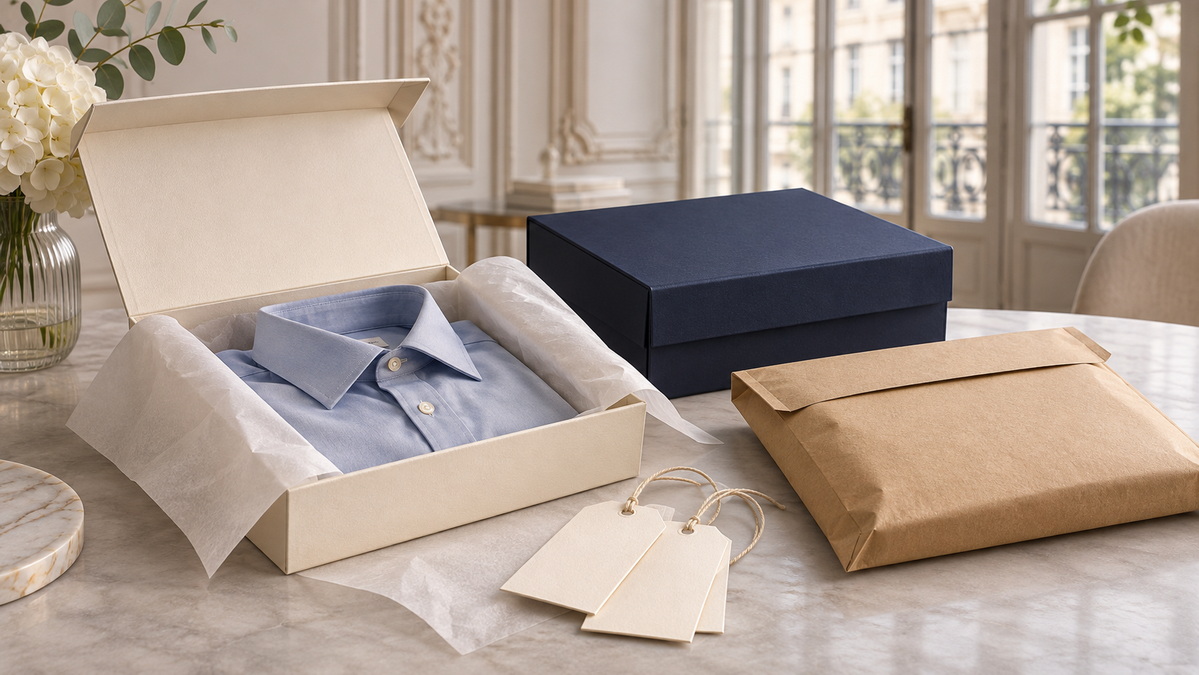
How These Clothing Box Suppliers Were Selected
The shortlist uses publicly available company information rather than undisclosed factory audits. Suppliers were assessed against six practical purchasing criteria:
1. Product relevance: rigid gift boxes, folding cartons, apparel mailers, or related retail packaging.
2. Development capability: structural design, material selection, prototypes, and customized printing.
3. Manufacturing transparency: disclosed facilities, equipment, production arrangements, and company history.
4. Quality management: inspection procedures and certification claims that buyers can independently investigate.
5. Purchasing flexibility: support for different order volumes, product launches, and repeat programs.
6. Market suitability: experience with international customers or established services relevant to French buyers.
Supplier-published claims are identified as such. Missing information is marked as undisclosed rather than replaced with estimated factory figures. A large factory area, for example, does not establish the number of finished clothing boxes available each month.
An Important Geographic Distinction
The first five entries are China-based sourcing alternatives, included for buyers comparing direct factory purchasing with French supply channels. The final two are French businesses.
None of the overseas suppliers should be presented as a French manufacturer. Likewise, a French supplier's involvement does not establish French origin for every product.
Why Source Clothing Boxes Through France?
A Substantial Paper-and-Board Industry
COPACEL's industry review published in 2025 reported that French paper-and-board production increased by 6.3% in 2024 to approximately 6.5 million tonnes. Packaging paper and board accounted for approximately 4.6 million tonnes. These are broad industry figures, not a measurement of the clothing box market.
More recent 2026 reporting on COPACEL's 2025 results indicates that overall production remained around 6.5 million tonnes, while packaging represented roughly 69% of output. The implication for buyers is an established materials ecosystem—not proof that every packaging converter has spare capacity or stable financial performance.
Luxury-Packaging Expertise and Commercial Coordination
The Paris region provides an identifiable concentration of luxury-packaging coordination and services. Gainerie 91 operates from the Île-de-France area, while RAJA's European headquarters is near Roissy. These businesses illustrate two different strengths: bespoke luxury development and broad packaging distribution. They should not be treated as a single, uniform manufacturing cluster.
French-based purchasing can simplify local communication, replenishment, and coordination with boutiques or fulfillment centers. Nevertheless, buyers should confirm the actual production location and stocked quantity rather than assuming that a local quotation guarantees local manufacture or immediate availability.
Seven Clothing Box Manufacturers and Suppliers to Evaluate
1. Shenzhen XingKun Packing Products Co., Ltd.
Shenzhen XingKun Packing Products Co., Ltd. was established in 2004. Its published company profile describes a 3,000-square-meter facility, exports to more than 30 countries, and Heidelberg CD102 four-color and XL75 six-color printing equipment.
Its relevance to apparel brands lies in coordinated packaging and print procurement. The company's range includes packaging boxes, labels, stickers, hang tags, and other printed products. Buyers developing a clothing box alongside matching brand materials can therefore investigate a consolidated supply arrangement rather than managing every component separately.
- Core strengths: custom printing, packaging development, and coordinated branded materials.
- Main markets: domestic and international customers; exports to more than 30 countries are company-reported.
- OEM/ODM scope: customer-specific packaging, design consultation, printing, and related printed accessories.
- Suitable purchasing profile: smaller and growing brands seeking flexible development support and a direct manufacturing relationship.
- Verification priority: obtain clothing-box-specific capacity, minimum order quantity, certificate details, and a project schedule.
XingKun states that it supports low-volume orders and full OEM/ODM services. These capabilities make it a candidate for buyers prioritizing specification discussions and iterative development. However, communication efficiency should be tested through the quotation and sampling process rather than assumed from promotional statements.
The website also reports annual output exceeding 10 million, without clearly defining the product mix or unit basis. Buyers should not interpret this as 10 million clothing boxes annually. Its advertised 7–15-day production window likewise requires confirmation against the actual structure, finishing, quantity, and material availability.
2. Xianda Printing Co., Ltd.
Xianda Printing Co., Ltd., operating through xiandagiftbox.com, presents itself as a Chinese custom packaging manufacturer with design and sampling departments. Its product range includes gift boxes, paper bags, and packaging for clothing and other consumer categories.
- Core strengths: decorative gift-box structures, custom printing, and presentation packaging.
- Main markets: export-oriented customers across multiple consumer-product sectors; geographic sales shares are not disclosed.
- OEM/ODM scope: customized dimensions, dielines, printing, structures, and finishing.
- Suitable purchasing profile: apparel gift sets and brands requiring distinctive presentation boxes.
- Verification priority: reconcile company history and manufacturing locations before contracting.
Its website contains conflicting establishment dates: one section states 2006, while another states 2014. It also describes different production locations. A responsible buyer should request the business license, contracting entity, and production-site details rather than selecting one date without clarification.
Xianda advertises samples within 3–5 days. Confirm whether this means an unprinted structural sample, a digitally printed mock-up, or a production-equivalent sample using the specified finishes.
3. Maituohong Packaging
Maituohong Packaging, operating through mthpackagingbox.com, publishes a portfolio covering magnetic boxes, foldable rigid boxes, drawer boxes, mailer boxes, folding cartons, and paper shopping bags. Its website specifically identifies apparel as an application.
The reviewed page uses the trading name Maituohong Packaging but does not clearly establish a complete registered legal name or incorporation year. It reports more than 15 years of experience; buyers should verify the precise legal entity before issuing a purchase order.
- Core strengths: a broad range of rigid and collapsible packaging structures.
- Main markets: worldwide customers, with stated experience serving North American and European requirements.
- OEM/ODM scope: structure, dimensions, materials, printing, inserts, magnets, ribbons, and other features.
- Suitable purchasing profile: brands comparing presentation quality with flat-pack storage and freight efficiency.
- Verification priority: confirm finished-box output and whether specialist processes are performed internally.
The company reports a 15,000-square-meter Shenzhen factory, more than 200 workers, and ISO 9001 and FSC certification. It also describes incoming, in-process, final, and outgoing inspections. These are useful qualification starting points, but certificate validity and actual inspection records still require review.
4. Bonito Packaging
Bonito Packaging, operating through bonitopack.com, describes more than a decade of paper-packaging experience and customer relationships across more than 20 countries and regions. Its range includes custom apparel boxes, rigid boxes, folding cartons, and e-commerce packaging.
The reviewed page does not clearly establish its registered legal name or exact founding year. Buyers should request both rather than converting "over a decade" into an assumed incorporation date.
- Core strengths: low-volume entry options and a broad custom paper-box portfolio.
- Main markets: international brands, retailers, and e-commerce businesses.
- OEM/ODM scope: structural development, material selection, printing, finishing, inspection, and production.
- Suitable purchasing profile: emerging apparel brands testing seasonal or limited-edition packaging.
- Verification priority: confirm whether the advertised starting quantity applies to the exact clothing box specification.
Bonito advertises orders starting from 100 units and scalable quantities extending to 500,000-plus units. The latter describes an offered order range, not independently verified monthly capacity. Its published references to ISO 9001, FSC, BSCI, and REACH should also be separated into certification, social-audit, and chemical-compliance evidence rather than treated as equivalent credentials.
5. Long-Win Display
Long-Win Display, operating through longwindisplay.com, focuses on retail displays, gift boxes, display boxes, and packaging. It reports more than 20 years of experience, but the reviewed page does not establish an exact incorporation year or complete registered legal name.
- Core strengths: packaging integrated with retail display engineering and prepacking.
- Main markets: international retail and promotional customers; country-level sales data are not disclosed.
- OEM/ODM scope: concepts, structural drawings, white samples, color samples, production, and prepacking.
- Suitable purchasing profile: apparel accessories, promotional clothing sets, and coordinated store campaigns.
- Verification priority: establish which processes are internal and which involve partner factories.
Long-Win is more relevant when the clothing box forms part of a wider merchandising program than when a buyer simply needs a standard shirt box. Its website describes both internal development and partner-factory involvement for certain display materials, reinforcing the importance of process-level supply-chain disclosure.
6. Gainerie 91 Group
Founded in 1967, Gainerie 91 Group is a French luxury-packaging and visual-merchandising specialist. Its official history describes expertise in leatherwork, covering, sewing, and gilding, supported by long-standing relationships with luxury houses.
- Core strengths: bespoke presentation, material craftsmanship, and luxury development.
- Main markets: international luxury businesses.
- OEM/ODM scope: custom packaging and presentation development, specialist materials, finishing, and coordinated delivery.
- Suitable purchasing profile: premium apparel accessories, collectible editions, and high-value presentation projects.
- Verification priority: request garment-related references and identify the production site assigned to the order.
Gainerie 91 operates an international production network. Its French identity should not be taken to mean that every order is manufactured entirely in France. The group's published services include worldwide shipment, making production origin and project allocation important quotation questions.
7. RAJA
Established in 1954, RAJA is a French packaging distribution group serving businesses across Europe. Its range includes shipping cartons, postal boxes, retail packaging, and customized packaging services relevant to clothing businesses.
- Core strengths: broad product availability, repeat purchasing, and packaging procurement consolidation.
- Main markets: European businesses across multiple industries.
- OEM/ODM scope: customized dimensions, printed packaging, and design-to-production support.
- Suitable purchasing profile: fashion retailers and fulfillment operations needing standard packaging alongside selected custom formats.
- Verification priority: distinguish stocked products, bespoke production, manufacturing origin, and item-specific environmental claims.
RAJA is not a directly comparable alternative to a specialist luxury rigid-box factory. Its value is broader procurement coverage. Its custom-packaging service describes a single contact and design support, while individual products and bespoke orders require separate availability and delivery confirmation.
Supplier Comparison: Capacity, MOQ, and Certification Evidence
The figures below come from supplier publications. "Not disclosed" means that a comparable figure was not established in the reviewed material—not that the supplier lacks the capability.
| Supplier | Published capacity indicator | Clothing box MOQ | Published certification or compliance information | Primary purchasing focus |
| Shenzhen XingKun Packing Products Co., Ltd. | 3,000 m²; annual output above 10 million, with product/unit basis unclear | Low-volume support; exact MOQ by quotation | ISO 9001 and FSC claims; verify certificates and scope | Coordinated custom boxes and printed materials |
| Xianda Printing Co., Ltd. | 15,000 m² and 175 staff claimed; comparable box output not disclosed | Not disclosed | Obtain current project-relevant documents | Decorative gift packaging |
| Maituohong Packaging | 15,000 m² and 200+ workers claimed | Project-dependent | ISO 9001 and FSC claims | Rigid, collapsible, and magnetic boxes |
| Bonito Packaging | Advertised order range up to 500,000+ units; not a capacity guarantee | Advertised from 100 units; specification-dependent | ISO 9001, FSC, BSCI, and REACH references; evidence types differ | Small launches and scalable programs |
| Long-Win Display | 20,000 m² facility claimed; clothing-box output not disclosed | Not disclosed | FSC and ISO references; verify exact standards and scope | Packaging plus retail displays |
| Gainerie 91 Group | International production network; comparable box output not disclosed | Project-dependent; not disclosed | Request site- and project-specific evidence | Bespoke luxury presentation |
| RAJA | Distribution network; factory output is not directly comparable | Stock pack quantities or custom quotation | Verify individual SKU claims and custom supply-chain evidence | Standard supply and replenishment |
Sources for supplier-published figures and service descriptions: XingKun, Xianda, Maituohong, Bonito, Long-Win, Gainerie 91, and RAJA.
Clothing Box Technical Specifications Buyers Should Define
Start With the Use Case
A boutique presentation box and a parcel-delivery box perform different jobs.
- Folding cartons prioritize compact storage and efficient assembly.
- Rigid lid-and-base boxes emphasize shape and presentation.
- Collapsible rigid boxes can reduce empty-box storage and shipping volume.
- Corrugated mailers prioritize handling and distribution protection.
These structures appear across the reviewed suppliers' portfolios. Buyers should choose the format before comparing quotations; otherwise, suppliers may price fundamentally different constructions.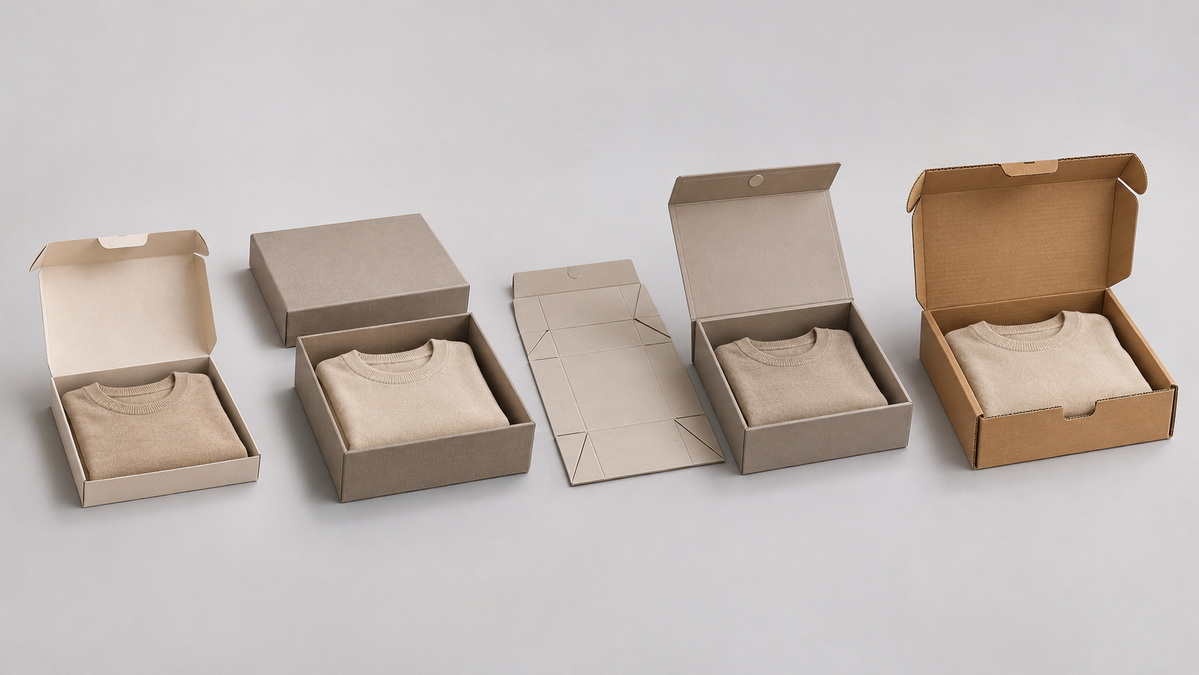
Specify Materials Beyond "Premium Cardboard"
Use a written material schedule rather than subjective descriptions. Ask suppliers to propose and document:
- Board grade, supplier, grammage, and caliper.
- Recycled-content claims and supporting evidence.
- Wrapping-paper grade and surface treatment.
- Inner-contact materials, tissue, adhesives, and inserts.
- Approved alternatives and a written substitution procedure.
For clothing, add sample checks for odor, surface abrasion, tissue staining, and color transfer onto the actual garment. Treat these as project-specific acceptance requirements, not universal guarantees attached to a particular board thickness.
Define Measurable Finishing Standards
Approve production-equivalent references for:
- Printed color and acceptable variation.
- Foil placement and coverage.
- Embossing or debossing depth.
- Scuff resistance on dark surfaces.
- Corner wrapping and exposed edges.
- Lid fit, magnetic closure, and repeated opening.
Maituohong's published finishing guidance notes that results depend on paper, artwork, coverage, and feature size. This is why a digital rendering alone cannot establish the final appearance of foil, embossing, or textured finishes.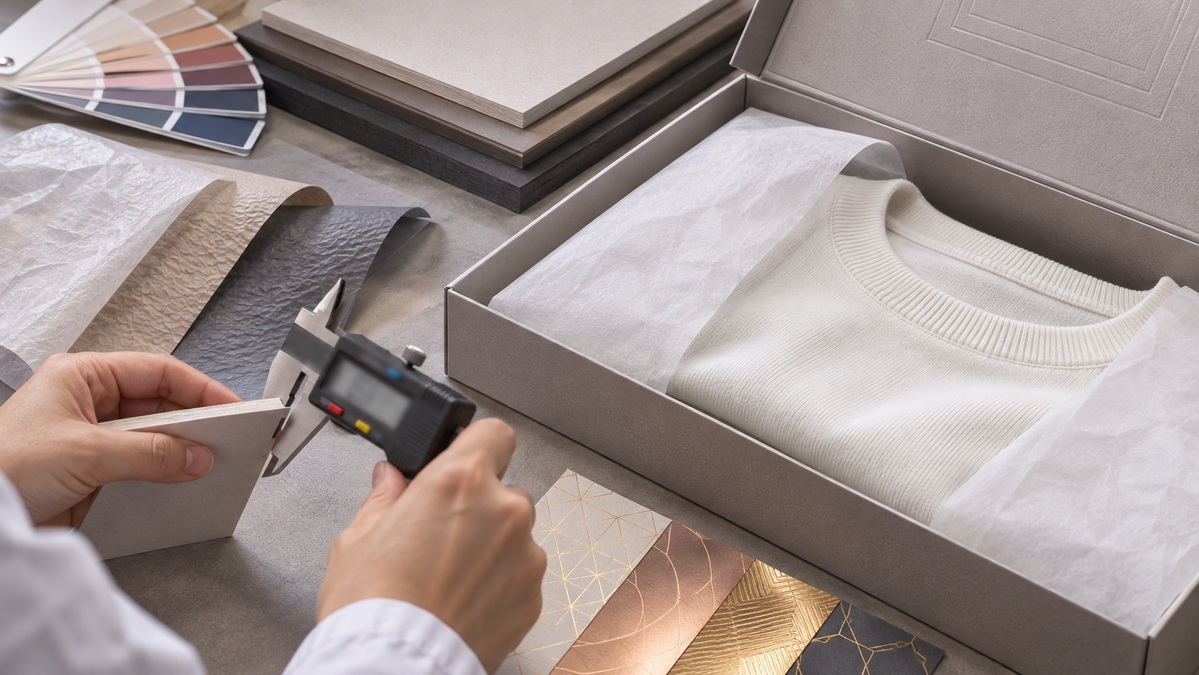
Apply the Correct Compliance Framework
Ordinary paper clothing boxes do not generally require CE marking. The European Union states that CE marking applies only where specific legislation requires it and must not be used on products outside that scope.
RoHS is also not a general packaging certification. The European Commission's guidance explicitly places ordinary packaging outside the scope of RoHS 2. Request packaging-relevant chemical and regulatory evidence instead of accepting an unrelated report as comprehensive approval.
The Packaging and Packaging Waste Regulation began applying on 12 August 2026, with requirements introduced on a phased timetable. Buyers should review the obligations relevant to their packaging and role, including technical documentation, conformity assessment, and later design or labeling requirements. Do not assume every future requirement became mandatory on the initial application date.
Buyer's Guide: From Factory Verification to Delivery
1. Verify the Contracting Entity and Production Site
Before paying a deposit, request:
- Registered company name and business-registration details.
- Factory address and the processes performed there.
- A list of subcontracted operations.
- Recent photographs or a live walkthrough of relevant equipment.
- Certification documents matching the named entity and site.
- A quotation issued by the entity receiving payment.
This is particularly important when public pages contain conflicting histories or use trading names without clearly identifying the registered company.
2. Use a Staged Sampling Process
Separate development into distinct approvals:
1. Structural sample: confirm garment fit, dimensions, assembly, and closure.
2. Printed sample: assess graphics and visual hierarchy.
3. Production-equivalent sample: confirm actual board, paper, finishes, and adhesives.
4. Pilot quantity: check packing-line compatibility and consistency before a larger commitment.
The reviewed suppliers themselves distinguish structural or white samples from printed and color samples. Ask which stage is included in a quoted sampling fee and timeline.
3. Reserve Capacity, Not Just a Delivery Promise
Ask suppliers to identify the critical production stages, planned start date, material readiness, and inspection window.
A statement such as "production takes 15 days" does not clarify whether the clock starts at deposit, artwork approval, sample approval, or material arrival. Put the trigger and shipment milestone in the purchase agreement.
4. Compare Landed Cost
Request both assembled and flat-packed options where technically appropriate. Compare:
- Unit price and tooling.
- Carton dimensions and packed quantity.
- Freight, insurance, and destination charges.
- Customs and tax responsibilities.
- Assembly labor and warehouse space.
- Inspection and replacement arrangements.
For imported orders, state the named delivery location and agreed Incoterm clearly. Do not compare an overseas factory-gate quotation with a French delivered quotation as though they cover identical costs.
Insider Pitfall: The Approved Sample May Not Control Bulk Production
A purchasing risk worth addressing explicitly is the gap between an attractive approval sample and the materials or processes used for the full order.
A handmade sample can demonstrate appearance without proving that the production line will reproduce its board stiffness, wrapping, closure, or surface finish consistently. The solution is not simply to request more photographs.
Create a golden sample system:
- Keep matching signed samples with buyer, supplier, and inspector.
- Attach the approved bill of materials.
- Prohibit substitutions without written approval.
- Define measurable defects and acceptance limits.
- Inspect randomly selected production goods, not only supplier-selected samples.
- Retain a reference from each repeat batch.
Also test the box with the garment inside. An empty box can pass a visual review while the packed combination reveals poor fit, tissue transfer, closure pressure, or handling damage. Sampling and inspection should therefore evaluate the complete packaging system.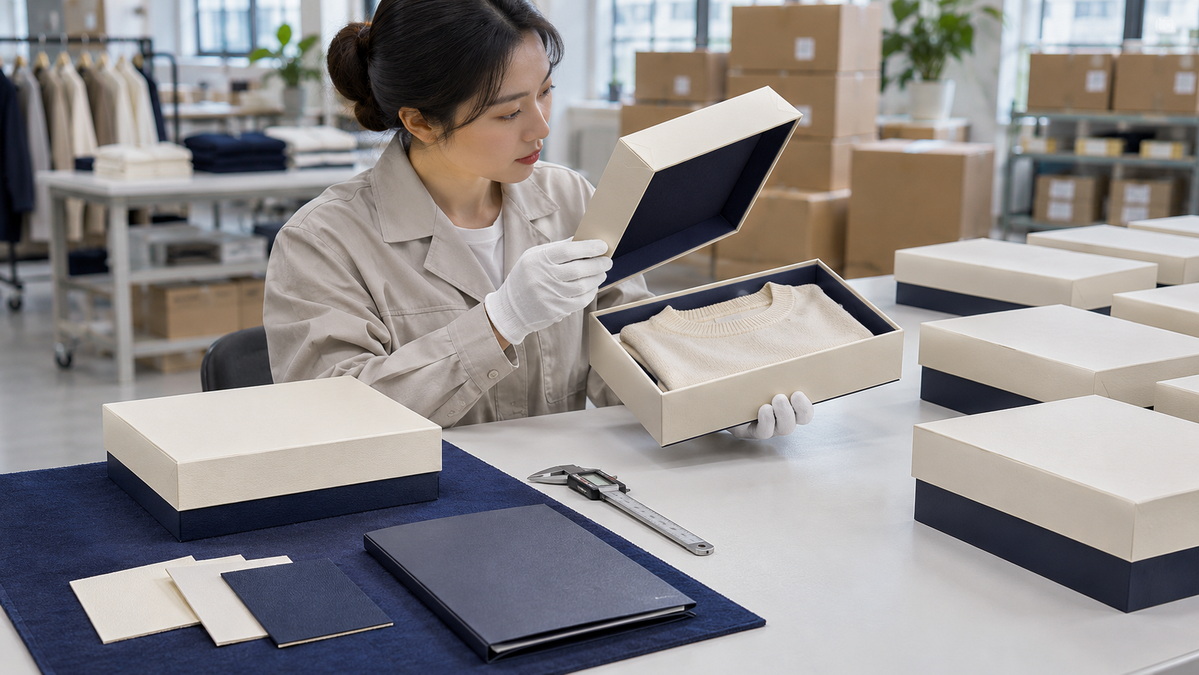
Conclusion: Select the Right Supply Model Before Selecting the Lowest Price
The strongest clothing box purchasing decision begins with a clear specification and a realistic supply model.
French businesses can offer useful distribution or luxury-development capabilities. Direct overseas factories can provide alternative customization and purchasing arrangements. Neither approach removes the need to verify the manufacturing site, approve production-equivalent samples, establish material controls, and confirm regulatory responsibilities.
For brands considering Shenzhen XingKun Packing Products Co., Ltd., begin with a structured project brief covering garment dimensions, box style, order quantity, artwork, finishing, destination, and required delivery date. Request a material proposal, sampling plan, clothing-box-specific production schedule, and current certification evidence before committing to production.
Five Advanced Purchasing FAQs
1. How Can We Verify Whether a Supplier's ISO Certificate Has Expired?
Request the complete certificate, including the certificate number, standard, legal entity, site address, scope, issuing body, and validity dates.
Verify it with the issuing certification body using independently located contact details. Check that the scope covers the relevant manufacturing activity and that the factory handling your order is included. A certificate image alone does not establish current status, and a quality-management certificate is not a guarantee that every box meets your specification.
2. Is FSC-Certified Paper Enough to Make the Finished Clothing Box FSC-Certified?
Do not assume so. Ask the supplier to explain the applicable chain-of-custody arrangement, the claim that will appear on the quotation and invoice, and who is authorized to apply any on-product label.
This distinction matters because suppliers may describe certified paper, a certified factory, and a certified finished-product claim differently. Maituohong, for example, specifically references chain-of-custody practices; buyers should still verify how those practices apply to their order.
3. How Can We Detect Material Substitution When Boxes Look Identical?
Make material identity part of the contract. Record board grade, caliper, grammage, wrapping paper, and approved alternatives.
Retain reference materials and compare random bulk-production samples. Where performance is consequential, commission the relevant physical or chemical tests. Visual similarity should not be the sole acceptance criterion.
4. Should We Choose a French Supplier or a Direct Overseas Factory?
Choose according to the operating model, not nationality alone.
RAJA illustrates a distribution-led option for broader packaging procurement, while Gainerie 91 represents bespoke luxury development. The overseas suppliers in this guide offer different combinations of direct customization, small-order support, and packaging development. Compare these options using the same specification, delivery basis, documentation requirements, and replenishment assumptions.
5. Does a French Supplier Guarantee "Made in France" Origin?
No. A supplier's headquarters, design office, or sales team does not determine the origin of every product.
Gainerie 91's international production network demonstrates why buyers should ask where their specific order will be manufactured. If French origin is commercially important, require written production-origin details and obtain appropriate customs advice before making an origin claim.
Referencs
1.COPACEL: 2025 economic press dossier, reporting French paper-and-board production and packaging-sector results for 2024. [copacel]
2.REVIPAC: review of COPACEL's 2025 results, published in 2026. [revipac]
3.European Commission: application of the Packaging and Packaging Waste Regulation and its phased implementation. [environment.ec.europa]
4.EUR-Lex: official summary of Regulation (EU) 2025/40 and economic-operator responsibilities. [eur-lex.europa]
5.Your Europe: official explanation of when CE marking is required or prohibited. [europa]
6.European Commission: RoHS guidance, including the exclusion of ordinary packaging. [environment.ec.europa]
7.Shenzhen XingKun Packing Products Co., Ltd.: company history, equipment, services, and published operating figures. [xkdisplay]
8.Xianda Printing Co., Ltd.: company descriptions, products, development services, and published facility information. [xiandagiftbox]
9.Maituohong Packaging: structures, factory claims, inspection stages, and customization services. [mthpackagingbox]
10.Bonito Packaging: apparel packaging, advertised order quantities, and compliance references. [bonitopack]
11.Long-Win Display: packaging, displays, development, and prepacking services. [longwindisplay]
12.Gainerie 91 Group: official history, production network, and services. [gainerie91]
13.RAJA: company history and custom-packaging services. [raja]


