Content Menu
● What Makes the Best Enamel Pins for Brand Merchandise?
● Hard Enamel vs. Soft Enamel: Which Is Better for Your Brand?
>> Hard Enamel Pins for a Smooth, Refined Presentation
>> Soft Enamel Pins for Texture and Graphic Character
>> A Practical Enamel Pin Comparison
● Design Custom Enamel Pins for Actual Size, Not Screen Size
>> Simplify the Brand Asset Without Losing Its Identity
>> Check Typography at the Intended Production Size
>> Avoid Treating One Supplier's Minimums as Universal Rules
● Choose Pin Backings Around Real Use
>> Compare Attachment Options Through Samples
>> Review Whether One or Two Posts Are Appropriate
● Build Enamel Pin Packaging Into the Product Brief
>> Backing Cards for Display and Brand Communication
>> Folding Cartons for a More Complete Retail Format
>> Rigid Boxes for Selected Gift Applications
● Use a Standardized RFQ to Compare Enamel Pin Suppliers
>> Include These Details in the Initial Brief
>> Ask Suppliers to Declare Substitutions
● Compare Total Delivered Cost, Not Just Unit Price
>> An Illustrative Procurement Calculation
● Create a Sample Approval and Quality-Control Plan
>> Stage 1: Artwork and Specification Approval
>> Stage 2: Physical Sample Approval
>> Stage 3: Production Inspection
● Review Safety and Compliance Before Making Claims
>> Give Children's Merchandise a Separate Review
>> Keep Compliance Claims Specific
● Measure Whether the Merchandise Program Works
● Work With XingKun on a Coordinated Packaging Brief
● Conclusion
● Frequently Asked Questions
>> 1. Are hard enamel pins always better than soft enamel pins?
>> 2. What artwork works best for custom enamel pins?
>> 3. What is the best backing for branded enamel pins?
>> 4. Should every enamel pin have a backing card?
>> 5. How can buyers compare custom enamel pin quotations accurately?
>> 6. Can enamel pins be marketed to children?
>> 7. What should a buyer confirm with XingKun before ordering?
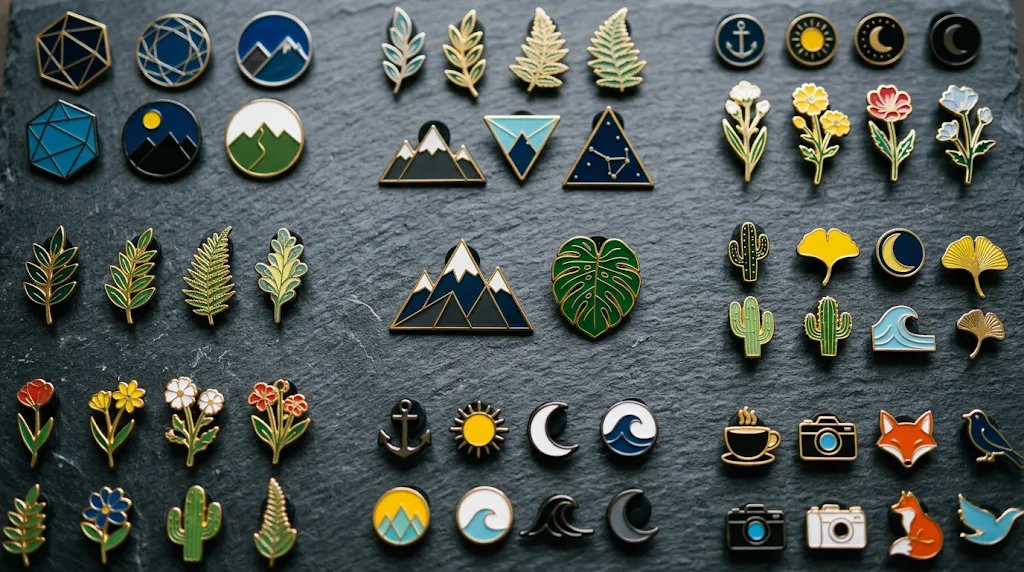
The best enamel pins for brand merchandise are the ones that translate your brand identity into a product people actually want to wear, collect, or give away. The right choice depends on more than appearance. Enamel type, artwork readability, backing security, packaging, quality control, and total delivered cost all influence whether a pin becomes a valued keepsake or an overlooked promotional item.
For overseas brands, wholesalers, and manufacturers sourcing custom merchandise, the most useful question is not simply, "Which enamel pin looks best?" It is, "Which specification best supports our audience, distribution channel, and commercial goal?"
This guide approaches that decision from a product-development and packaging perspective. It explains how to compare custom enamel pins, prepare an effective manufacturing brief, evaluate samples, and create packaging that supports the complete merchandise experience.
What Makes the Best Enamel Pins for Brand Merchandise?
There is no universal winner. A collectible pin for a premium retail launch has different requirements from a giveaway distributed at a crowded trade show.
I recommend evaluating every concept against five questions:
1. Can someone recognize the design at its actual production size?
2. Does the finish match the brand's intended positioning?
3. Does the attachment work for the expected use?
4. Will the packaging protect and present the product appropriately?
5. Can the supplier reproduce the approved specification consistently?
This approach shifts attention away from isolated features and toward the finished product.
A polished surface is not automatically better than a textured one. A heavier pin is not automatically more valuable. A low factory quotation is not automatically the most economical purchasing decision.
The strongest specification is the one that balances visual identity, usability, production feasibility, and commercial performance.
Hard Enamel vs. Soft Enamel: Which Is Better for Your Brand?
The first major decision is usually between hard enamel and soft enamel.
Soft enamel pins have recessed colored areas with raised metal outlines. Hard enamel pins are polished so that the colored areas and surrounding metal create a smooth surface. These construction differences produce distinct tactile and visual effects. [metalpromo]
Hard Enamel Pins for a Smooth, Refined Presentation
Hard enamel is worth considering when your creative brief calls for a smooth finish and a restrained, polished appearance.
Potential applications include:
- Corporate recognition merchandise.
- Premium retail collections.
- Membership and anniversary gifts.
- Minimalist brand emblems.
- Presentation-box gift sets.
My recommendation is to evaluate hard enamel alongside the proposed plating and packaging, rather than approving the pin finish in isolation. A refined pin can still feel poorly considered if its backing card bends, its box insert fits loosely, or the product arrives with visible surface marks.
Request a physical sample before deciding whether the finish supports your intended price and positioning.
Soft Enamel Pins for Texture and Graphic Character
Soft enamel provides a visible and tactile distinction between the metal outlines and recessed color areas. Suppliers commonly position it as a more economical alternative to hard enamel, although the actual quotation still depends on the full specification. [metalpromo]
It is a useful option to investigate for:
- Illustrated mascots.
- Community merchandise.
- Event giveaways.
- Bold logo designs.
- Multi-design promotional collections.
Do not assume that "soft" means flexible. The term describes the enamel finishing style, not a bendable pin body.
A Practical Enamel Pin Comparison
| Decision factor | Hard enamel | Soft enamel |
| Surface | Smooth, polished finish | Raised metal with recessed color |
| Visual direction | Suitable for a refined presentation | Suitable for a textured graphic effect |
| Initial sourcing approach | Request a sample showing polish and detail retention | Request a sample showing fill consistency and metal definition |
| Commercial comparison | Compare complete quotations | Compare complete quotations |
| Essential approval step | Review the physical product | Review the physical product |
The surface distinctions are established manufacturing differences; the positioning recommendations above are purchasing judgments, not universal quality rankings. [metalpromo]
Design Custom Enamel Pins for Actual Size, Not Screen Size
An illustration can look excellent on a monitor and become difficult to understand when reduced to a small metal product.
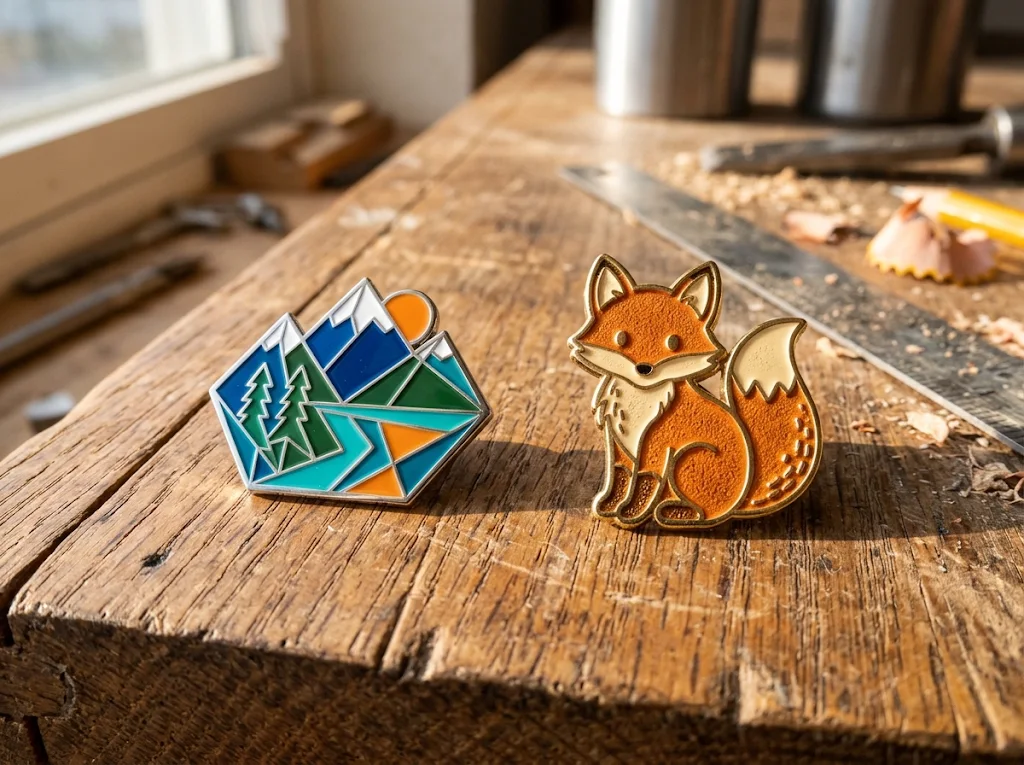
Industry design guidance consistently emphasizes clean shapes, readable lettering, and avoiding excessively intricate details. Thin outlines, tight spacing, and fragile projections should be reviewed with the manufacturer before production. [metalpromo]
Simplify the Brand Asset Without Losing Its Identity
Start by identifying the element that makes the brand recognizable:
- A distinctive silhouette.
- A mascot's face.
- A monogram.
- A recognizable icon.
- A short wordmark.
Then remove details that do not contribute to recognition.
For example, an illustrated character might retain its outline, expression, and signature accessory while losing background textures and tiny lettering.
This is not a recommendation to replace an approved brand logo casually. Instead, develop a merchandise-specific adaptation and obtain the brand owner's approval before manufacturing.
Check Typography at the Intended Production Size
Print the artwork at its proposed dimensions.
Review it under ordinary viewing conditions rather than relying on a magnified screen preview.
Ask:
- Can the main word or symbol be understood immediately?
- Do neighboring letters appear to merge?
- Are small enclosed areas still distinguishable?
- Does the silhouette remain recognizable without the packaging?
Bold, adequately spaced lettering is generally easier to translate into a small pin than delicate typography, and supplier guidance specifically highlights the importance of kerning and avoiding overly fine details. [metalpromo]
Avoid Treating One Supplier's Minimums as Universal Rules
Do not copy a minimum line width or enamel-fill dimension from an unrelated manufacturer and assume it applies everywhere.
Instead, ask the shortlisted supplier to mark up your artwork with its production requirements.
The approval document should identify:
- Minimum metal line width.
- Minimum fill area.
- Minimum lettering size.
- Cutout restrictions.
- Any proposed artwork simplification.
This creates a project-specific manufacturing reference instead of relying on a generic design checklist.
Choose Pin Backings Around Real Use
Backing hardware deserves its own purchasing decision.
Common options include butterfly clutches, rubber clutches, locking-style mechanisms, and magnetic attachments. Their construction and handling differ, so the appropriate choice depends on the application. [metalpromo]
Compare Attachment Options Through Samples
| Backing option | Questions to investigate |
| Rubber clutch | Is it comfortable to handle, and does it retain the post adequately? |
| Butterfly clutch | Can users attach and remove it easily without damaging the intended fabric? |
| Locking-style backing | Does the added mechanism provide a useful benefit for this product? |
| Magnetic attachment | Is it suitable for the intended garment, audience, and safety assessment? |
These are evaluation prompts rather than performance guarantees.
A backing that works on a lightweight shirt may behave differently on a thick bag strap. Sample testing on the intended material is more informative than choosing hardware from a photograph.
Review Whether One or Two Posts Are Appropriate
For a wide, asymmetrical, or top-heavy design, ask the supplier whether a second post would help control orientation.
Then test the sample.
Check whether the pin:
- Tilts during normal movement.
- Sits comfortably on the intended surface.
- Can be attached without awkward handling.
- Fits its packaging without pressure on the posts.
Avoid specifying a second post automatically. It changes the handling experience and the packaging hole pattern, so the complete product should be reviewed together.

Build Enamel Pin Packaging Into the Product Brief
Packaging should not be the final decision made after the pin is finished.
A backing card, folding carton, or presentation box changes how the customer encounters the product and what information the brand can communicate.
For XingKun, this is a particularly relevant part of the merchandise brief. The company presents custom printing, packaging, and OEM/ODM solutions among its services. Buyers should confirm the precise scope of any proposed pin-and-packaging project during quotation. [xkdisplay]
Backing Cards for Display and Brand Communication
A backing card gives the brand space for:
- Product or collection names.
- A short brand story.
- Product identification.
- Care or handling information.
- Required warnings, where applicable.
- A relevant QR code or web address.
Use that space deliberately.
A crowded backing card can compete with the pin rather than support it. My recommendation is to let the front establish the visual hierarchy and use the reverse for secondary information.
Before approval, confirm card dimensions, hole placement, print orientation, and how the pin will be assembled.
Folding Cartons for a More Complete Retail Format
A folding carton is worth evaluating when the merchandise requires more printable space or a more enclosed presentation.
However, an outer carton alone does not settle the protection question.
Review the internal arrangement:
- Can the pin move inside the carton?
- Can the post press against another surface?
- Does the backing remain accessible?
- Can fulfillment staff pack the product consistently?
- Does the product remain presentable after transport simulation?
Approve the complete packed sample, not just an empty printed carton.
Rigid Boxes for Selected Gift Applications
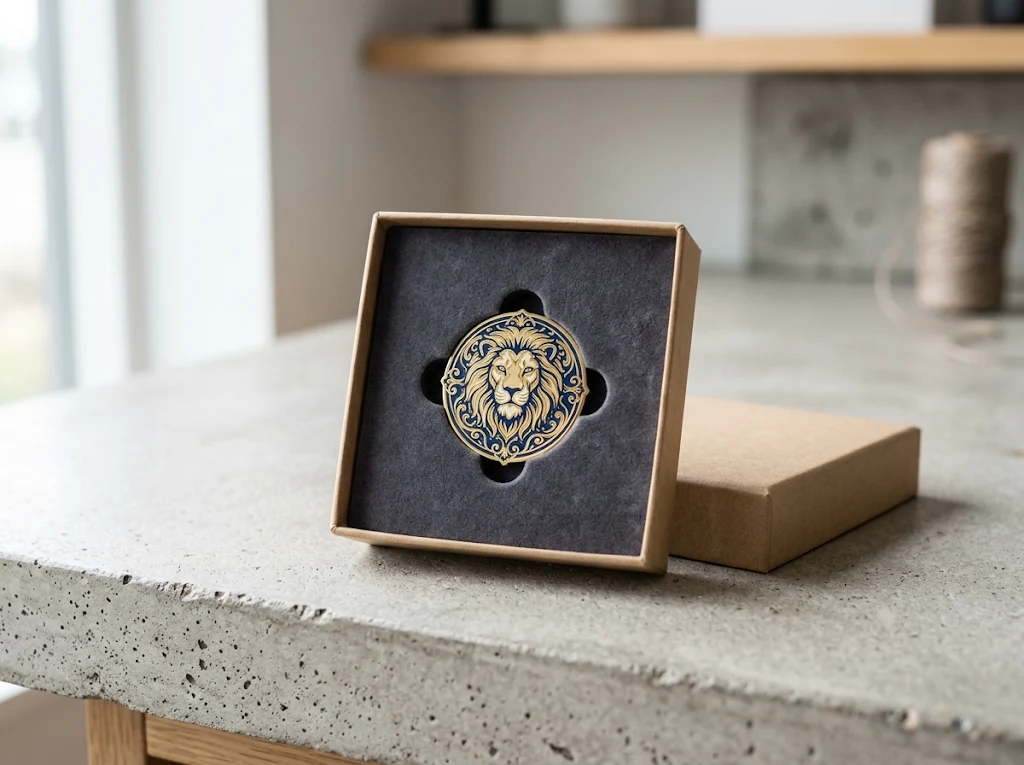
A rigid presentation box may suit a limited-edition release, recognition gift, or multi-item merchandise set.
Treat it as a commercial choice, not an automatic upgrade.
Evaluate whether the additional packaging cost, shipping volume, and assembly effort support the selling price or gifting objective.
For some campaigns, a carefully designed backing card will be the more appropriate solution. For others, a structured gift box may support the intended experience.
Use a Standardized RFQ to Compare Enamel Pin Suppliers
One of the most useful improvements to a merchandise sourcing process is a consistent RFQ, or request for quotation.
Without one, suppliers may quote different products while appearing to compete on the same item.
One quotation might include individual assembly and backing cards. Another may cover loose pins only.
Include These Details in the Initial Brief
| Specification area | Information to provide |
| Commercial purpose | Retail sale, giveaway, membership, recognition, or gifting |
| Audience | Intended users, age group, and destination markets |
| Artwork | Vector files, dimensions, and approved design references |
| Construction | Requested enamel type and proposed finish |
| Color | Defined color references and approval expectations |
| Hardware | Post arrangement and preferred backing |
| Packaging | Card, carton, box, insert, labeling, and assembly |
| Quantity | Total order and quantity per design |
| Sampling | Required approval stages and sample delivery destination |
| Quality | Proposed defect categories and inspection approach |
| Logistics | Delivery location, shipping terms, and required arrival date |
| Compliance | Applicable testing and documentation requirements |
Ask Suppliers to Declare Substitutions
Require suppliers to identify proposed changes rather than silently adjusting the specification.
Examples include:
- A different backing.
- Revised metal thickness.
- Simplified artwork.
- Alternative plating.
- Changed packaging stock.
- A different assembly method.
This makes quotations easier to compare and reduces the chance that the production order differs from the buyer's assumptions.
Compare Total Delivered Cost, Not Just Unit Price
A low unit price can conceal costs elsewhere in the project.
For decision-making, use a landed-cost model that includes the expenses relevant to your transaction:
Delivered cost per usable unit=(Relevant purchasing, logistics, and quality costs)÷Accepted usable units
Potential cost categories include:
- Pins.
- Tooling or setup.
- Samples.
- Packaging.
- Assembly.
- Inspection.
- Freight.
- Duties and applicable taxes.
- Rework or replacement costs.
Define the scope consistently when comparing suppliers.
An Illustrative Procurement Calculation
Suppose a hypothetical order includes 1,000 pins.
The pins cost $1,000, packaging and assembly cost $300, setup and samples cost $150, and freight and other included logistics expenses cost $250.
The defined project total is $1,700.
If all 1,000 units are accepted, the cost under this model is $1.70 per unit. If only 950 units are usable, it rises to approximately $1.79 per usable unit.
This is an illustrative calculation, not a market quotation. Its purpose is to show why packaging scope and usable yield belong in a purchasing comparison.
Create a Sample Approval and Quality-Control Plan
A digital proof confirms the proposed design. It does not fully demonstrate surface quality, hardware function, or packaging fit.
I recommend separating approval into three stages.
Stage 1: Artwork and Specification Approval
Confirm:
- Overall dimensions.
- Artwork orientation.
- Color references.
- Metal and enamel boundaries.
- Finish.
- Post locations.
- Backing selection.
- Packaging artwork and structural dimensions.
Record the approved revision so that later changes are traceable.
Stage 2: Physical Sample Approval
Review the pin and packaging together.
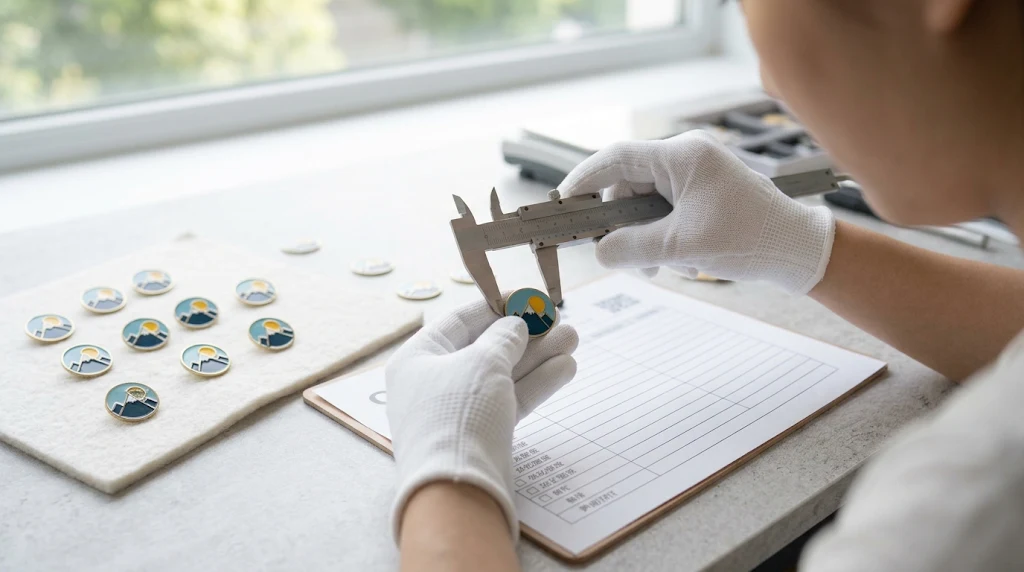
Evaluate appearance, readability, handling, attachment, and fit. Photograph the sample under repeatable conditions and document any accepted variations.
If the first sample requires changes, clarify whether the revised sample must be approved before bulk production begins.
Stage 3: Production Inspection
Agree on an inspection approach before the order is complete.
Potential inspection categories include:
| Inspection area | Issues to review |
| Appearance | Incorrect color, missing fill, scratches, visible contamination |
| Construction | Bent posts, insecure attachment, unexpected sharp features |
| Hardware | Incorrect backing or inconsistent function |
| Packaging | Wrong artwork, poor fit, damaged cards, missing components |
| Order accuracy | Incorrect design quantities, labeling, or assortment |
Not every cosmetic difference has the same significance. Define critical, major, and minor issues in writing, together with the sampling method and acceptance criteria.
A clearly documented approval standard is more useful than a broad promise of "premium quality."
Review Safety and Compliance Before Making Claims
Enamel pins combine metal components, posts, coatings, and detachable parts. The applicable requirements depend on the product's classification, intended users, and destination market.
Avoid treating all promotional pins as legally identical.
Give Children's Merchandise a Separate Review
For the United States, accessible components of children's products are generally subject to a total lead limit of 100 parts per million. Paint and similar surface coatings are subject to a separate limit of 90 parts per million. Applicable testing and certification requirements must also be considered. [cpsc]
The U.S. Consumer Product Safety Commission identifies ASTM F2923 for children's jewelry and ASTM F2999 for adult jewelry as industry consensus standards. It also explains that children's jewelry remains subject to applicable children's-product requirements. [cpsc]
Small-parts requirements require careful classification. The CPSC's guidance includes both covered products and specific exclusions; the presence of a small component does not, by itself, resolve which rule applies. [cpsc]
Before ordering merchandise intended for children, have the importer or qualified compliance adviser establish the applicable requirements and testing plan.
Keep Compliance Claims Specific
Avoid unsupported statements such as:
- "Safe for every age."
- "Completely non-toxic."
- "Fully compliant worldwide."
- "Certified" without naming the certification and its scope.
Instead, identify the actual standard, tested components, report details, and relevant market where those claims are supported.
A general supplier statement should not be treated as proof that a particular finished product meets every applicable requirement.
Measure Whether the Merchandise Program Works
The "best" pin should also be evaluated against the campaign objective.
Before launch, choose a small set of useful performance indicators.
For retail merchandise, these might include:
- Sell-through by design.
- Contribution margin.
- Returns or defect complaints.
- Sales of bundles containing the pin.
For promotional campaigns, they might include:
- Qualified interactions at distribution.
- Cost per relevant lead.
- Redemption of a campaign-specific offer.
- Visits to a dedicated landing page.
A QR code on the packaging can support measurement, but a scan alone does not prove that the pin caused a purchase.
Use a relevant destination, a clear reason to scan, and tracking that distinguishes the campaign from ordinary website traffic.
Work With XingKun on a Coordinated Packaging Brief
For an overseas brand sourcing merchandise, pin production and printed packaging should be coordinated through a shared specification.
Shenzhen XingKun Packing Products Co., Ltd. presents custom printing and packaging solutions with OEM/ODM service options. Its published product information also includes a badges category, although the availability and specifications of a particular enamel-pin project should be confirmed directly. [xkdisplay]
A useful initial inquiry should include:
1. Pin artwork or a concept reference.
2. Intended dimensions and quantities.
3. Destination market and intended audience.
4. Preferred enamel and backing options.
5. Packaging format.
6. Target delivery date.
7. Testing or documentation requirements.
Contact XingKun with this brief and request a project-specific proposal covering confirmed production scope, packaging construction, sampling, assembly, quality expectations, and delivery terms.
This gives both sides a clearer basis for discussing feasibility and price.
Conclusion
The best enamel pins for brand merchandise are not defined by a single finish, backing, or price point. They are defined by how well the finished product serves its audience and commercial purpose.
Start with readable artwork. Compare enamel styles through samples. Evaluate attachment hardware under realistic conditions. Develop packaging alongside the pin, and compare suppliers using the same specification and cost scope.
Most importantly, turn expectations into documented approvals. A coordinated approach to product design, packaging, inspection, and compliance gives a brand a stronger foundation for merchandise that looks intentional and arrives ready for its intended use.
Frequently Asked Questions
1. Are hard enamel pins always better than soft enamel pins?
No. Hard enamel offers a smooth, polished surface, while soft enamel has raised metal outlines and recessed color. The better choice depends on the desired appearance, approved sample, budget, and product positioning—not a universal quality hierarchy. [metalpromo]
2. What artwork works best for custom enamel pins?
Clear silhouettes, readable lettering, and simplified details are strong starting points. Review artwork at its intended physical size and ask the supplier to identify production limitations before approval. Fine details that look clear on screen may not translate well into a small pin. [metalpromo]
3. What is the best backing for branded enamel pins?
There is no single best backing for every application. Butterfly clutches, rubber clutches, locking-style mechanisms, and magnets offer different handling arrangements. Compare physical samples on the intended garment or accessory before making the final selection. [metalpromo]
4. Should every enamel pin have a backing card?
Not necessarily. A backing card is a useful format when the brand needs a display surface and printed information. A gift set may require a different arrangement. Choose the format through a complete packaging review rather than making it a default requirement.
5. How can buyers compare custom enamel pin quotations accurately?
Give every supplier the same specification. Confirm whether tooling, samples, backings, packaging, assembly, inspection, and freight are included. Compare the total cost for the same delivered product rather than comparing headline unit prices.
6. Can enamel pins be marketed to children?
That decision requires a product-specific safety and compliance assessment. In the United States, children's products may be subject to lead limits, testing, certification, and other requirements. Do not assume that adding a warning makes an otherwise unsuitable product acceptable. [cpsc]
7. What should a buyer confirm with XingKun before ordering?
Confirm the exact product and packaging scope, material and finish options, quantities, sample approval process, quality criteria, documentation, assembly requirements, and delivery terms. XingKun publishes custom packaging and OEM/ODM capabilities, but project-specific commitments should be established in the quotation and order documents. [xkdisplay]


