Content Menu
● Flat Shipping Boxes vs Pre-Assembled Rigid Boxes at a Glance
● What Are Flat Shipping Boxes?
>> How Flat-Pack Corrugated Boxes Work
>> When Flat Shipping Boxes Make Sense
● What Are Pre-Assembled Rigid Boxes?
>> Common Rigid Box Styles
>> Why Brands Choose Rigid Packaging
● Compare Protection Across the Complete Packaging System
>> Corrugated Shipping Protection
>> Rigid Box Protection
● Compare Total Cost, Not Just the Box Quotation
>> Flat Shipping Box Cost Drivers
>> Pre-Assembled Rigid Box Cost Drivers
● A Practical Labor Break-Even Example
● Freight and Warehouse Space: Separate Two Different Journeys
>> Inbound Empty-Box Logistics
>> Outbound Customer Shipping
● Branding and Unboxing: Match Presentation to the Purchase
>> Custom Flat Shipping Boxes
>> Custom Pre-Assembled Rigid Boxes
● Sustainability: Evaluate Materials and Real Disposal Conditions
● A Five-Step Validation Plan Before Bulk Production
>> 1. Define the Product and Distribution Route
>> 2. Build Comparable Prototypes
>> 3. Time the Full Packing Cycle
>> 4. Test the Complete Packaged Product
>> 5. Approve Written Acceptance Criteria
● Which Packaging Format Should You Choose?
● Frequently Asked Questions
>> Are flat shipping boxes cheaper than pre-assembled rigid boxes?
>> Can pre-assembled rigid boxes ship without an outer carton?
>> Does flat-packed packaging reduce customer shipping charges?
>> Which box is better for fragile products?
>> Can flat shipping boxes provide a premium experience?
>> What should I prepare when requesting a packaging quotation?
● References
Flat shipping boxes vs pre-assembled rigid boxes is more than a comparison of appearance and price. It is a decision about product protection, warehouse capacity, packing efficiency, and customer experience. Flat-packed shipping boxes generally prioritize logistics efficiency, while pre-assembled rigid boxes prioritize presentation and a ready-to-fill structure.
At Shenzhen XingKun Packing Products Co., Ltd., our approach starts with the product and its delivery journey—not simply the box style. With more than 20 years of printing and packaging manufacturing experience, serving brands and distributors across over 30 countries and regions, we understand why buyers need to evaluate the complete packaging system.
This guide compares both options and provides a practical framework for choosing packaging that supports your operational and commercial goals.
Flat Shipping Boxes vs Pre-Assembled Rigid Boxes at a Glance
| Comparison factor | Flat shipping boxes | Pre-assembled rigid boxes |
| Delivery format | Supplied flat; erected before filling | Supplied in their finished three-dimensional shape |
| Typical construction | Corrugated board with liners and a fluted medium | Thick, non-bending paperboard, commonly covered with a decorative wrap |
| Empty-box storage | Space-efficient | Usually requires more storage volume |
| Packing workflow | Requires erection and closure | Requires no box erection, but still needs filling and closure |
| Presentation | Functional to premium, depending on printing and design | Particularly suited to structured gift presentation |
| Transit role | Commonly serves as the outer shipping container | Often benefits from a separate protective shipping carton |
| Typical applications | Online orders, subscriptions, replacement parts | Jewelry, cosmetics, premium accessories, gift sets |
| Cost comparison | Include assembly, inserts, and closures | Include empty-box freight, storage, and outer protection |
Neither format is automatically stronger, cheaper overall, or more sustainable. Those outcomes depend on specifications and the distribution environment.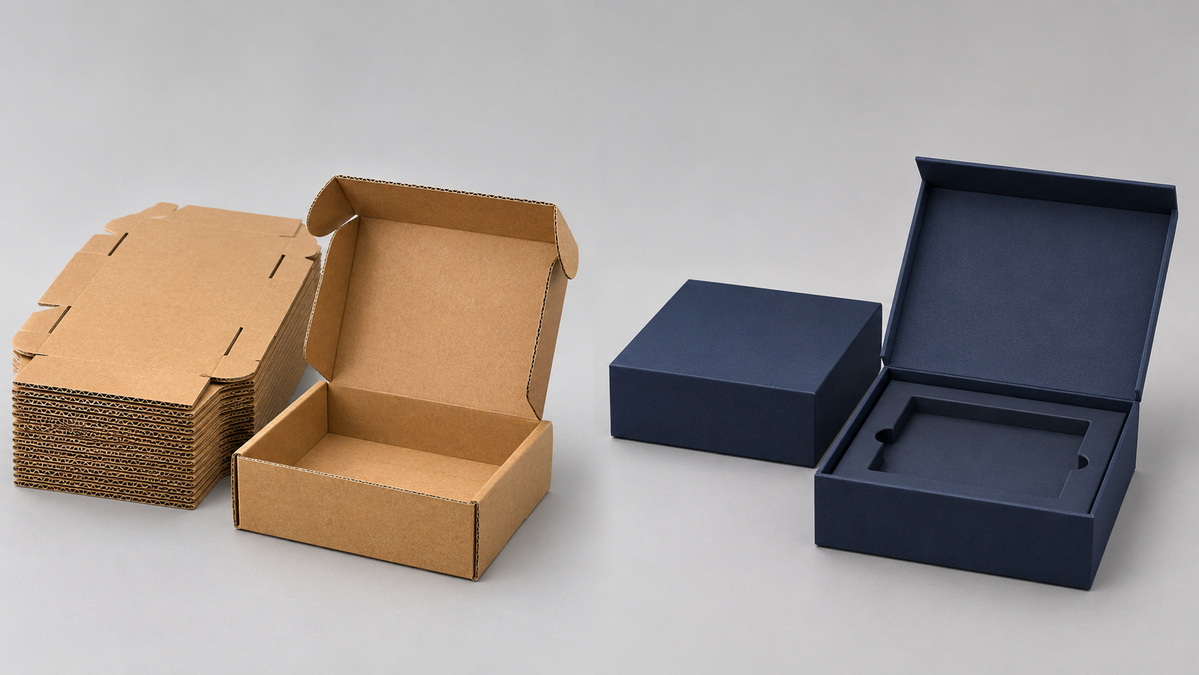
What Are Flat Shipping Boxes?
Flat shipping boxes are packaging containers supplied in a collapsed or unfolded state and assembled before use. Here, "flat" describes their delivery format—not necessarily a shallow finished shape.
For this comparison, the term refers primarily to corrugated shipping cartons and mailer boxes. Folding paperboard cartons also ship flat, but they are a different structural category.
How Flat-Pack Corrugated Boxes Work
Corrugated board combines flat liners with a fluted paper layer. The finished box may use taped flaps, locking tabs, or another closure system.
Common options include:
- Regular slotted shipping cartons.
- Die-cut mailer boxes.
- Self-locking corrugated boxes.
- Wraparound packaging for relatively flat products.
Their main operational advantage is straightforward: businesses store the packaging before creating its full three-dimensional volume.
When Flat Shipping Boxes Make Sense
Flat-pack shipping boxes are a practical starting point for businesses managing frequent parcel dispatches, limited storage, or multiple product sizes.
However, performance depends on more than the format. Board grade, dimensions, inserts, closure quality, and handling conditions all influence whether the package protects its contents successfully.
What Are Pre-Assembled Rigid Boxes?
Pre-assembled rigid boxes, also called setup boxes, arrive already formed. Conventional versions use thick, non-bending paperboard covered with printed or decorative wrapping material.
Unlike folding cartons, these boxes retain their shape during storage and filling.
Common Rigid Box Styles
Typical configurations include:
- Two-piece lid-and-base boxes.
- Shoulder-and-neck boxes.
- Hinged-lid presentation boxes.
- Drawer-style boxes with a sleeve.
Collapsible rigid boxes are a separate option. Although they can offer a rigid appearance after assembly, they should not be treated as conventional pre-assembled boxes when comparing freight and storage requirements.
Why Brands Choose Rigid Packaging
Rigid boxes provide a structured presentation surface and support features such as fitted compartments, decorative wraps, and controlled lid movement.
They are especially relevant when the package forms part of a gift or premium purchasing experience. Still, an attractive presentation box should not automatically be treated as a parcel-ready shipping container.
Compare Protection Across the Complete Packaging System
The most useful protection question is not "Which box feels harder?" It is "Which complete package protects this product through its actual journey?"
Corrugated Shipping Protection
A correctly specified corrugated box can function as the outer transport package. Its suitability depends on the product weight, board specification, box geometry, closure, and internal protection.
An oversized carton with inadequate cushioning may perform poorly despite using substantial board. Conversely, a well-fitted package can limit movement without unnecessary material.
Rigid Box Protection
Rigid boxes provide firm walls and support organized presentation. However, exposed wraps, corners, and decorative surfaces can suffer cosmetic damage during distribution.
For direct-to-consumer delivery, evaluate whether the rigid box needs:
- A corrugated outer carton.
- Spacing or cushioning around presentation surfaces.
- A fitted insert that restricts product movement.
- Protection against abrasion between components.
My recommendation is to approve the complete shipping configuration, rather than judging either box from an empty sample.
Compare Total Cost, Not Just the Box Quotation
A lower purchase price does not necessarily produce a lower cost per successfully delivered order.
Use this comparison:
Total packaging cost = box purchase + inbound freight + storage + packing labor + inserts and closures + outer protection + damage-related costs.
Flat Shipping Box Cost Drivers
Flat formats can reduce the volume occupied by empty packaging. Their economics also depend on erection time, tape consumption, packing consistency, and equipment compatibility.
A complicated locking structure may save tape but take longer to assemble. Test the actual workflow before assuming savings.
Pre-Assembled Rigid Box Cost Drivers
Rigid boxes eliminate erection at the filling stage, but they still require inspection, product placement, inserts, closure, and potentially an outer shipper.
Request quotations based on the same product, quantity, delivery destination, and protection requirement. Otherwise, the comparison may reward an incomplete specification.
A Practical Labor Break-Even Example
Consider an illustrative order of 10,000 units. These figures are planning assumptions, not XingKun production results or industry averages.
| Assumption | Flat shipping box | Pre-assembled rigid box |
| Erection time per box | 18 seconds | No erection required |
| Total erection time | 50 hours | None |
| Assumed labor rate | $12 per hour | $12 per hour |
| Erection labor cost | $600 | $0 |
| Erection cost per unit | $0.06 | $0 |
Under these assumptions, avoiding erection saves six cents per unit—not the entire packing labor cost.
If the rigid option adds more than six cents through purchase price, freight, storage, and outer protection, labor savings alone would not justify it. Presentation value or another measurable benefit would need to support the difference.
This calculation helps buyers replace vague claims about "faster packing" with a decision tied to their operation.
Freight and Warehouse Space: Separate Two Different Journeys
One of the most important distinctions is between transporting empty packaging to your facility and shipping packed products to customers.
Inbound Empty-Box Logistics
Flat-packed boxes generally use less space before assembly. Conventional rigid boxes retain their three-dimensional shape, which can increase inbound cube and storage demand.
Ask suppliers for:
- Units per master carton.
- Master-carton dimensions and gross weight.
- Total shipment volume.
- Pallet configuration, where applicable.
Use actual packing data rather than a universal percentage-saving claim.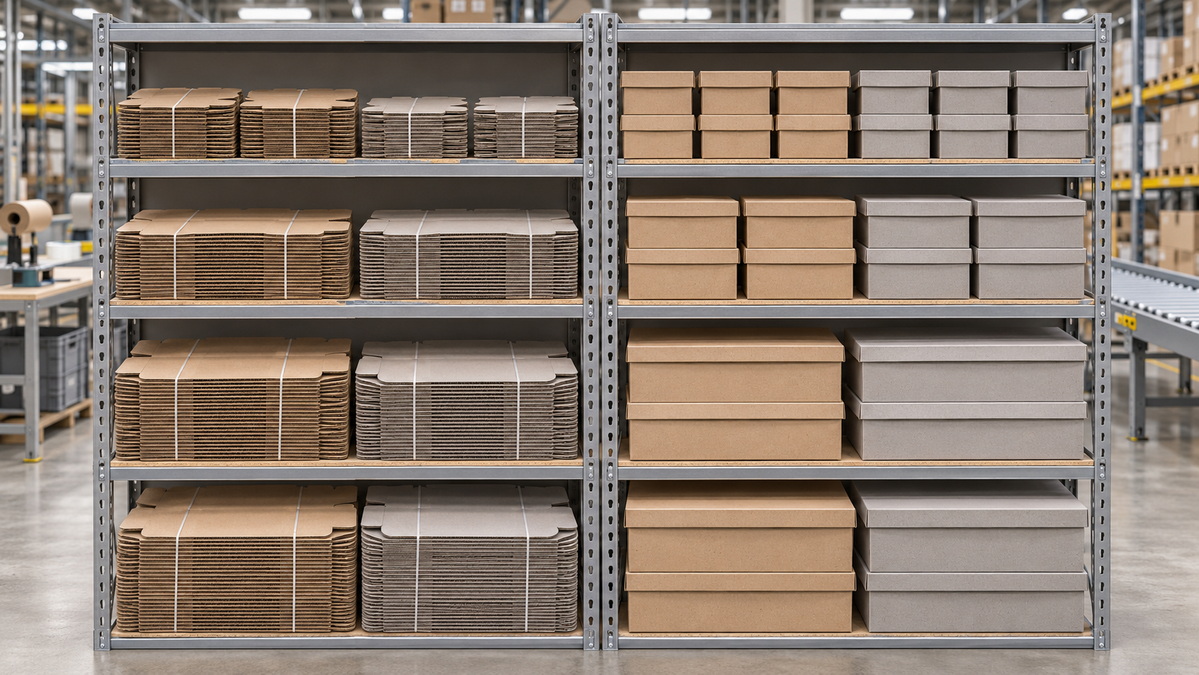
Outbound Customer Shipping
Once a flat shipping box is erected and filled, its original delivery format does not directly determine the parcel charge.
Carriers may assess dimensional weight using package length, width, height, and an applicable divisor. The relevant dimensions are those of the final shipping package.
For rigid packaging, measure the outer protective carton as well. A compact presentation box inside an unnecessarily large shipper can undermine logistics efficiency.
Branding and Unboxing: Match Presentation to the Purchase
Both formats can support custom graphics. The difference lies in how construction, printing, and opening behavior work together.
Custom Flat Shipping Boxes
Printed corrugated mailers can deliver a strong brand experience through exterior graphics, interior messages, and neatly arranged contents.
Evaluate printing on the proposed production material. Surface texture, flute profile, and printing method can affect fine details and color appearance.
Custom Pre-Assembled Rigid Boxes
Rigid packaging offers opportunities for specialty wraps, foil stamping, embossing, and fitted presentation compartments.
These features should serve a clear purpose. A precise insert can make a multi-item gift set easier to understand, while an unnecessarily elaborate opening sequence may frustrate customers.
From a packaging-development perspective, the strongest design makes the product easy to identify, remove, and enjoy—not merely photograph.
Sustainability: Evaluate Materials and Real Disposal Conditions
Neither box format deserves an automatic environmental advantage.
Flat delivery can improve empty-packaging logistics, but that does not establish the overall footprint of a finished packaging system.
Likewise, a rigid box may be suitable for reuse, but potential reuse should not be presented as proof that consumers will keep it.
Evaluate:
- Total material used per delivered product.
- Recycled-content documentation.
- Inserts, magnets, ribbons, and other components.
- Component separation.
- Recycling acceptance in the destination market.
- Damage prevention and replacement shipments.
Avoid blanket recyclability statements without checking the complete construction and local collection conditions.
A Five-Step Validation Plan Before Bulk Production
A structured approval process is more valuable than choosing from photographs alone.
1. Define the Product and Distribution Route
Provide product dimensions, weight, fragility, surface sensitivity, sales channel, and destination.
Specify whether the package will travel as an individual parcel, inside a master carton, or through a retail distribution network.
2. Build Comparable Prototypes
Evaluate both formats with the intended product, insert, closure, and outer protection. Do not compare a complete rigid packaging system against an unsupported corrugated shell.
3. Time the Full Packing Cycle
Measure erection, product placement, insert positioning, closure, labeling, and inspection. Include errors and rework, not just the fastest cycle.
4. Test the Complete Packaged Product
Choose a test approach suited to the distribution route. ISTA Procedure 3A, for example, addresses individual packaged products weighing 70 kilograms or less shipped through parcel delivery systems.
Confirm the applicable procedure and requirements with the testing provider.
5. Approve Written Acceptance Criteria
Document dimensions, artwork, materials, fit, cosmetic requirements, closure performance, and agreed testing outcomes.
Retain an approved reference sample for production comparison.
Which Packaging Format Should You Choose?
Start with flat shipping boxes when your priorities include efficient empty-box storage, parcel fulfillment, and a practical outer shipping container.
Start with pre-assembled rigid boxes when presentation, organized gift sets, and a ready-formed structure justify additional logistics requirements.
A combined system can also be appropriate: a rigid presentation box inside a fitted corrugated shipper. The trade-off is additional material, handling, and cost.
At Shenzhen XingKun Packing Products Co., Ltd., we recommend comparing specifications before committing to a format. Send your product dimensions, weight, order quantity, destination, artwork requirements, and intended customer experience. Request a side-by-side proposal covering structure, materials, inserts, master-carton packing, and sample approval—not simply two unit prices.
Frequently Asked Questions
Are flat shipping boxes cheaper than pre-assembled rigid boxes?
They can be, particularly when empty-box freight and storage matter. However, the final comparison must include assembly labor, inserts, closures, and protection requirements. Obtain matched quotations before deciding.
Can pre-assembled rigid boxes ship without an outer carton?
Some applications may permit this, but do not assume it. Assess cosmetic damage, closure security, labeling, and transit performance before approving a rigid box as the shipping container.
Does flat-packed packaging reduce customer shipping charges?
Not automatically. Flat packing primarily affects empty-packaging logistics. Customer shipping charges depend on the dimensions, weight, service, and applicable rules for the completed parcel.
Which box is better for fragile products?
Neither format wins universally. Fragile products require an appropriate combination of box structure, cushioning, inserts, and closure. Validate the complete package under relevant distribution conditions.
Can flat shipping boxes provide a premium experience?
Yes. Custom graphics, accurate fit, thoughtful inserts, and an intuitive opening sequence can create a polished experience. Premium presentation does not depend exclusively on rigid construction.
What should I prepare when requesting a packaging quotation?
Provide product dimensions and weight, quantity, destination, required delivery schedule, artwork, preferred finishes, insert requirements, and distribution method. These details help suppliers prepare comparable proposals.
References
1.Paperboard Packaging Council. "Rigid Box Industry Terminology." Definitions of rigid/setup boxes, chipboard, and wrapped construction. [paperbox]
2.Paperboard Packaging Council. "The Luxurious Rigid Box." Construction methods, decorative options, and presentation applications. [paperbox]
3.Paperboard Packaging Council. "What's a Rigid Box?" Ready-formed construction, filling-stage assembly differences, and common uses. [paperbox]
4.FEFCO. "FAQ — FEFCO Code." Flat delivery formats for corrugated packaging. [fefco]
5.UPS. "Package Dimensions, Size Limits and Weight Guide." Dimensional-weight principles and package measurement guidance; applicable service rules should be checked when quoting. [ups]
6.International Safe Transit Association. "Test Procedure 3A: Overview." Scope of parcel-delivery simulation testing for individual packaged products. [ista]
7.Paperboard Packaging Council. "ECMA Statement on Recyclability." Market-specific considerations and limitations surrounding recycling claims. [paperbox]


