Content Menu
● The Historical Origins of Tarot as a Game
● Understanding the Tarot Deck for Play
● The Objective of the Tarot Card Game
● The Hierarchy of Cards
● Common Variant: French Tarot
● Variant: Austrian Tarock (Königrufen)
● Strategic Elements and Tips
● Scoring Systems and Point Calculation
● Comparing Tarot with Other Trick-Taking Games
● Cultural Legacy and Modern Appreciation
● How to Learn and Practice Today
● Conclusion
● Related Questions and Answers
>> 1. What is the difference between tarot for gaming and tarot for divination?
>> 2. Can you play tarot with a regular 78-card divination deck?
>> 3. Are there variations of tarot still played in Italy?
>> 4. How long does a full tarot game usually take?
>> 5. Is tarot a game of skill or luck?
For most people in the English-speaking world, tarot immediately evokes images of fortune tellers, mystical readings, and symbolic archetypes like the Fool or the Lovers. Yet, long before tarot cards became linked to the esoteric arts, they were part of a trick-taking card game that swept across Renaissance Europe. The Tarot card game—sometimes called Tarock or Tarocchi—is still played today in parts of France, Austria, Switzerland, and Italy. Its evolution into a divination tool came only later.
This article will unpack everything you need to know to understand and play the tarot card game: from its historical roots, to the structure of the deck, the basic rules, scoring systems, and strategic principles that make it both challenging and rewarding.
The Historical Origins of Tarot as a Game
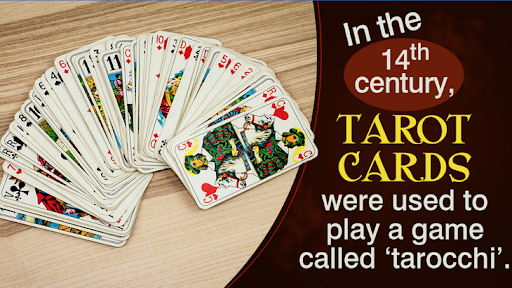
The tarot deck first appeared in northern Italy around the early 15th century. Wealthy families such as the Visconti of Milan commissioned lavish hand-painted decks, known as carte da trionfi (“cards of triumphs”). These cards were used for playing an early form of trick-taking known as Trionfi, which eventually evolved into Tarocchi—the ancestor of modern tarot games.
The idea spread quickly through trade and cultural exchange. By the 16th century, many regions had their own local variants:
Tarocchi in Italy
Tarot de Marseille in France
Tarock in central Europe (Austria, Hungary, Czech Republic, and beyond)
Though the imagery varied, the fundamental mechanics remained strikingly consistent: tarot is a game of suits, trumps, and strategic play, not originally a form of mysticism.
Understanding the Tarot Deck for Play
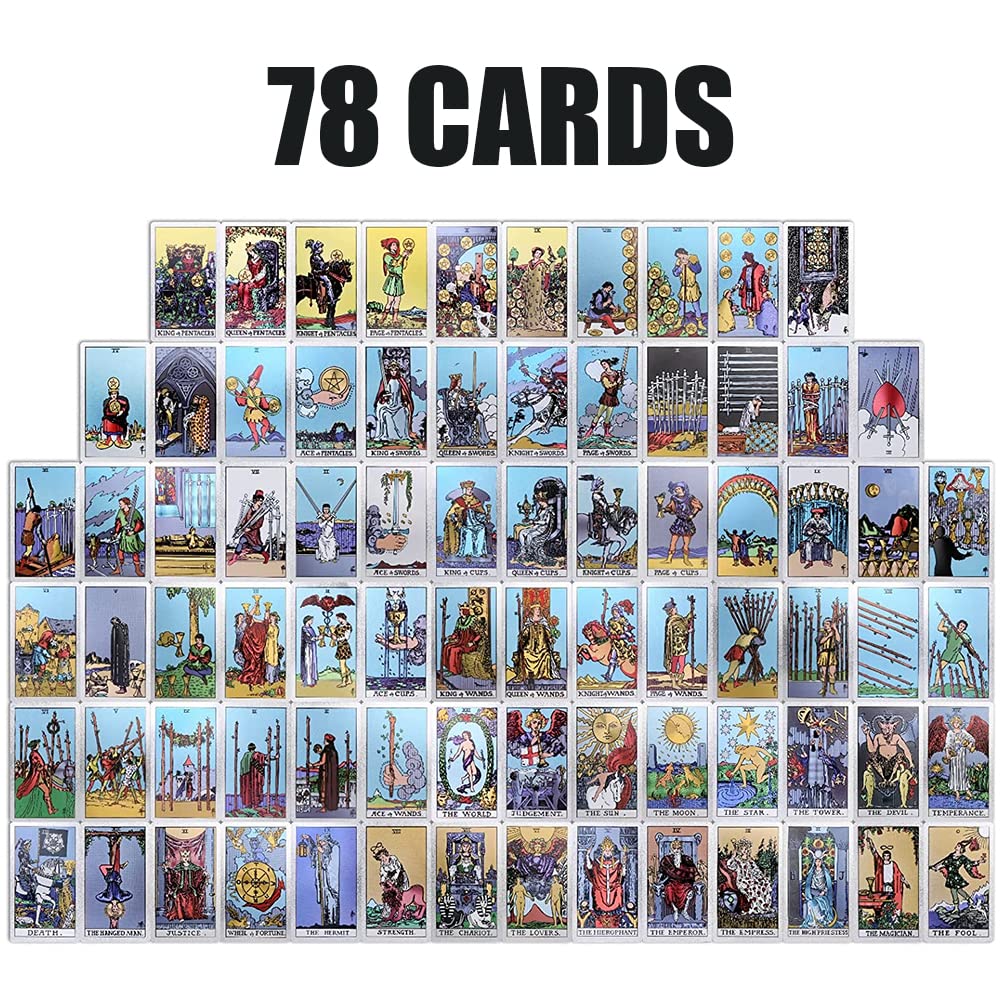
Unlike a standard 52-card deck, a tarot deck contains 78 cards divided into two main parts:
1.The Suit Cards (Minor Arcana)
Four suits: traditionally Cups, Swords, Coins (or Pentacles), and Batons (or Wands).
Each suit has 14 cards: numbers 1–10 plus four court cards—Page, Knight, Queen, and King.
These function like ordinary playing cards, forming the base of the trick-taking play.
2.The Trump Cards (Major Arcana)
21 numbered trumps (I to XXI), representing allegorical scenes—Strength, Justice, the World, etc.
One special card: the Fool, often unnumbered, sometimes called “Excuse.”
Trump cards outrank all suit cards, which adds complexity to strategy.
Notably, in gaming tarot, the imagery is decorative but has no symbolic function; it’s the rank and suit that matter. In central European versions, illustrations may have evolved into more abstract patterns for faster recognition during play.
The Objective of the Tarot Card Game
At its core, tarot is a trick-taking competition similar to bridge or spades. Players aim to win tricks containing valuable cards while carefully managing the limited supply of trumps and following suit whenever possible.
Depending on the variant, the game may be for:
3 players (most popular in French Tarot and Tarock)
4 players (common in Italian Tarocchi and Austrian Konigrufen)
Occasionally 5 players (special partnership versions exist)
The objective for each player or team is to collect enough card points through winning tricks to surpass a set threshold, determined by the rules of the variant played.
The Hierarchy of Cards
The ranking of cards depends on whether it is a suit or a trump.
In the suits:
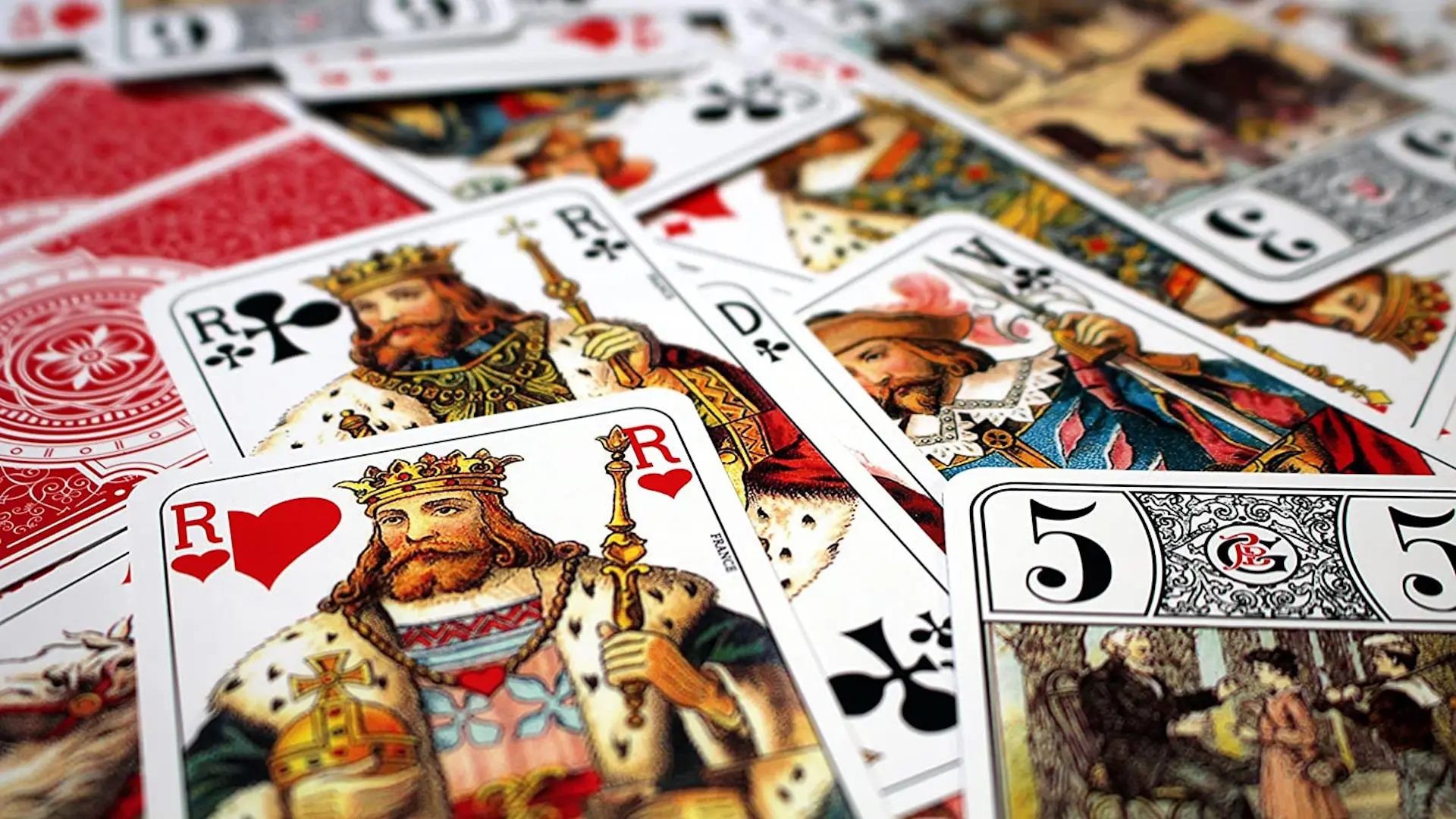
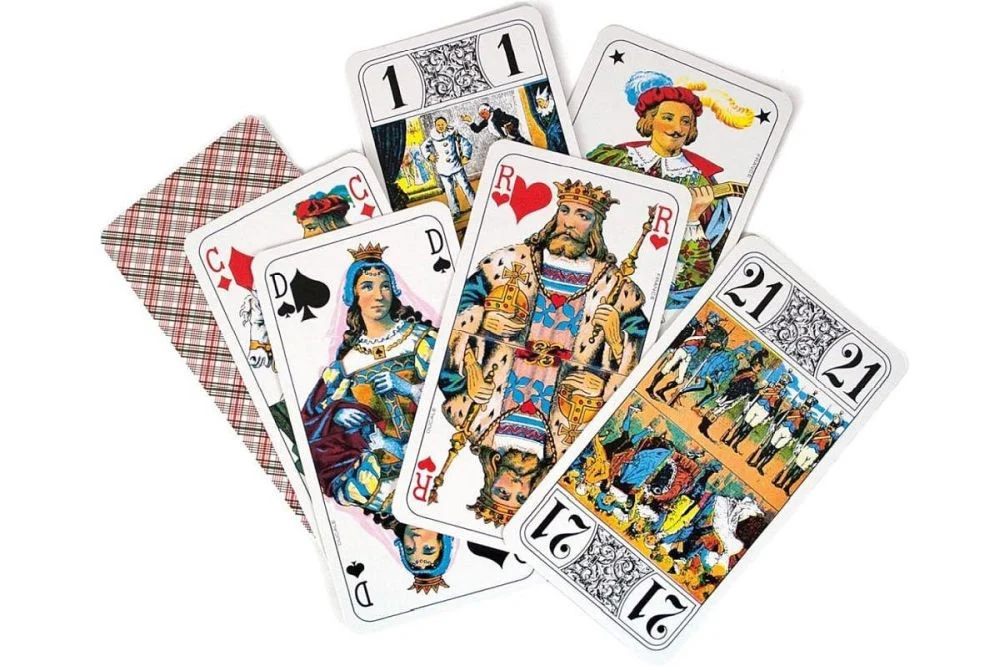
King (highest), Queen, Knight, Page, followed by numeric cards from 10 down to 1.
In the trumps:
Trump XXI (21) is usually the strongest.
Trump I (often called “Petit” or “Pagat”) is the weakest but can earn bonus points if it wins a trick.
The Fool stands apart—it can be played at almost any time to “excuse” a player from following suit; however, it cannot win a trick.
Common Variant: French Tarot
The French Tarot (Tarot Français) is the most standardized and widely played version today. It is an official sport in France with ratings, tournaments, and formalized rules governed by the Fédération Française de Tarot.
Setup:
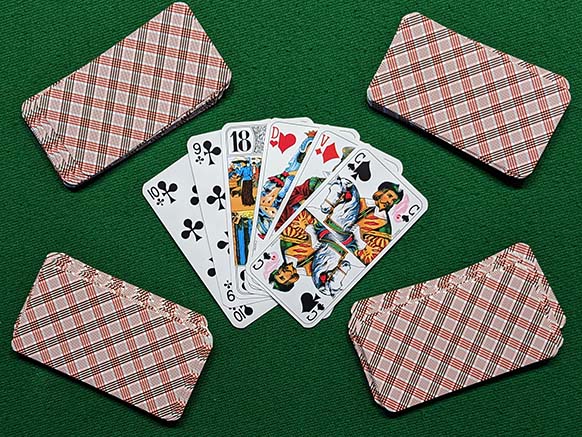
4 players; the 78-card deck is used.
Each player gets 18 cards, while 6 cards form a separate pile called the dog (le chien).
Bidding Phase:
Players declare how confident they are in winning by bidding one of several contracts:
1.Petite (small) — basic contract
2.Guard — higher risk, greater reward
3.Guard without the dog — dog cards stay hidden
4.Guard against the dog — dog cards go to the opponent’s side
The highest bidder becomes the taker (or “declarer”), playing against the other three.
Play Phase:
Suit must be followed.
If unable to follow suit, a player must play a trump.
The Fool may be used once to avoid playing either.
Scoring:
Each card has a point value. The taker must reach a minimum total depending on how many “oudlers” (key cards) they have:
3 oudlers (Fool, I, XXI): 36 points needed
2 oudlers: 41 points
1 oudler: 51 points
0 oudlers: 56 points
Bonuses are awarded for feats such as capturing all tricks (chelem) or winning the last trick with the smallest trump (Petit au bout).
Variant: Austrian Tarock (Königrufen)
In Austria, the Königrufen (“calling the king”) variant reigns as a beloved traditional pastime. Played with a 54-card Tarock deck, it features distinct pictorial trumps called “tarocks” and unique bidding mechanics.
Key Concepts:
The declarer “calls” a king at the beginning, making that card’s holder their secret partner (revealed later).
Partnerships add intrigue, as alliances are dynamic and can change with each round.
Multiple contracts exist, ranging from conservative (Three Strikes) to daring (Solo) where a player faces all others alone.
Scoring is complex but always revolves around capturing valuable trumps and high-value cards. Many Austrian families still treat Tarock as both a social ritual and mental workout—akin to how bridge is viewed in English-speaking countries.
Strategic Elements and Tips
Tarot isn’t just luck—it rewards analysis, risk assessment, and memory. Success often depends on timing and subtle communication through play. Here are some key strategic principles:
1.Track the trumps.
Remembering how many and which trumps have been played is crucial to deciding when to sacrifice or protect valuable cards.
2.Manage the Fool wisely.
Using it too early forfeits flexibility later; saving it too long could mean losing a key round without advantage.
3.Observe opponents’ patterns.
The way they respond when unable to follow suit reveals hints about their remaining cards.
4.Plan your discards.
In French Tarot, cards placed into the dog must balance offensive potential and defensive risk.
5.Adapt to the contract.
More ambitious bids demand stronger card combinations and risk tolerance. A cautious playstyle suits smaller contracts, while daring ones require aggressive trump management.
Scoring Systems and Point Calculation
Scoring is both arithmetic and psychological. Points usually derive from tricks won and card values, with bonuses or penalties depending on the outcome of contracts and special victories. Although specifics vary, most systems share these ideas:
| Card Type | Example | Point Value |
| King | King of any suit | 4.5 |
| Queen | – | 3.5 |
| Knight | – | 2.5 |
| Page | – | 1.5 |
| Other suit cards | Numbers | 0.5 each |
| Trumps (excluding special ones) | – | 0.5 each |
| Fool / Trump I / Trump XXI | “Oudlers” | Crucial for scoring thresholds |
The totals are typically halved after counting “packs” of three cards, simplifying calculations. Expert players can add or estimate mentally during play, which adds to the intellectual charm of tarot gaming.
Comparing Tarot with Other Trick-Taking Games
Though it may sound exotic, tarot’s structure parallels other games familiar to different regions.
| Feature | Tarot | Bridge | Spades | Hearts |
| Uses trumps | Yes | Yes | Yes | No |
| Partnership play | Often | Always | Always | No |
| Strategic bidding | Yes | Yes | No | No |
| Scoring by card values | Yes | Yes | No | Yes |
| Origin | 15th-century Italy | 19th-century Britain | U.S. | U.S. |
Tarot’s advantage lies in its rich variety: it blends structured bidding and trick-taking with flexible partnerships and a dash of unpredictability from the Fool card.
Cultural Legacy and Modern Appreciation
In many European regions, playing tarot remains as culturally anchored as chess clubs or family Scrabble nights elsewhere. France even televises championship tournaments; Austria’s small towns host local Tarock leagues.
Meanwhile, the symbolic resonance of the trumps—originally allegorical images of social and moral values—has kept the cards culturally alive far beyond gaming. Ironically, while English-speaking audiences embraced tarot mainly for fortune-telling, continental Europe preserved its original spirit: a social game of intellect, strategy, and chance.
How to Learn and Practice Today
If you want to learn to play:
1.Acquire a proper gaming tarot deck.
Use a French Tarot or Austrian Tarock deck, not a divination pack. Gaming ones are numbered clearly and sized for handling.
2.Start with online tutorials or apps.
French Tarot apps feature AI opponents that simulate bidding and play.
3.Join a local club or online community.
Enthusiasts in Europe and increasingly online welcome beginners.
4.Watch tournaments.
Observing real matches clarifies the flow of play better than reading rules.
5.Practice score counting.
Quick arithmetic and remembering oudlers’ thresholds build efficiency and confidence.
Over time, the game’s rhythm—its alternation of logic, risk, and intuition—becomes quite addictive. It offers centuries of tradition in every hand dealt.
Conclusion
Tarot in its original form is neither mystical nor occult—it’s mathematical art, blending probability with psychology and a hint of theatrical storytelling. The grandeur of its imagery masks deep strategy and human emotion: partnership, deception, triumph, and loss.
Learning to play the tarot card game connects you with five centuries of European culture. Each trick, each trump, carries history. Whether you play for leisure, competition, or curiosity, you’re joining a lineage of thinkers, gamblers, and storytellers who saw in seventy-eight painted cards a reflection of life’s unpredictable play.
Related Questions and Answers
1. What is the difference between tarot for gaming and tarot for divination?
Gaming tarot uses the same basic deck but with a focus on ranks, suits, and rules. Divination tarot interprets the imagery symbolically for insight or guidance.
2. Can you play tarot with a regular 78-card divination deck?
Technically yes, but gameplay can be cumbersome. Divination decks are large, ornate, and lack numbering clarity compared to gaming decks.
3. Are there variations of tarot still played in Italy?
Yes, several exist such as Tarocchi Bolognese and Minchiate Fiorentine, each with regional quirks like added trumps or altered scoring.
4. How long does a full tarot game usually take?
An average 4-player session lasts around 30–60 minutes, depending on the experience of the players and number of rounds.
5. Is tarot a game of skill or luck?
Both. Card distribution is luck-based, but decisions about bidding, timing, and memory create immense room for skillful play.


