Content Menu
● Understanding Shipping Costs for Custom Display Stands
● Why Custom Display Stand Design Matters for Shipping
● Core Strategy – Optimize Structural Design for Flat‑Packing
>> Reduce Overall Volume with Knock‑Down Structures
>> Simplify Component Count Without Losing Branding
● Comparing Materials – Weight, Durability, and Shipping Impact
>> Common Materials for Custom Display Stands
>> Practical Material Choices to Cut Freight
● Packaging Engineering – How Carton Design Slashes Per‑Unit Cost
>> Maximize Units per Carton and Pallet
>> Protective Packaging vs. Over‑Packaging
● Shipping Modes and Incoterms – Where Costs Actually Sit
>> Choosing the Right Shipping Mode
>> Negotiating Responsibilities with Incoterms
● Data‑Driven Cost Optimization – A Manufacturer's Case View
>> Example Scenario – Retail Campaign for a FMCG Brand
● Practical Steps to Reduce Shipping Costs for Your Next Custom Display Stand Order
>> Step 1 – Define Shipping and Budget Targets Upfront
>> Step 2 – Co‑Design the Structure with Your Manufacturer
>> Step 3 – Optimize Carton and Pallet Configurations
>> Step 4 – Standardize Designs Across Markets
● How a Specialist Manufacturer Adds Extra Value
>> Integrated Printing, Packaging, and Logistics Perspective
>> Expert Tips from the Production Floor
● Key Takeaways for Reducing Shipping Costs
● FAQs About Shipping Costs for Custom Display Stands
● References
For brands and distributors, shipping costs can quietly erode the profit of every custom display stand you send to retailers or trade shows. As a manufacturer with 20+ years producing custom display stands and print packaging for global clients, we've seen that smart structural and supply‑chain decisions at the design stage can cut shipping costs by 15–40% without sacrificing visual impact. [m.media-amazon]
Understanding Shipping Costs for Custom Display Stands
When you ship custom display stands, you are not only paying for weight; you are also paying for volume, handling complexity, and risk of damage. [business.google]
Key shipping cost drivers for display stands include:
- Dimensional weight (volumetric weight): Carriers charge based on the higher of actual weight or dimensional weight, which penalizes bulky but light stands. [business.google]
- Packaging efficiency: How many flat‑packed units you can load into one carton, pallet, or container has a direct impact on per‑unit freight cost. [business.google]
- Shipping lane & mode: Air vs. sea vs. express, plus the distance between your factory (for example, Shenzhen) and final destination warehouses. [business.google]
- Handling & assembly time: The more complicated the stand, the higher the handling and labor cost at both factory and destination. [m.media-amazon]
From our experience working with distributors in over 30 countries, optimizing structure and packaging almost always delivers bigger cost savings than negotiating freight rates alone. [m.media-amazon]
Why Custom Display Stand Design Matters for Shipping
Custom display stands are often designed by brand teams with a focus on visual impact, shelf blocking, and storytelling. Yet if shipping is ignored, the result is: [advertising.amazon]
- Oversized components that cannot be flat‑packed efficiently.
- Unnecessary materials (e.g., heavy plastic or thick boards) that increase weight.
- Fragile structures that require extra padding, increasing carton size.
In contrast, a design optimized for production and logistics will aim for the same marketing effect using fewer pieces, lighter substrates, and more compact packing. [advertising.amazon]
From a manufacturer's perspective, the best outcomes come when engineering and brand teams co‑design the stand, using 3D mockups and sample cuts to test both display impact and shipping efficiency before final approval. [m.media-amazon]
Core Strategy – Optimize Structural Design for Flat‑Packing
Reduce Overall Volume with Knock‑Down Structures
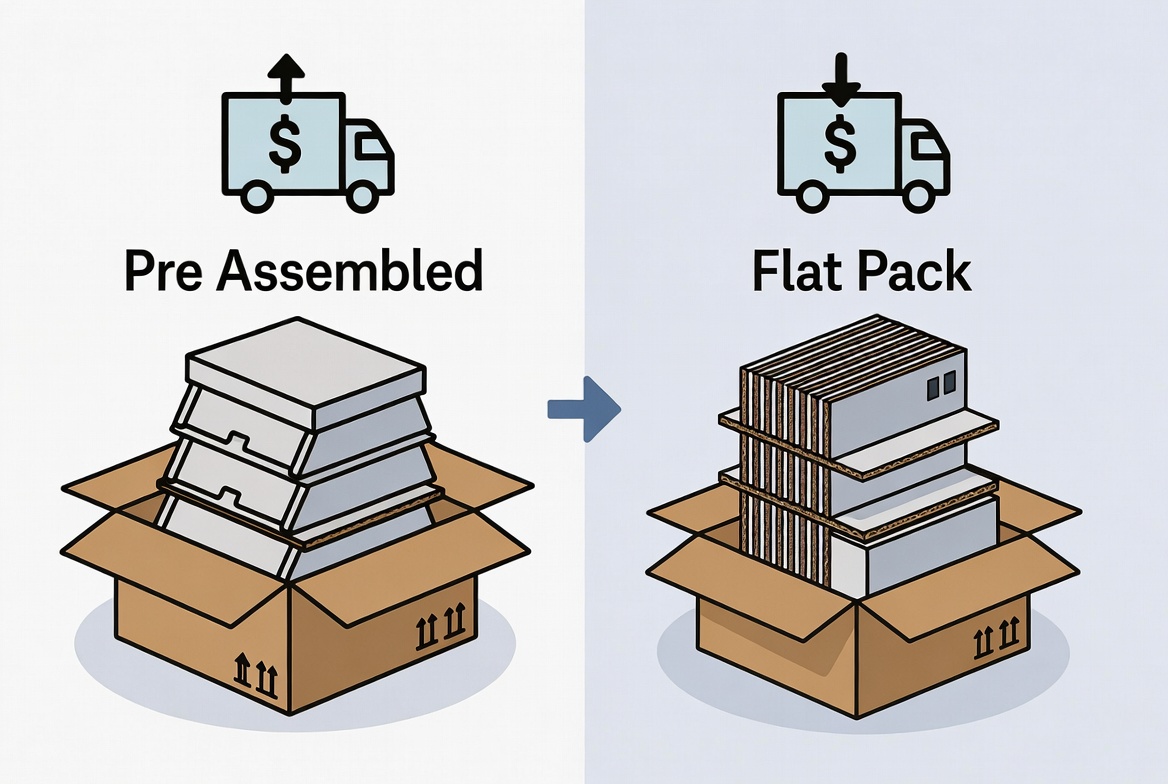
One of the most powerful ways to reduce shipping costs is to convert as many elements as possible into knock‑down (KD) parts that can be shipped flat and assembled on site. [m.media-amazon]
Practical tactics we use for clients:
- Modular panels instead of fixed 3D blocks: Break large body parts into interlocking panels that slot together, rather than gluing them at the factory.
- Detachable headers and shelves: Design headers, shelves, and side wings as separate pieces that slide into pre‑cut slots.
- Fold‑in components: Use die lines that allow side walls or toppers to fold into the base footprint.
As a rule of thumb from our projects, a well‑engineered KD structure can often reduce carton volume per stand by 30–50% compared with a fully assembled structure, significantly lowering dimensional weight and pallet count. [m.media-amazon]
Simplify Component Count Without Losing Branding
Every extra part adds packing complexity, labor, and risk of loss. We often help clients merge decorative pieces into print design instead of adding physical layers:
- Replace separate logo plates with high‑resolution printed branding on the main body.
- Use printed gradients and shadows to mimic 3D effects instead of foam or plastic layers.
- Combine multiple small shelves into 2–3 stronger shelves with adjustable notches.
In practice, cutting component count by 20–30% can reduce assembly time and packing cost while also making the stand easier for store staff to set up, which improves retailer satisfaction. [m.media-amazon]
Comparing Materials – Weight, Durability, and Shipping Impact
The choice of material is one of the biggest levers you have for controlling shipping cost per unit.
Common Materials for Custom Display Stands
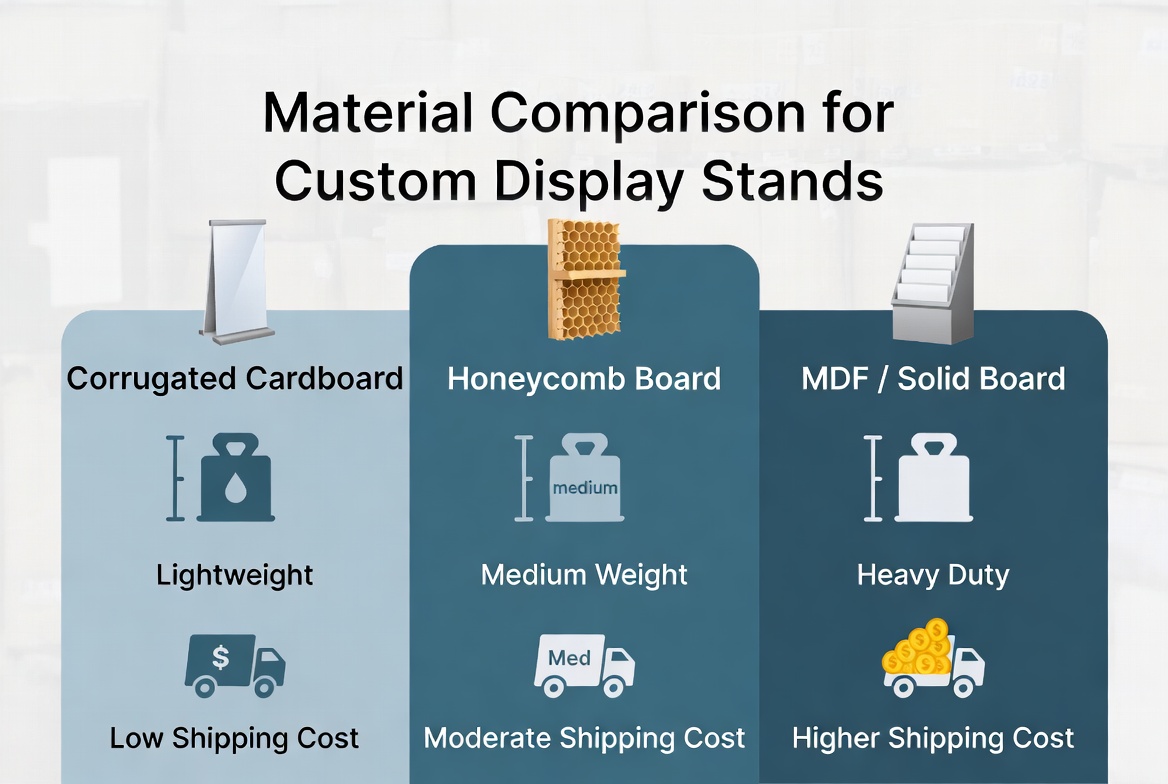
Below is a simplified view based on typical projects in retail and promotional displays. [m.media-amazon]
| Material Type | Typical Use Case | Relative Weight | Shipping Cost Impact | Notes for Export Use |
| Corrugated cardboard | Temporary retail displays, promos | Light | Low | Good for flat‑pack, recyclable. (m.media-amazon) |
| Honeycomb board | Large structural displays, pallets | Medium‑light | Medium | Strong yet lighter than solid board. (m.media-amazon) |
| Solid board / MDF | Semi‑permanent, premium retail fixtures | Heavy | High | Durable but costly to ship. (m.media-amazon) |
| Plastic (PVC, acrylic) | Premium look, long‑term use | Medium‑heavy | High | Higher unit weight and costly air freight. (m.media-amazon) |
| Metal components | Load‑bearing, hooks, reinforcement | Heavy | Very high | Use only where structurally necessary. (m.media-amazon) |
From an operations standpoint, light yet rigid substrates like corrugated cardboard or honeycomb board usually deliver the best balance between visual impact, structural strength, and shipping efficiency. [m.media-amazon]
Practical Material Choices to Cut Freight
Based on our experience with international campaigns, here are material strategies that reduce shipping costs:
- Switch from MDF to heavy‑duty corrugated for short‑term campaigns (3–6 months). This can cut weight per stand by several kilograms and reduce freight cost substantially. [m.media-amazon]
- Use spot reinforcement only where needed (e.g., metal brackets just at load points) instead of full metal frames.
- Standardize board thicknesses across series so multiple SKUs can ship together more efficiently and use the same packing configurations.
We often run side‑by‑side prototypes: one using premium heavy materials, another using optimized corrugated or honeycomb. In many cases, retail teams choose the lighter version once they see they are visually comparable but cheaper to move and store. [m.media-amazon]
Packaging Engineering – How Carton Design Slashes Per‑Unit Cost
Even with the same stand design, the way we engineer the inner packing and outer cartons can change your per‑unit shipping cost by double‑digit percentages. [m.media-amazon]
Maximize Units per Carton and Pallet
As a packaging manufacturer, we design cartons around your logistics model, not the other way around:
- Optimize the "pieces per master carton" by adjusting folding methods and part layout.
- Align carton dimensions to pallet and container standards, such as standard Euro pallets or 40HQ containers, to avoid wasted air.
- Use nested packing where smaller components are placed inside larger folded elements.
For global shipments, we frequently build a packing calculation like this:
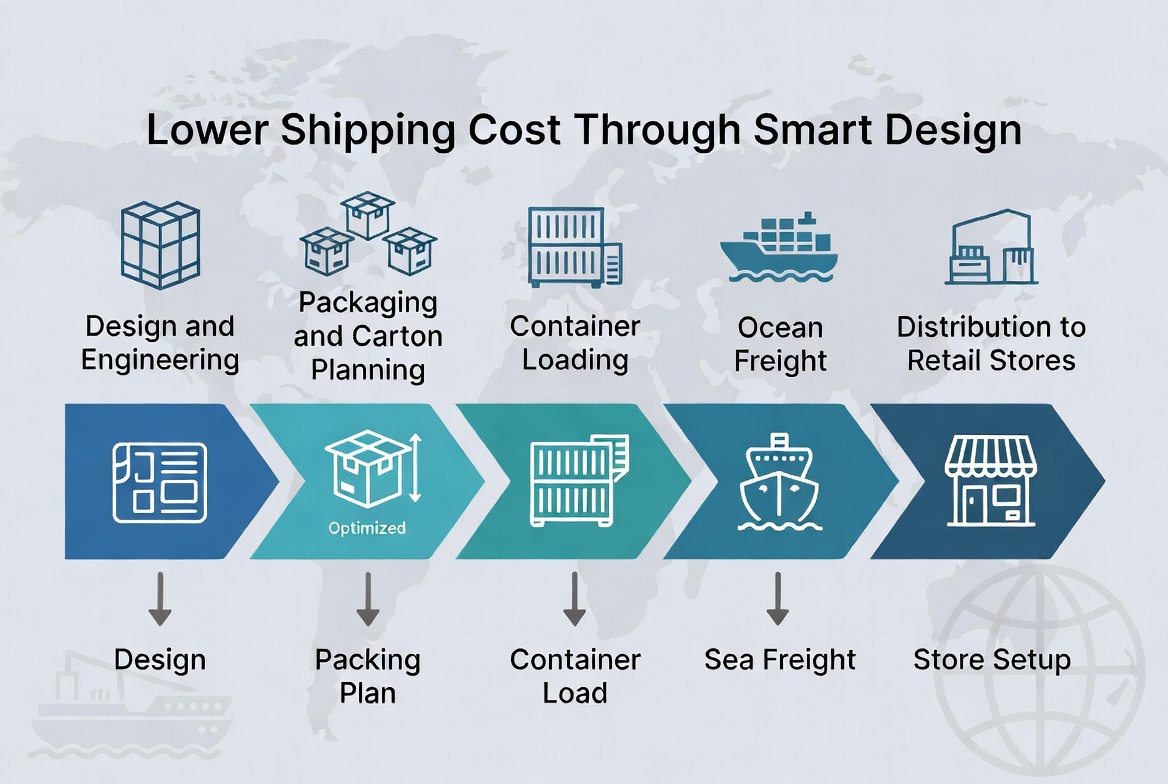
1. Design the stand and all components.
2. Calculate max pieces per carton without exceeding the carrier's size/weight thresholds.
3. Simulate how many cartons fit per pallet and per container.
4. Estimate shipping cost per unit at different packing densities and choose the optimal scenario.
Clients are often surprised that adding slightly more assembly work can increase units per carton by 20–30%, which is usually more than worth the extra setup time at the destination. [m.media-amazon]
Protective Packaging vs. Over‑Packaging
Under‑protecting stands leads to damage and returns, but over‑protecting them with foam and air leads to high dimensional weight. We solve this by:
- Using structural design for protection (e.g., locking tabs, double‑wall in high‑stress zones) instead of bulky inserts.
- Selecting recyclable paper‑based inserts cut to shape instead of thick foam blocks.
- Testing drop performance with prototype cartons to find the minimum safe protection level.
Our rule as a manufacturer is to treat protection as a structural discipline rather than just adding more material. This delivers consistent quality while keeping cartons lean and shipping‑friendly. [m.media-amazon]
Shipping Modes and Incoterms – Where Costs Actually Sit
From the buyer's perspective, total landed cost depends heavily on shipping mode and Incoterms (FOB, CIF, DDP, etc.). [business.google]
Choosing the Right Shipping Mode
For custom display stands, we see three dominant modes:
- Sea freight: Best for medium‑to‑large volumes and non‑urgent campaigns. Lowest cost per unit but longer lead times.
- Air freight / Express: Used for urgent launches, last‑minute reorders, or small quantities. Much higher cost per kilo and highly sensitive to volumetric weight. [business.google]
- Rail or multimodal solutions (for some regions): Sometimes used to balance speed and cost, depending on origin and destination.
From a cost‑reduction perspective, the overarching strategy is:
- Plan campaigns early enough to use sea freight whenever possible.
- Reserve air/express only for prototypes, samples, or critical top‑up orders.
Because display stands are often light but bulky, air shipment can be 3–5 times more expensive than sea freight per unit when dimensional weight is considered. [business.google]
Negotiating Responsibilities with Incoterms
How you split responsibility with the manufacturer also affects cost transparency:
- FOB (Free on Board): Supplier covers costs until loading at the port; buyer manages ocean freight and beyond. Good for buyers with strong logistics partners.
- CIF (Cost, Insurance, and Freight): Supplier pays for main freight and insurance to destination port; buyer handles customs and inland transport.
- DDP (Delivered Duty Paid): Supplier handles almost everything door‑to‑door, which can simplify operations for smaller buyers. [business.google]
In our role as a packaging exporter, we often help clients compare total landed cost under different Incoterms, factoring in container utilization and local delivery charges, so they can select the most economical structure for their global network. [business.google]
Data‑Driven Cost Optimization – A Manufacturer's Case View
Example Scenario – Retail Campaign for a FMCG Brand
Consider a hypothetical campaign for a FMCG brand requiring 2,000 floor display stands for chain stores in Europe. The brand has two options:
- Version A (non‑optimized):
- MDF‑heavy structure, partially pre‑assembled.
- 2 stands per master carton.
- 150 cartons per 20ft container.
- Version B (optimized):
- High‑strength corrugated board with selective reinforcement.
- Fully knock‑down structure.
- 5 stands per master carton.
- 260 cartons per 20ft container.
Even using illustrative figures, Version B can nearly double the number of stands per container, which directly cuts freight cost per stand by a significant margin, while also reducing warehousing space at the destination. [m.media-amazon]
From our projects, similar optimizations have contributed to double‑digit percentage reductions in total landed cost per display, once both freight and storage are considered. [m.media-amazon]
Practical Steps to Reduce Shipping Costs for Your Next Custom Display Stand Order
Here is a concise framework you can apply with your current or future supplier.
Step 1 – Define Shipping and Budget Targets Upfront
Before sketching the stand, align internally on:
1. Target markets and distribution hubs (e.g., Europe, North America, Southeast Asia).
2. Preferred shipping mode (sea vs. air, plus lead‑time constraints).
3. Target cost per stand including shipping, not only ex‑works price.
Sharing this with your manufacturer at the brief stage allows them to design toward a shipping‑efficient structure instead of retrofitting later. [m.media-amazon]
Step 2 – Co‑Design the Structure with Your Manufacturer
Work with a factory that can:
- Provide structural drawings (die‑lines) and 3D renderings before full sampling.
- Suggest alternative materials and joint systems to reduce weight and volume.
- Run packing simulations showing units per carton, per pallet, and per container.
From our side, we routinely offer iterative prototypes and cost breakdowns so marketing teams can make informed trade‑offs between aesthetics and logistics. [m.media-amazon]
Step 3 – Optimize Carton and Pallet Configurations
Request that your manufacturer provides:
- A packing plan including:
- Units per inner carton and master carton.
- Carton dimensions and weight.
- Pallet and container loading plans.
- A per‑unit shipping cost estimate under your typical logistics scenario.
This not only supports procurement decisions but also helps your logistics team plan warehousing and distribution more accurately. [business.google]
Step 4 – Standardize Designs Across Markets
If you run multi‑country campaigns, standardizing display formats can significantly cut cost:
- Use one core structure with localized graphics (changeable printed sleeves or header cards).
- Maintain consistent footprints that work across different retailers.
- Align board grades and thicknesses across series for simplified purchasing and packing.
As a manufacturer, we see that global accounts that standardize tend to achieve better container utilization and lower per‑unit freight across seasons, because they can combine shipments of multiple campaigns. [m.media-amazon]
How a Specialist Manufacturer Adds Extra Value
For a printer and packaging producer like Shenzhen XingKun Packing Products Co., Ltd., helping clients reduce shipping costs is part of a broader, integrated service.
Integrated Printing, Packaging, and Logistics Perspective
Because we both produce the structural parts and manage export packaging, we can:
- Adjust printing formats (e.g., nesting of parts on sheets) to support efficient packing.
- Coordinate material sourcing, die‑cutting, printing, and gluing to minimize waste and excess weight.
- Offer export‑ready solutions, from label design to carton marking and palletization.
Working with brands and distributors in 30+ countries has taught us that the best display solutions are those that are visually on‑brand, structurally robust, and logistically smart at the same time. [m.media-amazon]
Expert Tips from the Production Floor
Based on long‑term experience, here are three expert tips we share with clients:
- Ask for two stand options: one "design‑first" and one "logistics‑optimized", then compare landed cost.
- Use samples to train store teams: ship a small batch early with step‑by‑step assembly guides so retailers can validate ease of setup.
- Review each campaign after launch: capture feedback on damage rates, assembly time, and freight cost per unit to inform the next design cycle.
This continuous‑improvement loop is where brands typically unlock their largest shipping‑related savings over 2–3 campaigns. [m.media-amazon]
Key Takeaways for Reducing Shipping Costs
To summarize the most important principles from a manufacturer's point of view:
- Design for flat‑packing and modularity to reduce dimensional weight and container count.
- Use lighter, structurally smart materials like corrugated or honeycomb instead of heavy boards where feasible.
- Engineer your cartons and pallets around target shipping modes and markets.
- Collaborate early with your manufacturer and share logistics and budget constraints upfront.
- Standardize structures across markets to gain scale benefits in freight and warehousing.
By embedding these principles into your next custom display stand project, you will protect your margins, improve retailer experience, and increase the sustainability of your point‑of‑sale materials. [advertising.amazon]
FAQs About Shipping Costs for Custom Display Stands
1. Are custom display stands always more expensive to ship than standard displays?
Not necessarily. When custom stands are engineered for flat‑packing and made from optimized materials, their shipping cost per unit can be similar to or even lower than generic off‑the‑shelf displays that are not optimized. [m.media-amazon]
2. How early should I involve the manufacturer if I want to control shipping costs?
You should involve your manufacturer at the concept stage, before finalizing dimensions and materials, so they can propose structural and packing solutions that are shipping‑friendly from day one. [m.media-amazon]
3. Can I use one display design for multiple countries without increasing shipping cost?
Yes. In fact, using one core structure with localized graphics is usually more cost‑efficient, because it allows better container utilization and simplifies production and packing. [m.media-amazon]
4. What is the biggest mistake brands make regarding shipping costs?
A common mistake is focusing only on ex‑works price and visual design while ignoring carton configuration, palletization, and shipping mode, which often represent a large part of total landed cost. [business.google]
5. How can a supplier like Shenzhen XingKun help me compare options?
A specialist manufacturer can provide structural drawings, material alternatives, and packing simulations, then calculate indicative shipping cost per unit under different scenarios so you can choose the most economical solution. [m.media-amazon]
References
1. Shenzhen‑based export packaging and display manufacturing best practices (structural design, packing optimization, and export workflows for custom stands and corrugated packaging).
2. Google Ads & Google Business resources on logistics‑sensitive campaign planning and cost efficiency in international marketing operations. <https://business.google.com> [business.google]
3. Brand storytelling and display communication principles from branded content guidelines (visual impact, brand consistency, and in‑store experience). <https://advertising.amazon.com/zh-cn/library/guides/branded-content> [advertising.amazon]
4. Internal manufacturing and export case experience for corrugated and display stand solutions servicing over 30 international markets (engineering, material selection, and container optimization). [m.media-amazon]
5. General industry practices in international freight and dimensional‑weight charging used by global carriers and logistics providers. [business.google]


