Content Menu
● What Is Laser Engraving for Nameplates?
>> How Laser Engraved Nameplates Are Made
● What Is UV Printing on Nameplates?
>> How UV Printed Nameplates Are Made
● Laser Engraving vs UV Printing: Quick Comparison
● Durability: Which Nameplate Lasts Longer?
>> When Laser Engraving Is the Better Durability Choice
>> When UV Printing Provides Sufficient Durability
● Color, Branding, and Visual Impact
>> A Practical Design Example
● Precision for Text, QR Codes, and Variable Information
>> Expert Tip: Do Not Design Codes at the Minimum Size
● Material Compatibility and Surface Selection
● Cost, Lead Time, and Order Quantity
● How to Choose the Right Nameplate Method
>> Choose Laser Engraving If You Need:
>> Choose UV Printing If You Need:
>> Choose a Hybrid Solution If You Need Both
● Common Buying Mistakes to Avoid
>> Choosing Based on Appearance Alone
>> Ignoring the Installation Environment
>> Sending Low-Quality Artwork
>> Forgetting Mounting Requirements
>> Skipping Pre-Production Samples
● Work With an Experienced Nameplate Manufacturer
● Frequently Asked Questions
>> 1. Is laser engraving better than UV printing for metal nameplates?
>> 2. Can UV printing be used on aluminum nameplates?
>> 3. Are laser engraved nameplates waterproof?
>> 4. Can UV printed nameplates be used outdoors?
>> 5. Which method is best for QR codes and serial numbers?
>> 6. Can laser engraving produce full-color logos?
>> 7. Can one nameplate use both laser engraving and UV printing?
● References
Selecting between laser engraving and UV printing on nameplates affects far more than visual appearance. It determines how a product communicates quality, survives daily use, supports traceability, and represents a brand over time. For industrial equipment labels, control panels, machinery identification tags, branded metal plates, and promotional plaques, the best process depends on the substrate, environment, artwork, required lifespan, and budget.
At Shenzhen XingKun Packing Products Co., Ltd., we have spent more than 20 years manufacturing nameplates and a broad range of printed packaging products for brands and distributors in over 30 countries and regions. From our production experience, laser engraving is usually the stronger choice for permanent, high-abrasion identification, while UV printing offers a major advantage when vivid color, complex graphics, gradients, and flexible design are the priority.
This guide compares laser engraved nameplates vs UV printed nameplates from practical, technical, visual, and commercial perspectives to help buyers make a more confident specification decision.
What Is Laser Engraving for Nameplates?
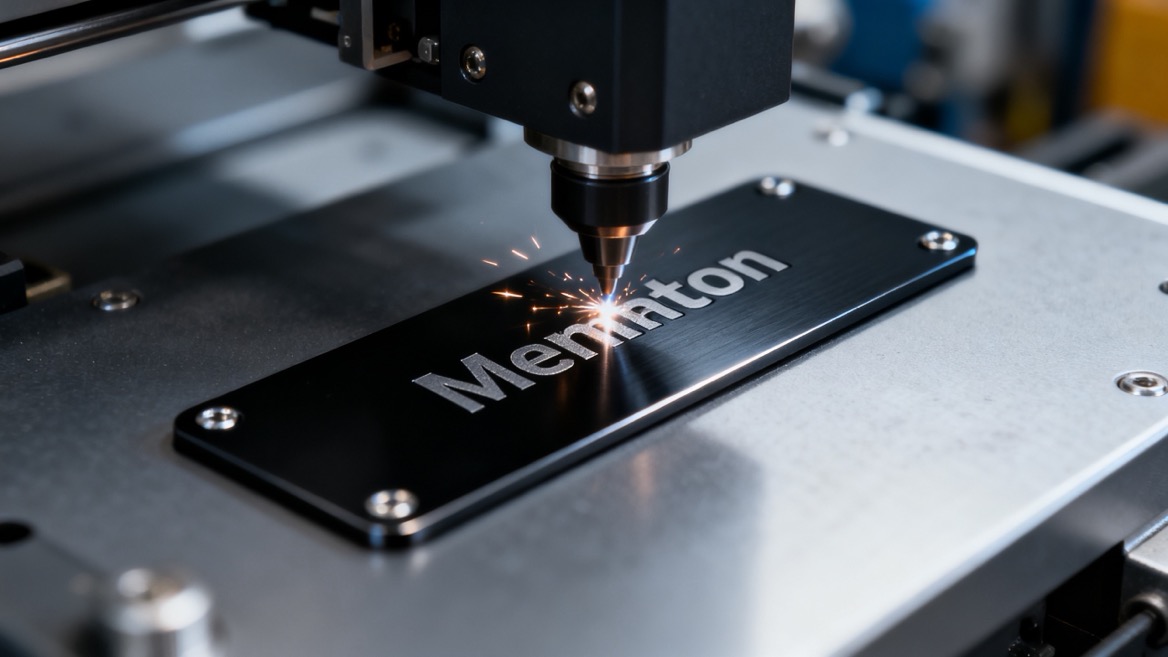
Laser engraving uses a concentrated laser beam to remove, alter, or mark a material surface. On a nameplate, the laser creates a design by changing the top layer of the substrate rather than applying conventional ink onto it.
Depending on the nameplate material and laser type, the process can remove a colored coating, expose a contrasting base layer, create a recessed mark, or permanently change the surface color of metal.
Common materials used for laser engraved nameplates include:
- Anodized aluminum
- Stainless steel
- Brass
- Coated metal
- Acrylic
- ABS engraving laminate
- Painted aluminum
- Plastic laminates
- Wood and leather for decorative applications
A major advantage of laser engraving is that the mark becomes part of the material itself. On anodized aluminum, for example, laser processing can remove color pigments from the anodized layer and reveal a high-contrast mark while preserving much of the protective coating. This makes anodized aluminum a highly practical material for machinery labels, rating plates, asset tags, and control-panel identification.
How Laser Engraved Nameplates Are Made
The production flow usually includes the following steps:
1. Select the correct material, thickness, coating color, and finish.
2. Prepare vector artwork, serial numbers, QR codes, logos, or technical data.
3. Set laser power, speed, frequency, focus, and marking parameters.
4. Laser engrave the required content onto each nameplate.
5. Inspect contrast, edge sharpness, readability, and variable data accuracy.
6. Apply holes, adhesive backing, protective film, bending, or custom finishing if required.
For batches containing serial numbers or variable codes, laser engraving can work especially well because the content can be generated and marked directly from a data file.
What Is UV Printing on Nameplates?
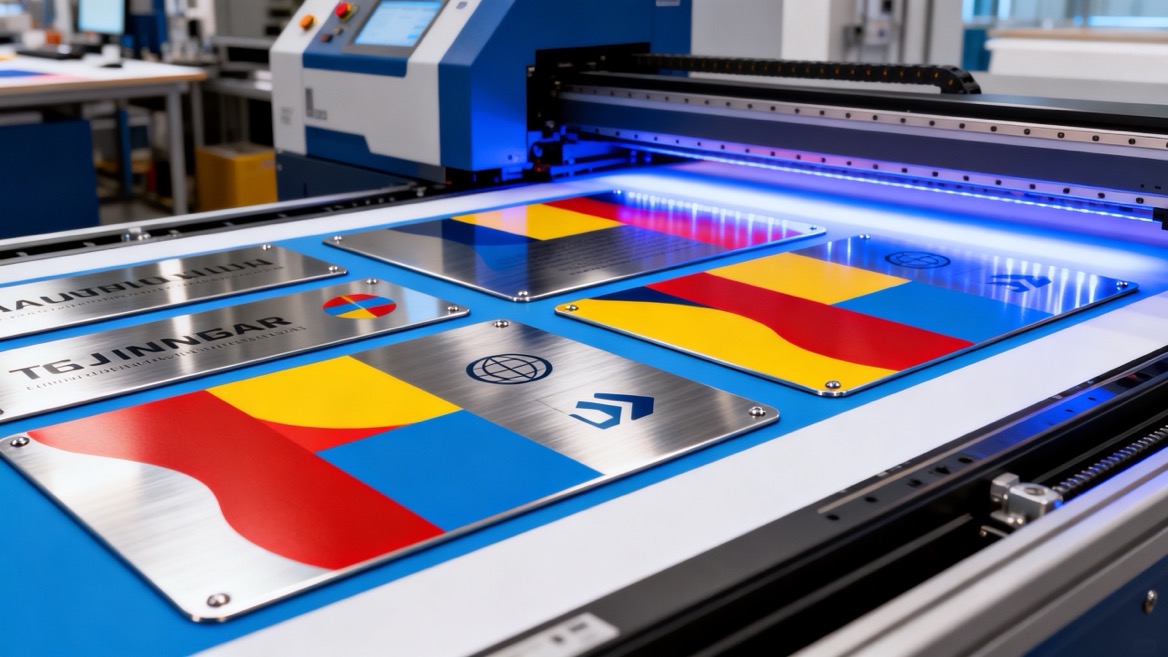
UV printing is a digital printing method that jets liquid ink directly onto a nameplate surface. Ultraviolet light cures the ink almost immediately, turning it into a solid printed layer.
Unlike laser engraving, UV printing is an additive process. The artwork remains on the surface as cured ink. This makes the technology exceptionally useful for full-color graphics, photographic images, multicolor logos, tiny text, color-coded operating instructions, and product branding.
UV printed nameplates can be produced on many materials, including:
- Aluminum
- Stainless steel
- Acrylic
- Polycarbonate
- PVC
- PET
- ABS
- Wood
- Glass
- Coated plastics
- Composite panels
Many industrial UV printers are designed for flatbed and specialty-substrate applications. The technology supports high-detail graphics and can print white ink beneath or above color layers, helping improve visibility on dark, clear, or metallic nameplate materials. UV-curable inkjet technology is widely used in industrial printing systems for signs, graphics, and direct-to-material applications.
How UV Printed Nameplates Are Made
A typical UV printing workflow includes:
1. Choose the substrate and verify ink adhesion compatibility.
2. Clean the nameplate surface to remove dust, oil, fingerprints, and static.
3. Prepare artwork with CMYK, white ink, varnish, and spot-color layers where needed.
4. Place the material on the printer bed or production jig.
5. Print the design directly onto the nameplate.
6. Cure the ink using UV light during or immediately after printing.
7. Add clear varnish, overlamination, doming, adhesive, holes, or die-cut finishing when specified.
8. Conduct adhesion, color, alignment, and appearance checks.
For buyers who need strong branding impact, UV printing provides a broader visual palette than most engraving approaches.
Laser Engraving vs UV Printing: Quick Comparison
| Feature |
Laser Engraving on Nameplates |
UV Printing on Nameplates |
| Marking method |
Removes or modifies the material surface |
Deposits cured ink onto the surface |
| Color capability |
Usually monochrome or material-dependent contrast |
Full color, white ink, gradients, photographic detail |
| Surface feel |
Often recessed or tactile |
Usually smooth; can be raised with layered print |
| Abrasion resistance |
Excellent when the mark is integrated into the substrate |
Good to excellent, depending on ink, substrate, coating, and use conditions |
| Outdoor suitability |
Strong on anodized aluminum and stainless steel |
Strong with suitable inks and protective coatings |
| Fine technical data |
Excellent for text, serial numbers, QR codes, and barcodes |
Excellent for small text and color-coded information |
| Brand visuals |
Best for refined, technical, premium, minimalist designs |
Best for vivid logos, illustrations, symbols, and multicolor branding |
| Variable data |
Highly suitable |
Suitable, depending on workflow and batch requirements |
| Material options |
Best on laser-compatible surfaces |
Broad compatibility with flat printable materials |
| Cost efficiency |
Often ideal for durable identification and smaller variable-data runs |
Often attractive for full-color designs and graphic-heavy production |
| Main limitation |
Limited color output |
Surface ink can eventually wear under intense abrasion without suitable protection |
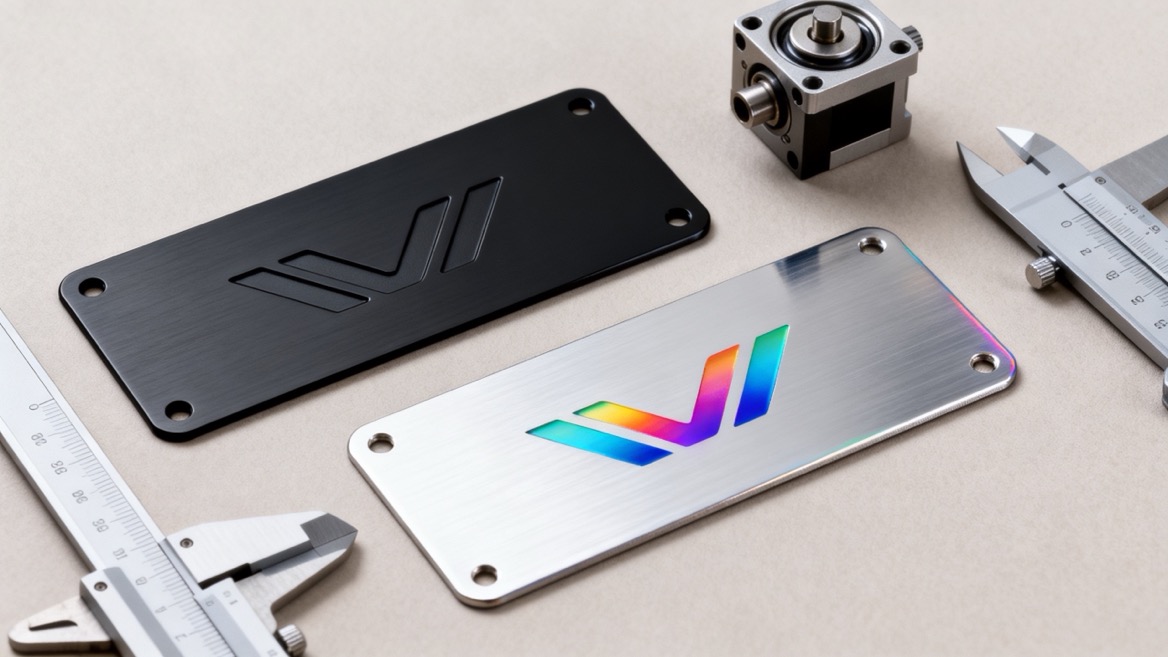
The key distinction is simple: laser engraving changes the nameplate surface, while UV printing builds the artwork on top of the surface.
Durability: Which Nameplate Lasts Longer?
For demanding industrial environments, laser engraving generally delivers the highest level of long-term durability. Because the information is etched, exposed, or permanently marked into the material, there is no conventional printed ink layer to peel away.
This matters for nameplates installed on:
- Industrial machines
- Construction equipment
- Electrical cabinets
- Pumps and motors
- Outdoor enclosures
- Marine equipment
- Factory fixtures
- Tools and instruments
- Asset-management systems
- Safety and compliance equipment
Laser engraved anodized aluminum nameplates are particularly valued because the engraved image can achieve strong contrast while retaining much of the material's protective characteristics. Anodized aluminum is also widely used where resistance to everyday external conditions is important.
However, UV printed nameplates should not be considered fragile by default. With the right substrate preparation, compatible ink system, curing settings, and protective finish, UV printing can perform very well in commercial and many industrial applications. The durability of UV printed graphics depends heavily on ink quality, substrate adhesion, environmental exposure, and whether a clear protective layer is applied.
When Laser Engraving Is the Better Durability Choice
Choose laser engraving when the nameplate will face:
- Frequent hand contact
- Repeated cleaning
- Abrasion from tools or equipment
- Outdoor exposure
- Oil, grease, or industrial contaminants
- High-value asset identification needs
- Long-term serial-number traceability
- A requirement for permanent product information
For instance, a stainless-steel or anodized aluminum serial number plate on a machine frame is usually a stronger candidate for laser engraving than UV printing.
When UV Printing Provides Sufficient Durability
Choose UV printing when the nameplate will be used:
- Indoors or in protected outdoor conditions
- On product housings with moderate handling
- On branded consumer products
- On showroom displays
- On retail fixtures
- On appliances
- On electronics panels
- On decorative plaques
- On promotional or point-of-sale products
Adding a clear varnish, protective laminate, or domed resin coating can improve resistance to scuffing, moisture, and everyday handling.
Color, Branding, and Visual Impact
If color is central to the project, UV printing is usually the preferred option.
Laser engraved nameplates offer a clean, precise, technical appearance. They can look premium, especially on brushed stainless steel, black anodized aluminum, brass, or acrylic laminate. However, their color options are typically limited by the material's layers and the contrast created by the laser.
UV printing offers significantly greater creative freedom. It can reproduce:
- Full-color logos
- CMYK artwork
- Gradient effects
- Product photographs
- Colored warning icons
- Brand guidelines
- Multilingual instructions
- Color-coded control-panel legends
- Decorative patterns
- White text on dark materials
- Metallic-looking visual effects through substrate selection
For a consumer electronics label, beverage equipment badge, cosmetic-device panel, or retail display plate, UV printing can provide a stronger first impression because it supports more detailed branding.
A Practical Design Example
Imagine a premium coffee-machine nameplate.
A laser engraved version could use black anodized aluminum with a sharp silver logo, model number, voltage details, and serial code. The result would feel durable, restrained, and engineering-focused.
A UV printed version could include a full-color brand logo, colored maintenance symbols, an illustrated control legend, a QR code, and decorative gradients. The result would be more visually expressive and more aligned with consumer-facing branding.
Neither solution is automatically better. The correct choice depends on whether the product needs to communicate permanence or visual richness most strongly.
Precision for Text, QR Codes, and Variable Information
Both processes can produce sharp text and detailed graphics when the artwork and equipment settings are correctly prepared.
Laser engraving is especially well suited to:
- Serial numbers
- VIN-style codes
- Barcodes
- QR codes
- Batch numbers
- Compliance data
- Electrical ratings
- Asset IDs
- Security markings
- Small machine labels
Because the laser is digitally controlled, it can mark repeatable variable data across large production runs. Laser software workflows are commonly used for data plates and parameter-controlled marking processes.
UV printing also performs well for QR codes, barcodes, small labels, and color-coded instructions. However, code readability should always be tested under real scanning conditions. A visually attractive code is not necessarily a reliably scannable code if contrast, size, quiet zone, or surface glare is insufficient.
Expert Tip: Do Not Design Codes at the Minimum Size
For industrial nameplates, avoid designing QR codes and barcodes at the smallest printable size simply to save space.
A more reliable specification should consider:
- Scanner type and working distance
- Surface reflectivity
- Dirt and wear exposure
- Print or engraving contrast
- Curved or flat application surface
- Minimum module size
- Required error correction level
- Future maintenance access
A QR code that scans perfectly in a clean factory sample room may perform poorly after months of dust, oil, abrasion, or outdoor weathering.
Material Compatibility and Surface Selection
Material selection should come before process selection. A beautiful printing method cannot compensate for an unsuitable substrate.
| Nameplate Material |
Laser Engraving Suitability |
UV Printing Suitability |
Typical Use |
| Anodized aluminum |
Excellent |
Good |
Equipment labels, control panels, asset tags |
| Stainless steel |
Excellent with suitable laser system |
Good with proper adhesion testing |
Industrial plates, premium badges, marine applications |
| Brass |
Excellent |
Good |
Luxury plaques, trophies, decorative plates |
| Acrylic |
Excellent |
Excellent |
Signage, decorative labels, display plaques |
| Polycarbonate |
Limited to material-specific marking |
Excellent |
Membrane panels, electronics overlays, control interfaces |
| PVC |
Material-dependent; caution is required |
Excellent |
Indoor labels, panels, promotional items |
| ABS laminate |
Excellent |
Good |
Engraved signage, equipment labels |
| Painted aluminum |
Good |
Excellent |
Branded plates, appliance labels, graphic panels |
Before mass production, request a material-and-process sample. This is especially important for outdoor, chemical-exposure, marine, medical, electrical, or heavy-equipment applications.
Cost, Lead Time, and Order Quantity
Price should be evaluated based on the finished product requirement, not only the unit price.
Laser engraving may offer strong value when the project requires:
- Small to medium quantities
- Variable serial numbers
- High durability
- Simple artwork
- One-color technical content
- Long service life
- Metal identification plates
UV printing may offer strong value when the project requires:
- Full-color graphics
- Multiple logo colors
- Detailed artwork
- Product imagery
- Color-coded information
- Promotional display value
- Larger graphic coverage
Tooling requirements, material cost, finishing, inspection standards, packaging, and personalization also affect the final quotation.
For global buyers, it is useful to provide the supplier with complete information early: material preference, dimensions, thickness, quantity, artwork, mounting method, target environment, and durability expectations. Clear specifications reduce revision time and help avoid choosing a visually attractive but technically unsuitable process.
How to Choose the Right Nameplate Method
Use this decision framework before placing an order.
Choose Laser Engraving If You Need:
- Permanent identification for equipment or assets
- Strong resistance to scratching and repeated contact
- A premium metal appearance
- Serial numbers, codes, or technical data
- Long-term outdoor or industrial use
- A monochrome, high-contrast design
- A recessed or tactile mark
- Excellent performance on anodized aluminum or stainless steel
Choose UV Printing If You Need:
- Full-color artwork and brand consistency
- Photographic images, gradients, or complex logos
- Color-coded instructions or warning icons
- White ink on dark or transparent materials
- Smooth surface graphics
- Decorative or retail-oriented visual impact
- Flexible design changes between product lines
- A combination of branding and functional information
Choose a Hybrid Solution If You Need Both
In some projects, the best answer is not laser engraving or UV printing alone.
A hybrid nameplate can combine:
- Laser engraved serial numbers for permanence
- UV printed full-color logos for branding
- Clear protective varnish for printed areas
- Anodized aluminum for industrial durability
- Adhesive backing or screw holes for installation
This approach is particularly useful for premium equipment, branded industrial products, medical devices, appliance panels, and export products where compliance information and visual identity are equally important.
Common Buying Mistakes to Avoid
Choosing Based on Appearance Alone
A bright UV printed nameplate may look excellent in a catalog but may not be ideal for constant abrasion or chemical exposure. A laser engraved plate may look less colorful but can be more suitable for permanent identification.
Ignoring the Installation Environment
Ask whether the nameplate will be exposed to sunlight, salt air, moisture, solvents, heat, vibration, dust, or frequent cleaning. These conditions should influence the material, ink, engraving depth, adhesive, and protective finish.
Sending Low-Quality Artwork
Provide vector artwork whenever possible, especially for logos, text, icons, and cut lines. Preferred file formats commonly include AI, PDF, EPS, SVG, or high-resolution editable files.
Forgetting Mounting Requirements
A nameplate is not finished until it can be installed correctly. Confirm whether the product needs:
- Pressure-sensitive adhesive
- Screw holes
- Rivet holes
- Bent edges
- Magnetic backing
- 3M adhesive tape
- Cutouts for switches or displays
- Protective film
- Individual packaging
Skipping Pre-Production Samples
A sample allows you to check color, engraving contrast, edge quality, thickness, adhesive, code readability, and overall fit before mass production. For technical or export-oriented projects, this step can prevent expensive rework.
Work With an Experienced Nameplate Manufacturer
The right nameplate should do more than display a logo. It should remain readable, support product traceability, reinforce brand quality, and perform reliably in its actual environment.
Shenzhen XingKun Packing Products Co., Ltd. offers more than 20 years of manufacturing experience in nameplates, printed products, and packaging solutions. We serve brands and distributors across more than 30 countries and regions, supporting customized materials, production methods, artwork development, variable data, finishing options, and export-ready packaging.
Whether you need durable laser engraved equipment nameplates, full-color UV printed metal badges, custom control-panel labels, serialized asset tags, or a hybrid solution, our team can help evaluate the most suitable material and production method for your application.
Send us your size, artwork, quantity, material preference, mounting method, and usage environment to request a tailored nameplate recommendation and sample evaluation.
Frequently Asked Questions
1. Is laser engraving better than UV printing for metal nameplates?
Laser engraving is generally better for metal nameplates that require long-term durability, abrasion resistance, permanent serial numbers, and technical identification. UV printing is better when the metal plate needs full-color artwork, gradients, brand imagery, or color-coded instructions.
2. Can UV printing be used on aluminum nameplates?
Yes. UV printing can be applied to aluminum nameplates when the surface is properly prepared and the ink system is compatible with the material. For demanding applications, a clear protective coating or varnish can improve resistance to wear and handling.
3. Are laser engraved nameplates waterproof?
Laser engraved nameplates made from suitable materials, such as anodized aluminum or stainless steel, can perform very well in wet environments. However, the full result depends on the material grade, mounting method, exposure conditions, and whether surrounding components also resist water intrusion.
4. Can UV printed nameplates be used outdoors?
Yes, UV printed nameplates can be used outdoors when suitable inks, substrates, curing conditions, and protective coatings are selected. For heavy outdoor exposure, buyers should request samples and discuss expected sunlight, moisture, temperature, abrasion, and chemical conditions before production.
5. Which method is best for QR codes and serial numbers?
Laser engraving is often preferred for permanent serial numbers, industrial QR codes, and asset-tracking labels because the information is marked directly into the material. UV printing can also produce clear codes, especially when color coding or graphic detail is needed, but scan testing is recommended.
6. Can laser engraving produce full-color logos?
Laser engraving does not normally produce conventional full-color graphics. It generally creates contrast based on the material surface, coating, or laser reaction. For multicolor logos, UV printing is usually the more suitable production method.
7. Can one nameplate use both laser engraving and UV printing?
Yes. A hybrid process can combine laser engraved serial numbers, QR codes, or technical data with UV printed logos, icons, and full-color graphics. This is a practical option when both durability and visual branding are important.
References
- [Trotec Laser — Laser Engraving Anodized Aluminum]
- [Trotec Laser — Anodised Aluminium Material Usage Hints]
- [Trotec Laser — Engraving Anodized Aluminum Data Plates]
- [Mimaki Global — UV and Industrial Printing Solutions]
- [Mimaki USA — Industrial UV Printing Product Information]
- [EufyMake — Laser Engraving vs. UV Printing: Benefits and Key Differences]
- [Kona Impact — Laser Engraving vs UV Printing]


