Content Menu
● Quick Comparison: Desk Name Plates vs Door Name Plates
● What Are Desk Name Plates?
>> When Desk Name Plates Work Best
>> Branding Advantages of Desk Name Plates
● What Are Door Name Plates?
>> When Door Name Plates Work Best
>> Branding Advantages of Door Name Plates
● Desk Name Plates vs Door Name Plates: Detailed Differences
>> Visibility and Viewing Distance
>> Installation and Flexibility
>> Material Selection
● Which Option Delivers Better Office Branding?
>> Choose Desk Name Plates When You Want to:
>> Choose Door Name Plates When You Want to:
>> Choose Both When You Want a Complete System
● Accessibility and Compliance Considerations
● A Practical Selection Framework for Buyers
>> 1. What Must the Sign Identify?
>> 2. How Often Will Information Change?
>> 3. Who Will Read It?
>> 4. What Is the Viewing Environment?
>> 5. Is Brand Consistency More Important Than Individual Customization?
>> 6. What Is the Total Signage System?
● Expert Design Tips for Better Results
>> Use a Clear Information Hierarchy
>> Keep Typography Consistent
>> Design for Replacement
>> Review Physical Proofs
● Common Ordering Mistakes to Avoid
● Final Recommendation
● FAQ
>> 1. What is the main difference between desk name plates and door name plates?
>> 2. Are desk name plates suitable for open-plan offices?
>> 3. What materials are best for custom door name plates?
>> 4. Can door name plates include Braille?
>> 5. Should a company logo appear on every desk name plate?
>> 6. How can companies reduce the cost of replacing name plates?
>> 7. Can desk name plates and door name plates be customized for multiple languages?
● References
For a professional workplace, desk name plates and door name plates do more than display a person's name. They help visitors navigate the space, support employee recognition, communicate hierarchy, and turn everyday touchpoints into a consistent expression of office branding.
At Shenzhen XingKun Packing Products Co., Ltd., we have spent more than 20 years producing nameplates and customized printed products for brands and distributors in over 30 countries and regions. From the production perspective, the best choice is rarely desk name plates *or* door name plates alone. A well-planned office typically uses both, assigning each format a clear role in the visitor journey.
This guide compares desk name plates vs door name plates in detail, including use cases, materials, visibility, installation, branding value, accessibility considerations, and ordering tips for corporate buyers.
Quick Comparison: Desk Name Plates vs Door Name Plates
| Comparison Area | Desk Name Plates | Door Name Plates |
| Primary purpose | Identifies people at individual workstations, counters, reception desks, and meeting tables | Identifies offices, departments, rooms, facilities, and occupants |
| Best viewing distance | Close range | Medium range, often before entering a room |
| Typical audience | Colleagues, clients, visitors, meeting attendees | Visitors, delivery personnel, employees, contractors, and guests |
| Mobility | Usually movable or replaceable | Usually fixed to a door, wall, or frame |
| Personalization level | High; often includes an employee name and job title | High; can show names, room numbers, department labels, and availability |
| Wayfinding contribution | Limited but helpful inside a defined work area | Strong; helps people locate destinations before arrival |
| Common materials | Acrylic, metal, wood, PVC, paper inserts, aluminum | Acrylic, aluminum, stainless steel, engraved plastic, wood, Braille-ready materials |
| Best for | Desks, cubicles, reception counters, conference tables, retail counters | Private offices, meeting rooms, restrooms, training rooms, reception areas, departments |
| Brand impact | Creates a personal, polished, employee-centered impression | Builds a structured, consistent, easy-to-navigate workplace identity |
| Replacement frequency | Often higher due to staffing changes | Often lower, unless rooms or departments change |
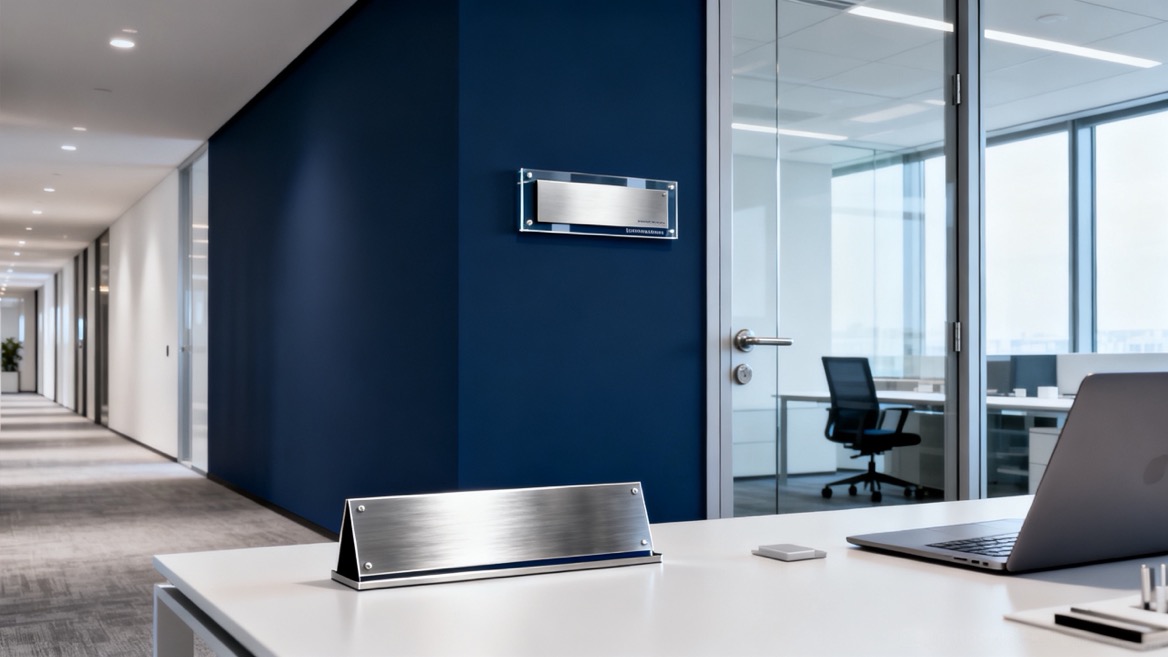
The core difference is simple: a desk name plate identifies who is sitting or working in a specific location, while a door name plate identifies the destination or person associated with a room or entrance.
What Are Desk Name Plates?
Desk name plates are compact identification signs placed directly on a desk, workstation, front counter, reception table, podium, or meeting table. They are usually designed for close viewing and may be freestanding, mounted in a holder, or created as an interchangeable insert system.
A typical desk name plate includes:
- Employee name
- Job title
- Company logo
- Department
- Pronouns, where relevant to company policy
- Contact details or QR code, in selected customer-facing settings
- Language versions for international offices
- A branded color bar or icon system
For example, a reception desk name plate might read:
> Emily Chen
> Client Services Manager
> [Company Logo]
This information immediately gives visitors confidence about whom they are speaking with. It also makes the front desk feel more organized and professional.
When Desk Name Plates Work Best
Desk name plates are especially effective in environments where people interact face to face. These include:
- Corporate reception areas
- Open-plan offices
- Shared desks and hot-desking zones
- Customer service counters
- Banks and financial service offices
- Hotels and hospitality desks
- Clinics and consultation rooms
- Government service counters
- Schools, universities, and training centers
- Trade-show booths and product demonstration tables
They are also valuable for internal meetings. A set of branded meeting-table name plates can help participants identify decision-makers, improve seating coordination, and make client presentations feel more formal.
Branding Advantages of Desk Name Plates
Desk name plates add a human layer to office branding. Rather than presenting only architecture, furniture, and wall graphics, they show that the company values the people within the organization.
This matters most in customer-facing environments. A visitor may forget the color of a conference-room wall, but they are likely to remember a helpful team member whose name and role were clearly displayed.
A well-designed desk name plate can reinforce brand details through:
- Consistent logo placement
- Company colors
- Typography aligned with brand guidelines
- Premium material selection
- Clean engraving or high-definition printing
- Matching desk accessories and visitor signage
For organizations with frequent staffing changes, insert-style desk name plates are often the most practical choice. The frame remains in place, while the printed name insert can be updated quickly and at a lower cost.
What Are Door Name Plates?
Door name plates are identification signs installed on or beside doors, walls, frames, partitions, and entrances. Their main function is to help people find the correct room, department, or person before entering.
They can identify:
- Executive offices
- Employee offices
- Conference rooms
- Training rooms
- Meeting rooms
- Interview rooms
- Break rooms
- Restrooms
- IT rooms
- Storage rooms
- Medical rooms
- Departments
- Private consultation spaces
- Floor numbers and room numbers
Unlike desk name plates, door name plates are part of a broader navigation system. They help people move through a building with less uncertainty and fewer interruptions.
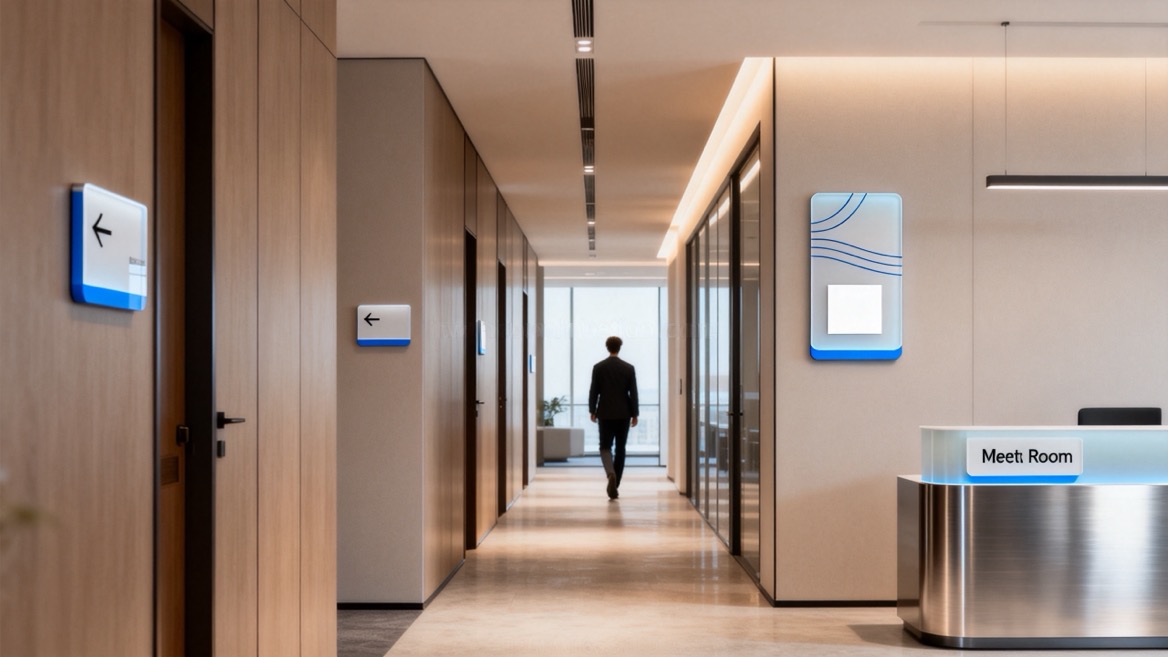
Office wayfinding includes the visual cues that help employees and visitors understand where they are and where they need to go. Identification signs, directional signs, room labels, directories, and digital displays can work together as one coordinated system.
When Door Name Plates Work Best
Door name plates are the stronger option when the goal is location identification. They are particularly important in larger offices, multi-room workplaces, coworking spaces, medical facilities, educational campuses, government buildings, and customer service centers.
Use door name plates when visitors need to answer questions such as:
- "Where is the Human Resources department?"
- "Which room is the boardroom?"
- "Is this the CEO's office?"
- "Where is Meeting Room B?"
- "Which door leads to the training room?"
- "Is this room available or occupied?"
- "Where is the accessible restroom?"
In these situations, a desk name plate alone cannot provide enough guidance. The visitor needs information before reaching the desk, not after entering the space.
Branding Advantages of Door Name Plates
Door name plates influence the visitor's first impression of how a company operates. Clear, durable, well-aligned signage suggests that the business is organized, established, and attentive to detail.
Poor door signage creates the opposite result. Inconsistent fonts, handwritten labels, peeling stickers, unclear room names, or mismatched materials can make even a high-quality office look temporary.
A consistent door name plate system can communicate:
- Professional structure
- Operational clarity
- Brand maturity
- Attention to visitor experience
- Consistency across departments and locations
- A premium standard of workplace presentation
For companies with multiple offices, standardized door signage can also support brand consistency across regions. The same materials, colors, layout rules, icon style, and installation approach can be applied from headquarters to regional branches.
Desk Name Plates vs Door Name Plates: Detailed Differences
Visibility and Viewing Distance
Desk name plates are usually viewed from one to several feet away. The text should be readable by someone standing at the desk, sitting across from the employee, or approaching a service counter.
Door name plates need stronger visibility from corridors and approach routes. Their type size, contrast, placement, and mounting position should help a visitor recognize the destination before reaching the doorway.
For this reason, door signs often require:
- Larger text
- Stronger contrast
- More space around the information
- A simple hierarchy of room name, number, or occupant name
- More durable mounting methods
A practical rule is this: if someone needs to find the location from a hallway, choose a door name plate. If they need to identify the person directly in front of them, choose a desk name plate.
Installation and Flexibility
Desk name plates are generally simpler to install. Freestanding models can be placed immediately on a desk or counter. Magnetic models, insert holders, acrylic blocks, and angled holders are popular because they can be changed without tools.
Door name plates require more planning. The installation method depends on the surface and the desired lifespan. Common methods include:
- Double-sided adhesive backing
- Screws
- Standoffs
- Magnetic mounting
- Slide-in holder systems
- Wall brackets
- Interchangeable name strips
For leased offices or flexible workplaces, removable and interchangeable systems can be a smart choice. They reduce wall damage and allow names or room functions to be updated without replacing the entire sign.
Material Selection
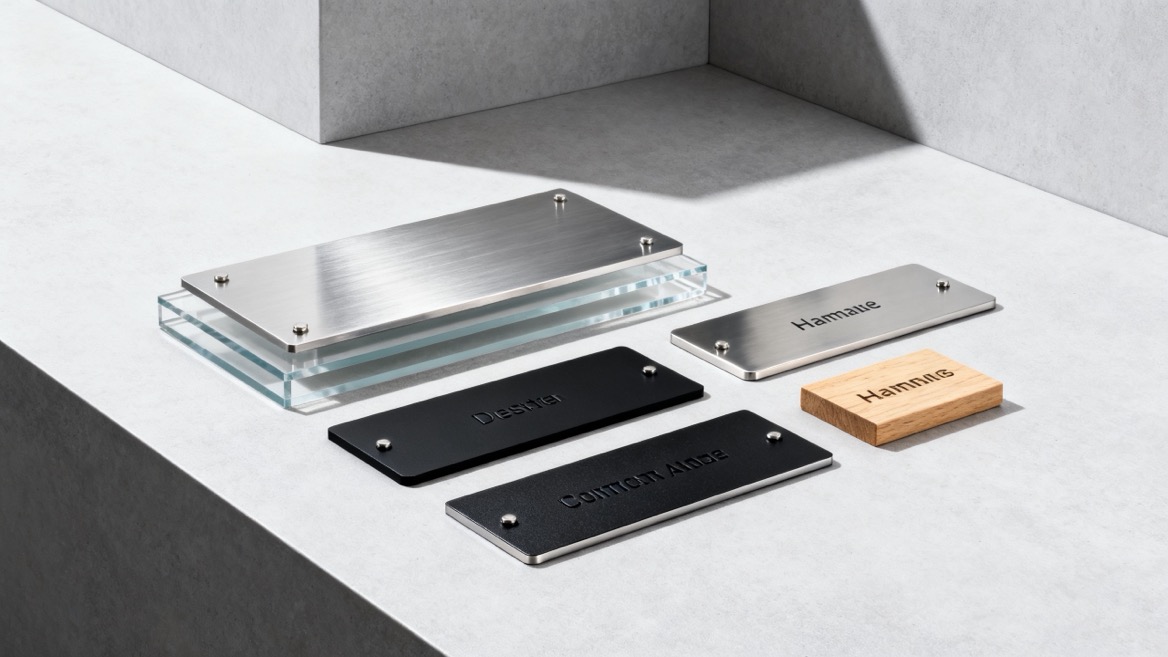
Material strongly affects perceived quality, durability, and cost. The right choice depends on the office style, budget, maintenance needs, and expected use period.
| Material | Best Use | Benefits | Considerations |
| Acrylic | Modern offices, reception areas, meeting rooms | Clean appearance, versatile colors, easy to print or engrave | Can scratch if low-grade material is used |
| Aluminum | Corporate offices, industrial facilities, professional settings | Lightweight, durable, refined metallic appearance | Usually requires more careful finishing |
| Stainless steel | Executive areas, premium offices, hospitality | High-end look, excellent durability | Higher material and processing cost |
| Engraved plastic | Door identification, room labels, operational facilities | Durable, practical, suitable for color layering | May look less premium if design is too basic |
| Wood | Boutique offices, hotels, creative studios | Warm, natural, distinctive appearance | Needs protection from moisture and wear |
| PVC or paper inserts | Temporary desks, shared offices, events | Cost-effective and easy to update | Less suitable for premium or permanent applications |
From a production standpoint, a material should not be selected only because it looks attractive in a catalog. It should match the environment.
For example:
- A factory office may need scratch-resistant engraved plastic or aluminum.
- A law firm may prefer brushed metal or layered acrylic.
- A hotel may choose wood-accented or metal door name plates.
- A coworking space may benefit from interchangeable acrylic holders.
- A healthcare facility may require surfaces that are easy to clean and signage that supports accessibility requirements.
Which Option Delivers Better Office Branding?
Neither product is universally better. The correct answer depends on the branding task.
Choose Desk Name Plates When You Want to:
- Make individual employees easier to identify
- Improve personal interaction at reception or service counters
- Present job titles clearly during client meetings
- Create a polished look for conference tables
- Support temporary seating, events, or shared workspaces
- Make staff feel recognized and included
- Use a flexible, lower-cost system for frequent personnel changes
Desk name plates are about personal presence. They make the workplace feel approachable and people-centered.
Choose Door Name Plates When You Want to:
- Help visitors navigate a multi-room office
- Identify private offices and meeting rooms
- Create a unified visual system throughout a building
- Reduce confusion at entrances and corridors
- Support room numbering, departmental organization, and facility management
- Improve the appearance of permanent spaces
- Build a consistent visitor experience from lobby to meeting room
Door name plates are about spatial clarity. They make the workplace easier to understand.
Choose Both When You Want a Complete System
For most established organizations, the strongest office branding program combines both formats.
A typical system may include:
1. Reception wall signage with the company logo.
2. Directional signs guiding guests toward departments or meeting rooms.
3. Door name plates identifying each office or room.
4. Desk name plates identifying employees at desks or counters.
5. Conference-room signs showing room names and availability.
6. Department signage with consistent colors or icons.
7. Accessibility-focused room identification signs where required.
This layered approach reflects how visitors actually experience an office. They first find the building or reception point, then locate the correct department, then identify the room, and finally recognize the person they need to meet.
Accessibility and Compliance Considerations
Door name plates may carry additional accessibility responsibilities, especially when they identify permanent rooms and spaces. In the United States, tactile and visual requirements apply to signs that identify permanent rooms or spaces, including room names and room numbers. These signs may require raised characters, Grade 2 Braille, non-glare finishes, and visual contrast.
The U.S. Access Board notes that tactile signs identifying permanent spaces must be installed within a defined height range: the baseline of the lowest tactile character must be at least 48 inches above the finished floor or ground, while the baseline of the highest tactile character must not exceed 60 inches.
For projects serving the U.S. market, buyers should consider the following before finalizing door signage:
- Whether the room is a permanent space requiring tactile identification
- Whether raised lettering is needed
- Whether Braille is required
- Whether text and background have sufficient contrast
- Whether the finish is non-glare
- Whether mounting location and height meet applicable requirements
- Whether the sign design leaves enough room for tactile content
Desk name plates normally serve a different purpose and may not fall under the same requirements. However, clear contrast, readable typography, and non-reflective surfaces remain good design practices for all office identification products.
For international projects, requirements vary by jurisdiction. Buyers should verify local building codes, accessibility rules, landlord standards, and project-specific specifications before production.
A Practical Selection Framework for Buyers
Before requesting a quotation, answer these six questions.
1. What Must the Sign Identify?
Identify whether the sign needs to show:
- A person
- A job title
- A department
- A room
- A room number
- A service point
- An availability status
- A safety or accessibility message
If it identifies a destination, choose a door or wall-mounted sign. If it identifies a person in a known location, choose a desk name plate.
2. How Often Will Information Change?
For fast-changing teams, choose an insert system, sliding name strip, magnetic panel, or replaceable printed plate.
For permanent spaces, engraved acrylic, aluminum, stainless steel, or layered plastic may offer better long-term value.
3. Who Will Read It?
Consider employees, guests, customers, elderly visitors, international clients, delivery drivers, contractors, and people with visual impairments.
If the audience is unfamiliar with the office, prioritize simple language, strong contrast, visible placement, and consistent naming.
4. What Is the Viewing Environment?
A bright lobby, dim corridor, warehouse office, hotel hallway, and private executive suite all require different material and finish choices.
Avoid highly reflective surfaces in strong lighting. Use clear contrast where fast recognition matters. Reserve subtle low-contrast designs for controlled, premium environments where readability has been tested.
5. Is Brand Consistency More Important Than Individual Customization?
A global organization may want all offices to use one standardized sign template. A boutique agency may prefer more personalized desk name plates that reflect team personality.
Both approaches can work, but the visual rules should remain controlled: font, logo size, color use, material palette, and layout should not vary randomly.
6. What Is the Total Signage System?
Do not order desk name plates or door name plates as isolated products. Review the full environment:
- Reception signage
- Wall logos
- Directional signs
- Room signs
- Desk identification
- Meeting-room signs
- Safety labels
- Floor directories
- Department markers
The best result comes from treating each item as part of one visual language.
Expert Design Tips for Better Results
After producing customized nameplates for international clients, one recurring lesson is clear: the most effective products are not necessarily the most decorative. They are the ones that deliver information immediately and remain consistent over time.
Use a Clear Information Hierarchy
The most important information should be the easiest to see.
For a door name plate, the hierarchy may be:
1. Room name
2. Room number
3. Occupant name
4. Job title or department
5. Brand mark, only if space allows
For a desk name plate, the hierarchy may be:
1. Employee name
2. Job title
3. Department or logo
Avoid giving the logo more visual weight than the name or room label. A visitor should not have to search for the information that the sign is meant to communicate.
Keep Typography Consistent
Use one primary typeface or a controlled family of fonts throughout the office. Too many styles can make a signage system feel fragmented.
Choose fonts that remain readable after engraving, UV printing, screen printing, laser marking, or small-format production. Thin strokes may look elegant on screen but become weak or unclear on a physical sign.
Design for Replacement
Staff roles, departments, seating plans, and room functions change. A sign system should anticipate that reality.
For example, a company can use a permanent aluminum backplate with a replaceable name insert. This protects the brand appearance while making updates faster and more economical.
Review Physical Proofs
Digital artwork is important, but physical samples reveal issues that files cannot always show:
- Surface reflection
- Text sharpness
- Color variation
- Engraving depth
- Edge finish
- Adhesive performance
- Fingerprint visibility
- Readability from actual viewing distance
For larger office rollouts, review a sample set before full production. This is particularly important when matching signs to architectural finishes, furniture colors, wall paint, or established brand standards.
Common Ordering Mistakes to Avoid
Several avoidable mistakes can weaken the appearance and usefulness of office name plates.
- Choosing a beautiful but low-contrast color combination
- Using text that is too small for the intended viewing distance
- Ordering fixed signs for a team with frequent staff changes
- Forgetting to include room numbers
- Using inconsistent job-title formats
- Selecting a glossy finish for a brightly lit corridor
- Not planning for multilingual content
- Treating accessibility as an afterthought
- Ordering only door signage without desk identification for customer-facing teams
- Ordering only desk name plates when visitors also need navigation support
A simple solution is to create a signage schedule before ordering. This document can list each location, sign type, dimensions, material, color, text content, mounting method, quantity, and update frequency.
Final Recommendation
For office branding, desk name plates and door name plates serve different but connected purposes. Desk name plates create personal recognition at the point of interaction, while door name plates provide clarity, navigation, and a more structured office environment.
Choose desk name plates for employee workstations, reception desks, service counters, and meeting tables. Choose door name plates for private offices, departments, meeting rooms, facilities, and permanent spaces. Combine both when you want a complete, professional workplace identification system.
Shenzhen XingKun Packing Products Co., Ltd. can help turn your logo, material preference, size requirements, and office layout into customized nameplate solutions for international projects. Whether you need engraved metal plates, acrylic office signs, interchangeable desk holders, branded door signs, or coordinated packaging, a clear production brief will help achieve a consistent result from sample approval to final delivery.
Contact our team with your artwork, required quantities, dimensions, installation method, and target market, and we can help you develop desk name plates and door name plates that fit your office branding system.
FAQ
1. What is the main difference between desk name plates and door name plates?
Desk name plates identify the person working at a desk, counter, or table. Door name plates identify a room, department, office, or person associated with a doorway. Desk plates are typically read at close range, while door plates support navigation before someone enters a space.
2. Are desk name plates suitable for open-plan offices?
Yes. Desk name plates are especially useful in open-plan offices because they help employees, visitors, and new team members quickly identify workstations. Interchangeable or magnetic designs work well when seating arrangements change often.
3. What materials are best for custom door name plates?
Acrylic, aluminum, stainless steel, engraved plastic, and wood are common choices. Acrylic offers a modern appearance, aluminum is durable and professional, stainless steel gives a premium look, engraved plastic is practical for high-use locations, and wood suits warm or boutique interiors.
4. Can door name plates include Braille?
Yes. Door name plates for permanent rooms may need tactile lettering and Braille depending on the project location and applicable requirements. In the United States, signs identifying permanent rooms and spaces can be subject to tactile, Braille, contrast, and mounting requirements.
5. Should a company logo appear on every desk name plate?
Not always. A logo can reinforce brand consistency, but the employee's name and role should remain the most visible information. On small desk name plates, a subtle logo or color accent is often more effective than a large brand mark.
6. How can companies reduce the cost of replacing name plates?
Use interchangeable systems. A permanent frame, holder, backplate, or slider can remain installed while only the name insert is replaced. This approach is practical for growing companies, shared offices, rotating teams, and organizations with regular staff changes.
7. Can desk name plates and door name plates be customized for multiple languages?
Yes. Nameplates can include bilingual or multilingual text, depending on available space and required readability. For international offices, it is important to establish a consistent content order, such as local language first followed by English, before production begins.
References
- [U.S. Access Board — Chapter 7: Signs]
- [Gable — Wayfinding Signage: The Complete Guide to Workplace Navigation]
- [Joan Workplace — Office Wayfinding]
- [Robin — 3 Ways Wayfinding Kiosk Software Improves Employee Experience]
- [BSign Store — Office Door Signs and Custom Office Nameplates]
- [Takeform — ADA Signage Guide and Compliance Tips]


