Content Menu
● What Are Custom Pin Badges?
● Types of Custom Pin Badges
>> Soft Enamel vs. Hard Enamel Pins
● How to Design Custom Pin Badges That Manufacture Well
>> Start With the Badge's Purpose
>> Use Clear Lines and Color Areas
>> Select an Appropriate Size
>> Specify Colors Correctly
>> Choose the Right Metal Finish
● Manufacturing Workflow for Custom Pin Badges
>> 1. Artwork Review and Engineering
>> 2. Digital Proof Approval
>> 3. Mold, Stamping, Casting, or Printing
>> 4. Coloring and Surface Finishing
>> 5. Attachment and Quality Control
>> 6. Packaging and Shipment
● A B2B Checklist Before Requesting a Quote
● Quality, Compliance, and Responsible Claims
>> Children's Products and Small-Part Safety
>> Intellectual Property and Licensed Artwork
>> Environmental and Sustainability Claims
● How Custom Pin Badges Support Brand Growth
● Why Work With XingKun for Custom Badges?
● Conclusion
● FAQ About Custom Pin Badges
>> 1. What is the best material for custom pin badges?
>> 2. What artwork file should I provide for custom enamel pins?
>> 3. Can custom pin badges include gradients or photographic artwork?
>> 4. How do I choose between a butterfly clutch and a magnetic backing?
>> 5. Are custom pin badges suitable for children?
>> 6. Can I use anime characters, movie images, or another company's logo on a badge?
>> 7. Can I order custom backing cards and packaging with my badges?
>> 8. What details should I include when requesting a custom badge quote?
● References
Custom pin badges are compact, highly visible brand assets that can serve as promotional merchandise, employee recognition tools, event giveaways, retail collectibles, membership identifiers, and premium packaging inserts. For brands, wholesalers, creators, and manufacturers, the right custom pin badge combines clear artwork, suitable materials, dependable fasteners, consistent color control, and packaging that protects the product while improving perceived value.
At Shenzhen XingKun Packing Products Co., Ltd. (XingKun), we work with international brands and B2B buyers on OEM and ODM custom printing and packaging projects. Our badge product range includes custom pin badges, magnetic badges, birthday badges, event badges, cartoon enamel pins, custom lapel pins, and anime enamel pins. This guide is written from a manufacturing and procurement perspective to help buyers make better decisions before requesting a quote or approving production. [xkdisplay]
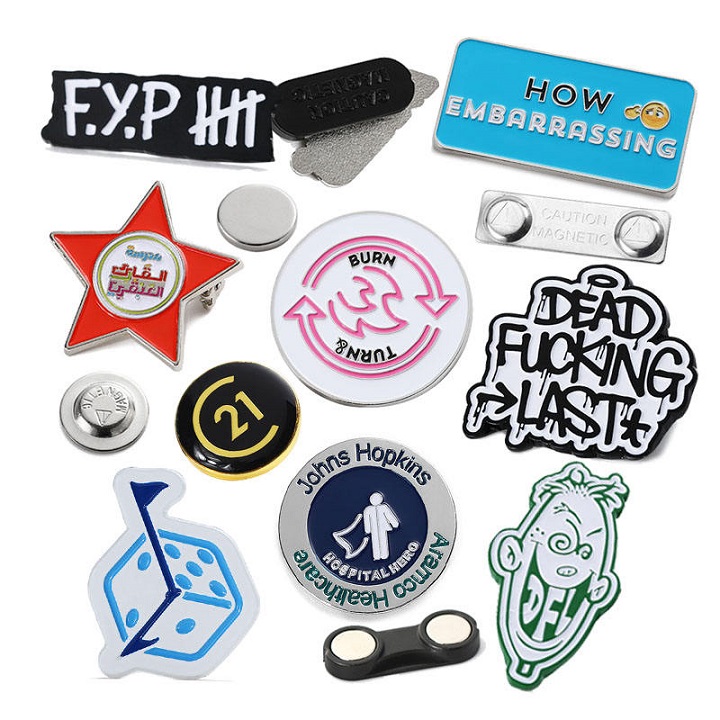
What Are Custom Pin Badges?
Custom pin badges are wearable, branded items made to display a logo, illustration, slogan, character, achievement, name, or campaign message. They are typically attached to clothing, bags, caps, lanyards, display cards, or collectible packaging using a pin, clutch, magnet, safety pin, clip, or other backing.
Although the phrase "custom pin badge" is often used broadly, the final product can vary significantly in look, cost, durability, and production method. A lightweight printed button badge for a one-day event is very different from a die-struck hard enamel lapel pin intended for long-term retail sale.
For B2B buyers, the key question is not simply, "Can this badge carry my logo?" It is:
> What type of badge best fits my campaign goal, brand position, order quantity, target audience, safety requirements, and budget?
A well-planned badge program can support multiple business objectives at once:
- Build brand recognition at trade shows, conferences, pop-up stores, and product launches
- Reward employees, distributors, volunteers, students, and community members
- Create collectible merchandise for fandom, gaming, entertainment, music, and creator brands
- Add a premium branded accessory to gift boxes, subscription boxes, apparel, or retail products
- Differentiate staff, VIP guests, speakers, sponsors, and event participants
- Encourage repeat engagement through limited-edition badge series
For example, a cosmetics brand may use a premium gold-plated enamel pin as a gift-with-purchase, while a university may choose economical button badges for orientation week. Both are "custom pin badges," but their specification, quality-control priorities, and unit economics are entirely different.
Types of Custom Pin Badges
Choosing the right badge type early prevents costly redesigns, inaccurate pricing expectations, and avoidable production delays.
| Badge Type | Best For | Main Benefits | Considerations |
| Soft enamel pins | Brand merchandise, collectible art, events | Textured surface, raised metal outlines, vivid color separation | Recessed enamel areas create a dimensional feel |
| Hard enamel pins | Premium retail, awards, corporate gifts | Smooth polished surface, durable premium appearance | Usually requires more finishing and tighter color control |
| Die-struck metal pins | Formal recognition, memberships, luxury branding | No color required; strong metal detail and classic finish | Fine visual impact depends on relief design and plating |
| Printed pins | Complex illustrations, gradients, photographs | Supports detailed artwork and multi-color imagery | A protective epoxy coating may be appropriate for surface protection |
| Button badges | Campaigns, schools, events, mass giveaways | Cost-effective, fast, familiar, lightweight | Usually less premium than metal enamel pins |
| Magnetic badges | Offices, uniforms, name badges | No needle hole in clothing | Magnet strength and garment thickness must be considered |
| Acrylic badges | Youth marketing, artist merchandise, short-run concepts | Lightweight, colorful, flexible shape options | Surface scratch resistance and edge finishing matter |
| PVC badges | Outdoor, playful, flexible designs | Soft-touch, durable, dimensional appearance | Best suited to bold forms rather than very small text |
Soft Enamel vs. Hard Enamel Pins
This is one of the most important choices for a custom lapel pin project.
Soft enamel pins have raised metal borders with colored enamel sitting below the metal lines. The result is tactile, textured, and visually dimensional. They are popular for illustration-led artwork, fan merchandise, club pins, gaming designs, and promotional branding.
Hard enamel pins are polished so that the enamel and metal lines sit at a smooth, level surface. They are often selected for premium corporate pins, commemorative pins, high-end retail merchandise, award badges, and formal membership programs.
Choose soft enamel when you want:
- A stronger raised-metal outline
- A detailed and tactile collector look
- A more accessible option for branded merchandise
- High contrast between metal lines and color fields
Choose hard enamel when you want:
- A smooth, refined surface
- A premium recognition or retail presentation
- A badge designed for frequent handling or long-term ownership
- An elegant finish for corporate or commemorative use
Neither option is universally "better." The right choice depends on the design language and intended customer experience.
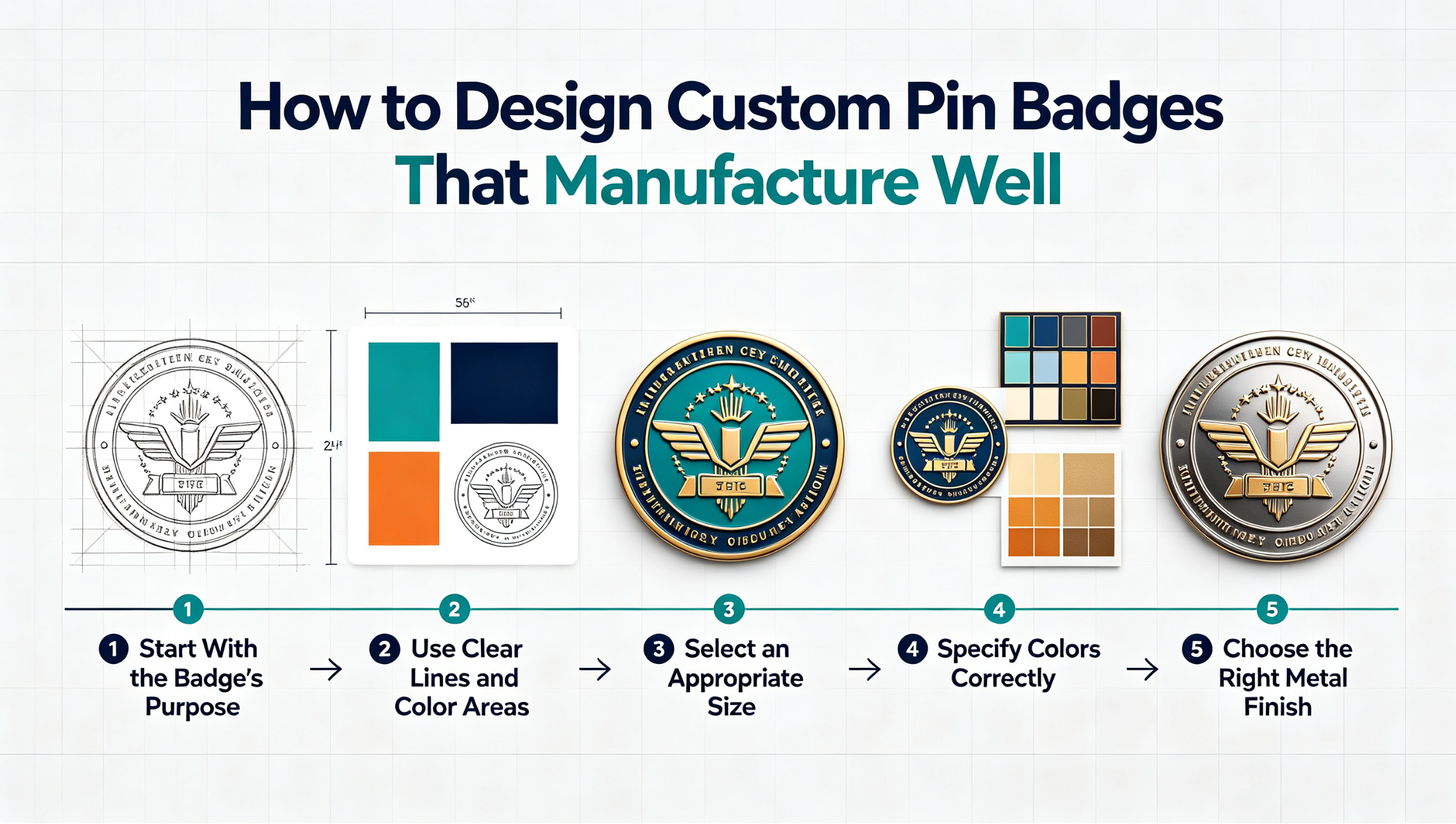
How to Design Custom Pin Badges That Manufacture Well
A badge design must be visually attractive, but it must also be manufacturable at the chosen size and process. This is where many first-time buyers face problems: artwork that looks perfect on a computer screen may not translate well into metal, enamel, ink, or small-scale production.
From a factory-preparation perspective, the most successful badge artwork is designed with physical production limits in mind.
Start With the Badge's Purpose
Before selecting colors or finishes, define the practical role of the badge.
Ask these questions:
1. Is the custom pin badge intended for retail sale, promotional distribution, internal recognition, or event identification?
2. Will it be worn every day, collected, displayed, or included inside a product package?
3. Does the design need to appeal to professionals, children, collectors, fans, or a general consumer audience?
4. Does the badge need to communicate a logo, a name, a membership tier, a character, or an achievement?
5. What is the target unit budget after packaging, freight, and potential fulfillment costs?
A conference badge may prioritize readability at a distance. A collectible enamel pin may prioritize illustration detail and a premium backing card. An employee-service award may prioritize a polished surface, durable fastening, and a formal metal finish.
Use Clear Lines and Color Areas
For enamel-style custom pin badges, each color area is typically separated by raised metal lines. This means tiny text, thin gaps, gradients, and extremely detailed illustrations may need to be simplified.
A useful practical rule is to design for clarity at the actual physical size, not only at 500% zoom on a monitor.
Industry guidance for enamel-pin artwork commonly recommends:
- Vector artwork whenever available
- No gradients or shaded transitions for standard enamel processes
- Minimum metal line thickness of approximately 0.2 mm
- Minimum color area of approximately 0.3 mm
- Text of at least 5 pt, depending on the final badge size and font style
- Simplified artwork for smaller pins [wizardpins]
These figures should be treated as starting points rather than absolute universal rules. A manufacturer should review the final artwork because the feasibility of detail also depends on the pin size, shape, metal line structure, plating, and chosen production method.
Select an Appropriate Size
A common mistake is trying to place too much information on a small badge.
For many logo pins and collector pins, sizes around 20–35 mm are practical starting points. Larger sizes give more room for detail but can increase material usage, weight, shipping volume, and the likelihood that one small fastening point will not provide enough stability.
Consider the following when selecting size:
- 15–20 mm: Small logos, simple symbols, understated corporate pins
- 20–30 mm: Versatile range for logos, icon-based designs, and promotional pins
- 30–40 mm: Detailed artwork, characters, event graphics, larger text
- 40 mm and above: Statement pieces, retail collectibles, multi-post designs, complex illustrations
For large, irregularly shaped, or heavy custom lapel pins, ask about adding a second pin post. Two attachment points can help prevent spinning or tilting during wear.
Specify Colors Correctly
A brand's visual identity depends on consistent color. For enamel badges, CMYK, RGB, and HEX values are useful design references, but enamel production normally requires matching to a physical color system such as Pantone.
Enamel-pin production guidance notes that Pantone matching is typically used instead of direct CMYK or HEX reproduction. [wizardpins]
For a professional RFQ, provide:
- Vector logo or high-resolution artwork
- Pantone references for each critical brand color
- A clear note identifying colors that are non-negotiable
- A mockup showing intended metal color and finish
- Written confirmation of whether minor color variation is acceptable
If your brand uses a signature red, blue, or metallic tone, do not assume that a screen preview represents the final manufactured product. Request a digital proof and, for sensitive projects, a physical pre-production sample.
Choose the Right Metal Finish
The plating finish affects the badge's personality as much as the artwork.
Popular options include:
- Gold plating: Warm, premium, celebratory, luxury-oriented
- Silver plating: Clean, modern, versatile
- Black nickel: Contemporary, bold, high contrast
- Antique brass: Heritage, vintage, outdoor, craft positioning
- Antique copper: Rustic or historical appearance
- Dyed black metal: Strong graphic contrast for colorful enamel
- Matte or polished finishes: Different tactile and visual impressions
A subtle but effective design decision is to match the metal finish to the brand story. For instance, an eco-conscious outdoor club may prefer antique brass, while a technology brand may favor polished nickel or black nickel.
Manufacturing Workflow for Custom Pin Badges
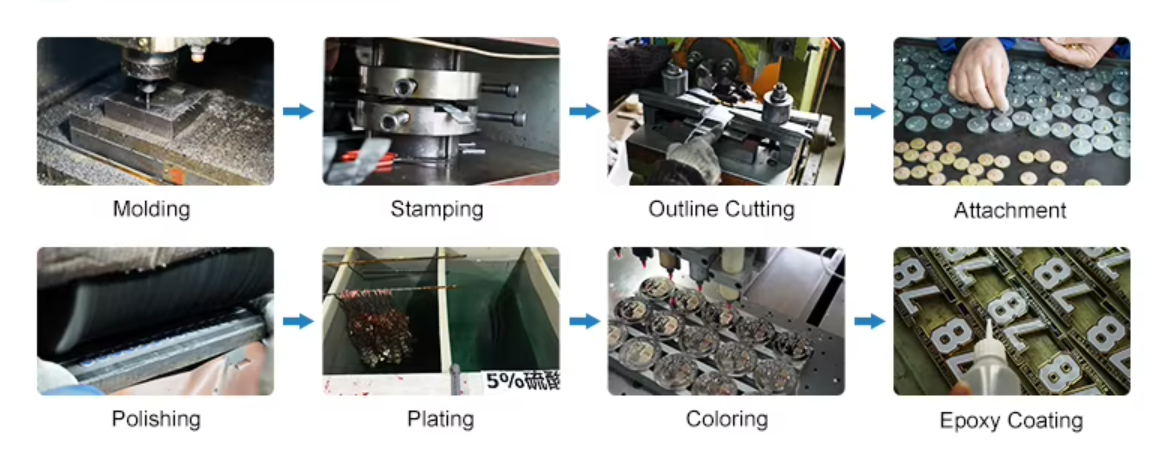
Custom badges become more reliable when buyers understand the production sequence. A transparent workflow also makes it easier to identify where approval is required.
1. Artwork Review and Engineering
The manufacturer reviews the supplied file, checks line thickness, separates colors, identifies small details, and converts the design into a production-ready layout.
At this stage, buyers should verify:
- Pin dimensions
- Shape and edge profile
- Metal finish
- Color references
- Backing type
- Placement of posts, magnets, or safety pins
- Packaging requirements
- Quantity by design or variation
2. Digital Proof Approval
The digital proof is the buyer's primary opportunity to correct spelling, proportions, color references, and placement.
Do not approve a proof until you have reviewed:
- Text and dates
- Trademark symbols
- Orientation of the pin backing
- Number of colors
- Whether raised or recessed areas are correctly shown
- Final dimensions in millimeters or inches
- Finishing notes, such as epoxy, glitter, screen print, or glow effects
3. Mold, Stamping, Casting, or Printing
The production method depends on the pin type.
For metal enamel badges, the design may be created through die striking, stamping, or casting. Printed pins are usually produced with a printed image layer on a metal base, often with a protective surface treatment. Button badges involve printed artwork assembled with metal and plastic components.
4. Coloring and Surface Finishing
For enamel pins, color is applied to designated recessed areas. Hard enamel badges require additional polishing to create a smooth surface. Soft enamel badges retain the characteristic raised-metal texture.
Optional enhancements may include:
- Epoxy dome coating
- Screen-printed detail
- Glitter enamel
- Glow-in-the-dark color
- Translucent enamel
- Sandblasted areas
- Cut-out sections
- Custom-shaped edges
- Sequential numbering for limited editions
5. Attachment and Quality Control
The backing is attached after the main badge body is completed. Quality checks should include appearance, color, sharp edges, plating consistency, fastening stability, count accuracy, and packaging condition.
For larger B2B programs, establish an agreed quality-control plan before production. This can include:
- Approved golden sample
- Acceptable quality level expectations
- Inspection photos or video
- Random sampling method
- Defect definitions
- Carton markings and shipping labels
- Reorder color-match requirements
6. Packaging and Shipment
Packaging is often underestimated. Yet, for retail and gifting, packaging can determine whether a badge feels like a low-cost giveaway or a valuable collectible.
Common packaging options include:
- Individual polybags
- Paper backing cards
- Printed hang cards
- Kraft cards for a natural presentation
- Custom envelopes
- Velvet pouches
- Custom printed boxes
- Subscription-box inserts
- Barcode labels and retail-ready cartons
As a printing and packaging supplier, XingKun can help buyers consider the badge and its presentation as one coordinated product experience, rather than treating packaging as an afterthought. [xkdisplay]
A B2B Checklist Before Requesting a Quote
A detailed request for quotation helps a supplier price accurately and reduces revision time.
Include the following:
1. Badge type: Hard enamel, soft enamel, printed metal, button badge, magnetic badge, acrylic, PVC, or another format.
2. Final size: State width and height in millimeters.
3. Shape: Round, square, rectangle, custom silhouette, or cut-out shape.
4. Quantity: Include each design quantity if you have multiple variations.
5. Artwork: Preferably AI, EPS, PDF, SVG, or editable vector format.
6. Color requirements: Include Pantone references where brand color accuracy matters.
7. Metal finish: Gold, silver, black nickel, antique brass, etc.
8. Backing: Butterfly clutch, rubber clutch, safety pin, magnet, brooch fitting, or custom fitting.
9. Packaging: Polybag, backing card, custom card, box, pouch, or bulk packed.
10. Delivery destination: Country, postal code, shipping preference, and target arrival date.
11. Compliance needs: Declare whether the badges are intended for children, retail sale, promotional distribution, or regulated markets.
12. Sample requirement: State whether you need a physical sample or pre-production approval before bulk manufacturing.
The more clearly a buyer defines these specifications, the easier it becomes to compare quotes fairly. A lower quote may omit important elements such as stronger backings, custom cards, individual packing, proofing rounds, or inspection requirements.
Quality, Compliance, and Responsible Claims
Professional badge sourcing is not only about design and price. It also requires attention to intended use, target market, intellectual-property rights, and marketing claims.
Children's Products and Small-Part Safety
Custom pin badges can contain small components, sharp points, detachable clutches, magnets, and metal pieces. If a badge is intended for children, particularly very young children, buyers should seek market-specific compliance guidance before sale or distribution.
In the United States, the Consumer Product Safety Commission states that children's products intended for children under three that present a choking, aspiration, or ingestion hazard because of small parts are banned hazardous substances under 16 C.F.R. Part 1501. The definition considers whether an object or detachable part fits entirely within the specified small-parts cylinder. [cpsc]
This does not mean every pin badge is automatically prohibited. It means buyers must evaluate the product's intended age group, design, detachable parts, labeling, packaging, and applicable regulations for the destination market.
For projects aimed at children:
- Avoid assuming that a "not for children under three" label solves every compliance issue.
- Evaluate pins, clutches, magnets, and decorative attachments separately.
- Use age-appropriate packaging and warnings where required.
- Confirm requirements with a qualified testing, regulatory, or legal professional for your sales market.
- Keep product specifications and relevant test documentation organized.
Intellectual Property and Licensed Artwork
Custom enamel pins are popular in anime, gaming, music, sports, film, and creator communities. That popularity also creates intellectual-property risk.
Only submit artwork that you own, have created, have written permission to use, or are authorized to reproduce. Enamel-pin suppliers commonly state that they will not reproduce artwork without appropriate intellectual-property rights or licensing. [wizardpins]
For a brand or wholesaler, good practice includes:
- Maintaining written license agreements
- Keeping source files and design ownership records
- Confirming use rights for logos, characters, slogans, and photographs
- Avoiding "inspired by" artwork that creates a confusingly similar commercial product
- Reviewing marketplace rules before listing products
Environmental and Sustainability Claims
Many buyers want environmentally responsible badge packaging. This is a valuable direction, but the claim must be specific and supportable.
The U.S. Federal Trade Commission's Green Guides advise marketers not to make misleading environmental claims. The guidance states that recyclable claims should not be made unless the product or package can be collected, separated, or recovered through an established recycling program. Claims about recycled content should be supported by evidence of recovered or diverted material; partial recycled-content claims should state the percentage clearly. [ftc]
Instead of using broad claims such as "100% eco-friendly," use specific language that can be verified, for example:
- "Backing card made with 80% recycled paper," if documented.
- "Plastic-free paper card packaging," if all relevant components meet that description.
- "FSC-certified paper option available," only when the selected paper and certification chain support the claim.
- "Designed to reduce individual plastic packaging," if the actual packaging configuration supports it.
Specific claims protect buyers, improve consumer trust, and make product pages more credible.
How Custom Pin Badges Support Brand Growth
Custom pin badges work particularly well because they are both a product and a visible signal of affiliation. A customer may wear a pin on a jacket, backpack, tote bag, or hat, extending its visibility beyond the original transaction.
For brand owners, this makes badges useful across the customer journey:
| Business Goal | Custom Pin Badge Strategy |
| Launch a new product | Offer a limited-edition pin with early orders |
| Improve customer loyalty | Create collectible badge series for repeat buyers |
| Build employee culture | Award milestone, training, or recognition pins |
| Increase event engagement | Use different designs for attendees, speakers, VIPs, and staff |
| Add retail value | Sell pins individually or bundle them with apparel, books, cards, or puzzles |
| Strengthen unboxing | Include a branded pin with a backing card or thank-you insert |
| Support a cause | Produce a campaign pin with clear donation or awareness messaging |
A strong example is a seasonal collector series. Instead of creating one generic logo pin, a brand can launch four coordinated custom enamel pins across the year. Each design can represent a seasonal product drop, a mascot variation, or a membership milestone. The collection format gives customers a reason to return, trade, display, and share.
For XingKun's customers, this approach can also connect badges with other printed products, such as custom packaging boxes, playing cards, jigsaw puzzles, printed books, stickers, labels, and branded inserts. A coordinated collection creates a stronger retail story than a standalone product.
Why Work With XingKun for Custom Badges?
XingKun is a China-based custom printing and packaging manufacturer serving brands, wholesalers, and product businesses with OEM and ODM requirements. According to its badge category page, XingKun provides multiple badge options, including magnetic badges, birthday badges, Christmas badges, event badges, Halloween badges, cartoon enamel pins, custom lapel pins, and anime enamel pins. The company also presents more than 20 years of production experience and positions its services around custom printing and packaging solutions. [xkdisplay]
A productive supplier relationship starts with transparent specifications and mutual review. XingKun can support projects that require:
- Custom badge artwork and manufacturing review
- Brand-oriented custom pin badges and lapel pins
- Event, campaign, birthday, holiday, and recognition badges
- Individual packaging or bulk packing
- Printed backing cards and coordinated product packaging
- OEM and ODM development
- Multi-product branding across badges, boxes, books, puzzles, stickers, and cards
Ready to develop custom pin badges for your brand, event, retail collection, or wholesale program? Send XingKun your artwork, preferred badge type, dimensions, quantity, backing choice, packaging needs, and destination country. A complete specification allows the production team to recommend an appropriate process and provide a more accurate quotation.
Conclusion
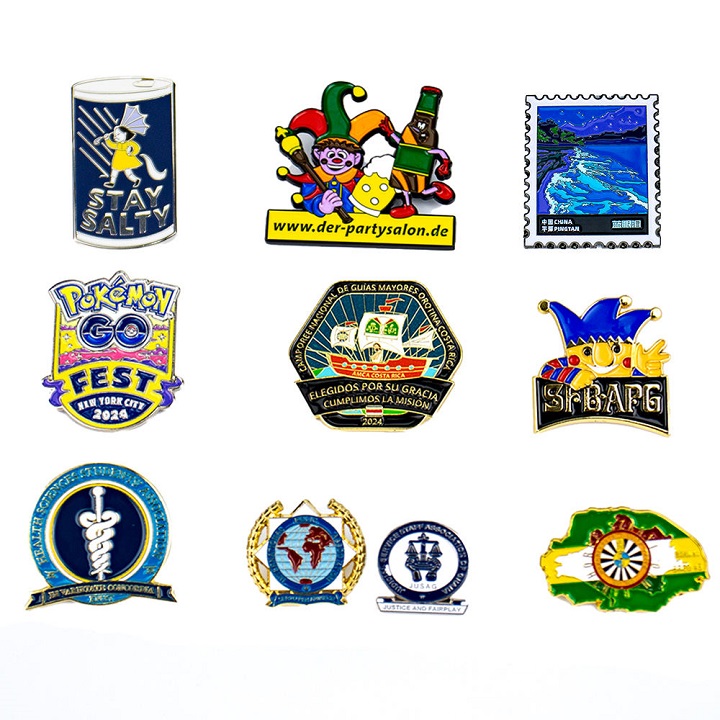
Custom pin badges are small products with substantial branding potential. The most successful badge projects begin with a clear purpose, choose the right material and production method, simplify artwork for real-world manufacturing, protect critical brand colors, and specify the fastening and packaging from the start.
For B2B buyers, the best custom pin badge is not automatically the cheapest option or the most elaborate one. It is the badge that fits the intended audience, communicates the brand clearly, holds up in use, meets relevant market requirements, and arrives in packaging that supports the desired customer experience.
Whether you are planning custom enamel pins for retail, custom lapel pins for employee recognition, promotional badges for an event, or a collectible series for a fan community, work with a manufacturer that can review the full product specification—not only the logo. XingKun can help turn your concept into a coordinated printed-product and packaging solution.
FAQ About Custom Pin Badges
1. What is the best material for custom pin badges?
The best material depends on the purpose of the badge. Soft enamel and hard enamel are popular for premium branded pins and collectible merchandise. Printed metal pins are useful for detailed artwork or image-based designs. Button badges are cost-effective for large events, while magnetic badges work well for uniforms or name tags because they do not puncture clothing.
2. What artwork file should I provide for custom enamel pins?
Vector files such as AI, EPS, PDF, or SVG are preferred because they preserve clean lines and scalable shapes. If you only have a PNG or JPG, provide the highest-resolution file possible. Include Pantone references for important brand colors and clearly identify the intended metal finish, badge size, and backing option.
3. Can custom pin badges include gradients or photographic artwork?
Standard enamel pins are best for simplified, flat-color designs with metal lines separating the colors. Gradients and photographs may not reproduce well through conventional enamel processes. For complex illustrations, photographs, or subtle shading, a printed pin or another suitable printing method may be a better choice. Manufacturing guidance commonly recommends avoiding gradients for enamel and using clear minimum line and color-area dimensions. [wizardpins]
4. How do I choose between a butterfly clutch and a magnetic backing?
A butterfly clutch is a widely used, practical option for lapel pins and merchandise. A magnetic backing is useful for office badges, uniforms, or garments that should not be pierced. Consider the garment type, badge weight, frequency of wear, safety needs, and whether strong magnet components create concerns for your intended customer group.
5. Are custom pin badges suitable for children?
They can be, but child-targeted badges need careful review. Pins, clutches, magnets, and small detachable parts can create hazards. In the United States, children's products intended for children under three that contain small parts presenting choking, aspiration, or ingestion risks may be banned under 16 C.F.R. Part 1501. Consult appropriate compliance professionals and destination-market requirements before production and sale. [cpsc]
6. Can I use anime characters, movie images, or another company's logo on a badge?
Only if you own the rights or have valid permission or licensing. This includes characters, logos, illustrations, photographs, and recognizable brand elements. Suppliers commonly require buyers to confirm that they hold the intellectual-property rights necessary to reproduce submitted artwork. [wizardpins]
7. Can I order custom backing cards and packaging with my badges?
Yes. Custom backing cards, paper cards, envelopes, pouches, boxes, barcode labels, and other retail presentation options can be developed alongside the badge. Coordinating the badge and packaging improves perceived value, protects the product during transit, and creates a more consistent brand experience.
8. What details should I include when requesting a custom badge quote?
Provide the badge type, artwork, size, shape, quantity, colors, metal finish, backing type, packaging preference, delivery country, target date, and any compliance or sample requirements. A complete brief enables a manufacturer to recommend the most suitable process and produce a more accurate quotation.
References
1. [XingKun Badges Product Category] — Product categories, badge types, production overview, customization and company information. [xkdisplay]
2. [U.S. Consumer Product Safety Commission: Small Parts Ban and Choking Hazard Labeling] — U.S. guidance on small parts and children's product hazards. [cpsc]
3. [Federal Trade Commission: Guides for the Use of Environmental Marketing Claims (Green Guides)] — Guidance on recyclable and recycled-content claims. [ftc]
4. [Federal Trade Commission: Green Guides Overview] — FTC overview of environmental marketing claims and substantiation principles. [ftc]
5. [Wizard Pins: Enamel Pin Guide] — Practical artwork considerations, vector-file preference, line and color-area guidance, Pantone matching, and IP considerations. [wizardpins]


