Content Menu
● Foam vs EVA vs Paper Inserts: Understanding the Categories
● Packaging Insert Comparison at a Glance
● General Foam Inserts: Flexible Protective Options
>> Polyethylene Foam for Structured Support
>> Polyurethane Foam for Conformable Cushioning
>> Where General Foam Inserts Need Extra Attention
● EVA Inserts: Precision Fit and Premium Presentation
>> Why EVA Works Well in Presentation Packaging
>> EVA Limitations Buyers Should Understand
>> Designing EVA Inserts for Comfortable Removal
● Paper Inserts: Structural Protection and Printable Presentation
>> Folded Paperboard Inserts
>> Corrugated Inserts
>> Molded Fiber Inserts
● How to Choose Packaging Box Inserts by Application
>> Fragile Electronics and Instruments
>> Cosmetics and Gift Sets
>> Tools and Reusable Kits
● Expert Insight: Compare Total Packaging Cost
● A Practical Five-Step Insert Development Process
>> 1. Define the Product and Distribution Risks
>> 2. Establish Pass and Fail Criteria
>> 3. Compare Complete Packaging Systems
>> 4. Test Production-Equivalent Samples
>> 5. Record the Approved Specification
● Sustainability: Evaluate the Finished Insert
● Develop an Insert Around Your Product
● Frequently Asked Questions
>> 1. Is EVA Better Than Other Packaging Foam?
>> 2. Can Paper Inserts Replace Foam Inserts?
>> 3. Which Packaging Insert Is the Cheapest?
>> 4. Are EVA Inserts Waterproof?
>> 5. What Information Is Needed for a Custom Insert Quote?
>> 6. Should Packaging Inserts Be Tested Before Mass Production?
● References
Choosing the right packaging box inserts means balancing product protection, presentation, cost, and disposal. Foam, EVA, and paper inserts can all perform well, but they solve different problems. The right choice depends on what you pack, how it travels, and what customers should experience when opening the box.
At Shenzhen XingKun Packing Products Co., Ltd., we bring more than 20 years of printing and packaging manufacturing experience to this discussion, serving brands and distributors across over 30 countries and regions.
Our starting point is straightforward: evaluate the product and its distribution risks before choosing the insert material.
Foam vs EVA vs Paper Inserts: Understanding the Categories
One distinction matters immediately: EVA is foam, not a separate non-foam material.
EVA stands for ethylene-vinyl acetate. In packaging, buyers often use "foam insert" to describe polyethylene or polyurethane foam, while requesting EVA separately because of its smooth appearance and rubber-like feel.
For a useful comparison, this guide separates:
- General foam inserts: primarily polyethylene, including expanded polyethylene, and polyurethane.
- EVA inserts: typically closed-cell foam cut into fitted cavities.
- Paper inserts: folded paperboard, corrugated structures, and molded fiber trays.
These are broad categories. Density, thickness, geometry, and surface treatment can change performance substantially.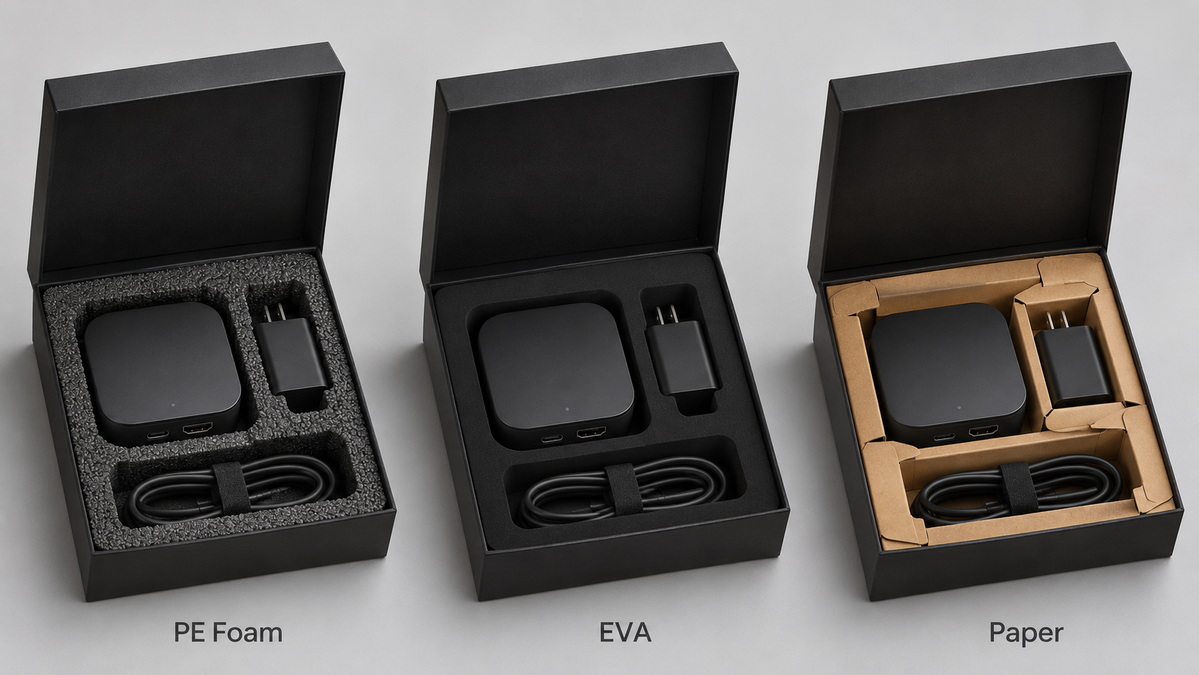
Packaging Insert Comparison at a Glance
| Selection factor | General foam inserts: PE or PU | EVA inserts | Paper inserts |
| Main advantage | Adaptable cushioning | Precise presentation and resilient support | Fiber-based structure and printable surfaces |
| Typical applications | Electronics, instruments, industrial components | Premium kits, tools, presentation boxes | Cosmetics, gift sets, retail products |
| Product fit | Cut cavities, pads, or conformable support | Defined cavities with a smooth finish | Folded platforms, partitions, or shaped trays |
| Moisture behavior | Closed-cell PE and open-cell PU differ | Typically resists water absorption | Requires evaluation under humid conditions |
| Appearance | Functional to premium, depending on grade | Clean, organized presentation | Natural, printed, or sculpted presentation |
| Cost considerations | Material grade, thickness, and conversion | Grade, cutting, layers, and finishing | Board structure, assembly, or molding tools |
| End-of-life considerations | Local collection and material acceptance | Local collection and material acceptance | Coatings, adhesives, and local acceptance |
This table is a starting point, not a performance specification. An engineered paper structure can outperform a poorly selected foam insert.
General Foam Inserts: Flexible Protective Options
Polyethylene Foam for Structured Support
Polyethylene foam is generally closed-cell. Its structure makes it useful where cushioning, moisture resistance, and product separation are priorities.
Custom polyethylene foam inserts can support industrial components, electronic equipment, and heavier products when the grade and bearing area suit the load.
However, "firmer" does not automatically mean "safer." An overly stiff insert may transmit impact rather than cushion it effectively.
For procurement, request:
- The exact foam type and density.
- Cushioning data for the proposed grade.
- Material thickness and product contact area.
- Samples using production-equivalent material.
Polyurethane Foam for Conformable Cushioning
Many flexible polyurethane packaging foams have an open-cell structure. They compress readily and can conform to irregular shapes.
This makes them candidates for delicate instruments and products requiring gentle support. However, they should not be treated as interchangeable with closed-cell polyethylene.
Moisture exposure, long-term storage, and compression behavior need evaluation. For sensitive surfaces, check whether prolonged contact causes marking, abrasion, or residue.
Where General Foam Inserts Need Extra Attention
A foam insert should do more than fill empty space. It must control movement without placing pressure on vulnerable features.
Avoid supporting a product through its display, switch, connector, or decorative edge. Locate contact points on stronger areas and provide clearance around fragile projections.
EVA Inserts: Precision Fit and Premium Presentation
Why EVA Works Well in Presentation Packaging
EVA inserts combine a smooth appearance with resilient support. Cut cavities can organize products and accessories into a clear visual layout.
They are worth considering for:
- Premium gift sets.
- Tool and demonstration kits.
- Camera accessories.
- High-value products retained in their original boxes.
Contrasting layers can also help customers identify where each component belongs.
From a packaging-design perspective, EVA is especially useful when the insert remains part of the product experience after delivery.
EVA Limitations Buyers Should Understand
A premium appearance does not prove shipping performance.
EVA still requires appropriate thickness, cavity geometry, and load distribution. A thin layer beneath a heavy product may offer insufficient cushioning, even when the fit looks excellent.
Detailed cavities and layered constructions can also increase conversion work and material waste.
Specify the proposed grade rather than approving "EVA" as a complete description. Check odor, surface compatibility, removal force, and any application-specific requirements before production.
Designing EVA Inserts for Comfortable Removal
A tight cavity can hold a product securely but frustrate the customer.
Include finger notches, suitable clearance, or a lifting feature where needed. Test removal using the actual product, including its labels, protective film, and dimensional variation.
Retention and easy removal should be designed together.
Paper Inserts: Structural Protection and Printable Presentation
Folded Paperboard Inserts
Paperboard inserts can create platforms, accessory compartments, and shaped openings inside retail boxes.
Their advantages include printable surfaces and the possibility of shipping some designs flat. Graphics can explain product placement or guide the opening sequence without adding a separate leaflet.
However, structural performance depends on folds, locking features, board properties, and product weight. A decorative platform is not automatically a protective cushion.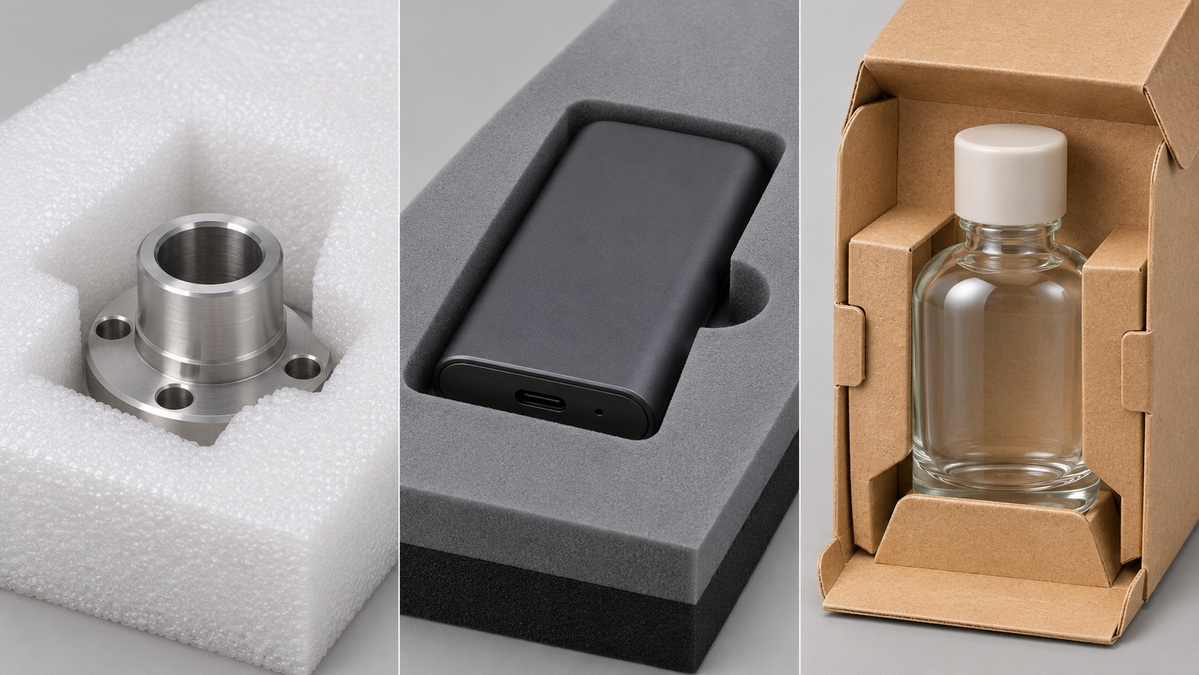
Corrugated Inserts
Corrugated inserts use fluted board to create partitions, supports, and cushioning structures.
They are useful when products need separation or loads must be directed toward stronger areas. A well-designed structure can prevent items from colliding without enclosing every surface.
The trade-off is appearance: exposed edges may look more functional than a smooth EVA tray. Whether that matters depends on the brand and product.
Molded Fiber Inserts
Molded fiber trays create shaped support around products and accessories.
They can provide a cohesive fiber-based presentation, but tooling, surface finish, dimensional tolerances, and order volume affect suitability.
Do not group every molded fiber tray under one performance assumption. Ask for representative samples and evaluate fit, abrasion risk, and environmental conditioning.
How to Choose Packaging Box Inserts by Application
Fragile Electronics and Instruments
Start with product fragility, weight, and shipping conditions rather than appearance.
PE, PU, EVA, and engineered paper structures may all be candidates. Select the construction that controls movement and manages impact for the complete package.
If electrostatic protection is required, specify and verify the relevant material properties. Ordinary foam or paper should not be assumed to provide them.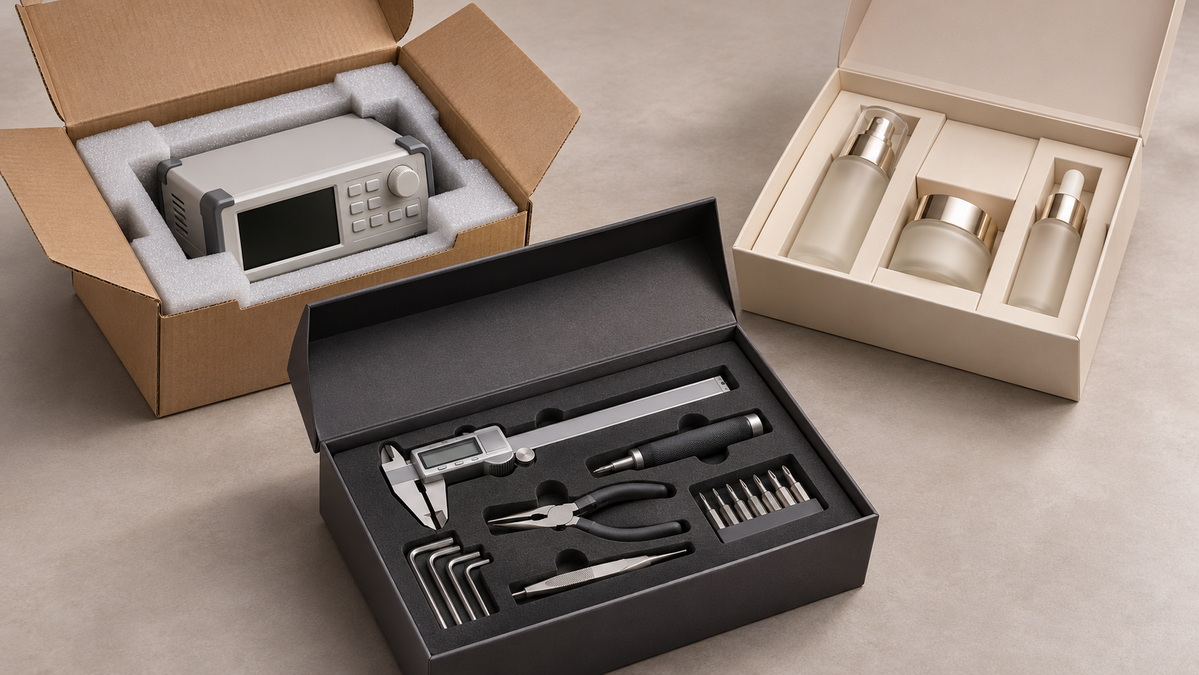
Cosmetics and Gift Sets
For lightweight products, paperboard inserts can provide organized presentation and useful printing space.
For heavier bottles or high-value sets, compare a reinforced paper structure with a fitted foam solution. Protect pumps, caps, and glass contact points while keeping each item easy to remove.
Tools and Reusable Kits
EVA is worth evaluating when customers repeatedly return items to fitted cavities.
For heavier equipment, polyethylene foam may also suit the application. Reuse performance depends on the selected grade, loading, and handling conditions—not the material name alone.
Expert Insight: Compare Total Packaging Cost
Unit price is only one part of the buying decision.
A useful evaluation includes:
> Total packaging cost = insert cost + assembly labor + freight impact + tooling allocation + damage-related cost.
Consider an illustrative calculation, not a customer case: a $0.20 insert saving across 10,000 shipments reduces purchasing cost by $2,000. If a weaker design creates 100 additional damage incidents costing $25 each, those incidents add $2,500.
The cheaper insert would then cost more overall.
The same logic applies in reverse. A simpler paper structure may reduce cost if it meets protection requirements and speeds packing.
Ask suppliers to quote against the same product, performance target, quantity, and delivery basis.
A Practical Five-Step Insert Development Process
1. Define the Product and Distribution Risks
Provide dimensions, weight, fragile features, surface finishes, accessories, and destination markets.
Explain whether the product ships individually, inside a master carton, or on a pallet.
2. Establish Pass and Fail Criteria
Define acceptable outcomes before testing.
Check product function, cosmetic condition, component retention, box appearance, and opening experience. "No visible damage" alone may not identify hidden functional problems.
3. Compare Complete Packaging Systems
Evaluate the insert together with the presentation box and shipping carton.
A rigid gift box may look protective without being sufficient for parcel delivery. Changes to the outer carton can also affect insert requirements.
4. Test Production-Equivalent Samples
Use representative products and the intended packaging construction.
ISTA Procedure 3A is one established option for individual packaged products of 70 kg or less moving through parcel delivery systems. The appropriate protocol depends on the actual distribution route.
5. Record the Approved Specification
Document material grade, thickness, cavity dimensions, tolerances, adhesives, and assembly method.
Keep an approved sample. Uncontrolled material substitutions can change performance even when the insert looks similar.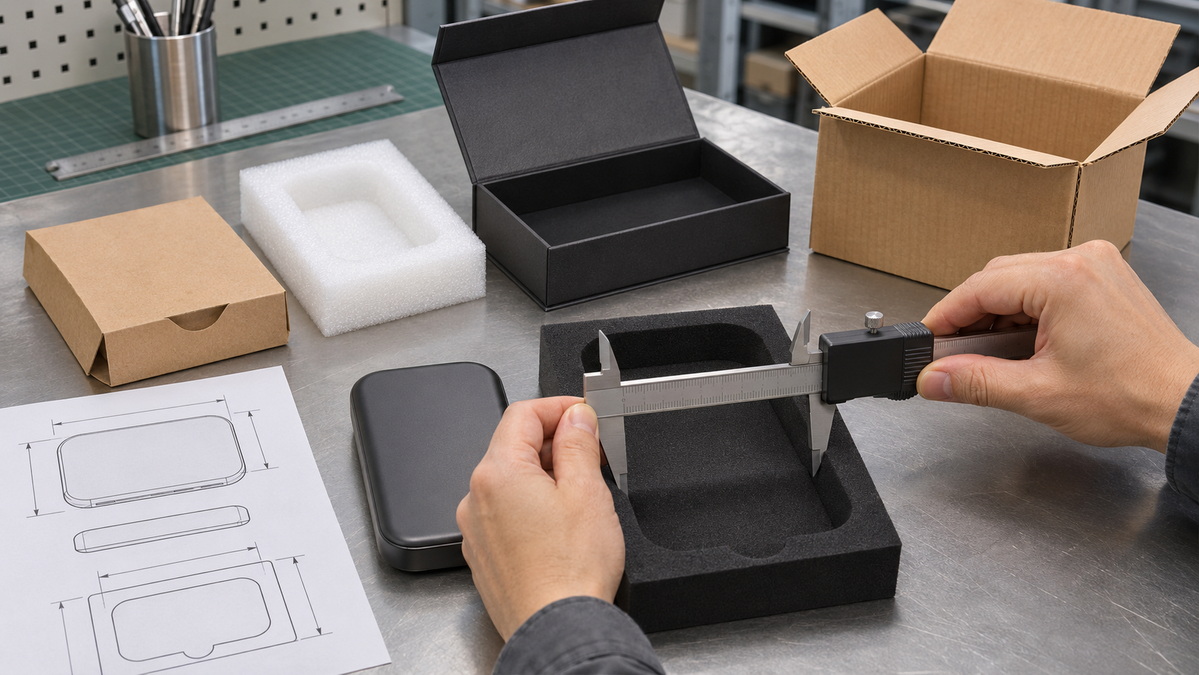
Sustainability: Evaluate the Finished Insert
Paper-based inserts can support a fiber-focused packaging strategy, particularly when unnecessary mixed-material layers are avoided.
However, paper content does not automatically make an insert recyclable everywhere. Coatings, adhesives, contamination, construction, and local collection systems all matter.
Foam recycling also depends on the specific material and available collection routes. Technical recyclability is not the same as convenient access for customers.
A practical review should ask:
- Can components be separated easily?
- Does the destination market accept the finished material?
- Is the recycled-content claim documented?
- Could a smaller design provide equivalent protection?
- Does the structure prevent avoidable product damage?
Avoid blanket claims that one material is always environmentally superior. Compare protection, material use, transport, reuse, and disposal together.
Develop an Insert Around Your Product
The strongest packaging decision combines protection, presentation, production efficiency, and a realistic disposal route.
Shenzhen XingKun Packing Products Co., Ltd. brings more than 20 years of printing and packaging manufacturing experience to projects for brands and distributors across over 30 countries and regions.
Send our team your product drawing or sample, weight, target quantity, destination market, and preferred box style. Request a custom packaging review comparing suitable insert structures before committing to production.
Frequently Asked Questions
1. Is EVA Better Than Other Packaging Foam?
Not universally. EVA can offer a smooth finish and precise presentation. Polyethylene or polyurethane may better suit other cushioning, cost, or conformity requirements. Compare specific grades and tested designs.
2. Can Paper Inserts Replace Foam Inserts?
Yes, in suitable applications. Folded, corrugated, or molded fiber structures can provide effective support. Replacement requires structural development and testing, not simply copying a foam cavity into paper.
3. Which Packaging Insert Is the Cheapest?
There is no fixed ranking. Quantity, dimensions, tooling, assembly labor, material waste, and performance requirements influence cost. Compare complete quotations rather than raw material prices.
4. Are EVA Inserts Waterproof?
Closed-cell EVA generally resists water absorption, but an EVA insert does not make the entire package waterproof. Water can still enter through the box, seams, or other components.
5. What Information Is Needed for a Custom Insert Quote?
Provide product dimensions, weight, quantity, box dimensions, destination markets, preferred appearance, and shipping method. A physical sample or accurate drawing helps suppliers assess fit and manufacturability.
6. Should Packaging Inserts Be Tested Before Mass Production?
Yes. Test representative samples in the complete packaging system. Confirm product protection, retention, cosmetic condition, and removal experience before approving the production specification.
References
1. International Safe Transit Association. "Test Procedures." Official overview of packaged-product testing categories and distribution-specific procedures; supports the discussion of complete-package validation. [ista]
2. International Safe Transit Association. "Procedure 3A: Packaged-Products for Parcel Delivery System Shipment, 70 kg (150 lb) or Less." Official procedure overview; supports the stated application and weight scope. [ista]
3. Brown Packaging. "The Different Types of Packaging Foam." Industry overview of polyethylene, polyurethane, EVA, and other packaging foams; supports broad material distinctions and applications, not universal performance rankings. [brownpackaging]
4. PAX Solutions. "EPS vs EPE vs EVA vs PU vs XLPE." Industry comparison covering cell structures, material-selection variables, cushioning considerations, and grade-dependent limitations. [pax]
5. U.S. Federal Trade Commission. "Guides for the Use of Environmental Marketing Claims," Section 260.12, "Recyclable Claims." Supports the distinction between material recyclability and established collection and recovery programs. [ftc]
6. U.S. Federal Trade Commission. "Environmental Claims: Summary of the Green Guides." Supports qualified recycling claims and documented recycled-content statements. [ftc]


