Content Menu
● What Are Custom Casino Playing Cards?
>> Casino-Themed Promotional Cards
>> Cards Intended for Professional Gaming Operations
● Start With the Application Before Choosing Specifications
● How to Choose Materials for Custom Casino Playing Cards
>> Coated Paper Playing Cards
>> Fully Plastic Playing Cards
>> Paper vs. Plastic: A Better Buying Comparison
● Card Size, Deck Composition, and Index Design
>> Confirm the Complete Deck Configuration
>> Prioritize Readability Over Decorative Complexity
● Custom Casino Playing Card Design: Branding Without Compromising Consistency
>> Examine Symmetry and Edge Appearance
>> Keep Specialized Finishes Application-Appropriate
● Prepare Print-Ready Artwork With a Supplier-Approved Template
>> Request the Correct Dieline Before Designing
>> Separate Artwork Approval From Physical Approval
● A Practical Quality-Control Plan for Wholesale Orders
>> Define Critical Defects Separately
>> Test Equipment Compatibility With the Actual Product
● Build Security Around the Entire Card Lifecycle
>> Do Not Confuse Branding With Regulatory Approval
● Custom Playing Card Packaging: Design for the Sales Channel
>> Tuck Boxes for Straightforward Presentation
>> Presentation Boxes for Premium Programs
>> Keep Packaging Revisions Under Control
● OEM and ODM: Choose the Right Development Approach
>> OEM Custom Playing Cards
>> ODM Custom Playing Cards
● Compare Total Project Cost, Not Just the Price per Deck
● A Seven-Step Sourcing Workflow With XingKun
● Conclusion
● Frequently Asked Questions About Custom Casino Playing Cards
>> 1. What is the difference between custom casino cards and ordinary promotional cards?
>> 2. Are plastic cards always better than paper cards?
>> 3. Can the card backs, faces, and packaging all be customized?
>> 4. What artwork files should I prepare?
>> 5. What is the minimum order quantity?
>> 6. How can I check whether a deck works with an automatic shuffler?
>> 7. What should I include in my first inquiry to XingKun?
Custom Casino Playing Cards need to do more than display a logo. For casino operators, gaming brands, wholesalers, and hospitality businesses, a successful deck must balance brand presentation with readable faces, consistent handling, reliable production, and packaging that suits its intended use.
This guide explains how to source custom casino playing cards, compare materials, prepare artwork, assess samples, and build a more dependable OEM or ODM purchasing process with Shenzhen XingKun Packing Products Co., Ltd., known as XingKun.
What Are Custom Casino Playing Cards?
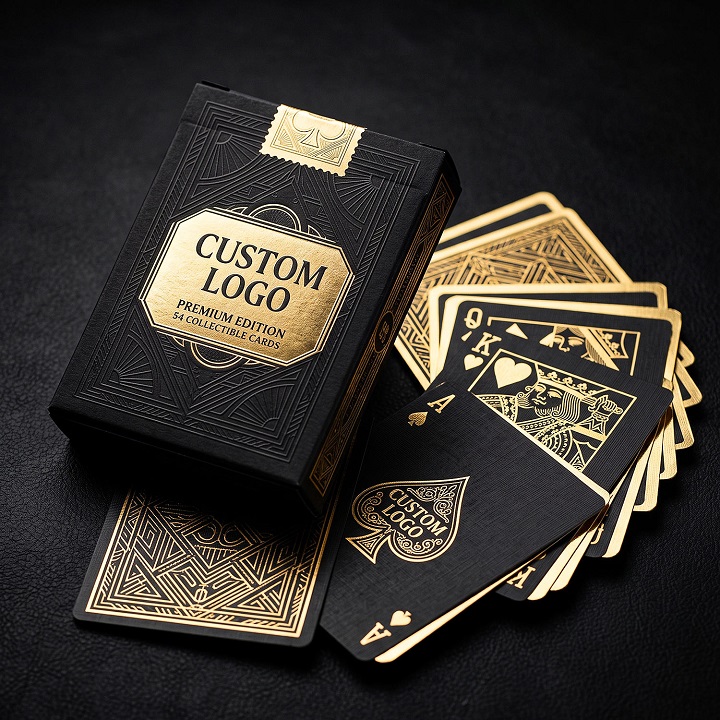
Custom casino playing cards are playing-card decks developed with buyer-specific artwork, materials, dimensions, face layouts, packaging, or production requirements. Customization may involve a simple branded back design or a coordinated product containing cards, tuck boxes, instructional inserts, and retail packaging.
However, "casino" describes an intended market or style; it should not be treated as proof of regulatory acceptance.
A promotional deck for a casino hotel and a deck intended for a regulated gaming table are different purchasing projects. Nevada's gaming framework, for example, includes operational rules and internal controls for card games, including controls over access to playing cards. A printed product description cannot replace those requirements. [gaming.nv]
Casino-Themed Promotional Cards
These decks may support:
- Hotel gift shops and loyalty programs.
- Corporate entertainment.
- Trade-show giveaways.
- Branded merchandise.
- Private events and hospitality promotions.
Their specifications can prioritize attractive packaging, brand recognition, and an appropriate playing experience.
Cards Intended for Professional Gaming Operations
These projects require closer coordination with the operator.
The buyer should establish applicable operating requirements, approval procedures, equipment compatibility, and acceptance criteria before production. For example, Nevada's published internal controls require new and used cards awaiting issue to be held securely and require cards not intended for reuse to be canceled and removed from service. [gaming.nv]
That distinction matters: product quality and operational control must work together.
Start With the Application Before Choosing Specifications
The most useful first question is not "What is your cheapest deck?"
It is "What must this deck reliably do?"
A wholesale distributor developing retail merchandise has different priorities from a gaming operator evaluating table-use cards. Treating both projects identically can lead to unnecessary cost or an unsuitable product.
| Intended application | Primary purchasing priority | What to confirm first |
| Casino-branded merchandise | Brand presentation and retail appeal | Artwork, packaging, barcode needs |
| Hospitality promotions | Budget and campaign consistency | Quantity, delivery deadline, design versions |
| Poker clubs and organized events | Readability and repeatable handling | Material, index layout, sample performance |
| Professional gaming operations | Operational suitability and control | Operator requirements and approval process |
| Premium corporate gifts | Perceived value and presentation | Box construction, inserts, finishing |
| Wholesale distribution | Repeatability across replenishment orders | Specifications, version control, carton labeling |
This application-first approach gives the manufacturer a clearer brief and makes supplier quotations easier to compare.
How to Choose Materials for Custom Casino Playing Cards
Material selection should follow the intended use, not a simple assumption that heavier or more expensive automatically means better.
The casino supply market includes both coated paper cards and fully plastic cards. A casino-card brochure from Abbiati and Cartamundi describes both constructions, with different material and handling characteristics. [abbiati]
Coated Paper Playing Cards
Coated paper is an established option for casino cards. The Abbiati–Cartamundi brochure describes nontransparent coated paper and a prelinen surface intended to support gliding and durability. These are descriptions of that supplier's products, not verified specifications for every paper deck. [abbiati]
When evaluating paper-based custom poker cards, request details about:
- Stock composition and supplier reference.
- Nominal thickness and agreed tolerance.
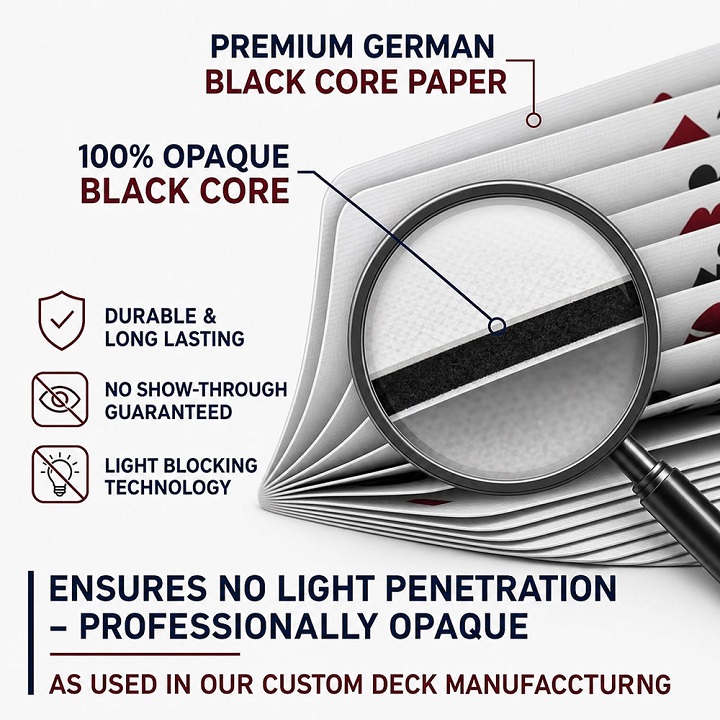
- Opacity.
- Surface treatment.
- Flexibility and recovery.
- Cut-edge consistency.
- Intended storage conditions.
I would not approve a paper deck on grammage alone. A purchasing specification should describe the performance you need and the sample you have accepted, rather than rely on one headline material number.
Fully Plastic Playing Cards
Fully plastic cards are a separate construction from plastic-coated paper.
Cartamundi describes its ACE plastic cards as durable and waterproof. Its casino product literature also describes plastic cards designed for smooth handling and shuffling-machine performance. These product-specific statements support evaluating plastic as an option, but they do not establish identical performance for every manufacturer or every machine. [abbiati]
For a plastic deck, ask the supplier to identify the actual substrate and provide a representative sample.
Then evaluate:
1. Grip during dealing.
2. Flexibility during normal play.
3. Recovery after handling.
4. Surface response under the intended lighting.
5. Suitability for the actual equipment, where relevant.
Paper vs. Plastic: A Better Buying Comparison
| Purchasing question | Paper-based cards | Fully plastic cards |
| What construction is supplied? | Confirm paper layers, core, and coating | Confirm the specific plastic substrate |
| What handling is expected? | Approve a representative physical sample | Approve a representative physical sample |
| Is moisture exposure relevant? | Define the required resistance | Verify the supplier’s stated resistance |
| Will equipment be used? | Test the proposed finished deck | Test the proposed finished deck |
| How should value be assessed? | Compare cost against accepted service performance | Compare cost against accepted service performance |
The strongest purchasing decision is based on the approved finished product, not the material label by itself.
Card Size, Deck Composition, and Index Design
Custom casino playing cards should be specified in exact dimensions.
Terms such as "poker size" and "bridge size" are useful starting points, but they are not substitutes for a manufacturing drawing. One casino-card supplier lists a poker format of 63 × 88 mm, while another custom-card supplier lists bridge cards at 2.25 × 3.5 inches. The practical lesson is to confirm the supplier's actual finished size rather than assume all industry labels are interchangeable. [abbiati]
Confirm the Complete Deck Configuration
Your order specification should identify:
- Finished card width and height.
- Corner shape and radius.
- Number of cards per deck.
- Whether jokers are included.
- Any instruction, advertising, or replacement cards.
- Required deck sequence.
- Face design and index format.
Game requirements can differ. Nevada-published rules describe some games using a standard 52-card deck, while its published Yin Yang Pai Gow rules specify 52 cards plus one joker. Do not assume every casino-related application needs the same deck composition. [gaming.nv]
Prioritize Readability Over Decorative Complexity
My design recommendation is to keep ranks and suits visually clear before adding ornamental detail.
Review face artwork at actual printed size. A design that looks balanced on a large monitor may be difficult to interpret when held in a hand of cards.
Where appropriate, ask dealers, event staff, or representative users to assess alternative index layouts before approving production.
Custom Casino Playing Card Design: Branding Without Compromising Consistency
The back design carries your brand identity. It also deserves careful technical review.
A good design brief should explain where the logo appears, how colors are controlled, and how the pattern behaves near the cut edges.
Examine Symmetry and Edge Appearance
The Ivey litigation provides a real-world reason to take back-pattern differences seriously. Legal commentary on the UK Supreme Court decision describes the use of distinguishable card backs and the deliberate manipulation of card orientation in the edge-sorting dispute. [sports]
For buyers, the lesson is not to seek a supposedly "cheat-proof" graphic.
It is to include back-pattern consistency and edge appearance in design review and sample inspection.
Recommended review questions include:
- Does the artwork have an intentional orientation?
- Are differences between opposite edges easily noticeable?
- Does the design remain visually consistent after trimming?
- Do samples show unexpected card-to-card variation?
- Has the operator reviewed the proposed back design where necessary?
Keep Specialized Finishes Application-Appropriate
Foil, embossing, and other special effects can be attractive for branded merchandise. Custom-card suppliers offer a range of such options, including packaging finishes. [makeplayingcards]
My recommendation for professional-use projects is more conservative: place decorative effects on the packaging unless the proposed treatment on the cards has been specifically evaluated and approved.
Brand impact should not take priority over the intended playing experience.
Prepare Print-Ready Artwork With a Supplier-Approved Template
Artwork preparation is a production-control step, not merely a file-upload task.
A custom-card printer such as PrintNinja requests print-ready files with specifications including CMYK, 300 DPI, and 3 mm bleed. Those requirements illustrate a common workflow, but they should not be copied automatically to another supplier's template. [printninja]
Request the Correct Dieline Before Designing
Ask XingKun for the template applicable to the proposed construction, then confirm:
1. Finished trim size.
2. Bleed area.
3. Safe area for important elements.
4. Corner treatment.
5. Accepted file formats.
6. Color requirements.
7. Front-to-back orientation.
8. Packaging dimensions.
The approved template should guide the design—not the other way around.
Separate Artwork Approval From Physical Approval
I recommend treating these as two different decisions.
Artwork approval confirms content, layout, spelling, orientation, and intended colors.
Physical approval addresses the material, thickness, finish, cutting, packaging fit, and handling of the supplied sample.
If the sample uses a different printing method or stock from the planned production run, ask the supplier to document that difference before approving it.
A Practical Quality-Control Plan for Wholesale Orders
"High quality" is not a measurable purchase specification.
For custom casino playing cards wholesale, define what will be checked, how it will be checked, and what happens when a result falls outside the agreed limit.
The following is a proposed buyer's checklist, not a claim that every item is already included in XingKun's standard inspection process.
| Inspection area | Suggested check | What to agree before production |
| Card dimensions | Measure selected cards from sampled decks | Nominal dimensions and tolerances |
| Deck composition | Verify count and required card identities | Complete deck list and sequence |
| Printing | Compare faces and backs with approved reference | Color and visible-defect criteria |
| Opacity | Examine under agreed conditions | Practical acceptance method |
| Cutting | Inspect edges and corners | Acceptable edge and corner condition |
| Handling | Conduct agreed dealing and shuffling trials | Procedure and evaluation criteria |
| Packaging | Check fit, closure, and print content | Approved packaging reference |
| Traceability | Review batch and carton identification | Required records and label fields |
Define Critical Defects Separately
My recommendation is to distinguish defects that make a deck unusable from minor cosmetic variation.
Missing cards, duplicated identities, unreadable ranks, or visibly distinguishable backs may warrant different treatment from a small packaging blemish.
The buyer and supplier should agree on defect categories and the sampling plan in writing. Do not let the phrase "standard quality inspection" stand in for a shared acceptance procedure.
Test Equipment Compatibility With the Actual Product
A supplier's statement about machine compatibility should be treated as a starting point for validation.
Although casino-card literature discusses performance in shuffling machines, suitability remains a product-and-equipment question. Test the proposed finished deck with the relevant equipment and operator procedures before a significant commitment. [abbiati]
Build Security Around the Entire Card Lifecycle
Printing consistency is only one part of card control.
Nevada's published card-game controls address secure access to new and used cards and the cancellation and removal of cards that will not be reused. This demonstrates why procurement decisions should connect with operating procedures rather than stop at delivery. [gaming.nv]
For an operator-led project, I recommend discussing:
- Receiving inspection.
- Restricted storage.
- Deck or batch identification.
- Issue and return records.
- Separation of new and used stock.
- Procedures for damaged or retired decks.
- Treatment of rejected production.
These are planning topics, not a universal compliance checklist. Requirements vary by jurisdiction and operating model.
Do Not Confuse Branding With Regulatory Approval
A custom logo, security-style pattern, sealed box, or "casino-grade" description does not independently establish that a deck is approved for regulated use.
Ask the operator or relevant authority what documentation, supplier acceptance, or product review is required. Keep those requirements separate from the commercial printing quotation.
Custom Playing Card Packaging: Design for the Sales Channel
Packaging should reflect how the deck will be shipped, stored, opened, and sold.
For this reason, I recommend defining the distribution channel before selecting an elaborate presentation box.
Tuck Boxes for Straightforward Presentation
For a standard branded deck, consider a tuck-box concept and evaluate:
- Fit around the finished deck.
- Ease of opening.
- Closure design.
- Printed product information.
- Barcode location, if needed.
- Protection during shipment.
Approve the packaging with the actual or production-representative deck inside.
Presentation Boxes for Premium Programs
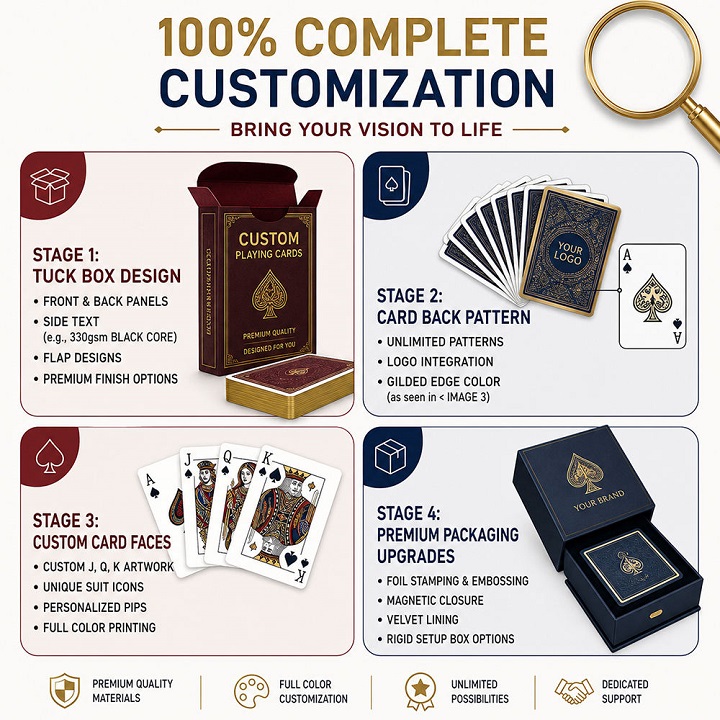
For gifting or retail programs, ask about presentation-box concepts, inserts, and coordinated printed materials.
These should be treated as project options to confirm with XingKun, not assumed standard inclusions.
The most useful question is whether the packaging improves the buyer's actual commercial objective. A sophisticated gift box may support a premium campaign but add unnecessary cost to an operational replenishment order.
Keep Packaging Revisions Under Control
Record the approved box artwork, structural drawing, and insert layout alongside the card files.
A replenishment order can fail commercially even when the cards are correct if an outdated barcode, old logo, or incorrect language version appears on the box.
OEM and ODM: Choose the Right Development Approach
For this guide, OEM describes producing a buyer-defined product, while ODM describes a more supplier-assisted development route. Because suppliers may use these labels differently, define the actual responsibilities in the quotation and purchase agreement.
OEM Custom Playing Cards
An OEM-style brief may include:
- Buyer-owned artwork.
- Defined dimensions and materials.
- Required packaging construction.
- Inspection requirements.
- Approved reference samples.
This approach suits a project with an established product specification.
ODM Custom Playing Cards
An ODM-style brief may begin with the application, price target, and brand identity, followed by supplier proposals for materials, layout, and packaging.
For either approach, document:
- Artwork ownership.
- Responsibility for revisions.
- Rights to supplied illustrations.
- Approval authority.
- Confidentiality requirements.
- Restrictions on reuse of brand assets.
The goal is to remove ambiguity before production begins.
Compare Total Project Cost, Not Just the Price per Deck
A low quotation is useful only when it covers the same deliverable.
I recommend comparing quotations using an identical specification sheet and a consistent commercial basis.
Review:
- Deck composition.
- Material and finish.
- Printing requirements.
- Packaging.
- Sampling charges.
- Setup or tooling charges.
- Inspection arrangements.
- Freight assumptions.
- Import-related responsibilities.
- Delivery terms.
For repeated-use applications, an additional internal measure can be helpful:
Cost per accepted use=Landed deck cost/Accepted uses before retirement
This is a proposed purchasing metric, not an industry performance benchmark. Use results from your own trials rather than an unsupported supplier promise about deck lifespan.
A Seven-Step Sourcing Workflow With XingKun
Based on the company information supplied for this article, XingKun is a China-based OEM and ODM manufacturer serving overseas brands, wholesalers, and manufacturers across playing cards, packaging, and other printed products.
A structured inquiry can help turn that broad manufacturing relationship into a clearly defined card project.
1. Define the application. State whether the deck is for merchandise, promotions, organized play, or proposed professional gaming use.
2. Submit the initial specification. Include quantity, destination, dimensions, material preference, deck composition, and packaging concept.
3. Request material and construction options. Ask which choices can be supplied and sampled.
4. Prepare artwork using the approved template. Resolve ownership, color requirements, and file versions.
5. Review samples. Record the sample's construction and any differences from planned production.
6. Approve specifications and inspection criteria. Confirm what constitutes an acceptable shipment.
7. Authorize production and retain records. Keep the approved files, reference sample, and order documentation for replenishment.
Avoid approving changes through scattered messages without updating the master specification.
Conclusion
Custom Casino Playing Cards are most successful when branding, materials, readability, production consistency, and packaging are developed together.
My central recommendation is to buy against an agreed specification and an approved physical reference—not a broad promise of premium quality. For regulated applications, involve the operator's compliance and technical teams early, and keep product approval separate from attractive marketing language.
To start an OEM or ODM project with XingKun, send a brief containing your intended use, quantity, destination, preferred material, deck configuration, artwork status, and packaging requirements. Request confirmation of available options, sample arrangements, inspection criteria, and commercial terms before committing to production.
Frequently Asked Questions About Custom Casino Playing Cards
1. What is the difference between custom casino cards and ordinary promotional cards?
The distinction lies primarily in the intended application and the specification. Promotional decks may prioritize branding and packaging. Cards proposed for regulated gaming require operator-specific evaluation and must fit the relevant operating controls; a casino-style design alone does not establish suitability. [gaming.nv]
2. Are plastic cards always better than paper cards?
No universal choice follows from the material name alone. Casino suppliers offer both paper and plastic constructions. Compare representative samples against handling needs, moisture exposure, equipment requirements, and replacement practices rather than assuming one material is best for every project. [abbiati]
3. Can the card backs, faces, and packaging all be customized?
Custom-card suppliers offer options covering backs, faces, card formats, and packaging. For a XingKun order, request written confirmation of the specific options available for your quantity and construction; another supplier's catalog does not establish XingKun's capabilities. [makeplayingcards]
4. What artwork files should I prepare?
Begin with the selected supplier's template. Common commercial requirements include print-ready artwork, appropriate resolution, a defined color workflow, and bleed, but the exact specification must come from your printer. PrintNinja's published requirements are one example, not a universal standard. [printninja]
5. What is the minimum order quantity?
This article does not establish XingKun's minimum order quantity. Request a quotation based on your card material, deck configuration, printing requirements, packaging, and quantity. Do not assume that an MOQ advertised by another printer applies to the same construction or manufacturer.
6. How can I check whether a deck works with an automatic shuffler?
Arrange a trial using the proposed finished cards and the actual equipment, following the operator's procedures. Supplier literature may describe machine-oriented products, but that is not a substitute for validating your selected deck and equipment combination. [abbiati]
7. What should I include in my first inquiry to XingKun?
Include intended use, order quantity, destination, card dimensions, deck composition, material preference, artwork readiness, packaging concept, and required delivery window. Also identify any operator approval or inspection requirements so the quotation addresses the real project.


