Content Menu
● What Are Engraved Nameplates?
● How Custom Engraved Nameplates Are Made
>> Rotary Engraving: Mechanically Cut Characters
>> Laser Engraving: Material Removal by Focused Energy
>> Laser Annealing: A Different Marking Mechanism
● Choosing Materials for Engraved Nameplates
>> Stainless Steel Engraved Nameplates
>> Aluminum and Decorative Metal Nameplates
>> Engraved Plastic Nameplates
● What Actually Determines Nameplate Durability?
● Designing Engraved Nameplates for Readability and Traceability
>> Establish an Information Hierarchy
>> Verify Barcodes on Finished Plates
● Mounting Engraved Nameplates: Adhesive or Mechanical Fixing?
>> Adhesive Mounting
>> Screws and Rivets
● A Practical Sample Approval Plan Before Mass Production
>> Example: Outdoor Pump Identification
● Compliance and Purchasing Documentation
● What to Include in an Engraved Nameplate Quote Request
● Start Your Custom Nameplate Project With XingKun
● Frequently Asked Questions About Engraved Nameplates
>> Are engraved nameplates suitable for outdoor use?
>> Is stainless steel always better than aluminum?
>> What is the difference between engraved and laser-marked nameplates?
>> Can engraved nameplates include serial numbers and barcodes?
>> Do engraved nameplates need paint filling?
>> What should I send to request custom engraved nameplates?
● References
Engraved nameplates help manufacturers keep product identities, operating information, and asset records readable throughout equipment use. However, choosing custom engraved nameplates involves more than selecting a metal and adding a logo. The marking process, surface finish, mounting method, and service environment must work together.
At Shenzhen XingKun Packing Products Co., Ltd., we bring more than 20 years of printing and packaging experience and serve brands and distributors across more than 30 countries and regions. Our perspective is straightforward: a successful nameplate starts with a clear specification, not an attractive sample alone.
This guide explains how to evaluate engraved metal nameplates, compare manufacturing options, and prepare an inquiry that supports reliable production.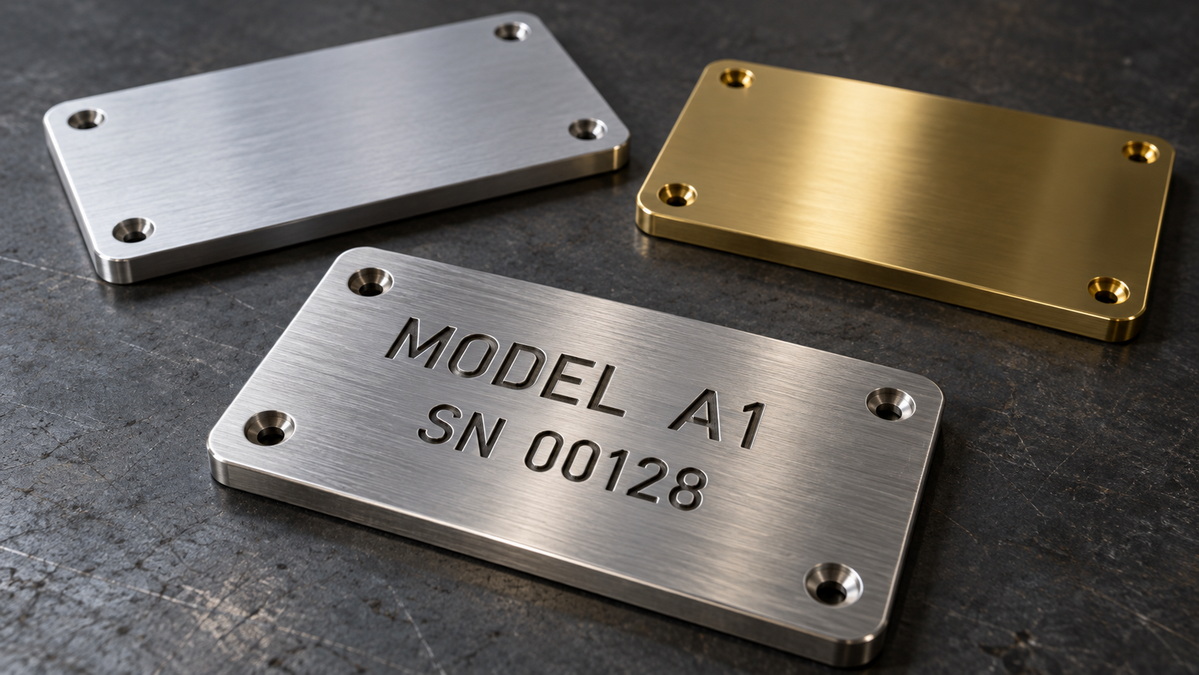
What Are Engraved Nameplates?
Engraved nameplates are identification plates with text, numbers, symbols, or graphics recessed into the substrate. They can identify machinery, label control panels, display equipment ratings, or add branding to finished products.
Common content includes:
- Manufacturer and product names.
- Model numbers and serial numbers.
- Electrical ratings and operating limits.
- Maintenance instructions and warning text.
- Barcodes or other machine-readable identifiers.
The important distinction is physical material removal. Not every product sold as "laser engraved" has a recessed mark. Some processes change surface color or remove a coating instead. Buyers should specify the result they need rather than relying on a broad process label.
How Custom Engraved Nameplates Are Made
Rotary Engraving: Mechanically Cut Characters
Rotary engraving uses a cutting tool to remove material along a programmed path. The recessed characters can remain unfilled or receive a contrasting paint fill.
This method is worth considering when a clearly recessed appearance matters. However, tool geometry influences fine details, and paint introduces another material that must tolerate the intended chemicals and temperatures.
Ask for a sample showing the smallest text, narrowest lines, and actual finish. A large logo on a demonstration plate does not establish whether your detailed artwork will reproduce successfully.
Laser Engraving: Material Removal by Focused Energy
Laser engraving removes material using concentrated energy. Equipment selection and processing settings depend on the substrate and the required marking result.
For procurement, request confirmation of whether the proposed process removes base material, removes only a surface layer, or changes the surface color. These outcomes can differ in texture, contrast, and performance.
Laser Annealing: A Different Marking Mechanism
Laser annealing can produce contrasting marks on suitable metals without removing material. It is therefore different from engraving, even when suppliers use the terms loosely.
Neither process is automatically superior. Specify the required appearance and exposure conditions, then evaluate the proposed process on production-representative samples.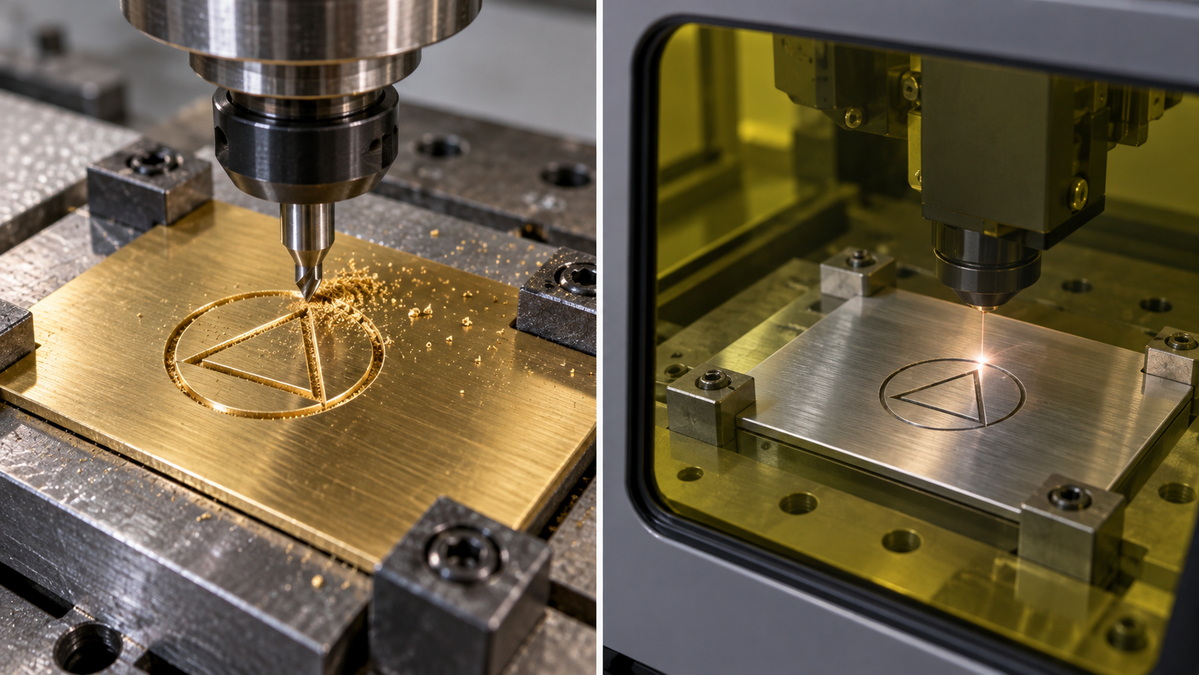
Choosing Materials for Engraved Nameplates
Material selection should begin with exposure conditions: indoor or outdoor use, moisture, cleaning agents, heat, abrasion, and the mounting surface.
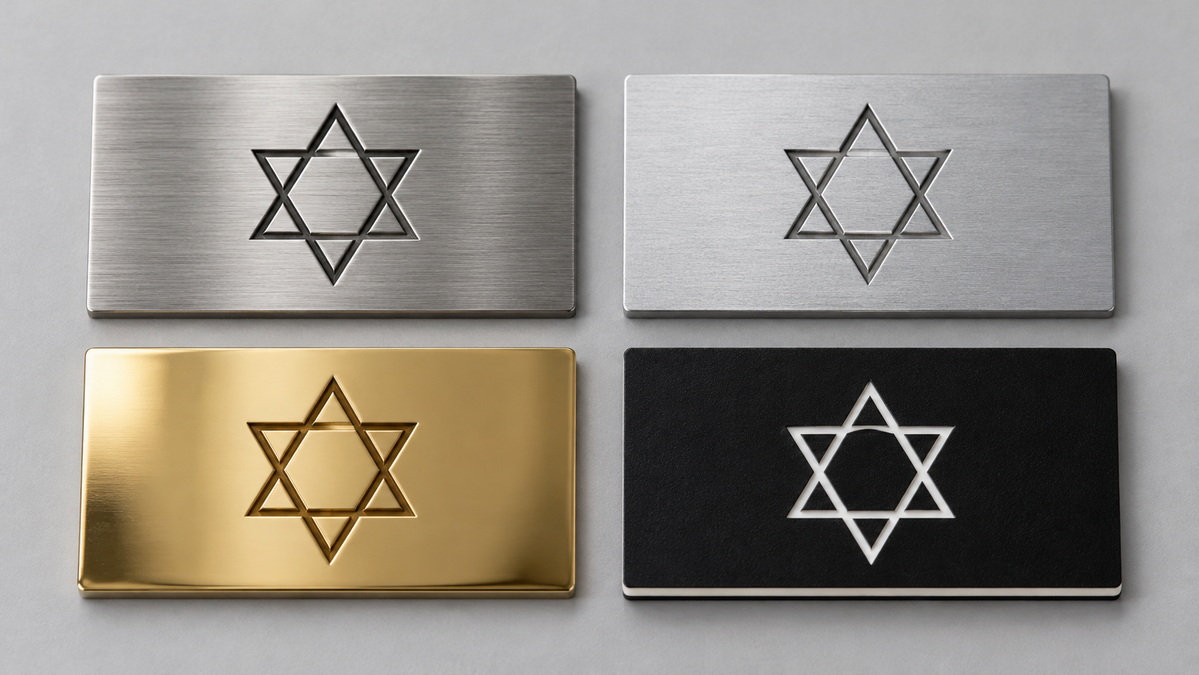
| Material | Typical applications | Main purchasing consideration |
| Stainless steel | Machinery identification and demanding equipment environments | Specify the grade, finish, and chemical exposure |
| Aluminum | Equipment plates, branded panels, and lightweight identification | Confirm the alloy, surface treatment, and marking contrast |
| Brass | Decorative branding, plaques, and furniture identification | Agree on the desired finish and acceptable appearance changes |
| Engraving laminate | Control panels and indoor equipment labels | Verify the exact grade and environmental suitability |
Stainless Steel Engraved Nameplates
Stainless steel is a useful starting point for many industrial applications, but "stainless" does not mean corrosion-proof. Chlorides can cause localized attack, including pitting and crevice corrosion.
For coastal installations or chemical cleaning, provide the actual exposure details. Avoid accepting a generic statement that a plate is suitable for "harsh environments." The alloy, surface condition, marking process, and installation all deserve review.
Aluminum and Decorative Metal Nameplates
Aluminum offers a lightweight option for equipment identification. Surface treatment and marking method affect the final appearance, so approve them together rather than as separate decisions.
Brass is often selected for its decorative character. For branded products, establish whether a changing appearance is acceptable and whether a protective finish is required.
Engraved Plastic Nameplates
Engraving laminates can reveal a contrasting layer beneath the surface, making them useful for readable equipment labels. However, indoor suitability does not establish outdoor performance.
Specify the exact material grade and processing method. Not all plastics are suitable for laser processing; PVC, for example, should not be treated as an interchangeable engraving material.
What Actually Determines Nameplate Durability?
My preferred purchasing question is not "How long does engraving last?" It is "What must remain readable, under which conditions, for how long?"
Durability has several independent parts:
1. Substrate survival: the plate must resist unacceptable corrosion, cracking, or deformation.
2. Marking survival: characters must remain identifiable after expected exposure.
3. Contrast retention: the information must remain readable under operating lighting.
4. Attachment reliability: the plate must stay in its intended position.
5. Data accuracy: the plate must carry the correct information from the beginning.
A recessed serial number can survive while its paint fill deteriorates. A readable plate can detach from a poorly prepared surface. Assess the complete identification system rather than engraving alone.
Designing Engraved Nameplates for Readability and Traceability
Establish an Information Hierarchy
Give critical operating information enough space. Separate ratings, warnings, model details, and branding so users can find each item quickly.
For industrial nameplates, prioritize:
- Clear character forms and sufficient spacing.
- Contrast under actual lighting conditions.
- Text sized for the expected reading distance.
- Consistent units and unambiguous symbols.
- A layout that keeps fasteners away from important information.
Review artwork at actual size. Enlarged screen previews can hide readability problems.
Verify Barcodes on Finished Plates
An attractive barcode is not proof of reliable scanning. Marking quality, glare, contamination, and scanner position can affect results.
Test the finished plate with the intended reader after installation. Define acceptance criteria before production, including any required verification method. Keep human-readable identifiers where operators need a fallback.
For serialized orders, approve both the layout and the data workflow. Confirm prefixes, leading zeros, sequence boundaries, duplicate prevention, and how rejected plates will be handled.
Mounting Engraved Nameplates: Adhesive or Mechanical Fixing?
Adhesive Mounting
Adhesive attachment can avoid drilling and preserve a clean appearance. Its suitability depends on the specific adhesive, mounting surface, preparation, temperature, and loading.
For certain VHB tape applications, published guidance describes bond strength building over time: approximately 50% after 20 minutes, 90% after 24 hours, and 100% after 72 hours at room temperature. These figures are not universal promises for every adhesive or installation.
Request instructions for the selected tape. Confirm surface preparation, application pressure, temperature limits, and the waiting period before loading or exposure.
Screws and Rivets
Mechanical fixing may be appropriate where the installation permits holes or where maintenance procedures favor replaceable plates.
Specify hole diameter, spacing, edge clearance, and fastener details on the drawing. Also assess the mounting interface, possible moisture traps, and compatibility between the plate, fasteners, and equipment surface.
The strongest plate is not necessarily the best installation if its attachment creates new problems.
A Practical Sample Approval Plan Before Mass Production
A drawing approval confirms intent. A physical sample helps confirm whether the proposed construction achieves it.
Use this five-step plan:
1. Inspect dimensions and finish. Check thickness, outline, holes, edges, surface treatment, and artwork position against the approved drawing.
2. Review readability. Inspect the smallest text under representative lighting and viewing angles.
3. Challenge the marking. Agree on exposure checks relevant to actual cleaners, abrasion, moisture, or temperature.
4. Evaluate the attachment. Install samples on the intended substrate using the proposed preparation procedure.
5. Confirm variable data. Compare engraved identifiers with the approved data file and test machine-readable codes.
Write acceptance criteria before testing. "Durable" is not a measurable result. Instead, define acceptable legibility, scanning performance, attachment condition, and appearance after the agreed exposure.
Do not convert a short sample test into an unsupported service-life guarantee.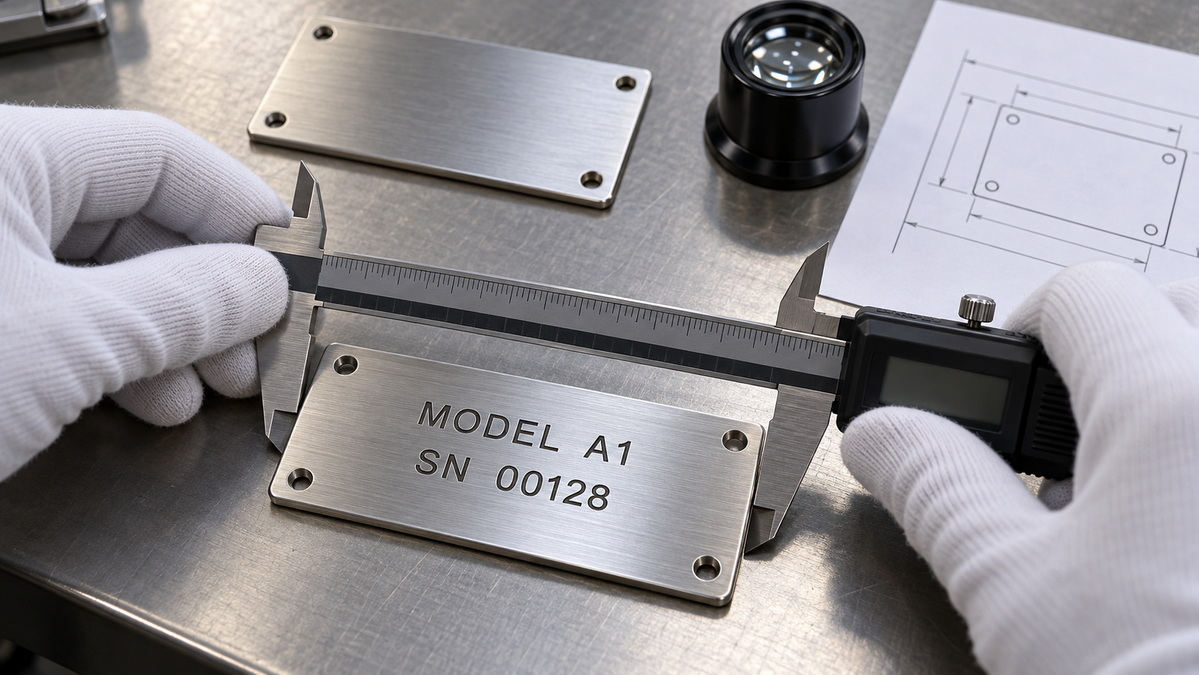
Example: Outdoor Pump Identification
Consider a hypothetical pump manufacturer sourcing identification plates for coastal installations. The initial request might simply say "engraved stainless steel."
A better specification adds chloride exposure, cleaning chemicals, reading distance, fixing details, and required serial-number format. Sample approval then checks the complete plate and installation against those conditions.
This is an illustrative procurement scenario, not a reported customer project or a claim of proven field performance.
Compliance and Purchasing Documentation
Engraving alone does not make a nameplate compliant with every product requirement. The applicable equipment standard and intended market determine what must be marked and how permanence is assessed.
Where a recognized marking and labeling system is required, review its documented conditions of acceptability. These can cover application surfaces, temperature ratings, environmental exposures, and other limitations.
A supplier's general certification statement does not replace verification that the proposed construction suits your application. Ask for relevant documentation before approving production, and do not assume that every mechanically attached metal plate follows the same evaluation route as an adhesive label.
What to Include in an Engraved Nameplate Quote Request
A complete inquiry makes quotations easier to compare and reduces avoidable revisions.
Send the following:
- Application: product type, destination market, installation location, and intended service conditions.
- Construction: preferred material, thickness, finish, dimensions, and tolerances.
- Artwork: editable files, fonts or outlined text, language versions, and color requirements.
- Marking: required process or performance, recessed depth if relevant, and paint-fill requirements.
- Attachment: adhesive specification or hole and fastener drawings.
- Variable data: serial-number rules, barcode format, and approved source files.
- Acceptance: sample requirements, inspection criteria, documentation, quantity, and delivery expectations.
When comparing prices, check that each quotation covers the same specification, sampling, inspection, and packaging. A lower unit price may reflect a different construction rather than better value.
Start Your Custom Nameplate Project With XingKun
Send Shenzhen XingKun Packing Products Co., Ltd. your artwork, dimensions, expected quantity, mounting details, and operating conditions. Ask our team to review the proposed construction, sample requirements, and quotation scope before you commit to production. A clearly specified nameplate is easier to approve, reproduce, and integrate into your finished product.
Frequently Asked Questions About Engraved Nameplates
Are engraved nameplates suitable for outdoor use?
Yes, when the material, marking, finish, and attachment suit the exposure. Outdoor suitability should be verified for the proposed construction rather than assumed from engraving alone.
Is stainless steel always better than aluminum?
No. Stainless steel may suit demanding applications, while aluminum can be appropriate when weight, appearance, and the operating environment favor it. Compare defined requirements rather than material names alone.
What is the difference between engraved and laser-marked nameplates?
Engraving removes material. Laser marking is a broader term that can include engraving, annealing, or coating removal. Ask the manufacturer to identify the actual mechanism.
Can engraved nameplates include serial numbers and barcodes?
Yes. Confirm data formatting, duplicate controls, and the proposed marking resolution. Test finished codes using the intended reading equipment before approving a serialized production run.
Do engraved nameplates need paint filling?
Not always. Paint can improve contrast, but it adds its own exposure limitations. Approve an unfilled and filled sample when the best option is unclear.
What should I send to request custom engraved nameplates?
Provide your drawing, quantity, application conditions, artwork, attachment requirements, and variable-data rules. Include any required standards or documentation so the proposal addresses the complete application.
References
1. American Nameplate Co. "All About Engraved Nameplates." Published January 31, 2020. Original article reviewed for topic coverage, conventional materials, rotary engraving, paint filling, and industrial applications. Its company-specific services, lead times, and promotional claims have not been transferred to XingKun. [american-nameplate]
2. Trotec Laser. "Can a Trotec Laser Machine Engrave and Mark Metal?" Technical explanation of engraving, annealing, and surface-layer removal; supports the distinction between recessed engraving and other laser-marking mechanisms. [troteclaser]
3. Trotec Laser. "Laser Marking Metal: Annealing." Explains color change without material removal and identifies process-related considerations for metal marking. [troteclaser]
4. Outokumpu. "What Makes Stainless Steel Corrosion Resistant?" Explains corrosion resistance and the risk of chloride-related pitting and crevice corrosion. [outokumpu]
5. Trotec Laser. "Laser Engraving Plastic Sheets." Describes engraving laminates and removal of the top layer to reveal contrasting material beneath. [troteclaser]
6. Trotec Laser. "Plastic Laser Marking and Cutting Machines." Identifies unsuitable plastics, including PVC, and the hazardous gases associated with processing them. [troteclaser]
7. 3M. "Surface Preparation for 3M™ VHB™ Tape Applications." Source for surface-preparation principles and approximate room-temperature bond-strength development of 50% after 20 minutes, 90% after 24 hours, and 100% after 72 hours. Actual performance remains application- and product-dependent. [3m]
8. UL Solutions. "Marking and Labeling Systems Program." Explains permanence evaluation and conditions of acceptability, including application surfaces, temperature ratings, and exposure limitations. [ul]
9. UL Solutions. "Marking and Labeling Systems FAQs." Clarifies how end-product requirements and documented application conditions affect the selection of recognized marking and labeling systems. [ul]
10. Shenzhen XingKun Packing Products Co., Ltd. Client-provided company brief. Source for the statements concerning more than 20 years of experience and service to brands and distributors in more than 30 countries and regions. No public verification page or customer reviews were supplied. The purchasing framework, sample-approval checklist, and hypothetical pump example are editorial recommendations, not reported test results or customer testimonials.


