Content Menu
● Common Nameplate Shapes and Their Best Applications
>> Rectangular Nameplates: Practical for Information-Heavy Layouts
>> Square Nameplates: Balanced for Compact Designs
>> Circular Nameplates: Strong for Centered Branding
>> Oval Nameplates: Suitable for Horizontal Brand Marks
>> Custom-Shaped Nameplates: Distinctive but Specification-Dependent
● How to Choose a Nameplate Shape: Five Practical Steps
>> 1. Define What the Nameplate Must Communicate
>> 2. Measure the Real Installation Area
>> 3. Establish a Readable Layout
>> 4. Match the Shape to the Attachment Method
>> 5. Compare Cost Across the Full Order Cycle
● Match Nameplate Materials and Adhesives to the Application
>> Consider the Complete Construction
>> Identify the Exact Mounting Surface
>> Separate Application Temperature From Service Temperature
● Why Nameplate Shape Alone Does Not Establish Compliance
● Validate Custom Nameplates Before Mass Production
>> Stage 1: Review the Drawing and Artwork
>> Stage 2: Inspect a Physical Sample
>> Stage 3: Test the Installed Construction
● A Practical Design Scenario: Branding Versus Equipment Data
● What to Include in a Custom Nameplate Inquiry
● Discuss Your Nameplate Design With XingKun
● Frequently Asked Questions About Nameplate Shapes
>> What Is the Best Shape for an Industrial Nameplate?
>> Are Rounded Corners Necessary for Adhesive Nameplates?
>> Can a Custom-Shaped Nameplate Cost More?
>> Which Nameplate Shape Is Best for a Logo?
>> Can One Adhesive Be Used on Every Product Surface?
>> What Should Buyers Approve Before Production?
● References
Common shapes for nameplates include rectangles, squares, circles, and ovals, but choosing the right outline involves more than appearance. A successful nameplate must fit the product, communicate clearly, support reliable attachment, and remain practical to manufacture.
At Shenzhen XingKun Packing Products Co., Ltd., we bring more than 20 years of printing and packaging experience to product identification and brand presentation. Having served brands and distributors across more than 30 countries and regions, we understand why buyers need specifications that work beyond the artwork approval stage.
Our starting point is simple: function should guide the shape. This guide explains how to compare common nameplate shapes, evaluate custom profiles, and prepare a specification that helps prevent avoidable production problems.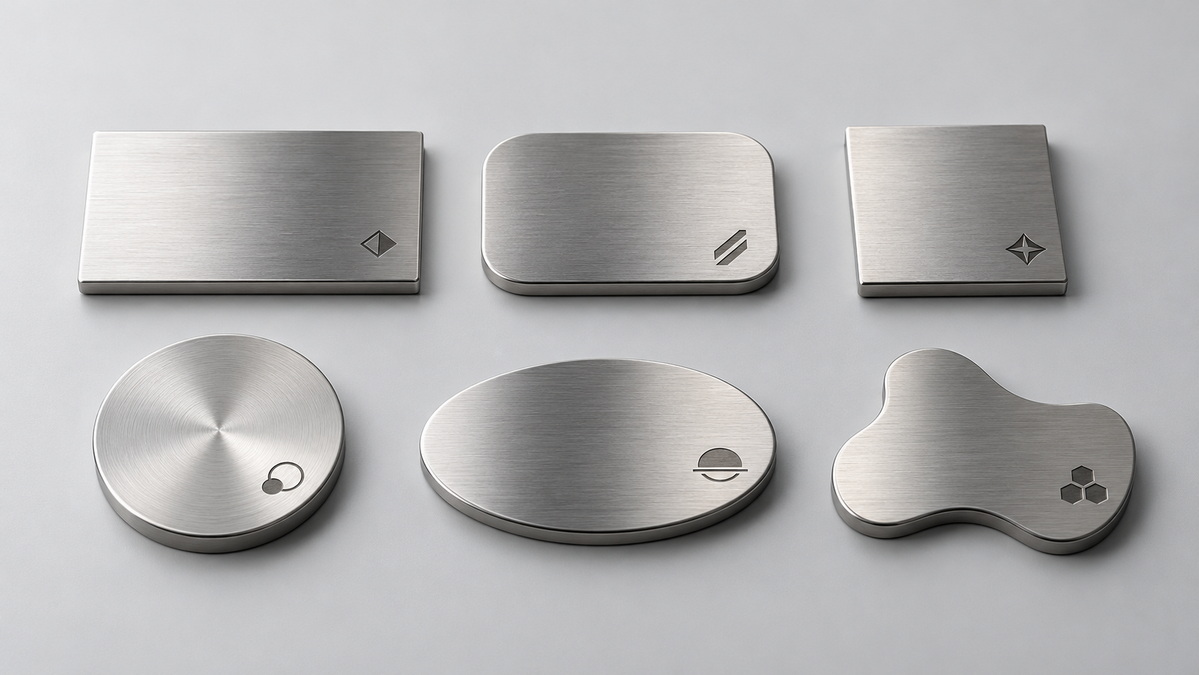
Common Nameplate Shapes and Their Best Applications
Each outline creates a different balance between usable space, visual character, and installation flexibility.
| Shape | Suitable applications | Main advantage | Design consideration |
| Rectangle | Equipment identification, specifications, serial numbers | Efficient space for structured information | Check corners, mounting clearance, and text margins |
| Square | Compact branding, short identification layouts | Balanced appearance | Confirm that required text remains readable |
| Circle | Logos, product badges, centered graphics | Strong visual focus | Less suitable for long text lines |
| Oval | Brand emblems, decorative identification | Accommodates horizontal logos | Tapered ends reduce usable text space |
| Custom contour | Distinctive branding, shaped recesses | Matches a specific identity or product feature | Review cutting method, tooling, and inspection requirements |
Rectangular Nameplates: Practical for Information-Heavy Layouts
Rectangular nameplates provide a straightforward format for model numbers, electrical ratings, manufacturer details, and operating information.
Their main advantage is layout efficiency. Designers can organize information into rows and columns without leaving large unused areas.
For industrial equipment, begin with the required content rather than a preferred plate size. Arrange the information at a readable scale, then determine the outline.
Rounded-corner rectangles offer another option. They preserve most of the available space while removing sharp external points. However, a corner radius alone does not guarantee reliable adhesion; the complete construction and installation conditions still matter.
Square Nameplates: Balanced for Compact Designs
Square nameplates suit layouts with similar horizontal and vertical proportions, such as a centered symbol above a short product identifier.
The limitation appears when additional information arrives late in development. A square layout can become crowded if buyers add multilingual wording, certification information, or tracking details.
Before approving the dimensions, include every required field. Reserve enough space for variable information and check the smallest text at actual size.
Circular Nameplates: Strong for Centered Branding
Circular nameplates work well with round logos, monograms, and compact emblems. They can also complement a circular product feature or mounting recess.
Their curved boundary makes long text lines less efficient. As text moves toward the top and bottom, the available width decreases.
Use circles when the message is brief. If the design includes substantial technical information, compare it with a rectangular alternative before committing.
Oval Nameplates: Suitable for Horizontal Brand Marks
Oval nameplates provide a distinctive frame for wordmarks and decorative product identification.
They offer more horizontal room than circles, but the tapered ends remain a constraint. Keep essential text within the central area rather than extending it toward the edges.
An oval should follow the proportions of the brand mark, not force the artwork into an unsuitable shape.
Custom-Shaped Nameplates: Distinctive but Specification-Dependent
Custom profiles can follow a logo, fit a recess, or accommodate surrounding components.
They deserve early manufacturing review. Narrow sections, pointed features, internal openings, and complex curves can affect cutting, handling, finishing, and inspection.
Ask the manufacturer to compare feasible production methods. A custom outline may require dedicated tooling, while another process may suit smaller quantities. The economical choice depends on material, thickness, geometry, quantity, and repeat-order expectations.
How to Choose a Nameplate Shape: Five Practical Steps
1. Define What the Nameplate Must Communicate
Separate essential information from optional decoration.
Typical content includes:
- Brand or manufacturer name.
- Model and serial numbers.
- Product ratings or operating limits.
- Required identification or safety information.
- Tracking codes or service details.
This distinction prevents visual styling from displacing information the end user actually needs.
2. Measure the Real Installation Area
Measure the product itself, not only the drawing.
Check the available width and height, nearby fasteners, surface curvature, recess depth, and access for installation.
A nameplate may fit within the visible space yet interfere with a screw head or bridge a curved surface. Record these constraints before selecting the outline.
3. Establish a Readable Layout
Print the artwork at its intended physical size.
Review it from the expected viewing position and under representative lighting. Check contrast, character spacing, and whether finishes create distracting reflections.
Do not solve overcrowding simply by shrinking every element. Consider increasing the plate size, changing the shape, or moving nonessential content elsewhere.
4. Match the Shape to the Attachment Method
Adhesive-backed and mechanically fastened nameplates need different design checks.
For adhesive attachment, evaluate the mounting surface and the complete bonding system.
For screws or rivets, define hole positions, hole sizes, and surrounding clearances. Confirm that the fastening arrangement does not obstruct the printed information.
Neither attachment method makes geometry irrelevant.
5. Compare Cost Across the Full Order Cycle
Compare more than the initial unit price.
Include tooling, samples, finishing, inspection, packaging, and repeat-order requirements. Ask whether tooling charges are separate and how approved production files will be controlled.
For recurring purchases, consistent specifications can matter as much as a small difference in quoted price.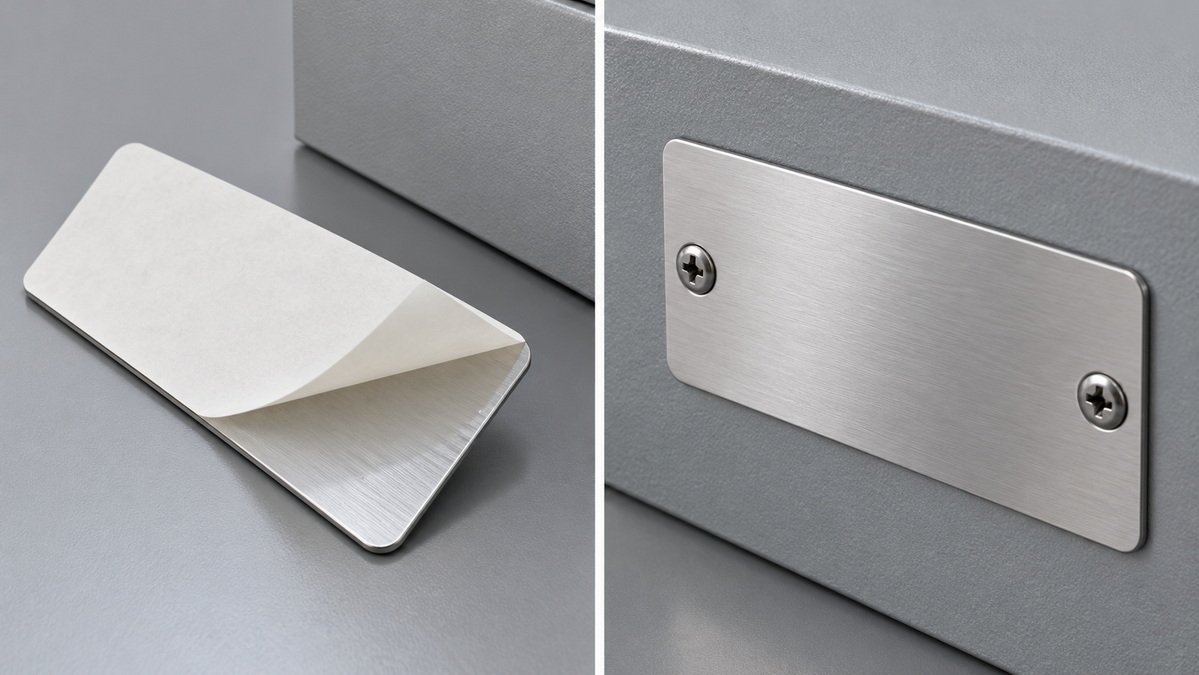
Match Nameplate Materials and Adhesives to the Application
Shape, material, printing, finish, and attachment should be specified together.
Consider the Complete Construction
Metal and polymer-based nameplates can serve different needs, but neither category is universally suitable.
Define the expected exposure before selecting the construction:
- Indoor or outdoor use.
- Operating temperature range.
- Moisture and sunlight.
- Cleaning agents or process chemicals.
- Abrasion and handling.
- Flat, textured, or curved mounting surfaces.
Avoid specifications such as "weatherproof" without explaining the actual environment. A meaningful requirement identifies the exposure and how acceptable performance will be evaluated.
Identify the Exact Mounting Surface
Adhesive performance depends partly on how effectively the adhesive contacts the substrate.
Bare metal, painted metal, powder coatings, and plastics should not be treated as interchangeable. Surface energy, texture, contamination, and coatings can influence bonding.
Tell the supplier exactly where the nameplate will be applied. When possible, provide a representative component or material sample.
This information is more useful than asking for the "strongest adhesive" without defining the application.
Separate Application Temperature From Service Temperature
Application temperature describes conditions during installation. Service temperature describes conditions after installation.
These limits are not necessarily identical.
A label material may tolerate demanding operating conditions after proper installation while requiring a warmer surface during application. Follow the selected material's technical instructions rather than transferring temperature claims from another product.
Why Nameplate Shape Alone Does Not Establish Compliance
A particular outline does not automatically make a nameplate compliant with an equipment requirement.
For adhesive-attached identification carrying safety-related information, suitability can depend on the evaluated label construction, printing system, application surface, temperature limits, and environmental exposure.
UL Solutions' marking and labeling program evaluates properties such as permanence, legibility, and adhesion. Its guidance also describes checking labels for problems including curling, wrinkling, shrinkage, and perimeter adhesion loss after conditioning.
If your product has applicable marking requirements:
1. Identify the end-product requirements.
2. Confirm the intended surface and environment.
3. Request documentation for the proposed construction.
4. Verify that the documented conditions match your application.
Do not assume that a material's recognition covers every ink, adhesive, substrate, or finished design.
Validate Custom Nameplates Before Mass Production
An attractive artwork proof cannot establish how a finished nameplate will perform.
A practical approval process should separate visual approval from application testing.
Stage 1: Review the Drawing and Artwork
Confirm the outline, dimensions, corner treatment, holes, text, colors, and variable-data fields.
Check the drawing revision and make sure the artwork matches it.
Stage 2: Inspect a Physical Sample
Evaluate dimensions, print clarity, finish, edges, and fit on the actual product.
For custom profiles, inspect narrow features and internal cutouts carefully. Confirm that the part can be handled and installed without unintended damage.
Stage 3: Test the Installed Construction
Apply or fasten the sample using the intended production method.
For adhesive-backed products, follow the supplier's surface preparation, pressure, and dwell-time instructions. Use cleaning methods compatible with both the substrate and workplace safety procedures.
Then expose the installed sample to conditions representative of its intended use.
Record the method and acceptance criteria. A documented test is more useful than an unsupported statement that the sample "looks durable."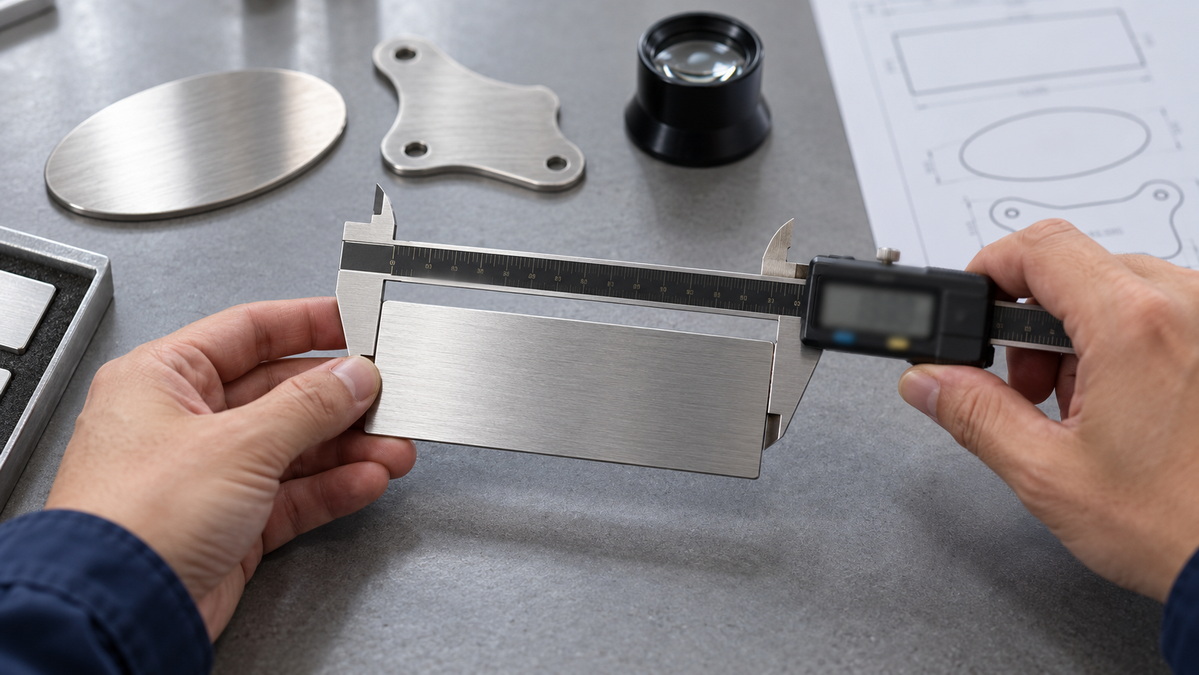
A Practical Design Scenario: Branding Versus Equipment Data
Consider a hypothetical appliance with a horizontal front panel and a textured rear housing.
The front nameplate carries only a logo. An oval or custom contour might support the intended appearance.
The rear nameplate carries model information, ratings, and a serial number. A rectangle may organize that content more effectively.
Although both parts belong to one product, they may need different materials, adhesives, layouts, and approval checks.
The lesson is not that one shape is superior. It is that a product family can benefit from different nameplate designs for different jobs.
This scenario illustrates a design approach, not a reported customer project or measured performance result.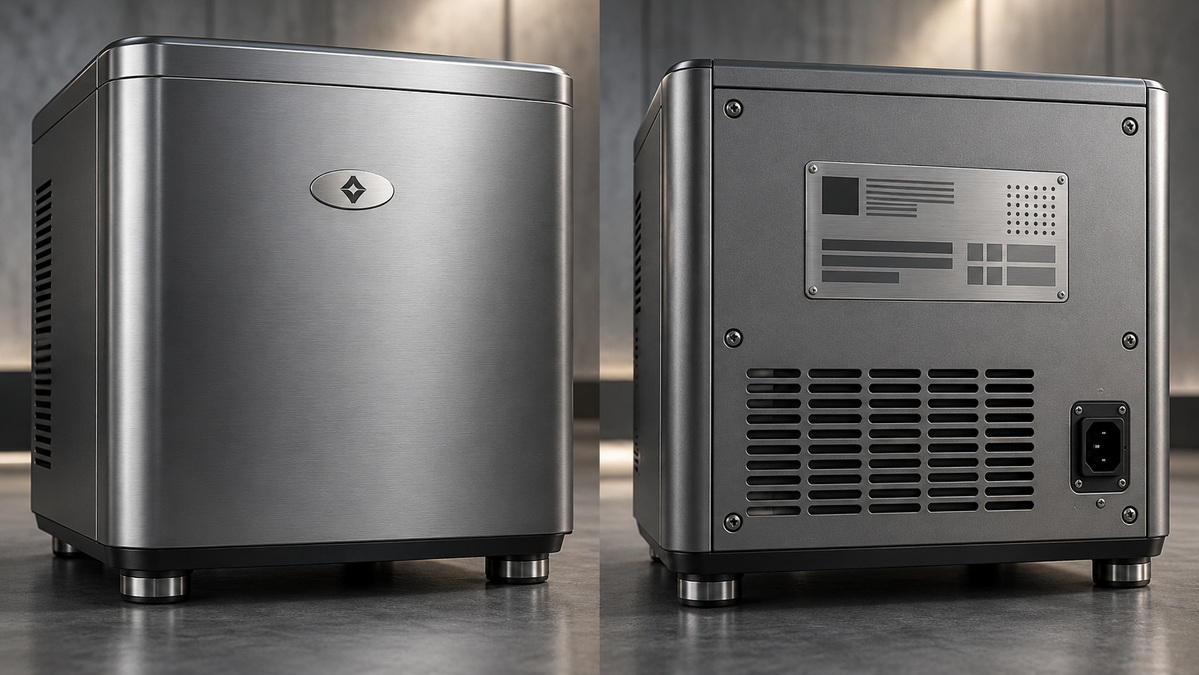
What to Include in a Custom Nameplate Inquiry
A detailed inquiry helps manufacturers compare realistic options and identify missing requirements early.
Provide the following:
- Dimensioned drawing and artwork.
- Preferred shape and acceptable alternatives.
- Material and thickness, if already determined.
- Mounting surface and attachment method.
- Hole locations and relevant tolerances.
- Environmental and cleaning conditions.
- Required text, languages, and variable data.
- Order quantity and anticipated repeat demand.
- Sample and approval requirements.
- Packaging, delivery, and documentation needs.
If a requirement is undecided, say so. Requesting recommendations is more productive than allowing an unstated assumption to become a production specification.
Discuss Your Nameplate Design With XingKun
Send Shenzhen XingKun Packing Products Co., Ltd. your artwork, dimensions, mounting-surface details, order quantity, and application conditions.
Ask us to review suitable shapes, material options, attachment requirements, and sample arrangements before you finalize the specification. Whether you need a straightforward identification plate or a distinctive branded outline, a clear brief is the first step toward a better-informed production decision.
Frequently Asked Questions About Nameplate Shapes
What Is the Best Shape for an Industrial Nameplate?
A rectangle is a practical starting point for information-heavy layouts because it accommodates rows and columns efficiently. However, the final choice should reflect the available mounting area, required content, attachment method, and application requirements.
Are Rounded Corners Necessary for Adhesive Nameplates?
Not universally. Rounded corners remove sharp external points, but they do not compensate for unsuitable adhesive, contamination, poor application, or an incompatible surface. Evaluate the complete construction and test it under representative conditions.
Can a Custom-Shaped Nameplate Cost More?
Yes. Complex geometry can introduce tooling, processing, handling, or inspection costs. Ask for a comparison based on the actual material, quantity, and production method rather than assuming every custom shape has the same cost premium.
Which Nameplate Shape Is Best for a Logo?
Choose an outline that supports the logo's proportions. Circles suit compact centered graphics; ovals can suit horizontal wordmarks; custom contours can follow distinctive artwork. Review the design at actual size before approval.
Can One Adhesive Be Used on Every Product Surface?
Do not assume so. Surface energy, texture, coatings, cleanliness, and operating conditions affect adhesive selection. Identify the actual substrate and confirm suitability through technical documentation and application testing.
What Should Buyers Approve Before Production?
Approve the drawing, artwork revision, material construction, attachment details, physical sample, and any required performance checks. Define acceptance criteria before production so both parties understand what a conforming nameplate must achieve.
References
1. [American Nameplate Co. — "Common Shapes for Nameplates"]. Original article used as the starting point for the discussion of rectangles, squares, circles, ovals, custom profiles, and potential tooling costs. [american-nameplate]
2. [3M — "Substrate Surface Consideration for Adhesive Selection"]. Technical basis for the discussion of substrate compatibility, surface energy, cleanliness, application pressure, and adhesive contact. [3m]
3. [3M — "Thermal Transfer Polyester Label Material 7810, 7813: Technical Data"]. Product-specific example demonstrating the distinction between minimum application temperature and service temperature. Its numerical ratings should not be generalized to other constructions. [multimedia.3m]
4. [UL Solutions — "Marking and Labeling Systems Program"]. Basis for the discussion of evaluated marking systems, environmental conditioning, legibility, adhesion, and post-conditioning inspection. [ul]
5. [UL Solutions — "Compliance Guidelines for Marking and Labeling Systems"]. Supporting guidance on permanent nameplates, representative application surfaces, exposure conditions, and temperature considerations. [ul]
6. [Shenzhen XingKun Packing Products Co., Ltd. — "About Us"]. Company background and printing-and-packaging scope. The company page states establishment in 2004; the service coverage of more than 30 countries and regions comes from the client-provided brief, not independently verified customer records. [xkdisplay]


