Content Menu
● What Is a Nameplate Used For?
● Nameplate vs. Label vs. Tag: What Is the Difference?
● How to Choose Custom Nameplate Materials
>> Aluminum Nameplates
>> Stainless Steel Nameplates
>> Plastic and Film Nameplates
>> Material Selection at a Glance
● Which Nameplate Printing or Marking Method Should You Choose?
>> Surface Printing
>> Reverse Printing
>> Engraving and Etching
● How to Specify a Custom Nameplate in Seven Steps
>> 1. Define the Nameplate's Function
>> 2. Describe the Exposure
>> 3. Identify the Mounting Surface
>> 4. Confirm Dimensions and Features
>> 5. Separate Fixed and Variable Information
>> 6. Define Acceptance Criteria
>> 7. Approve a Representative Sample
● Adhesive vs. Mechanical Attachment: What Buyers Should Check
>> Adhesive-Backed Nameplates
>> Mechanically Attached Nameplates
● Do Nameplates Need Certification?
● A Practical Nameplate Sample-Approval Checklist
● What to Send With Your Nameplate Quotation Request
● Frequently Asked Questions
>> 1. What Is the Main Purpose of a Nameplate?
>> 2. Is a Nameplate Always Made of Metal?
>> 3. What Is the Best Material for an Outdoor Nameplate?
>> 4. Can a Custom Nameplate Include a QR Code?
>> 5. What Makes Adhesive Nameplates Fail?
>> 6. What Should I Approve Before Mass Production?
● References
A nameplate is a plate, label, or tag that identifies a product, machine, component, organization, or person. Depending on its purpose, it may display a brand name, model number, serial number, operating instructions, or safety information. Custom nameplates range from decorative product badges to durable identification plates used on industrial equipment.
For buyers, the important question is not simply what a nameplate looks like. It is whether the complete construction—material, marking method, protective finish, and attachment—will remain suitable throughout the intended use.
At Shenzhen XingKun Packing Products Co., Ltd., we bring more than 20 years of printing and packaging experience to customer projects. We have served brands and distributors across more than 30 countries and regions. Our starting principle is straightforward: define the application before selecting the appearance.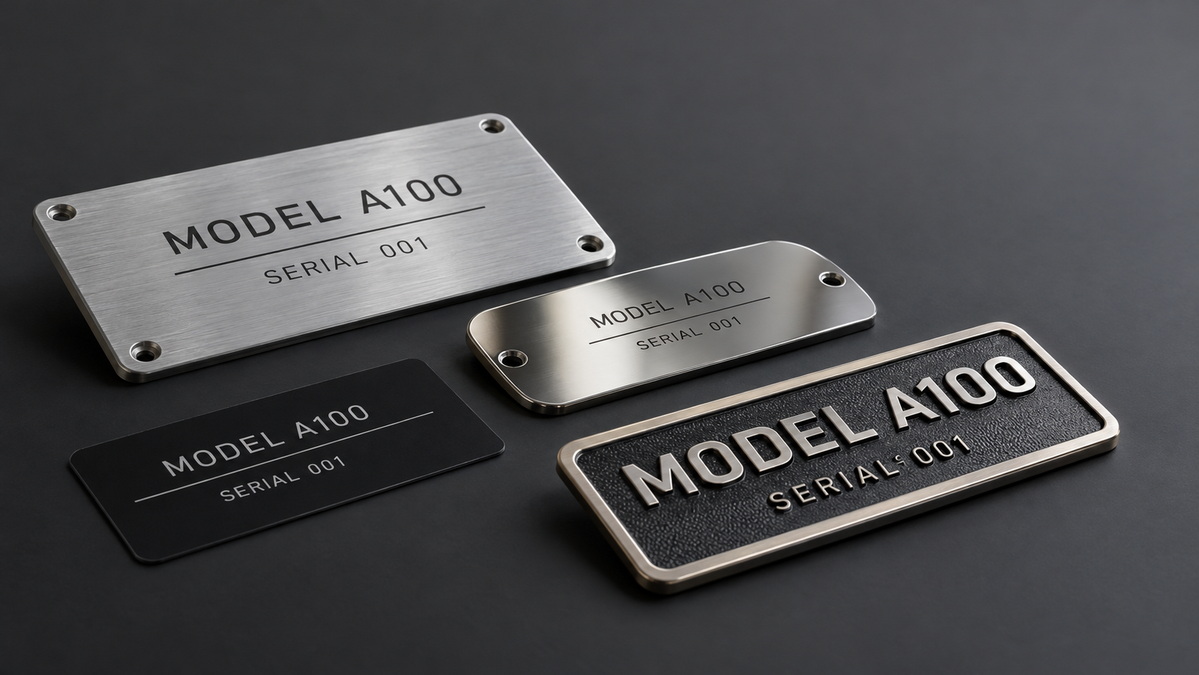
What Is a Nameplate Used For?
A nameplate connects a physical product with the information people need to recognize, operate, maintain, or trace it.
Its content depends on the product and application. A decorative badge may need only a logo. An equipment identification plate may require several technical fields.
Common uses include:
- Brand identification on appliances, furniture, electronics, and packaging.
- Product identification through model numbers and manufacturing details.
- Asset tracking using serial numbers, barcodes, or QR codes.
- Operating guidance on controls, instruments, and machinery.
- Safety communication where durable warnings or instructions are required.
- Workplace identification on desks, doors, and cabinets.
These functions can overlap. A machine nameplate may combine branding, technical information, and traceability. The challenge is to establish a readable hierarchy rather than give every element equal visual weight.
Nameplate vs. Label vs. Tag: What Is the Difference?
Industry terminology is not completely standardized. One buyer's "machine label" may be another supplier's "identification nameplate."
The original American Nameplate article illustrates this overlap by listing graphic overlays, instruction plates, faceplates, safety labels, and serialization plates within the wider nameplate category.
| Term | Common interpretation | Typical application |
| Nameplate | Identification component, often intended for extended use | Equipment identification or product branding |
| Label | Printed information carrier, frequently adhesive-backed | Instructions, warnings, or product information |
| Tag | Identifier often attached through a hole, loop, or fastener | Valves, assets, or movable components |
| Graphic overlay | Printed interface layer with openings or functional areas | Control panels and instruments |
| Badge | Primarily decorative or brand-focused identifier | Consumer products and presentation packaging |
These are working distinctions, not universal rules. A flexible label can serve as a permanent nameplate, while a metal plate can perform a largely decorative role.
When requesting quotations, describe the function and construction rather than relying on the product name alone.
How to Choose Custom Nameplate Materials
No material is automatically best. Selection should reflect exposure, appearance, installation, and the required information lifespan.
Aluminum Nameplates
Aluminum is worth considering when a project needs a relatively lightweight metal identification component.
However, the base metal is only part of the specification. The marking process, finish, thickness, and mounting arrangement all affect suitability.
Ask the supplier to explain how the proposed construction addresses the actual exposure conditions.
Stainless Steel Nameplates
Stainless steel is another candidate for demanding identification applications, particularly where cleaning, handling, or chemical exposure influences the specification.
Do not treat "stainless steel" as a complete material description. Specify the grade where necessary and identify the cleaning agents, concentrations, temperatures, and contact times involved.
A general corrosion-resistance claim does not establish compatibility with every environment.
Plastic and Film Nameplates
Plastic and film constructions can be considered for lightweight identification, detailed graphics, and interface applications.
They deserve particular attention when the design includes multiple colors, transparent areas, or a low-profile adhesive-backed format.
Suitability still depends on the exact film, ink, adhesive, protective layer, and exposure conditions.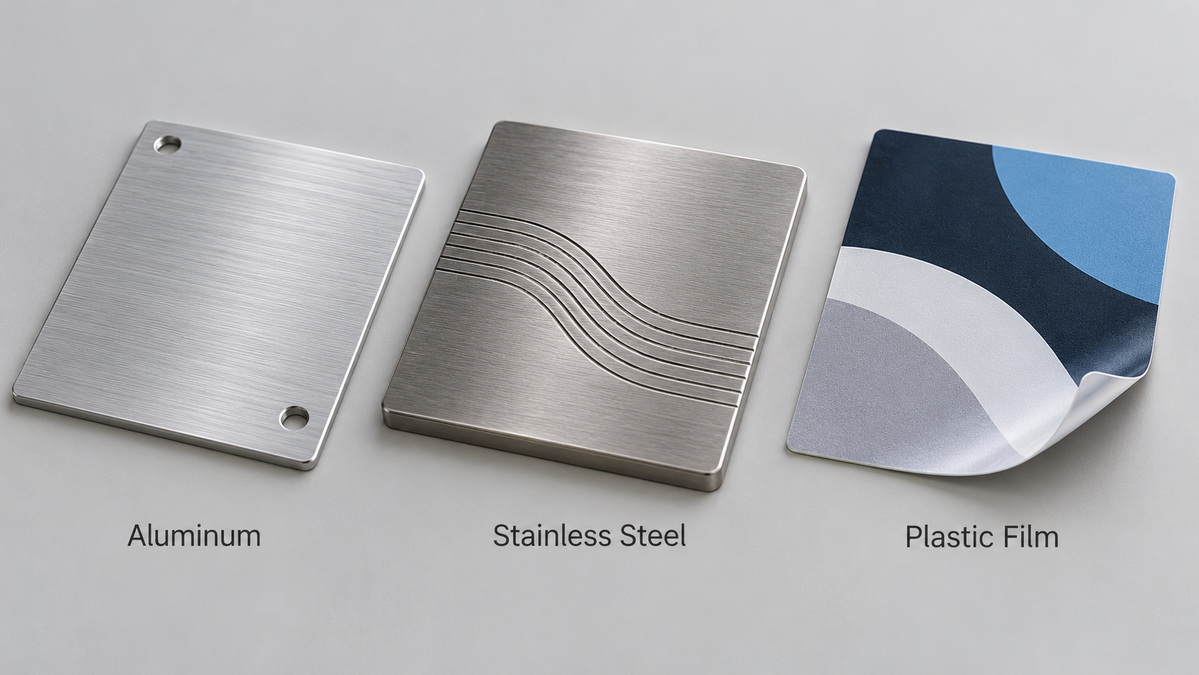
Material Selection at a Glance
| Project priority | Construction to investigate | Important verification |
| Lightweight metallic appearance | Aluminum | Finish and marking durability |
| Frequent cleaning or demanding exposure | Appropriate stainless steel construction | Chemical compatibility |
| Detailed graphics and interface features | Plastic or film system | Print protection and dimensional fit |
| Adhesive-backed installation | Compatible plate or film with selected adhesive | Bond performance on the actual surface |
Use this table to narrow options, not to replace application testing.
Which Nameplate Printing or Marking Method Should You Choose?
A quotation that specifies only "printed nameplate" leaves important questions unanswered.
Ask how the information is created, whether it receives protection, and what evidence supports the intended service conditions.
Surface Printing
Surface printing is an option to discuss when a design emphasizes colors, logos, or detailed graphics.
The review should address ink compatibility, abrasion exposure, cleaning, and any proposed protective coating or laminate.
A visually accurate first sample does not establish long-term durability.
Reverse Printing
For suitable transparent constructions, reverse printing places the graphic behind the viewing surface.
This can help separate the printed image from direct contact. However, it does not remove the need to assess the front surface, edges, adhesive, and environmental suitability.
Engraving and Etching
Engraving and etching are marking options to evaluate for identification plates.
Their suitability depends on the material, character size, process details, contrast, and intended exposure. Recessed information is not automatically readable under every lighting condition.
Request a sample that uses the smallest text and most demanding detail in the actual design.
How to Specify a Custom Nameplate in Seven Steps
A clear specification reduces assumptions and makes supplier quotations easier to compare.
1. Define the Nameplate's Function
Identify whether the part primarily supports branding, operation, safety, traceability, or several functions together.
This determines which information must remain readable and which elements are decorative.
2. Describe the Exposure
List indoor or outdoor use, temperature conditions, sunlight, moisture, cleaning chemicals, abrasion, and expected handling.
Replace vague descriptions such as "harsh conditions" with measurable details wherever possible.
3. Identify the Mounting Surface
Specify the actual substrate: painted steel, powder-coated metal, plastic, glass, or another surface.
Include texture, curvature, and available installation space. A smooth laboratory panel may not represent the finished product.
4. Confirm Dimensions and Features
Provide overall dimensions, thickness requirements, corner shapes, mounting holes, cutouts, and tolerances.
For overlays, check alignment against the mating component rather than reviewing artwork alone.
5. Separate Fixed and Variable Information
Identify which elements stay unchanged and which vary by unit or batch.
Typical variable fields include serial numbers, manufacturing dates, barcodes, and destination-specific information.
6. Define Acceptance Criteria
Agree on what constitutes an acceptable result.
Possible checks include text accuracy, dimensions, color references, adhesion, appearance after cleaning, and code readability.
7. Approve a Representative Sample
Where practical, evaluate the proposed production construction on the actual mounting surface.
Artwork approval confirms content and layout. It does not, by itself, confirm attachment performance or environmental suitability.
Adhesive vs. Mechanical Attachment: What Buyers Should Check
Attachment deserves the same attention as the printed face.
An attractive plate that lifts, moves, or detaches cannot perform its identification function reliably.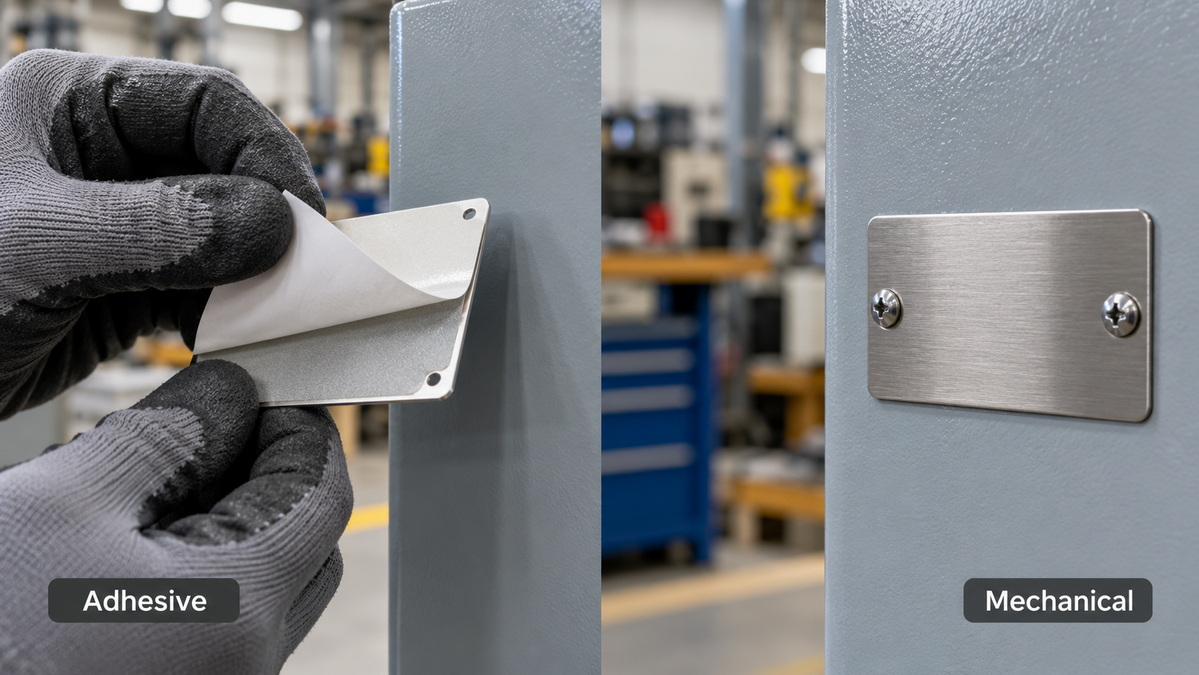
Adhesive-Backed Nameplates
For adhesive-backed constructions, ask about:
- Compatibility with the actual substrate.
- Surface preparation requirements.
- Application temperature and pressure.
- Time before handling or service exposure.
- Performance on textured or curved surfaces.
3M's VHB tape guidance emphasizes clean, dry, unified surfaces and adequate application pressure. Its instructions also show why surface preparation must be matched to the substrate.
Follow the selected adhesive manufacturer's instructions rather than transferring one tape's procedure to every product.
Mechanically Attached Nameplates
Screws, rivets, or other fasteners introduce different design questions.
Check hole locations, edge clearance, installation access, and whether the assembly permits drilling or penetration.
Confirm the attachment method with the product designer before finalizing the plate drawing.
Do Nameplates Need Certification?
Not every nameplate requires third-party evaluation. Requirements depend on the product, destination market, information displayed, and applicable end-product requirements.
UL Solutions evaluates certain marking and labeling systems for permanence when they carry safety-related information.
UL 969 addresses labels and related products used as permanent nameplates or markings. Importantly, suitability is assessed for specified uses and surfaces, and acceptance in an application depends on the requirements for the finished product.
For procurement, this creates a crucial distinction: a recognized material or label system is not blanket approval for every construction or installation.
Before production, confirm:
1. Which marking requirements apply to the finished product.
2. Whether an evaluated labeling system is necessary.
3. Whether the proposed construction matches the relevant conditions of use.
4. Who approves the final technical content.
Do not add certification symbols merely as decorative artwork.
A Practical Nameplate Sample-Approval Checklist
Sample evaluation should answer two questions: "Is it correct?" and "Will it work here?"
| Check | What to examine |
| Information accuracy | Model numbers, units, spelling, symbols, and serial formats |
| Readability | Smallest text, contrast, glare, and installed viewing conditions |
| Dimensional fit | Outline, holes, cutouts, and alignment |
| Attachment | Bond or fastening performance on the intended assembly |
| Exposure response | Legibility and condition after agreed application-relevant tests |
| Digital identification | Barcode or QR-code readability before and after testing |
Set the test conditions and pass/fail criteria before testing begins.
A claim such as "waterproof" or "chemical resistant" is incomplete unless the exposure and acceptance conditions are defined.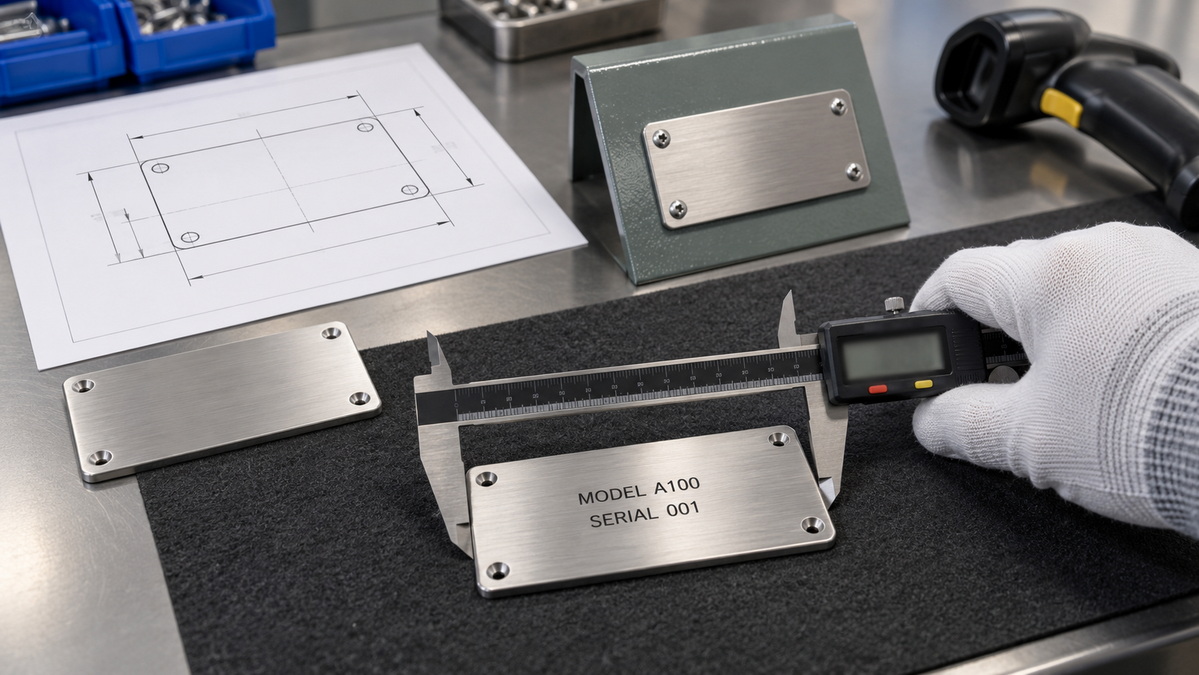
What to Send With Your Nameplate Quotation Request
A useful inquiry includes more than a logo and quantity.
Send the supplier:
- Artwork and a dimensioned drawing.
- Intended application and mounting surface.
- Environmental and cleaning conditions.
- Preferred material, if already specified.
- Attachment requirements.
- Fixed and variable information.
- Order quantity and repeat-order expectations.
- Applicable marking requirements.
- Sample and delivery expectations.
For a faster project review, send Shenzhen XingKun Packing Products Co., Ltd. your artwork, dimensions, intended use, mounting surface, and quantity. Ask us to confirm the proposed construction, sample plan, and quotation scope before production approval.
Frequently Asked Questions
1. What Is the Main Purpose of a Nameplate?
Its main purpose is identification. Depending on the application, it may also communicate operating information, safety instructions, technical ratings, or traceability details.
2. Is a Nameplate Always Made of Metal?
No. A nameplate can use metal, plastic, film, or another suitable construction. The function and performance requirements matter more than the terminology.
3. What Is the Best Material for an Outdoor Nameplate?
There is no universal answer. Evaluate the complete construction against sunlight, moisture, temperature, abrasion, and attachment conditions. Request evidence or testing relevant to the intended installation.
4. Can a Custom Nameplate Include a QR Code?
Yes, when the selected design and production process can reproduce it reliably. Test the finished code at its actual size and after relevant exposure. Also plan who will maintain the linked destination.
5. What Makes Adhesive Nameplates Fail?
Potential causes include incompatible surfaces, contamination, unsuitable application conditions, or an adhesive that does not match the exposure. Investigate the complete installation process rather than assuming the plate material caused the problem.
6. What Should I Approve Before Mass Production?
Approve the information, artwork, dimensions, construction, attachment method, and acceptance criteria. For performance-critical applications, include representative sample testing rather than relying only on a digital proof.
References
- [American Nameplate — "What Is a Nameplate?"]
Source for overlapping industry terminology and the original article's discussion of nameplates, labels, tags, and related identification products. [american-nameplate]
- [UL Solutions — Marking and Labeling Systems Program]
Source for the evaluation of marking systems, permanence requirements, and distinctions between program categories and intended uses. [ul]
- [UL Standards & Engagement — UL 969, Marking and Labeling Systems]
Source for the standard's scope, application-specific acceptance, and evaluation for specified surfaces and uses. [shopulstandards]
- [UL Solutions — Compliance Guidelines for Marking and Labeling Systems]
Source for the relationship between labeling requirements, finished-product standards, permanence, and legibility. [ul]
- [3M — Surface Preparation for VHB Tape Applications]
Source for VHB-specific surface preparation and application guidance; not presented as a universal procedure for all adhesives. [3m]
- [Shenzhen XingKun Packing Products Co., Ltd. — About Us]
Source for the company's establishment in 2004 and printing and packaging background. The statement about serving more than 30 countries and regions was supplied by the company for this brief. No customer testimonials were provided or invented. [xkdisplay]


