Content Menu
● Why Age-Appropriate Puzzles Matter
>> What Research Actually Says About Puzzle Play
● Puzzle Piece Count by Age: A Practical Starting Guide
● How to Choose Puzzles for Toddlers and Preschoolers
>> Under Age 2: Prioritize Safety and Simple Handling
>> Ages 2–3: Look for Clear Matching Tasks
>> Ages 3–5: Introduce Interlocking Pieces Gradually
● How to Choose Jigsaw Puzzles for School-Age Children
>> Ages 5–8: Build on Experience, Not Assumptions
>> Ages 8 and Older: Offer Meaningful Choice
● Why Two Puzzles with the Same Piece Count Can Feel Different
>> An Illustrative Example
● A Practical Five-Step Method for Testing Puzzle Suitability
>> Step 1: Check Safety Before Starting
>> Step 2: Watch the Child's First Approach
>> Step 3: Change One Thing
>> Step 4: Offer a Prompt Before Taking Over
>> Step 5: Use the Experience to Guide the Next Purchase
● Choosing Puzzles for Children with Different Support Needs
● Puzzle Safety: What Parents and Buyers Should Verify
>> Separate Safety Suitability from Challenge Level
>> Do Not Rely on "Non-Toxic" as a Complete Safety Statement
● Custom Children's Puzzles: An OEM/ODM Buyer's Checklist
>> Define the Intended User Before Choosing the Cut
>> Review a Physical Sample, Not Just a Digital Mockup
>> Treat Packaging as Part of the User Experience
● Request a Custom Children's Puzzle Proposal from XingKun
● Conclusion
● Frequently Asked Questions
>> 1. How many puzzle pieces should a three-year-old have?
>> 2. Is a 100-piece puzzle suitable for a five-year-old?
>> 3. Are wooden puzzles always safer than cardboard puzzles?
>> 4. Can puzzles improve children's spatial skills?
>> 5. What should I do when a child becomes frustrated?
>> 6. How should a brand choose an age label for a custom puzzle?
>> 7. What information does XingKun need for a puzzle quotation?
>> Source and Editorial Notes
Learning how to choose a puzzle for children by age starts with a simple principle: match the puzzle to the child's current abilities, not just the birthday printed on the box. Age guidance matters, especially for safety, but interests, experience, piece size, and the type of puzzle also affect whether an activity feels enjoyable or frustrating. The U.S. Consumer Product Safety Commission recommends choosing toys that match children's interests and abilities while following the safety information on the packaging. [cpsc]
The most useful keyword in puzzle selection is fit: the fit between the child, the challenge, and the product.
For parents, this means looking beyond a piece-count label. For brands, wholesalers, and educational product developers, it means treating age suitability as a design decision—not simply a marketing statement.
This guide combines published child-development and safety guidance with a practical product-selection framework. It also explains what international buyers should discuss when developing custom children's puzzles with an OEM/ODM manufacturing partner.
Why Age-Appropriate Puzzles Matter
A well-chosen puzzle gives a child an achievable problem to explore. The activity can involve recognizing shapes, comparing colors, moving pieces, and testing possible solutions. The American Academy of Pediatrics identifies traditional manipulative toys, including puzzles, as opportunities to support fine-motor skills and problem-solving. [healthychildren]
However, educational value does not come from making the puzzle as difficult as possible.
A useful buying question is:
"Can this child make meaningful progress while still having something new to figure out?"
That question keeps the focus on participation rather than performance.
What Research Actually Says About Puzzle Play
A University of Chicago study followed 53 child-parent pairs and examined puzzle play during interactions recorded between 26 and 46 months of age. Children observed playing with puzzles performed better on a spatial-transformation task at 54 months, even after researchers accounted for several background factors. [news.uchicago]
This is useful evidence, but it needs careful interpretation. The study identified an association; it did not establish that purchasing a particular puzzle would cause higher intelligence or guarantee stronger mathematics performance. [news.uchicago]
For families and product marketers, the responsible message is that puzzles offer opportunities for spatial play—not a promised developmental outcome.
Puzzle Piece Count by Age: A Practical Starting Guide
Piece count is helpful, but it is not a complete measure of difficulty. CPSC age-determination guidance considers characteristics such as the number and size of parts, motor skills required, and whether the pieces are interlocking or placed in a frame. [cpsc]
The following table is an editorial shopping framework, not a clinical milestone chart or a legal age-grading standard. The suggested ranges are deliberately flexible. Always follow the actual product's safety classification.
| Child’s age or stage | Puzzle format to consider | Illustrative starting range | What to evaluate first |
| Under 2 years | Simple inset puzzles specifically designed for the labeled age | A few large pieces | Product safety, graspability, and simple matching |
| 2–3 years | Large-piece inset or beginner framed puzzles | Approximately 4–12 pieces | Clear shapes, manageable handling, and age suitability |
| 3–4 years | Simple framed or introductory jigsaw puzzles | Approximately 8–24 pieces | Familiar pictures and obvious visual differences |
| 4–5 years | Beginner interlocking jigsaw puzzles | Approximately 12–48 pieces | Previous experience and ability to connect pieces |
| 5–6 years | More detailed children’s jigsaw puzzles | Approximately 24–60 pieces | Sorting opportunities and persistence |
| 6–8 years | Intermediate jigsaw puzzles | Approximately 50–150 pieces | Artwork complexity and independent strategy |
| 8–10 years | More involved jigsaw projects | Approximately 100–300 pieces | Interest, experience, and available workspace |
| 10 years and older | Larger or more challenging puzzles | Approximately 200–500 pieces or more | Personal preference and established skill |
Do not treat the upper number as a target. A child who enjoys repeating a familiar puzzle does not need a harder one simply because another birthday has arrived.
Equally, an experienced older child may comfortably exceed these illustrative ranges. The purpose is to identify a starting point, then adjust.
How to Choose Puzzles for Toddlers and Preschoolers
Under Age 2: Prioritize Safety and Simple Handling
For the youngest children, choose only products explicitly designed for their age group.
Inspect how pieces are held and moved. A puzzle that looks simple to an adult may still require more precise handling than the child can comfortably manage.
Safety takes priority over educational claims. In the United States, products intended for children under three that present a small-parts choking, aspiration, or ingestion hazard are subject to the small-parts ban. [cpsc]
Do not assume that supervision turns an unsuitable small-piece puzzle into an appropriate toddler toy.
Ages 2–3: Look for Clear Matching Tasks
Simple puzzles can give toddlers opportunities to match shapes and recognize relationships between objects. The American Academy of Pediatrics describes shape-sorting toys and simple jigsaw puzzles as examples of activities connected with a two-year-old's emerging understanding of these relationships. [healthychildren]
When comparing products, consider:
- Whether each piece represents a recognizable object.
- Whether the tray makes the destination easy to understand.
- Whether pieces can be picked up comfortably.
- Whether the product's age label matches the intended user.
For an initial shopping shortlist, a few clearly different pieces may be more useful than a crowded image with many similar sections.
Ages 3–5: Introduce Interlocking Pieces Gradually
Preschool puzzle selection should account for both visual understanding and physical handling.
A child might recognize where a piece belongs but still find it difficult to rotate and connect it. CPSC guidance notes that three-year-olds have developing fine-motor skills and visual discrimination, and some may still benefit from knobs or an inset frame. [cpsc]
A practical progression is:
1. Start with a familiar image.
2. Choose a manageable number of large pieces.
3. Introduce interlocking connections.
4. Increase either picture complexity or piece count.
5. Reassess before increasing both.
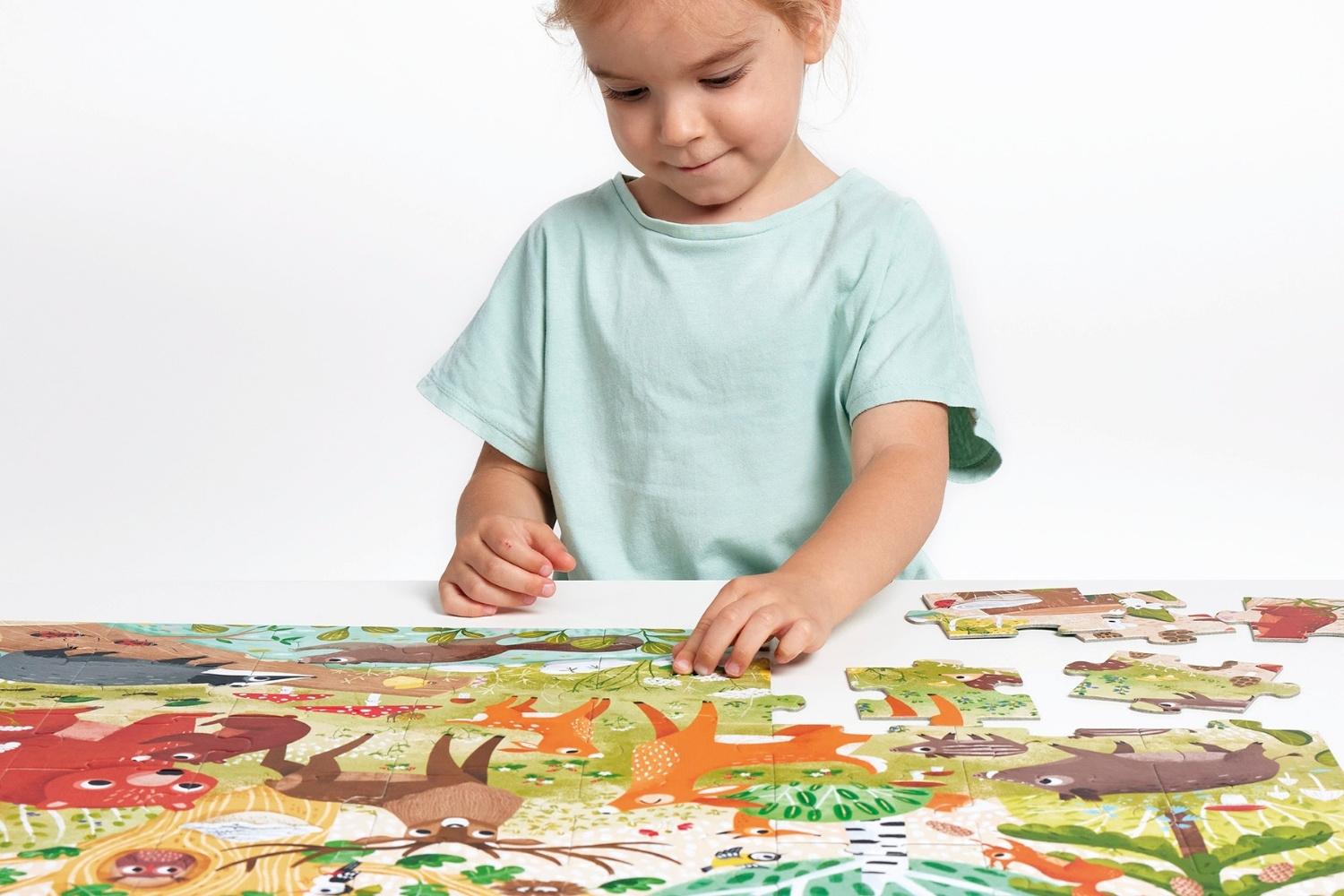
A simple animal scene with distinct objects is a different challenge from an illustration filled with nearly identical leaves, even when both contain the same number of pieces.
How to Choose Jigsaw Puzzles for School-Age Children
Ages 5–8: Build on Experience, Not Assumptions
For school-age children, ask what they already enjoy completing.
A first-time puzzler may prefer a smaller puzzle that feels achievable. A child with regular puzzle experience may enjoy a more involved image without needing much assistance.
When comparing two options, ask:
- Does the picture contain recognizable sections?
- Can the child distinguish different areas by color or subject?
- Is there a useful reference image?
- Will the puzzle fit on the available table or floor space?
- Is the child interested in the theme?
These questions provide a more useful product comparison than choosing the largest piece count within a price range.
Ages 8 and Older: Offer Meaningful Choice
For older children, involve them in selecting the theme and challenge.
Possible directions include wildlife, maps, illustrated stories, vehicles, or original artwork. Treat these as choices, not age-based prescriptions.
One child may want a long project with hundreds of pieces. Another may prefer a smaller puzzle with a favorite subject. Neither preference needs to become a judgment about ability.
A practical approach is to discuss the intended experience first: a quick independent activity, a shared family project, or a challenge completed across several sessions.
Why Two Puzzles with the Same Piece Count Can Feel Different
Piece count describes quantity. It does not describe every demand placed on the solver.
For a more useful comparison, evaluate five dimensions:
| Dimension | Easier starting option | More demanding option |
| Visual differentiation | Distinct objects and color areas | Repeated textures or similar colors |
| Piece handling | Larger, easily grasped pieces | Smaller pieces requiring precise placement |
| Format | Inset tray or supportive frame | Unframed interlocking puzzle |
| Image reference | Clear picture available throughout | Limited or intentionally absent reference |
| Previous experience | Familiar format and theme | Several unfamiliar features at once |
This comparison is an editorial decision tool rather than a validated difficulty scale. Its purpose is to help buyers identify why a puzzle may be challenging before assuming the piece count is wrong.
An Illustrative Example
Imagine two 48-piece puzzles.
The first shows six clearly separated vehicles, each in a different color. The second shows a field of similar flowers.
Although the quantities match, the second offers fewer obvious visual landmarks. A child who manages the vehicle puzzle may still need help organizing the flower image.
The purchasing lesson is straightforward: compare the artwork and construction alongside the number on the box.
A Practical Five-Step Method for Testing Puzzle Suitability
This method is a suggested home or classroom routine, not a diagnostic assessment.
Step 1: Check Safety Before Starting
Read the age guidance and warnings. Inspect the puzzle for damage, missing components, or loose elements.
Keep small-piece puzzles away from younger siblings. CPSC specifically advises keeping toys with small parts away from children under three. [cpsc]
Step 2: Watch the Child's First Approach
Give the child an opportunity to explore.
Notice whether they study the image, identify a recognizable section, or immediately need help handling the pieces. You are gathering information about the activity—not testing the child.
Step 3: Change One Thing
If the full puzzle feels overwhelming, simplify the presentation:
- Offer pieces from one recognizable section.
- Keep the reference image visible.
- Start a small part together.
- Move the activity to a more comfortable workspace.
Changing one element makes it easier to understand what helped.
Step 4: Offer a Prompt Before Taking Over
Try a specific observation:
- "This piece has part of a wheel."
- "Which piece has the same blue?"
- "What happens when you turn it?"
The AAP notes that preschool children may need adult support, or "scaffolding," when trying new activities or sustaining involvement. [healthychildren]
Step 5: Use the Experience to Guide the Next Purchase
After play, record a simple observation: independently enjoyable, enjoyable with support, or not currently a good match.
Do not use completion time as the only measure. Your practical goal is to choose a product the child wants to return to.
Choosing Puzzles for Children with Different Support Needs
Children of the same age do not necessarily need the same product. CPSC's consumer guidance emphasizes matching toys to both interests and abilities. [cpsc]
As a practical shopping approach, consider:
- Larger pieces when handling is difficult.
- Clearer visual contrast when the picture feels hard to interpret.
- Fewer competing details when the image feels overwhelming.
- A comfortable surface and reachable workspace.
- A familiar subject when introducing a new format.
These are options to trial, not treatment recommendations or promises of benefit.
If a child already receives professional support, ask the relevant practitioner which product features suit the child's individual goals. Avoid interpreting difficulty with one puzzle as evidence of a developmental problem.
Puzzle Safety: What Parents and Buyers Should Verify
Separate Safety Suitability from Challenge Level
A puzzle can be intellectually simple yet physically unsuitable for a younger child.
Likewise, an older child's advanced puzzle-solving ability does not remove the risks that small components may present to a younger sibling.
CPSC considers more than the manufacturer's stated age when determining whether a product is intended for children under three. Marketing, promotion, and how the product is commonly recognized also matter. [cpsc]
For brands, this means the product, packaging, photography, and sales copy should communicate a consistent intended audience.
Do Not Rely on "Non-Toxic" as a Complete Safety Statement
"Non-toxic" alone does not establish whether a puzzle is appropriate for a particular age.
Ask separate questions about the physical product, component size, foreseeable breakage, and applicable documentation. CPSC small-parts guidance addresses both components and parts that may become hazardous through relevant use-and-abuse testing. [cpsc]
For commercial orders, request documentation applicable to the actual product and destination market rather than relying only on broad promotional language.
Custom Children's Puzzles: An OEM/ODM Buyer's Checklist
For international brands, wholesalers, and manufacturers, age-appropriate puzzle design begins in the product brief.
XingKun's children's puzzle page presents customization options including assembly size, piece count, puzzle format, and packaging. Listed formats include floor puzzles, mini-piece puzzles, and special-shape puzzles, with packaging options such as flip boxes and paper tube boxes. These are published product options, not evidence that every configuration suits every age. [xkdisplay]
Define the Intended User Before Choosing the Cut
A useful development brief should specify:
| Brief element | What the buyer should communicate |
| Intended age | The proposed user group and sales positioning |
| Destination market | Where the finished product will be sold |
| Play setting | Home, classroom, travel, or promotional use |
| Challenge level | Introductory, intermediate, or experienced |
| Puzzle dimensions | Finished size and available play space |
| Piece design | Count, handling requirements, and proposed format |
| Artwork | Theme, reference image, and visual complexity |
| Packaging | Storage, retail display, and information requirements |
| Verification | Sample review and required product documentation |
From a product-development perspective, the most useful question is not simply "How many pieces can we produce?"
It is "What experience should this specific child be able to have?"
Review a Physical Sample, Not Just a Digital Mockup
A digital image can help evaluate artwork placement. It cannot fully show how the finished pieces handle.
Use the sample review to check:
- Whether pieces separate cleanly.
- Whether printed details remain clear after cutting.
- Whether the reference image is useful.
- Whether the pieces connect as intended.
- Whether the packaging supports repeated storage.
- Whether the proposed age positioning still makes sense.
These are recommended purchasing checks, not claims that a particular product has already passed an independent evaluation.
Treat Packaging as Part of the User Experience
For a reusable puzzle, the box should do more than attract attention.
A practical packaging brief can request a clear finished-image reference, piece count, dimensions, intended age information, and any required warnings. Storage should also be considered so that the product remains usable after the first session.
This is particularly relevant when coordinating the puzzle and its custom printed packaging as one OEM/ODM project.
Request a Custom Children's Puzzle Proposal from XingKun
Developing a branded puzzle range?
Send Shenzhen XingKun Packing Products Co., Ltd. your intended age group, destination market, finished dimensions, proposed piece count, artwork concept, order quantity, and preferred packaging.
Ask the team to discuss a suitable configuration, physical sample arrangements, and the documentation required for your project. XingKun's product page specifically requests assembly size, piece count, quantity, packaging, and other requirements when preparing a quotation. [xkdisplay]
For a more useful inquiry, include the experience you want to create—for example, an introductory framed puzzle or a more involved family activity—rather than submitting piece count alone.
Conclusion
Choosing a puzzle for children by age works best when age is the starting filter, not the entire decision. Follow the product's safety guidance, then compare format, piece handling, visual complexity, prior experience, and personal interest. For custom product buyers, translate those same considerations into a clear manufacturing brief and sample-review process. The aim is not to offer the hardest puzzle a child might finish. It is to create a safe, engaging challenge that suits the intended user and makes the next play session worth returning to.
Frequently Asked Questions
1. How many puzzle pieces should a three-year-old have?
There is no single number that suits every three-year-old. For shopping purposes, a simple large-piece puzzle with roughly 8–12 pieces can be an introductory option, but format and previous experience matter. CPSC guidance also notes that some three-year-olds may still benefit from knobs or an inset frame. Always follow the actual product's age and safety information. [cpsc]
2. Is a 100-piece puzzle suitable for a five-year-old?
It may suit an experienced child, but it should not be treated as a default purchase. Compare the child's recent experience with the proposed puzzle's artwork, piece size, and format. Consider offering it as a supported family activity rather than making independent completion an expectation.
3. Are wooden puzzles always safer than cardboard puzzles?
Material alone does not establish suitability. Evaluate the complete product, including its intended age, component size, construction, condition, and safety information. Small-parts requirements concern relevant hazards and intended users, rather than treating a material name as a guarantee of safety. [cpsc]
4. Can puzzles improve children's spatial skills?
Research has found an association between early puzzle play and later spatial-transformation performance. However, that does not establish that a particular commercial puzzle will cause a measurable improvement. Puzzles are best described as opportunities for spatial exploration and problem-solving. [news.uchicago]
5. What should I do when a child becomes frustrated?
Pause and simplify the activity. Try one section, a clearer reference image, or a smaller puzzle next time. Offer a specific clue rather than immediately placing the piece yourself. Adult scaffolding can be useful for preschoolers trying unfamiliar activities. [healthychildren]
6. How should a brand choose an age label for a custom puzzle?
Do not assign an age label from piece count alone. Consider the complete design, intended users, marketing presentation, and applicable destination-market requirements. CPSC guidance considers multiple product characteristics when assessing age appropriateness, and small-parts decisions also consider how a product is presented and commonly recognized. [cpsc]
7. What information does XingKun need for a puzzle quotation?
Start with assembly size, piece count, quantity, and packaging requirements, which XingKun requests on its children's puzzle page. Add your target age, destination market, artwork, sample expectations, and documentation requirements to make the development discussion more precise. [xkdisplay]
Source and Editorial Notes
- U.S. Consumer Product Safety Commission, *Age Determination Guidelines: Relating Consumer Product Characteristics to the Skills, Play Behaviors, and Interests of Children* — the principal source for age-appropriateness factors and early-childhood puzzle considerations. [cpsc]
- U.S. Consumer Product Safety Commission, *Small Parts Ban and Choking Hazard Labeling* — regulatory guidance on small-parts hazards for products intended for children under three. [cpsc]
- U.S. Consumer Product Safety Commission, *Small Parts and Choking Hazard Labeling FAQs* — explanation of intended-use factors, labeling, and small-parts definitions. [cpsc]
- U.S. Consumer Product Safety Commission, *Toys* — consumer guidance on age information, interests, abilities, and keeping small parts away from young children. [cpsc]
- American Academy of Pediatrics, HealthyChildren.org, *Toy Buying Tips for Babies & Young Children* — guidance on traditional toys, manipulative play, and developmental opportunities. [healthychildren]
- American Academy of Pediatrics, HealthyChildren.org, *Cognitive Development: Two-Year-Old* — context on shape matching and simple puzzles. [healthychildren]
- American Academy of Pediatrics, HealthyChildren.org, *3 Ways Your Child Builds Important Life Skills Through Play* — context on preschool activities and adult scaffolding. [healthychildren]
- University of Chicago News, *Puzzle Play Helps Boost Learning of Important Math-Related Skills*, February 15, 2012 — reporting on the 53-family longitudinal study; cited as historical research, not presented as newly published data. [news.uchicago]
- XingKun, *Children's Puzzles* — the source for the company's published customization options and quotation requirements. Product-page statements are not represented here as independent certification evidence. [xkdisplay]


