Content Menu
● What Japanese Buyers Evaluate First in an Anime Badge Supplier
● Product Quality and Material Selection
>> Common anime badge types
>> Key quality points to inspect
● Consistency Matters More Than One Perfect Sample
>> Request a production control plan
>> Use an approved sample as a reference
● Communication and Sampling Process
>> What good communication looks like
>> Ask for samples before committing
>> Questions to ask during sampling
● How to Review Factory Capability and Certifications
>> Review the factory's production scope
>> Certifications should match the product risk
● Intellectual Property Compliance for Japanese Orders
>> Establish an artwork authorization process
>> Avoid unauthorized "fan art" assumptions
● Delivery Reliability and After-Sales Support
>> Evaluate the full lead time
>> Confirm the shipping terms
>> Define after-sales procedures before payment
● Red Flags When Choosing a Badge Manufacturer
● A Practical Supplier-Scoring System
>> Example supplier comparison
● How XingKun Can Fit Japanese Wholesale Projects
● Recommended Ordering Workflow
● Packaging and Sustainability Considerations
● Conclusion
● FAQs
>> 1. What is the best supplier for anime merch?
>> 2. How do I find a wholesale anime badge supplier in Japan?
>> 3. Can an OEM anime badge supplier manufacture licensed character designs?
>> 4. What should I include in an anime badge quotation request?
>> 5. Should I order a sample before placing a wholesale order?
>> 6. How can I check whether an anime badge manufacturer is a real factory?
>> 7. What are the main risks of choosing a low-cost badge supplier?
>> 8. Can XingKun provide packaging for anime badges?
● References
Choosing the right anime badge supplier is not simply a matter of comparing unit prices. For Japanese wholesalers, retailers, event organizers, and licensed merchandise brands, supplier selection directly affects product quality, delivery performance, customer trust, and intellectual-property compliance.
A capable wholesale anime badge supplier in Japan's supply chain should be able to provide accurate samples, stable mass production, clear communication, reliable export documentation, and responsive after-sales support. This guide explains how to evaluate an OEM anime badge supplier, review factory capability, identify red flags, and build a lower-risk sourcing process.
> Important note: Anime artwork, character names, logos, and franchise elements may be protected by copyright, trademarks, or design rights. Japanese Customs states that infringing goods can be prohibited at the border, including counterfeit products sent from overseas businesses to Japan. Buyers should confirm licensing and artwork authorization before production. [customs.go]

What Japanese Buyers Evaluate First in an Anime Badge Supplier
Japanese buyers often pay close attention to details that may be overlooked in other markets. The first evaluation is usually not "Who offers the lowest price?" but rather:
- Can the supplier reproduce the approved design accurately?
- Can the factory maintain consistent quality across the entire batch?
- Can the supplier communicate clearly and professionally?
- Can it meet the required shipping date?
- Can it provide evidence of production capability?
- Can it support quality claims after delivery?
For anime merchandise, visual accuracy is especially important. Small differences in line thickness, color, facial expression, plating, or enamel filling can affect the perceived value of the product. Collectors and fans may compare merchandise with the original character artwork in detail.
Japanese wholesale buyers also tend to value predictability. A supplier that delivers the same result repeatedly is often more valuable than a supplier that offers an attractive first sample but cannot maintain consistency during mass production.
Product Quality and Material Selection
A reliable anime badge manufacturer should explain how the selected material, production technique, and finish affect the final product. "High quality" is not a sufficient specification.
Common anime badge types
Depending on the design and target price, Japanese buyers may consider:
| Badge type | Main advantages | Typical applications |
| Printed button badge | Economical and suitable for colorful artwork | Events, promotional campaigns, fan merchandise |
| Soft enamel pin | Textured appearance and strong color separation | Anime collections, character goods, limited editions |
| Hard enamel pin | Smooth, polished surface and premium appearance | Higher-value merchandise and gift products |
| Acrylic badge | Lightweight and suitable for complex illustrations | Character goods, retail collections, campaign items |
| Magnetic badge | Easy to attach without piercing clothing | Staff use, events, temporary identification |
| Custom-shaped badge | Strong visual differentiation | Mascots, logos, special-edition merchandise |
The best supplier should help you choose a format based on design complexity, expected retail price, durability, attachment method, packaging, and order quantity.
Key quality points to inspect
Ask the factory to explain how it controls the following details:
- Color reproduction: Are Pantone references, CMYK values, or approved physical samples used?
- Line clarity: Can small facial details, typography, and decorative lines remain sharp?
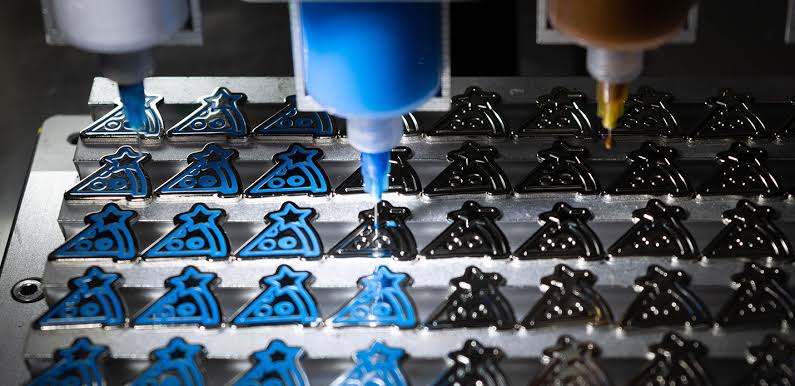
- Metal surface: Is the plating even and free from scratches, pits, stains, or discoloration?
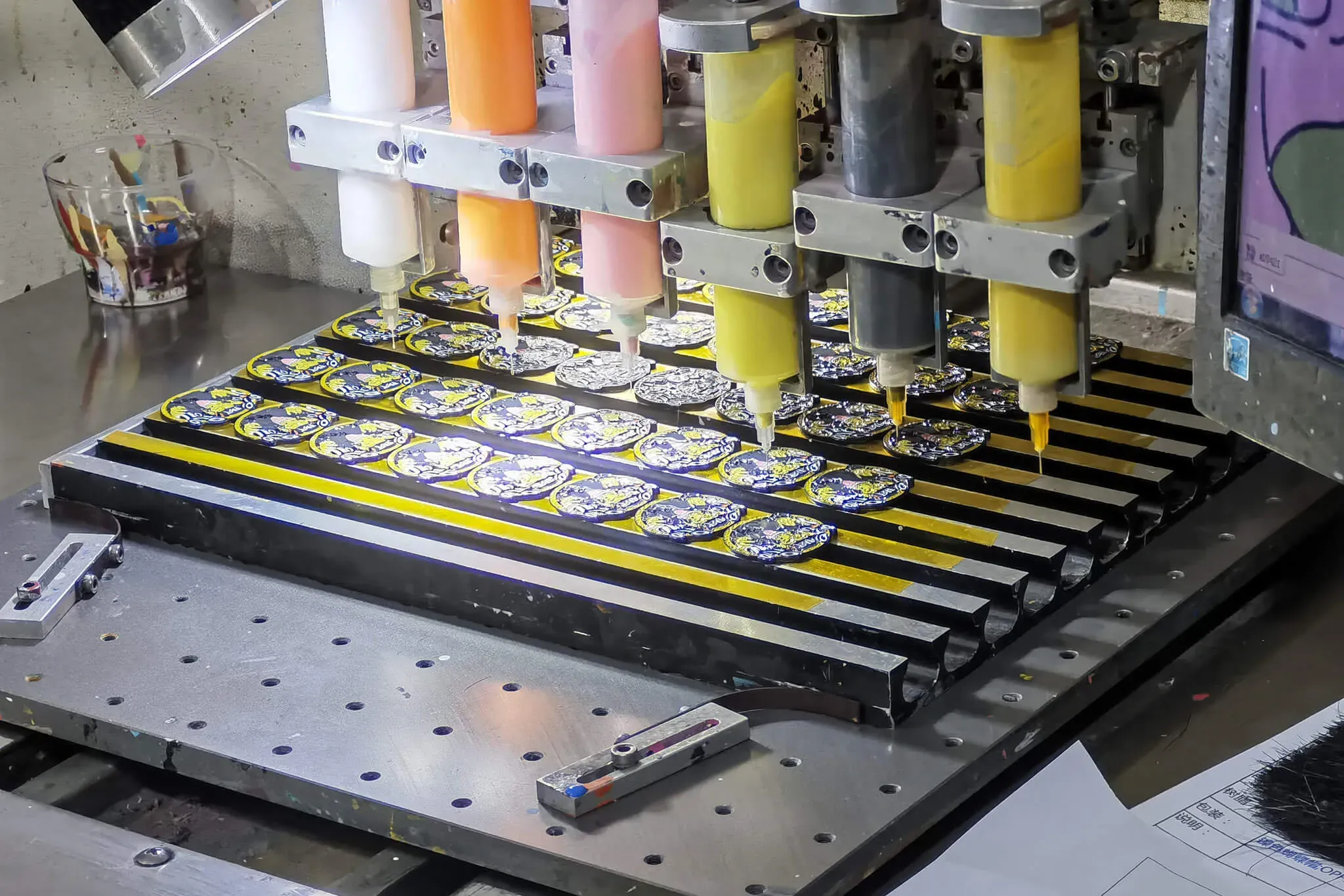
- Enamel filling: Are color areas level, clean, and free from overflow?
- Shape accuracy: Does the finished outline follow the approved die line?
- Pin or magnet attachment: Is the backing securely fixed and correctly positioned?
- Protective coating: Is epoxy, varnish, or another coating required for the intended use?
- Packaging: Are individual units protected from rubbing, bending, moisture, and scratching?
For anime products, quality control should focus on the face, eyes, hair details, logos, and color blocks. These are often the first areas customers notice.
Consistency Matters More Than One Perfect Sample
A common sourcing mistake is to approve a beautiful sample and assume the entire production batch will look identical. In practice, the sample may be produced with extra attention, while mass production introduces variation in color, alignment, plating, or assembly.
A professional reliable anime merchandise manufacturer should have a documented process for transferring the approved sample into production.
Request a production control plan
Before placing a wholesale order, ask the supplier to confirm:
1. Which artwork file will be used for production.
2. Which color references are approved.
3. Which dimensions and tolerances apply.
4. Which plating and finishing options are selected.
5. How many inspection stages are performed.
6. How defective units are classified.
7. How approval is recorded before mass production.
8. Whether a pre-production sample or production proof is available.
Your purchase order should include the final artwork version, size, material, finish, backing type, packaging method, quantity, and agreed quality standard.
Use an approved sample as a reference
For repeat orders, retain a signed or photographically documented golden sample. The supplier should compare the production batch against this reference rather than relying only on digital artwork.
A useful inspection record may include:
- Approved sample photographs.
- Close-up images of important design details.
- Front and back views.
- Exact finished dimensions.
- Weight, where relevant.
- Packaging photographs.
- Date and approval contact.
This creates a shared reference for both the buyer and the factory. It also makes later dispute resolution more objective.
Communication and Sampling Process
Communication quality is a strong indicator of supplier reliability. If a factory is slow, vague, or careless during the quotation and sampling stage, the problem may become more serious after payment.
What good communication looks like
An experienced custom badge factory for Japan should be able to provide:
- A clear quotation with included and excluded costs.
- Response to artwork questions before production.
- A realistic sample and production schedule.
- Written confirmation of specifications.
- Progress updates at agreed milestones.
- Advance notice when a problem could affect cost or delivery.
- Export and shipping information in a usable format.
The supplier should also ask sensible questions. For example, it may need to clarify whether your artwork contains gradients, transparent areas, very small text, metallic effects, or multiple color variations.
Ask for samples before committing
Sampling is one of the most effective ways to reduce risk. A sample allows you to check the product itself rather than relying on photographs or descriptions.
A practical sampling process is:
1. Send vector artwork, references, and target specifications.
2. Request a digital proof or production drawing.
3. Confirm size, material, colors, backing, and packaging.
4. Order a physical sample.
5. Inspect the sample under normal retail lighting.
6. Compare it with the original artwork and brand guidelines.
7. Record revisions in writing.
8. Approve the final sample before mass production.
For a multi-character collection, do not sample only the easiest design. Select a difficult representative design with small details, multiple colors, or an unusual shape. If the factory can reproduce the most demanding design well, its capability is easier to evaluate.
Questions to ask during sampling
- Is the sample made using the same process as mass production?
- Will the production batch use the same material and plating?
- Are sample fees refundable against a bulk order?
- How many revision rounds are included?
- What happens if the approved sample and bulk goods differ?
- Can the supplier send inspection photos before shipment?
How to Review Factory Capability and Certifications
A professional supplier should be able to show more than a website and a product catalog. You need to understand whether the company is a real manufacturer, a trading company, or a combination of both.
A trading company is not automatically unsuitable. However, you should know who controls production, who performs inspection, and who accepts responsibility for defects.
Review the factory's production scope
Ask for evidence such as:
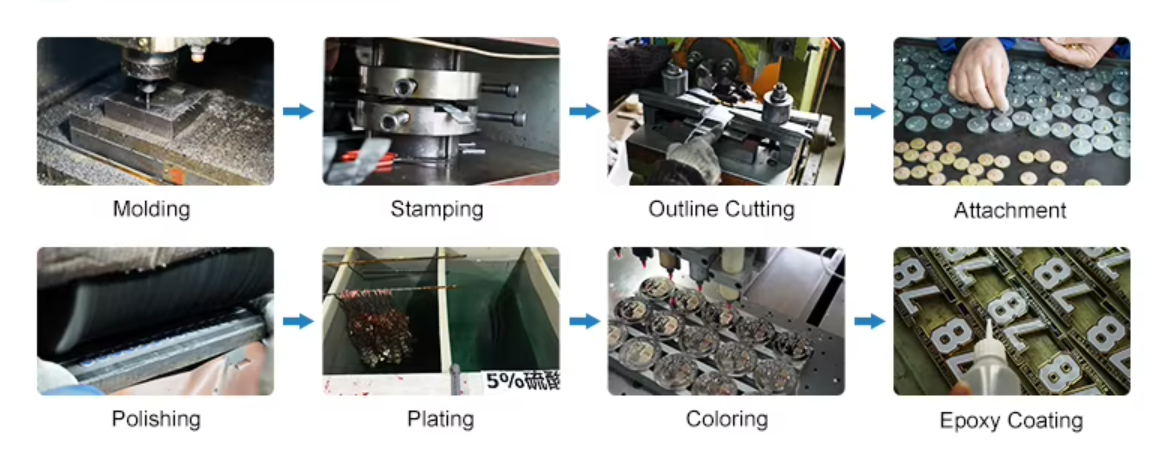
- Factory photographs or a video inspection.
- Production-line images.
- Equipment and process information.
- Examples of similar anime or character merchandise.
- Monthly capacity or realistic batch capacity.
- Quality-control procedures.
- Names of responsible sales and quality contacts.
- Business registration details where appropriate.
- References from comparable B2B customers, subject to confidentiality.
XingKun states that it has approximately 20 years of production experience and provides customized printing and packaging solutions. Its badge product range includes magnet badges, event badges, cartoon enamel pins, custom lapel pins, and anime enamel pins. Buyers should still confirm the exact production location, process ownership, and current capacity for the requested product before ordering. [xkdisplay]
Certifications should match the product risk
Do not select a supplier merely because it displays many certificates. Instead, check whether the documentation is relevant, current, and issued to the correct legal entity.
Depending on the product and destination, buyers may ask about:
- Quality-management systems.
- Material declarations.
- Coating or plating information.
- Nickel-release or restricted-substance testing where relevant.
- Packaging-material declarations.
- Factory audit reports.
- Social-compliance documentation.
- Product testing requested by the retailer or marketplace.
A badge may be a collectible accessory, promotional product, or children's item. The applicable requirements can differ according to intended use, age grading, materials, coatings, and sales channel. Ask the supplier to identify which tests are available, but confirm regulatory obligations with your importer, legal adviser, or testing laboratory.
Intellectual Property Compliance for Japanese Orders
This is a critical section for anime merchandise. A supplier willing to manufacture any popular character without asking for authorization may create a serious commercial and legal risk.
Japan Customs explains that goods infringing intellectual-property rights can be subject to border enforcement. The relevant rights may include trademarks, design rights, copyrights, patents, and other protected rights. [customs.go]
Establish an artwork authorization process
Before production, prepare:
- A statement confirming that you own or are authorized to use the artwork.
- A license agreement or authorization letter, where applicable.
- Approved character names and trademarks.
- Restrictions on territory, quantity, sales channel, and duration.
- Rules for surplus goods, rejected goods, and production waste.
- A requirement that the supplier not sell, photograph, or reuse the artwork.
Your supplier contract should clearly state that the factory may use the artwork only to fulfill your authorized order.
Avoid unauthorized "fan art" assumptions
"Fan art," "inspired by," or slightly modified character artwork may still create infringement risk. Changing the color, pose, or wording does not automatically make a design legally safe.
A responsible OEM anime badge supplier should respect your authorization process and avoid presenting unlicensed products as official merchandise. It should also be willing to keep customer artwork confidential.

Delivery Reliability and After-Sales Support
A supplier can produce excellent badges and still be unsuitable if it cannot deliver on schedule. Japanese wholesalers may have fixed retail launches, convention dates, seasonal campaigns, or coordinated product releases.
Evaluate the full lead time
Ask the supplier to separate:
- Artwork review time.
- Sample production time.
- Sample approval time.
- Tooling or mold time.
- Mass-production time.
- Inspection time.
- Packaging time.
- Export-document preparation.
- Transit time.
- Customs-clearance allowance.
Do not accept a single vague statement such as "delivery in two weeks." A credible schedule identifies the stages and the assumptions behind them.
Confirm the shipping terms
The quotation should state the applicable Incoterm or shipping arrangement, such as:
- EXW.
- FOB.
- CIF.
- DAP.
- DDP, where legally and commercially appropriate.
Also confirm:
- Shipping method.
- Estimated transit time.
- Freight responsibility.
- Insurance responsibility.
- Import-tax responsibility.
- Commercial invoice and packing-list requirements.
- Carton dimensions and gross weight.
- Tracking availability.
A factory that provides consistent carton data helps Japanese buyers plan warehouse receiving and landed-cost calculations.
Define after-sales procedures before payment
Your agreement should specify:
- The inspection window after delivery.
- The acceptable defect rate.
- The evidence required for a claim.
- The response time.
- Replacement, refund, or credit options.
- Responsibility for confirmed production errors.
- Procedures for concealed defects.
A supplier's after-sales promise is more meaningful when it appears in the quotation, purchase order, or sales contract rather than only in a chat message.
Red Flags When Choosing a Badge Manufacturer
The following warning signs deserve careful attention:
- The supplier refuses to provide a physical sample.
- The quotation is unusually low but excludes essential costs.
- The company changes its legal name or payment account without explanation.
- The supplier cannot identify the actual production location.
- Sales staff promise impossible delivery dates.
- Artwork questions are ignored.
- The supplier refuses to confirm specifications in writing.
- Product photographs appear copied from unrelated manufacturers.
- Certificates are blurry, expired, or issued to another company.
- The factory offers copyrighted anime characters without asking about licensing.
- Quality problems are blamed on the buyer despite approved specifications.
- The supplier pressures you to pay the full amount immediately.
- Inspection photographs are refused before shipment.
- The factory will not explain its replacement or compensation policy.
One red flag may have an innocent explanation. Several together indicate that you should slow down, conduct additional verification, or select another supplier.
A Practical Supplier-Scoring System
A structured scorecard is more reliable than choosing based on personal impressions. Score each candidate from 1 to 5.
| Evaluation category | Suggested weighting |
| Product quality and sample accuracy | 25% |
| Production consistency and QC | 20% |
| Communication and documentation | 15% |
| Delivery reliability | 15% |
| IP and compliance awareness | 10% |
| Price and payment terms | 10% |
| After-sales support | 5% |
Multiply each score by its weighting and compare the total. Price should not dominate the decision, because a low unit price can become expensive after defects, missed launches, rework, customs problems, or customer complaints.
Example supplier comparison
| Supplier | Quality | Communication | Delivery | Compliance | Price | Overall impression |
| Supplier A | 5 | 4 | 4 | 5 | 3 | Strong candidate for licensed premium goods |
| Supplier B | 3 | 5 | 3 | 2 | 5 | Low-cost but higher compliance risk |
| Supplier C | 4 | 3 | 5 | 4 | 4 | Suitable if documentation improves |
This method helps purchasing teams explain their decision internally and reduces the risk of selecting a supplier solely because of a low quotation.
How XingKun Can Fit Japanese Wholesale Projects
Shenzhen XingKun Packing Products Co., Ltd. presents itself as a customized printing and packaging manufacturer serving international customers. Its published badge categories include anime enamel pins, cartoon enamel pins, custom lapel pins, magnetic badges, event badges, birthday badges, Christmas badges, and Halloween badges. [xkdisplay]
For a Japanese wholesale inquiry, XingKun buyers should provide a complete project brief containing:
- Product type.
- Character or artwork authorization status.
- Finished dimensions.
- Material and thickness.
- Number of colors.
- Plating or surface finish.
- Backing type.
- Individual packaging.
- Quantity per design.
- Total order quantity.
- Required delivery date.
- Destination and shipping preference.
- Testing or retailer requirements.
XingKun's broader printing capability may also be useful when badges need to be bundled with custom packaging boxes, backing cards, stickers, playing cards, books, or other printed promotional materials. However, buyers should request a project-specific quotation and confirm that all components will meet the same quality and delivery requirements. [xkdisplay]
Recommended Ordering Workflow
Use the following workflow when selecting the best supplier for anime merchandise:
1. Shortlist three to five suppliers with relevant product experience.
2. Send the same technical brief to each candidate.
3. Verify artwork authorization before sharing sensitive files.
4. Request quotations with comparable specifications.
5. Ask for factory and quality documentation.
6. Order samples using a difficult representative design.
7. Inspect color, shape, finish, backing, and packaging.
8. Confirm the production schedule in writing.
9. Approve a golden sample and final artwork.
10. Use a pre-shipment inspection for important wholesale orders.
11. Retain samples, documents, and photographs for repeat orders.
12. Review supplier performance after delivery.
This process is slower than choosing the first inexpensive listing, but it gives buyers a repeatable method for building a stable supply chain.
Packaging and Sustainability Considerations
Anime badges are often sold as collectible products, so the packaging contributes to perceived value. A suitable presentation may include a printed backing card, clear protective bag, paper envelope, folding carton, or premium gift box.
When selecting packaging, consider:
- Protection against scratches and bending.
- Efficient carton packing.
- Retail display requirements.
- Barcode and product information.
- Language requirements.
- Material separation for disposal.
- Avoidance of unnecessary plastic.
- Packaging compatibility with the retail channel.
Japan has legislation promoting the reduction, sorted collection, and recycling of waste containers and packaging. Buyers should review the requirements relevant to their role, product category, and Japanese distribution model rather than assuming that the factory alone handles all obligations. [japaneselawtranslation.go]
Conclusion
The right anime badge supplier should be evaluated as a long-term manufacturing partner, not merely as a low-price vendor. Japanese wholesale buyers should prioritize design accuracy, batch consistency, transparent communication, relevant factory capability, documented quality control, delivery reliability, IP compliance, and after-sales support.
A supplier such as XingKun may be worth evaluating when you need customized anime enamel pins, magnetic badges, event badges, or coordinated printed packaging. The safest approach is to begin with a detailed specification, verify authorization, request a representative sample, approve a golden sample, and define quality and delivery responsibilities in writing.
Ready to evaluate your next anime merchandise project? Send the supplier your artwork, quantity, badge type, packaging requirements, target delivery date, and destination. Request a project-specific quotation and sample plan before placing a wholesale order.
FAQs
1. What is the best supplier for anime merch?
The best supplier is not necessarily the cheapest. Look for a manufacturer that can reproduce artwork accurately, maintain batch consistency, communicate clearly, meet delivery commitments, protect confidential files, and support legally authorized production.
2. How do I find a wholesale anime badge supplier in Japan?
You can search for suppliers serving Japan, attend trade exhibitions, request referrals from merchandise distributors, and contact experienced Chinese manufacturers directly. Compare suppliers using the same specifications and always request samples before committing to a large order.
3. Can an OEM anime badge supplier manufacture licensed character designs?
Yes, a factory can produce licensed designs when the buyer has appropriate authorization. The buyer should provide licensing evidence and define how the artwork, surplus goods, rejected items, and production waste must be handled.
4. What should I include in an anime badge quotation request?
Include badge type, artwork, size, material, colors, plating, backing, packaging, quantity per design, total quantity, target delivery date, destination, shipping method, testing requirements, and whether you need printed backing cards or retail boxes.
5. Should I order a sample before placing a wholesale order?
Yes. A physical sample helps you verify color, line detail, shape, plating, enamel filling, pin attachment, packaging, and overall appearance. For complex artwork, sample the most difficult design rather than only the simplest one.
6. How can I check whether an anime badge manufacturer is a real factory?
Ask for a factory video, production photographs, process details, business information, quality documents, and examples of comparable work. You can also arrange a video audit, third-party factory inspection, or pre-shipment inspection.
7. What are the main risks of choosing a low-cost badge supplier?
The main risks include inconsistent quality, inaccurate colors, weak attachments, delayed delivery, hidden tooling or freight charges, poor communication, inadequate packaging, and intellectual-property problems. These risks can cost more than the original unit-price savings.
8. Can XingKun provide packaging for anime badges?
XingKun publishes customized printing and packaging services and lists badge products such as anime enamel pins and magnetic badges. It may also be able to coordinate printed backing cards, boxes, stickers, and other promotional materials, subject to project-specific confirmation. [xkdisplay]
References
1. [XingKun — Badges and Customized Printing & Packaging Solutions]
2. [Japan Customs — Crackdown on Importing Goods Infringing Intellectual Property Rights]
3. [Japan Customs — Strengthening Border Control Measures for Counterfeit Goods]
4. [Japan Customs — Import Restrictions on Articles Infringing Intellectual Property Rights]
5. [Google Search Central — Creating Helpful, Reliable, People-First Content]
6. [Japanese Law Translation — Containers and Packaging Recycling Act]
7. [Japan Containers and Packaging Recycling Association — Profile]
8. [Japan Containers and Packaging Recycling Association — Overview of the Act]


