Content Menu
● What Big-Box Retail Buyers Evaluate Before Listing a Product
● Start With Retailer–Product Fit, Not Store Size
>> Match Your Product to the Retail Format
● Conduct a Store Walk Before Building Your Pitch
● Build a Retail-Ready Buyer Proposal
● Why Custom Retail Displays Strengthen Your Retail Case
● Use a 90-Day Retail Launch Plan
>> Days 1–30: Confirm Store-Level Readiness
>> Days 31–60: Measure What Shoppers Respond To
>> Days 61–90: Improve and Re-Present the Opportunity
● Common Mistakes When Choosing a Big-Box Retailer
● Choose the Retailer That Helps You Grow Sustainably
● FAQ
>> 1. What makes a product suitable for a big-box retailer?
>> 2. Should a new brand start with a major national retailer?
>> 3. What should I include in a retail buyer pitch?
>> 4. Why are retail displays important for product launches?
>> 5. How do I know whether my display should be a countertop unit or floor display?
>> 6. How early should I plan display packaging for a retail launch?
>> 7. What should I measure after a retail launch?
● References
Getting a product into a big-box retailer can transform a growing brand—but choosing the wrong retailer can strain margins, overload operations, and leave great products unnoticed on the shelf. The right big-box retailer for your product is not simply the largest name on your target list. It is the retailer whose shoppers, price architecture, supply expectations, category strategy, and in-store environment match what your brand can deliver consistently.
After more than 20 years producing retail display stands, printed packaging, and point-of-purchase materials for brands and distributors in over 30 countries and regions, we have seen one pattern repeatedly: retail fit comes before retail scale. A product may be well made, competitively priced, and beautifully packaged, yet still fail to gain traction if it enters a channel that does not match its shopper or merchandising needs.
This guide explains how to select the right retail partner, prepare a stronger buyer case, and build a display strategy that helps your product earn attention once it reaches the sales floor.

What Big-Box Retail Buyers Evaluate Before Listing a Product
A retail buyer does not evaluate a product in isolation. They evaluate whether that product can create demand, fit their assortment, protect profitability, and operate reliably across stores.
A compelling product should answer five commercial questions quickly:
- Who will buy it?
- Why will they choose it over existing options?
- What role will it play in the category?
- Can the supplier deliver at scale without disruption?
- Can the product earn its space in a busy retail environment?
Buyers often compare a proposed item with products already on the shelf. Therefore, a vague claim such as "premium quality" is rarely enough. A stronger proposition shows a practical customer benefit, a clear price position, and visible evidence that the product can move.
For example, a reusable household product may be a better fit for a value-led mass retailer when it offers a simple benefit, accessible price, compact packaging, and dependable replenishment. The same item may suit a specialty retailer if its materials, design story, and higher price point support a more considered purchase.
Your job is not to convince every retailer that your product belongs everywhere. Your job is to show one buyer why it belongs specifically in their stores.
Start With Retailer–Product Fit, Not Store Size
Large retail chains can offer reach, brand visibility, and significant order potential. However, a large order also creates larger commitments: inventory, production capacity, packaging compliance, logistics coordination, marketing support, and possible deductions when requirements are missed.
Before approaching a buyer, score each potential retailer against the factors that determine a sustainable relationship.
| Evaluation Area | Questions to Ask | What a Strong Fit Looks Like |
| Shopper profile | Does this retailer attract your core customer? | Your target shopper already visits the store |
| Price position | Does your retail price align with the category? | Your margin remains workable after all channel costs |
| Category relevance | Is there a clear shelf, aisle, or display location? | Your product solves a visible category need |
| Competitive context | How crowded is the shelf? | You have a clear point of difference |
| Supply readiness | Can you meet order volume and delivery windows? | Production and logistics have realistic capacity buffers |
| Display opportunity | Can your product be seen and understood quickly? | Shelf-ready packaging or a display can improve visibility |
| Brand alignment | Does the retailer's image support your brand? | The store strengthens—not weakens—your positioning |
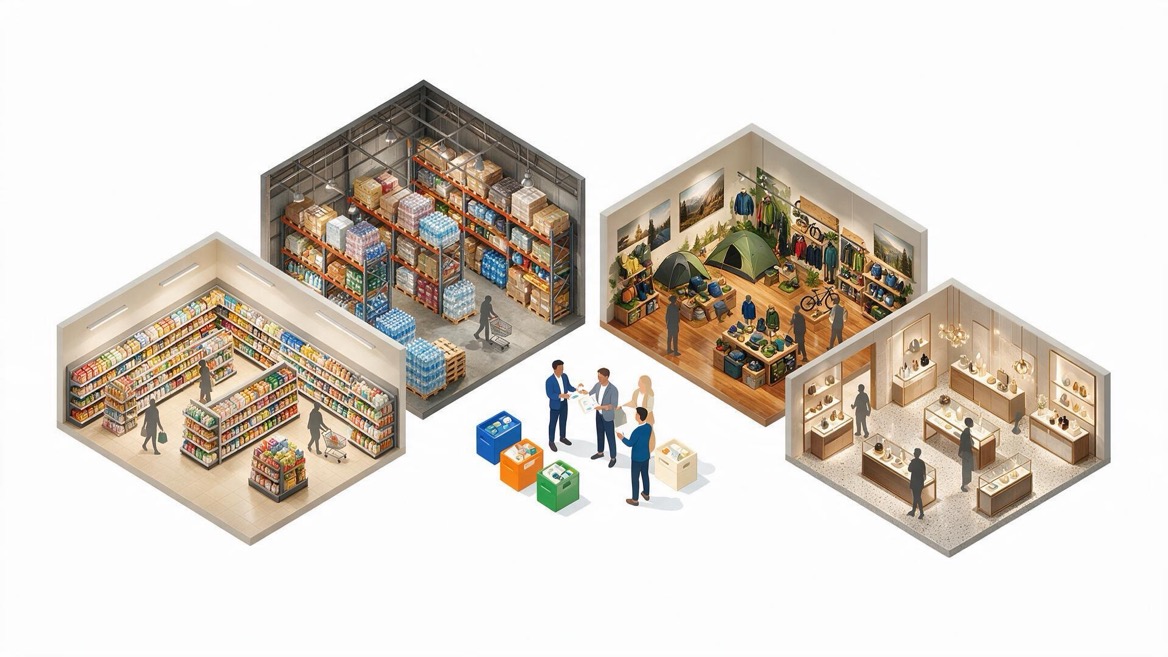
A retailer should be treated as a business model, not merely a sales channel. The same product can perform differently in a warehouse club, discount chain, supermarket, home-improvement retailer, or premium natural-products store because shoppers arrive with different expectations.
Match Your Product to the Retail Format
Mass retailers typically serve broad customer groups and carry wide assortments. Products need clear benefits, competitive prices, dependable supply, and strong shelf communication.
Warehouse clubs often favor value-packed formats, multipacks, efficient palletization, and products that make sense in larger purchase quantities. They may be less suitable for small, highly customized, or high-unit-price products unless the bundle creates obvious value.
Specialty big-box retailers can be an excellent match for products that require more education, technical explanation, lifestyle storytelling, or category expertise. Here, display design can help customers compare features and understand use cases.
Natural, premium, or curated retailers may value product quality, ingredients, sourcing, design, and brand purpose more heavily. The product presentation should support a premium perception without making the buying decision complicated.
Conduct a Store Walk Before Building Your Pitch
One of the most useful forms of research happens in the store itself. Visit several locations, not just one flagship store. Photograph only where permitted, take notes, and study the category like a merchandiser.
Look for the following:
- Shelf position: Are comparable products at eye level, low shelves, endcaps, checkout areas, or promotional zones?
- Price ladder: What are the entry, mid-tier, and premium price points?
- Packaging language: Which colors, claims, formats, and materials dominate the category?
- Shopper behavior: Do customers browse, compare, seek help, or buy quickly?
- Display standards: Are there floor displays, shelf trays, counter units, pallet displays, or digital signs?
- Whitespace: Is there a customer need that current products do not explain or serve well?
Then ask a practical question: can a shopper understand your product in three to five seconds?
If the answer is no, the product may need stronger packaging hierarchy, a simpler front-of-pack message, better imagery, or a retail display that makes the buying occasion clearer. In crowded categories, visibility is not decoration. It is a sales requirement.
Build a Retail-Ready Buyer Proposal
A buyer presentation should reduce uncertainty. It should make it easy for the buyer to understand the opportunity, assess the financial case, and picture how the item will work in their stores.
Prepare a concise sales package containing:
1. A one-sentence product promise
State who the product is for, what problem it solves, and why it is different.
2. Product and market proof
Include sales history, repeat purchase signals, online performance, customer feedback, test-market results, or distributor interest where available.
3. Clear product specifications
Provide dimensions, materials, retail packaging, case pack, master carton details, product codes, lead times, and origin information.
4. Retail economics
Present suggested retail price, wholesale price, margin expectations, promotional flexibility, and any introductory support clearly.
5. Supply plan
Explain production capacity, quality-control procedures, logistics capability, contingency planning, and replenishment timing.
6. Merchandising concept
Show exactly where the product should sit and how it will be presented. Include a visual mock-up of shelf-ready packaging, a counter display, floor display, tray, dump bin, or endcap concept if relevant.
7. Launch support
Outline how you will support awareness through content, sampling, demonstrations, retailer media, promotions, or local activation.
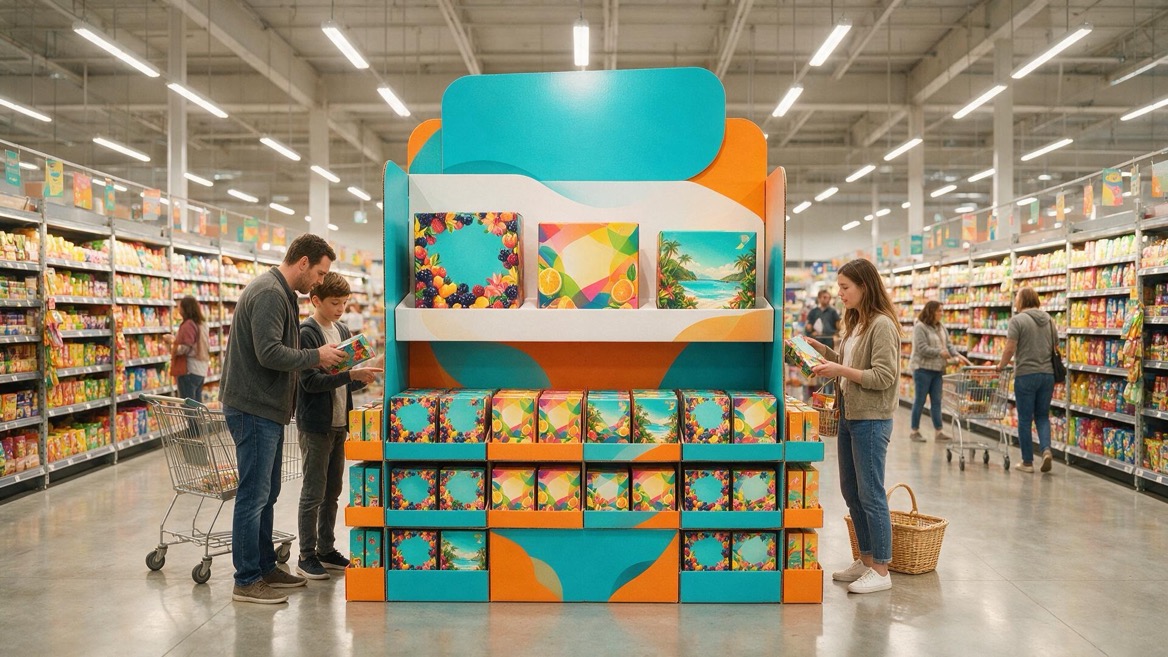
A good proposal is specific. It does not say, "Our display will attract customers." It says, "This corrugated floor display holds 48 units, uses brand-colored header signage, communicates three buying benefits, ships flat for efficient logistics, and can be assembled quickly at store level."
Why Custom Retail Displays Strengthen Your Retail Case
A product can be listed and still be invisible. That is why retail display planning should begin before the buyer meeting—not after the purchase order arrives.
A well-designed display stand can help a brand:
- Separate from competing packaging
- Clarify product benefits at the point of decision
- Encourage impulse purchases in high-traffic areas
- Support seasonal or promotional campaigns
- Create a consistent visual identity across locations
- Make replenishment and store setup easier
For a buyer, a display can also demonstrate that the supplier understands the practical realities of selling in-store. It shows initiative: the brand is not expecting the retailer to create demand alone.
At Shenzhen XingKun Packing Products Co., Ltd., our work in printed packaging and display stand production begins with the retail objective. We consider product weight, unit quantity, store environment, transport efficiency, assembly needs, brand messaging, and shopper interaction before recommending a structure.
For instance, a compact countertop display may be suitable for small accessories near checkout. A full-size corrugated floor display may be better for seasonal promotions, bundled products, or new launches that need stronger visual impact. The right format depends on the product, retailer rules, available space, and expected replenishment model.
Use a 90-Day Retail Launch Plan
Winning a listing is only the beginning. The first weeks in store can determine whether a buyer sees the product as a long-term opportunity or a short-term experiment.
Days 1–30: Confirm Store-Level Readiness
Before and immediately after launch, verify that inventory arrives as planned and reaches the sales floor.
Focus on:
- Product availability by store or distribution center
- Correct pricing and shelf labels
- Display delivery and setup
- Packaging condition after transit
- Staff access to simple product information
- Photos or field checks of actual placement
A display sitting in a stockroom cannot drive sales. A product placed in the wrong aisle cannot reach the intended customer. Early checks prevent small execution errors from becoming lost selling weeks.
Days 31–60: Measure What Shoppers Respond To
Review performance at store level whenever data is available. Compare locations, promotional periods, display formats, and product variants.
Useful indicators include:
- Unit sales per store per week
- Inventory availability
- Sell-through speed
- Display compliance
- Customer questions and objections
- Return or damage patterns
- Performance before, during, and after promotions
If a display attracts attention but shoppers do not convert, the message may be unclear, the price may be misaligned, or the product benefit may need stronger proof. If sales are strong in some locations but weak in others, investigate local placement, inventory, staff familiarity, or shopper fit.
Days 61–90: Improve and Re-Present the Opportunity
Use early results to strengthen the next conversation with the retailer. A professional supplier does not wait for a buyer to raise concerns.
Bring practical recommendations:
- Refresh the display header or key message
- Test a different location or display size
- Introduce a seasonal bundle
- Improve case packing for easier replenishment
- Adjust assortment based on regional demand
- Add a QR code for product education or usage ideas
- Plan a second promotional window based on early results
This approach turns a one-time listing into a collaborative retail program.
Common Mistakes When Choosing a Big-Box Retailer
The most expensive mistakes often happen before the first buyer meeting.
Chasing prestige over fit. A famous retailer can create exposure, but exposure without demand, margin, or supply readiness can damage a young brand.
Ignoring total channel costs. Retail pricing must account for packaging, freight, displays, promotions, returns, compliance requirements, and operational labor—not only product cost.
Overpromising capacity. Buyers value reliable suppliers. A realistic launch plan is more credible than aggressive volume promises that cannot be fulfilled.
Treating packaging as an afterthought. Packaging must protect the product, communicate value, meet retailer requirements, and work with the planned display format.
Launching without a visibility plan. Shelf placement alone may not be enough. A product needs a clear visual story that can compete with dozens of alternatives.
Using one generic pitch for every retailer. Tailor the proposal to the retailer's customer, category, price range, and operational model.
Choose the Retailer That Helps You Grow Sustainably
The best big-box retailer is the one where your product can be understood, supplied, and repurchased profitably. Start with customer fit. Validate the price and competitive position. Prove operational readiness. Then use packaging and display design to ensure the product is not only stocked—but noticed.
If you are preparing a retail pitch, launching a new product, or upgrading an in-store program, Shenzhen XingKun Packing Products Co., Ltd. can help you develop custom display stands, retail packaging, and printed promotional materials built around your product, channel, and brand objective.
Contact our team to discuss a retail-ready display and packaging solution for your next launch.
FAQ
1. What makes a product suitable for a big-box retailer?
A suitable product has a clear customer benefit, competitive pricing, dependable supply capability, retail-ready packaging, and a strong reason to exist beside competing products. It should also match the retailer's shopper profile and category strategy.
2. Should a new brand start with a major national retailer?
Not always. Starting with regional chains, specialty retailers, independent stores, or online channels can help a brand build sales evidence, customer feedback, and operational confidence before a larger rollout.
3. What should I include in a retail buyer pitch?
Include your product value proposition, target customer, product specifications, pricing, supply capacity, sales proof, competitive difference, packaging details, and a clear merchandising or display concept.
4. Why are retail displays important for product launches?
Retail displays make products easier to find, understand, and compare. They can highlight core benefits, support promotions, create stronger brand recognition, and encourage unplanned purchases in high-traffic areas.
5. How do I know whether my display should be a countertop unit or floor display?
Choose based on product size, unit weight, quantity, price point, store location, campaign objective, and available retail space. Small accessories often suit countertop displays, while larger promotions, bundles, or seasonal products may benefit from floor displays.
6. How early should I plan display packaging for a retail launch?
Plan it during product and buyer-pitch preparation. Early planning allows the display structure, packaging dimensions, case pack, shipping method, and retail setup process to work together efficiently.
7. What should I measure after a retail launch?
Track sales by store and week, stock availability, sell-through, display setup quality, product damage, customer feedback, promotional performance, and differences between locations.
References
- [Creative Displays Now — Chapter 3: Find the Right Big-Box Store for Your Products] [creativedisplaysnow]
- [Creative Displays Now — How to Get Your Product Into Big-Box Stores] [creativedisplaysnow]
- [SCORE — How to Get Your Product in Stores: 9 Tips From Entrepreneurs] [score]
- [ThirdChannel — How to Enhance Product Launches] [blog.thirdchannel]
- [SimplyDepo — How to Pitch Your Product to a Retail Buyer or Distributor] [simplydepo]
- [T-ROC — New Product Launch Retail Strategy] [trocglobal]


