Content Menu
● Why High-End Shopping Bags Matter to Luxury Brands
● Luxury Brands vs. High-End Shopping Bags
● The Six Design Decisions Behind Premium Bags
>> 1. Material Sets the First Impression
>> 2. Structure Turns Packaging into a Usable Object
>> 3. Printing and Finishing Create Visual Depth
>> 4. Handles Carry Both Weight and Meaning
● Designing for Reuse and Responsibility
● A Production Checklist for Luxury Buyers
>> Pre-Production Review
● Create a Shopping Bag Worth Keeping
● FAQ
>> What makes a shopping bag look luxurious?
>> Which paper is best for high-end shopping bags?
>> Are laminated luxury paper bags recyclable?
>> How should brands choose shopping bag handles?
>> What should be tested before bulk bag production?
>> Can custom tote bags be used as luxury shopping bags?
● References
Luxury brands do not treat high-end shopping bags as a simple way to carry a purchase. They design them as a physical extension of the brand experience. From the moment a customer receives the bag, its weight, texture, color, print finish, handles, and construction communicate a message about value.
For luxury brands, a high-end shopping bag must feel intentional before it is even opened. It should protect the product, photograph well, travel comfortably, and remain attractive enough to be reused. In many cases, the bag becomes a moving brand touchpoint on streets, in offices, airports, and homes.
At Shenzhen XingKun Packing Products Co., Ltd., we have spent more than 20 years producing printed packaging and tote bags for brands and distributors in over 30 countries and regions. From a production perspective, the strongest luxury shopping bags are not created by adding more decoration. They are built by aligning materials, structural details, printing precision, and brand purpose.
Why High-End Shopping Bags Matter to Luxury Brands
A luxury purchase is often emotional. Customers may remember the packaging almost as clearly as the product itself. A well-designed shopping bag creates anticipation before the item is used, worn, or gifted.
This matters in a luxury market where product quality alone is not always enough to create distinction. Personal luxury goods remain a major global category, and brands must make every physical customer interaction feel considered and memorable.
A high-end shopping bag performs several roles at once:
- It protects a product during retail handover and transport.
- It communicates a recognizable visual identity.
- It reinforces the perceived value of the purchase.
- It offers a reusable object that extends brand visibility.
- It supports gift presentation without requiring excessive extra packaging.
- It demonstrates the brand's approach to materials and responsibility.
The best luxury brands understand that the shopping bag is not an afterthought. It is part of the retail product.
A plain paper bag can be functional. A luxury paper shopping bag must also feel balanced in the hand, structurally reliable, visually refined, and consistent with the brand's position. That difference is where design discipline becomes visible.
Luxury Brands vs. High-End Shopping Bags
The relationship between luxury brands and high-end shopping bags is close, but the two terms describe different parts of the value equation. A luxury brand defines the identity, target customer, heritage, and desired emotional response. A high-end shopping bag is the engineered object that translates those ideas into a real-world experience.
| Design Area | What Luxury Brands Define | What High-End Shopping Bags Deliver |
| Brand identity | Signature colors, logo rules, tone, heritage | Accurate color matching, logo placement, consistent finishing |
| Customer experience | How the purchase should feel | Weight, texture, handle comfort, opening experience |
| Product protection | Product size, fragility, retail requirements | Board strength, gussets, reinforced base, secure handles |
| Perceived value | Desired market position | Premium paper, clean folds, precise print, refined details |
| Reuse potential | Long-term visibility outside the store | Durable construction and timeless visual appeal |
| Material direction | Responsible sourcing and brand commitments | Traceable paper options, recyclable formats, reduced mixed materials |
A common mistake is to focus only on the logo. In reality, a luxury logo printed on weak paper or attached to poorly secured handles can reduce the entire experience.
The reverse is also true. Strong materials and flawless manufacturing cannot compensate for an unclear brand design. Luxury packaging works when the visual direction and physical construction support each other.
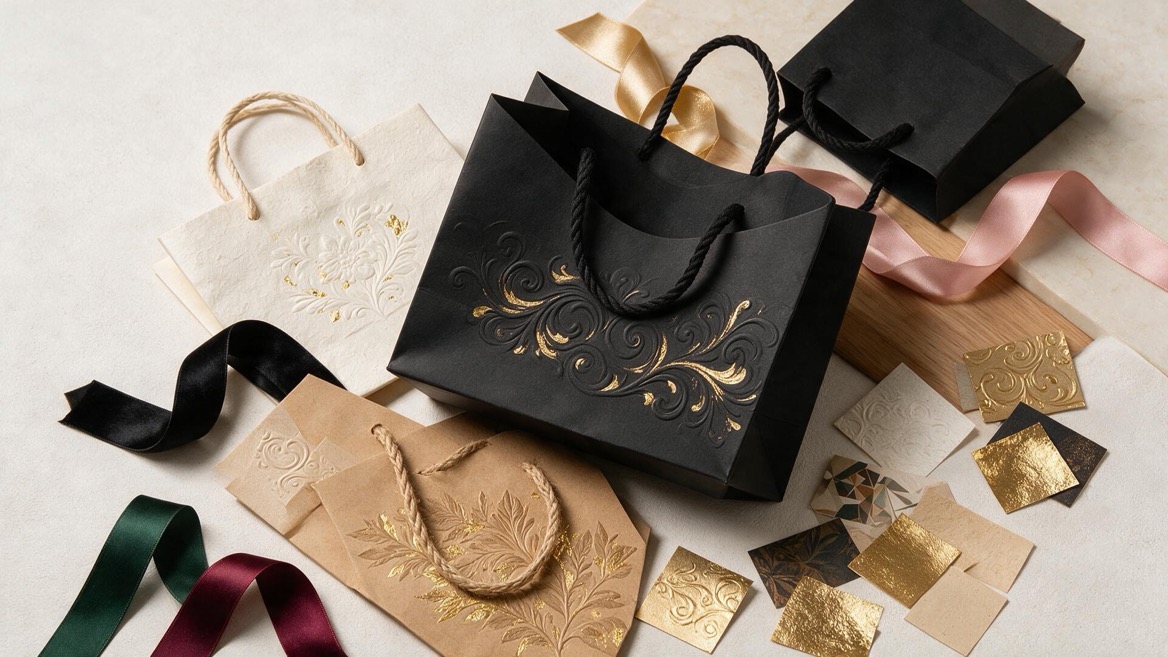
For example, a minimalist fashion house may choose a matte black bag with blind embossing and soft cotton handles. The design looks restrained, but the execution must be exact. Any uneven embossing, color variation, glue marks, or misaligned handles will be much more visible because the design has no busy graphics to hide flaws.
The Six Design Decisions Behind Premium Bags
1. Material Sets the First Impression
Material selection is the first major decision in luxury shopping bag design. It affects appearance, durability, print quality, cost, handling, and end-of-life options.
Common choices include coated art paper, uncoated specialty paper, textured paper, kraft paper, recycled paper, rigid board, fabric, cotton canvas, and laminated paper. Each material creates a different emotional signal.
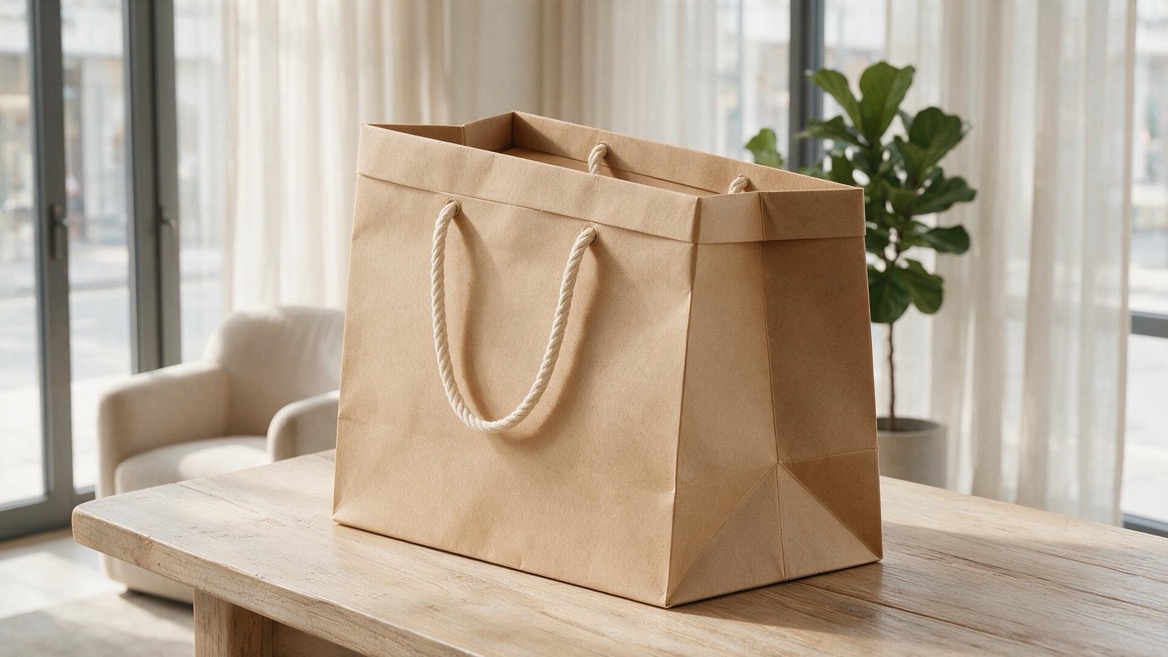
A smooth, coated paper surface can support sharp color blocks and fine graphic detail. An uncoated textured sheet can feel more artisanal and tactile. Heavy kraft paper can communicate natural simplicity, while a thick specialty board can create a more formal and structured impression.
For premium paper shopping bags, brands should consider:
- Paper weight: The paper must match the product weight and bag size.
- Surface texture: Smooth, linen, felt-marked, or natural fibers create different sensory impressions.
- Color consistency: Brand colors should remain stable across production batches.
- Opacity: Dark colors and light interiors should not show through unexpectedly.
- Fold performance: Paper should not crack excessively at gussets, top folds, or reinforced areas.
- Print compatibility: Fine logos, metallic details, and small typography require a stable print surface.
The goal is not always to choose the heaviest material. A bag that feels unnecessarily thick may add cost and shipping weight without improving the customer experience. The right specification is the one that supports the product and feels appropriate to the brand.
2. Structure Turns Packaging into a Usable Object
A shopping bag may look beautiful on a sample table but fail in daily use. Structural design is what prevents that failure.
Luxury brands usually expect a bag to carry products securely, stand upright when needed, keep its shape during handling, and remain presentable after the customer leaves the store. This requires more than selecting thick paper.
Key structural elements include:
- Reinforced bottom boards for heavier products.
- Top-fold reinforcements around handle holes.
- Side gussets that allow the bag to expand without distorting.
- Cleanly glued seams with no visible adhesive marks.
- Interior bottom cards that keep the base flat.
- Proper handle spacing for balance and comfort.
- Correct bag proportions for the item inside.
A high-end shopping bag should not feel awkward when carried. If the handles are too close together, the bag may tilt. If they are too wide apart, they may pull against the shoulder or wrist. If the bag is too tall for a compact product, it can look empty and wasteful.
At production stage, we recommend testing bags with the actual product weight rather than relying only on theoretical measurements. A bottle, garment, cosmetics box, catalog, or gift set behaves differently inside a bag. Real-use testing reveals stress points that a flat drawing cannot show.
3. Printing and Finishing Create Visual Depth
Luxury packaging design often depends on controlled restraint. One carefully executed detail can create more value than several competing decorative effects.
Popular finishing options for high-end shopping bags include:
- Hot foil stamping in gold, silver, copper, black, or custom colors.
- Embossing for raised logos and patterns.
- Debossing for recessed brand marks.
- Spot UV for contrast on matte surfaces.
- Soft-touch lamination for a velvet-like feel.
- Matte lamination for a quiet, contemporary look.
- Gloss lamination for brighter color intensity.
- Screen printing for dense ink coverage.
- Edge painting for select rigid packaging formats.
Each technique must support the intended brand identity. Hot foil works well for formal gifting, jewelry, beauty, and celebration collections. Blind embossing can suit brands that want understated distinction. A soft-touch finish may feel elegant, but it should be tested for scuff resistance, especially on deep black or dark navy bags.
Print design also requires technical discipline. Fine white lines may fill in on textured paper. Metallic foil may not reproduce every small graphic element cleanly. Large solid color areas can reveal differences in paper texture or ink density. These are not reasons to avoid premium effects; they are reasons to build the artwork around the real production process.
The most successful luxury brands design for the material, rather than forcing the material to imitate a digital mockup.
4. Handles Carry Both Weight and Meaning
Handles are among the most frequently touched parts of a high-end shopping bag. They are a small detail with an outsized effect on comfort and quality perception.
Common options include cotton rope, ribbon, grosgrain ribbon, satin ribbon, twisted paper cord, flat paper handles, polyester cord, leather-like handles, and die-cut handles. The right choice depends on brand image, product weight, and material direction.
Cotton rope can feel soft and durable. Ribbon handles can elevate gift presentation. Paper handles may support a more mono-material approach and easier material separation. Rope handles are often suitable for heavier bags, while flat ribbon handles work especially well for lightweight premium apparel and beauty products.
When choosing handles, brands should evaluate:
- Handle pull strength.
- Comfort when carrying weight.
- Knot quality and consistency.
- Hole reinforcement.
- Color matching with the bag.
- Resistance to fraying, staining, and fading.
- Ease of separating materials after use.
A handle should never be selected only because it looks attractive in a photograph. It must survive repeated lifting and maintain a clean appearance during retail use.
Designing for Reuse and Responsibility
Luxury customers increasingly notice whether a package feels wasteful. Reuse is therefore not merely an environmental consideration; it is also a design opportunity.
A bag that remains useful after purchase can continue carrying the brand into daily life. This can happen when the format is versatile, the construction is durable, and the visual design is refined enough to be carried beyond the store.
Luxury brands are increasingly exploring paper from responsibly managed sources, recycled content, lightweight construction, reusable fabric formats, water-based inks, and designs that reduce difficult-to-separate components. Some leading houses have also moved toward recyclable bags and simplified material systems.
However, responsible design should not become a vague marketing claim. A brand needs to ask practical questions:
1. Can the selected paper be sourced consistently?
2. Does the bag use materials that customers can reasonably separate or recycle?
3. Is the bag size optimized for the actual product?
4. Can unnecessary plastic coatings or accessories be reduced?
5. Will the bag remain durable enough to be reused?
6. Are material claims supported by supplier documentation?
For paper-based shopping bags, chain-of-custody documentation can help brands understand how forest-based materials move through the supply chain. This is particularly important when a buyer requests specific claims about recycled content or responsible forest management.
The strongest approach is not to promise perfection. It is to make practical improvements that can be measured, documented, and repeated across future orders.
A Production Checklist for Luxury Buyers
Before approving bulk production, luxury brands and packaging buyers should review a physical sample against a detailed checklist. Digital artwork approval alone is not enough.
Pre-Production Review
- Confirm the final bag dimensions with the real product inside.
- Check paper specification, texture, shade, and grain direction.
- Approve the exact logo color, foil color, and print finish.
- Verify handle material, length, attachment style, and pull strength.
- Review the bottom board and top reinforcement.
- Check gusset folds, seam alignment, and glue cleanliness.
- Test whether the bag stands upright when required.
- Inspect the sample under retail lighting, daylight, and photography lighting.
- Confirm packaging method for export transport to prevent scratching or crushing.
- Define acceptable quality limits before bulk manufacturing begins.
A useful practice is to compare the approved sample with the first bulk-production pieces. This helps catch variations in color, foil placement, lamination, or handle installation before full shipment.
For global brands, clear communication is equally important. A packaging supplier should provide dielines, material options, production samples, inspection photos, packing details, and realistic lead times. When these steps are managed early, the final luxury shopping bag is more likely to match the original creative direction.
Create a Shopping Bag Worth Keeping
Luxury brands design high-end shopping bags by combining emotional design with practical engineering. The most memorable bags are not necessarily the most elaborate. They are the ones where paper, print, structure, handles, and brand identity work together without compromise.
For fashion, beauty, jewelry, gifting, lifestyle, and premium retail brands, the shopping bag can become a lasting part of the customer experience. It protects the purchase today and keeps the brand visible tomorrow.
Shenzhen XingKun Packing Products Co., Ltd. helps brands turn packaging ideas into production-ready shopping bags, custom tote bags, and printed packaging solutions. Share your bag size, product weight, artwork, preferred material, and target quantity to start developing a sample that reflects your brand at every touchpoint.

FAQ
What makes a shopping bag look luxurious?
A luxury shopping bag combines premium-feeling material, accurate printing, clean construction, durable handles, balanced proportions, and a design that matches the brand's character. Small details, such as fold alignment and foil quality, strongly influence the final impression.
Which paper is best for high-end shopping bags?
There is no single best option. Coated art paper is suitable for sharp graphics and saturated color, while textured specialty paper can create a more tactile and understated effect. The ideal paper depends on product weight, finish requirements, brand style, and planned reuse.
Are laminated luxury paper bags recyclable?
It depends on the lamination type and local recycling systems. Brands seeking simpler recycling should discuss uncoated paper, water-based coatings, and reduced mixed-material designs with their packaging supplier before production.
How should brands choose shopping bag handles?
Choose handles based on product weight, comfort, visual identity, and intended material system. Cotton rope is durable and premium-feeling, ribbon supports gifting, and paper handles can be suitable for simplified paper-based construction.
What should be tested before bulk bag production?
Test the actual product inside the bag, handle pull strength, bottom support, print color, foil placement, fold quality, glue cleanliness, scuff resistance, and carton packing performance. A physical pre-production sample is essential.
Can custom tote bags be used as luxury shopping bags?
Yes. Cotton canvas, recycled fabric, and other durable tote bag materials can work well for premium retail, events, membership gifts, and product launches. Their longer usable life can provide continued brand exposure beyond the initial purchase.
References
1. Bain & Company and Fondazione Altagamma, "Global Luxury Stabilizes Amid Compounding Disruptions." Market figures and luxury-sector outlook. [View source] [bain]
2. Forest Stewardship Council, "Paper & Packaging." Information on chain-of-custody certification and responsible material sourcing. [View source] [fsc]
3. Forest Stewardship Council, "Chain of Custody Certification." Explanation of traceability for forest-based materials. [View source] [fsc]
4. CHANEL, "The Art of Detail." Information on recyclable packaging, recycled materials, and paper from responsibly managed forests. [View source] [chanel]
5. Gucci, "Sustainable Packaging." Details on responsibly sourced paper, uncoated paper packaging, recycled polyester handles, and reusable packaging formats. [View source] [equilibrium.gucci]
6. LVMH, "Our Commitment for Environment." Group-level information on client packaging, recycled materials, eco-design, and packaging targets. [View source] [lvmh]


