Content Menu
● Why This Comparison Matters For Brands Today
● Understanding The Core Differences
● What Customers Actually Prefer And Why
● The Environmental Reality Behind The Preference
● Manufacturing Insights From Two Decades In Printed Packaging
● Standard Production Workflow For Custom Tote Bags
● Making The Right Choice For Your Brand
● Frequently Asked Questions
● References
Customers increasingly favor paper tote bags over plastic tote bags for everyday shopping and retail packaging, driven by sustainability concerns, brand image, and recyclability, though plastic still holds an edge in durability and cost for specific industrial uses.

Why This Comparison Matters For Brands Today
Retailers and distributors across more than 30 countries are rethinking their packaging strategy as consumer expectations shift toward visible environmental responsibility. After two decades of manufacturing printed packaging solutions, we have watched this shift firsthand: buyers no longer ask "how cheap is the bag," they ask "what does this bag say about our brand."
Choosing between paper tote bags and plastic tote bags is not just a cost decision anymore. It's a brand positioning decision that affects customer trust, repeat purchases, and even regulatory compliance in certain markets.
Understanding The Core Differences
Before comparing preference data, it helps to break down what actually separates these two materials in real-world use.
| Feature |
Paper Tote Bags |
Plastic Tote Bags |
| Biodegradability |
Decomposes naturally, often compostable |
Takes 400–1,000 years to decompose |
| Water use in production |
About 1,004 gallons per 1,000 bags |
About 58 gallons per 1,000 bags |
| CO2 emissions per 1,000 bags |
Roughly 0.08 tons |
Roughly 0.04 tons |
| Reuse threshold to offset impact |
Must be reused at least 3 times |
Reference baseline for comparison |
| Durability in wet conditions |
Weaker, prone to tearing |
Stronger, water-resistant |
| Print and branding surface |
Excellent for premium print finishes |
Good, but glossier and less "premium" feel |
| Consumer perception |
Seen as cleaner, more responsible |
Increasingly seen as wasteful |
What Customers Actually Prefer And Why
Consumer research consistently shows a shift toward paper. Buyers describe paper packaging as feeling more "natural," easier to trust, and more aligned with a brand's sustainability story. Compared with plastic, paper bags tend to leave a cleaner, more responsible impression on the people carrying them out of a store.
That said, preference isn't universal. Some sectors — particularly wet-goods retail, produce, and heavy industrial packaging — still lean on plastic because of its strength and moisture resistance.
Key drivers behind the paper preference trend:
- Visual brand impression: Kraft paper totes with custom printing photograph well for social media unboxing content.
- Perceived sustainability: Shoppers associate paper with recyclability even when actual environmental math is more nuanced.
- Retail-ready feel: Paper totes with rope handles are now a retail standard in fashion, cosmetics, and gift categories.
- Regulatory pressure: Several countries have introduced restrictions on single-use plastic bags, pushing brands toward paper alternatives.

The Environmental Reality Behind The Preference
Here is where nuance matters, and where many articles oversimplify the story. The environmental footprint of a bag is not just about the material — it's about how many times it gets reused.
A widely cited UK Environment Agency analysis found that a paper bag must be reused at least three times to match the climate impact of a single-use plastic bag. A cotton tote, by comparison, needs roughly 131 reuses to break even on climate impact against plastic.
Producing paper bags also requires about four times more water than plastic bag production, alongside higher energy consumption per unit. Paper manufacturing further generates more municipal solid waste per 1,000 units — around 33.9 kg compared to plastic's 7 kg.
This means the "greener" choice actually depends on usage pattern, not just material. A plastic tote reused for years can outperform a paper tote used once and discarded.
Manufacturing Insights From Two Decades In Printed Packaging
Having produced printed tote bags for global brands and distributors for more than 20 years, a few operational realities stand out that customer surveys rarely capture.
1. Print fidelity differs by material. Paper substrates absorb ink differently than laminated plastic film, producing a matte, premium finish that many retail and cosmetics brands specifically request for gift packaging.
2. Structural reinforcement changes cost. Paper totes need reinforced handles and bottom gussets to carry weight safely, which adds a small per-unit cost that many buyers underestimate during initial quoting.
3. Order volume affects material choice more than sustainability goals alone. Large-volume distributors often blend both materials — plastic for high-frequency logistics use, paper for retail-facing customer touchpoints — rather than choosing one exclusively.
4. Compliance requirements vary by destination market. Bags shipped to the EU, parts of Southeast Asia, and several Middle Eastern markets increasingly require documentation proving recyclable or biodegradable material composition.
These are the kinds of details a factory floor teaches you that a preference survey never will.
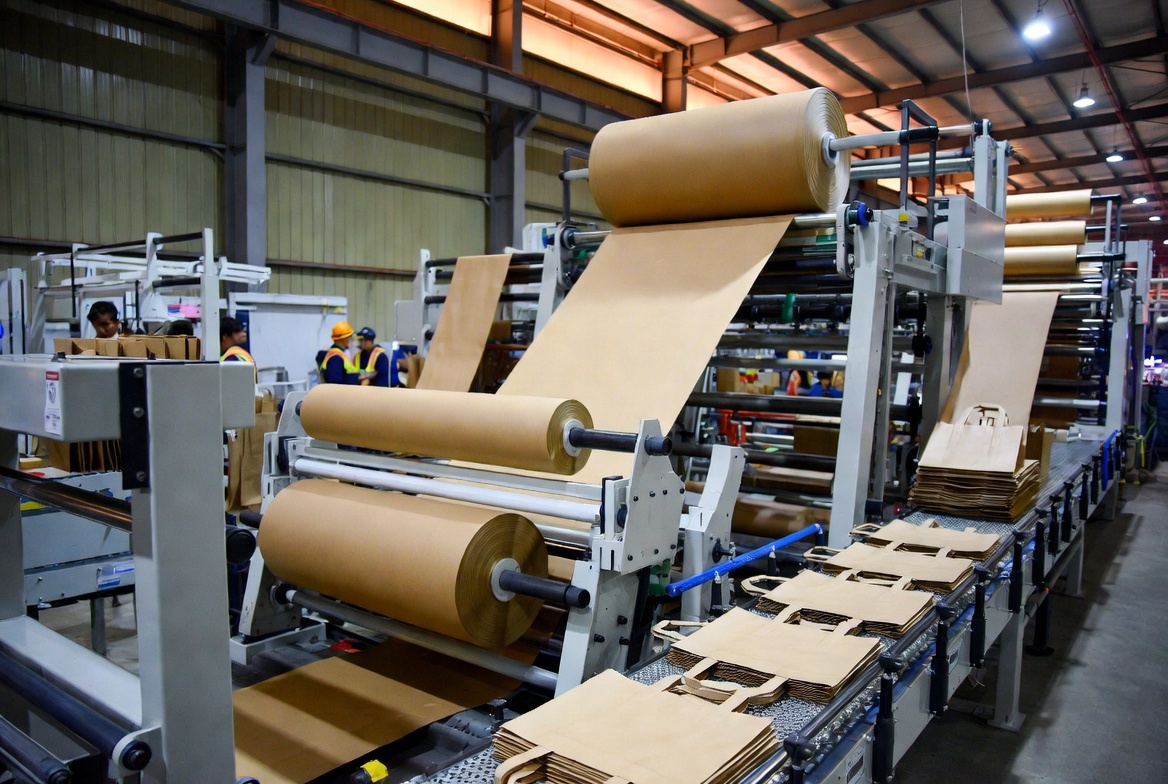
Standard Production Workflow For Custom Tote Bags
For teams sourcing custom tote bags, understanding the production sequence helps set realistic expectations on lead time and cost:
1. Design confirmation and artwork proofing (color separation for paper, film-ready art for plastic)
2. Material sourcing and cutting to specified dimensions
3. Printing (screen printing, offset, or heat transfer depending on substrate)
4. Assembly — stitching for paper/fabric totes, heat-sealing for plastic totes
5. Handle attachment and reinforcement
6. Quality control checks on print clarity and structural strength
7. Packing and export documentation
This workflow applies broadly across suppliers, though exact steps vary by bag style and order specifications.
Making The Right Choice For Your Brand
The right answer depends on your customer base, product category, and how the bag will actually be used after purchase.
- Choose paper totes if your brand sells fashion, cosmetics, gifts, or retail goods where unboxing and shelf appeal matter.
- Choose plastic totes if your product line demands moisture resistance, heavy-duty carrying capacity, or lower unit cost at scale.
- Consider a hybrid strategy, using paper for customer-facing retail bags and plastic for logistics or bulk transport packaging.
Brands that want to combine strong print quality with dependable structural performance should work directly with an experienced manufacturer who can prototype both material options before committing to large production runs. If you're evaluating packaging for an international rollout, request material samples and printing proofs in both paper and plastic before finalizing your order — this single step prevents costly reprints and shipping delays.
Frequently Asked Questions
Are paper tote bags more expensive than plastic tote bags?
Generally yes, especially with reinforced handles and premium printing, though the gap narrows at high order volumes.
Which bag type is better for heavy or wet products?
Plastic tote bags handle moisture and heavier loads more reliably than paper.
Do customers actually recycle paper tote bags?
Recycling rates vary by region, but paper is more widely accepted in standard recycling streams than most plastic film.
Can plastic tote bags be made more sustainable?
Yes, using recycled plastic content or designing bags for repeated long-term reuse significantly reduces their environmental footprint.
How many times should a bag be reused to be considered environmentally sound?
Paper bags need roughly 3 reuses and plastic bags roughly 4 reuses to offset their production impact, according to UK Environment Agency findings.
Which material offers better branding opportunities for retailers?
Paper offers a more premium, matte print finish favored in fashion and cosmetics, while plastic supports glossy, vibrant branding for high-visibility retail use.
References
1. Columbia Climate School — Plastic, Paper or Reusable? https://news.climate.columbia.edu/2020/04/29/plastic-paper-reusable-bags/
2. New York Times — Paper, Plastic or Reusable? https://www.nytimes.com/2017/09/14/climate/plastic-paper-tote-bags-environment.html
3. EcoWatch/Sustainability report — Which Bag is Greener: Plastic, Paper, or Reusable? https://www.ecowatch.com/plastic-paper-reusable-bags.html
4. Consumer Preferences Research — Understanding Consumer Preferences for Bag Materials https://www.packagingdigest.com/consumer-preferences-bag-materials
5. Industry Insight — What Do Consumer Preferences In Paper Packaging Bags Look Like https://www.packworld.com/paper-packaging-consumer-preferences
6. BBC News — Plastic or paper: Which bag is greener? https://www.bbc.com/news/business-46893019
7. Enviro-Tote, Inc. — Custom Canvas Tote Bags Made in the USA https://www.enviro-tote.com/
8. Greenpeace/Green Living Guide — Are Tote Bags Eco-Friendly? https://www.thegoodtrade.com/features/are-tote-bags-eco-friendly


