Content Menu
● What Makes These Materials Different?
● Material Structure and Performance
>> Strength Profile
>> Print and Surface Quality
● Side-by-Side Comparison
● Which One Fits Display Stands Best?
>> Best Use Cases for Honeycomb Cardboard
>> Best Use Cases for Corrugated Cardboard
● Cost, Logistics, and Reuse
● Sustainability and Brand Positioning
● Expert Selection Framework
● Practical Design Advice
● Industry Insight for Brand Owners
● Conclusion
● FAQ
>> 1. Is honeycomb cardboard stronger than corrugated cardboard for display stands?
>> 2. Which material is better for retail display stands?
>> 3. Which material gives a better print result?
>> 4. Can both materials be recycled?
>> 5. Which one is more cost-effective?
>> 6. Which material should I choose for international exhibition stands?
● References
Choosing between honeycomb cardboard and corrugated cardboard for display stands is not just a material decision. It affects structure, print quality, shipping efficiency, setup time, sustainability, and the way your brand performs in retail or exhibition environments. For brands that need display stands to look premium while still being practical, the right substrate can make a measurable difference.
For more than 20 years, manufacturers like Shenzhen XingKun Packing Products Co., Ltd. have seen one clear pattern: the best display solution is rarely the strongest material alone, but the one that fits the product, the venue, the budget, and the campaign goal.
What Makes These Materials Different?
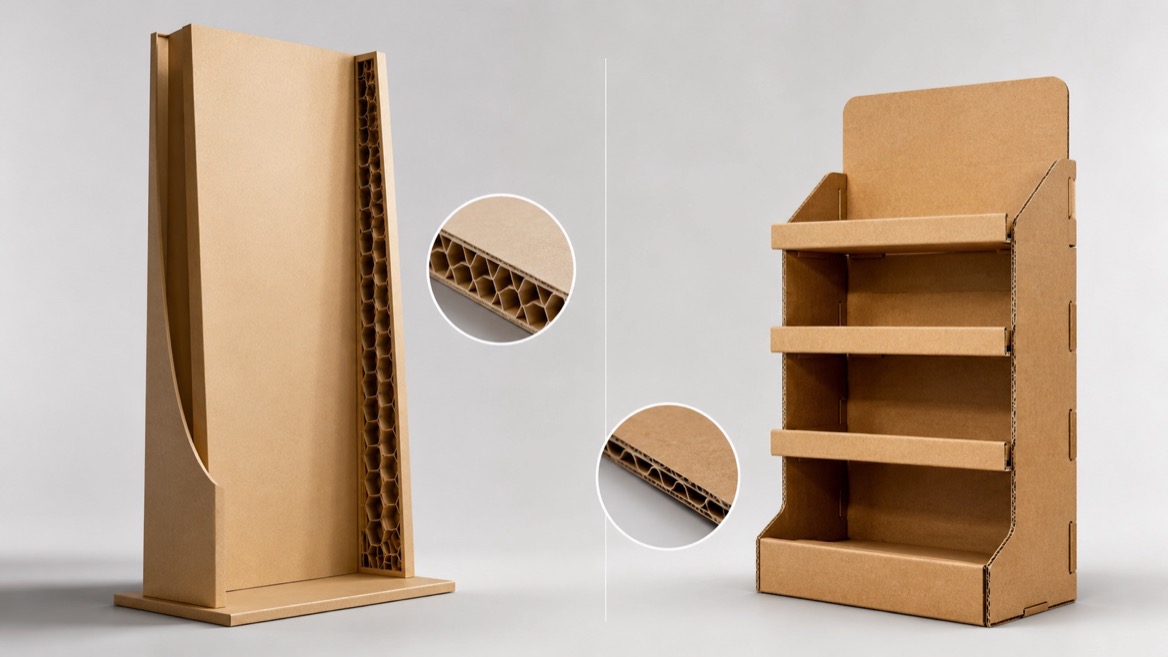
Honeycomb cardboard and corrugated cardboard are both paper-based materials, but they work in very different ways. Honeycomb cardboard uses a hexagonal core between linerboards, while corrugated cardboard uses fluted arches sandwiched between liners. That structural difference changes how each material carries weight, resists bending, and handles large display formats.
In practical terms, honeycomb board tends to deliver better stiffness and a flatter surface, while corrugated board is usually easier to engineer, easier to source, and more cost-efficient for common retail display shapes. This is why both materials remain important in display stand production.

Material Structure and Performance
Honeycomb cardboard is designed for high rigidity with low material usage. Its internal cell structure spreads pressure across the panel more evenly, which helps when you need tall, freestanding panels or wide branding walls. It is often selected for larger exhibition-style structures where visual flatness and load stability matter.
Corrugated cardboard relies on flutes to provide strength and cushioning. It is widely used in retail display stands because it is versatile, economical, and easy to die-cut into shelf units, counter displays, floor displays, and quick-assembly promotional structures. For many campaigns, corrugated board offers the best balance of price and performance.
Strength Profile
If your display must support large panels or resist bending over a wider span, honeycomb cardboard usually has the advantage. Its core structure is especially effective in reducing sagging and maintaining geometric stability. This makes it attractive for high-end display walls, branded towers, and reusable event fixtures.
Corrugated cardboard performs well in lighter and medium-load applications. Double-wall and triple-wall options can improve strength significantly, especially when the display needs shelves or product load support. In short, corrugated board is usually the more flexible engineering option, while honeycomb board is often the more structurally refined one.
Print and Surface Quality
For branding, surface quality matters. Honeycomb cardboard typically provides a smoother and flatter face, which can help with high-resolution graphics, premium finishes, and large-area visual consistency. This is useful when the display stand is meant to look like part of the brand architecture.
Corrugated cardboard can also print very well, especially when using white-top liners or laminated surfaces. However, the flute structure may create more visible limitations in very large, uninterrupted graphics unless the board is carefully selected and finished. For fast-moving retail promotions, though, corrugated board still delivers excellent print value.
Side-by-Side Comparison
| Factor | Honeycomb Cardboard | Corrugated Cardboard |
| Core structure | Hexagonal cells | Fluted arches |
| Best use | Large panels, exhibition walls, premium freestanding stands | Retail floor displays, counter units, shelf displays |
| Strength-to-weight | Very high | High, especially in reinforced versions |
| Surface flatness | Excellent | Good to very good |
| Graphic presentation | Premium, smooth visual impact | Strong, cost-effective branding support |
| Setup and handling | Lightweight, stable, often used in modular systems | Easy to fabricate, widely used for quick assembly |
| Cost efficiency | Usually higher | Usually lower |
| Typical choice when | Visual impact and stiffness matter most | Budget, speed, and versatile production matter most |
Which One Fits Display Stands Best?
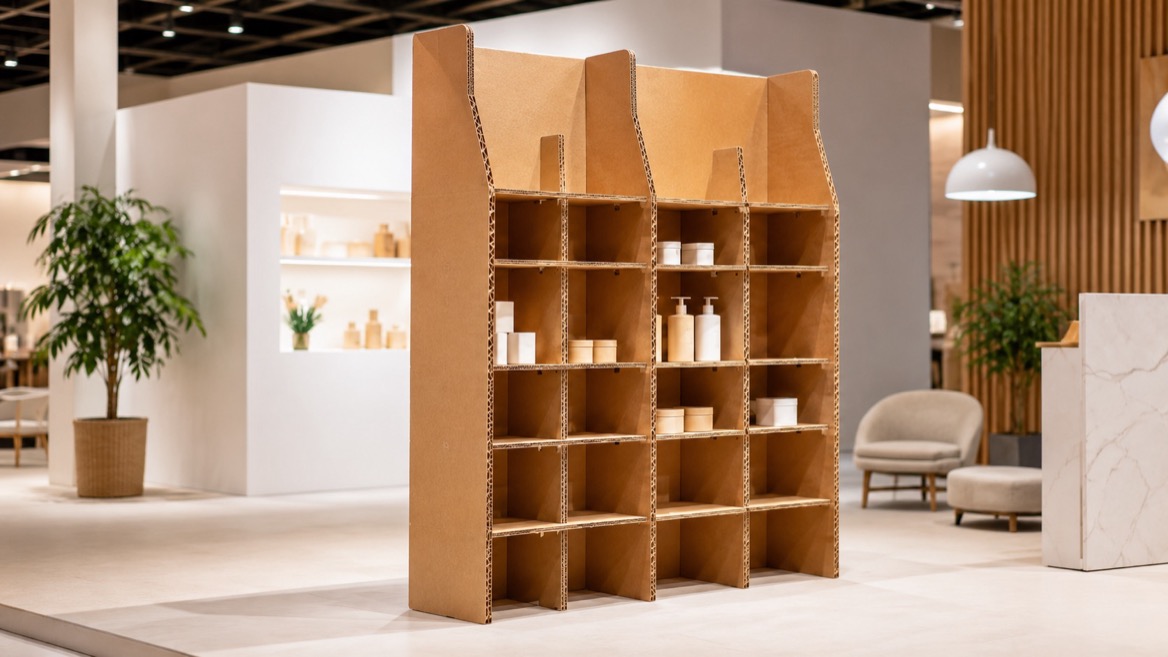
For large exhibition display stands, honeycomb cardboard is often the better choice. It gives a clean, premium appearance and handles broad vertical surfaces well. If the structure must look architectural, support large panels, or create a strong brand statement, honeycomb board is often the stronger solution.
For retail display stands, corrugated cardboard is frequently the smarter choice. It is easier to customize for product shelves, hooks, tiered units, dump bins, and seasonal promotions. When a display needs to be produced in volume and shipped efficiently, corrugated board often wins on total project practicality.
Best Use Cases for Honeycomb Cardboard
- Exhibition back walls.
- Freestanding brand towers.
- Large-format event displays.
- Premium pop-up installations.
- Reusable modular visual structures.
Best Use Cases for Corrugated Cardboard
- Floor display stands.
- Countertop displays.
- Shelf-ready promotional units.
- Hook displays for lightweight goods.
- High-volume seasonal retail campaigns.
Cost, Logistics, and Reuse
Cost is often the deciding factor. Corrugated cardboard generally costs less to produce and is easier to convert into many display stand styles. That makes it ideal for promotions with short lifecycles, high quantities, or strict budget targets.
Honeycomb cardboard usually has a higher unit cost, but that can be justified when the display needs better stiffness, a more premium look, or stronger reusability. It can also reduce unnecessary material usage in larger structures, which may help balance logistics and performance over multiple events.
If your campaign involves international shipping, honeycomb cardboard can be attractive because the panels are lightweight and can be shipped flat. Corrugated cardboard also ships flat, but the material choice should be based on the display's geometry, load demand, and desired finish rather than shipping alone.
Sustainability and Brand Positioning
Both materials support paper-based recycling streams, which makes them appealing for brands looking to reduce environmental impact. Honeycomb cardboard can be particularly efficient in terms of material usage because it achieves high rigidity with less mass. That efficiency is valuable when brands want a more responsible material story without sacrificing presentation.
Corrugated cardboard also fits well into sustainability-driven retail programs because it is widely recyclable and commonly made from recycled fiber. For many brands, corrugated display stands are the most accessible way to combine fast deployment with a lighter environmental footprint.
From a brand perspective, sustainability is not only about recycling. It is also about using the right amount of material, designing for flat-pack shipping, and choosing a structure that can be reused when possible. That is where a well-planned display strategy creates both commercial and environmental value.
Expert Selection Framework
When we evaluate a display stand project, we usually start with four questions. This simple framework helps avoid choosing a material based only on habit or price.
1. How heavy are the products?
- Heavier products require stronger shelf support and better load distribution.
2. How important is visual impact?
- Premium launches and exhibitions often benefit from a flatter, more architectural material.
3. How long will the display be used?
- Short campaigns often favor corrugated board, while reusable installations may justify honeycomb board.
4. How much handling will it face?
- If staff will move, reset, or store the display repeatedly, durability and stability become more important.
This decision process usually leads to one of two outcomes: use honeycomb when structure and presentation are the priority, and use corrugated when speed and cost efficiency are the priority.
Practical Design Advice
A display stand performs best when the material and structure are engineered together. A strong board alone does not guarantee success if the base, shelf depth, or scoring lines are weak. Good design matters just as much as board choice.
Here are practical ways to improve results:
- Reinforce load zones near shelves and joints.
- Use clean die-cut geometry to reduce assembly errors.
- Match board grade to product weight instead of choosing one universal option.
- Use white liners or coated surfaces when graphics are central to the sale.
- Test one prototype before moving into mass production.
For brands preparing retail campaigns, this step is essential. A display that looks good in a rendering can still fail in the store if the board grade, shelf angle, or locking structure is not properly matched to the load.
Industry Insight for Brand Owners
In our experience, many buyers initially ask for the cheapest display material, but later discover that the real cost comes from deformation, poor presentation, or slow setup. A slightly better material choice can improve shelf stability, protect the merchandise, and strengthen the retail image at the same time.
For premium launches, honeycomb cardboard often creates a more polished first impression. For high-volume promotions, corrugated cardboard often delivers the best combination of speed, flexibility, and cost control. The best choice depends on whether the display is meant to impress, hold, repeat, or all three.
Conclusion
Honeycomb cardboard and corrugated cardboard both have a strong place in display stand production, but they solve different problems. Honeycomb board is the better fit for larger, more premium, and more structurally demanding displays, while corrugated board is usually the more practical choice for retail promotions, shelf units, and budget-sensitive campaigns.
For brands that need the right balance of visual impact, function, and production efficiency, the smartest move is to match the material to the display's purpose rather than defaulting to the cheapest option. That is how a display stand becomes a business asset instead of just a temporary fixture.
If you are planning a custom display stand project, the best next step is to define your product weight, target venue, graphic requirements, and expected usage cycle before choosing the board structure.
FAQ
1. Is honeycomb cardboard stronger than corrugated cardboard for display stands?
Yes, in many large-panel and structural applications honeycomb cardboard offers higher stiffness and better load distribution. Corrugated cardboard can still be very strong, especially when double-wall or triple-wall construction is used.
2. Which material is better for retail display stands?
Corrugated cardboard is usually better for retail display stands because it is versatile, cost-efficient, and easy to convert into shelf units, floor displays, and counter displays. Honeycomb cardboard is more often chosen for premium or large-format installations.
3. Which material gives a better print result?
Honeycomb cardboard usually provides a flatter, smoother face for premium graphics. Corrugated cardboard can also print well, especially with coated liners or laminated surfaces.
4. Can both materials be recycled?
Yes, both are paper-based and commonly recyclable. Their recyclability can depend on local recycling systems and any added coatings or laminations.
5. Which one is more cost-effective?
Corrugated cardboard is usually more cost-effective for most standard display stand projects. Honeycomb cardboard may cost more, but it can be worth it for premium presentation or larger structures.
6. Which material should I choose for international exhibition stands?
Honeycomb cardboard is often preferred for larger exhibition stands because it is lightweight, stable, and visually clean. Corrugated cardboard may still be suitable for smaller modular event displays and supporting components.
References
1. [Honeycomb Cardboard Display: Functional And Eco-Friendly Event Solutions]
2. [Honeycomb Cardboard Exhibition Stands: Sustainable Lightweight Solutions for Trade Shows]
3. [Classification and Material Requirements of Corrugated Display Boards]
4. [Cardboard Displays | Corrugated Counter Stands & Dump Bins]
5. [Temporary Retail Display Load-Bearing Capabilities]
6. [Honeycomb Board Display Stand]
7. [Going Green With Cardboard Displays]
8. [What Are Honeycomb Cardboard Exhibition Stands Made Of?]


