Content Menu
● What Is Hardcover Book Printing?
● Why Choose Custom Hardcover Book Printing?
>> Improved Durability
>> Premium Brand Presentation
>> Higher Perceived Value
● Hardcover Book vs. Paperback and Board Book
● Custom Hardcover Book Materials
>> Cover Board
>> Cover-Wrapping Materials
>> Interior Paper
● Printing Methods for Hardcover Books
>> Offset Printing
>> Digital Printing
>> UV Printing
● Hardcover Book Finishing Options
>> Lamination and Coating
>> Foil Stamping
>> Embossing and Debossing
>> Dust Jackets and Slipcases
● How to Prepare Artwork for Printing Hardcover Books
>> Recommended File Preparation
>> Color Management
● The Custom Hardcover Book Manufacturing Process
>> 1. Requirement Review
>> 2. Quotation and Specification Confirmation
>> 3. Digital Proof or Physical Sample
>> 4. Prepress and Production
>> 5. Case Making and Casing-In
>> 6. Inspection and Packing
● A Practical Quality-Control Checklist
>> Preproduction Checks
>> During-Production Checks
>> Pre-Shipment Checks
● Sustainable Hardcover Book Printing
● How to Select a Hardcover Book Printing Manufacturer
● New Product Development Opportunity: Hardcover Book Sets
● Cost Factors in Hardcover Book Printing
● Request a Custom Hardcover Book Quote
● Conclusion
● Frequently Asked Questions
>> 1. What is the difference between a hardcover book and a paperback book?
>> 2. What types of books are suitable for hardcover book printing?
>> 3. Is offset or digital printing better for hardcover books?
>> 4. Can I customize the hardcover book cover?
>> 5. How do I calculate the hardcover book spine width?
>> 6. Can hardcover books use recycled or FSC-certified paper?
>> 7. Should I order a sample before mass production?
>> 8. What information should I provide when requesting a quotation?
>> 9. Can one supplier produce hardcover books and packaging boxes?
>> 10. Does a lower unit price always mean a better hardcover book deal?
● References
Printing hardcover book projects are an effective way to create durable, premium publications for publishers, brands, wholesalers, educators, and creative businesses. Compared with paperback production, a custom hardcover book offers stronger protection, a more substantial reading experience, and a higher-value presentation for novels, children's books, art books, corporate reports, annual reports, academic theses, photo books, journals, and collector editions.
For international buyers, selecting the right hardcover book printing manufacturer involves more than comparing unit prices. Paper selection, page count, binding construction, color management, cover finishing, proofing, quality control, packaging, and shipping all affect the final result. As a China-based OEM and ODM manufacturer, Shenzhen XingKun Packing Products Co., Ltd. (XingKun) provides customized printing solutions for overseas brands, wholesalers, and production companies.
This guide explains how to plan, print, customize, and manufacture hardcover books efficiently.

What Is Hardcover Book Printing?
Hardcover book printing combines printed interior pages with a rigid cover made from greyboard or another strong board wrapped in printed paper, coated paper, specialty paper, or bookbinding material.
The main components usually include:
- Printed text block: The interior pages containing text, illustrations, photographs, charts, or other content.
- Hardcover boards: Rigid boards that protect the pages and give the book its structure.
- Endpapers: Sheets that connect the text block to the hardcover case.
- Spine: The central section that holds the book together and may be printed, embossed, or foil stamped.
- Cover wrap: Printed paper, cloth, coated paper, or another material applied to the boards.
- Finishing: Lamination, varnish, foil stamping, embossing, debossing, or special coatings.
- Optional dust jacket: A removable printed jacket that provides additional branding and decoration.
A hardcover book is not simply a paperback with a thicker cover. Its construction requires more precise board preparation, folding, casing-in, alignment, and binding control. For this reason, the specifications should be finalized before production begins.
XingKun's hardcover book product options include multiple paper materials, printing methods, coatings, foil processes, and embossing effects. These options allow buyers to create either a practical commercial book or a premium presentation product. [xkdisplay]
Why Choose Custom Hardcover Book Printing?
A hardcover format is suitable when the book must communicate durability, authority, collectability, or premium value.
Improved Durability
The rigid cover provides stronger protection against bending, abrasion, and repeated handling. This makes hardcover books suitable for:
- Children's storybooks.
- School and educational books.
- Cookbooks and reference books.
- Corporate documents.
- Art and photography books.
- Memory books and family albums.
- High-end promotional publications.
- Limited-edition and collector books.
A strong case-bound structure can also help a book maintain its shape during storage and display. However, durability depends on more than the cover board. Paper weight, sewing or adhesive binding, hinge construction, endpaper quality, and production accuracy also matter.
Premium Brand Presentation
A professionally manufactured hardcover book creates a stronger first impression than a basic paperback. The rigid cover provides a larger visual and tactile area for branding, photography, typography, textures, and special effects.
For example, a luxury food brand could produce a hardcover recipe book with:
- A deep green bookbinding cover.
- Gold foil on the front and spine.
- Matte lamination for a soft, refined appearance.
- Full-color interior food photography.
- A custom slipcase for retail presentation.
The same principles can be applied to corporate reports, product catalogs, educational resources, and promotional books.
Higher Perceived Value
Hardcover books are commonly associated with long-term ownership and premium positioning. A publisher may use the format for a special edition, while a brand may use it as a high-value gift for customers, partners, or investors.
The format is particularly effective when the publication is intended to be:
- Displayed on a shelf.
- Kept as a reference.
- Given as a premium gift.
- Sold at a higher retail price.
- Used to support a luxury or professional brand identity.
Hardcover Book vs. Paperback and Board Book
Choosing the correct book structure depends on the intended use, age group, budget, and expected handling conditions.
| Book format | Construction | Main advantages | Suitable applications |
| Hardcover book | Rigid boards wrapped with printed or decorative material | Durable, premium, highly customizable | Art books, novels, corporate books, collector editions |
| Paperback book | Flexible printed cover | Lightweight and economical | Mass-market books, manuals, catalogs, workbooks |
| Board book | Thick laminated board pages | Strong pages for young children | Baby books, toddler books, learning books |
| Casebound notebook | Hard case with blank or lined pages | Durable writing product | Journals, planners, branded notebooks |
| Hardcover photo book | Rigid cover with high-quality image pages | Strong visual impact | Weddings, portfolios, photography, brand stories |
A hardcover book is generally the best choice when the cover needs to feel substantial and the publication is expected to last. A board book is different: its pages are also made from thick board, making it more appropriate for toddlers and very young children.
For high-volume projects where cost and shipping weight are major concerns, paperback may be more practical. For a premium edition, hardcover is often the stronger commercial choice.
Custom Hardcover Book Materials
Material selection affects appearance, durability, color reproduction, sustainability, and cost.
Cover Board
Hardcover boards provide the structural strength of the book. The board thickness should be selected according to:
- Finished book size.
- Page count.
- Book weight.
- Intended age group.
- Opening behavior.
- Shipping and handling requirements.
A board that is too thin may feel weak, while an excessively thick board can increase production cost and shipping weight. The correct specification should be confirmed with the manufacturer after reviewing the full book dimensions and page count.
Cover-Wrapping Materials
Common cover materials include:
- Coated art paper.
- Textured paper.
- Uncoated paper.
- Natural kraft paper.
- Black kraft paper.
- Book cloth.
- Synthetic leather.
- Specialty decorative paper.
- Metallic or holographic paper.
XingKun lists materials such as SBS, CCNB, kraft papers, textured paper, metallic paper, holographic paper, and recycled paperboard options for customized printed products. The final availability should be confirmed according to the project specification and intended market. [xkdisplay]
Interior Paper
Interior pages may be printed on:
- Uncoated book paper.
- Coated art paper.
- Offset paper.
- Recycled paper.
- Cream paper.
- High-opacity paper.
- Specialty textured paper.
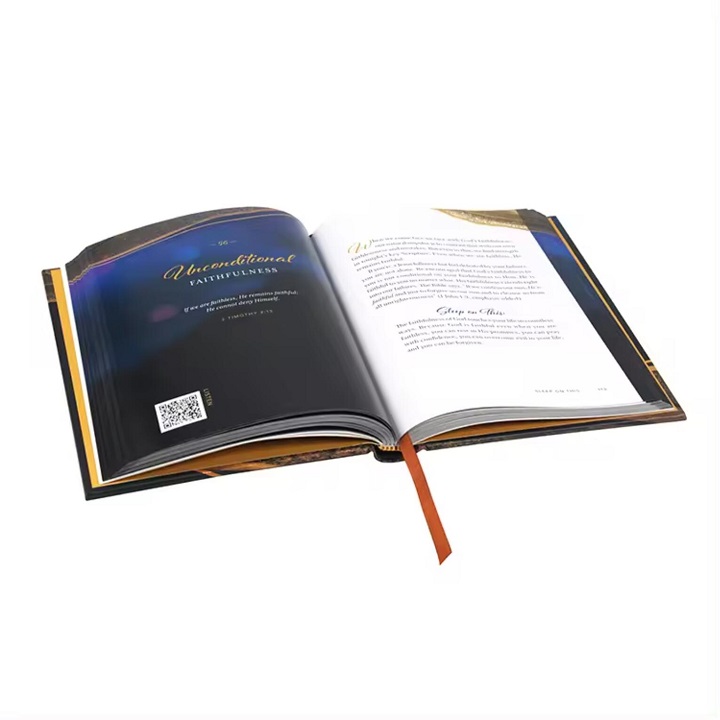
The paper should match the content. Text-heavy novels usually benefit from readable, lightweight uncoated paper. Photo books and art books often require coated paper for sharper image detail and stronger color reproduction.
For children's books, paper thickness and surface durability are especially important. A gloss or matte coating can help protect printed pages, but the manufacturer should evaluate the product's age grading, ink system, coating, and applicable safety requirements.
Printing Methods for Hardcover Books
The most suitable printing process depends on quantity, image quality, page count, deadline, and personalization requirements.
Offset Printing
Offset printing is commonly selected for medium and large production runs. It is suitable when a buyer needs:
- Consistent color across many copies.
- Competitive unit pricing at higher quantities.
- Full-color images and illustrations.
- Pantone or brand color matching.
- Large-scale commercial production.
Before production, the printer should check the artwork, bleed, color profile, image resolution, overprint settings, and special color requirements.
Digital Printing
Digital printing is useful for short runs, prototypes, test editions, and variable-content books. It can reduce the need for printing plates and may be suitable when the buyer needs:
- A smaller initial quantity.
- Fast sample production.
- Multiple versions of one book.
- Personalized names or content.
- Print-on-demand production.
- Market testing before mass production.
Industry research from Smithers reported that the global digital print market was worth approximately USD 167.5 billion in 2025 and identified books and publications as important areas of future growth. This does not mean digital printing is always cheaper. For each project, the total cost should be compared according to quantity, page count, finishing, setup, and logistics. [smithers]
UV Printing
UV printing can be used for selected cover applications and specialty effects. It may be appropriate for:
- High-opacity white ink.
- Printing on dark or specialty materials.
- Short-run decorative covers.
- Strong visual contrast.
- Direct-to-material applications.
UV printing is not automatically the best process for every hardcover book. The cover material, folding requirements, adhesion, and finishing compatibility should be tested before full production.
Hardcover Book Finishing Options
Finishing transforms a standard printed cover into a distinctive branded product.
Lamination and Coating
Common options include:
- Matte lamination: Creates a calm, premium appearance and reduces glare.
- Gloss lamination: Enhances color saturation and visual brightness.
- Soft-touch lamination: Provides a smooth, velvety surface.
- Anti-scratch lamination: Helps reduce visible scuffing during handling.
- Aqueous coating: Offers a water-based protective surface.
- Spot UV: Adds selective gloss to logos, titles, or images.
- Varnish: Provides a protective or decorative surface effect.
A practical design approach is to combine finishes rather than apply too many effects. For instance, a matte cover with spot UV on the title can create contrast without making the design visually crowded.
Foil Stamping
Hot foil stamping applies a metallic or colored foil to the cover. Popular choices include:
- Gold foil.
- Silver foil.
- Copper foil.
- Black foil.
- Holographic foil.
- Colored foil.
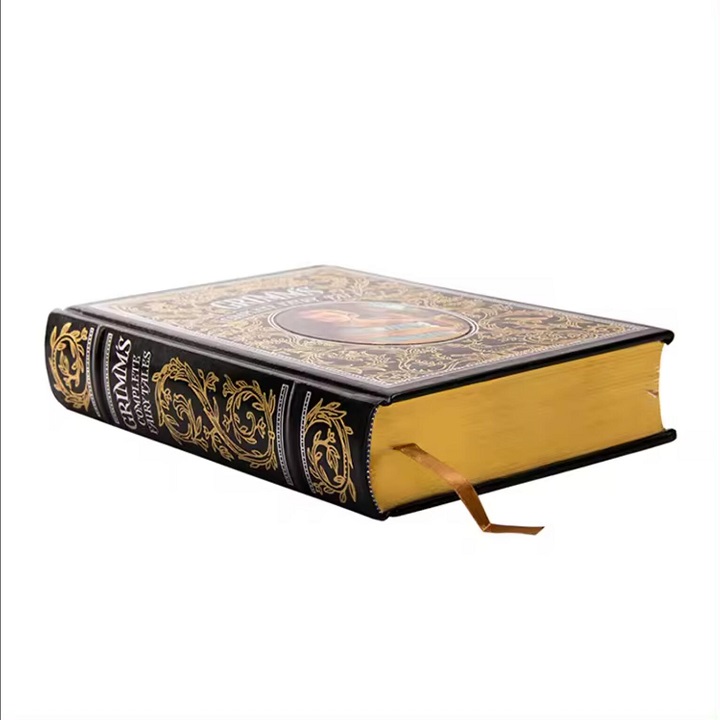
Foil is especially effective for book titles, logos, borders, and small decorative patterns. Fine lines and small type should be reviewed carefully because intricate foil details may lose clarity during production.
Embossing and Debossing
Embossing raises a design above the cover surface, while debossing presses the design into the material. These processes add a tactile dimension that readers can feel.
Typical applications include:
- Brand logos.
- Book titles.
- Decorative patterns.
- Character illustrations.
- Geometric textures.
- Premium certification marks.
Combination embossing can be used with foil stamping, but the artwork must be prepared accurately. The printer should review line thickness, minimum type size, registration, and the distance between design elements.
Dust Jackets and Slipcases
A dust jacket adds a separate printed layer around the hardcover. It can contain:
- Front-cover artwork.
- Back-cover information.
- Author biography.
- Retail barcode.
- Promotional copy.
- Publisher or brand information.
A slipcase provides additional protection and can turn a book into a gift set or collector edition. It is often used for photography collections, luxury brand books, historical publications, and multi-volume sets.
How to Prepare Artwork for Printing Hardcover Books
Correct artwork preparation reduces delays, color problems, and unexpected costs.
Recommended File Preparation
Before submitting files, confirm the following:
1. Use the printer's approved template for the cover and interior.
2. Set the correct finished size and spine width.
3. Add bleed according to the manufacturer's specification.
4. Keep important text and logos inside the safe area.
5. Use high-resolution images suitable for the final print size.
6. Convert or manage colors consistently.
7. Check black text and rich black settings.
8. Include separate files for the cover, dust jacket, endpapers, and interior.
9. Outline fonts or package all fonts correctly.
10. Remove hidden layers, comments, and unused objects.
11. Confirm barcode readability and placement.
12. Export a press-ready PDF after final inspection.
The spine width cannot be estimated from page count alone. It depends on paper thickness, paper bulk, and the final number of pages. Ask the factory to calculate the spine using the selected paper and binding method.
Color Management
Color expectations should be agreed before production. A screen display, digital proof, and offset press sheet may not appear identical.
For branded books, provide:
- CMYK artwork.
- Pantone references where appropriate.
- A physical color sample for critical colors.
- A signed proof or approved digital proof.
- Clear tolerance expectations.
A proof is not only a visual preview. It is also a checkpoint for text, image cropping, page sequence, cover alignment, barcode placement, and finishing position.
The Custom Hardcover Book Manufacturing Process
A reliable manufacturing workflow should include clear approval points.
1. Requirement Review
The buyer provides:
- Book size.
- Page count.
- Quantity.
- Interior color.
- Cover design.
- Paper requirements.
- Binding preference.
- Finishing options.
- Packaging requirements.
- Delivery destination.
At this stage, the factory can recommend materials and identify technical risks.
2. Quotation and Specification Confirmation
The quotation should state more than a unit price. Confirm whether it includes:
- Proofing.
- Plate or setup charges.
- Finishing.
- Packing.
- Cartons.
- Inland transportation.
- Export documentation.
- Shipping.
- Taxes or duties.
A low unit price may not represent the lowest total landed cost.
3. Digital Proof or Physical Sample
For complex hardcover books, a physical sample is strongly recommended. It allows the buyer to inspect:
- Cover color.
- Board rigidity.
- Spine construction.
- Page opacity.
- Binding strength.
- Foil and embossing.
- Dust-jacket fit.
- Overall dimensions.
4. Prepress and Production
After approval, the printer prepares the files, creates printing plates if offset printing is used, prints the pages, applies coatings, folds and gathers signatures, and binds the text block.
5. Case Making and Casing-In
The hardcover case is produced by wrapping the board with the selected cover material. The text block is then attached to the case using endpapers and adhesive or another binding method.
6. Inspection and Packing
Finished books should be inspected for:
- Color consistency.
- Missing or duplicated pages.
- Page order.
- Cover scratches.
- Foil registration.
- Embossing depth.
- Binding strength.
- Trim accuracy.
- Dust-jacket positioning.
- Carton damage.
A packaging plan is essential. Protective wrapping, suitable carton strength, corner protection, and palletization may reduce damage during international transportation.
A Practical Quality-Control Checklist
From a buyer's perspective, quality control should be agreed in writing rather than handled informally.
Preproduction Checks
- Are the final files approved?
- Is the correct paper confirmed?
- Is the cover board thickness documented?
- Is the spine width correct?
- Are Pantone colors specified?
- Are special finishing dies approved?
- Is the sample signed off?
During-Production Checks
- Does the first production sheet match the approved proof?
- Are the pages aligned correctly?
- Is the ink coverage stable?
- Are coating and lamination surfaces clean?
- Are foil and embossing registered correctly?
- Are books being handled to prevent scuffing?
Pre-Shipment Checks
- Is the final quantity correct?
- Are cartons labeled clearly?
- Are random cartons opened for inspection?
- Are book dimensions and weights recorded?
- Are photographs or inspection records available?
- Are shipping documents complete?
For large orders, buyers may also arrange third-party inspection. The inspection scope should define the sampling method, acceptable defect levels, packaging checks, and reporting format.
Sustainable Hardcover Book Printing
Sustainability should be evaluated across the entire product, not only through a single "eco-friendly" claim.
Possible considerations include:
- FSC-certified paper or board.
- Recycled paper content.
- Water-based or soy-based inks.
- Reduced plastic packaging.
- Recyclable cover materials.
- Efficient carton design.
- Lower-waste production planning.
- Consolidated shipping.
- Durable construction that extends product life.
The Forest Stewardship Council explains that chain-of-custody certification allows organizations to use recognized FSC claims and labels on eligible finished products. Buyers should verify whether the specific factory, material supplier, and product claim are covered by a valid certification scope. A printer should not use an FSC claim simply because a paper is described as "eco-friendly." [fsc]
XingKun lists water-based inks, soy-vegetable-based inks, and several recycled or kraft material options among its customization choices. Buyers should confirm the exact material composition, certificate status, and labeling requirements for each order. [xkdisplay]
How to Select a Hardcover Book Printing Manufacturer
A suitable supplier should be evaluated on capability, communication, quality, and commercial reliability.
Ask the manufacturer:
- Can you produce the required finished size and page count?
- Which binding method do you recommend?
- Can you provide a physical sample?
- What paper brands and grades are available?
- Can you match Pantone colors?
- Which cover finishes can you produce in-house?
- What is the minimum order quantity?
- What is the normal production lead time after approval?
- How do you inspect and pack finished books?
- Can you provide export packaging specifications?
- Can you support OEM and ODM development?
- Can you provide material or sustainability documentation?
A factory that produces multiple paper products may also provide packaging coordination. For a brand selling books, cards, puzzles, stickers, and packaging boxes, a unified supplier can simplify artwork coordination, purchase orders, quality communication, and shipment planning.
XingKun positions itself as a China manufacturer offering OEM and ODM services for custom printed products, including hardcover books and other paper-based products. Its product information presents a range of material, printing, coating, ink, foil, and embossing choices for hardcover book projects. [xkdisplay]
New Product Development Opportunity: Hardcover Book Sets
One underused opportunity is to develop a complete hardcover book presentation set rather than selling the book alone.
Possible components include:
- Hardcover book.
- Printed slipcase.
- Matching bookmark.
- Certificate or thank-you card.
- Protective paper sleeve.
- Branded packaging box.
- Decorative stickers.
- Limited-edition numbering card.
This approach is useful for:
- Luxury brand storytelling.
- Museum and gallery publications.
- Collector editions.
- Corporate anniversary books.
- Premium children's learning sets.
- Artist portfolios.
- Fan merchandise and licensed products.
A coordinated set increases the number of production variables, so the buyer should test the complete package before approving mass production. The book, box, insert, and accessories should be checked for color consistency and dimensional fit.
Cost Factors in Hardcover Book Printing
The final price depends on the interaction of several variables:
- Finished book size.
- Total page count.
- Quantity.
- Interior color pages.
- Paper type and weight.
- Cover board thickness.
- Binding method.
- Lamination or coating.
- Foil stamping.
- Embossing or debossing.
- Dust jacket.
- Slipcase.
- Individual wrapping.
- Export carton requirements.
- Shipping destination and method.
Generally, larger quantities can reduce the unit cost of offset printing because setup costs are distributed across more copies. However, increasing page count, adding special finishing, or using heavy paper can increase both manufacturing and shipping costs.
For an accurate quotation, send the supplier a complete specification instead of asking only for "the price of a hardcover book."
Request a Custom Hardcover Book Quote
XingKun can support overseas brands, wholesalers, and manufacturers that need customized hardcover books for retail, publishing, marketing, education, or promotional use.
To request a practical quotation, prepare the following information:
- Book title or project name.
- Finished size.
- Number of pages.
- Interior color requirement.
- Quantity.
- Cover material.
- Paper preference.
- Binding style.
- Lamination or coating.
- Foil, embossing, or debossing requirements.
- Dust jacket or slipcase requirement.
- Destination country and postal code.
- Target delivery date.
Send your specifications and artwork requirements to XingKun for a customized OEM or ODM hardcover book solution. A complete brief enables the factory to recommend suitable materials, estimate production costs, and identify technical issues before sampling.
Conclusion
Printing hardcover book projects require coordinated decisions about structure, paper, artwork, binding, finishing, quality control, packaging, and logistics. Hardcover is an excellent format when durability, premium presentation, and long-term product value are important.
The best result comes from treating the project as a complete manufacturing system rather than focusing only on the cover or unit price. Select the correct paper and board, calculate the spine accurately, approve a physical sample when necessary, define inspection standards, and confirm sustainability claims with documentation.
For overseas brands, wholesalers, publishers, and manufacturers, XingKun offers a customizable OEM and ODM route for hardcover books and related printed packaging products. With the right specification and approval workflow, a custom hardcover book can become a durable publication, a premium brand asset, or a collectible product with lasting value.

Frequently Asked Questions
1. What is the difference between a hardcover book and a paperback book?
A hardcover book uses rigid boards covered with printed paper, cloth, or another material. A paperback book uses a flexible paper-based cover. Hardcover books are generally more durable and premium, while paperbacks are usually lighter and more economical.
2. What types of books are suitable for hardcover book printing?
Hardcover printing is suitable for novels, children's books, art books, photo books, cookbooks, corporate reports, academic books, annual reports, journals, memoirs, collector editions, and premium promotional publications.
3. Is offset or digital printing better for hardcover books?
Offset printing is often suitable for larger quantities and consistent full-color production. Digital printing can be more practical for prototypes, short runs, variable data, and print-on-demand projects. The best option depends on quantity, page count, deadline, and finishing requirements.
4. Can I customize the hardcover book cover?
Yes. Common customization options include printed cover artwork, book cloth, textured paper, matte or gloss lamination, soft-touch lamination, spot UV, foil stamping, embossing, debossing, custom dust jackets, and slipcases.
5. How do I calculate the hardcover book spine width?
Spine width depends on the number of pages and the actual thickness or bulk of the selected paper. It should be calculated by the manufacturer after the paper specification and binding method have been confirmed.
6. Can hardcover books use recycled or FSC-certified paper?
They can, depending on material availability and certification requirements. Buyers should confirm the exact paper or board specification and verify whether the manufacturer can support the required FSC chain-of-custody claim. [fsc]
7. Should I order a sample before mass production?
A sample is recommended for projects that include special finishing, unusual materials, complex color requirements, premium packaging, or a high order value. A physical sample helps verify the structure, appearance, and fit before mass production.
8. What information should I provide when requesting a quotation?
Provide the finished size, page count, quantity, interior color, paper type, cover material, binding, finishing, packaging, destination, and required delivery date. Artwork or a reference sample can make the quotation more accurate.
9. Can one supplier produce hardcover books and packaging boxes?
Some manufacturers support multiple printed products, including books, paper boxes, cards, puzzles, and stickers. Confirm the supplier's actual production scope, quality system, and ability to coordinate multiple products under one project.
10. Does a lower unit price always mean a better hardcover book deal?
No. The total cost also includes sampling, finishing, packaging, shipping, duties, quality risks, and potential rework. Compare the full specification and landed cost rather than evaluating unit price alone.
References
1. [XingKun Hardcover Book Product Page] — Product materials, printing methods, coatings, inks, foil stamping, embossing, and customization options.
2. [Google Search Central: Creating Helpful, Reliable, People-First Content] — Guidance on original information, clear sourcing, completeness, expertise, and user-focused content.
3. [Google Search Central: Introducing the New "E" in E-E-A-T] — Explanation of Experience, Expertise, Authoritativeness, and Trustworthiness.
4. [Google Search Quality Rater Guidelines Overview PDF] — Overview of how first-hand experience, expertise, authority, and trust are considered in page-quality evaluation.
5. [Forest Stewardship Council: Chain of Custody Certification] — Information about FSC chain-of-custody certification and the use of FSC claims on finished products.
6. [Forest Stewardship Council: Paper and Packaging] — Information about FSC-certified paper and packaging applications.
7. [Smithers: Forecasts 54.3% Growth in Digital Print] — Industry information about the global digital printing market and future growth.


