Content Menu
● What Is Cover Your Assets?
● Cover Your Assets Game Components
● How to Set Up Cover Your Assets
● How to Play Cover Your Assets: Four Turn Actions
>> 1. Make a Pair From Your Hand
>> 2. Make a Pair With the Discard Pile
>> 3. Challenge Another Player to Steal a Set
>> 4. Discard One Card and Draw One Card
● How Stacking Protects Your Assets
● How to Score and Win
● Cover Your Assets Strategy Tips
>> Protect High-Value Sets Quickly
>> Count Challenge Resources
>> Challenge for More Than Face Value
>> Watch the Discard Pile
>> Do Not Reveal Your Hand Plan Too Early
● Common Rules Questions and Mistakes
>> Can You Steal Any Set in an Opponent's Stack?
>> Can You Steal a Player's First Set?
>> Can You Use the Discard Pile to Challenge?
>> Can Two Wild Cards Make a Pair?
>> What Happens When the Draw Pile Runs Out?
● What Quick Guides Often Miss
● Custom Cover Your Assets-Style Card Game Production
● Conclusion
● FAQ
>> 1. How many players can play Cover Your Assets?
>> 2. What is the goal of Cover Your Assets?
>> 3. Can you steal the bottom asset set in Cover Your Assets?
>> 4. Can you use a wild card to steal assets?
>> 5. Can a discard-pile card be used to start a challenge?
>> 6. Why are sets placed crosswise on the table?
>> 7. What should be included in a custom card game package?
● References
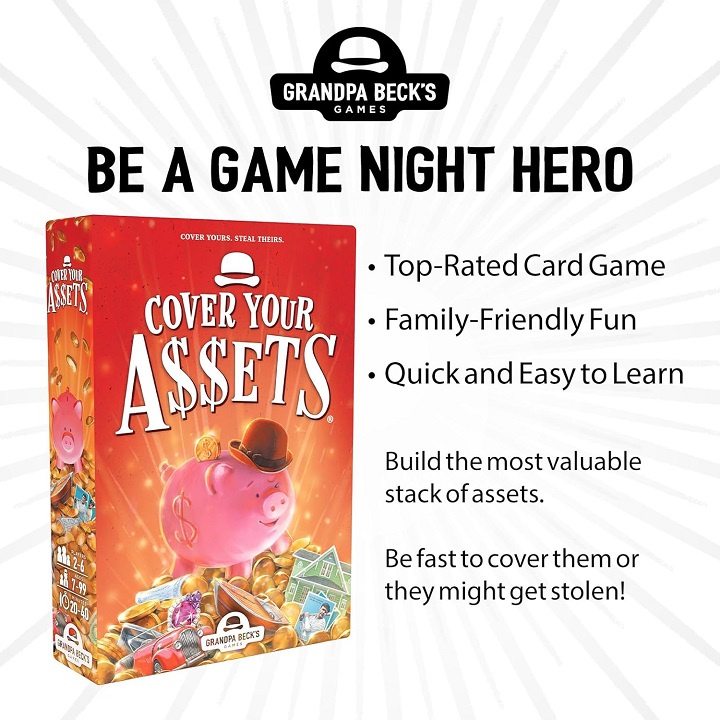
Cover Your Assets is a fast-paced set-collection card game in which players build stacks of valuable assets, protect them by covering them with new sets, and challenge opponents to steal their exposed top sets. This guide explains how to play the card game Cover Your Assets step by step, including setup, turn actions, stealing rules, scoring, practical strategy, and production insights for brands developing a custom card game.
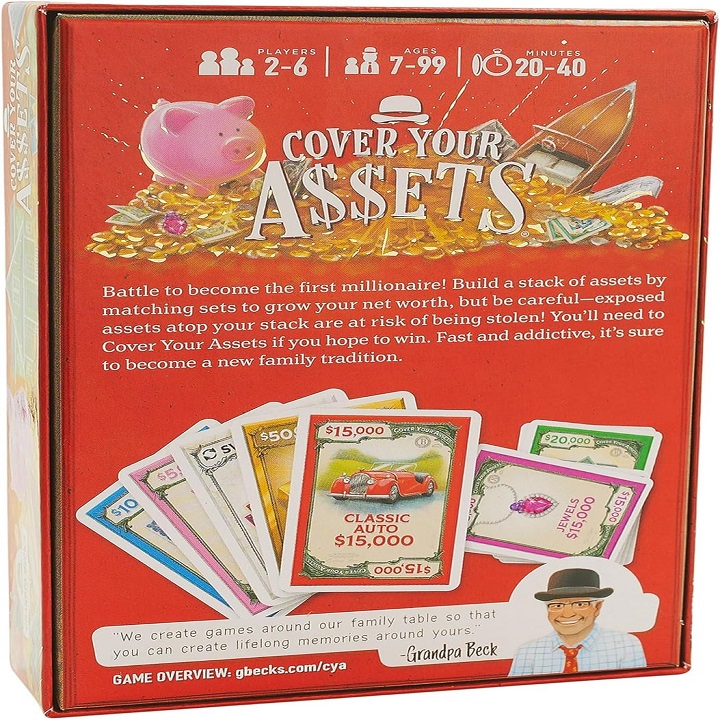
Originally published by Grandpa Beck's Games, Cover Your Assets is designed for 2–6 players, recommended for ages 7–99, and typically takes about 20–40 minutes. Its appeal is simple: the rules are easy to learn, but every successful asset stack becomes a visible target for other players. [grandpabecksgames]
What Is Cover Your Assets?
Cover Your Assets is a competitive family card game built around three connected mechanics:
- Pairing matching asset cards to create sets
- Stacking new sets over earlier ones to protect them
- Challenging opponents to steal their exposed assets
Players collect illustrated asset pairs such as Piggy Banks, Cash Under the Mattress, Jewels, and Classic Autos. A new pair is placed on top of the player's existing stack, physically covering the previous pair. This creates the game's central tension: the more assets you collect, the more valuable your stack becomes—but only the top set is generally exposed to challenges. [grandpabecksgames]
The long-term objective is to become the first player to reach $1,000,000 in accumulated assets across rounds. This makes Cover Your Assets suitable for family game nights, classrooms, casual social events, and retail card-game collections that need accessible gameplay with a strong replay factor. [youtube]
Cover Your Assets Game Components
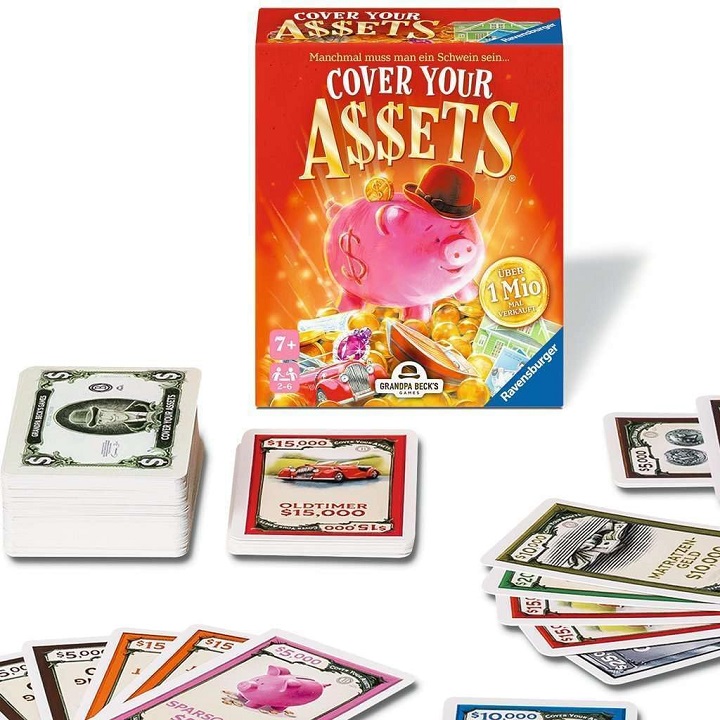
A standard Cover Your Assets game includes a deck of asset cards, wild cards, and—depending on the edition—additional action cards or advanced-rule components. Before play begins, players should identify the major card types and their purpose.
| Card type | Primary use | Important rule |
| Asset cards | Create matching pairs and challenge matching top sets | Two cards of the same asset form a pair |
| Wild cards | Complete a pair or support a challenge | Silver and Gold cards function as wild cards |
| Discard pile card | Helps form a pair with a card in hand | It cannot be used directly to initiate a challenge |
| Swap and Move cards | Used in editions or modes with advanced rules | These cards may be discarded out of play and cannot later be picked up |
The official publisher confirms that the game uses matching asset pairs and that Silver and Gold cards may be used as wild cards during challenges. It also clarifies that Swap and Move cards, when discarded, are removed from play rather than becoming available to the next player. [grandpabecksgames]
For a smooth first session, explain the game using a simple phrase: build, cover, defend, and steal. Players usually understand the game immediately when they see one complete challenge take place.
How to Set Up Cover Your Assets
The exact hand size can differ between printings, optional rules, and player counts. Many classic-rule explainers use four cards per player, while some two-player or alternate setups use five cards. Therefore, the best practice is to follow the rule sheet included with the specific edition in your box. [youtube]
Use this standard setup process for classic gameplay:
1. Shuffle all gameplay cards thoroughly.
2. Choose a dealer.
3. Deal each player the required starting hand, commonly four cards in the classic setup.
4. Place the remaining cards face down in the centre of the table to create the draw pile.
5. Turn over the top card and place it beside the draw pile to create the discard pile.
6. Leave space in front of every player for an asset stack.
7. The player to the dealer's left usually takes the first turn.
Each player keeps their hand private. Asset stacks, however, remain face up because opponents need to see which top set may be challenged. The visual openness of the table is one reason this game creates strong interaction: players must make decisions using both their own cards and the visible opportunities in front of everyone else.

How to Play Cover Your Assets: Four Turn Actions
On each turn, a player chooses one of four possible actions. A player cannot combine multiple standard actions in the same turn.
1. Make a Pair From Your Hand
The most direct move is to play a matching pair from your hand.
A legal pair can be:
- Two identical asset cards
- One asset card plus one wild card
Place the two cards face up in front of you as a set. If you already have an asset stack, place the new pair crosswise, or perpendicular, over the previous pair. This makes every individual set easier to identify and ensures players can see the current top asset.
For example, if you play two Jewel cards, you create a Jewel set. On a later turn, you may play two Classic Auto cards over the Jewels. The Classic Auto pair becomes your exposed top set, while the Jewels become covered and cannot normally be challenged.
2. Make a Pair With the Discard Pile
You may use the top card of the discard pile if it matches a card in your hand or if your hand contains a wild card that can complete the pair.
For example:
- The discard pile shows a Piggy Bank.
- You have another Piggy Bank in hand.
- Take the discard card and place it with your matching card to form a new asset pair.
This option gives players a reason to watch every discard. A card that looks unimportant to one player may complete an opponent's valuable set.
The discard pile has a strict limitation: it may be used to make a pair, but it may not be used to launch a challenge against another player. The official rules FAQ specifically confirms this distinction. [grandpabecksgames]
3. Challenge Another Player to Steal a Set
The challenge action is the most exciting part of Cover Your Assets.
You may attempt to steal the top set from another player if:
- You already have at least one asset set in your own stack.
- The chosen opponent has at least two sets in their stack.
- You can reveal a matching asset card or a wild card.
The opponent's first set is often called their "nest egg." It cannot be challenged or stolen under the classic rules because it has no covered asset beneath it. The official rules FAQ also distinguishes between a first set that cannot be challenged and a first set that may be affected by a Swap card in applicable rule variants. [grandpabecksgames]
To begin a challenge, reveal a card that matches the target player's top set. For instance, if their exposed set is Jewels, you can reveal a Jewel card or a wild card.
The defending player may then reveal another matching card or wild card to defend it. The challenger can counter with another eligible card. The two players continue alternating until one player either cannot respond or chooses not to continue.
The player who reveals the final eligible card wins the contest:
- If the defender reveals the last card, they keep the asset set.
- If the challenger reveals the last card, they steal the top asset set.
- All cards played during the challenge are added to the contested set.
This last rule has major strategic value. A successful challenge does not merely transfer an existing pair; it can make that pair more valuable because every card committed during the battle becomes part of the resulting asset set. The official product description confirms that the player who reveals the final card takes or keeps the set together with the cards used in the challenge. [grandpabecksgames]
4. Discard One Card and Draw One Card
If you cannot or do not want to form a pair or make a challenge, discard one card from your hand and draw a replacement from the draw pile.
This action looks passive, but it involves risk. Your discard may help the next player complete a pair. Before discarding, check whether the player after you is likely to need that card based on visible stacks, prior challenges, and the cards they may have collected from the discard pile.
A newly drawn card cannot generally be used to take another action on the same turn. The turn ends after the discard-and-draw action. [youtube]
How Stacking Protects Your Assets
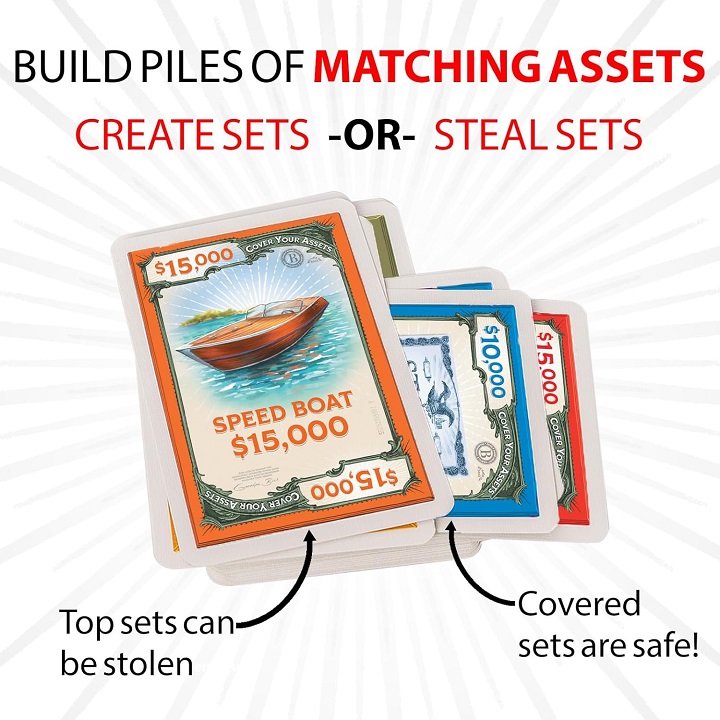
The name "Cover Your Assets" describes the game's most important defensive mechanic. You do not protect a set by hiding it. You protect it by placing another set on top of it.
Imagine this asset stack:
| Stack position | Set | Status |
| Top | Classic Autos | Exposed and challengeable |
| Middle | Jewels | Covered and protected |
| Bottom | Piggy Banks | Base set and protected |
In this example, opponents can challenge only the Classic Autos. They cannot directly steal the Jewels or Piggy Banks.
This leads to a basic but powerful lesson: a high-value set is not automatically safe simply because it is valuable. It becomes safer only after you cover it with a new pair. Players who focus only on collecting expensive assets may leave their best set exposed for too long.
How to Score and Win
The game is usually played in rounds. At the end of each round, players add up the values of their collected asset cards. Record each player's total, reshuffle, and begin a new round.
The first player to reach $1,000,000 wins the overall game. [youtube]
For a shorter session, families, teachers, or event hosts can agree on a lower target before starting. For example:
- $250,000 for a quick introductory game
- $500,000 for a standard family-game session
- $1,000,000 for the full classic objective
When creating a custom-branded version for retail, promotional distribution, or hospitality events, publishers can also adapt the scoring target to fit the intended playing time. A compact 10–15 minute version may work better for trade-show engagement, while a longer version may be more suitable for a boxed retail game.
Cover Your Assets Strategy Tips
Luck matters because players draw cards from a shuffled deck. However, experienced players consistently make better decisions about timing, hand management, challenges, and visible risk.
Protect High-Value Sets Quickly
Do not leave a valuable top set exposed simply because you want to save a weaker pair for later. If you have a legal pair that can cover a valuable set, playing it may be the safest move.
A lower-value pair can serve as a defensive shield. Its job is not only to add points; it also prevents opponents from directly attacking the valuable set below it.
Count Challenge Resources
Wild cards are flexible, powerful resources. Avoid spending them too casually to complete a low-value pair if they could help you win or defend a large challenge later.
Before challenging, estimate whether you can sustain a back-and-forth exchange. Starting a challenge with only one matching card may force an opponent to reveal useful cards, but it can also make you lose a valuable opportunity if they have several defenses ready.
Challenge for More Than Face Value
A top set may become more attractive after a long challenge because the contesting cards join the set. This creates a useful decision rule:
- Challenge when the asset's value is high.
- Challenge when the opponent's hand appears weak.
- Challenge when the potential set has already accumulated several cards.
- Avoid challenging merely to disrupt another player if you cannot realistically win.
Watch the Discard Pile
The discard pile is not just a source of cards. It is public information.
If you discard a card matching an opponent's probable hand, you may give them a free way to build a new defensive cover. Conversely, if the discard pile contains a card you need, consider whether taking it now creates an exposed set that another player can immediately target later.
Do Not Reveal Your Hand Plan Too Early
Repeatedly collecting or defending one asset type can signal what remains in your hand. Skilled opponents will notice patterns. Vary your plays when possible and avoid revealing that you are holding multiple cards useful for a specific challenge.
Common Rules Questions and Mistakes
New players often make the same mistakes. Addressing them before the first round prevents arguments and keeps the game moving.
Can You Steal Any Set in an Opponent's Stack?
No. In standard play, you may challenge only the opponent's top set. Covered sets remain protected until they become exposed again. [thetabletopfamily]
Can You Steal a Player's First Set?
No. A player's first or bottom set cannot be challenged or stolen under the classic rules. It is their protected base set. However, official rules clarify that a first set may be swapped when a Swap card is used in a version that includes this action. [grandpabecksgames]
Can You Use the Discard Pile to Challenge?
No. You can use the top discard only to form a pair with an eligible card in your hand. You cannot take it from the discard pile to begin a challenge. [grandpabecksgames]
Can Two Wild Cards Make a Pair?
Use the rulebook included with your edition as the final authority. In classic gameplay explanations, a pair is normally two matching asset cards or one asset card plus a wild card; wild cards are intended to support an asset, not replace both cards in a pair. [youtube]
What Happens When the Draw Pile Runs Out?
Do not automatically reshuffle the discard pile unless your edition's instructions explicitly tell you to do so. One published play explanation notes that the discard area may remain empty until a player discards a card again. Check your own printed rules because editions and variants may differ. [youtube]
What Quick Guides Often Miss
Many short "how to play Cover Your Assets" pages explain the four actions but fail to explain the decisions behind them. This creates an information gap for first-time players: they know what they can do, but not why one legal move may be much stronger than another.
Three practical insights improve the learning experience:
1. The top set is a tactical shield. Its value is less important than its ability to cover what lies beneath it.
2. A challenge is also hand compression. Even when you lose, you may force an opponent to spend cards that could have defended against later attacks.
3. Visual card layout affects gameplay clarity. Crosswise stacking is not decorative. It allows every player to identify individual sets, target the correct top set, and calculate visible risk quickly.
For brands developing their own matching card games, these lessons should shape both the rules and the physical product. Clear card hierarchy, high-contrast values, consistent card backs, and durable finishing reduce gameplay friction and make the game feel more professional.
Custom Cover Your Assets-Style Card Game Production
A successful custom card game needs more than attractive artwork. It must survive repeated shuffling, handling, stacking, and transport while keeping rules easy to understand.
For a custom asset-collection card game, consider the following production decisions:
| Production element | Recommended consideration | Why it matters |
| Card stock | Select durable playing-card board | Improves shuffle performance and perceived quality |
| Surface finish | Matte, linen, gloss, or protective coating | Influences grip, glare, scratch resistance, and visual style |
| Card size | Standard poker, bridge, square, or custom format | Must match hand comfort and package dimensions |
| Card backs | Use a consistent non-directional design | Prevents players from identifying cards by orientation |
| Rulebook | Include diagrams and visual examples | Reduces onboarding time and customer-service questions |
| Packaging box | Choose tuck box, rigid box, magnetic box, or custom game box | Protects cards and strengthens retail presentation |
| Proofing | Approve artwork, colour, copy, and dielines before mass production | Prevents expensive production errors |
At XingKun, a custom card-game project can be developed as a complete packaging system: printed playing cards, instruction booklets, stickers, branded inserts, and custom packaging boxes. This is especially useful for overseas brands, wholesalers, creators, publishers, and promotional agencies that need OEM and ODM support from one manufacturing partner.
A good product brief should specify the card quantity, dimensions, material, finish, packaging format, artwork files, target market, safety requirements, and expected order volume. The clearer the specification, the faster a factory can quote, sample, and move toward mass production.
Conclusion
Cover Your Assets is easy to learn because every turn follows one clear choice: make a pair, use the discard pile to make a pair, challenge an opponent, or discard and draw. Its real depth comes from knowing when to cover a valuable set, when to hold wild cards, and when a challenge is worth the risk.
For game brands and publishers, its structure also offers a useful lesson in product design: memorable card games combine simple rules, visible interaction, durable components, and packaging that makes the game easy to pick up and share. If you are planning a custom asset-collection card game, promotional deck, or retail-ready boxed game, contact XingKun to discuss card printing, rulebook production, and custom game packaging options.
FAQ
1. How many players can play Cover Your Assets?
Cover Your Assets is designed for 2–6 players and is generally recommended for players aged 7 and above. Typical playtime is around 20–40 minutes. [grandpabecksgames]
2. What is the goal of Cover Your Assets?
The objective is to collect asset sets and become the first player to reach $1,000,000 in total accumulated value across rounds. [youtube]
3. Can you steal the bottom asset set in Cover Your Assets?
No. In classic gameplay, only the opponent's top set may be challenged. The bottom or first set is protected from direct stealing. [thetabletopfamily]
4. Can you use a wild card to steal assets?
Yes. Silver and Gold wild cards can be used to initiate or continue a challenge for an opponent's exposed top set. [grandpabecksgames]
5. Can a discard-pile card be used to start a challenge?
No. The discard pile can be used only to help form a matching pair with a card in your hand; it cannot be used to initiate a challenge. [grandpabecksgames]
6. Why are sets placed crosswise on the table?
Crosswise stacking makes each set visually distinct. It lets players see which asset is currently exposed, which sets are covered, and which set can be challenged.
7. What should be included in a custom card game package?
A complete custom card-game package can include playing cards, a printed rulebook, a branded box, inserts, stickers, promotional cards, and protective packaging. The final selection should reflect the game's positioning, retail channel, and target production budget.
References
1. Grandpa Beck's Games. "[Cover Your Assets® Product Overview]." Official product information covering player count, recommended age range, playtime, gameplay premise, wild cards, and challenge outcomes. [grandpabecksgames]
2. Grandpa Beck's Games. "[Cover Your Assets Rules and Gameplay FAQ]." Official clarification on discard-pile use, Swap and Move cards, and first-set rules. [grandpabecksgames]
3. Board Game Empire. "[Cover Your Assets Game: How to Play and Playthrough]." Video explanation of setup, pairing, stacking, and challenge mechanics. [youtube]
4. The Rules Girl. "[How to Play Cover Your Assets in 3 Minutes]." Overview of the $1,000,000 objective, set creation, and asset stealing. [dicetower]
5. The Tabletop Family. "[Cover Your Assets]." Independent classic-rules explanation of turn actions, discard-pile restrictions, and protected first sets. [thetabletopfamily]
6. Geeky Hobbies. "[Cover Your Assets Card Game Review and Rules]." Independent reference for classic setup, pair formation, challenge conditions, and turn options. [geekyhobbies]
7. Shenzhen XingKun Packing Products Co., Ltd. "[Cover Your Assets Card Game Custom Product Page]." Product reference supplied for the custom playing-card and packaging context.


