Content Menu
● What Is Screen Printing for Industrial Nameplates?
● The Screen Printing Process: Step by Step
>> 1. Define the Application Before Preparing Artwork
>> 2. Prepare Production-Ready Artwork
>> 3. Select and Prepare the Substrate
>> 4. Produce the Screen Stencil
>> 5. Mix the Ink and Print Each Color
>> 6. Dry and Cure the Printed Ink
>> 7. Add Protection and Inspect Finished Plates
● Choosing Materials and Inks for Screen-Printed Nameplates
● How to Validate Nameplate Durability Before Ordering
>> Adhesion Testing
>> Chemical and Cleaning Resistance
>> Outdoor and Mechanical Exposure
● Common Screen Printing Problems and How to Investigate Them
● A Practical Qualification Example: A Frequently Cleaned Control Panel
● What Determines Screen-Printed Nameplate Cost?
● A Buyer's Checklist for More Accurate Quotations
● Plan Your Custom Nameplate Project with XingKun
● Frequently Asked Questions
>> 1. How does screen printing work on metal nameplates?
>> 2. Are screen-printed nameplates suitable for outdoor use?
>> 3. Does every screen-printed nameplate need a clear coat?
>> 4. How long does screen-printing ink take to cure?
>> 5. Can screen printing reproduce small lettering?
>> 6. What should I send when requesting a quotation?
● References
The screen printing process for nameplates transfers ink through a prepared mesh stencil onto a metal or other suitable substrate. It can produce clear lettering, distinctive brand colors, and functional markings. However, lasting performance depends on more than an attractive print: surface preparation, ink selection, curing, and testing must work together.
At Shenzhen XingKun Packing Products Co., Ltd., we bring more than 20 years of printing and packaging manufacturing experience to projects for brands and distributors across over 30 countries and regions. Our approach to nameplate planning starts with a practical question: what must remain readable after installation?
This guide explains the production process, the decisions that influence durability, and the information buyers should provide before approving an order.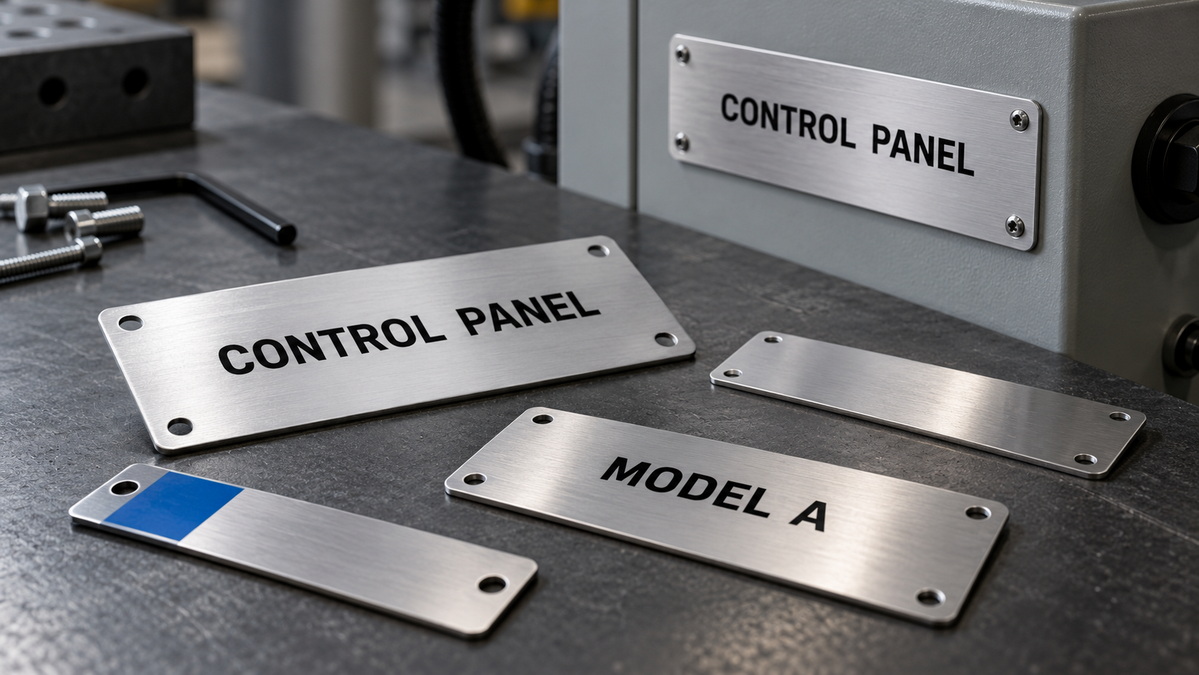
What Is Screen Printing for Industrial Nameplates?
Screen printing uses a mesh screen containing a stencil. The stencil blocks selected areas while leaving the design open. A squeegee pushes ink through those openings onto the nameplate.
For conventional spot-color work, each color typically requires its own screen and printing pass. Accurate positioning keeps logos, lettering, and borders aligned.
The process can suit identification plates, equipment labels, control-panel markings, and decorative branding. Its suitability depends on the design, substrate, ink system, production quantity, and operating environment.
A useful distinction is that screen printing creates a surface ink layer. It does not engrave information into the metal. The finished plate therefore needs an appropriate combination of adhesion, curing, and protection for its intended use.
The Screen Printing Process: Step by Step
1. Define the Application Before Preparing Artwork
Start with operating conditions rather than appearance alone.
Provide:
- Indoor or outdoor installation.
- Expected temperature range.
- Contact with cleaners, oils, or chemicals.
- Frequency of handling and abrasion.
- Required attachment method.
- Target service life and order quantity.
"Water-resistant" and "chemical-resistant" are incomplete specifications. Identify the actual exposure, including the cleaning agent, concentration, contact time, and cleaning frequency.
These details help the manufacturer select a realistic construction and testing plan.
2. Prepare Production-Ready Artwork
Artwork review should confirm dimensions, text, color references, print position, and mounting features.
Vector artwork is generally useful for logos and lettering because it supports clean, scalable outlines. Small text and narrow gaps still require a manufacturability check.
Ask the supplier to review:
- Fine lines and reversed lettering.
- Spacing around holes and edges.
- Alignment between multiple colors.
- Barcode or code-reading requirements.
- Areas reserved for variable information.
A digital proof confirms content and layout. It does not, by itself, prove physical color, adhesion, or durability.
3. Select and Prepare the Substrate
Aluminum, stainless steel, brass, and other suitable materials may be used, but their printable surfaces are not interchangeable.
A coating, anodized finish, protective film residue, or handling contamination can change ink adhesion. Specify the actual surface condition, not simply the base metal.
Cleaning and any required pretreatment should follow the selected ink system's guidance. The goal is a consistent, compatible printing surface.
From a manufacturing perspective, surface preparation deserves close attention: a visually clean plate can still carry contamination that affects bonding.
4. Produce the Screen Stencil
A common method uses light-sensitive emulsion applied to mesh. After exposure through the artwork and washout, the image areas remain open for ink transfer.
Mesh selection affects ink deposit and image reproduction. It must suit the artwork, ink, and pigment characteristics.
There is no universal mesh specification for every nameplate. For example, oversized metallic pigment particles may not pass through small mesh openings and can eventually block printing.
Stencil quality and screen condition also influence repeatability across a production run.
5. Mix the Ink and Print Each Color
The operator prepares the ink according to its technical instructions. Depending on the formulation, this may involve mixing, adding a catalyst, observing an induction period, or controlling usable working time.
The plate is positioned in a fixture, and the squeegee transfers ink through the stencil.
Stable production depends on controlling:
- Ink viscosity.
- Squeegee condition and pressure.
- Screen positioning.
- Part location.
- Print sequence.
A first-off inspection should confirm coverage, alignment, text clarity, and visible defects before the batch proceeds.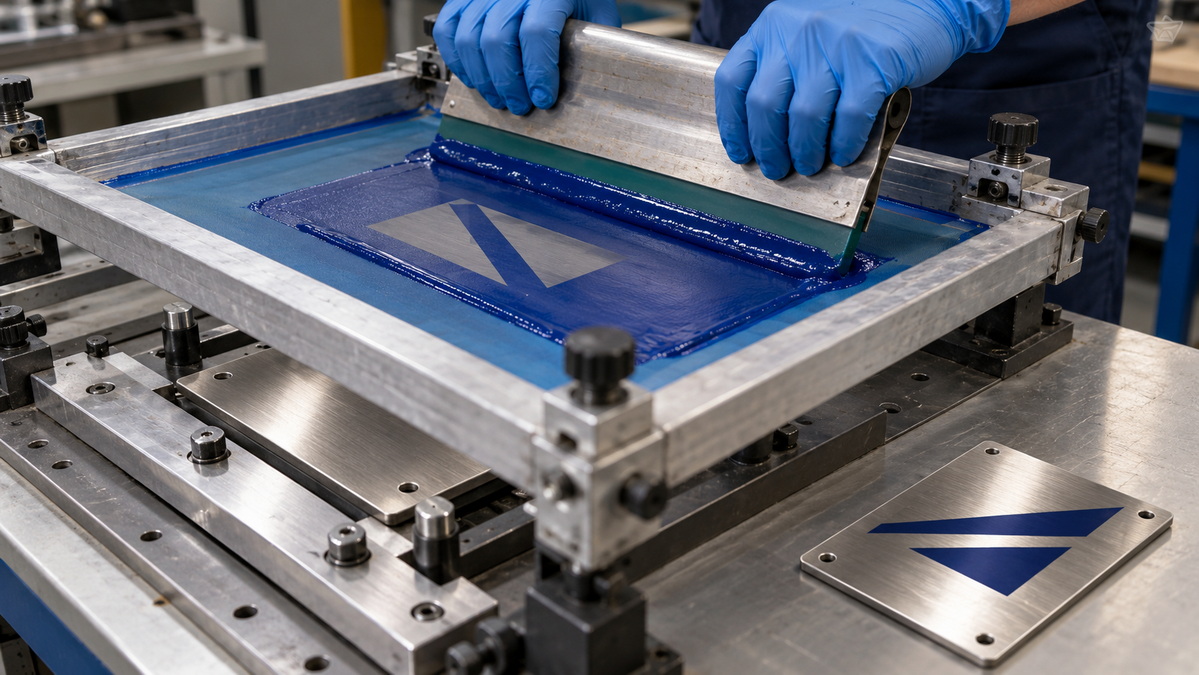
6. Dry and Cure the Printed Ink
Drying and curing are related but not identical.
Some inks become touch-dry before developing their final adhesion, hardness, or chemical resistance. Curing must therefore be treated as a controlled production stage, not simply a waiting period before packing.
For example, Nazdar's ADE epoxy ink documentation describes approximately 30–60 minutes to touch-dry at room temperature, while full cure may require five to seven days. It also provides a separate heat-curing route.
These figures apply to that specific system. They are not universal production settings.
7. Add Protection and Inspect Finished Plates
A compatible protective coating may improve resistance to certain exposures. However, not every plate needs varnish, and adding a clear coat does not automatically make a product suitable for outdoor use.
The complete construction must be evaluated.
Final inspection should cover dimensions, print position, color, readability, surface condition, and attachment features. Where required, it should also include agreed adhesion and resistance tests.
Packaging should protect finished surfaces without creating marking, sticking, or abrasion during transport.
Choosing Materials and Inks for Screen-Printed Nameplates
Material selection should connect appearance with operating conditions.
| Material or surface | Typical consideration | What buyers should confirm |
| Aluminum | Weight, finish, and surface treatment | Exact finish and ink compatibility |
| Stainless steel | Surface condition and exposure | Preparation method and adhesion |
| Brass | Decorative appearance and finish protection | Color expectations and coating compatibility |
| Coated metal | Interaction with the existing coating | Compatibility with that specific coating |
The ink must also match the application. "Industrial ink" is not a complete specification.
Manufacturer documentation distinguishes between formulations for different substrates, curing methods, and exposure requirements. Nazdar ADE, for example, is a two-part epoxy screen ink intended for metal and other substrates. Marabu likewise offers different ink systems with distinct resistance and processing requirements.
Ask which ink system is proposed, why it suits the surface, and how the supplier will verify performance.
How to Validate Nameplate Durability Before Ordering
A sample that looks excellent on arrival may still be unsuitable for its operating environment. Approval should evaluate function as well as appearance.
Adhesion Testing
Cross-cut tape testing is one method referenced in ink technical documentation, including procedures associated with ASTM D3359.
Agree on the applicable method and acceptance criteria before production. Results should be assessed after the required cure period.
A pass on one surface does not automatically qualify another surface, even when both use the same base metal.
Chemical and Cleaning Resistance
Test representative samples with the actual substances used in service.
Define:
1. Chemical identity and concentration.
2. Contact duration.
3. Application or rubbing method.
4. Number of repetitions.
5. Acceptable changes in color, gloss, adhesion, and legibility.
A vague promise of "chemical resistance" is less useful than a documented test matching the intended cleaning routine.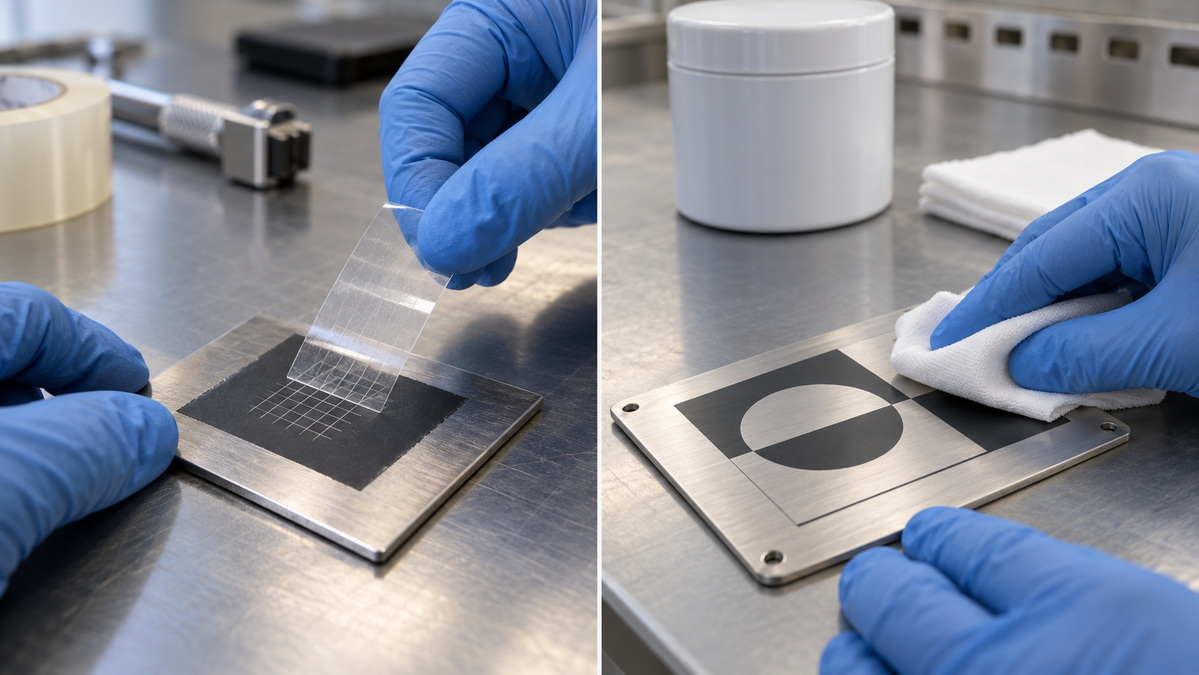
Outdoor and Mechanical Exposure
Outdoor suitability should address sunlight, moisture, temperature changes, and abrasion as applicable.
Accelerated testing can help compare constructions, but a test duration should not be converted casually into a guaranteed number of outdoor service years.
Also assess the attachment system. Durable printing cannot compensate for an adhesive or fixing method that fails under actual installation conditions.
Common Screen Printing Problems and How to Investigate Them
A useful quality review links each defect to possible causes rather than assigning every failure to the ink.
| Problem | Possible contributors | Investigation priority |
| Ink lifts from the surface | Contamination, incompatible ink, incomplete cure | Check preparation, compatibility, and curing records |
| Fine text appears filled in | Ink flow, stencil, pressure, or artwork limits | Review the print setup and design |
| Colors appear misaligned | Fixture movement or screen registration | Check positioning consistency |
| Printed surfaces mark when stacked | Insufficient drying or curing | Review release time and stacking conditions |
| Color varies between batches | Mixing, film thickness, or substrate changes | Compare with the approved physical standard |
A practical principle is to change one variable at a time during troubleshooting. Otherwise, an improved result may be difficult to reproduce.
A Practical Qualification Example: A Frequently Cleaned Control Panel
Consider a control-panel nameplate that operators wipe repeatedly with a specified cleaning solution.
Choosing stainless steel alone does not resolve the specification. The printed information remains a separate performance concern.
A sensible qualification plan would:
1. Confirm the metal finish and cleaning solution.
2. Select a compatible ink system.
3. Produce samples using the proposed production process.
4. Allow the specified cure period.
5. Test adhesion and repeated cleaning.
6. Inspect lettering, color, and attachment performance.
This is an illustrative purchasing scenario, not a reported XingKun customer result.
Its value is the decision sequence: define exposure, build a representative sample, and verify performance before committing to volume production.
What Determines Screen-Printed Nameplate Cost?
Screen printing should not be described as the cheapest option for every order.
Costs depend on setup requirements, quantity, color count, substrate, finishing, inspection, and packing. Multiple spot colors generally add screens and printing stages.
Repeat orders may benefit from established artwork and process settings, although changes to materials or performance requirements can require renewed qualification.
When comparing quotations, check whether they include:
- Artwork preparation and tooling.
- Material and thickness.
- All printing colors.
- Protective finishing.
- Holes, cutting, and attachment features.
- Sampling and testing.
- Protective packaging.
The relevant comparison is the cost of an acceptable, usable nameplate—not simply the lowest quoted unit price.
A Buyer's Checklist for More Accurate Quotations
A complete brief reduces assumptions and makes supplier proposals easier to compare.
Send your manufacturer:
- Drawing with dimensions and tolerances.
- Artwork and color references.
- Material, thickness, and surface finish.
- Order quantity and expected repeat volume.
- Installation environment.
- Cleaning and chemical exposure.
- Mounting requirements.
- Required tests and acceptance criteria.
- Delivery and packing requirements.
For appearance-sensitive projects, request a physical sample. For demanding operating conditions, request a sample made with the proposed substrate, ink, curing route, and protective construction.
Approve the specification as well as the appearance.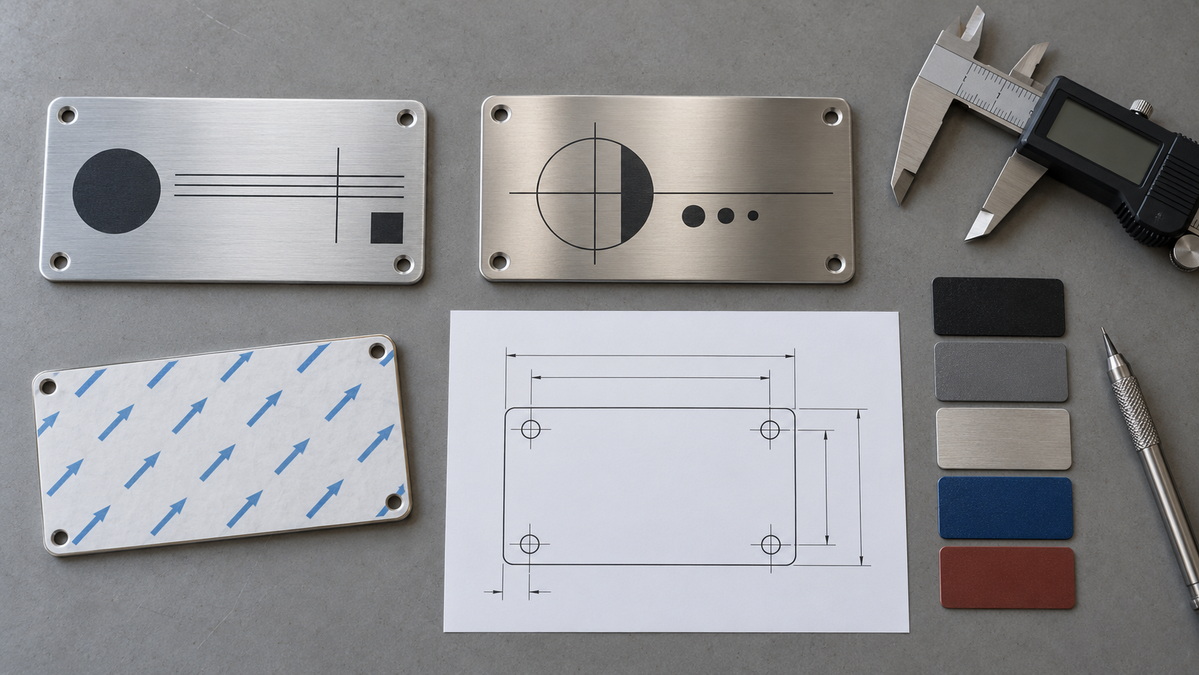
Plan Your Custom Nameplate Project with XingKun
Shenzhen XingKun Packing Products Co., Ltd. combines more than 20 years of printing and packaging manufacturing experience with service to brands and distributors across over 30 countries and regions.
Send us your drawing, artwork, quantity, installation conditions, and durability requirements to request a project review and quotation.
For applications involving frequent cleaning, abrasion, or outdoor exposure, include those conditions at the beginning. A clearly defined sample and approval process helps connect the finished appearance with the performance your product needs.
Frequently Asked Questions
1. How does screen printing work on metal nameplates?
Ink passes through open areas in a prepared mesh stencil onto the metal surface. The print is then dried or cured according to the ink system. Additional colors normally require separate printing passes.
2. Are screen-printed nameplates suitable for outdoor use?
They can be, provided the substrate, ink, protective construction, and attachment method suit the exposure. Outdoor suitability should be verified rather than assumed from the printing method alone.
3. Does every screen-printed nameplate need a clear coat?
No. A clear coat is an application-dependent option. Its compatibility and contribution to performance should be evaluated as part of the complete nameplate construction.
4. How long does screen-printing ink take to cure?
It depends on the ink, temperature, film thickness, and curing method. Some formulations feel dry well before achieving final properties. Follow the selected product's technical instructions.
5. Can screen printing reproduce small lettering?
Yes, within the limits of the artwork, mesh, stencil, ink, and production setup. Request a physical sample when small text or narrow reversed details are important.
6. What should I send when requesting a quotation?
Provide dimensions, artwork, material preferences, quantity, mounting details, and operating conditions. Include any required durability tests so suppliers can quote against the same specification.
References
- American Nameplate. "Screen Printing Process," published October 19, 2018. Original source used to identify the basic process explanation and areas requiring expansion. [View original article]. [american-nameplate]
- Nazdar. "ADE Series Epoxy Screen Ink," Technical Data Sheet, Revision 22. Basis for the discussion of metal compatibility, two-part ink preparation, touch-dry versus full cure, and adhesion testing. [View technical data sheet]. [nazdar]
- Nazdar. "Metallic Powders & Pastes," Technical Data Sheet. Basis for the explanation of pigment particle size, mesh openings, and metallic-ink processing considerations. [View technical guidance]. [nazdar]
- Marabu North America. "Solvent-Based Screen Printing Inks." Supports the distinction between ink systems and their substrate, resistance, and processing requirements. [View product overview]. [marabu-northamerica]
- Marabu. "MaraGlass MGL." Product-specific example of different processing requirements for chemical and water resistance; not a universal nameplate specification. [View product details]. [marabu-inks.co]


