Content Menu
● Why Nameplate Adhesive Selection Matters
● Nameplate Adhesive Options Compared
● Match the Adhesive to the Actual Mounting Surface
>> Smooth Metal and Higher-Surface-Energy Plastics
>> Polypropylene, Polyethylene, and Powder Coatings
● Choose Adhesive Thickness for Surface Contact
● Evaluate Heat, Chemicals, and Outdoor Exposure
>> Separate Installation Temperature From Service Temperature
>> Describe Exposure Precisely
● How to Install Adhesive-Backed Nameplates
>> 1. Inspect and Clean the Surface
>> 2. Confirm Temperature and Surface Condition
>> 3. Align Without Touching the Adhesive
>> 4. Apply Uniform Pressure
>> 5. Allow Bond Development
● Validate the Complete Assembly Before Volume Production
● Troubleshoot Failures Before Changing the Tape
● Prepare a Better Nameplate Adhesive Inquiry
● Discuss Your Custom Nameplate Requirements With XingKun
● Frequently Asked Questions
>> What is the best adhesive for metal nameplates?
>> Can the same adhesive bond metal and plastic housings?
>> Is a thicker nameplate adhesive always stronger?
>> Can adhesive-backed nameplates be used outdoors?
>> How long should a nameplate remain undisturbed after installation?
>> When should mechanical fasteners be considered?
● References
Choosing the right nameplate adhesive options starts with the mounting surface, not the tape catalog. A backing that performs well on smooth stainless steel may struggle on polypropylene, textured paint, or a curved housing. Reliable attachment depends on matching adhesive chemistry, thickness, installation conditions, and environmental exposure.
At Shenzhen XingKun Packing Products Co., Ltd., we bring more than 20 years of printing and packaging experience to custom nameplates and other printed products, serving brands and distributors across more than 30 countries and regions.
Why Nameplate Adhesive Selection Matters
A nameplate does more than display a logo. It may carry operating instructions, electrical ratings, serial numbers, or traceability information. If it detaches, the consequences can extend beyond appearance.
However, there is no universally "strongest" backing. Adhesives behave differently under different stresses:
- Peel forces lift an edge away from the surface.
- Shear forces push the plate parallel to the mounting surface.
- Sustained loads can cause gradual movement.
- A rigid plate on a curved housing can create continuous lifting forces.
The useful question is not simply, "How strong is this tape?" It is, "Will this adhesive keep this nameplate attached to this surface throughout its intended service?"
Nameplate Adhesive Options Compared
Use the following table to develop a shortlist, rather than treating any category as an automatic specification.
| Adhesive option | Typical starting applications | Main advantage | Important limitation |
| High-performance acrylic transfer tape | Smooth metals and higher-surface-energy plastics | Thin bond line and good shear resistance | Not automatically suitable for polypropylene or polyethylene |
| Modified acrylic for difficult surfaces | Selected plastics and powder-coated finishes | Better wetting on challenging substrates | Actual coating and plastic grades still require testing |
| High-performance acrylic transfer constructions | Applications requiring specified temperature or load performance | Specialized bonding characteristics | Performance depends on the exact product |
| Foam-backed tape | Uneven surfaces or applications needing a compliant bond line | Conformability and spacing | Adds thickness and may expose a vulnerable edge |
| Specialized high-temperature adhesive | Equipment with elevated operating temperatures | Performance within a defined thermal range | Brief exposure ratings are not continuous-use ratings |
Also distinguish construction from chemistry. "Transfer tape" describes an adhesive layer supplied on a release liner. "Foam tape" includes a foam component. Neither description alone tells you whether the adhesive suits your substrate.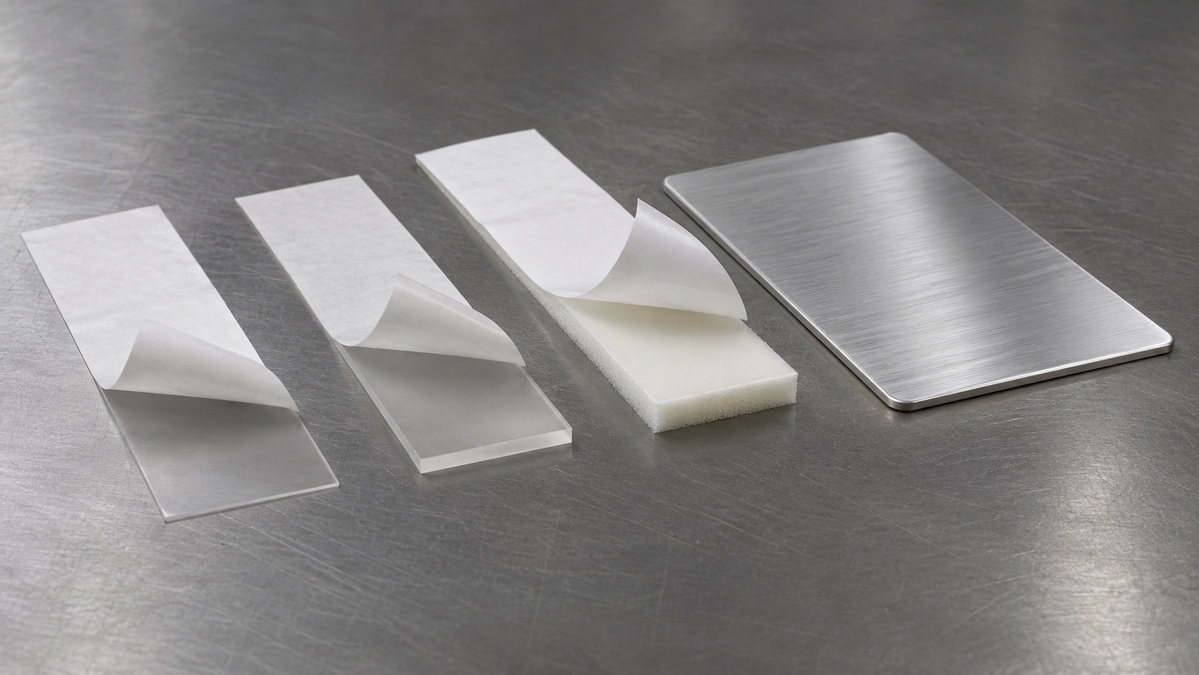
Match the Adhesive to the Actual Mounting Surface
Smooth Metal and Higher-Surface-Energy Plastics
For smooth metal surfaces, acrylic transfer tapes are a common starting point. The 3M 467MP and 468MP families, for example, are intended for applications including graphic attachment and nameplate bonding to metals and higher-surface-energy plastics.
Their relatively thin construction can help preserve a clean, close-fitting appearance.
However, the surface touching the adhesive matters more than the material underneath. A powder-coated steel enclosure presents a coating interface, not bare steel. Similarly, an aluminum panel with processing oil requires different preparation from a clean finished panel.
Ask for the actual surface description, including its coating and cleaning history.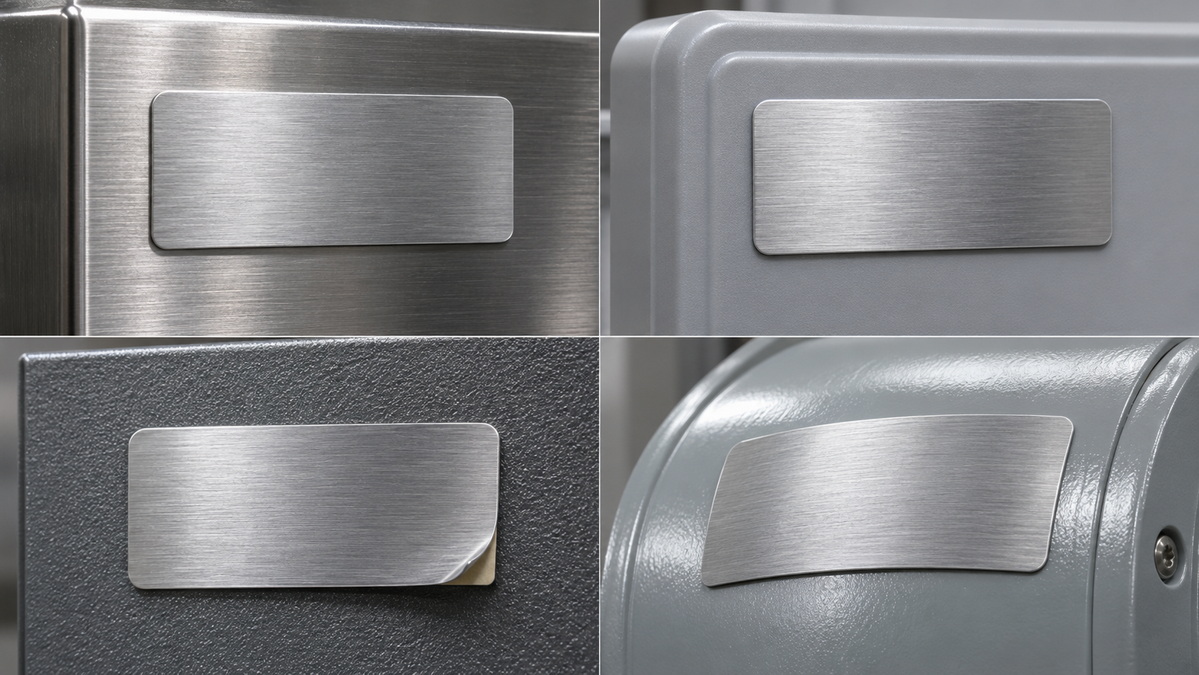
Polypropylene, Polyethylene, and Powder Coatings
Some plastics are difficult to bond because an adhesive cannot readily spread across their surfaces. This spreading and contact process is called wet-out.
Modified acrylic systems, including the 3M 300LSE family, are designed for improved bonding to many challenging materials.
Nevertheless, "plastic housing" is not a sufficient specification. Identify:
- Polymer type and grade.
- Mold texture and surface finish.
- Mold-release agents or contamination.
- Coating chemistry, if present.
- Expected temperature and chemical exposure.
Powder coatings also vary. A successful test on one finish does not establish suitability for every color, formulation, or production supplier.
Choose Adhesive Thickness for Surface Contact
A thicker adhesive layer can improve contact with a textured surface, but greater thickness does not automatically mean a better assembly.
On a smooth, flat panel, a thin transfer adhesive may provide the desired appearance without unnecessary spacing. On a mildly textured finish, a thicker compatible adhesive may improve contact. More pronounced irregularities may require a different construction or mounting approach.
Three details deserve attention:
1. Compare adhesive thickness, not release-liner thickness.
2. Check whether published measurements describe adhesive alone or the complete tape construction.
3. Confirm the current specification for the exact product and regional version.
For metal nameplates, also consider plate stiffness. A rigid plate cannot always follow a curved housing. Increasing adhesive thickness may not overcome the plate's tendency to return to its original shape.
Evaluate Heat, Chemicals, and Outdoor Exposure
Separate Installation Temperature From Service Temperature
An adhesive can tolerate elevated temperatures after bonding yet perform poorly when applied to a cold surface.
Installation temperature affects flow and initial contact. Service temperature describes conditions encountered after application. Both must fall within the manufacturer's guidance.
Also distinguish continuous exposure from short temperature excursions. A brief high-temperature rating should not be used as a permanent operating limit.
Specify the temperature at the bond line where possible, rather than relying only on room temperature.
Describe Exposure Precisely
"Outdoor," "waterproof," and "chemical-resistant" are incomplete requirements.
A more useful brief identifies:
- Direct sunlight and weather exposure.
- Condensation, occasional splashing, or immersion.
- Cleaning chemicals and concentrations.
- Contact duration and cleaning frequency.
- Oils, fuels, or process fluids.
- Abrasion and potential pressure-washing exposure.
Evaluate the complete nameplate. The backing may remain attached while the printing becomes unreadable, or the plate may stay legible while the adhesive edges lift.
How to Install Adhesive-Backed Nameplates
A suitable adhesive can still fail if installation is inconsistent. Build a documented process around the selected tape manufacturer's instructions.
1. Inspect and Clean the Surface
Remove dust, oil, moisture, and other contaminants using a cleaning method compatible with the substrate and coating.
Do not assume that every solvent is safe for every plastic. Check compatibility, follow safety instructions, and allow the surface to dry completely.
Avoid casual substitution of household cleaners that may leave residues.
2. Confirm Temperature and Surface Condition
Check that the nameplate, adhesive, and mounting surface meet the recommended application conditions.
A dry-looking panel may still have condensation or contamination. Resolve these issues before removing the liner.
3. Align Without Touching the Adhesive
Use a positioning guide for repeat production. Keep fingers away from the exposed adhesive and avoid repeated lifting and repositioning unless the product permits it.
For larger plates, plan the application sequence to minimize trapped air.
4. Apply Uniform Pressure
Pressure helps establish contact between the adhesive and substrate.
Use a suitable roller, fixture, or controlled pressing method. Pressing only the corners leaves the center dependent on accidental contact.
5. Allow Bond Development
Pressure-sensitive adhesives generally develop additional adhesion as surface contact increases over time.
Follow the selected product's guidance before exposing the assembly to demanding cleaning, loading, or environmental conditions. Do not apply one universal waiting period to every adhesive family.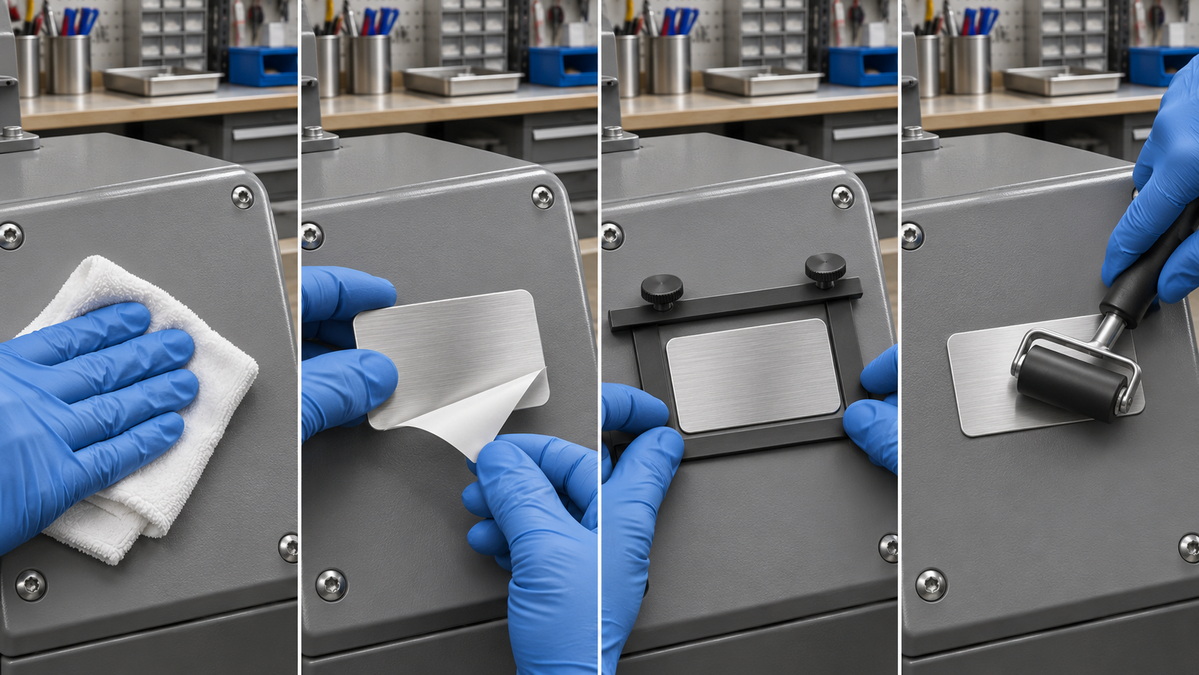
Validate the Complete Assembly Before Volume Production
A convincing hand-pull demonstration is not the same as an application qualification.
Use production-representative nameplates and mounting surfaces. A convenient stainless-steel test coupon cannot establish performance on a textured plastic housing.
A practical validation plan includes:
| Evaluation | What to examine |
| Initial installation | Alignment, trapped air, contact, and edge condition |
| Bond development | Attachment after the specified conditioning period |
| Temperature exposure | Movement, distortion, and edge lifting |
| Moisture and cleaning | Adhesion loss, swelling, and print damage |
| Product handling | Snagging, abrasion, and local lifting |
| Final inspection | Readability, attachment, and agreed appearance |
Define acceptance criteria before testing. Examples include no visible edge lifting, retained readability, and a project-specific minimum adhesion requirement.
For safety-related markings, confirm applicable requirements with the responsible product team. UL 969 evaluations concern marking permanence under defined conditions. Selecting a recognized material does not, by itself, demonstrate that every finished nameplate construction is suitable for every application.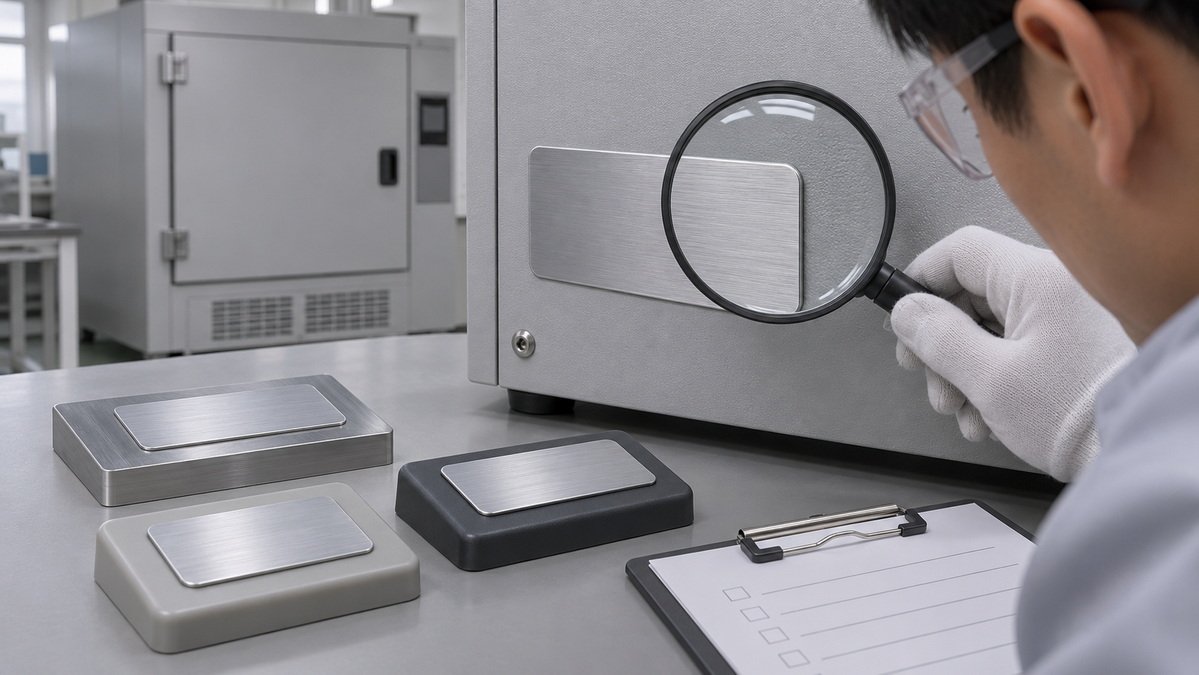
Troubleshoot Failures Before Changing the Tape
When a nameplate lifts, immediately choosing a more aggressive backing can obscure the real cause.
| Observed problem | Possible issue to investigate |
| Clean release from the housing | Contamination, poor wet-out, or incompatible substrate |
| Paint remains on the adhesive | Coating adhesion may be the weak interface |
| Corners repeatedly lift | Curvature, plate stiffness, edge exposure, or insufficient contact |
| Plate slides at elevated temperature | Shear performance, temperature, or sustained loading |
| Adhesive bonds but printing fails | Incomplete qualification of the finished construction |
These are diagnostic starting points, not definitive failure determinations.
Photograph the failure, preserve samples, and record the cleaning method, application temperature, installation pressure, and exposure history. This information makes the next trial more informative than changing multiple variables simultaneously.
Prepare a Better Nameplate Adhesive Inquiry
A detailed inquiry helps a manufacturer recommend a relevant construction instead of quoting a generic backing.
Provide:
- Nameplate dimensions, material, thickness, and artwork.
- Mounting substrate, coating, texture, and curvature.
- Installation temperature and production method.
- Operating temperatures and environmental exposure.
- Cleaning agents and maintenance practices.
- Required service life and applicable marking requirements.
- Order quantity, sample needs, and delivery schedule.
Include photographs and representative mounting samples when possible. Request the adhesive manufacturer, product designation, construction thickness, storage requirements, and agreed validation approach.
Evaluate total application cost, not just tape price. Installation difficulties, rework, replacement visits, and lost identification can outweigh a small saving on backing material.
Discuss Your Custom Nameplate Requirements With XingKun
Send Shenzhen XingKun Packing Products Co., Ltd. your artwork, dimensions, mounting-surface details, and operating conditions when requesting a quotation.
Ask us to discuss the nameplate material, adhesive backing, and sample requirements together. Approving a representative assembly before mass production provides a clearer basis for purchasing than choosing tape from a product name alone.
Frequently Asked Questions
What is the best adhesive for metal nameplates?
For clean, smooth metal surfaces, high-performance acrylic transfer tape is often a useful starting point. The final choice depends on coating, temperature, chemical exposure, plate stiffness, and testing on the actual assembly.
Can the same adhesive bond metal and plastic housings?
Sometimes, but not automatically. Plastics vary significantly in surface energy and composition. A tape suitable for stainless steel may need to be replaced by a modified acrylic system for polypropylene or polyethylene.
Is a thicker nameplate adhesive always stronger?
No. Additional thickness may improve contact with texture, but performance also depends on adhesive chemistry, loading, substrate condition, and plate geometry. Choose thickness to support the application rather than maximize it.
Can adhesive-backed nameplates be used outdoors?
Yes, when the complete construction is appropriate for the intended exposure. Validate attachment, print durability, temperature resistance, moisture performance, and cleaning resistance under representative conditions.
How long should a nameplate remain undisturbed after installation?
Follow the selected adhesive's technical guidance. Bond development varies with chemistry, temperature, pressure, and substrate. Avoid assuming that immediate tack represents the final bond strength.
When should mechanical fasteners be considered?
Consider mechanical attachment when permitted by the product design and when adhesive bonding cannot reliably satisfy surface, loading, temperature, or maintenance requirements. Evaluate drilling, corrosion, sealing, and access before choosing fasteners.
References
1. American Nameplate — "Various Adhesive Options for Nameplates," published February 8, 2017. Original article reviewed for its adhesive categories, named products, and application overview; the rewrite replaces its catalog-led structure with a selection and validation framework. [american-nameplate]
2. 3M — "3M™ Adhesive Transfer Tape 467MP." Manufacturer information supporting discussion of metal and higher-surface-energy plastic bonding, graphic attachment, nameplate applications, and shear resistance. Product-specific specifications should be checked before ordering. [3m]
3. 3M — "Substrate Surface Consideration for Adhesive Selection." Technical basis for surface energy, wet-out, clean and dry surfaces, application pressure, and bond development over time. [3m]
4. 3M — "Bonding Low Surface Energy Plastics." Application guidance supporting the distinction between conventional bonding surfaces and challenging plastics, including nameplate attachment applications. [3m]
5. 3M — "Adhesive Transfer Tapes for Bonding & Assembly." Manufacturer guidance supporting the discussion of 300LSE acrylic adhesives for many low-surface-energy plastics and powder-coated finishes. [3m]
6. UL Solutions — "Marking and Labeling Systems Program." Basis for the discussion of construction examination, environmental conditioning, adhesion, legibility, and marking permanence. [ul]
7. UL Solutions — "Marking and Labeling Systems FAQs." Guidance on application surfaces, exposure conditions, temperature ratings, and the conditions under which recognized materials and finished marking systems are suitable. [ul]


