Content Menu
● What Are Sustainable Packaging Boxes and Traditional Packaging?
>> Sustainable Packaging Boxes: Improvement Across the Life Cycle
>> Traditional Packaging: An Approach, Not One Material
● Sustainable Packaging Boxes vs Traditional Packaging: Comparison Table
● Materials and Recyclability: Look Beyond the Surface
>> Recycled Paperboard vs Virgin Fiber
>> Coatings, Inserts, and Mixed Materials
>> What Recycling Data Actually Shows
● Product Protection: Why Less Packaging Is Not Always Better
>> Compare Packages That Deliver the Same Result
>> Choose Structures Before Adding Material
● Cost Comparison: Purchase Price vs Total Delivered Cost
>> Why Sustainable Packaging Is Not Always More Expensive
>> An Illustrative Material-Reduction Calculation
● Branding and Customer Experience: Can Sustainable Boxes Look Premium?
>> Premium Presentation Does Not Require Maximum Complexity
>> Make Disposal Instructions Part of the Experience
● Environmental Claims and Export-Market Requirements
>> Replace Broad Promises With Specific Information
>> Review European Requirements by Applicable Date
● A Practical Six-Step Packaging Redesign Process
>> 1. Establish a Baseline
>> 2. Define Non-Negotiable Requirements
>> 3. Develop Comparable Alternatives
>> 4. Test the Finished Package
>> 5. Verify Documentation and Claims
>> 6. Pilot Before Scaling
● Which Packaging Approach Should Your Business Choose?
>> Discuss Your Packaging Brief With XingKun
● Frequently Asked Questions
>> 1. Are sustainable packaging boxes always better than traditional packaging?
>> 2. Is all paper packaging recyclable?
>> 3. Do sustainable packaging boxes cost more?
>> 4. Can recycled paperboard be used for premium packaging?
>> 5. Does biodegradable packaging belong in a recycling bin?
>> 6. What should buyers request from a packaging manufacturer?
● References
Sustainable packaging boxes vs traditional packaging is not simply a choice between paper and plastic. For brands and distributors, the real question is which packaging system protects the product, supports an attractive presentation, controls total costs, and reduces avoidable environmental impacts.
At Shenzhen XingKun Packing Products Co., Ltd., our perspective starts with a practical principle: performance comes first, but unnecessary material should not. With more than 20 years of printing and packaging manufacturing experience, serving brands and distributors across over 30 countries and regions, we approach packaging as a balance of protection, presentation, and purchasing requirements.
This guide compares sustainable packaging boxes and traditional packaging across materials, durability, cost, branding, and disposal. It also provides a practical framework for evaluating a packaging redesign before committing to production.
What Are Sustainable Packaging Boxes and Traditional Packaging?
Sustainable Packaging Boxes: Improvement Across the Life Cycle
Sustainable packaging boxes are designed to reduce environmental impacts while fulfilling their intended purpose. Relevant strategies include:
- Reducing unnecessary material and empty space.
- Incorporating verified recycled content.
- Sourcing forest-based materials responsibly.
- Simplifying components for easier separation.
- Designing for reuse or locally available recycling.
No material is automatically sustainable. A recycled paperboard box with excessive layers, difficult-to-remove inserts, and unnecessary dimensions may offer fewer advantages than a simpler, carefully engineered alternative.
Traditional Packaging: An Approach, Not One Material
Traditional packaging includes conventional folding cartons, rigid gift boxes, plastic containers, laminated boxes, and mixed-material protective systems.
Many established designs prioritize visual impact, low purchasing cost, or maximum protection. However, traditional packaging can also be lightweight, recyclable, or reusable.
The distinction is therefore not absolute. A conventional carton can become a more sustainable packaging solution through better sizing, material selection, and finishing choices.
Sustainable Packaging Boxes vs Traditional Packaging: Comparison Table
| Decision factor | Sustainability-focused packaging boxes | Conventional packaging designs |
| Material selection | Prioritizes appropriate recycled content, responsible sourcing, and recovery options | Often follows existing specifications and appearance requirements |
| Structural design | Seeks adequate protection with less unnecessary material | May retain oversized dimensions or redundant layers |
| Product protection | Must be validated for the actual product and distribution route | May provide proven protection, sometimes through material-intensive construction |
| Printing and finishing | Evaluates finishes alongside recyclability and separation | May prioritize decorative effects without reviewing disposal implications |
| Purchasing cost | Can increase or decrease depending on specifications | Benefits from established tooling and purchasing arrangements |
| Logistics | Right-sizing can improve storage and shipping efficiency | Oversized formats may consume avoidable transport space |
| End of life | Considers collection, sorting, and processing infrastructure | Disposal considerations may receive less attention |
| Environmental claims | Requires specific, supportable statements | Broad claims may appear without adequate qualification |
These are design tendencies, not guarantees. Buyers should compare complete specifications rather than rely on category labels.
Materials and Recyclability: Look Beyond the Surface
Recycled Paperboard vs Virgin Fiber
Recycled paperboard can reduce demand for newly harvested fiber. However, buyers still need to assess stiffness, cleanliness, appearance, and consistency.
Responsibly sourced virgin fiber may remain appropriate where performance requirements demand it. The practical goal is not to eliminate virgin material indiscriminately, but to select a suitable composition and avoid unnecessary consumption.
For certified forest-based packaging, verify the applicable chain-of-custody documentation and product claim. Purchasing certified board alone does not automatically authorize every downstream company to apply a certification label.
Coatings, Inserts, and Mixed Materials
A paper exterior does not tell the whole story. Plastic windows, foam inserts, magnetic closures, laminations, and adhesives can affect separation and recycling compatibility.
Likewise, a water-based coating is not automatically proof that a finished box is recyclable. The complete construction and intended recycling system matter.
Ask suppliers to identify:
- The board grade and recycled-content percentage.
- Every coating, adhesive, insert, and accessory.
- Whether components separate easily.
- Evidence supporting finished-package recycling claims.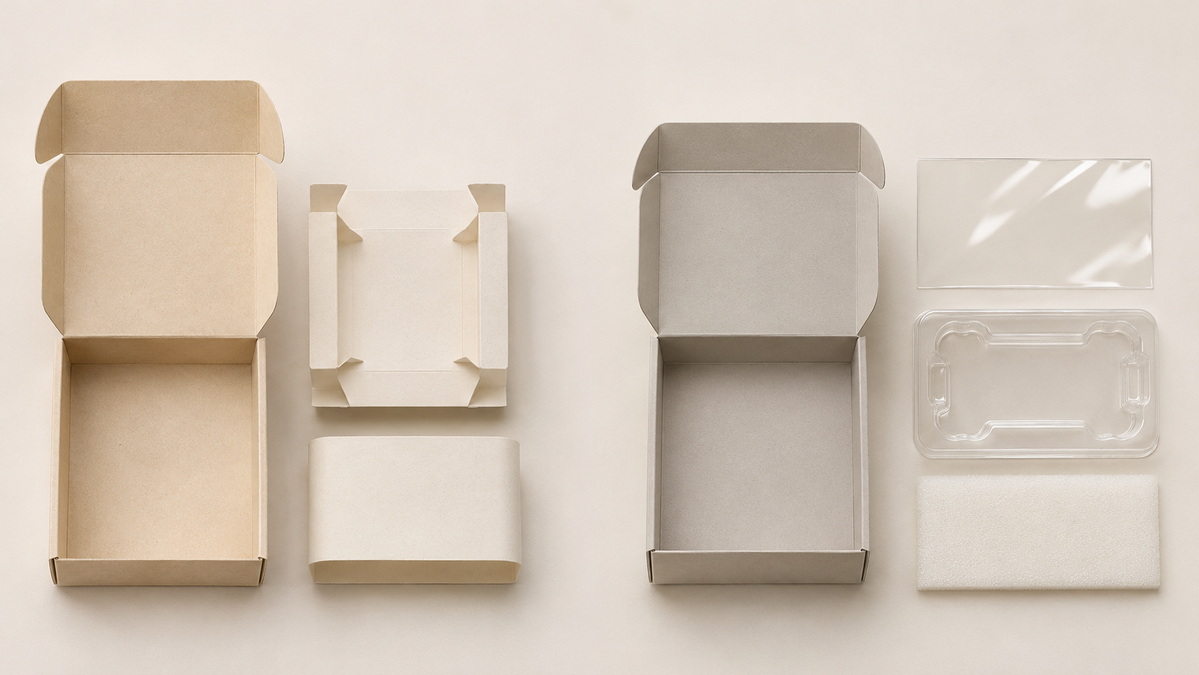
What Recycling Data Actually Shows
The U.S. Environmental Protection Agency reported a 68.2% recycling rate for paper and paperboard in 2018. Within that historical dataset, corrugated boxes reached 96.5%, while paper packaging excluding corrugated boxes reached 20.8%.
These figures describe different material categories in a specific country and year. They are not current global rates or proof that an individual retail box will be recycled.
The useful lesson is that packaging format and recovery infrastructure matter as much as the word "paper."
Product Protection: Why Less Packaging Is Not Always Better
Compare Packages That Deliver the Same Result
Our recommended starting point is one successfully delivered, saleable product—not one empty box.
A lighter package is not an improvement if it increases breakage, returns, or replacement shipments. Equally, a heavy package is not justified simply because its construction feels premium.
Define the actual risks first:
- Compression during stacking.
- Drops and vibration during transport.
- Humidity exposure and storage duration.
- Surface scratching or component movement.
- Leakage or barrier requirements where applicable.
Then assess alternative structures against those risks.
Choose Structures Before Adding Material
For many projects, the first redesign opportunity is structural rather than material-based.
A better-fitting insert may limit movement without additional wrapping. A revised box layout may eliminate an unnecessary outer sleeve. A smaller shipping carton may require less void fill.
These are possibilities to test, not universal outcomes. Prototype evaluation should confirm that material reductions preserve protection and packing efficiency.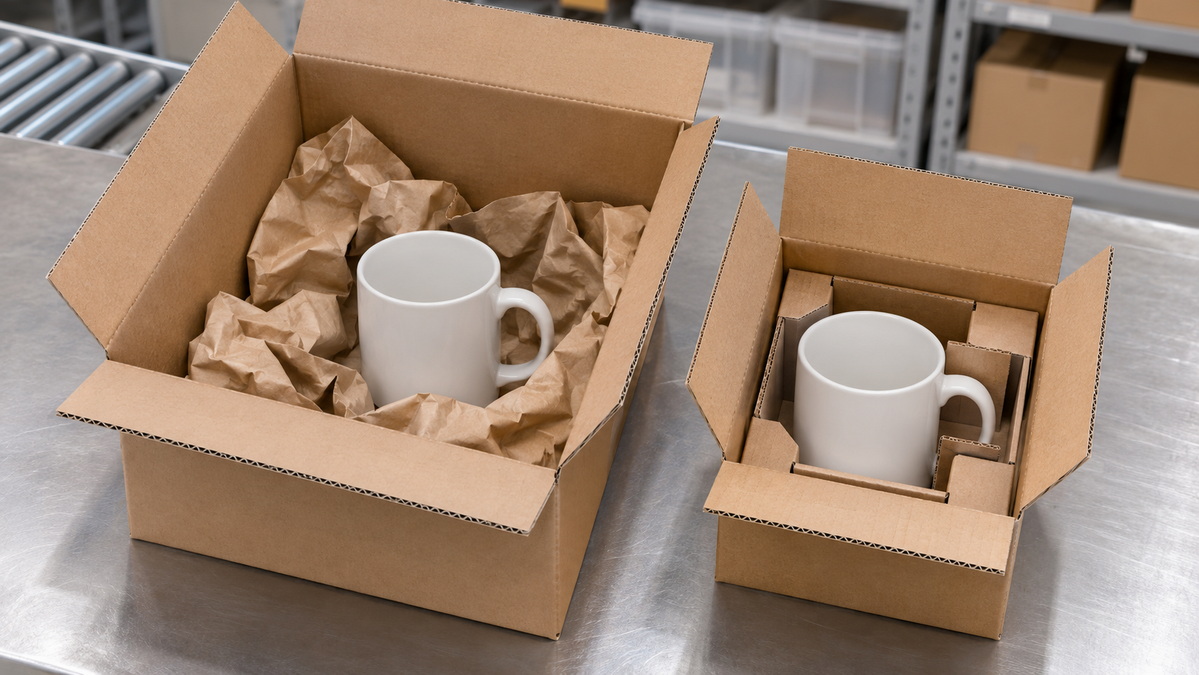
Cost Comparison: Purchase Price vs Total Delivered Cost
Why Sustainable Packaging Is Not Always More Expensive
A sustainability-focused specification may cost more when it requires specialized materials, new tooling, or additional verification.
However, simplifying construction or reducing dimensions may lower material consumption and logistics costs. Results depend on order quantity, production efficiency, shipping arrangements, and the existing design.
Compare equivalent quotations covering:
- Identical product protection requirements.
- The same order quantity and delivery terms.
- Tooling and sampling charges.
- Printing coverage and finishing specifications.
- Packing labor and storage requirements.
An Illustrative Material-Reduction Calculation
Suppose an existing box weighs 120 grams and a validated redesign weighs 100 grams. Across 50,000 boxes, the redesign uses 1,000 kilograms less packaging material.
That is a material-saving calculation, not a carbon-footprint assessment or a guaranteed cost saving. Environmental and financial outcomes also depend on production, transport, damage rates, and disposal.
For purchasing decisions, compare total delivered cost: packaging, packing labor, storage, freight, and damage-related expenses.
Branding and Customer Experience: Can Sustainable Boxes Look Premium?
Premium Presentation Does Not Require Maximum Complexity
Sustainable packaging boxes can support premium positioning through precise dimensions, controlled color, thoughtful typography, and a well-organized opening experience.
Uncoated board is one aesthetic option, not a requirement. A sustainability-focused package does not have to look rustic, brown, or unfinished.
The strongest design connects presentation to product value without adding components that serve little purpose.
Make Disposal Instructions Part of the Experience
Customers should not have to guess how to separate a package.
Where appropriate, provide concise instructions identifying removable inserts, windows, or other components. Match those instructions to destination-market requirements and actual collection options.
Avoid treating "recycled," "recyclable," "biodegradable," and "compostable" as interchangeable. Each describes a different attribute and requires different evidence.
Environmental Claims and Export-Market Requirements
Replace Broad Promises With Specific Information
Statements such as "100% eco-friendly" can imply benefits that are difficult to substantiate.
More useful claims identify a measurable attribute, such as a verified recycled-content percentage or a documented reduction in packaging weight.
Under U.S. Federal Trade Commission guidance, unqualified recyclable claims generally depend on appropriate facilities being available to at least 60% of consumers or communities where the product is sold. This is a marketing-claim threshold, not a recycling-rate target.
Compostability claims also require evidence and may need qualification concerning home composting or access to suitable facilities.
Review European Requirements by Applicable Date
The European Union's Packaging and Packaging Waste Regulation began applying on August 12, 2026. It establishes a framework addressing packaging reduction, reuse, recyclability, and other requirements, with measures taking effect on different schedules.
Exporters should therefore review the specific packaging format, destination, and relevant implementation dates. A general environmental label does not demonstrate full regulatory compliance.
A Practical Six-Step Packaging Redesign Process
1. Establish a Baseline
Record current dimensions, weight, material composition, packing time, damage rate, and purchasing cost.
Without a baseline, improvements remain difficult to verify.
2. Define Non-Negotiable Requirements
Document product protection, appearance, storage conditions, distribution routes, and any relevant product-contact requirements.
Separate essential functions from familiar design habits.
3. Develop Comparable Alternatives
Request alternatives such as a right-sized structure, revised insert, reduced-component design, or different board composition.
Avoid changing every variable simultaneously if doing so makes results difficult to interpret.
4. Test the Finished Package
Evaluate representative samples under conditions relevant to the actual supply chain.
Inspect both package integrity and product condition. Include packing-line handling and customer opening experience.
5. Verify Documentation and Claims
Obtain the material specification, relevant certification records, test evidence, and proposed environmental wording.
Check whether evidence concerns a raw material, one component, or the complete package.
6. Pilot Before Scaling
Run a controlled production or shipping trial. Compare damage, packing speed, customer feedback, and total cost against the baseline.
Approve the redesign only when the results support its intended benefits.
Which Packaging Approach Should Your Business Choose?
Choose sustainability-focused packaging boxes when you can demonstrate a better balance of protection, material efficiency, recovery options, and commercial requirements.
Retain necessary conventional features when they perform an essential function that alternatives have not yet matched. Then investigate targeted improvements rather than making an unsupported all-or-nothing change.
Our manufacturer-side recommendation is straightforward: start with one high-volume product, establish measurable objectives, and validate the result before expanding the program.
Discuss Your Packaging Brief With XingKun
Send Shenzhen XingKun Packing Products Co., Ltd. your product dimensions, weight, target market, order quantity, shipping method, and current packaging specification.
Request a comparison of suitable structures, materials, and finishes, together with sampling requirements and documentation relevant to your intended claims. A clear brief makes it easier to evaluate practical improvements without sacrificing protection or brand presentation.
Frequently Asked Questions
1. Are sustainable packaging boxes always better than traditional packaging?
No. They must deliver the required protection while demonstrating meaningful improvements. Material choice alone cannot establish a lower overall environmental impact.
2. Is all paper packaging recyclable?
No. Coatings, contamination, mixed-material components, and local processing capabilities can affect acceptance. Assess the finished package and destination-market infrastructure.
3. Do sustainable packaging boxes cost more?
Sometimes. Specialized materials or new tooling may increase purchasing costs, while simpler construction and right-sizing may reduce other expenses. Compare total delivered cost.
4. Can recycled paperboard be used for premium packaging?
Yes, where the selected grade meets appearance and structural requirements. Review printed samples, surface consistency, and finished-box performance before approving production.
5. Does biodegradable packaging belong in a recycling bin?
Not necessarily. Biodegradability does not establish recycling compatibility or compostability. Follow material-specific instructions and local collection requirements.
6. What should buyers request from a packaging manufacturer?
Request material specifications, component details, relevant certification records, testing information, and evidence for proposed environmental claims. Distinguish supplier promises from independently supported documentation.
References
1. [United Nations Environment Programme — "What Is the Life-Cycle Approach and How Can It Help Tackle Plastic Pollution?"], August 22, 2024. Supports the whole-life-cycle evaluation framework. [unep]
2. [U.S. Environmental Protection Agency — "Paper and Paperboard: Material-Specific Data."] Source for the explicitly dated 2018 U.S. recycling figures and category distinctions. [epa]
3. [Federal Trade Commission — "Environmental Claims: Summary of the Green Guides."] Guidance on recyclable, compostable, recycled-content, and other environmental claims. [ftc]
4. [Forest Stewardship Council — "Chain of Custody Certification."] Explains tracking, documentation, and certification requirements across forest-product supply chains. [fsc]
5. [Council of the European Union — "Packaging."] Overview of the European packaging framework, its application date, and longer-term policy objectives. [consilium.europa]
6. [United Nations Environment Programme — "Addressing Single-Use Plastic Products Pollution Using a Life Cycle Approach."], 2021. Supports evaluating reuse and complete packaging systems rather than assuming material substitution alone delivers improvement. [wedocs.unep]


