Content Menu
● What Does Packaging Box MOQ Mean?
● Why Do Custom Packaging Boxes Have Minimum Order Quantities?
>> Printing and Machine Setup
>> Materials and Finishing Requirements
>> Production Efficiency
● Low MOQ vs. High MOQ Packaging Boxes
● What Is a Realistic Custom Packaging Box MOQ?
● Digital vs. Offset Printing: How the Method Changes MOQ
>> Digital Printing for Small Packaging Orders
>> Offset Printing for Repeat Production
● Compare Landed Cost, Not Just the Price Per Box
>> An Illustrative Small-Business Comparison
● A Better MOQ Decision: Compare Three Demand Scenarios
● How to Reduce Packaging MOQ Without Weakening the Customer Experience
>> Standardize the Box Structure
>> Separate Permanent and Changeable Information
>> Reduce Unnecessary Finishing
>> Discuss Shared Components Across Products
● The Hidden MOQ Question: How Many Designs Are Included?
● Samples, Proofs, and Reorders: Check Before Production
● What to Send a Packaging Manufacturer for an Accurate Quote
● Plan Your Packaging Order With XingKun
● Frequently Asked Questions
>> What Is the Minimum Order Quantity for Custom Packaging Boxes?
>> Can I Order Custom Boxes in Small Quantities?
>> Does Ordering More Boxes Always Save Money?
>> Can Different Designs Be Combined to Meet the MOQ?
>> Will Reordering the Same Box Reduce My MOQ?
>> How Can I Lower MOQ Without Making My Packaging Look Basic?
● References
Packaging box MOQ can determine whether a small business launches confidently or ties up too much cash in unused inventory. When you request custom packaging boxes, the minimum order quantity affects more than the number of boxes you buy. It also influences your printing options, upfront investment, storage requirements, and ability to change designs.
At Shenzhen XingKun Packing Products Co., Ltd., our perspective comes from more than 20 years in printing and packaging, serving brands and distributors across over 30 countries and regions. We believe the right packaging order should support your business stage—not simply deliver the lowest quoted unit price.
This guide compares low-MOQ and higher-volume packaging orders, explains the manufacturing decisions behind minimums, and provides a practical framework for choosing your first order.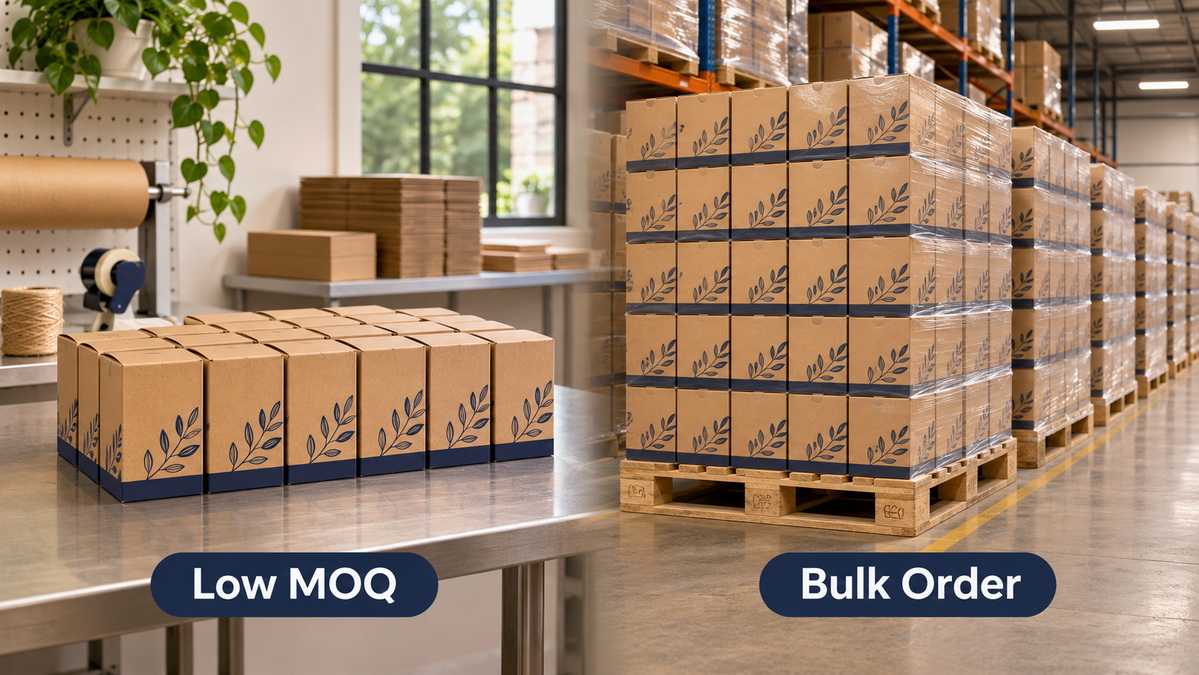
What Does Packaging Box MOQ Mean?
Packaging box MOQ means minimum order quantity: the smallest number of boxes a supplier accepts for a particular production specification.
However, the specification matters as much as the quantity.
A minimum may apply to:
- One box size and structural design.
- One artwork version.
- One material or board grade.
- One printing and finishing combination.
- One production run.
For example, an order for 1,000 boxes does not automatically allow five different designs at 200 units each. Shared materials and dimensions may create efficiencies, but artwork changes can introduce separate production requirements.
Before comparing quotations, ask: "Does this minimum apply per order, per size, or per artwork?"
That clarification can prevent an apparently affordable quotation from becoming an unexpected commitment.
Why Do Custom Packaging Boxes Have Minimum Order Quantities?
Manufacturers establish minimums because production requires preparation before usable boxes emerge from the line.
Printing and Machine Setup
Conventional printing can require plates, press adjustments, color calibration, and trial sheets. Cutting, creasing, folding, and gluing also involve preparation.
These costs must be recovered across the production run.
A short order spreads preparation costs across fewer boxes. A larger order distributes them more widely, potentially reducing the cost per unit.
Materials and Finishing Requirements
Specialty papers, particular board grades, coatings, and decorative finishes may have their own purchasing or processing minimums.
Foil stamping, embossing, windows, and custom inserts can introduce additional operations. A supplier may accept a small printed-box order but require a larger quantity for a particular finishing combination.
Production Efficiency
Manufacturers organize schedules around equipment capacity, labor, and material usage. Frequent changeovers can make very small jobs less economical on a high-volume production line.
This explains why two suppliers can quote different minimums for a seemingly identical box. Their equipment, workflows, and commercial priorities may differ.
Low MOQ vs. High MOQ Packaging Boxes
Neither option is automatically better. Each solves a different business problem.
| Decision factor | Low-MOQ packaging | Higher-volume packaging |
| Initial cash commitment | Usually lower | Usually higher |
| Cost per box | Often higher | Often lower when production scales efficiently |
| Unsold inventory exposure | Lower | Higher if demand disappoints |
| Design flexibility | Easier to revise between smaller runs | Changes may leave existing stock unusable |
| Storage needs | Smaller | Larger |
| Purchasing frequency | More frequent | Less frequent |
| Best fit | Launches, trials, seasonal tests | Stable products with predictable demand |
The useful comparison is not "cheap boxes versus expensive boxes."
It is "lower commitment versus potential production savings."
For a new business, preserving cash and testing demand may outweigh a lower unit price. For an established product, repeated small orders may create unnecessary purchasing work and higher cumulative costs.
What Is a Realistic Custom Packaging Box MOQ?
There is no universal minimum for all packaging boxes.
Some suppliers offer very small quantities through stock formats and digital production. Others focus on conventional production runs requiring larger commitments.
For example, Packlane advertises low minimums and notes that orders of 5,000 or more may qualify for non-digital printing methods. That is a supplier-specific production option, not an industry-wide threshold.
Use the following as a comparison framework rather than a guaranteed quantity guide:
| Packaging route | Why the minimum may be lower or higher | Suitable use |
| Stock boxes with printed labels | Existing structures avoid some custom-production requirements | Early-stage validation |
| Digitally printed boxes | No conventional printing plates | Short runs and artwork testing |
| Conventionally printed folding cartons | Setup costs favor longer runs | Repeat retail orders |
| Custom rigid presentation boxes | Materials, wrapping, assembly, and inserts influence economics | Premium presentation |
| Boxes with multiple special finishes | Additional processes introduce separate constraints | Established premium products |
Ask suppliers for their actual minimum against your exact specification. A generic website claim cannot replace a project quotation.
Digital vs. Offset Printing: How the Method Changes MOQ
Digital Printing for Small Packaging Orders
Digital printing transfers artwork from a file without conventional printing plates.
That can reduce the entry cost for short runs and make artwork variations more practical.
It is worth evaluating when:
- Demand is unproven.
- Several designs need testing.
- Packaging changes frequently.
- A limited launch requires a small quantity.
However, digital printing does not eliminate every setup cost. Cutting, finishing, material handling, and assembly still require consideration.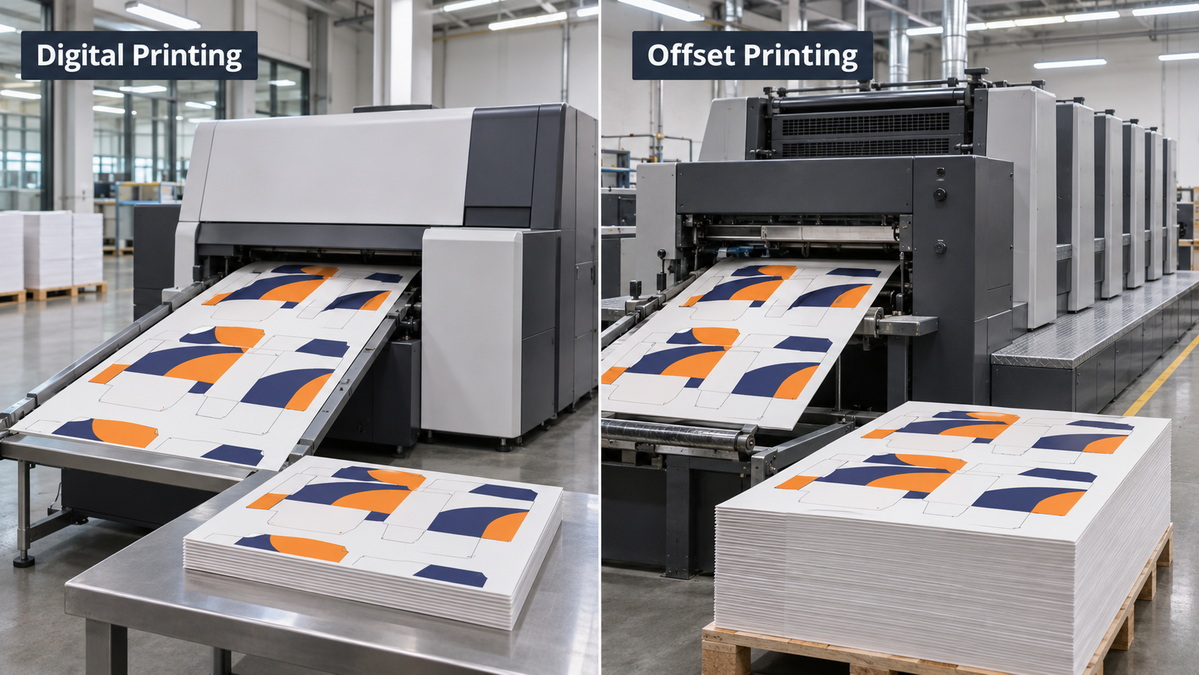
Offset Printing for Repeat Production
Offset printing uses plates and a transfer process to print onto the substrate.
Its preparation costs can make very short runs less attractive, while longer runs may distribute those costs more efficiently.
The crossover between digital and offset depends on box dimensions, sheet layout, materials, colors, finishing, and equipment.
Request both options when feasible. Avoid choosing a printing method solely because an online guide gives a supposedly universal break-even quantity.
Compare Landed Cost, Not Just the Price Per Box
A useful purchasing calculation is:
Total landed packaging cost = boxes + separately charged setup + freight + applicable duties and taxes + receiving costs.
Storage and obsolete inventory should then be considered when evaluating the wider business cost.
An Illustrative Small-Business Comparison
The figures below are hypothetical teaching examples, not market averages or XingKun quotations.
| Cost component | Small launch order | Larger production order |
| Quantity | 500 boxes | 2,000 boxes |
| Quoted box price | $1.20 | $0.75 |
| Box subtotal | $600 | $1,500 |
| Separately charged setup | $100 | $150 |
| Freight | $150 | $350 |
| Total before other charges | $850 | $2,000 |
| Cost per purchased box | $1.70 | $1.00 |
The larger order saves money per purchased box but requires $1,150 more upfront.
If the business uses only 600 boxes before changing its branding, the remaining inventory creates a different financial outcome. If all 2,000 boxes remain usable and sell through, the larger order becomes more attractive.
The decision depends on expected usage—not the discount alone.
A Better MOQ Decision: Compare Three Demand Scenarios
Instead of choosing a quantity from one optimistic sales forecast, test three scenarios:
1. Conservative demand.
2. Expected demand.
3. Strong demand.
For each scenario, estimate how many boxes you will use before the next likely packaging change.
Then compare:
- Cash required today.
- Inventory remaining at the review date.
- Likely replenishment needs.
- Storage capacity.
- Exposure to artwork or product changes.
This approach makes uncertainty visible.
A beauty brand awaiting final product information, for example, may value flexibility more than a mature product with unchanged packaging. A seasonal gift seller may also face a shorter useful inventory window than an evergreen household-goods brand.
Treat these as decision examples, not documented customer outcomes.
How to Reduce Packaging MOQ Without Weakening the Customer Experience
Standardize the Box Structure
Ask whether an existing size or structural format can protect your product adequately.
A standard structure may reduce development requirements, although an established design does not guarantee that no tooling charges apply.
Never sacrifice fit simply to reduce the minimum. An oversized or poorly supported product can undermine the savings.
Separate Permanent and Changeable Information
Keep stable branding on the box and evaluate labels, sleeves, or inserts for information that changes frequently.
Potential variable elements include:
- Product variants.
- Promotional messages.
- Seasonal campaigns.
- Regional language information.
Any mandatory labeling must remain appropriate for the product and destination market.
Reduce Unnecessary Finishing
Ask the supplier to identify which decorative operation creates the largest cost or minimum-order constraint.
Removing one complex finish may help more than simplifying several minor design details.
Prioritize the features customers notice and value.
Discuss Shared Components Across Products
Different products may share an outer box while using different inserts or labels.
This can consolidate purchasing, but check protection, fit, assembly time, and identification accuracy before committing.
Shared dimensions do not automatically mean different artworks qualify as one production run.
The Hidden MOQ Question: How Many Designs Are Included?
Small businesses often budget around total quantity while overlooking artwork-level requirements.
Imagine launching four flavors in the same carton size.
A quotation for 2,000 boxes could mean:
- 2,000 boxes using one artwork.
- 500 boxes for each of four artworks.
- A different minimum for every artwork version.
These are commercially different offers.
Ask the supplier to explain which processes can be shared and which must be repeated.
Also clarify whether design changes affect only printing or require different inserts, finishing tools, or assembly instructions. This is especially important when planning a multi-product launch.
Samples, Proofs, and Reorders: Check Before Production
A digital artwork proof, a structural sample, and a production-representative sample answer different questions.
- Artwork proofs help review content, layout, and print preparation.
- Structural samples help assess dimensions, fit, and opening.
- Production-representative samples help evaluate specified materials, printing, and finishing.
Ask what the sample actually represents. A digitally printed prototype may not reproduce the final production process exactly.
Before approval, confirm:
1. Internal dimensions and product clearance.
2. Material specification.
3. Artwork version.
4. Agreed color expectations.
5. Insert fit and assembly.
6. Production and delivery schedule.
For reorders, ask whether tooling is retained, how long it remains available, and which setup charges recur. Previously paid tooling does not necessarily eliminate every future production cost.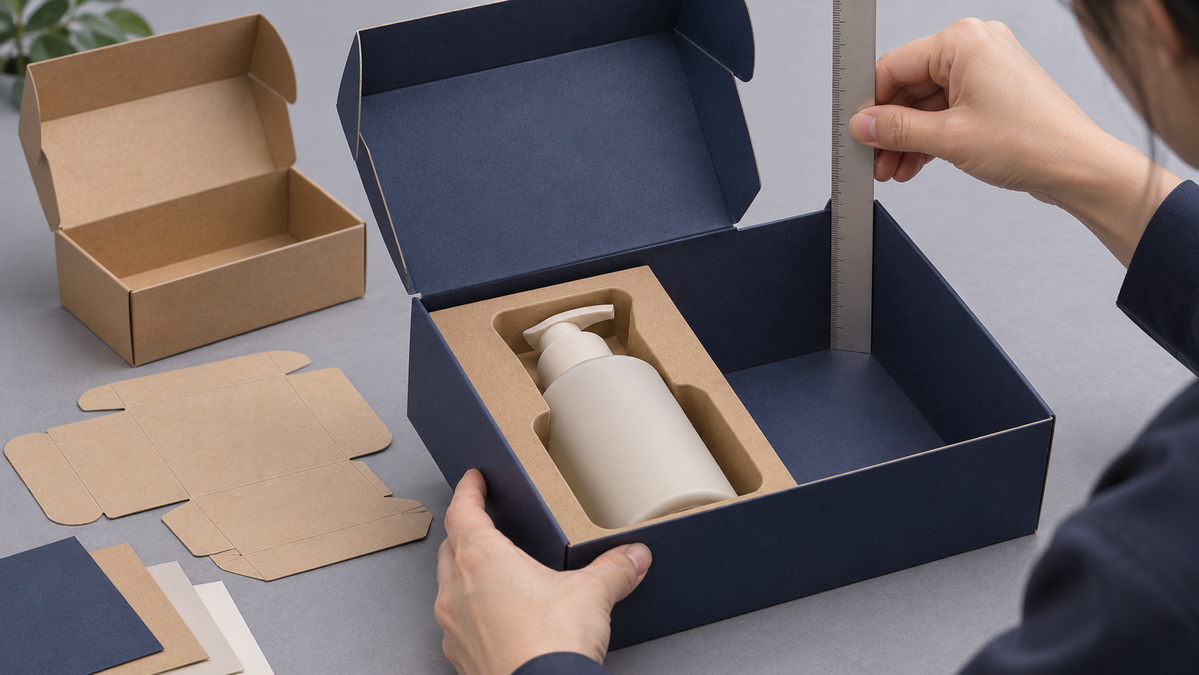
What to Send a Packaging Manufacturer for an Accurate Quote
A complete brief reduces avoidable quotation revisions.
Include:
- Product dimensions, weight, and fragility.
- Required internal box dimensions, if known.
- Box style or reference images.
- Expected order quantity and alternative quantity breaks.
- Number of sizes and artworks.
- Material and finishing preferences.
- Insert requirements.
- Delivery destination.
- Required arrival date.
- Sampling expectations.
Ask for comparable quotations at three practical quantities.
Also request written confirmation of payment terms, quantity tolerances, freight assumptions, and whether the stated schedule begins after artwork approval or sample approval.
A useful quotation should explain both the price and its boundaries.
Plan Your Packaging Order With XingKun
At Shenzhen XingKun Packing Products Co., Ltd., we approach packaging as a balance of presentation, protection, production practicality, and purchasing risk.
Our more than 20 years of experience and service to brands and distributors across over 30 countries and regions provide the background for a specification-led discussion—not a one-size-fits-all quantity promise.
Send XingKun your product dimensions, preferred box style, artwork count, target quantity, and delivery destination. Request a comparison of feasible order quantities, printing options, sampling requirements, and total quoted costs.
The goal is a packaging order your business can use confidently, with room to grow.
Frequently Asked Questions
What Is the Minimum Order Quantity for Custom Packaging Boxes?
It depends on the supplier, structure, material, artwork count, printing method, and finishing. Request a written minimum for your exact specification rather than relying on a general advertised figure.
Can I Order Custom Boxes in Small Quantities?
Yes, some suppliers support small quantities through digital printing or standard formats. Availability and pricing depend on the product. Confirm whether cutting, finishing, and assembly introduce additional minimums.
Does Ordering More Boxes Always Save Money?
Not overall. A larger order may reduce the price per box while increasing cash commitment, storage, and unused-inventory exposure. Compare the quantity you expect to use, not only the quantity purchased.
Can Different Designs Be Combined to Meet the MOQ?
Sometimes, but do not assume so. Common sizes and materials may create efficiencies, while different artworks or finishes can require separate setup. Ask for minimums per size and artwork.
Will Reordering the Same Box Reduce My MOQ?
Possibly. Existing tooling and approved specifications may simplify repeat production. However, material purchasing, scheduling, and machine setup still influence the supplier's minimum and pricing.
How Can I Lower MOQ Without Making My Packaging Look Basic?
Evaluate a standard structure, focused printing, and one distinctive visual feature. Labels or sleeves may provide flexibility. Preserve product protection and clear branding before spending on decorative complexity.
References
1. Packlane. "Custom Boxes & Custom Packaging." Manufacturer information on pricing factors, low minimums, and non-digital options for qualifying larger orders. [packlane]
2. White Graphics. "Short-Run Packaging: Small-Batch Boxes, Cartons & More." Production explanation covering digital printing, conventional setup, and short-run manufacturing. Supplier-specific numerical thresholds were not treated as universal benchmarks. [whitegraphics]
3. Maple Sourcing. "Custom Packaging MOQ for Small Business: Cut It 4 Ways." Discussion of setup costs, stock packaging, labels, and production alternatives. [maplesourcing]
4. Shenzhen Xingkun Packing Products Co., Ltd. Company website. Background on establishment, packaging production, customization, and sampling services. [xkprint-pack]
5. XingKun. Official product and company website. Information on packaging boxes, printing capabilities, and the distinction between digital samples and bulk-production output. [xkdisplay]


