Content Menu
● Quick Answer: Standard Deck Card Count
● What Are the 52 Cards in a Standard Deck?
>> How many red and black cards are there?
>> How many face cards are in a deck?
>> How many numbered cards are in a deck?
● Does a Standard Deck Include Jokers?
>> Why are Jokers included?
● Why Does a Standard Deck Have 52 Cards?
● Standard Decks vs. Other Types of Card Decks
>> Industry insight: "Standard" should never be assumed in manufacturing
● Standard Playing Card Sizes for a 52-Card Deck
● How Card Count Affects Custom Playing Card Production
>> 1. Artwork planning
>> 2. Collation and sequencing
>> 3. Packaging capacity
>> 4. Quality inspection
● A Practical Checklist for Ordering a Custom Deck
● Common Mistakes When Designing a Custom 52-Card Deck
● Conclusion
● FAQ
>> 1. How many cards are in a standard deck without Jokers?
>> 2. How many cards are in a deck with Jokers?
>> 3. How many face cards are in a standard deck?
>> 4. How many red cards are in a standard deck?
>> 5. Are Jokers part of a standard 52-card deck?
>> 6. What size is a standard deck of playing cards?
>> 7. Can I make a custom deck with more or fewer than 52 cards?
>> 8. What should I provide to a custom playing-card manufacturer?
● References
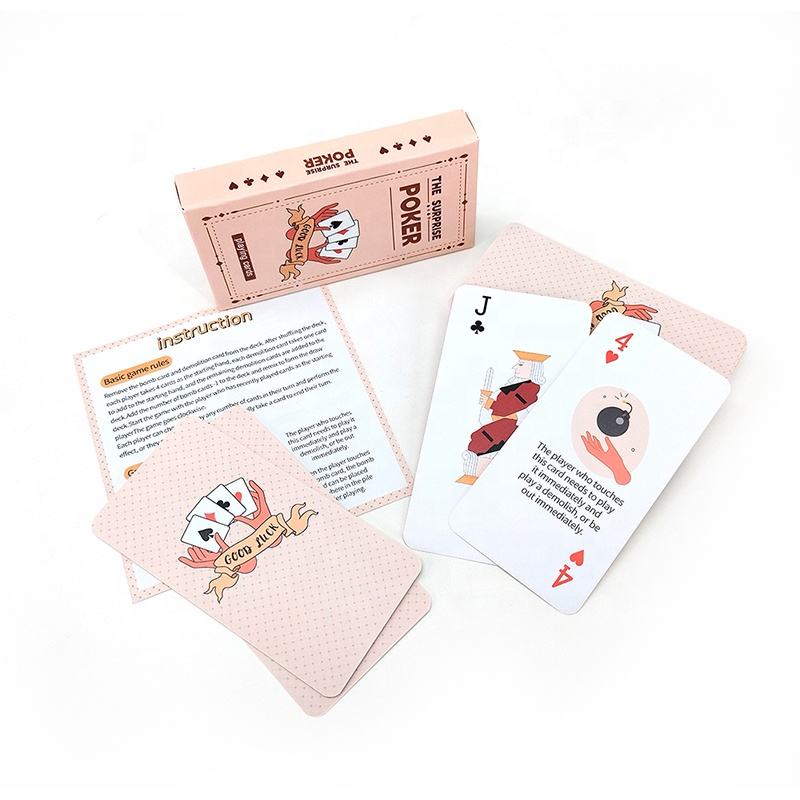
A standard deck of playing cards contains 52 cards: four suits with 13 cards in each suit. In many retail packs, the deck also includes two Jokers, which means the sealed pack may contain 54 playable cards—plus occasional advertising or instruction cards.
For card-game players, this distinction affects rules and setup. For brands, publishers, casinos, event companies, and custom card-game creators, it affects artwork planning, manufacturing quotations, collation, packaging, and quality control. At XingKun, we approach a custom playing-card project by first confirming not only the card size and material, but also the exact card count and card sequence required for the finished deck.
Quick Answer: Standard Deck Card Count
A conventional French-suited deck—the format most people mean when they ask, "How many cards are in a standard deck?"—contains 52 standard cards:
| Deck component | Quantity | Details |
| Suits | 4 | Hearts, Diamonds, Clubs, and Spades |
| Cards per suit | 13 | Ace through King |
| Number cards per suit | 9 | 2 through 10 |
| Court cards per suit | 3 | Jack, Queen, and King |
| Aces | 4 | One Ace in each suit |
| Standard cards | 52 | 4 suits × 13 cards |
| Common Jokers | 2 | Often included, but not part of the core 52-card deck |
| Typical retail pack | 54 cards | 52 standard cards + 2 Jokers |
The 52-card, four-suit design is the most widely recognized international playing-card format. Each suit has 13 ranks, making every standard card identifiable by its unique combination of suit and rank. The usual suit colors are red for Hearts and Diamonds, and black for Clubs and Spades. [britannica]
What Are the 52 Cards in a Standard Deck?
A standard deck has four suits:
- Hearts ♥
- Diamonds ♦
- Clubs ♣
- Spades ♠
Every suit includes the same 13 ranks:
1. Ace
2. 2
3. 4
4. 5
5. 6
6. 7
7. 8
8. 9
9. 10
10. Jack
11. Queen
12. King
Therefore:
4 suits×13 cards per suit=52 cards
The mathematical symmetry is one reason the deck works so well across many games. Poker, blackjack, bridge, rummy, solitaire, baccarat, and many custom tabletop games all use the same underlying card structure, even though the gameplay differs.
How many red and black cards are there?
A standard deck contains:
- 26 red cards: 13 Hearts and 13 Diamonds
- 26 black cards: 13 Clubs and 13 Spades
This even split is especially important in games and probability questions involving color. For example, before any card is dealt, the probability of drawing a red card from a 52-card deck is:
26÷52=1÷2=50%
How many face cards are in a deck?
There are 12 face cards in a standard 52-card deck:
- 4 Jacks
- 4 Queens
- 4 Kings
Each suit has three face cards. They are also commonly called court cards because of their traditional royal imagery.
Some people informally describe the Ace as a face card, but in standard card-game terminology, the face cards are normally the Jack, Queen, and King. Aces are separate rank cards and may be high or low depending on the rules of a particular game.
How many numbered cards are in a deck?
There are 36 numbered cards if you count the cards numbered 2 through 10:
4 suits×9 numbered ranks=36 numbered cards
The remaining cards are:
- 4 Aces
- 12 face cards
Together:
36 + 4 + 12 = 52
Does a Standard Deck Include Jokers?
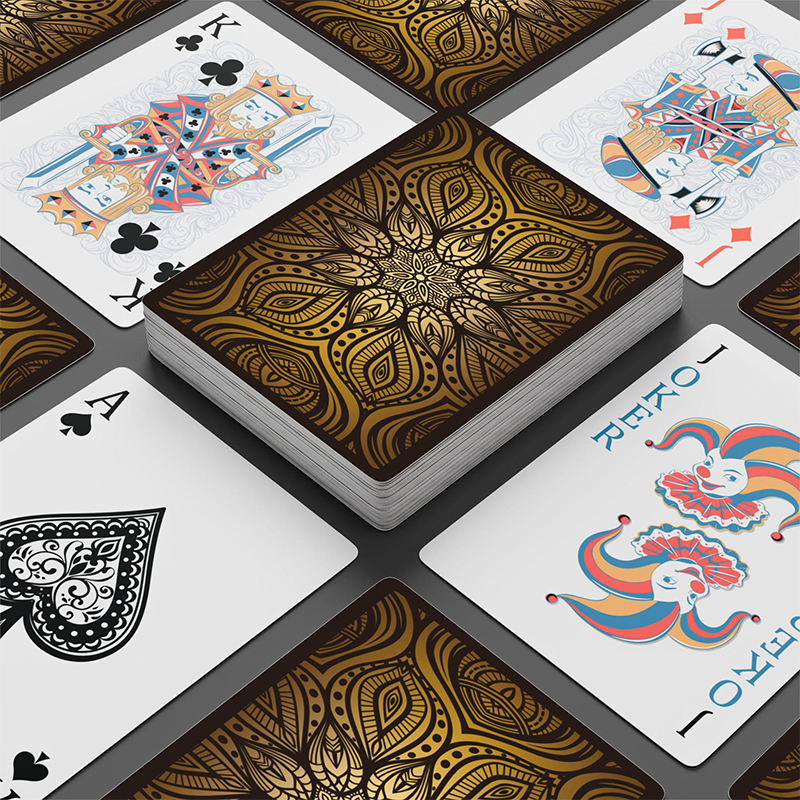
Strictly speaking, no. The core standard deck is 52 cards. Jokers are usually supplied as extra cards in a retail playing-card pack.
A common commercially sold deck contains:
- 52 standard suited cards
- 2 Jokers
- Sometimes 1–2 advertising, guarantee, rules, or promotional cards
For example, Bicycle's standard retail decks are commonly described as containing 52 traditional suited cards, two Jokers, and two additional advertising cards. Retail listings that cite the Bicycle team likewise state that a deck contains the 52 standard cards plus two Jokers. [amazon]
That is why different people may give different answers:
| Question being asked | Correct answer |
| How many cards are in a standard playing-card deck? | 52 |
| How many cards are in a typical deck with Jokers? | 54 |
| How many items may be inside a retail tuck box? | Often 54–56, depending on inserts or ad cards |
| How many cards are used in most poker games? | Usually 52, without Jokers |
| How many cards are used in many games with Jokers? | Often 54, depending on the rules |
Why are Jokers included?
The Joker developed as a special-purpose card and is not assigned to one of the four suits. It may function as:
- A wild card in some games
- A high trump in games such as Euchre variants
- A replacement card in certain game rules
- A branded illustration, mascot, or collector feature
- A visual security or authentication element for premium decks
For custom deck publishers, the Joker is also a valuable branding location. One Joker can feature a logo, character, campaign slogan, or QR code, while the other can hold game rules, customer-service information, or a second promotional design.
Why Does a Standard Deck Have 52 Cards?
The 52-card deck is a product of historical development rather than a universally mandated rule. Playing cards appeared in Europe in the 1370s, likely through trade connections with the Islamic Mamlūk world. French suit symbols later became especially influential because their simple shapes were well suited to mass production through printing methods. [britannica]
Over time, the French-suited deck became the dominant international format:
- Four suits: Hearts, Diamonds, Clubs, and Spades
- Two colors: red and black
- Thirteen ranks in each suit
- A 52-card total
Britannica describes the 52-card, four-suit, 13-rank deck as the most successful and universally recognized playing-card format. [britannica]
You may hear a popular claim that the 52 cards represent the 52 weeks of the year, the four suits represent the seasons, and the 13 cards per suit represent lunar cycles. These comparisons are interesting, but they should be treated as symbolic interpretations, not a proven single origin story for the modern deck. The commercial and historical success of the deck comes more directly from its flexible suit-and-rank structure, its manufacturability, and its suitability for many games.
Standard Decks vs. Other Types of Card Decks
Not every deck is a 52-card deck. This is particularly important for product sourcing, game development, and e-commerce product descriptions. A buyer requesting "custom playing cards" may actually need a different card count, size, sequence, or game format.
| Deck type | Typical card count | Primary use | Key difference |
| Standard French-suited deck | 52 | Poker, blackjack, rummy, solitaire | Four suits, 13 cards each |
| Standard deck with Jokers | 54 | General retail, wild-card games | 52 standard cards + 2 Jokers |
| Euchre deck | Often 24 or 32 | Euchre | Uses selected ranks only |
| Tarot deck | 78 | Tarot games, divination | Major Arcana + Minor Arcana |
| Uno-style card game | Varies | Family card games | Custom colors, actions, and rules |
| Trading card game deck | Varies | TCG and competitive play | Game-specific card counts and mechanics |
| Flashcard deck | Varies | Education and training | Information-driven rather than suit-based |
| Promotional card deck | Varies | Branding and events | May use 52 cards or a fully custom count |
A tarot deck, for example, commonly has 78 cards, structured as 22 Major Arcana cards and 56 Minor Arcana cards. A custom educational deck may have 30, 50, 100, or more cards, depending on its learning objective. [museumofplay]
Industry insight: "Standard" should never be assumed in manufacturing
From a custom-printing and packaging perspective, the word standard can cause costly misunderstandings if it is not defined in the specification sheet.
Before artwork begins, a professional card manufacturer should confirm:
- Total number of cards
- Number of unique card faces
- Number of duplicate cards
- Whether Jokers are included
- Whether blank or replacement cards are needed
- Card order and collation sequence
- Front and back artwork variations
- Card size
- Card stock and finish
- Packaging style
- Required inserts, rules cards, or certificates
For example, a client may say, "We need a standard 54-card poker deck." In production terms, this could mean:
- 52 traditional card faces
- 2 branded Jokers
- One common card-back design
- One tuck box
- One cellophane wrap
- Optional instruction or ad card
However, another client could mean 54 completely unique cards for a branded game. These are very different artwork, prepress, collation, and quality-control requirements.
Standard Playing Card Sizes for a 52-Card Deck
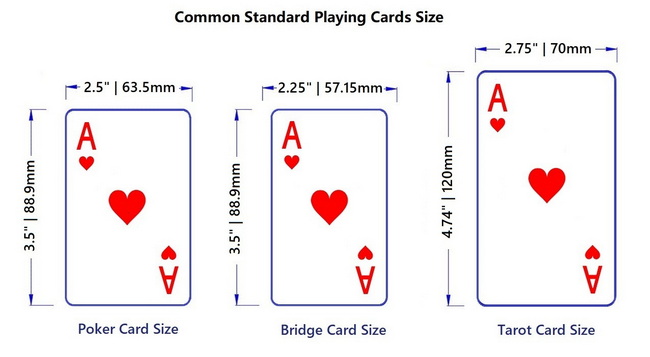
Card count and card size are separate specifications. A 52-card deck can be printed in poker size, bridge size, mini size, oversized format, or a completely custom dimension.
The most common formats are:
| Card format | Inches | Approximate metric size | Common use |
| Poker size | 2.5 × 3.5 in | 63.5 × 88.9 mm | Poker, promotional decks, tabletop games |
| Bridge size | 2.25 × 3.5 in | 57.15 × 88.9 mm | Bridge, canasta, games with larger hands |
| Mini size | Varies | Varies | Travel games, promotional items, novelty decks |
| Custom size | Varies | Varies | Brand campaigns, educational decks, specialty games |
Poker-size cards are widely used for general playing cards, custom games, and promotional decks. Bridge-size cards are the same height but narrower, which makes them easier to fan and hold when players need to manage larger hands. [printninja]
XingKun's playing-card product page identifies 2.5 × 3.5 inches as a typical standard poker-card dimension and notes that bridge-size formats are slightly narrower. It also offers custom-size possibilities depending on project requirements. [xkdisplay]
How Card Count Affects Custom Playing Card Production
A custom deck is more than a stack of printed cards. The number of cards changes the project's design workload, printed-sheet layout, packing process, and inspection criteria.
1. Artwork planning
A traditional 52-card deck usually needs individual artwork or correctly formatted layouts for:
- 4 Aces
- 36 number cards
- 12 court cards
- 1 or 2 Joker cards, if included
- 1 card-back design, or more for premium editions
- Tuck-box artwork
- Optional rules, ad, or certificate cards
For fully custom decks, each face may need its own illustration. This applies to artist decks, licensed merchandise, educational products, destination souvenirs, corporate gifts, and collector editions.
2. Collation and sequencing
Collation means assembling cards in the correct order and quantity. This matters even more when a deck contains nonstandard cards.
A production-ready file should state:
- Card number
- Card name or title
- Front artwork filename
- Back artwork assignment
- Quantity per deck
- Final sequence
- Language version, if applicable
For example, a bilingual learning deck may include English on one side and Japanese, French, German, or Spanish on the other. A clear collation list prevents duplicated cards, missing cards, and incorrect order.
3. Packaging capacity
The difference between 52, 54, 60, or 100 cards affects the thickness of the finished product. This can change:
- Tuck-box dimensions
- Tray depth
- Magnetic-rigid-box structure
- Shipping-carton configuration
- Product weight
- Fulfillment and storage requirements
A standard deck with 52 cards plus two Jokers may fit a classic tuck box comfortably. A 100-card game deck may need a deeper tuck box, two-deck box, telescoping box, rigid box, or a custom insert.
4. Quality inspection
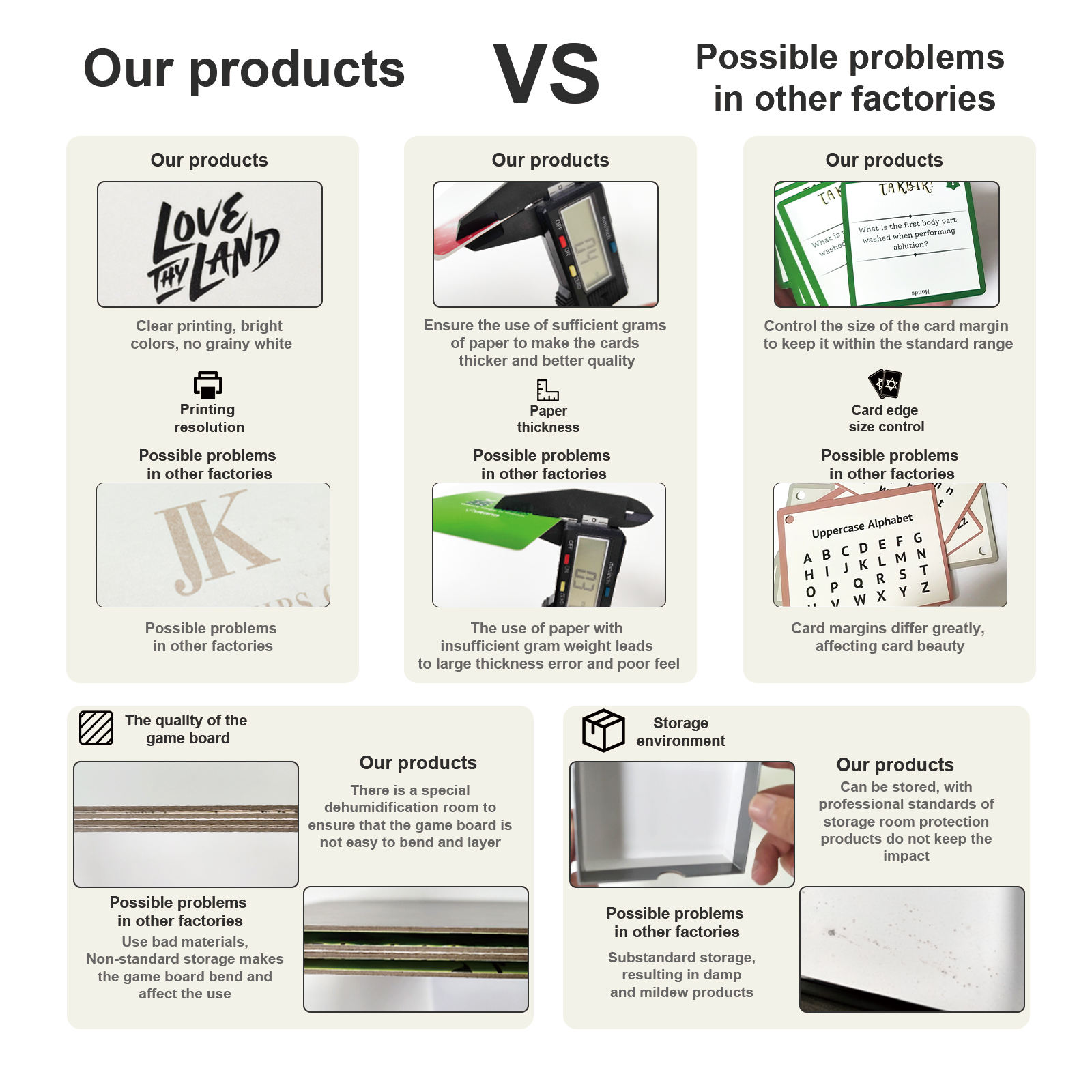
For branded or retail custom decks, quality control should include more than checking print color. A thorough inspection should verify:
- Correct total card count
- Correct card order
- Correct front-to-back pairing
- Trim consistency
- Rounded-corner quality
- Registration accuracy
- Color consistency
- Coating or lamination quality
- Box fit and structural integrity
- Barcode, warning, and compliance artwork where required
XingKun's manufacturing overview describes a workflow that includes artwork preparation, CMYK color separation, printing, cutting, collation, finishing, corner rounding, packaging, and final quality inspection. It also describes production options such as offset printing, digital printing, and specialty finishes including foil stamping, embossing, and protective coatings. [xkdisplay]
A Practical Checklist for Ordering a Custom Deck
If you are a brand owner, wholesaler, game publisher, event organizer, or marketing agency, use this checklist before requesting a quote.
1. Confirm the card count.
State whether your product has 52 standard cards, 54 cards with Jokers, or a nonstandard quantity.
2. Define the card dimensions.
Choose poker size, bridge size, mini size, tarot size, or a custom format.
3. Choose card material and finish.
Consider paper stock, plastic-coated paper, PVC, premium cardstock, matte or glossy varnish, linen texture, and lamination based on your intended use.
4. Clarify the artwork structure.
Decide whether you need traditional faces, fully custom faces, one shared card back, multiple card backs, or variable-data cards.
5. Plan the packaging.
Select a tuck box, rigid box, magnetic box, plastic case, tin box, sleeve, or display packaging.
6. Add functional cards when needed.
Consider Jokers, instruction cards, ad cards, QR-code cards, warranty cards, collector certificates, or blank replacement cards.
7. Request a prototype or sample.
A physical sample helps you evaluate card thickness, color, shuffling feel, edge quality, box fit, and overall brand presentation before mass production.
Common Mistakes When Designing a Custom 52-Card Deck
The following problems frequently appear in first-time custom card projects:
- Designing 52 faces but forgetting the two Jokers.
- Adding an instruction card without including it in the final card count.
- Assuming every card back is identical when the game requires differentiated backs.
- Using low-resolution artwork that becomes soft after printing.
- Placing key artwork too close to the trim or rounded corners.
- Forgetting bleed and safe-area requirements.
- Choosing a deck box before confirming the final card stock and quantity.
- Not providing a numbered card manifest for collation.
- Treating poker-size and bridge-size cards as interchangeable.
- Ordering a standard deck when the intended game actually needs custom ranks, suits, icons, or action cards.
A clear production brief saves time and reduces revision risk. It also makes it easier for a manufacturer to recommend the most suitable printing method, card stock, finish, and packaging solution.
Conclusion
A standard deck of playing cards has 52 cards: four suits—Hearts, Diamonds, Clubs, and Spades—with 13 cards in each suit. When two Jokers are added, the commonly sold retail deck typically contains 54 cards, while some packs also include advertising or instruction inserts.
For game players, knowing the difference helps with rules and probability. For businesses creating promotional, educational, collectible, casino, event, or retail decks, the card count is only the first production decision. The final product also depends on card size, paper or plastic material, artwork structure, finishing, collation, and packaging. A precise specification makes custom deck production more efficient and helps ensure that every finished set looks professional, functions correctly, and represents the brand well.
Need a custom 52-card, 54-card, tarot, educational, or fully original card deck? Contact XingKun with your target card quantity, size, artwork concept, material preference, and packaging needs to discuss OEM and ODM custom playing-card production.

FAQ
1. How many cards are in a standard deck without Jokers?
A standard deck contains 52 cards. It has four suits, and each suit contains 13 ranks: Ace through King.
2. How many cards are in a deck with Jokers?
A typical deck with Jokers contains 54 cards: 52 standard suited cards plus two Jokers. Some retail boxes also include advertising or information cards, increasing the total number of physical inserts.
3. How many face cards are in a standard deck?
There are 12 face cards: four Jacks, four Queens, and four Kings. Each suit contains one Jack, one Queen, and one King.
4. How many red cards are in a standard deck?
There are 26 red cards: 13 Hearts and 13 Diamonds. The other 26 cards are black: 13 Clubs and 13 Spades.
5. Are Jokers part of a standard 52-card deck?
No. Jokers are usually extra cards included in retail packs. They are not part of the core 52-card French-suited deck.
6. What size is a standard deck of playing cards?
The most common poker-size card is 2.5 × 3.5 inches (about 63.5 × 88.9 mm). Bridge-size cards are usually 2.25 × 3.5 inches and are narrower for easier handling in games with large hands. [printninja]
7. Can I make a custom deck with more or fewer than 52 cards?
Yes. Custom decks can contain nearly any card quantity, including 24-card, 30-card, 36-card, 52-card, 54-card, 60-card, 78-card, or 100-card formats. The correct count depends on the game rules, campaign objective, educational content, or collector concept.
8. What should I provide to a custom playing-card manufacturer?
Provide the desired card count, finished card size, artwork files, card sequence, card-back design, material preference, finish, packaging style, target order quantity, and destination market. If available, include a card manifest and packaging dieline requirements.
References
1. [XingKun Playing Cards: Custom Playing Card Types, Materials, Printing, Sizes, Production Process, and Applications]
2. [Encyclopaedia Britannica: Playing Cards—Names, Games, and History]
3. [Target: Bicycle Standard Playing Cards—52 Cards Plus Two Jokers]
4. [Amazon: Bicycle Standard Playing Cards Product Description]
5. [PrintNinja: Playing Card Sizes—Poker, Bridge, Tarot, and TCG Dimensions]
6. [The Strong National Museum of Play: From Playing Cards to Divination]


