Content Menu
● Start With Your Playing Card Product Brief
>> Define The Core Specifications First
>> Separate "Must-Have" From "Nice-To-Have"
● Evaluate Playing Card Material Performance
>> Look Beyond GSM When Comparing Cardstock
>> Match The Finish To Real User Behavior
● Verify Manufacturing Capability, Not Just Product Photos
>> Ask About The Production Workflow
>> Confirm Whether The Factory Controls Critical Processes
● Use Samples To Reduce Production Risk
>> Request The Right Type Of Sample
>> Run A Practical Sample Test
● Assess Print Quality And Color Management
>> Ask How The Manufacturer Controls Color
>> Inspect Registration And Cut Accuracy
● Check Quality Control And Defect Handling
>> Ask For A Documented QC Plan
>> Define Defects Before Mass Production
● Review Compliance For Your Target Market
>> Consider Children's Product Requirements Early
>> Verify Sustainability Claims Properly
● Compare Quotes By Total Value, Not Unit Price
>> Build A Like-For-Like Quote Comparison
>> Understand MOQ And Production Method
● Evaluate Communication And Project Management
>> Look For These Signs Of A Reliable Partner
● A Practical Manufacturer Selection Scorecard
● Why OEM And ODM Experience Matters
● Conclusion
● FAQ
>> 1. What should I ask a playing card manufacturer before ordering?
>> 2. What is the best cardstock for custom playing cards?
>> 3. Should I order a sample before mass production?
>> 4. What file format is best for playing card printing?
>> 5. How long does custom playing card production take?
>> 6. Do playing cards need EN 71 testing?
>> 7. Can a Chinese playing card manufacturer provide FSC-certified paper?
● References
Choosing the right playing card manufacturer is not simply about finding the lowest quotation. For a branded deck, card game, promotional giveaway, collector's edition, casino-style deck, or crowdfunding product, your manufacturer directly affects product feel, print consistency, durability, compliance, delivery reliability, and ultimately your customers' perception of your brand.
A strong custom playing card manufacturer should work as an extension of your product team. They should help you turn artwork into a repeatable, commercially viable product—not just print images on paper. For overseas buyers sourcing from China, the most reliable decision comes from evaluating technical capability, quality systems, sample control, communication, compliance support, and total landed cost together.
At Shenzhen XingKun Packing Products Co., Ltd. (XingKun), we work with international brands, wholesalers, publishers, creators, and manufacturers that need OEM and ODM production for custom packaging boxes, playing cards, jigsaw puzzles, printed books, stickers, and related paper products. Based on real production workflows, this guide explains how to choose a playing card manufacturer with fewer avoidable risks.
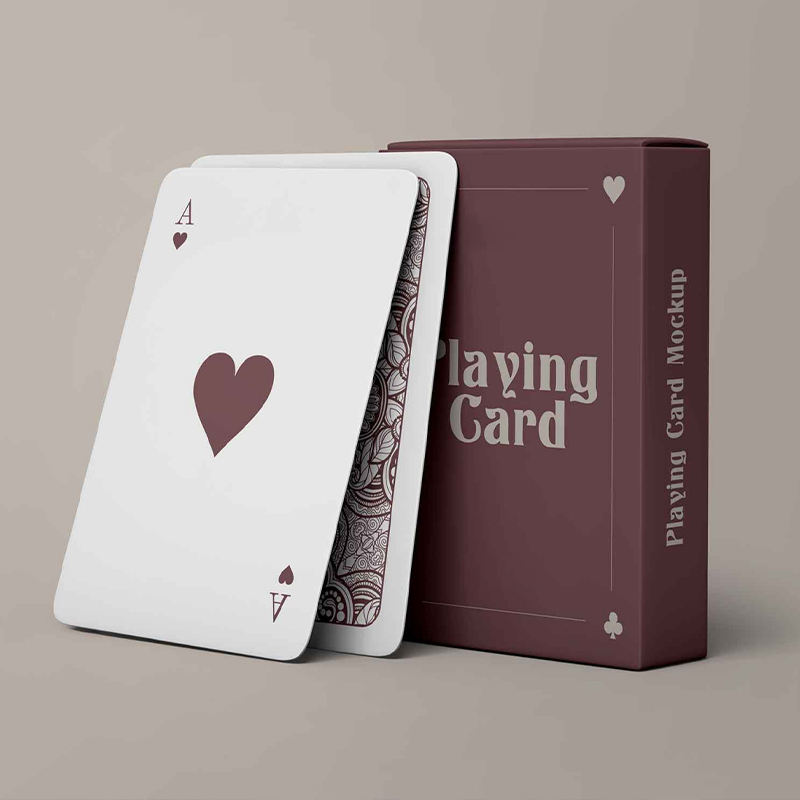
Start With Your Playing Card Product Brief
Before contacting any custom playing card manufacturer, clarify what you are making. A manufacturer can only quote accurately when the product specification is clear.
"Custom playing cards" can refer to very different products:
- Standard 54-card poker decks
- Tarot or oracle card decks
- Educational flashcards
- Trading cards
- Board-game cards
- Promotional card decks
- Casino-style playing cards
- Luxury collector decks
- Children's card games
- Waterproof or plastic cards
Each category has different expectations for cardstock, opacity, coating, shuffle performance, cutting precision, packaging, compliance, and order volume.
Define The Core Specifications First
Prepare a clear request-for-quotation, usually called an RFQ. At minimum, include the following details:
| Specification |
What To Confirm |
Why It Matters |
| Card size |
Poker, bridge, tarot, square, or custom size |
Determines paper yield, die-cutting, packing, and unit cost |
| Card quantity |
54 cards, 78 cards, 100 cards, or a custom count |
Affects collation, packing, and production efficiency |
| Cardstock |
Black-core, blue-core, white-core, greyboard, PVC, PET |
Influences opacity, stiffness, snap, and durability |
| Paper weight |
For example, 300 gsm, 310 gsm, or 330 gsm |
Weight alone does not define quality, but it affects the feel |
| Finish |
Matte, gloss, linen, air-cushion, varnish, UV, lamination |
Determines hand feel, friction, visual effect, and wear resistance |
| Printing |
CMYK, Pantone, metallic ink, fluorescent ink, foil |
Controls color accuracy and premium appearance |
| Corners |
Standard radius, large radius, custom shape |
Poor corner consistency can make a deck feel cheap |
| Packaging |
Tuck box, rigid box, magnetic box, tin box, shrink wrap |
Protects the deck and supports retail presentation |
| Quantity |
Prototype, small run, wholesale quantity, recurring orders |
Influences production method, MOQ, and unit economics |
| Market |
United States, EU, UK, Japan, Australia, etc. |
Determines safety, labeling, and documentation needs |
A buyer who supplies this information receives more comparable quotations. A buyer who only asks, "What is your playing card price?" will often receive a low but incomplete quotation that later changes.
Separate "Must-Have" From "Nice-To-Have"
One of the most practical ways to control cost is to rank your requirements.
Must-have requirements might include:
- Black-core paper for opacity
- Accurate brand colors
- Rounded corners
- Durable coating
- A branded tuck box
- Pre-shipment inspection
- Safety testing for a children's product
Nice-to-have requirements might include:
- Gold foil on every card
- Holographic lamination
- Edge gilding
- Embossed tuck box
- Custom inserts
- Individual serial numbers
This distinction helps your supplier recommend value-engineered alternatives. For example, foil on the tuck box may create a premium retail impression at much lower cost than foil on all card faces.
Evaluate Playing Card Material Performance
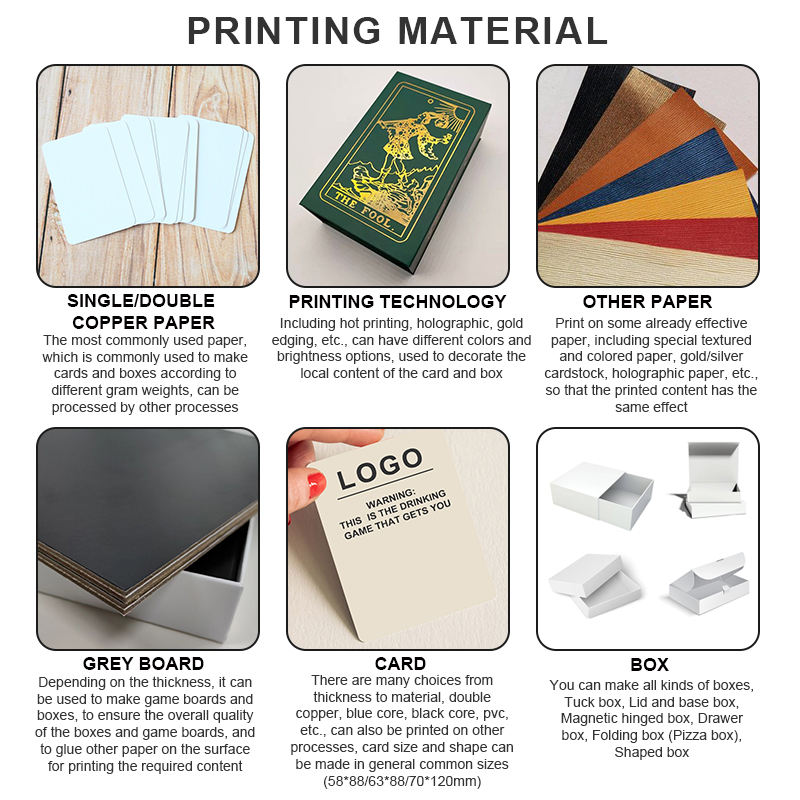
The best-looking deck is not always the best-performing deck. Playing cards are handled, shuffled, bent, stacked, fanned, packed, and sometimes used outdoors. Material selection therefore deserves more attention than buyers often give it.
Look Beyond GSM When Comparing Cardstock
Many buyers compare card stock only by paper weight. This is incomplete.
A 300 gsm playing card can feel better than a heavier card if it has stronger fiber structure, a more appropriate core, better coating, and more controlled converting. When assessing cardstock, ask about:
- Opacity: Can users see through the card under strong light?
- Stiffness: Does the card feel substantial without becoming difficult to shuffle?
- Snap: Does it return well after a normal bend?
- Surface friction: Does it spread and shuffle smoothly?
- Resistance to cracking: Will the surface break along folds or bends?
- Color stability: Does the card remain visually consistent across production batches?
- Thickness consistency: Are all cards in the deck uniform?
For poker, casino-inspired, magic, and cardistry products, buyers often prefer black-core or blue-core cardstock because the internal layer improves opacity. For educational cards or lower-cost promotional decks, white-core stock may be acceptable if the application does not require high opacity.
Match The Finish To Real User Behavior
The finish affects both design appearance and usability. It should be selected based on the intended user experience.
| Finish Type |
Best For |
Key Consideration |
| Matte varnish |
Educational cards, modern branded decks |
Reduces glare and offers a clean feel |
| Gloss varnish |
Bright promotional images |
Can show fingerprints and reflections |
| Linen texture |
Classic playing cards, cardistry, premium decks |
Enhances tactile feel and shuffle performance |
| Aqueous coating |
General commercial decks |
Offers a practical balance of cost and protection |
| UV coating |
Selected visual areas or premium effects |
Can be overly slick or prone to cracking if poorly controlled |
| Matte lamination |
Retail packaging and durable card surfaces |
Provides protection but can change card flexibility |
| Soft-touch lamination |
Luxury packaging boxes |
Usually more suitable for packaging than high-flex cards |
| Plastic/PVC |
Waterproof decks |
Offers water resistance but creates different shuffle and sustainability trade-offs |
Expert tip: Request physical samples with the same paper-and-finish combination you plan to use. A sample that uses a different stock, coating, or printing process is only partially useful.
Verify Manufacturing Capability, Not Just Product Photos
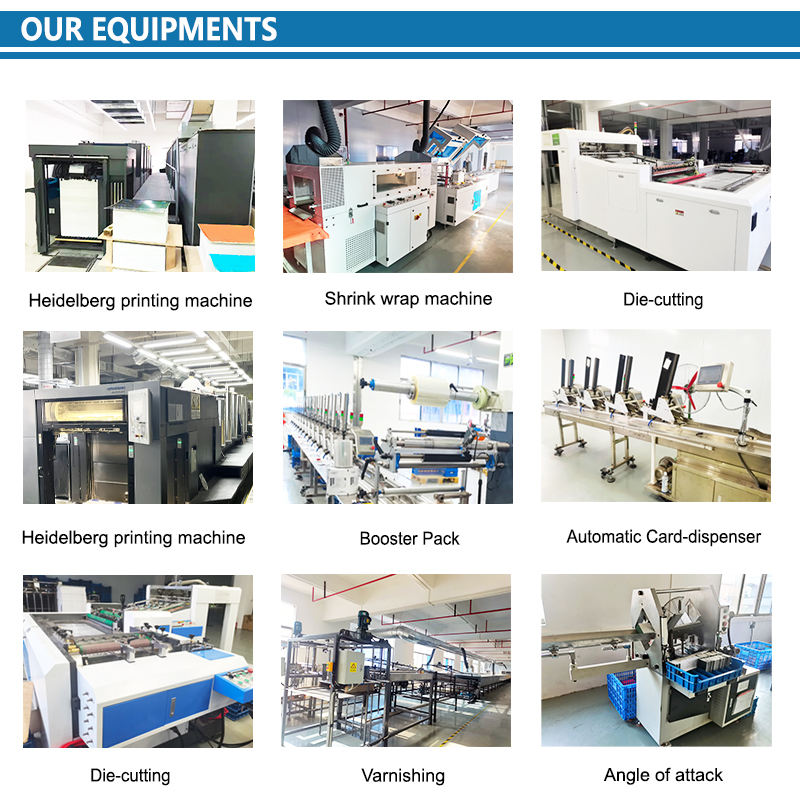
Supplier websites can display attractive photographs, but photos do not prove whether the factory can reproduce your deck consistently at scale. A capable manufacturer should explain its process clearly and provide evidence when requested.
Ask About The Production Workflow
A professional playing card manufacturer should be able to describe a controlled production path:
1. Artwork preflight and file review
2. Color proofing or digital proof approval
3. Paper and material preparation
4. Printing and color control
5. Coating, varnishing, laminating, or specialty finishing
6. Die-cutting and corner rounding
7. Card sorting, collating, and deck assembly
8. Tuck-box or rigid-box production
9. Shrink wrapping, packing, and carton inspection
10. Final quality control before shipment
If a supplier cannot explain how cards are printed, cut, sorted, and packed, that is a warning sign. Playing-card quality depends on all these connected steps. Good printing alone cannot compensate for poorly controlled die-cutting or incorrect card collation.
Confirm Whether The Factory Controls Critical Processes
When comparing a playing card manufacturer in China, ask which operations are performed in-house and which are outsourced.
In-house control is particularly valuable for:
- Prepress and artwork checking
- Offset or digital printing
- Die-cutting
- Corner rounding
- Folding and gluing tuck boxes
- Quality inspection
- Packing and export carton preparation
Outsourcing is not automatically negative. Many experienced manufacturers use specialist partners for foil stamping, metal tins, complex rigid boxes, or laboratory testing. The important question is whether the supplier has a documented way to manage those partners and inspect incoming materials.
An ISO 9001 quality-management framework is designed to help organizations deliver consistent products and services while meeting customer and regulatory expectations. However, buyers should verify a supplier's actual certificate status and scope rather than treating an ISO logo on a website as proof. ISO itself does not certify companies; independent certification bodies do. [iso]
Use Samples To Reduce Production Risk
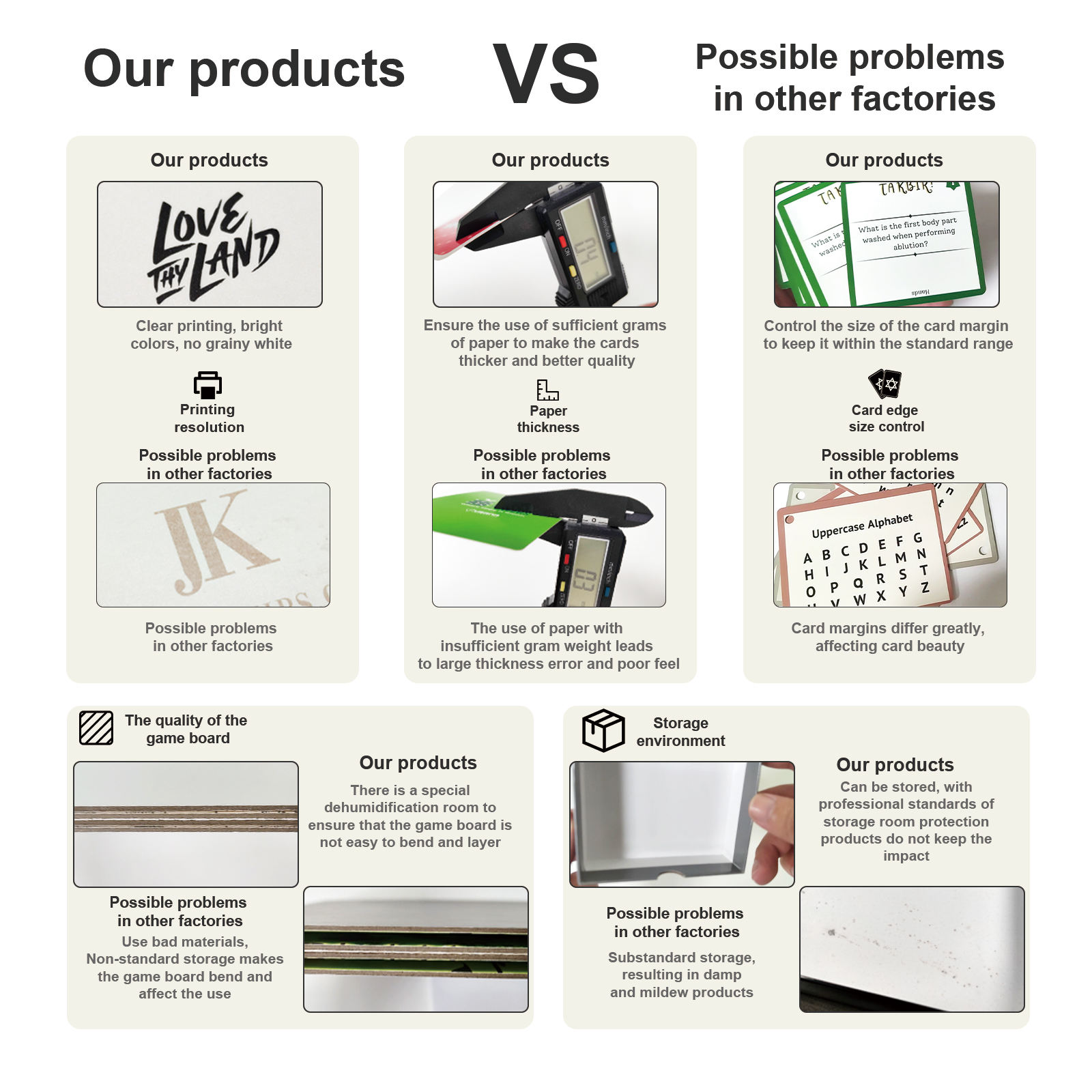
The most common and expensive sourcing mistake is approving a project from a digital mockup alone. Screens, digital PDFs, and 3D renders cannot accurately show card stiffness, coating friction, edge quality, print density, or packaging durability.
Request The Right Type Of Sample
There are three useful sample stages.
| Sample Type |
Purpose |
What You Should Check |
| Existing stock sample |
Assesses general factory quality |
Card feel, cut quality, box construction, print sharpness |
| Digital or dummy sample |
Checks layout, content, and packaging structure |
Text, artwork placement, card count, box fit |
| Pre-production sample |
Approves the actual mass-production specification |
Color, material, finish, collation, packaging, and final workmanship |
A pre-production sample is the strongest risk-control tool for a branded card project. It should use the approved artwork, requested material, selected finish, and final packaging configuration as closely as possible.
Run A Practical Sample Test
Do not only inspect the sample visually. Test it as a user would.
- Shuffle the deck repeatedly.
- Fan the cards across a flat table.
- Inspect for edge roughness or inconsistent corner radii.
- Hold cards against a strong light source to assess opacity.
- Compare front and back alignment.
- Check whether dark colors rub, scratch, or show fingerprints.
- Verify that every card appears once and in the correct order.
- Open and close the tuck box multiple times.
- Check whether the box fits the deck without crushing or excessive looseness.
- Review key colors under daylight, office light, and warm indoor light.
For critical brand colors, provide Pantone references and request a physical proof. Industry guidance for custom card projects similarly recommends using Pantone colors as a reference and approving physical samples under multiple lighting conditions before mass production. [ezracard]
Assess Print Quality And Color Management
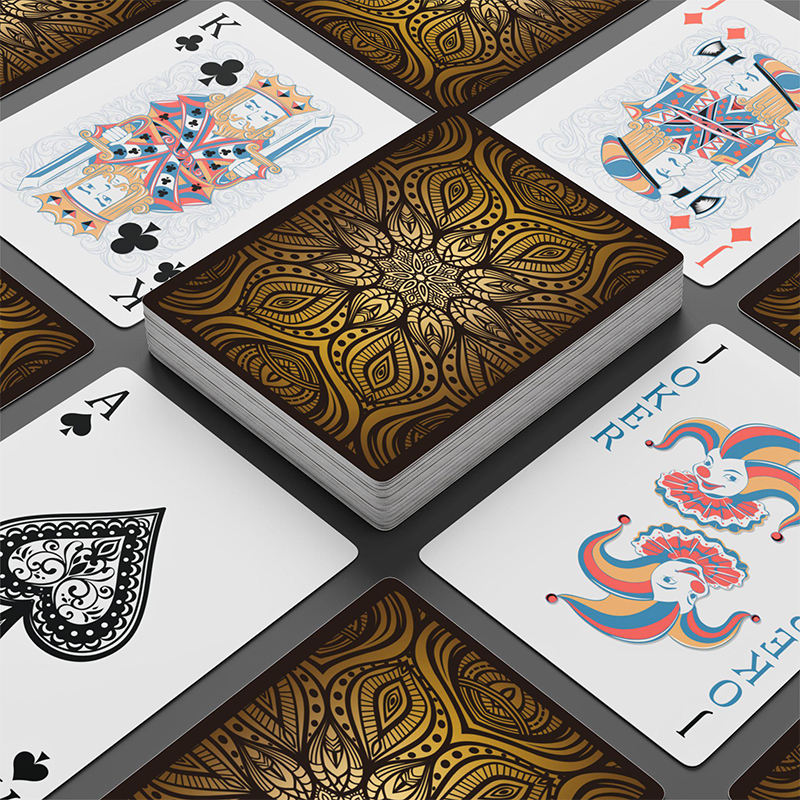
Playing cards often use large solid-color areas, fine linework, small text, dark backgrounds, metallic details, and artwork that repeats across the deck. These elements expose quality problems quickly.
Ask How The Manufacturer Controls Color
A qualified manufacturer should discuss color control in practical terms, including:
- CMYK conversion and color profiles
- Pantone spot-color options
- Proof approval procedures
- Press calibration
- Density and color checks during printing
- Acceptable production tolerances
- Reprint or correction procedures if the result deviates from the approved standard
For custom playing card artwork, use CMYK files at 300 dpi or higher and include the required bleed and safe area. A common print-preparation guideline is 0.125 inch of bleed on each side, but buyers should always follow the manufacturer's own dieline because card sizes and cutting tolerances vary. [universalprintandcopy]
Inspect Registration And Cut Accuracy
A premium deck requires strong alignment across all cards. Check:
- Whether borders look equal on all four sides
- Whether front and back artwork aligns properly
- Whether card corners are evenly rounded
- Whether fine lines remain sharp
- Whether black areas appear rich and even
- Whether small type remains readable
- Whether foil and embossing align with printed artwork
- Whether the tuck-box die-cutting is clean
For border-heavy designs, tell the manufacturer early. Perfectly centered borders are difficult to maintain in commercial print and die-cutting because minor mechanical tolerances become highly visible. A manufacturer should advise you on wider borders, borderless artwork, or production tolerance expectations before printing.
Check Quality Control And Defect Handling
A playing card manufacturer should have more than a final visual inspection. Reliable quality control begins before printing and continues through packing.
Ask For A Documented QC Plan
A practical QC plan may include:
- Incoming-paper inspection
- Print-color checks during production
- Random card inspection for scratches, dents, and marks
- Die-cut and corner-radius verification
- Card-count and collation checks
- Tuck-box folding and gluing inspection
- Shrink-wrap inspection
- Carton drop-test or transit-protection review
- Final AQL inspection before shipment
AQL means Acceptable Quality Limit. It is commonly used in third-party inspections to determine how many defects can be accepted in a sampled lot. You should agree on the inspection standard before production begins, especially for retail, wholesale, or high-value collector decks.
Define Defects Before Mass Production
The supplier and buyer should agree on what counts as a critical, major, or minor defect.
| Defect Level |
Example |
Expected Response |
| Critical |
Wrong card content, missing card, unsafe material, incorrect barcode |
Reject or fully correct |
| Major |
Noticeable print shift, damaged deck, wrong color, poor box fit |
Rework, replace, or negotiate corrective action |
| Minor |
Small cosmetic variation within agreed tolerance |
Review against agreed quality standard |
This approach prevents disputes caused by vague phrases such as "high quality" or "premium quality." A good supplier will welcome clear standards because they make production and inspection more predictable.
Review Compliance For Your Target Market
Compliance depends on what your playing cards are, who will use them, how they are marketed, and where they will be sold. A standard adult promotional deck may face different requirements from a children's educational card game.
Consider Children's Product Requirements Early
If your cards are designed or clearly intended for children under 14 in the European Union, they may fall within the scope of toy-safety requirements. European guidance defines a toy as a product or material designed or clearly intended for play by children under 14. [webgate.ec.europa]
Relevant checks may include:
- EN 71-1 for mechanical and physical properties
- EN 71-2 for flammability
- EN 71-3 for migration of certain elements
- Age grading and warning labels
- Small-parts risk, where applicable
- REACH-related chemical requirements
- Documentation for importers, distributors, and marketplaces
EN 71 is widely used to evaluate toy safety, including mechanical, flammability, and chemical-migration considerations. Whether it applies to your deck must be assessed based on the actual product classification and market—not assumed from product type alone. [compliancegate]
For the U.S. market, children's products can involve CPSIA and ASTM F963 considerations. Discuss requirements with your importer, compliance consultant, laboratory, or legal advisor before production. Do not rely on a generic test report from a different product, ink system, or production batch.
Verify Sustainability Claims Properly
If you market a deck or packaging as FSC-certified, recycled, plastic-free, or eco-friendly, the claim should be supported by the appropriate material documentation and supply-chain controls.
FSC chain-of-custody certification supports traceability and allows eligible companies to make FSC claims in sales documents and product labeling, subject to applicable rules. Buyers can verify certificate data through FSC's public certificate search. [us.fsc]
Ask potential suppliers for:
- FSC chain-of-custody certificate number and scope
- Recycled-content documentation, if claimed
- Ink and coating specifications
- Packaging-material details
- Certification validity dates
- Permission and requirements for using FSC trademarks
Avoid vague claims such as "100% eco-friendly." A more credible claim is specific: "FSC-certified paper available upon request, subject to approved material sourcing and labeling requirements."
Compare Quotes By Total Value, Not Unit Price
A low unit price can become expensive if it produces rework, delays, chargebacks, customer complaints, or excess freight costs. Compare each quotation on the same specification sheet.
Build A Like-For-Like Quote Comparison
| Cost Area |
Questions To Ask |
| Product price |
Does it include the agreed card count, paper, coating, and box? |
| Tooling |
Are die-cutting, custom molds, or special setup charges included? |
| Sampling |
Is the sample fee refundable against a production order? |
| Packaging |
Are individual boxes, shrink wrap, master cartons, inserts, and labels included? |
| Testing |
Are laboratory tests included, optional, or buyer-arranged? |
| Freight terms |
Is the quote EXW, FOB, CIF, DDP, or another Incoterm? |
| Payment terms |
What deposit, balance, and payment method are required? |
| Lead time |
Does it begin after artwork approval, deposit receipt, or sample approval? |
| Defect policy |
What happens if goods do not match the approved sample? |
For comparison purposes, request the same Incoterm from every supplier. Otherwise, one supplier may appear cheaper only because freight, export documents, customs clearance, or delivery costs are excluded.
Understand MOQ And Production Method
MOQ, or minimum order quantity, varies based on size, material, finish, packaging complexity, and production method. Digital printing can support smaller quantities and faster prototypes, while offset printing is generally better for larger quantities and consistent high-volume output.
Do not choose a manufacturer only because it advertises "no MOQ." For a brand-ready commercial product, ask whether that supplier can maintain the same material, color, finish, and cost structure when your order grows from 100 decks to 10,000 decks.
Evaluate Communication And Project Management
For international sourcing, communication is part of product quality. A technically capable factory can still create delays if approvals, revisions, specifications, and shipment details are poorly managed.
Look For These Signs Of A Reliable Partner
A strong manufacturer should:
- Ask detailed questions before quoting
- Provide a clear dieline and artwork guide
- Identify potential production risks early
- Confirm every revision in writing
- Share photos or videos of samples and production when appropriate
- Provide realistic lead times instead of unrealistic promises
- Explain what is included and excluded from the quote
- Respond clearly in English or your preferred working language
- Offer practical alternatives when a design is difficult or costly to produce
- Maintain consistent contact from quotation through shipment
For example, if your deck uses black borders, foil details, and a tight-fitting tuck box, an experienced supplier should flag the risks: visible cutting variation, foil-registration tolerance, and possible scuffing during packing. That early warning is valuable expertise—not a sales obstacle.
A Practical Manufacturer Selection Scorecard
Use a scorecard to compare potential suppliers objectively. Score each category from 1 to 5, then compare the total.
| Evaluation Area |
Weight |
What Good Looks Like |
| Product quality |
25% |
Consistent cards, smooth edges, controlled color, durable finish |
| Sample quality |
15% |
Samples match promised specification and pass handling tests |
| Manufacturing capability |
15% |
Clear process, suitable equipment, controlled key operations |
| Communication |
10% |
Fast, precise, proactive, and documented responses |
| Quality control |
10% |
Defined inspection process and defect-management system |
| Compliance support |
10% |
Can provide relevant documentation and coordinate testing |
| Price transparency |
10% |
Comparable, complete quotation with no hidden assumptions |
| Lead time and logistics |
5% |
Realistic schedule and export-ready packaging |
A supplier with the lowest price but weak sample quality, vague compliance answers, and unclear QC procedures is usually not the lowest-risk option.
Why OEM And ODM Experience Matters
OEM and ODM services mean different things, and buyers should understand the difference before selecting a partner.
OEM manufacturing means producing a product according to your established design, artwork, branding, and specification.
ODM support may include helping you develop the product structure, choose materials, optimize packaging, create a practical card layout, or adjust the specification for cost and manufacturability.
For first-time creators and expanding brands, ODM-level support can prevent common mistakes:
- Choosing material that does not suit the intended use
- Designing borders that are too sensitive to cutting tolerances
- Using packaging that does not protect the deck in transit
- Underestimating the cost impact of foil, embossing, or special materials
- Submitting files with insufficient bleed, resolution, or safe margins
- Ordering without a practical inspection plan
At XingKun, the goal is not simply to produce a deck. The goal is to help customers build a repeatable product specification that can be reordered consistently as their brand grows.
Conclusion
The right playing card manufacturer should deliver more than attractive printed cards. They should provide material guidance, reliable sampling, controlled printing and finishing, transparent pricing, quality inspection, compliance support where needed, and responsive project management.
Start by defining your product clearly. Then compare suppliers using physical samples, documented quality processes, compliance evidence, and total landed cost—not only a headline unit price. The best manufacturing partner is the one that can reproduce your approved deck consistently, protect your brand standards, and support your business from prototype to repeat production.
If you are sourcing custom playing cards, tarot decks, educational cards, game cards, or premium card packaging from China, contact XingKun with your artwork, quantity, target market, material preferences, and packaging requirements. Our team can review your files, recommend practical production options, and prepare a tailored OEM or ODM quotation.
FAQ
1. What should I ask a playing card manufacturer before ordering?
Ask about cardstock, core type, thickness, coating, printing method, color matching, corner radius, card sorting, packaging, MOQ, sample options, quality-control process, lead time, compliance support, payment terms, and shipping terms. Request a written quotation based on a complete product specification.
2. What is the best cardstock for custom playing cards?
The best choice depends on how the deck will be used. Black-core or blue-core paper is often preferred for premium poker, magic, cardistry, and collector decks because it provides opacity and a substantial feel. White-core stock can be suitable for educational, promotional, or value-focused projects.
3. Should I order a sample before mass production?
Yes. A pre-production sample is strongly recommended for branded or retail products. It allows you to check print color, paper feel, finish, cutting, card count, packaging fit, and overall product quality before approving a larger order.
4. What file format is best for playing card printing?
High-resolution PDF files are typically preferred, with artwork prepared in CMYK at 300 dpi or higher. Use the manufacturer's dieline, include bleed, keep important elements inside the safe area, and outline fonts or package fonts according to the supplier's instructions.
5. How long does custom playing card production take?
Timing depends on order quantity, printing method, finishes, packaging complexity, sample approval, and shipping method. Production lead time should be confirmed after the supplier reviews final artwork and specifications. Always allow additional time for sampling, revisions, inspection, and international delivery.
6. Do playing cards need EN 71 testing?
Not all playing cards automatically require EN 71 testing. However, cards designed or clearly intended for children may be subject to toy-safety requirements in the EU. Product classification, age grading, sales claims, materials, and destination market all matter. Consult an appropriate compliance professional or testing laboratory for your specific product. [webgate.ec.europa]
7. Can a Chinese playing card manufacturer provide FSC-certified paper?
Many manufacturers can source FSC-certified paper, but buyers should verify the supplier's valid FSC chain-of-custody certification, certificate scope, material availability, and rules for making an FSC claim on the finished product. FSC certification is about traceability through the supply chain, not merely the use of paper described as sustainable. [us.fsc]
References
1. International Organization for Standardization. [ISO 9001 explained]. Explains ISO 9001:2015 as a quality-management framework and clarifies that ISO does not directly certify organizations. [iso]
2. International Organization for Standardization. [ISO 9001:2015—Quality management systems]. Describes ISO 9001's role in establishing, implementing, maintaining, and improving a quality-management system. [iso]
3. Forest Stewardship Council. [Chain of Custody Certification]. Explains FSC chain-of-custody certification and eligible FSC product claims. [us.fsc]
4. Forest Stewardship Council. [FSC Public Certificate Search]. Public resource for checking FSC certification data. [connect.fsc]
5. Forest Stewardship Council. [Paper, Print & Packaging]. Discusses chain-of-custody transparency in paper, printing, and packaging supply chains. [us.fsc]
6. European Commission. [Guidance Document No. 11 on the Application of the Toy Safety Directive]. Provides guidance on toy definition, age warnings, and product suitability for children. [webgate.ec.europa]
7. Compliance Gate. [EN 71 Toy Safety Lab Testing: A Complete Guide]. Summarizes major EN 71 areas, including mechanical, flammability, and chemical-migration testing. [compliancegate]
8. Ezra Card. [How to Start a Custom Playing Card Project]. Offers practical guidance on Pantone references and physical proof approval for custom card projects. [ezracard]
9. Universal Print & Copy. [How to Order Custom Playing Cards]. Provides practical artwork-preparation guidance, including CMYK, 300 DPI, bleed, and safe margins. [universalprintandcopy]


