Content Menu
● Quick Answer: White Card Paper or Kraft Paper?
● What Is White Card Paper for Tote Bags?
>> Why White Card Paper Looks More Premium
● What Is Kraft Paper for Tote Bags?
>> Why Kraft Paper Feels Authentic
● White Card Paper vs Kraft Paper: Print Quality
● Strength, Load Capacity, and Bag Construction
>> A Practical Load-Test Method
● Sustainability: Look Beyond the Paper Colour
● Cost Factors That Affect Your Tote Bag Quote
● How to Choose the Right Material
>> Choose White Card Paper When
>> Choose Kraft Paper When
>> Consider a Hybrid Approach
● Expert Advice Before Production
● Create Your Premium Tote Bag
● FAQs
>> Is white card paper stronger than kraft paper for tote bags?
>> Can kraft paper tote bags print in full colour?
>> Which paper tote bag is better for luxury brands?
>> Are laminated paper tote bags recyclable?
>> What is the best handle for a premium paper tote bag?
>> Should I use matte or glossy lamination?
>> What information should I provide for a tote bag quotation?
● References
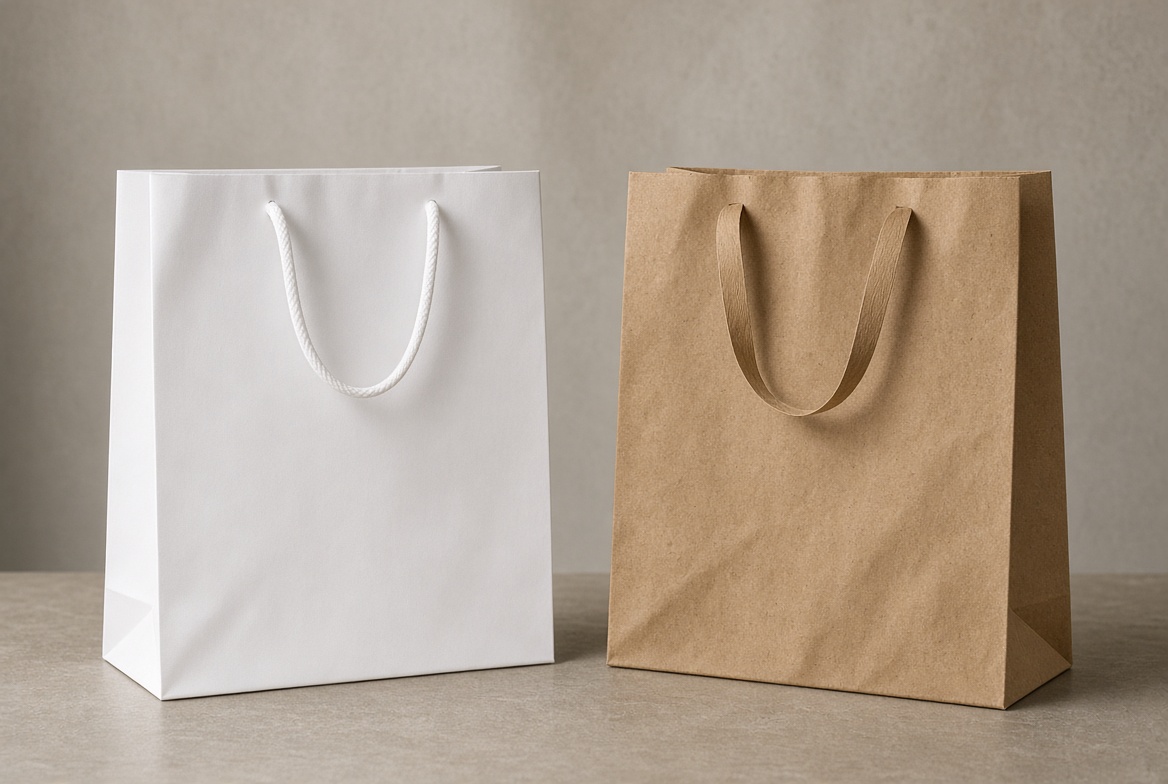
For a premium paper tote bag, the material is not simply a production choice. It shapes how customers perceive your brand before they see the product inside. In the comparison of white card paper vs kraft paper for premium tote bags, white card paper typically delivers sharper colour reproduction and a refined retail feel, while kraft paper communicates natural texture, strength, and a more understated environmental story.
At Shenzhen XingKun Packing Products Co., Ltd., we have spent more than 20 years producing custom printed packaging for brands and distributors in over 30 countries and regions. From boutique shopping bags to promotional event carriers and product-launch packaging, one lesson remains consistent: the best paper is the one that matches the brand experience, product weight, print design, distribution route, and end-of-life requirements.
Quick Answer: White Card Paper or Kraft Paper?
Choose white card paper tote bags when your priority is premium visual presentation, detailed artwork, vibrant brand colours, or luxury retail positioning.
Choose kraft paper tote bags when you want a tactile, natural appearance, dependable carrying performance, a simpler print style, or an environmentally conscious brand expression.
Neither material is automatically "better." A premium tote bag succeeds when its material, printing process, handle construction, and intended use work together.
| Factor | White Card Paper Tote Bags | Kraft Paper Tote Bags |
| Surface appearance | Bright, clean, smooth, polished | Natural, textured, warm, organic |
| Print performance | Excellent for detailed graphics and colour accuracy | Best for bold logos, limited colours, and minimalist artwork |
| Brand positioning | Luxury, beauty, fashion, gifts, technology | Organic, handmade, food, lifestyle, outdoor, eco-led retail |
| Colour background | White base gives colours strong visual contrast | Brown base changes the appearance of printed colours |
| Perceived value | High-end and presentation-focused | Authentic, practical, craft-oriented |
| Moisture response | Depends on paper grade and finishing | Depends on paper grade and finishing |
| Recyclability considerations | Strong when designed with compatible inks and finishes | Strong when uncoated and kept structurally simple |
| Typical design direction | Full-colour print, foil stamping, embossing, spot effects | One- or two-colour printing, debossing, natural fibre visibility |
What Is White Card Paper for Tote Bags?
White card paper is a stiff, high-quality paperboard with a bright white surface. In premium tote bag production, it is often selected because it provides a smooth printing foundation and a clean canvas for brand colours, photography, fine typography, and decorative finishing.
Depending on the project, buyers may refer to materials such as white card, white board, ivory board, or solid bleached paperboard. The exact grade should always be confirmed during sampling because paper naming can differ by market and supplier.
For premium branded shopping bags, white card paper is particularly effective when the artwork includes:
- Fine serif or script typography
- Small product details and ingredient information
- Full-colour illustrations or photography
- Pale shades, gradients, and skin-tone-sensitive visuals
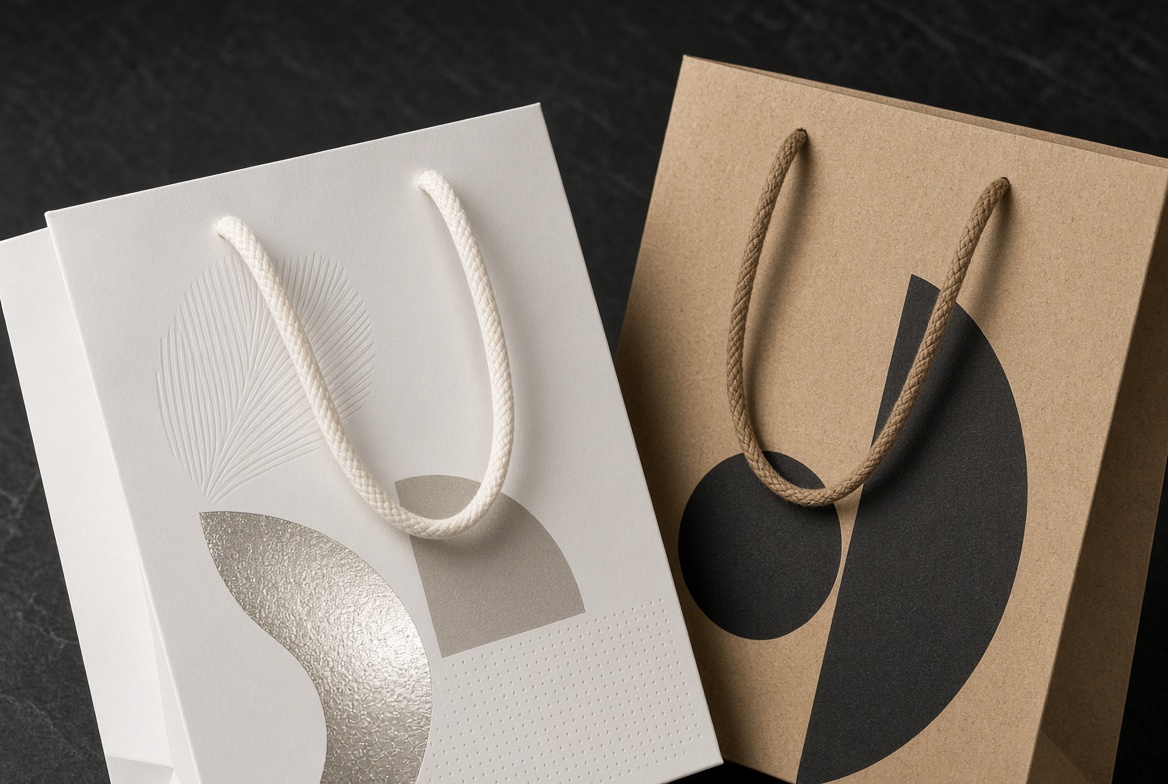
- Metallic foil, spot UV, embossing, or debossing
- Large areas of white as part of the brand identity
A white surface allows ink colours to appear closer to their intended artwork values. This matters for beauty, jewellery, fragrance, apparel, gifting, and consumer-electronics brands, where packaging consistency is part of the buying experience.
Why White Card Paper Looks More Premium
The premium effect comes from control. White card paper usually has a more uniform surface, which supports sharper lines and more predictable ink coverage. When combined with matte lamination, soft-touch film, foil stamping, or embossed logos, it can create a highly deliberate luxury finish.
For example, a skincare brand using a pale beige logo and a thin gold border may struggle to achieve the same clean result on natural brown kraft. On white card paper, those quiet design elements remain visible and elegant.
However, premium does not mean excessive. A heavy board, a reinforced folded top, neat cotton rope handles, and one well-executed foil detail can often feel more sophisticated than an over-designed bag with multiple competing effects.
What Is Kraft Paper for Tote Bags?
Kraft paper is known for its visible fibre texture and natural brown appearance. It is widely used for retail bags, takeaway packaging, gift bags, apparel carriers, and promotional tote bags because it combines a practical look with good structural performance.
The word "kraft" comes from the German word for strength. In practical tote bag sourcing, though, the buyer should not assume that every kraft grade performs the same way. Paper strength depends on factors including basis weight, fibre composition, machine direction, bag construction, handle attachment, glue quality, and whether the bag will face humidity or repeated use.
Kraft paper tote bags are often chosen by brands that want to appear approachable, responsible, handmade, local, or nature-oriented. The material itself becomes part of the graphic design.
Why Kraft Paper Feels Authentic
Kraft paper has a visual honesty that many brands value. Its natural base colour and fibre texture make a bag feel less manufactured and more grounded. A simple black logo, dark green illustration, or white ink print can create a memorable premium result without needing a complex finish.
Kraft paper works especially well for:
- Organic food and beverage brands
- Coffee roasters and bakeries
- Natural skincare and wellness products
- Handmade gifts and craft retailers
- Outdoor and lifestyle brands
- Subscription boxes and direct-to-consumer fulfilment
- Sustainable event packs and conference materials
The key is to let the material support the story. A minimalist design usually performs better than artwork designed as if it were printed on a bright white surface.
White Card Paper vs Kraft Paper: Print Quality
Print quality is one of the clearest differences between white card paper and kraft paper for premium tote bags.
White card paper creates a brighter and more neutral printing base. It is usually the stronger option for multi-colour printing, fine images, high-detail logos, and accurate colour matching. If your visual identity relies on a specific Pantone shade or detailed visual assets, white card paper offers greater control.
Kraft paper has a brown or natural base, so colours interact with the substrate. A yellow ink can appear warmer or darker. Pale blue may lose brightness. Fine details may also be less prominent because of the paper texture.
This does not make kraft printing inferior. It simply requires a different design approach.
| Printing Requirement | Better Material Choice | Why |
| Full-colour product photography | White card paper | White base supports more accurate image reproduction |
| Detailed illustrations | White card paper | Smooth surface helps preserve fine lines |
| Light or pastel brand colours | White card paper | Colours remain brighter and more consistent |
| Black logo and simple typography | Kraft paper | Strong contrast and natural visual appeal |
| One- or two-colour graphics | Kraft paper | Cost-effective and aligned with the material character |
| White ink logo on brown bag | Kraft paper | Creates high contrast with a natural premium look |
| Foil stamping and embossing | White card paper | Smooth surface enhances fine decorative details |
Before mass production, request a physical printed sample. Digital artwork alone cannot show how ink will absorb, how foil will reflect, or how a rope handle colour will look against the final paper.
Strength, Load Capacity, and Bag Construction
Paper selection should never be separated from engineering. A visually premium bag that tears at the handle or collapses under the product weight damages brand trust immediately.
For both white card paper and kraft paper tote bags, carrying performance depends on the full structure:
- Paper basis weight and fibre quality
- Bag width, gusset depth, and bottom construction
- Folded top reinforcement
- Bottom card or base reinforcement
- Handle type and attachment method
- Glue performance
- Product weight and shape
- Warehousing and transport humidity
Testing should be built into the development process. Industry test methods measure properties such as bursting strength, tensile strength, stretch, and stiffness. For example, TAPPI T 403 provides a recognised method for measuring the bursting strength of paper products within a defined range. This is useful for quality discussions, but a finished tote bag should also be tested under realistic loading conditions.
A Practical Load-Test Method
For a retail tote bag project, we recommend testing the finished bag rather than relying only on paper specifications.
1. Place the actual product, or an equivalent weight and shape, inside the bag.
2. Hold the bag by its handles for several minutes.
3. Repeat the lift-and-lower movement multiple times.
4. Check handle holes, knots, pasted areas, folded top, and bottom seams.
5. Test after the bag has been stored in conditions similar to its shipping or retail environment.
6. Approve production only after the sample passes visual and functional checks.
For heavier items, reinforced folded tops, strong paper rope handles, ribbon handles with internal reinforcement, or cotton rope handles may be appropriate. The best solution depends on your brand style and required load capacity.
Sustainability: Look Beyond the Paper Colour
A brown kraft bag may look more natural, but colour alone does not confirm a responsible material choice. Likewise, a white card paper tote bag can support a strong sourcing story when it uses responsibly sourced fibre and is designed for practical recovery.
The Forest Stewardship Council identifies its label as a way for paper and packaging companies to demonstrate responsible forest-management credentials. If a brand plans to make a sourcing claim, material traceability and approved label use should be verified before artwork is finalised.
The most useful question is not "Is this bag eco-friendly?" It is: What happens to this specific bag after use?
A bag's recovery potential can be affected by:
- Plastic lamination or heavy film layers
- Metallic laminates
- High levels of non-paper decoration
- Water-resistant or grease-resistant coatings
- Adhesives, handle materials, and metal eyelets
- Local collection and recycling infrastructure
European design guidance notes that coatings and barriers can make recycling more difficult, while combinations that support higher secondary-material yield are preferable. It also sets a high-compatibility benchmark at 95% or more recyclability performance in the relevant framework.
For brands prioritising a simple end-of-life path, an uncoated or lightly finished paper tote bag with water-based inks and minimal mixed materials is often easier to explain and dispose of than a heavily laminated luxury bag.
Cost Factors That Affect Your Tote Bag Quote
Material cost matters, but it is only one part of the total project cost. Buyers should compare complete specifications rather than comparing a single paper price.
A white card paper tote bag can cost more when it includes high-grade board, full-colour printing, lamination, foil, embossing, and premium rope handles. Kraft paper can be economical for simple printing, but pricing rises with heavier paper, white ink, special handles, custom sizes, and reinforcement.
Key cost variables include:
- Paper grade and basis weight
- Bag dimensions and gusset size
- Printing colours and coverage area
- Print method
- Surface finishing
- Handle material and attachment style
- Bottom board and top reinforcement
- Order quantity
- Packaging requirements
- Freight volume and destination
For premium bags, do not reduce cost by weakening the area customers touch most often: the handles, top fold, bottom structure, and print finish. These elements strongly influence perceived quality.
How to Choose the Right Material
Use this decision framework before requesting a quotation.
Choose White Card Paper When
- Your brand requires bright, exact, or pastel colours
- The bag contains photography or detailed artwork
- You sell luxury, gifting, cosmetics, fashion, or technology products
- You want embossing, debossing, foil stamping, or spot effects
- The bag is part of a high-value unboxing or retail presentation
- A clean white background is central to your brand identity
Choose Kraft Paper When
- Your brand story is natural, handmade, organic, or outdoors-oriented
- Your artwork is simple and high contrast
- You want the paper texture to remain visible
- You prefer a restrained, warm, and approachable look
- You want to avoid unnecessary decorative layers
- You need a practical retail bag that still feels considered
Consider a Hybrid Approach
Some brands do not need to choose only one visual direction. A white kraft or light natural paper can provide a softer alternative to bright white card stock. Another option is to use kraft paper for everyday retail bags and white card paper for seasonal launches, gift sets, VIP orders, or flagship-store packaging.
This approach helps manage budget while creating a clear packaging hierarchy.
Expert Advice Before Production
After two decades of producing printed packaging, our practical advice is simple: start with the product and customer moment, not with a paper name.
Ask these questions first:
- What product will the tote bag carry?
- What is the real maximum weight?
- Will customers reuse the bag?
- Is the bag for in-store presentation, events, delivery, or gifting?
- Does the design depend on precise colour reproduction?
- Is a natural paper texture part of the brand story?
- What finishes are essential, and which are only decorative?
- What sourcing and disposal claims can the brand substantiate?
A premium tote bag is successful when the customer can carry it confidently, recognise the brand instantly, and feel that the packaging belongs to the product.
Create Your Premium Tote Bag
White card paper and kraft paper can both create exceptional premium tote bags. The correct choice depends on the balance between visual impact, material character, structural needs, and responsible design choices.
Shenzhen XingKun Packing Products Co., Ltd. can help you compare paper options, refine your bag structure, develop print-ready artwork, and produce physical samples before bulk manufacturing. Send us your bag size, product weight, artwork, target quantity, and preferred handle style to receive a tailored recommendation and quotation.
FAQs
Is white card paper stronger than kraft paper for tote bags?
Not necessarily. Strength depends on the exact paper grade, basis weight, fibre structure, direction of the sheet, bag dimensions, reinforcement, handles, adhesives, and product weight. Kraft is often chosen for its robust character, but a well-engineered white card paper bag can also perform very well.
Can kraft paper tote bags print in full colour?
Yes, but colours will look different because the brown paper base affects ink appearance. For strong full-colour graphics, white card paper is usually the better choice. If kraft is essential, use bold artwork, darker colours, white ink, or a simplified palette.
Which paper tote bag is better for luxury brands?
White card paper is usually the preferred choice for traditional luxury packaging because it supports crisp artwork, bright colours, foil, embossing, and refined finishes. Kraft paper can also feel luxurious when the brand style is minimalist, artisanal, natural, or heritage-led.
Are laminated paper tote bags recyclable?
It depends on the laminate type, its location, the amount of non-paper material, local recycling systems, and the bag's overall construction. Coatings and laminations can complicate fibre recovery, so brands should evaluate finishes case by case rather than assuming all paper bags follow the same recovery path.
What is the best handle for a premium paper tote bag?
Cotton rope, paper rope, ribbon, and die-cut handles can all work well. Cotton rope is often chosen for a more upscale feel, paper rope suits natural and practical brand styles, and ribbon can support gift-oriented packaging. The right choice must also meet the bag's required load performance.
Should I use matte or glossy lamination?
Matte lamination generally creates a calm, sophisticated look and works well for fashion, beauty, and premium gift brands. Gloss lamination creates stronger colour intensity and shine. If recyclability is a priority, discuss lower-impact finishing options and test the complete bag structure before making claims.
What information should I provide for a tote bag quotation?
Provide the finished bag size, paper preference, estimated product weight, artwork format, print colours, quantity, handle type, finishing requirements, delivery country, and target delivery date. This allows the manufacturer to recommend the right construction rather than quoting only a basic bag.
References
1. Forest Stewardship Council. "[Packaging]." Information on FSC labels and responsible paper and packaging sourcing.
2. TAPPI. "[Bursting Strength of Paper, Test Method T 403 om-22]." Method for measuring paper bursting strength.
3. TAPPI. "[Tensile Breaking Properties of Paper and Paperboard]." Technical method covering tensile strength, stretch, tensile energy absorption, and tensile stiffness.
4. Council of the European Union. "[Packaging Recyclability Performance Grades]." Guidance addressing recyclable packaging performance, coatings, and barriers.
5. CEPI Eurokraft and Eurosac. "[Paper Sacks: Design for Recyclability Guidelines]." Guidance on fibre-based packaging design, coatings, and compatibility with recycling processes.
6. van der Velden, et al. "[Evaluation and Enhancement of Recyclability for Coated Packaging Papers]." Research on coatings, repulping, and paper packaging recyclability.


