Content Menu
● What Retail Buyers Look for Before Saying Yes
>> The five questions behind every retail pitch
● Build a Product That Is Easy to Sell
>> Define your product's retail proposition
>> Validate demand before approaching large retailers
● Make Packaging Retail-Ready From Day One
>> Design for the shelf and supply chain
>> Use display stands to improve in-store visibility
>> Check codes, dimensions, and carton information early
● Create a Buyer Pitch That Solves a Business Problem
>> Prepare a one-page sell sheet
>> Present a realistic financial case
>> Show that you understand the retailer
● Build Brand Demand Before the Meeting
>> Build trust through consistent customer experiences
● Build a Retail Launch Plan
>> Use a 90-day launch checklist
>> Prepare for operational compliance
● Turn Packaging Into a Retail Advantage
● FAQs
>> How do I market my product to retail buyers?
>> What should be included in a retail sell sheet?
>> Why is packaging important when selling to retailers?
>> Do I need a display stand for my retail product?
>> What proof of demand do retail buyers want to see?
>> How can a small brand prepare for a large retail order?
>> What are common reasons retailers reject a new product?
● References
Getting your product into retail stores is not only about having an original idea. Buyers need confidence that your product can sell, arrive correctly, look compelling on shelf, and scale without creating operational problems.
For emerging consumer brands, the path to major retailers starts long before the buyer meeting. You need a clear consumer proposition, evidence of demand, retail-ready packaging, dependable production capacity, and a concise story that explains why your product deserves limited shelf space.
At Shenzhen XingKun Packing Products Co., Ltd., we have worked with brands and distributors across more than 30 countries and regions for over 20 years. From custom packaging and printed marketing materials to retail display stands, we see a consistent pattern: products earn stronger retail opportunities when their packaging, display, and commercial preparation all support one clear reason to buy.

What Retail Buyers Look for Before Saying Yes
A retail buyer does not evaluate a product only as a consumer. They assess it as a commercial decision.
They need to understand whether the product fits their customers, supports their category strategy, can be replenished reliably, and creates enough profit to justify shelf space. Your job is to make these answers easy to see.
The five questions behind every retail pitch
Before contacting a retailer, prepare a direct answer to these questions:
1. Who will buy this product?
2. What problem, desire, or occasion does it serve?
3. Why will customers choose it instead of alternatives?
4. Why is this retailer the right channel for it?
5. Can your company deliver consistently at the required scale?
A buyer may like an innovative item and still decline it if the business case is unclear. A product that is difficult to explain, poorly packaged, incorrectly labelled, or operationally risky creates friction for the retailer.
Your presentation should therefore communicate two things at once:
- Consumer value: why shoppers will notice, understand, and purchase the product.
- Retail value: why the retailer can list, receive, merchandise, and reorder it with confidence.
Build a Product That Is Easy to Sell
Retail shelves are crowded. A product does not need to be entirely new to win attention, but it must be meaningfully differentiated for a specific shopper.
Differentiation can come from performance, materials, design, convenience, price architecture, bundling, sustainability, flavor, size, format, or brand identity. The strongest positioning is clear enough to explain in one sentence.
Define your product's retail proposition
Use this simple framework before developing your pitch:
> For [target shopper], our [product] helps them [solve a problem or achieve a desired outcome] because it offers [specific and credible difference].
For example:
> For busy office workers, our reusable lunch container helps simplify weekday meal preparation because its compartment system keeps hot and cold foods separated without requiring multiple containers.
This statement gives direction to your packaging, product photographs, display design, sales sheet, and buyer presentation.
Validate demand before approaching large retailers
Retailers want evidence that people will buy the product. Early traction reduces their perceived risk.
Useful forms of evidence include:
- Sales through your own website or marketplace storefront.
- Repeat-purchase data and customer reviews.
- Growth in independent stores or regional chains.
- Waitlists, pre-orders, or successful product tests.
- Customer surveys and product-use interviews.
- Social content with genuine engagement and saved posts.
- Trade-show conversations, distributor interest, or purchase commitments.
- Category data showing a relevant customer need or market opening.
Consumer and retail data can help brands understand product performance by market, pricing, distribution, and store environment. This type of evidence makes the buyer conversation more specific than simply claiming that a product is "popular."
Do not present vanity metrics as proof of retail demand. A large follower count is less persuasive than strong repeat sales, a high conversion rate, customer testimonials, or documented performance in a comparable retail environment.
Make Packaging Retail-Ready From Day One
Packaging is your product's silent salesperson. It must attract shoppers in seconds while also protecting the product through warehousing, transportation, receiving, and shelf replenishment.
For a retailer, packaging is not merely visual design. It is also a logistics tool, data carrier, and operational requirement.
Design for the shelf and supply chain
Effective retail packaging should do the following:
| Packaging role |
What buyers and shoppers need |
| Shelf communication |
A clear product name, key benefit, and easy-to-scan visual hierarchy |
| Brand recognition |
Consistent colors, typography, logo use, and product-family structure |
| Product protection |
Materials and construction suited to handling, transit, storage, and display |
| Scanning |
Correct, readable product identification codes in an approved position |
| Compliance |
Required labels, warnings, country-of-origin details, and category-specific information |
| Replenishment |
Case packs and outer cartons that help stores and distribution centers handle stock efficiently |
| Merchandising |
A format that sits, hangs, stacks, or displays properly in the intended retail environment |
A shopper should understand what the product is, who it is for, and why it matters within a few seconds. Avoid packaging that relies on a salesperson to explain the value.
For products with multiple variants, create a consistent system. The master brand should be easy to recognize, while colors, icons, or product descriptors should make each option easy to distinguish.
Use display stands to improve in-store visibility
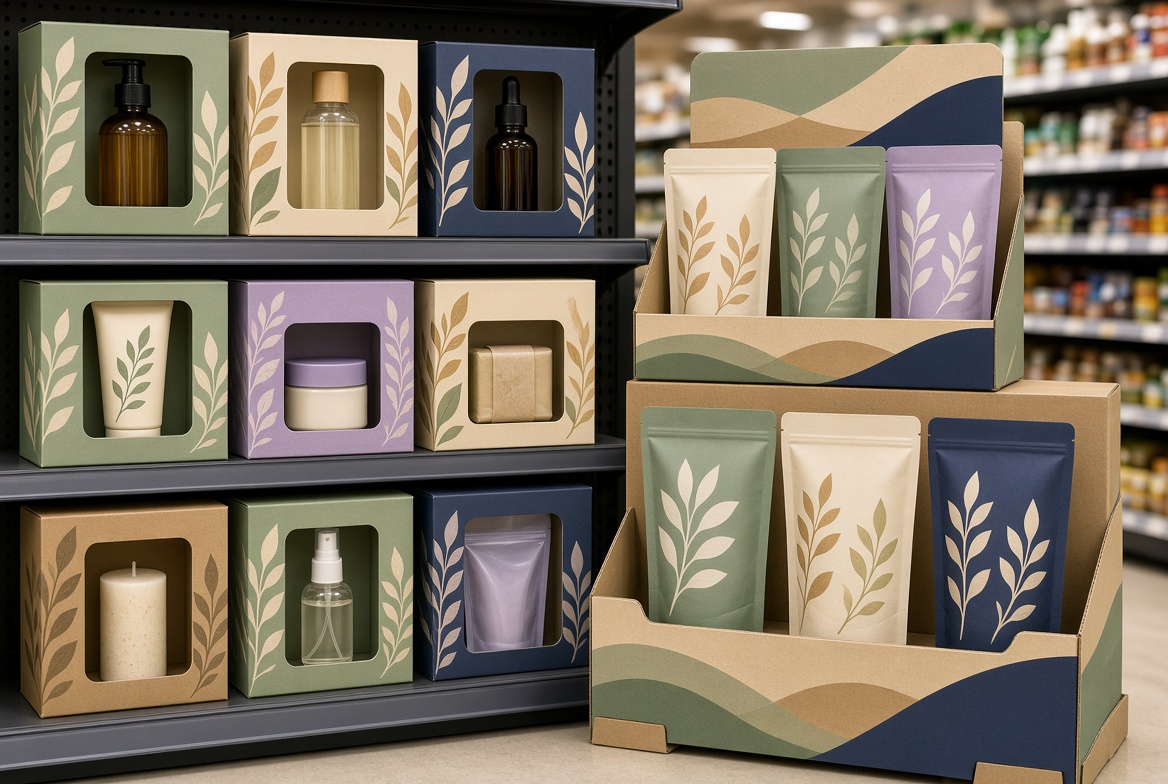
Even strong packaging can disappear when placed among similar products. Custom display stands create a focused brand zone and can support new-product launches, seasonal programs, promotional bundles, and high-margin impulse purchases.
A well-planned display stand can help you:
- Increase product visibility in crowded aisles.
- Present related items as a coordinated collection.
- Communicate benefits beyond the front of a small package.
- Encourage multi-item purchases through bundles or cross-selling.
- Improve brand recall through consistent graphics and structure.
- Give retailers a display solution that is easier to set up and maintain.
For example, a countertop display for a new personal-care range can present three product variants together, include a simple "choose your routine" message, and make trial-size items more visible near checkout. The display becomes part of the selling strategy, not simply a container for inventory.
Check codes, dimensions, and carton information early
Small technical errors can delay onboarding, create receiving problems, or lead to costly corrections after production begins.
Retail systems depend on accurate product and shipment data. Key preparation items usually include:
- A unique item code for each sellable product variation.
- Correct product dimensions and weights.
- Scannable barcode artwork with appropriate contrast and clear space.
- Accurate case-pack quantities.
- Outer-carton labels aligned with retailer instructions.
- Pallet plans that protect goods and fit warehouse requirements.
- Complete product data files matching the physical product.
GS1 guidance covers barcode requirements such as size, quality, placement, syntax, and human-readable information. Its retail guidance also explains that an item using a 2D code as its only barcode requires a 14-digit GTIN in human-readable form.
Build a final pre-production approval process that checks artwork, barcode placement, product dimensions, case-pack configuration, and shipping marks together. Treat these items as one retail-readiness system rather than separate tasks.
Create a Buyer Pitch That Solves a Business Problem
A buyer meeting is not a brand presentation alone. It is a decision-making meeting. Your materials should allow the buyer to quickly assess the opportunity.
Prepare a one-page sell sheet
A sell sheet is often the first document a buyer, distributor, or category manager reviews. Keep it focused, visual, and commercially useful.
Include:
- Brand name and logo.
- Product image on a clean background.
- Product name and short positioning statement.
- Top three consumer benefits.
- Target customer or use occasion.
- Product dimensions, case pack, and recommended retail price.
- Wholesale price or price range, where appropriate.
- Product identification details.
- Minimum order quantity and lead time.
- Available displays, packaging formats, or launch support.
- Proof of demand, such as sales performance, reviews, retail tests, or reorder data.
- Contact details and a direct next step.
Your sell sheet should answer the question: Why should this product earn a place in this retailer's assortment?
Present a realistic financial case
Retailers need margin, but they also need sell-through. Do not assume a lower price automatically creates a better retail opportunity.
Build your commercial plan around:
- Recommended retail price.
- Wholesale price.
- Retailer margin expectations.
- Promotional allowance or introductory offer.
- Freight and distribution costs.
- Display and merchandising costs.
- Product returns or damage assumptions.
- Payment terms.
- Production capacity and replenishment lead time.
Be honest about your minimum order requirements and production windows. Overpromising may win an initial order but can damage a long-term relationship if your team cannot deliver on time.
Show that you understand the retailer
Generic outreach is easy to ignore. Research the retailer before you pitch.
Look at:
- Their target shoppers.
- Price points within the category.
- Similar brands already listed.
- Store format and shelf space.
- Product assortment gaps.
- Promotional calendar.
- Sustainability or packaging priorities.
- Online merchandising approach.
- Regional versus national distribution potential.
A specialty retailer, club store, department store, home-improvement chain, and grocery retailer may all sell consumer goods, but they operate differently. Select the retailer whose customer base, price level, category strategy, and fulfillment expectations best match your product.
Build Brand Demand Before the Meeting
Buyers take more interest when they can see that customers already care about the brand.
Brand affinity is built when customers recognize your point of view, trust your product, and feel that the brand fits their needs or values. It is not created by one campaign. It is reinforced through every customer experience.
Build trust through consistent customer experiences
Focus on these areas:
- Clear brand voice: Use the same tone across packaging, product pages, email, social posts, and customer service.
- Useful content: Show product use, answer common questions, and solve customer problems.
- Responsive service: Reply quickly and handle product issues fairly.
- Honest proof: Use real reviews, product demonstrations, and verified performance claims.
- Community listening: Learn from feedback, comments, surveys, and product returns.
- Visual consistency: Make your website, packaging, display stands, and sales materials look like one brand.
Strong buyer-facing materials should reflect the same promise that customers see in the market. When your website, retail packaging, display program, and customer feedback all reinforce one message, the brand appears more established and easier to merchandise.
Build a Retail Launch Plan
The first order is only the beginning. A retailer wants to know how you will support the product after it reaches stores.
Use a 90-day launch checklist
| Timing |
Brand action |
Retail outcome |
| Before launch |
Finalize product data, packaging, codes, case packs, and display instructions |
Fewer receiving and setup problems |
| Weeks 1–2 |
Confirm store delivery, merchandising, and online product-page accuracy |
Better availability and product visibility |
| Weeks 3–6 |
Monitor sales, reviews, stock levels, and customer questions |
Faster response to weak sell-through signals |
| Weeks 7–12 |
Adjust messaging, promotional support, display placement, or assortment |
Stronger chance of reorder and expansion |
Keep a close record of inventory, sell-through, product feedback, and operational issues. Data-driven launch tracking helps brands refine their plan and communicate more effectively with retail partners.
Prepare for operational compliance
Retail readiness continues after a purchase order is issued. Retailers commonly require precise alignment between the ordered product, item data, labels, cartons, and shipment documents.
Industry guidance for first-time suppliers highlights several recurring areas: valid product identifiers, accurate dimensions and weights, compliant carton labels, approved case packs, shelf-ready packaging, origin disclosures, pallet compatibility, and complete item data. Errors in these areas can create receiving delays, inventory mismatches, rejected shipments, or chargebacks.
Create an internal owner for every operational step. One person should be accountable for artwork approval, another for product data, another for production quality, and another for shipping documentation. Clear ownership helps prevent a small error from affecting a major retail launch.

Turn Packaging Into a Retail Advantage
The brands most likely to win retail opportunities are not necessarily the ones with the loudest pitch. They are the ones that make the buyer's decision easier.
Your product should be differentiated. Your packaging should communicate fast. Your display should improve visibility. Your product data and logistics should be accurate. Your pitch should show evidence of demand and a credible plan for growth.
Shenzhen XingKun Packing Products Co., Ltd. helps brands turn product concepts into practical retail presentation systems. With more than 20 years of printing and packaging manufacturing experience, we produce custom display stands, printed packaging, and branded retail materials for customers serving markets worldwide.
Contact our team to discuss your retail packaging or display project. Share your product size, target retail channel, quantity, packaging concept, and desired delivery timeline, and we can help you evaluate a practical production solution.
FAQs
How do I market my product to retail buyers?
Start with a focused product proposition, evidence of customer demand, a clear sell sheet, retail-ready packaging, realistic pricing, and reliable fulfillment information. Tailor every pitch to the retailer's target shoppers and category strategy.
What should be included in a retail sell sheet?
Include a product image, brand story, top benefits, retail price, wholesale details, product dimensions, case pack, lead time, product identification information, proof of demand, and contact details. Keep it easy to scan in one page.
Why is packaging important when selling to retailers?
Packaging affects both customer conversion and retailer operations. It must explain the product clearly, protect it during distribution, carry accurate product information, scan correctly, and fit the store's merchandising requirements.
Do I need a display stand for my retail product?
Not every product requires a display stand, but displays are especially useful for new launches, impulse items, small products, seasonal promotions, bundled collections, and products that need stronger visibility in a busy retail environment.
What proof of demand do retail buyers want to see?
Buyers may consider sales history, reorder rates, customer reviews, online conversion, independent-store performance, marketplace results, survey findings, pre-orders, and category data. The more directly the evidence relates to the retailer's customer, the more valuable it becomes.
How can a small brand prepare for a large retail order?
Confirm production capacity, raw-material availability, quality controls, packaging specifications, item codes, case packs, pallet plans, lead times, shipping procedures, and cash-flow requirements before accepting a large purchase order.
What are common reasons retailers reject a new product?
Common reasons include unclear differentiation, weak demand evidence, unsuitable pricing, poor packaging, incomplete product data, barcode problems, unreliable fulfillment, insufficient margin, and a poor match between the product and the retailer's shoppers.
References
1. [Creative Displays Now — Chapter 2: How to Market Your Product to Retailers]
2. [GS1 — 2D Barcodes at Retail Point of Sale Implementation Guideline]
3. [NielsenIQ — How to Successfully Launch New Products With Data]
4. [NielsenIQ Marketing Data — Kilts Center, Chicago Booth]
5. [SPS Commerce — Retail-Ready Product Requirements for First-Time Suppliers]


