Content Menu
● What Is Spot UV on Luxury Shopping Bags?
>> How Spot UV Creates a Premium Effect
>> Best Materials for Spot UV Bags
● What Is Foil Stamping on Luxury Shopping Bags?
>> Why Foil Stamping Feels Luxurious
>> Foil Stamping Options for Paper Bags
● Spot UV vs Foil Stamping: Key Differences
>> The Fastest Decision Rule
● Which Finish Fits Your Brand Positioning?
>> Choose Spot UV for Modern Luxury
>> Choose Foil Stamping for Immediate Recognition
● Paper, Artwork, and Bag Construction Considerations
>> Paper Stock Matters
>> Artwork Preparation Checklist
● Cost, MOQ, and Production Planning
>> Budget Questions to Ask Before Ordering
● Combining Spot UV and Foil Stamping
● Sustainability and End-of-Life Decisions
● Conclusion
● FAQ
>> 1. Is Spot UV more expensive than foil stamping on shopping bags?
>> 2. Can Spot UV be applied directly to kraft paper bags?
>> 3. Does foil stamping crack when a paper bag is folded?
>> 4. Which foil colour looks most luxurious?
>> 5. Can I use foil stamping and Spot UV on the same bag?
>> 6. Is foil stamping suitable for small text?
>> 7. Which finish is better for a black luxury shopping bag?
● References
Luxury shopping bags do more than carry a purchase. They create a physical brand moment that customers see, touch, photograph, and remember. When comparing Spot UV vs foil stamping on luxury shopping bags, the best choice depends on your brand's visual identity, paper stock, order quantity, budget, and the experience you want to deliver at the point of sale.
At Shenzhen XingKun Packing Products Co., Ltd., our team has spent more than 20 years producing printed packaging for brands and distributors across over 30 countries and regions. From experience, a finish that looks impressive in a digital mock-up can behave very differently once it is applied to textured paper, folded into a bag gusset, or viewed under retail lighting. The practical details matter.
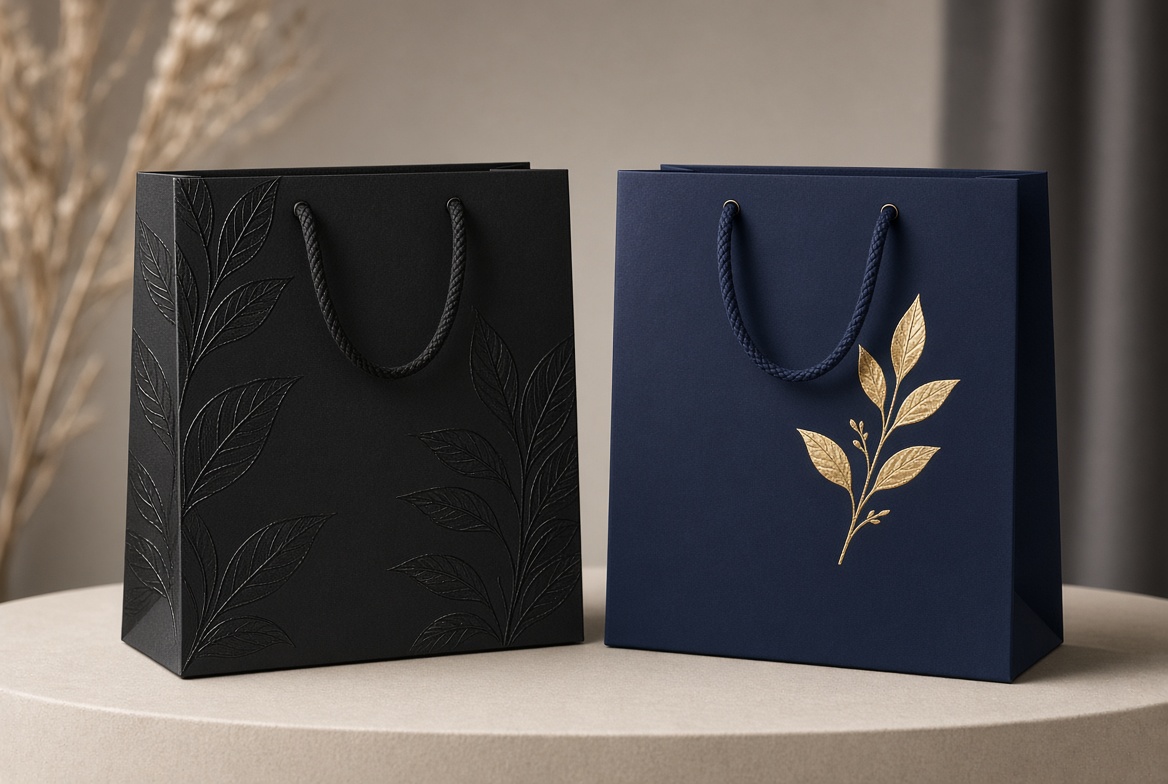
What Is Spot UV on Luxury Shopping Bags?
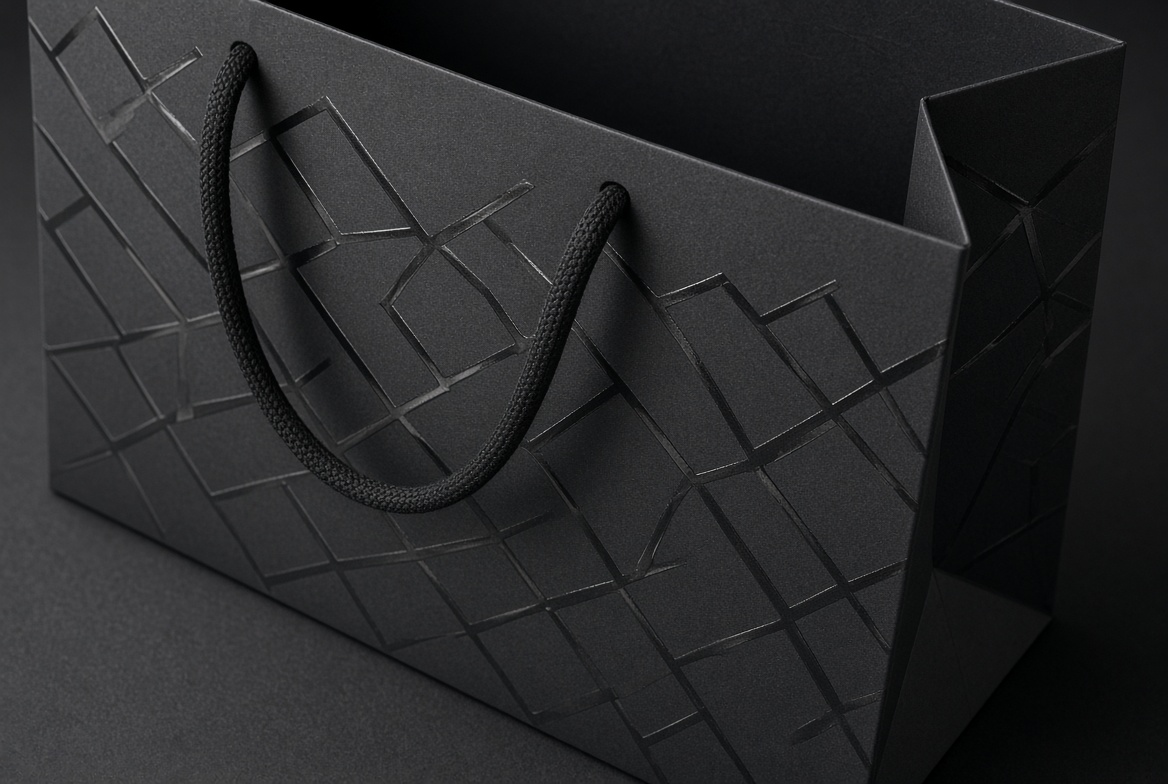
Spot UV is a clear, high-gloss coating applied only to selected parts of a printed design, such as a logo, pattern, product illustration, or headline. It is cured with ultraviolet light, creating a glossy visual contrast against the surrounding paper surface.
On a luxury paper bag, Spot UV is often paired with a matte laminated surface. The matte background absorbs light, while the coated area reflects it. This contrast makes brand elements appear sharper, richer, and more tactile without changing the printed colour palette.
How Spot UV Creates a Premium Effect
Spot UV is transparent. It does not add metallic colour. Instead, it makes existing printed elements visually stronger through gloss, depth, and reflected light.
Common applications include:
- A glossy logo on a matte black shopping bag
- A clear floral or geometric pattern over a solid colour background
- Highlighted product names, monograms, or brand icons
- Glossy details on photography or illustration
- Raised-looking graphical elements created with thick UV coating
For brands seeking a refined, understated luxury look, Spot UV can be more effective than a highly reflective finish. It rewards close viewing and physical interaction rather than demanding attention from across the store.
Best Materials for Spot UV Bags
Spot UV performs best on smooth, stable surfaces, especially:
- Matte laminated art paper
- Coated paperboard
- Smooth specialty papers
- Black, navy, charcoal, and deep-coloured printed bags
- White bags with clean, minimal graphics
It is less predictable on highly textured, uncoated, fibrous, or uneven kraft papers. The coating may still be applied, but the gloss can appear inconsistent because the underlying texture interrupts the reflected light.
What Is Foil Stamping on Luxury Shopping Bags?
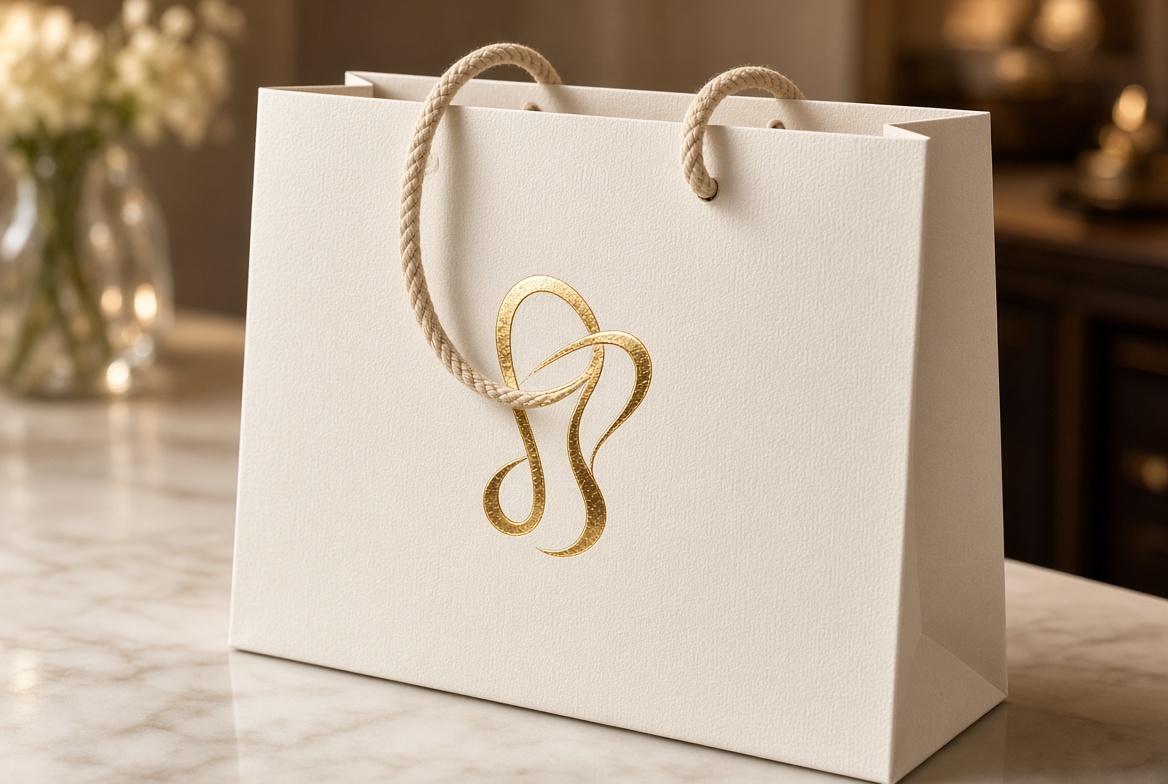
Foil stamping uses a heated metal die, pressure, and decorative foil to transfer a design onto the bag surface. Metallic gold and silver are the best-known options, but foil can also be matte, holographic, coloured, pearlescent, or pigment-based.
Unlike Spot UV, foil stamping adds a visible material layer. It creates a crisp, reflective, high-contrast design that immediately signals ceremony, exclusivity, and premium positioning.
The basic production process involves creating a custom die, positioning foil between the die and paper, then using controlled heat and pressure to bond the foil to the selected design area.
Why Foil Stamping Feels Luxurious
Foil is particularly effective because it behaves differently under changing light. A gold logo may appear bright in direct lighting, deep and warm in shadow, and highly visible in product photography.
This makes foil stamping a strong choice for:
- Premium fashion shopping bags
- Jewellery and watch packaging
- Fragrance and cosmetics bags
- Gift bags for seasonal launches
- Boutique retail packaging
- VIP event bags and limited-edition collections
A small foil logo can often create more perceived value than a large full-colour graphic. The effect comes from restraint: generous empty space, quality paper, sharp typography, and precise registration.
Foil Stamping Options for Paper Bags
Luxury bag projects can use multiple foil styles:
| Foil type | Visual character | Best for |
| Metallic gold | Warm, classic, prestigious | Fashion, cosmetics, gifting |
| Metallic silver | Clean, modern, cool-toned | Technology, skincare, jewellery |
| Matte gold or silver | Soft, understated, editorial | Minimalist premium brands |
| Coloured foil | Bold and brand-specific | Youthful beauty, lifestyle, seasonal collections |
| Holographic foil | High-energy, light-reactive | Limited editions, events, trend-led products |
| Pigment foil | Opaque, non-metallic colour | Fine text, darker stocks, special colour matching |
Spot UV vs Foil Stamping: Key Differences
Both finishes elevate custom luxury shopping bags, but they communicate different brand personalities.
| Factor | Spot UV | Foil Stamping |
| Main visual effect | Transparent gloss contrast | Metallic or pigmented decorative detail |
| Brand mood | Modern, subtle, tactile | Prestigious, celebratory, eye-catching |
| Colour impact | Enhances printed colours already present | Adds a new reflective or opaque foil colour |
| Best background | Matte laminated or smooth coated surface | Coated, uncoated, textured, or specialty paper depending on testing |
| Fine-detail performance | Good, but small details need sufficient coating area | Excellent with well-prepared vector artwork and suitable die detail |
| Setup requirement | Requires a dedicated coating mask and production setup | Requires a custom metal die and foil setup |
| Photography impact | Visible mainly through light angle and close-up detail | Highly visible under retail and campaign lighting |
| Tactile feel | Smooth to slightly raised, depending on coating thickness | Can be flat, lightly textured, or combined with embossing |
| Ideal logo style | Large logos, patterns, filled shapes | Fine typography, line art, compact logos, monograms |
| Premium message | "Sophisticated and contemporary" | "Exclusive and elevated" |
The Fastest Decision Rule
Choose Spot UV when your bag relies on a matte-versus-gloss contrast, tonal artwork, or a polished minimalist identity.
Choose foil stamping when you want the logo to be immediately visible, highly decorative, and strongly associated with luxury or gifting.
Choose a combined finish when the bag is a flagship retail asset, launch package, VIP gift bag, or high-value seasonal piece.
Which Finish Fits Your Brand Positioning?
The right finish should support brand recognition, not compete with it.
Choose Spot UV for Modern Luxury
Spot UV is an excellent fit when your design already has strong printed colour, typography, or imagery. It adds dimension without introducing another colour or material.
It works especially well for:
- Clean skincare and wellness brands
- Contemporary fashion labels
- Premium tech accessories
- Minimal black-and-white identity systems
- Brands using subtle patterns and tone-on-tone graphics
- Retail bags where customers are expected to touch and reuse the packaging
For example, a dark green matte bag with a glossy repeating botanical pattern can feel luxurious without using a single metallic element. The logo may remain simple and quiet, while the pattern becomes visible only when the customer changes the viewing angle.
Choose Foil Stamping for Immediate Recognition
Foil stamping is ideal when your logo needs to stand out quickly at a checkout counter, in a gift presentation, or in a social-media unboxing video.
Use foil when your visual language includes:
- Gold, silver, bronze, or metallic brand colours
- Fine serif typography
- Monograms and emblems
- Formal or heritage-led design
- Premium gifting cues
- A small logo positioned in the centre of a spacious bag face
A metallic foil logo is especially effective on black, white, deep navy, burgundy, forest green, and textured neutral papers. However, the exact effect changes by paper. A bright gold foil on smooth black lamination looks polished and modern; the same foil on textured ivory paper can feel more artisanal and heritage-focused.
Paper, Artwork, and Bag Construction Considerations
A premium finish is only as good as the substrate beneath it. Before choosing Spot UV or foil stamping, evaluate the whole bag specification.
Paper Stock Matters
Paper affects colour, adhesion, texture, and visual impact.
- Coated art paper provides smooth graphics and high detail.
- Matte laminated paper is the most popular base for Spot UV because it creates clear gloss contrast.
- Uncoated specialty paper can make foil feel more tactile and crafted.
- Kraft paper supports natural brand positioning, though fine foil and UV details should be tested carefully.
- Recycled paper may include visible fibres or colour variation, which should be treated as part of the intended design character.
When sourcing paper bags in bulk, evaluate paper material, certification, coatings, laminations, handles, and other components as part of the bag's end-of-life plan.
Artwork Preparation Checklist
Production-ready artwork reduces delays, waste, and inconsistent finishing.
1. Supply foil stamping and Spot UV artwork on separate, clearly named layers.
2. Use solid vector shapes for foil whenever possible.
3. Avoid gradients, transparency, and photographic images in foil artwork.
4. Create a dedicated Spot UV mask using solid, clearly defined areas.
5. Keep critical foil or UV details away from fold lines, gussets, handle holes, and edge creases.
6. Allow adequate line thickness and spacing for the selected finish.
7. Request a physical pre-production sample for high-value projects.
Foil artwork should be supplied as clear vector shapes, while gradients and transparency should be avoided in foil areas. For Spot UV, a separate mask layer helps the printer apply the coating accurately to intended elements.
Cost, MOQ, and Production Planning
Foil stamping usually involves a higher initial setup cost because a custom metal die must be created. This cost becomes more economical as volume rises, particularly for long-running retail bag programs.
Spot UV can also require dedicated setup, screens, or masks, but it is often a practical way to add premium contrast to bags that already use full-colour printing and matte lamination.
Budget Questions to Ask Before Ordering
Ask your packaging supplier:
- Is the quoted price based on one foil colour or multiple foil colours?
- Is the foil die included, reusable, and stored for future orders?
- Does the Spot UV area affect production speed or rejection rates?
- Will the bag have matte or gloss lamination?
- Are there artwork limitations for fine lines, small type, or large solid areas?
- Is sampling available before mass production?
- Can the supplier test the finish on the exact paper stock and bag structure?
The lowest unit price is not always the lowest total cost. A weak finish, poor registration, or cracked foil at a fold line can damage the perceived quality of every bag in a retail campaign.
Combining Spot UV and Foil Stamping
For premium launches, combining Spot UV and foil stamping can create a layered result that neither technique achieves alone.
A practical layout might include:
- Matte black laminated bag
- Gold foil logo in the centre
- Spot UV pattern across the lower section
- Cotton rope handles
- Reinforced cardboard bottom insert
The foil provides immediate logo recognition. The Spot UV pattern creates a second discovery moment when the customer touches or tilts the bag. This layered approach is particularly effective for luxury fashion, beauty sets, jewellery, wine gifts, and corporate presentation packaging.
The key is discipline. Too much foil, gloss, colour, and texture can make a luxury bag look busy rather than premium. Use one dominant focal point and one supporting decorative feature.
Sustainability and End-of-Life Decisions
Luxury packaging must balance appearance with practical material choices. Recycling outcomes vary by region, local collection systems, and the total bag construction—not just the finish.
Some paper recycling processes can separate thin coatings, inks, adhesives, and foil residues during pulping and screening, while recovering usable paper fibres. However, brands should not make broad recycling claims without confirming local infrastructure and the complete bag specification.
For more responsible luxury shopping bag development:
- Choose responsibly sourced or recycled paper where appropriate.
- Avoid unnecessary mixed materials.
- Keep foil coverage targeted rather than excessive.
- Use durable bag construction that encourages reuse.
- Ask for material specifications and recycling guidance for your target market.
- Review handle material, lamination, reinforcement boards, and adhesives together.
The most sustainable luxury bag is often one that customers keep and reuse. A durable construction, timeless design, and restrained premium finish can extend the bag's useful life beyond the original purchase.
Conclusion
Spot UV and foil stamping are not competing solutions in every project. They are different tools for creating luxury perception.
Spot UV is best for modern, tactile, understated bags with strong matte-and-gloss contrast. Foil stamping is best for brands that need a bright, prestigious, instantly recognisable logo or decorative detail. For high-value retail and campaign packaging, combining both can create an exceptional unboxing and carry experience.
Shenzhen XingKun Packing Products Co., Ltd. can help you evaluate paper stock, bag structure, logo size, finish compatibility, and production requirements before bulk manufacturing. Share your artwork, target quantity, preferred bag dimensions, and reference style to develop a luxury shopping bag that looks as strong in the customer's hand as it does in your brand presentation.
FAQ
1. Is Spot UV more expensive than foil stamping on shopping bags?
The answer depends on the design, quantity, paper, and setup requirements. Foil stamping often has a higher initial cost because it requires a custom die, while Spot UV may be more economical for larger highlighted areas. Request quotes based on the same bag size, paper, finish, and order volume for an accurate comparison.
2. Can Spot UV be applied directly to kraft paper bags?
It can be applied, but the final gloss effect may be less uniform on rough or porous kraft surfaces. Test samples are recommended, especially for fine logos, thin lines, and large coated areas.
3. Does foil stamping crack when a paper bag is folded?
It can crack if the foil crosses a sharp fold, if the paper is unsuitable, or if the finishing process is not properly controlled. Keep critical foil artwork away from fold lines and request physical samples before full production.
4. Which foil colour looks most luxurious?
Gold remains a classic choice for fashion, beauty, and gifting. Silver often suits contemporary, technical, or minimalist brands. The most luxurious option is the one that supports your existing brand colours and works well with the selected paper.
5. Can I use foil stamping and Spot UV on the same bag?
Yes. Foil stamping can highlight the logo, while Spot UV can enhance patterns, illustrations, or secondary graphics. Combined finishing works best when the design has a clear visual hierarchy.
6. Is foil stamping suitable for small text?
Foil stamping can reproduce fine typography well when the artwork is supplied in vector format and the type size, line thickness, and spacing meet production requirements. Very small text should always be checked through a proof or sample.
7. Which finish is better for a black luxury shopping bag?
Both work well. Spot UV creates a subtle black-on-black gloss effect, while gold or silver foil creates stronger visibility. Choose Spot UV for quiet sophistication and foil for a more immediate premium statement.
References
- [GentlePK: Spot UV Printing—How It Enhances the Look of Premium Packaging]
- [Gentlever: What Is Spot UV for Custom Packaging?]
- [Gentlever: What Is Foil Stamping? Hot Foil Guide for Luxury Boxes]
- [Black Line Packaging: What Is Foil Stamping? Types, Uses and Materials Explained]
- [Epack Printing: Paper Bag Properties to Check Before Bulk Ordering]
- [Epack Printing: The Ultimate Guide to Foil Stamping Printing]
- [BoxesGen: What Is Spot UV?]
- [Aura Print: Sustainable Packaging—Essential Guide for a Greener Future]


