Content Menu
● How to Choose Jewelry Packaging for Your Sales Channel
● Match Custom Jewelry Boxes to Each Product
>> Ring Boxes: Check the Setting, Not Just the Band
>> Necklace Boxes: Control the Chain and Pendant Separately
>> Earring Boxes: Protect Posts and Separate Pairs
>> Bracelet and Watch Boxes: Support Without Strain
● Jewelry Packaging Materials: Compare Structure and Contact Surfaces
>> Outer Box Materials
>> Jewelry Box Inserts and Linings
● Prevent Tarnishing: A Material Compatibility Checklist
● Design Luxury Jewelry Packaging Around a Clear Visual Hierarchy
>> Choose Finishes With a Purpose
>> Make Opening and Repacking Easy
● Test the Complete Jewelry Shipping Package
>> Validate the Whole Packaging System
>> Create a Practical Acceptance Checklist
● Sustainable Jewelry Packaging: Make Specific, Defensible Choices
>> Separate Recycled Content From Recyclability
>> Reduce Complexity Without Reducing Protection
● Compare Total Packaging Cost, Not Just Unit Price
● From Packaging Brief to Production Approval
>> Step 1: Share Product and Distribution Details
>> Step 2: Approve Structure Before Decoration
>> Step 3: Review the Decorated Sample
>> Step 4: Agree on Quality Checks
● Build Jewelry Packaging Around Your Product
● Frequently Asked Questions
>> What Is the Best Packaging for Jewelry?
>> Are Rigid Jewelry Boxes Suitable for Shipping?
>> What Is the Best Lining for a Silver Jewelry Box?
>> How Do I Choose the Right Jewelry Box Size?
>> Can Jewelry Packaging Be Both Premium and Recyclable?
>> What Should I Send a Custom Jewelry Packaging Manufacturer?
● References
Jewelry packaging should do more than make a beautiful first impression. It should hold each piece securely, support your brand positioning, and arrive in a condition that reflects the care behind your products. This jewelry packaging guide explains how to choose custom jewelry boxes, protective inserts, materials, and finishes for retail, gifting, and online orders.
At Shenzhen XingKun Packing Products Co., Ltd., we bring more than 20 years of printing and packaging manufacturing experience to projects for brands and distributors across more than 30 countries and regions.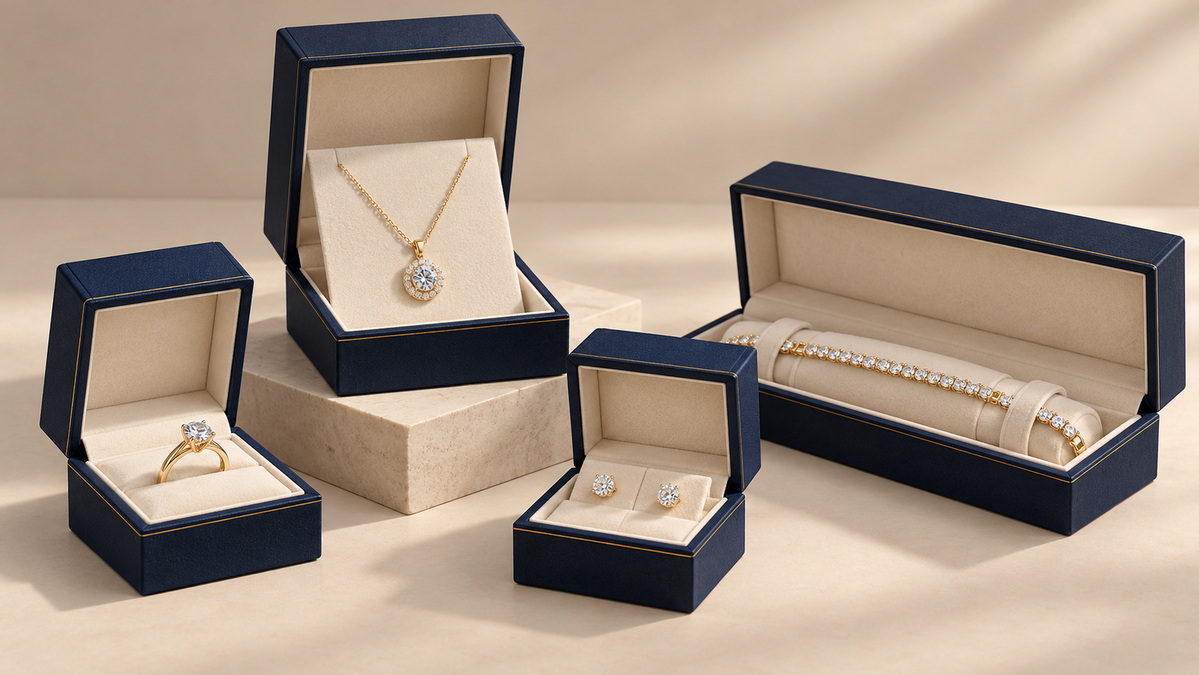
How to Choose Jewelry Packaging for Your Sales Channel
Start with how customers receive your jewelry—not simply which box looks most attractive.
A boutique purchase, an international parcel, and a wholesale shipment place different demands on packaging. Define those demands before selecting materials or requesting quotations.
| Sales channel | Main packaging priority | Practical starting point |
| Boutique retail | Presentation and easy handling | Rigid presentation box with a fitted insert |
| Direct-to-consumer shipping | Product restraint and transit protection | Presentation packaging inside a protective shipping box |
| Gift collections | Coordinated presentation | Matching boxes, message cards, and optional sleeves |
| Wholesale distribution | Consistent identification and efficient packing | Standardized boxes with protective master cartons |
| Lightweight accessories | Compactness and organization | Jewelry cards or pouches with suitable outer protection |
These are starting points rather than fixed rules. A delicate necklace may need more movement control than a heavier bracelet, regardless of selling price.
Match Custom Jewelry Boxes to Each Product
Ring Boxes: Check the Setting, Not Just the Band
A ring insert should hold the band without pressing against the stone, prongs, or decorative setting.
Measure the full ring profile, including its height. Check that the lid closes without touching the jewelry and that customers can remove the ring comfortably.
An attractive box is unsuitable if the insert grips too tightly or allows the ring to rotate during handling.
Necklace Boxes: Control the Chain and Pendant Separately
Necklaces need anchor points that limit tangling and keep the pendant positioned.
Use a fitted card, retaining tabs, or a purpose-designed insert. Provide space behind the display surface for excess chain, rather than forcing it into a crowded compartment.
Test the package upright, flat, and inverted. A necklace that looks perfect on a table may shift when the parcel changes orientation.
Earring Boxes: Protect Posts and Separate Pairs
Stud earrings need clearance behind the display card so posts and backs do not press against the box.
Hoops and drop earrings require enough separation to prevent contact. Check the heaviest and longest designs in your collection, not only the smallest sample.
Bracelet and Watch Boxes: Support Without Strain
Bracelets, bangles, and watches often need shaped supports or cushions.
The support should stabilize the product without stretching flexible components or creating unnecessary pressure. Confirm that clasps, watch crowns, and raised decorative details remain clear of surrounding surfaces.
Jewelry Packaging Materials: Compare Structure and Contact Surfaces
The outside of the box creates the presentation. The inside determines how the jewelry is supported.
Treat these as two connected but separate decisions.
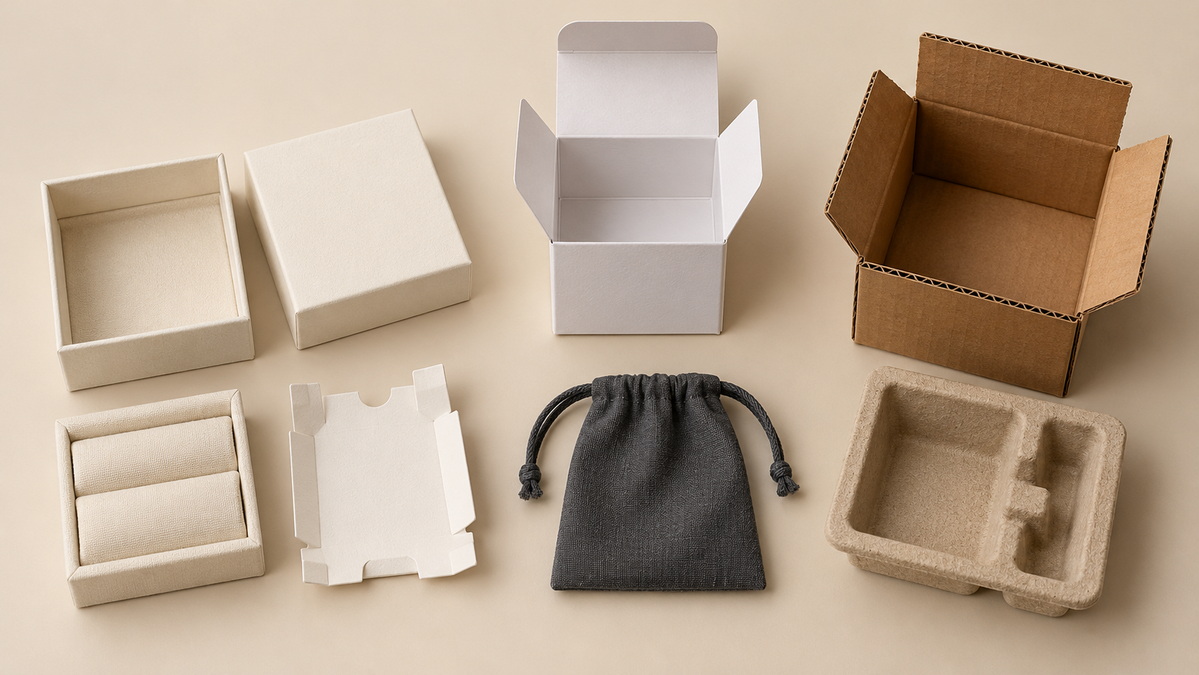
Outer Box Materials
| Material or construction | Main advantage | What to verify |
| Wrapped rigid board | Structured, substantial presentation | Corner quality, wrapping consistency, and storage volume |
| Folding paperboard | Compact storage and flexible printing | Assembly quality and resistance to crushing |
| Corrugated board | Useful shipping protection | Board specification and performance of the complete package |
| Paper sleeves | Additional branding or collection identification | Fit, friction, and ease of removal |
| Fabric pouches | Soft presentation and potential reuse | Fabric compatibility, closure security, and protection needs |
A pouch alone does not provide the same crush protection as a structured box. Likewise, a rigid presentation box should not automatically be treated as a shipping carton.
Jewelry Box Inserts and Linings
Common options include paperboard structures, molded fiber, fabric-covered supports, and selected foams.
Evaluate each option against four questions:
- Does it hold the jewelry securely?
- Could its surface mark or snag the product?
- Is it compatible with the metal, coating, and gemstones?
- Can customers remove and replace the jewelry easily?
Softness is not proof of compatibility. Request information about the complete material system, including fabric, foam, adhesive, printing, and coatings.
Prevent Tarnishing: A Material Compatibility Checklist
Silver packaging deserves particular attention because appearance alone cannot reveal chemical compatibility.
Tiffany's silver-care guidance recommends dry storage, tarnish-resistant fabric, and separation between individual pieces. It also warns against rubber contact because sulfur in rubber can cause tarnishing and corrosion.
For silver and other sensitive products, discuss the following with your packaging supplier:
1. Identify every material touching or enclosing the jewelry.
2. Ask whether relevant compatibility information is available.
3. Confirm whether any anti-tarnish treatment has supporting documentation.
4. Assess representative jewelry samples inside the proposed packaging.
5. Review storage duration and expected humidity conditions.
Do not describe ordinary velvet, satin, or foam as "anti-tarnish" without evidence for the specific material.
Where desiccants or anti-tarnish components are proposed, confirm their suitability, placement, and replacement guidance. They should support a considered packaging system, not substitute for compatible materials.
Design Luxury Jewelry Packaging Around a Clear Visual Hierarchy
Luxury jewelry packaging does not require decoration on every surface.
A more useful approach is to decide what customers should notice first: the brand, the opening detail, or the jewelry itself.
Choose Finishes With a Purpose
Foil stamping can create a focal point. Embossing and debossing can introduce tactile detail. Printed patterns can connect packaging to a collection.
However, combining multiple finishes increases the number of variables that need approval.
Check:
- Fine-line and small-text reproduction.
- Foil alignment against printed artwork.
- Surface scuffing during handling.
- Appearance under different lighting.
- Consistency between the exterior and interior.
Approve physical samples when texture, metallic effects, or precise color relationships influence the purchase decision.
Make Opening and Repacking Easy
The customer should understand how to open the package without forcing it.
Test ribbon pulls, drawers, lids, and closures with people who have not seen the design before. Observe whether they hesitate, struggle, or accidentally disturb the jewelry.
Also consider repacking. Customers may use the box for storage, gifting, or returns.
Test the Complete Jewelry Shipping Package
An undamaged presentation box does not guarantee an undamaged product. Conversely, jewelry may remain intact while the gift box arrives visibly crushed.
Define acceptable outcomes for both.
Validate the Whole Packaging System
Test the jewelry, insert, presentation box, protective materials, shipping carton, and closure together.
For parcel shipments, a qualified laboratory can help determine whether a procedure such as ISTA 3A is appropriate. The procedure addresses packaged products shipped through parcel delivery systems within its specified scope.
Do not assume that testing an empty box proves protection for every jewelry item.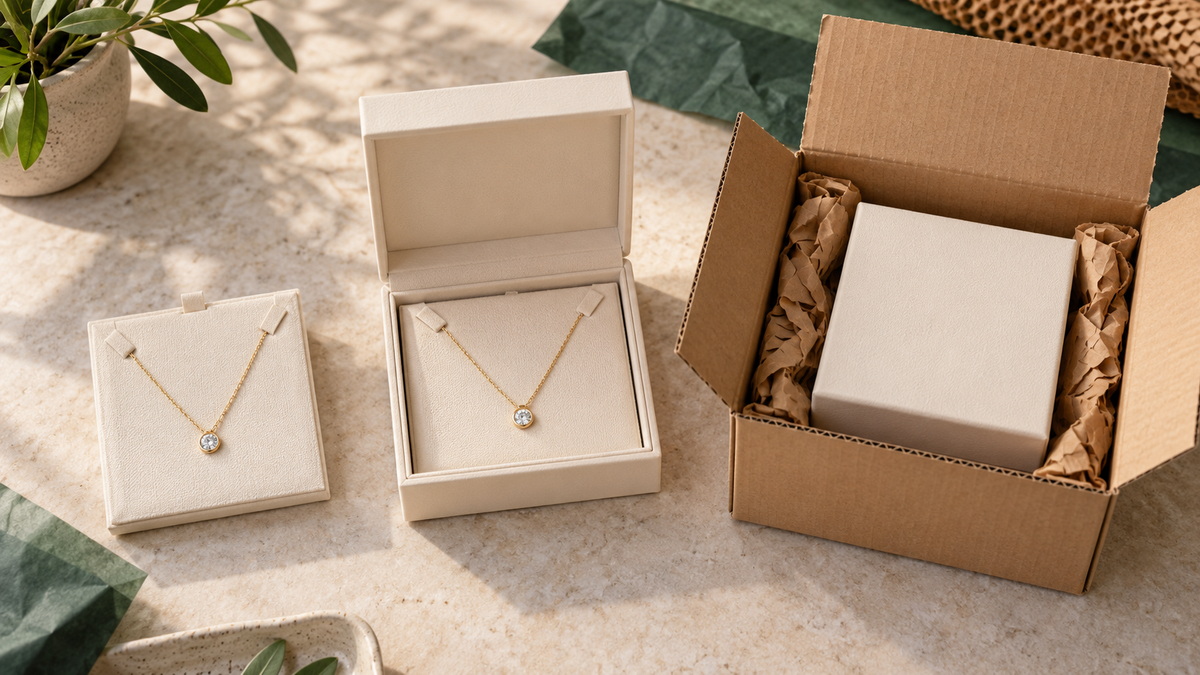
Create a Practical Acceptance Checklist
Before testing, document what counts as failure:
- Jewelry escapes its retaining position.
- Chains become tangled.
- Posts, clasps, or settings deform.
- Surfaces show scratches or abrasion.
- The presentation box becomes unacceptable for gifting.
- The shipping carton or closure loses integrity.
Photograph samples before and after evaluation. Use the findings to improve the insert, clearances, or outer protection before production approval.
Sustainable Jewelry Packaging: Make Specific, Defensible Choices
"Sustainable" is not a material specification.
A useful discussion starts with measurable decisions: packaging weight, recycled content, unnecessary components, separability, and disposal options in the destination market.
Separate Recycled Content From Recyclability
These terms answer different questions.
Recycled content describes material inputs. Recyclability concerns whether an item can actually enter an available collection and processing system.
A paper-covered box containing magnets, foam, fabric, and permanent adhesives should not automatically be described as fully recyclable.
For packaging sold in the United States, environmental claims should reflect the Federal Trade Commission's guidance, including the need for clear qualifications where appropriate.
Reduce Complexity Without Reducing Protection
Consider:
- Removing decorative layers that serve no clear purpose.
- Using appropriately sized boxes.
- Designing inserts customers can separate.
- Requesting evidence for material-content claims.
- Providing disposal instructions suited to the destination market.
A reusable box may offer practical value, but reuse alone does not prove a lower overall environmental impact.
Compare Total Packaging Cost, Not Just Unit Price
The cheapest quoted box may not produce the lowest delivered cost.
Compare quotations using the same dimensions, materials, finishes, inserts, quantities, and delivery assumptions.
Include:
- Structural development and sampling.
- Printing plates, dies, or other setup charges.
- Packaging assembly and packing labor.
- Freight and warehouse space.
- Damage-related replacements.
- Excess inventory and obsolete designs.
For example, a bulky rigid box may offer excellent presentation but require more storage and shipping space than an alternative construction. Whether that trade-off is worthwhile depends on your product positioning and distribution model.
Standardizing some components across a collection can simplify purchasing. However, shared boxes should not force different products into poorly fitting inserts.
From Packaging Brief to Production Approval
A clear brief reduces avoidable assumptions and makes quotations easier to compare.
Step 1: Share Product and Distribution Details
Provide dimensions, weight, materials, photographs, quantities, target markets, and shipping methods.
Where practical, supply representative jewelry samples, including unusually large or delicate designs.
Step 2: Approve Structure Before Decoration
Review an unprinted structural sample first.
Check product positioning, removal, lid clearance, and overall dimensions. Correcting these issues before decorative sampling avoids approving artwork on an unsuitable structure.
Step 3: Review the Decorated Sample
Confirm color, logo placement, finishing, wrapping, and insert appearance.
Record the approved specifications. A reference sample is more useful when supported by written requirements.
Step 4: Agree on Quality Checks
Define inspection points such as dimensions, visible defects, insert fit, print registration, and packing configuration.
Agree on tolerances and inspection arrangements before production rather than negotiating acceptable quality after delivery.
Build Jewelry Packaging Around Your Product
Effective packaging connects protection, presentation, and production consistency.
At Shenzhen XingKun Packing Products Co., Ltd., our printing and packaging background provides a foundation for discussing custom jewelry packaging alongside broader packaging box requirements.
Send your jewelry dimensions, product photographs, estimated quantity, preferred style, and destination market. Request a packaging proposal covering box construction, insert design, finishing options, sampling, and shipping protection—so your next decision is based on a complete specification, not appearance alone.
Frequently Asked Questions
What Is the Best Packaging for Jewelry?
The best option depends on the product and delivery conditions. A fitted presentation box can suit retail or gifting, while online orders usually require additional shipping protection. Prioritize secure positioning, compatible contact materials, and appropriate outer protection.
Are Rigid Jewelry Boxes Suitable for Shipping?
They can form part of a shipping system, but they should not automatically replace a protective shipping carton. Evaluate the complete packed order, including cushioning, closures, and the condition expected on arrival.
What Is the Best Lining for a Silver Jewelry Box?
Choose a lining with evidence of suitability for silver. Tarnish-resistant fabrics may be appropriate, but ordinary velvet or satin should not be assumed to provide anti-tarnish protection. Keep silver dry and avoid unsuitable rubber contact.
How Do I Choose the Right Jewelry Box Size?
Measure the jewelry's complete profile, then account for the insert, safe clearances, and removal space. Avoid selecting a box solely from external dimensions, because internal usable space varies with construction.
Can Jewelry Packaging Be Both Premium and Recyclable?
Potentially, but the complete construction matters. Review coatings, magnets, fabric, foam, adhesives, and local recycling availability. Support any recyclability claim with evidence rather than relying on the appearance of the outer paper covering.
What Should I Send a Custom Jewelry Packaging Manufacturer?
Send product dimensions, photographs or samples, order quantity, artwork, preferred box style, destination market, and shipping requirements. Add your target budget and required delivery date so proposals can address practical constraints.
References
1. Custom Box Makers. "Jewelry Packaging Guide." Original article used as the starting point for topic analysis and structural redevelopment; not a source of XingKun company claims.
[https://www.customboxmakers.com/jewelry-packaging-guide/] [customboxmakers]
2. Tiffany & Co. "How Should I Store My Silver?" Supports the discussion of dry storage, tarnish-resistant fabric, separate compartments, and avoiding sulfur-containing rubber contact.
[https://www.tiffany.ca/faq/care-and-repair-faq/how-should-i-store-my-silver/] [tiffany]
3. UL Solutions. "ISTA Packaging Test and Certification." Supports the discussion of transportation simulation, packaging evaluation, and the scope of ISTA 3A parcel-delivery testing.
[https://www.ul.com/services/ista-packaging-test-and-certification] [ul]
4. Eurofins. "A Quick Guide to ISTA Packaging." June 9, 2023. Provides additional context on selecting packaging test procedures for different distribution environments.
[https://www.eurofins.com/en/consumer-product-testing/softlines-hardlines/news-articles/a-quick-guide-to-ista-packaging/] [eurofins]
5. Federal Trade Commission. "6 Tips for Keeping Your Green Claims Clean." October 2013. Supports the need for specific environmental claims, appropriate qualifications, and real-world recycling availability.
[https://www.ftc.gov/business-guidance/blog/2013/10/6-tips-keeping-your-green-claims-clean] [ftc]


